# Commentary: German economy
* [*1 German economic recovery temporarily interrupted*](#tar-1 "1 German economic recovery temporarily interrupted")
* *[*2 Industry suffered a setback in the third quarter*](#tar-2 "2 Industry suffered a setback in the third quarter")*
* **[*3 Private consumption remained subdued*](#tar-3 "3 Private consumption remained subdued")**
* ***[*4 Further deterioration in labour market, but outlook less negative*](#tar-4 "4 Further deterioration in labour market, but outlook less negative")***
* ***[*5 Energy commodity prices continue to rise across the board*](#tar-5 "5 Energy commodity prices continue to rise across the board")***
* ***[*6 Inflation up significantly to 3.3 % in September*](#tar-6 "6 Inflation up significantly to 3.3 % in September")***
* ***[*List of references*](#tar-7 "List of references")***
***1 German economic recovery temporarily interrupted*** {#tar-1}
-----------------------------------------------------------------
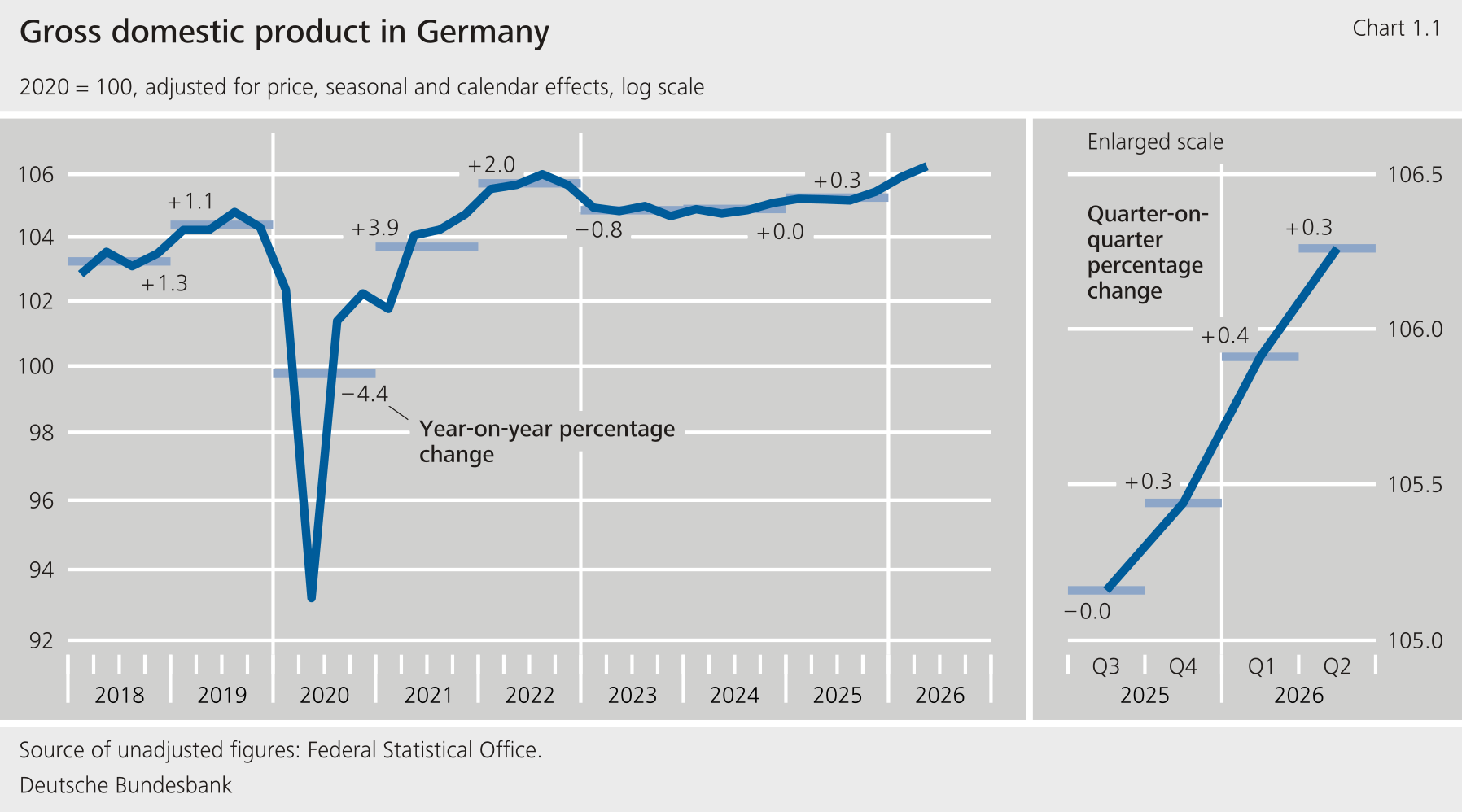
*****German economic output is likely to have stagnated in the third quarter of 2026.** Following the marked increase in the first half of the year, seasonally adjusted[\[1\]](#_ftn_root_1) real has probably not risen any further in the third quarter. The economic recovery has thus been interrupted for the time being. This was mainly due to temporary stress factors. In particular, the low levels on the Rhine and the associated restrictions on inland water transport put pressure on industry. Water levels fell significantly below historical lows at times.[\[2\]](#_ftn_root_2) In addition, the competitive edge over foreign competitors, who were particularly burdened by supply chain problems related to the war in the Middle East, is likely to have expired at the beginning of the second half of the year. This is likely to have weakened exports in the third quarter. One-off effects related to the fuel rebate also played a role. They dampened retail sales in the third quarter owing to consumers shifting their fuel purchases. In addition, high energy prices weighed on households' purchasing power. Overall, private consumption is therefore unlikely to have provided any stimulus to growth in the third quarter. Firms' investment was dampened by still low capacity utilisation in industry. By contrast, construction had a supportive effect. Construction output increased once again in August.[\[3\]](#_ftn_root_3) Civil engineering, in particular, is increasingly benefiting from the easing of fiscal policy. There were also favourable developments in building construction recently, although the rise in interest rates for building finance is expected to have a dampening effect in the future.***{#par-a45e67}
****German economic output is likely to improve again markedly in the fourth quarter.** According to sentiment indicators provided by the Institute, in September enterprises were already assessing their current situation more favourably than before. This also holds true for their business prospects for the next few months. However, the future economic recovery depends, not least, on the development of the war in the Middle East.**{#par-i678a6}
{#par-i27843}
****
**2 Industry suffered a setback in the third quarter** {#tar-2}
---------------------------------------------------------------
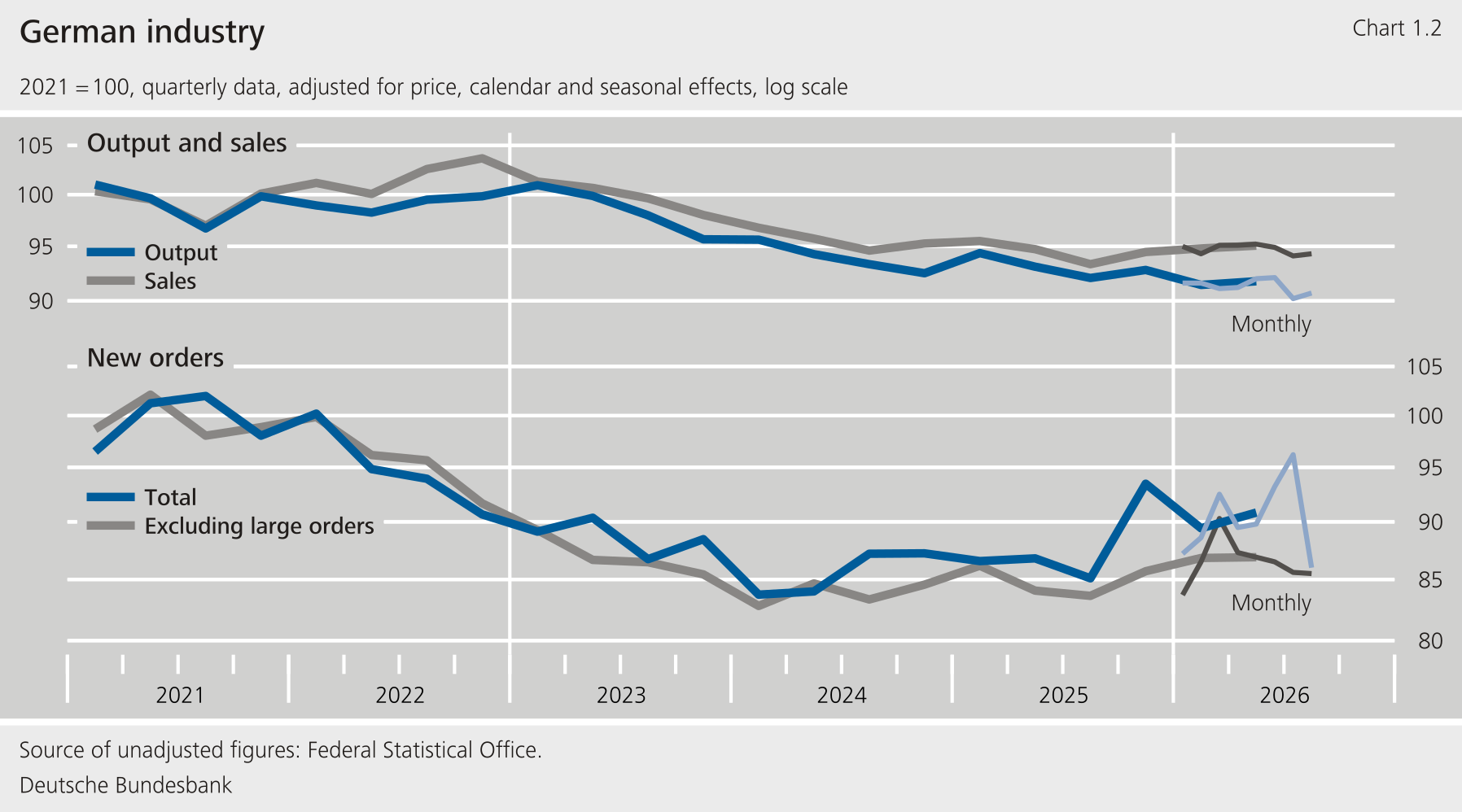
****Temporary factors weighed on industrial production in the third quarter.** After the sharp decline in output at the beginning of the third quarter, industrial production in August was up again somewhat on the month after seasonal adjustment. However, it remained significantly below the level of the previous quarter. Real industrial sales likewise rose only slightly in August and continued to fall distinctly short of their level in the previous quarter. This is likely to make it increasingly difficult to recoup the loss of output by the end of the quarter. The automotive industry was the main driver of the weak industrial production in August. In addition to the generally weak development, the timing of factory holidays, which occurred in August to an unusually large extent this year, is likely to have played a role here.[\[4\]](#_ftn_root_4) The entire quarter was affected by a plant closure lasting several weeks as part of the conversion to the production of electric vehicles in July. In addition to the automotive industry, output in the energy-intensive sectors also continued to contract in August. The manufacture of coke and refined petroleum products, in particular, alongside the chemical industry recorded significant declines in production again. The effects of the persistent low water levels are likely to have made themselves felt here. The low levels of major waterways make it more difficult to transport input products and goods and, by shifting to other transport routes, lead to higher transport costs. As the Rhine, in particular, continued to record very low levels in September, the burdens this brings with it are likely to have lingered over the remainder of the quarter.[\[5\]](#_ftn_root_5) In addition, the higher than expected production in energy-intensive industry in the second quarter will probably have been supported by one-off effects in the wake of the war in Iran. In particular, firms are likely to have initially stocked up their inventories and have probably gained a temporary competitive edge over some international competitors in anticipation of further supply chain tensions. These effects were phased out in the third quarter and thus weighed on output in the energy-intensive sectors. By contrast, excluding the areas of the energy-intensive and automotive sectors which were burdened by one-off effects, industrial production, on average over the quarter so far, climbed above the level of the previous quarter. This suggests that the current weakness is temporary.**{#par-a1e84i}
****However, the order situation in industry also deteriorated recently.** New orders decreased substantially in August. This was mainly due to a significant decline in volatile large orders in the other transport equipment sector (aircraft, ships, trains, military vehicles).[\[6\]](#_ftn_root_6) However, even excluding large orders, new orders declined slightly. Domestic orders developed somewhat more favourably and supported demand. By contrast, foreign orders contracted as they had done in July. The recovery in foreign demand that had previously been evident was thus dampened.**{#par-ie42ee}
****Foreign trade was also markedly weaker at the start of the second half of the year.** Following an already weak July, price-adjusted goods exports fell again perceptibly on the month in August and were even more clearly down on the average of the previous quarter than previously. The low water levels are also likely to continue to have a negative impact on foreign trade via European ports as a result of restrictions on inland water transport. However, export expectations as surveyed by the Institute remained in positive territory in September, suggesting that exports will recover.**{#par-i24eio}
{#par-e9e23a}
****
**3 Private consumption remained subdued** {#tar-3}
---------------------------------------------------
****Private consumption probably provided hardly any positive stimuli in the third quarter.** Real retail sales rose again in August but remained well below the level of the second quarter. Furthermore, one-off effects related to the fuel rebate are likely to have depressed retail sales markedly in the third quarter. With a view to its reintroduction in October, households may have postponed fuel purchases from September to October. Petrol station sales are likely to have come under significant strain in September as a result. July was already muted because fuel purchases had been brought forward to June owing to the fuel rebate expiring at that time. Price-adjusted sales in the hotel and restaurant sector also fell in August, but were still slightly up on the quarter. Purchases of motor vehicles are expected to have had a supportive effect, as indicated by the increase in private car registrations.**{#par-a52a7e}
**4 Further deterioration in labour market, but outlook less negative** {#tar-4}
--------------------------------------------------------------------------------
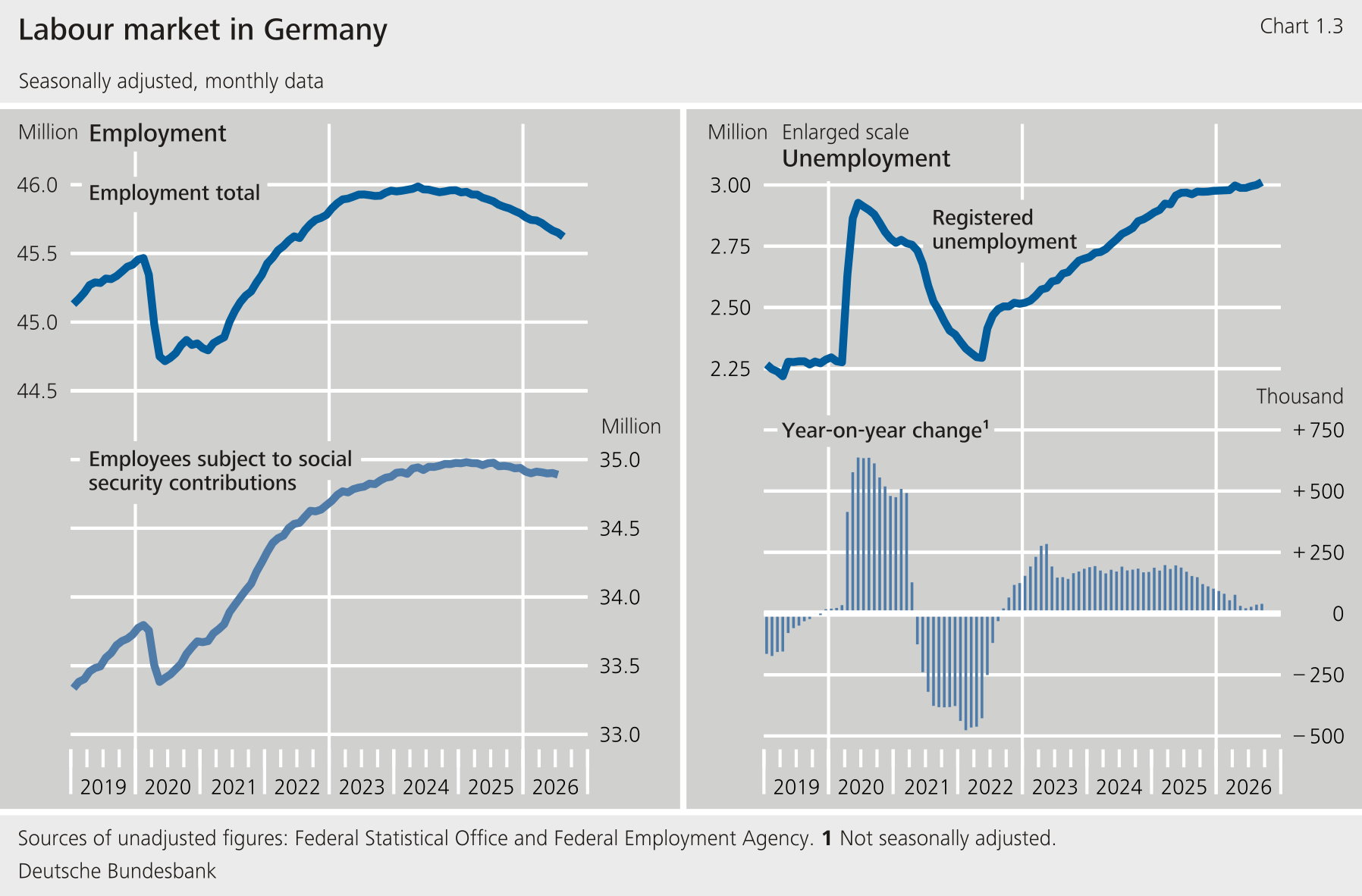
****Employment continued to decline during the summer holiday months.**In August, employment in Germany was down on the month after seasonal adjustment, falling by 29,000 to 45.62 million persons. A significant part of the decrease is likely to be attributable to the number of persons in exclusively low-paid employment, which has been falling sharply for some time now. Self-employment has likewise been in decline over a long period. According to the current data estimates for July, employment subject to social security contributions, which has recently been relatively stable in the economy as a whole, also dropped somewhat. The loss of jobs was concentrated in manufacturing and in trade, which comprises not only retail but also wholesale and foreign trade. Employment subject to social security contributions remained stable in most other economic sectors. The substantial job creation in health and social services continued.**{#par-i8o88u}
{#par-oiue55}
****
****The cautiously positive reading of leading indicators from the previous month was confirmed in September.** The employment barometer, which reflects employment plans in trade, industry and services over the next three months, rose again slightly following the sharp growth in August. Nevertheless, employment plans remain negative on balance. The employment component of the labour market barometer, which also encompasses publicly financed sectors, remained more or less constant on the month in slightly negative territory. The total number of vacancies reported to the Federal Employment Agency was likewise virtually unchanged after seasonal adjustment. The number of new job vacancies appears to have bottomed out, even though the level is still fairly moderate in a long-term comparison. This raises the expectation that at least the pace of job cutting could decline.**{#par-u73936}
****Registered unemployment rose only slightly and remained at around 3 million persons.** The number of persons officially registered as unemployed was 3.01 million in September in seasonally adjusted terms. This was 12,000 more than in August. The unemployment rate remained unchanged at 6.4 %. Unemployment covered by the statutory unemployment insurance scheme, which is closely linked to current cyclical developments, increased slightly in the month under review. The number of unemployed people receiving the basic welfare allowance also rose marginally in September, although it has been trending downwards for just over a year now. This could be due to changes at the beginning of summer in the rules for reasonably rejecting a job offer in the case of persons entitled to benefits with childrearing responsibilities. They are therefore deemed to be available more frequently than before and are included in the unemployment statistics. In contrast to registered unemployment, total underemployment, which, according to the Federal Employment Agency definition, also includes persons engaged in labour market policy measures (except short-time work), even declined slightly in September. In this respect, a decrease in labour market policy measures is also likely to have contributed to the rise in unemployment. According to the relevant barometer, unemployment will probably remain constant over the next few months. The leading indicator had recently risen to neutral territory.**{#par-a6i483}
**5 Energy commodity prices continue to rise across the board** {#tar-5}
------------------------------------------------------------------------
****Energy commodity prices continued to rise steeply across the board in September and October.** The ongoing Middle East conflict was the main reason. In particular, exports of petroleum products and liquefied natural gas from the Gulf region remained severely restricted until recently. In recent weeks, the disruptions and risks to shipping have also led to a significant rise in freight rates for oil deliveries. This made crude oil imports from distant production areas more expensive. In import-dependent regions such as Europe, upward pressure on the prices of locally produced oil blends also increased as a result. A barrel of Brent crude oil has so far cost $126 on average in October. Since the beginning of the conflict, only the period of military escalation at the beginning of April saw higher prices. In October, wholesale prices for key petroleum products such as diesel were also only slightly below their annual highs from the previous month. European natural gas prices continued to rise until recently. Natural gas in the European wholesale market cost €82 per megawatt hour on average in October so far, more than twice as much as a year earlier.**{#par-io5113}
**6 Inflation up significantly to 3.3 % in September** {#tar-6}
---------------------------------------------------------------
****Prices at the upstream stages of the economy rose steeply on the month recently in seasonally adjusted terms.**This was true of both import prices, for which data extend to August, and domestic industrial producer prices, for which data for September are already available. Energy prices picked up markedly again at both stages. Prices for other goods also increased at a noticeably faster pace. In year-on-year terms, import prices rose by 8.3 % and industrial producer prices by 6.7 %.**{#par-i4iu11}
****The inflation rate rose significantly in September, as energy prices hiked sharply again.**The year-on-year rate of the Harmonised Index of Consumer Prices () stood at 3.3 % in September, up from 2.9 % in August.[\[7\]](#_ftn_root_7) This is the highest rate since the end of 2023. The core rate excluding energy and food dropped slightly to 2.5 %, however. In seasonally adjusted terms, the went up significantly by 0.6 % compared with the previous month. As in August, this was mainly due to the sharp rise in prices for fuel and heating oil as a result of the markedly higher crude oil prices. Prices of the other components also went up slightly, however. In the case of food, this was mainly due to unprocessed products, while processed food prices remained constant. Prices for services and non-energy industrial goods were likewise somewhat higher than in the previous month. However, in the case of the latter, the previously very steep inflation eased again somewhat.**{#par-u77i53}
{#par-i175u7}
**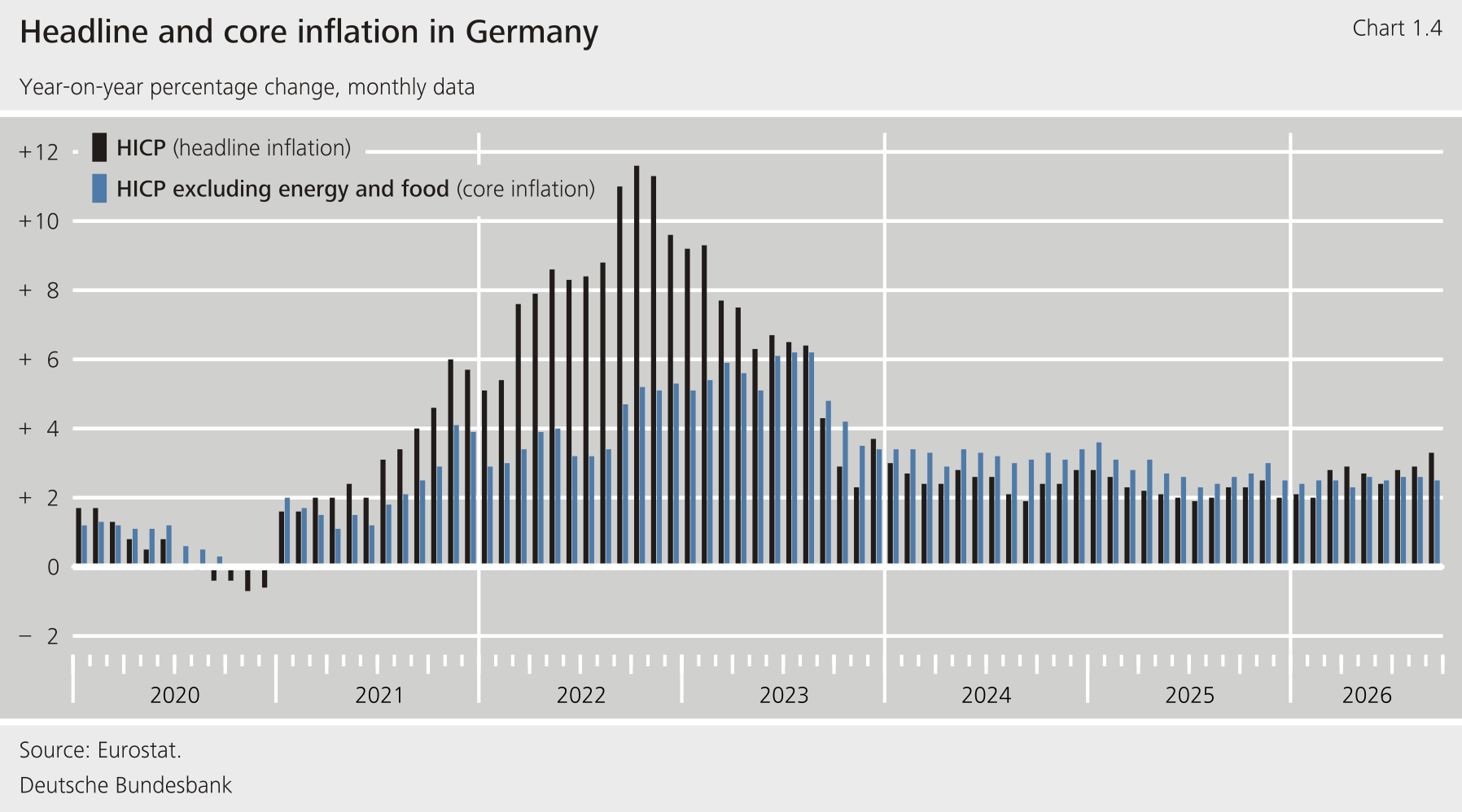**
****The inflation rate is likely to remain elevated for the time being.** Energy price inflation is likely to remain at a very high level for the period from October to December, despite the temporary reintroduction of the fuel rebate.[\[8\]](#_ftn_root_8) In addition, indirect effects from the energy price shock will probably become increasingly evident in the case of non-energy industrial goods, food and services.[\[9\]](#_ftn_root_9) This is likely to affect mainly sectors that use fossil fuels intensively, such as transport services, but also food, as fertiliser prices are related to oil prices. The inflation rate is likely to pick up markedly at the beginning of 2027, mainly because the health reform that will enter into force will significantly increase prescription charges and hospital services.[\[10\]](#_ftn_root_10) In addition, the fuel rebate will expire, causing the inflation rate to rise again. Depending on the specific form it might take, a fuel price cap would have a dampening effect. Overall, uncertainty remains strongly elevated, especially in relation to the future developments in energy commodity prices. The longer the oil price shock lasts and the more prices for other energy sources rise, the greater the risk that indirect effects will push inflation higher than currently expected.**{#par-ao69i1}
**List of references** {#tar-7}
-------------------------------
**Deutsche Bundesbank (2026), [Forecast for Germany: Energy price shock fuels inflation and slows the economic recovery](https://publikationen.bundesbank.de/content/999218), Monthly Report, June 2026.**{#par-u54727}
**Federal Ministry for Economic Affairs and Energy (2026), [Entwicklung der Produktion im Produzierenden Gewerbe Berichtsmonat August 2026\|](https://www.bundeswirtschaftsministerium.de/Redaktion/DE/Pressemitteilungen/Produzierendes-Gewerbe/2026/20261007-entwicklung-produzierendes-gewerbe-august.html), press release of 7 October 2026**{#par-i84861}
**Federal Statistical Office (2026a), [Production in August 2026: + 2.0 % on the previous month](https://www.destatis.de/EN/Press/2026/10/PE26_355_421.html), press release No 355 of 7 October 2026.**{#par-ia19e1}
**Federal Statistical Office (2026b), Press release, [New orders in manufacturing in August 2026: − 10.6 % on the previous month](https://www.destatis.de/EN/Press/2026/10/PE26_354_421.html).**{#par-a11u1u}
**Federal Waterways and Shipping Administration (2026), [Wasserstände \& Vorhersagen an schifffahrtsrelevanten Pegeln](https://www.elwis.de/DE/dynamisch/Wasserstaende/Pegelvorhersage:KAUB)**{#par-e979oi}
**German Association of the Automotive Industry, (2026a), [German electric car market: share of electric vehicles climbs to 44 %](https://www.vda.de/en/press/press-releases/2026/260903_PM_Nationale_PM_Production_in_Germany_in_August_2026), press release of 3 September 2026**{#par-o36933}
**German Association of the Automotive Industry, (2026b), [German passenger car market: Share of electric vehicles rises to 41 %](https://www.vda.de/en/press/press-releases/2026/260806_PM_Nationale_PM_Production_in_Germany_in_July_2026), press release of 6 August 2026**{#par-eu1183}
**Tagesschau (2026), [Pegelstand auf Rekordtief -- Lkw-Fahrverbot in bleibt ausgesetzt](https://www.tagesschau.de/inland/regional/nordrheinwestfalen/rheinpegel-tiefststand-100.html), 28 September 2026**{#par-u3a63e}
**Wasserinformationssystem "Pegel online" (2026): [Aktueller Rheinpegel bei Kaub](https://pegelonline.wsv.de/gast/stammdaten?pegelnr=25700100).**{#par-iei31o}
1. **{#_ftn_root_1} Seasonal adjustment here and in the remainder of this text also includes adjustment for calendar effects, provided they can be verified and quantified.**
2. **{#_ftn_root_2} See Tagesschau (2026) and the water information system, "Pegel online" (2026).**
3. **{#_ftn_root_3} In addition to the favourable developments in building construction and civil engineering, this increase was also driven by strong growth in the finishing trades. However, this is largely attributable to the completion of a larger energy infrastructure project, see Federal Ministry for Economic Affairs and Energy (2026).**
4. **{#_ftn_root_4} See Federal Statistical Office (2026a) and German Association of the Automotive Industry (2026a, 2026b).**
5. **{#_ftn_root_5} Levels remained low in the first few weeks of the fourth quarter, too, meaning that this stress factor persisted at the beginning of the current quarter at minimum. See Federal Waterways and Shipping Administration (2026).**
6. **{#_ftn_root_6} See Federal Statistical Office (2026b).**
7. **{#_ftn_root_7} The annual rate of inflation as measured by the national Consumer Price Index () also increased from 2.9 % to 3.3 %.**
8. **{#_ftn_root_8} Based on previous experience with the fuel rebate, it is assumed that just over three-quarters of this will be passed on to customers. This is likely to lower the headline rate by 0.2 percentage points.**
9. **{#_ftn_root_9} See Deutsche Bundesbank (2026).**
10. **{#_ftn_root_10} The reform is expected to raise headline inflation by 0.2 percentage points. The expiry of the fuel rebate is likely to add a further 0.2 percentage points.**
*[GDP]: gross domestic product
*[NRW]: Nordrhein-Westfalen
*[ifo]: economic research institution
*[IAB]: Institute for Employment Research
*[CPI]: consumer price index
*[US]: United States
*[HICP]: Harmonised Index of Consumer Prices