# EU budget and NextGenerationEU: Member States’ financial relationships with the EU in 2025
* [*1 EU budget and NextGenerationEU*](#tar-1 "1 EU budget and NextGenerationEU")
* *[*2 Payment flows in 2025*](#tar-2 "2 Payment flows in 2025")
* *[*2.1 Regular EU budget*](#tar-3 "2.1 Regular EU budget")*
* **[*2.2 NextGenerationEU*](#tar-4 "2.2 NextGenerationEU ")**
* ***[*2.3 Net contributions in 2025*](#tar-5 "2.3 Net contributions in 2025 ")****
* ***[*3 Outlook: NGEU disbursements to end, burden of debt service to have impact*](#tar-6 "3 Outlook: NGEU disbursements to end, burden of debt service to have impact ")***
* ***[*List of references*](#tar-7 "List of references")***
****Intense deliberations on the 's next multiannual financial framework for 2028‑34 are currently under way. However, the positions of Member States are still very controversial. This regular article looks at how finances developed in the previous year and what net positions this resulted in for Member States.****{#par-e27537}
****As in the previous year, expenditure within the regular budget amounted to just over 0.8 % of gross national income ( ) in 2025. The expenditure structure shifted towards spending on cohesion policy. In addition, the temporary off-budget entity, NextGenerationEU (), will continue to finance additional expenditure until the end of 2026. In 2025, just under 0.3 % of went to Member States as grants. That was lower than in the previous year (just over 0.4 %). In particular, Member States made fewer calls on the Recovery and Resilience Facility (), the main programme. For 2026, around one-third of the grant allocation is still available for request (0.7 % of ). As things stand, the European Commission is likely to disburse most of these funds by the end of 2026.****{#par-o2589a}
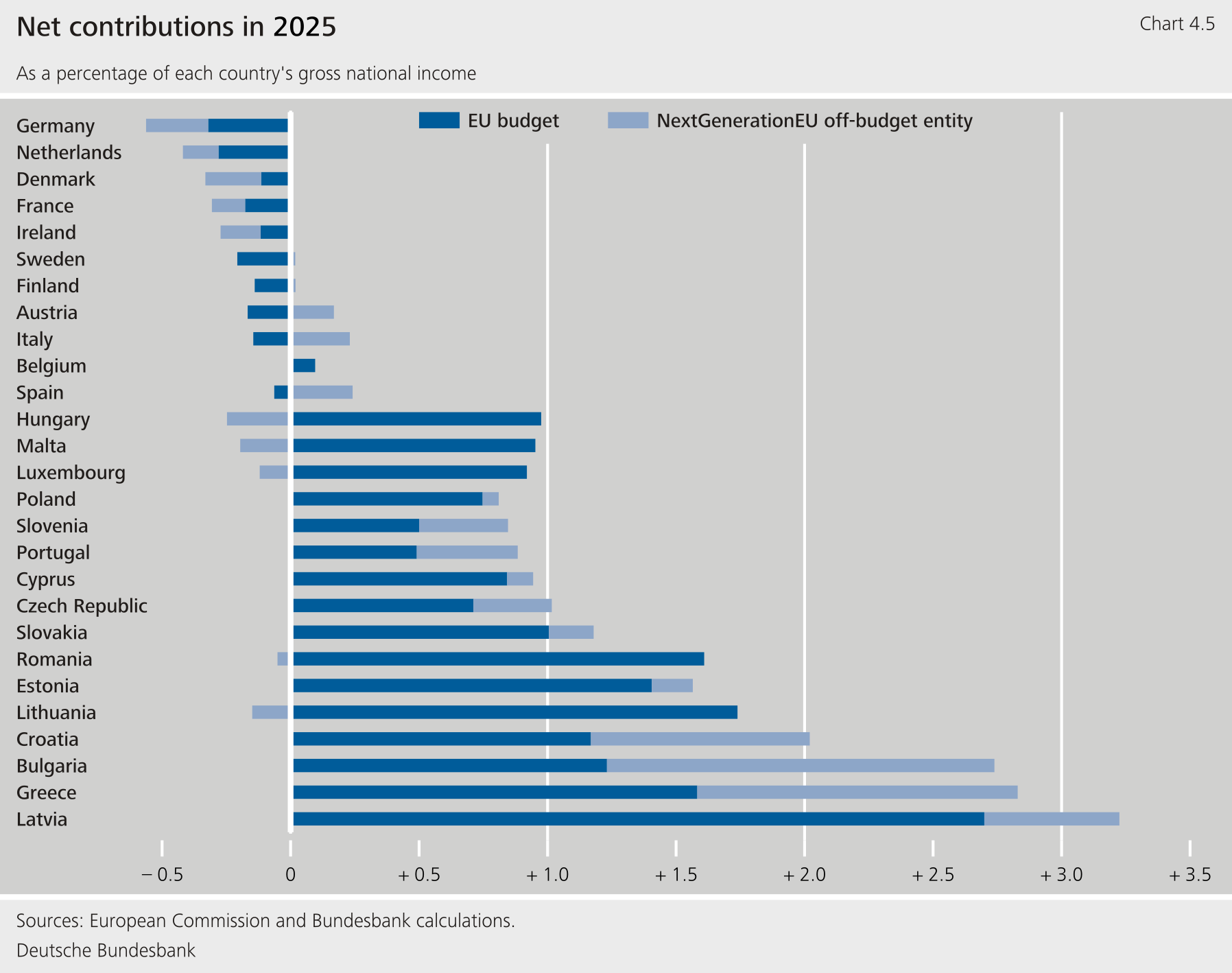
****Member States finance the budget mainly through contributions, which change broadly in proportion to . As a result, contribution levels are similar across countries in terms of economic performance. By contrast, payments from the budget and from , as measured in terms of , vary much more widely, resulting in different net positions of Member States. Germany was once again among the seven net contributors in 2025. Its net contribution was €26 billion, or just under 0.6 % of . Among the 20 net recipients, Latvia received the highest net grants, at over 3 % of .****{#par-aa8eiu}
****is financed by borrowing. The budget has to date funded only the interest payments. From 2028 onwards, it is also intended to cover the repayment of the debt raised for the grants. After the end of the programme, this is expected to amount to around €420 billion (2.2 % of 2025 ). In its draft for the next seven-year financial framework starting in 2028, the European Commission estimates debt service totalling €149 billion (in 2025 prices). This corresponds to an annual average of 0.1 % of 2025 .****{#par-o4ae35}
****To finance debt service, Member States will have to either make higher contributions to the budget or reduce other expenditure within the budget. The deferral of repayments being discussed in some quarters would merely shift the burden into the future and narrow the scope for future action. Joint borrowing therefore does not solve distribution issues, but merely postpones them. These discussions highlight the limited overall willingness of Member States to pay higher net contributions to the or to forego net returns. Joint debt should be presented in a transparent manner and taken into account in the European fiscal rules. If debt levels rise at the level, national borrowing should decline accordingly.****{#par-u96u89}
***1 budget and NextGenerationEU*** {#tar-1}
--------------------------------------------
*****The financial relationships between the Member States and the** **encompass both the regular** **budget and the temporary off-budget entity** .The regular budget covers one calendar year and funds joint European tasks and programmes. Every seven years, Member States also set a multiannual financial framework () for that timespan. It defines focal points of spending and imposes ceilings on the ongoing national funding contributions to the annual budgets. The current is for the period from 2021 to 2027. It accounts for around 1 % of [\[1\]](#_ftn_root_1) per year.***{#par-aa6742}
****temporarily supplements the regular** **budget and differs from it mainly in the way in which it is financed.** Member States adopted in response to the ‑19 pandemic. Unlike the regular budget, they initially finance the agreed grants and loans via joint European borrowing.[\[2\]](#_ftn_root_2) As agreed, this is to be repaid from the regular budget at the start of the new financial framework in 2028. The bulk of funding is channelled through the , which accounts for all loans and around 80 % of the grants.[\[3\]](#_ftn_root_3) The European Commission disburses the funds to the Member States when they submit payment requests and have achieved the agreed milestones and targets.**{#par-oe13u7}
****will change the fiscal balances (surpluses and deficits) at the** **level far beyond the end of the programme.** The regular budget is generally balanced. Credit-financed grants have led to deficits at the level between 2021 and 2026. Repayments of the debt raised for this purpose will begin from 2028 onwards. The budget will therefore have to generate surpluses until 2058 in order to make the repayments. Member States will have to provide the funds required for this as well as for the interest expenditure by paying higher contributions or by cutting budget expenditure elsewhere.**{#par-ua8828}
****This regular article is aimed at presenting the financial relationships of the Member States in a transparent manner not too long after the end of the respective fiscal year.** **To this end, it would be helpful if the data were published as promptly and predictably as possible.** Since the European Commission stopped reporting the net contributions to the budget itself, it has not published the underlying data on a fixed date. Previously, the data were released simultaneously with the publication of the annual financial report at the end of June. In recent years, the publication date has moved around and tended to get later and later. If the data were made available sooner, this would allow for more up-to-date reporting.**{#par-i39948}
**2 Payment flows in 2025** {#tar-2}
------------------------------------
### **2.1 Regular budget** {#tar-3}
****Expenditure within the regular** **budget rose in 2025.** [\[4\]](#_ftn_root_4) It amounted to around €157 billion, compared with €146 billion in the previous year. After rounding, however, it amounted to 0.8 % of in both years. Operating expenditure[\[5\]](#_ftn_root_5) amounted to €139 billion, while administrative expenditure was €13 billion. Debt service for grew significantly to €5 billion (2024: €2.1 billion).**{#par-ueou46}
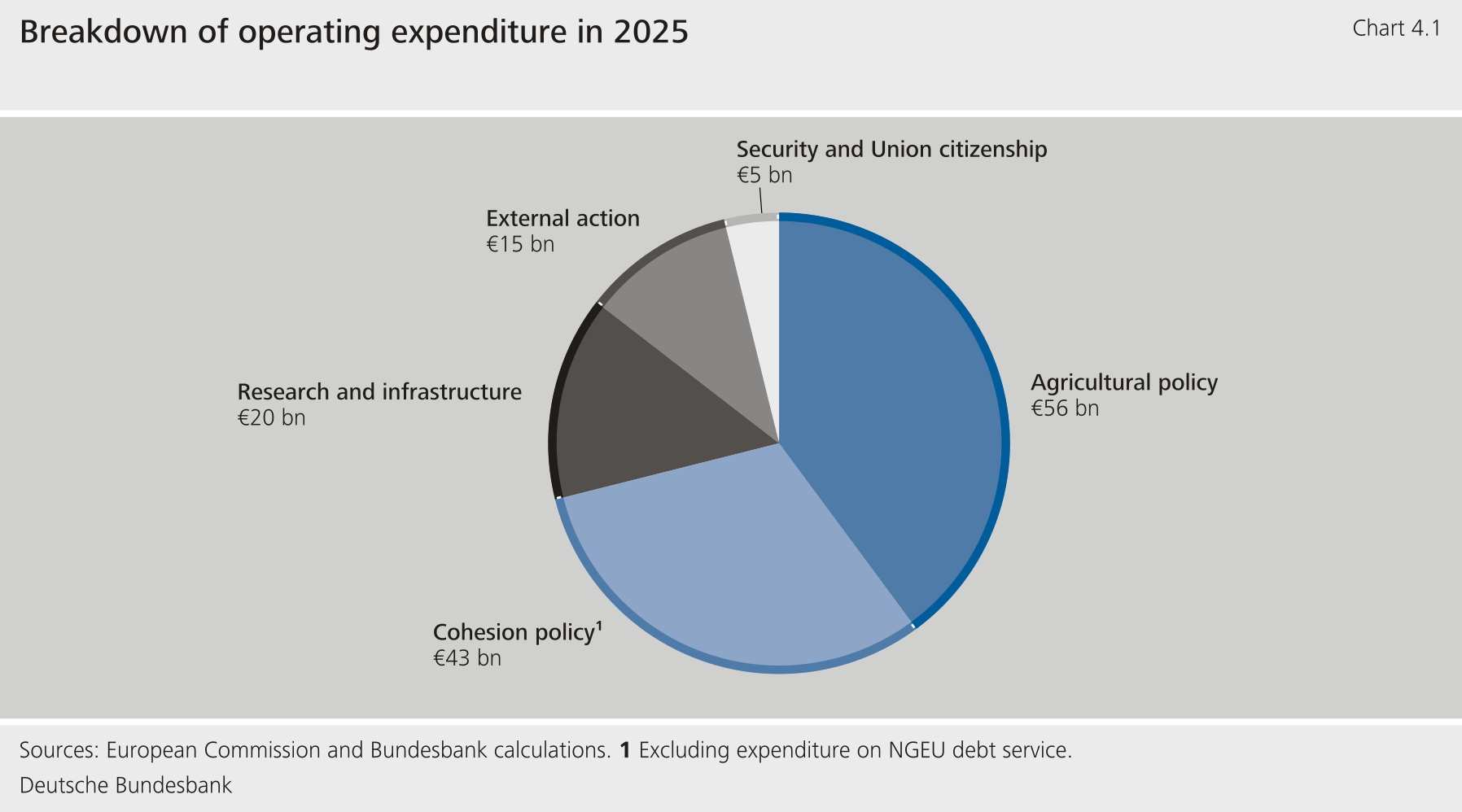
****The rise in operating expenditure was mainly driven by spending on cohesion policy, which increased significantly (+ €8 billion) after a sharp decline in the previous year.**It rose to around €43 billion, thus accounting for just under one-third of operating expenditure (see Chart 4.1). Agricultural expenditure, once again the largest spending category, was virtually unchanged at €56 billion. Together, the two policy areas accounted for 71 % of operating expenditure.**{#par-e6ai88}
{#par-o77a44}
****
****However, spending on cohesion policy was well below the level seen between 2021 and 2023.** The renewed increase was probably mainly due to Member States making less use of funds in 2025 than in the previous year. At the same time, the continued low level lines up with the typical disbursement pattern within a financial framework. Experience has shown that Member States call up more cohesion funding at the beginning and towards the end of a financial framework.**{#par-ii6e85}
****Member States' contributions to the** **budget also rose (+ €4 billion) owing to the higher expenditure volume.** They amounted to roughly €132 billion in 2025. As usual, the largest share was attributable to -based own resources (€102 billion). In addition, there were -based own resources (€24 billion) and plastics own resources (€7 billion). Otherwise, the budget predominantly received customs revenue of €23 billion.**{#par-a6284o}
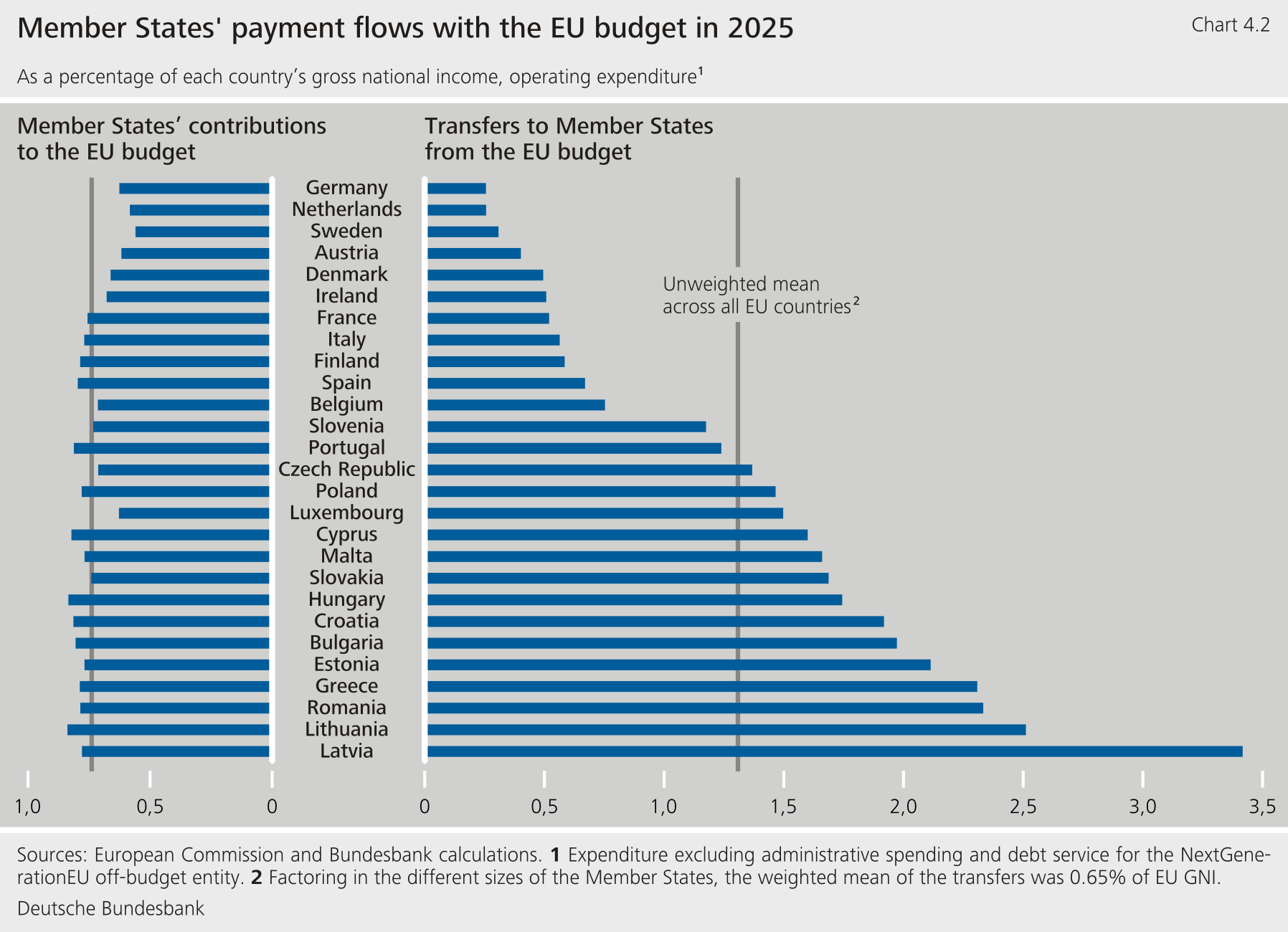
****As usual, there was significantly less variation in Member States' contributions than in** **budget grants** (see Chart 4.2).Contributions are mostly based on Member States' economic performance. By contrast, the return flows depend on the respective expenditure programmes, with economically weaker Member States (measured in terms of per capita) generally receiving higher grants.**{#par-uu547o}
{#par-uii498}
****
### **2.2 NextGenerationEU** {#tar-4}
****The distribution of** **grants across Member States again varied widely in 2025.** An amount of €49 billion, or just under 0.3 % of , was disbursed in 2025. Of this amount, €40 billion was attributable to the (including REPowerEU). As a percentage of their respective , Bulgaria, Greece and Croatia received the highest grants (between 1.8 % and 1.1 %; see Chart 4.3). By contrast, Hungary, Germany, Denmark, Malta, Ireland and Lithuania each received less than 0.1 %.**{#par-a951ia}
{#par-i34e63}
**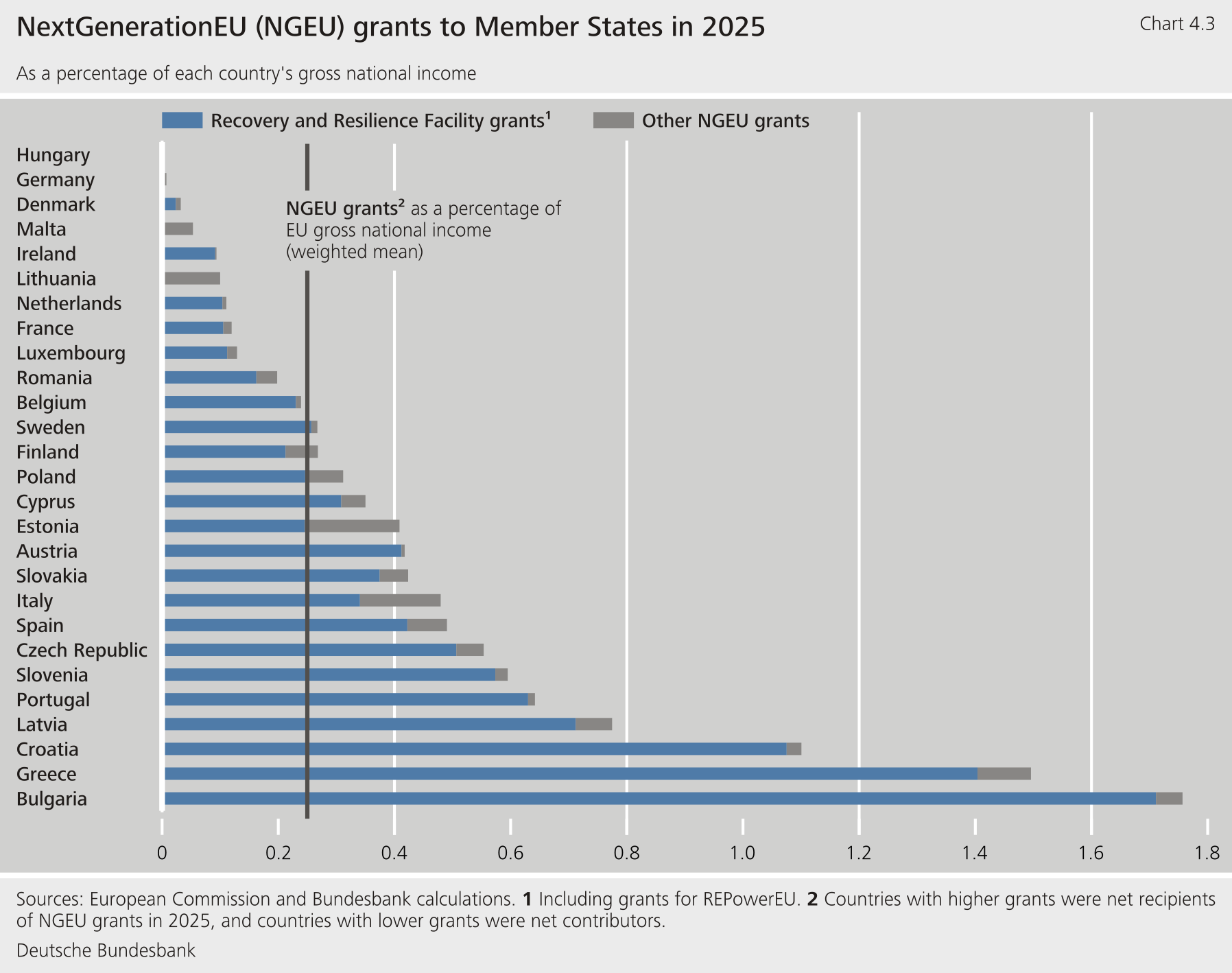**
****The** **is a key driver of the distribution of** **grants.** It accounts for the largest share of grants. The large differences in the disbursement of funds are due, firstly, to varying amounts of funding being allocated to the Member States. Secondly, Member States request the disbursements in line with their reform and investment progress. As a result, the funds are often disbursed in larger tranches rather than continuously (see Chart 4.3).**{#par-iu954a}
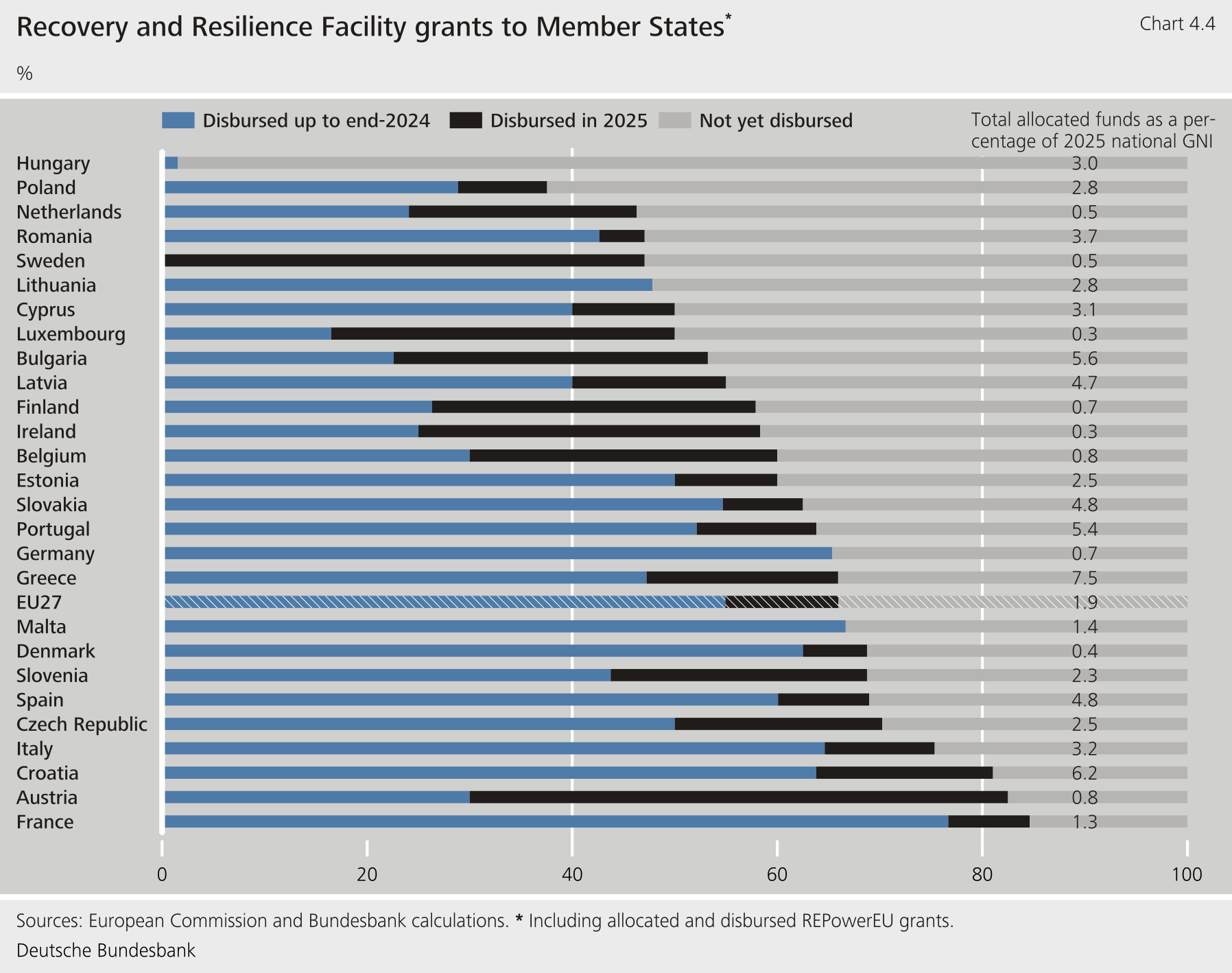
****In total, Member States called up around 11 % of the allocated** **funds in 2025** (see Chart 4.4).That was less than the average of previous years (14 %). Again, there were significant differences in the pace of disbursements between Member States. In 2025, four countries did not call up any, or any significant, funds (Hungary, Lithuania, Germany and Malta). By contrast, Austria received the most in relative terms, at 53 % of the funds allocated to it for the entire term.**{#par-a92874}
****Cumulatively, only around two-thirds of the total** **grants allocated had been disbursed by the end of 2025** (see Chart 4.4).The share of the funds disbursed up to then also continued to differ significantly between Member States. The amounts disbursed to Hungary were particularly small as the country had only received pre-financing up to that point. The Council had linked regular disbursements to special milestones -- in relation to the rule of law and the protection of the 's financial interests.[\[6\]](#_ftn_root_6) Hungary had not yet submitted any regular payment request by the end of 2025.**{#par-iea52i}
{#par-e31131}
****
### **2.3 Net contributions in 2025** {#tar-5}
****The payment flows described are reflected in the net contributions of the Member States.** These constitute the difference between grants received and payments made by a Member State.[\[7\]](#_ftn_root_7) They therefore show the direct financial redistribution by the European budgets, but do not reflect the macroeconomic benefits or the total costs of membership.**{#par-e97876}
****Looking at the** **budget and** **combined, seven Member States were net contributors in 2025** (see Chart 4.5 for the individual countries, broken down into budget and ). Germany made the highest net contributions, at 0.6 % of , followed by the Netherlands (0.4 %) and Denmark, France and Ireland (around 0.3 % each). 20 Member States were net recipients from the budget and . Latvia received the highest net grants, at over 3 %, followed by Greece and Bulgaria, at over 2 %, and Croatia, at 2 %. For Austria, Italy and Spain, reversed the sign of their net positions. Overall, they were net recipients, but net contributors to the budget.**{#par-o862a8}
{#par-a95252}
****
**3 Outlook: disbursements to end, burden of debt service to have impact** {#tar-6}
-----------------------------------------------------------------------------------
****The European Commission is expected to disburse most of the remaining** **grants by the end of 2026.** By 30 September 2026, all Member States had submitted their final payment requests.[\[8\]](#_ftn_root_8) The European Commission is now assessing whether they have fulfilled the agreed milestones and targets. If the requirements have been met, the European Commission can disburse the appropriate funds by the end of 2026.[\[9\]](#_ftn_root_9) After November 2025, all Member States made further adjustments to their recovery and resilience plans to avoid forfeiting the remaining funds. The European Commission had given Member States this additional flexibility, effectively lifting the programme's time limit.[\[10\]](#_ftn_root_10) For example, Member States can make any remaining resources available as capital to national development and promotional banks. These institutions can subsequently use the funds for additional eligible investments.**{#par-e569i6}
****At the start of the new financial framework in 2028, repayments of the debt raised for** **grants are set to begin from the** **budget.** The European Commission is planning a total of €149 billion (in 2025 prices) for the debt service from 2028 to 2034.[\[11\]](#_ftn_root_11) This corresponds to an annual average of 0.1 % of 2025 , or just over 9 % of the budget volume proposed by the European Commission. In current prices, it is planning to spend €24 billion per year on debt service. If interest costs rise even further beyond their currently expected level, repayments will be lower than planned. As a result, a larger share of repayments will be shifted into future financial frameworks. That the debt service would restrict future fiscal headroom was known when was adopted and does not come as a surprise. Member States now have to agree on whether they want to finance these resources by making higher contributions to the budget or by reducing other expenditure within it.For either variant, the debt burden will ultimately be borne by the population of the Member States.**{#par-e6828u}
****The debt burden is one of the factors making negotiations on the next financial framework difficult and controversial.** In July 2025, the European Commission proposed a financial framework totalling just under €2 trillion, or 1.26 % of per year. Germany and other net contributors are now calling for significant cuts, especially in traditional spending on cohesion and agricultural policy.[\[12\]](#_ftn_root_12) At the same time, they want to give greater weight to spending on other priorities, such as competitiveness and defence, in the budget. No agreement has been reached so far.**{#par-eo77uo}
****If repayment of** **debt is postponed, this will shift burdens further into the future and could undermine credibility.** Such a postponement is being discussed. However, deferring repayment will not reduce the burden, but instead allocate it to future budgets and exacerbate the financial problems there. There are no signs that the pressure on public finances in the will ease elsewhere in the future. On the contrary, public finances are likely to come under even greater pressure in future, for example as a result of demographic change and increasing geopolitical challenges. When agreeing on , Member States resolved that repayments should not be a burden in the current financial framework. Instead, repayment is to be addressed in the coming financial framework. The credibility of such repayment promises will be undermined if repayment is postponed before its financial burden has even been felt.**{#par-i4o27a}
****The** **budget is to be geared more towards joint European tasks. However, this does not mean that the** **will have to take on additional debt.** In some areas, there are good reasons for taking joint action at a European level. Examples include basic research, cross-border infrastructure, foreign policy and development aid, migration to the , border protection, energy security and climate action. It would therefore be welcome if these areas were to be given greater focus in the budget. The Member States will, however, be able to finance these tasks within the regular budget by reprioritising expenditure or making higher contributions.**{#par-a71o6a}
****If the** **incurs debt under certain conditions, such as for** ,**this should be reported in a transparent manner.** For example, when they report the Maastricht debt level, the Bundesbank and the Dutch central bank also publish the national share of debt.[\[13\]](#_ftn_root_13)**{#par-e9uuao}
****In addition, European fiscal rules should also limit joint** **debt so that it does not endanger sound public finances.** This is another reason for looking at the fiscal burden holistically. The additional debt will ultimately have to be serviced by the Member States. It therefore should not supplement national fiscal headroom. Instead, higher debt should lead to a corresponding reduction in national borrowing.**{#par-aii288}
****A recent proposal from the Bundesbank shows how this can be achieved without revisiting the European fiscal rules, which have just been reformed.** [\[14\]](#_ftn_root_14) In the case of borrowing, the proposal suggests that, where debt is not already included in national debt levels, Member States should transfer the corresponding volume of national bonds to the . This would make the fiscal burden of joint borrowing visible in the national deficit and debt ratios. In addition, national fiscal headroom would shrink automatically.**{#par-i588a6}
**List of references** {#tar-7}
-------------------------------
**Council of the European Union (2022), [Council Implementing Decision on the approval of the assessment of the recovery and resilience plan for Hungary](https://data.consilium.europa.eu/doc/document/ST-15447-2022-INIT/en/pdf), 5 December 2022.**{#par-i6a15o}
**De Nederlandsche Bank (2025), [What is the Dutch share of debt?](https://www.dnb.nl/en/general-news/background-2025/what-is-the-dutch-share-of-eu-debt/), 10 November 2025.**{#par-a7i43a}
**Deutsche Bundesbank (2026), [Commentaries](https://publikationen.bundesbank.de/content/993252), Monthly Report, April 2026.**{#par-i33376}
**Deutsche Bundesbank (2025), [EU finances: Member States' financial relationships with the EU in 2024 and the multiannual financial framework for 2028-34](https://publikationen.bundesbank.de/content/967188), Monthly Report, October 2025.**{#par-i5io65}
**Deutsche Bundesbank (2024), [EU budget and NextGenerationEU off-budget entity: Member States' financial relationships in 2023](https://publikationen.bundesbank.de/content/940582), Monthly Report, September 2024.**{#par-o9u6iu}
**Euronews (2026), [Magyar says must decide whether to 'survive or win' and slams Brussels' lack of leadership](https://www.euronews.com/2026/08/31/magyar-says-eu-must-decide-whether-to-survive-or-win-and-slams-brussels-lack-of-leadership), 31 August 2026.**{#par-uuoo3i}
**European Commission (2026a),, [Consolidated annual accounts of the European Union: Integrated Financial and Accountability Reporting 2025](https://commission.europa.eu/publications/consolidated-annual-accounts-european-union-financial-year-2025_en), Publications Office of the European Union, 1 July 2026.**{#par-u9o15o}
**European Commission (2026b), [spending and revenue 2021‑2027, interactive chart showing the spending and revenue for the 2021‑2027 period by year and by country](https://commission.europa.eu/strategy-and-policy/eu-budget/long-term-eu-budget/2021-2027/spending-and-revenue_en).**{#par-ue8219}
**European Commission (2026c), [Report from the Commission to the European Parliament and the Council on the implementation of the Recovery and Resilience Facility](https://reforms-investments.ec.europa.eu/document/download/bf366e9e-1343-4415-8b1a-76368c3fac5c_en?filename=COM_2026_546_1_EN_ACT_part1_v3.pdf), Brussels, 7 October 2026.**{#par-o43oe4}
**European Commission (2025a), [NextGenerationEU -- The road to 2026, Communication from the Commission to the European Parliament and the Council](https://commission.europa.eu/document/download/ad5f00c9-4101-41a0-9d8f-e78f06c0c7ed_en?filename=COM_2025_310_1_EN_ACT_part1_v8.pdf), (2025) 310 final, Brussels, 4 June 2025.**{#par-u336a7}
**European Commission (2025b), [A dynamic Budget for the priorities of the future -- The Multiannual Financial Framework 2028‑2034](https://eur-lex.europa.eu/legal-content/EN/TXT/PDF/?uri=CELEX:52025DC0570), (2025) 570 final, Brussels, 16 July 2025.**{#par-e4uo3a}
**European Court of Auditors (2026), Annual reports on the implementation of the budget and on the activities funded by the 9th, 10th and 11th European Development Funds () for the 2025 financial year.**{#par-e478i6}
**Frederiksen, M., F. Merz, R. Jetten, C. Stocker and P. Orpo (2026), [Five leaders: Europe must spend better, not just more, Politico](https://www.politico.eu/article/five-eu-leaders-europe-must-spend-better-not-just-more/?utm_source=chatgpt.com), 18 September 2026.**{#par-e38a49}
**Lemmer, A., A. Mahle, K. Wendorff (2026), Mind the gap: Bringing debt into the Stability and Growth Pact, VoxEU, 22 October 2026.**{#par-e1o4i3}
1. **{#_ftn_root_1} has been defined as the benchmark for the budget. It differs from by the balance of primary domestic and foreign income. accordingly encompasses the entire income of all residents, regardless of whether it is generated domestically or abroad. The difference between the and of a given country is normally small; in the cases of Ireland and Luxembourg, however, is significantly higher than .**
2. **{#_ftn_root_2} comprises grants and loans of €830 billion (in current prices). Grants of up to €420 billion and loans of €390 billion were allocated initially. In the wake of the energy crisis, further grants of around €20 billion through REPowerEU were added and are being financed using revenue from the early sale of emissions allowances (see the supplementary information entitled "REPowerEU" in Deutsche Bundesbank (2024)).**
3. **{#_ftn_root_3} The remaining 20 % of the grants is covered by existing spending programmes within the regular budget.**
4. **{#_ftn_root_4} See European Commission (2026a). In addition, country-specific figures are based on payment flows into the budget, which the European Commission publishes on its website. See [European Commission (2026b)](https://commission.europa.eu/strategy-and-policy/eu-budget/long-term-eu-budget/2021-2027/spending-and-revenue_en). Current data were used for .**
5. **{#_ftn_root_5} Expenditure excluding administrative expenditure and debt service.**
6. **{#_ftn_root_6} See Council of the European Union (2022).**
7. **{#_ftn_root_7} For , future funding via -based contributions is already included in the year of the grant payment. For details, see the supplementary information entitled "Methodological information on determining net contributions" in Deutsche Bundesbank (2025).**
8. **{#_ftn_root_8} Germany submitted a final payment request for €6 billion on 25 September 2026, after having received €4.6 billion on 5 May 2026. This means that all funds still outstanding at the end of 2025 have either already been disbursed or requested. See European Commission (2026c).**
9. **{#_ftn_root_9} This also applies to Hungary, which submitted the last payment request on 30 September 2026. Previously, at the beginning of August, the Hungarian government had declared that it had met all the conditions to receive funds. See [Euronews (2026)](https://www.euronews.com/2026/08/31/hungary-says-it-has-met-all-conditions-to-unlock-full-10bn-eu-recovery-fund?utm_source=chatgpt.com).**
10. **{#_ftn_root_10} See European Commission (2025a) and, for a critical view fof compliance with agreed objectives and milestones, European Court of Auditors (2026).**
11. **{#_ftn_root_11} Unless stated otherwise, figures are in 2025 prices. See European Commission (2025b).**
12. **{#_ftn_root_12} See the joint article by the heads of government of Austria, Denmark, Finland, Germany and the Netherlands: Frederiksen et al. (2026).**
13. **{#_ftn_root_13} See Deutsche Bundesbank (2026) and De Nederlandsche Bank (2025).**
14. **{#_ftn_root_14} See Lemmer et al. (2026).**
*[COM]: Communication from the Commission
*[GNI]: gross national income
*[Eurostat]: European Union
*[RRF]: Recovery and Resilience Facility
*[VAT]: value added tax
*[**EU**]: European Union
*[MFF]: multiannual financial framework
*[NGEU]: NextGenerationEU
*[EU]: European Union
*[COVID]: coronavirus disease
*[GDP]: gross domestic product
*[**NGEU**]: NextGenerationEU
*[**RRF**]: Recovery and Resilience Facility