# Public finances
* [*\[1\]*](#tar-1 "[1]")
* *[*1.1 Expansionary government finances, large deficit*](#tar-2 "1.1 Expansionary government finances, large deficit")*
* **[*1.2 Tie temporary increase in deficits to addressing acute challenges*](#tar-3 "1.2 Tie temporary increase in deficits to addressing acute challenges")**
* ***[*1.3 Comply with EU rules and safeguard sound public finances*](#tar-4 "1.3 Comply with EU rules and safeguard sound public finances")***
* ***[*2 Tax revenue*](#tar-5 "2 Tax revenue")
* *[*2.1 Tax estimate: Tax growth will accelerate next year*](#tar-6 "2.1 Tax estimate: Tax growth will accelerate next year")*
* **[*2.2 Upward revision to May estimate*](#tar-7 "2.2 Upward revision to May estimate")*****
* ***[*3 Central government finances*](#tar-8 "3 Central government finances")
* *[*3.1 Overall deficit will rise sharply in 2026 but remain below planned figure*](#tar-9 "3.1 Overall deficit will rise sharply in 2026 but remain below planned figure")*
* **[*3.2 Outlook for 2027*](#tar-10 "3.2 Outlook for 2027 ")*****
* ***[*\[17\]*](#tar-11 "[17] ")***
* ***[*5 Social security funds*](#tar-12 "5 Social security funds")
* *[*5.1 Pension insurance scheme*](#tar-13 "5.1 Pension insurance scheme")*
* **[*5.2 Federal Employment Agency*](#tar-14 "5.2 Federal Employment Agency")*****
* ***[*6 Annex: A review of subsidies*](#tar-15 "6 Annex: A review of subsidies")
* *[*6.1 Why review subsidies?*](#tar-16 "6.1 Why review subsidies?")*
* **[*6.2 How large is the subsidy volume?*](#tar-17 "6.2 How large is the subsidy volume?")**
* ***[*6.3 What approaches to reducing subsidies are being discussed?*](#tar-18 "6.3 What approaches to reducing subsidies are being discussed?")******
* ***[*List of references*](#tar-19 "List of references")***
****Non-final working translation****{#par-u3o27i}
****The decisions of the coalition committee on 17 November 2026 were not yet known at the regular cut-off date for this section of the Monthly Report and are not taken into account. The committee's decisions will introduce additional budget burdens. For the 2027 central government budget, the committee has agreed to reduce electricity tax for all tax payers to the minimum, among other measures. There will be additional burdens on the central government budget and the general government deficit.****{#par-ooe7a9}
***I General government[\[1\]](#_ftn_root_1)*** {#tar-1}
--------------------------------------------------------
### **1.1 Expansionary government finances, large deficit** {#tar-2}
****German fiscal policy is very expansionary this year. The general government deficit ratio could rise to around 4 %, up from 2.9 % in 2025.** Additional spending on defence as well as on pensions, healthcare and long-term care are key drivers of fiscal expansion. This is joined by tax relief, particularly in the form of higher tax depreciation rates as well as a temporarily lower energy tax on fuels (fuel rebate) and a lower rate for meals in restaurants. Apart from this, too, taxes are rising only weakly: receipts from assessed profit-related taxes are likely to fall. In addition, revenue-boosting one-off effects from 2025 (in the case of energy and inheritance tax) are now absent. On the expenditure side, spending on unemployment benefits relating to cyclical developments and rising interest expenditure are having an impact. The debt ratio stood at 63.4 % at the end of the second quarter of 2026, following 62.8 % at end-2025.**{#par-iea6eo}
****Fiscal policy will remain expansionary in 2027 under current plans. However, the deficit will rise less sharply than in the current year.** That is because, first, expenditure is likely to increase somewhat more slowly from its high level. This is partly due to changes in the health and long-term care insurance schemes.[\[2\]](#_ftn_root_2) Second, tax revenue is expected to rise significantly faster than in 2026. The debt ratio will also keep rising in 2027.**{#par-e2e3ue}
### **1.2 Tie temporary increase in deficits to addressing acute challenges** {#tar-3}
****Temporarily higher deficits make sense if used by policymakers to address acute challenges in the short term. However, borrowing using the expanded scope is likely to rise much more strongly than defence expenditure and non-military investment.** The Bundestag and the Bundesrat saw an urgent need for action to improve defence capabilities and infrastructure quality. In March 2025 the two bodies therefore expanded the scope for borrowing in the Basic Law by creating debt brake exemptions for defence spending and the Infrastructure and Climate Neutrality Fund. Central government is financing the increase in the deficit in its planning up to 2030 via borrowing effected under this expanded scope alone. However, additional defence spending and non-military investment are likely to be considerably lower. The significant local government deficit is not due to higher investment to close infrastructure gaps, either.[\[3\]](#_ftn_root_3)**{#par-i38ie4}
### **1.3 Comply with rules and safeguard sound public finances** {#tar-4}
****Irrespective of the broad national rules, a correction is necessary to comply with the** **rules and to safeguard sound public finances.** The current debt brake no longer effectively limits deficits. The high deficits currently permitted and planned for the longer term cause the debt ratio to rise sharply. As an exception, the rules also allow higher deficits ( exemption for defence expenditure). However, compared with the German sectoral exemption, the exemption is more narrowly restricted to higher defence expenditure. In addition, it expires after 2028. In fact, the latest projection by the German Federal Ministry of Finance shows that the general government deficit will exceed the 3 % limit under rules from 2026 onwards, even when the exemption is taken into account. At the same time, the debt brake requirements will be met. From 2029 onwards, the discrepancy between fiscal requirements and the debt brake will widen considerably, as the exemption will have expired.[\[4\]](#_ftn_root_4)**{#par-aiiii9}
****The finance ministers of central and state government are concerned that Germany will breach the** **deficit limit. However, no countermeasures have been proposed.** Since autumn 2025, the Federal Ministry of Finance has been presenting the Stability Council[\[5\]](#_ftn_root_5) with fiscal projections in which the general government deficit ratio exceeds the 3 % limit from 2026 onwards. It also exceeds the limit when taking into account the exemption. However, the Stability Council does not discuss measures to prevent the deficit ratio from exceeding the limit. Instead, it believes that the exemption needs to be extended.[\[6\]](#_ftn_root_6) It is therefore aiming not to adapt German fiscal policy to requirements but to change the requirements. The Independent Advisory Board to the Stability Council considers it problematic that the Stability Council merely notes with concern the projected violation of the rules.[\[7\]](#_ftn_root_7)**{#par-o25i85}
****Central and state governments need to take action in order to reliably comply with the** **rules.** One step could be to tie the expanded national scope for defence and infrastructure more closely to the actual objectives. If central government defines additional infrastructure and defence expenditure more narrowly and uses the expanded scope for borrowing only for these objectives, deficits will then also be lower. Comparable standards could apply to state and local governments' access to borrowing via the Infrastructure and Climate Neutrality Fund. This would require adjustments to budgets in the short term, but would do justice to the rules and ensure closer alignment with the challenges. A reduction in subsidies could contribute to consolidation -- as specified in the coalition agreement (see the annex entitled "[A review of subsidies](https://preview.publikationen.bundesbank.de/publikationen-en/reports-studies/monthly-reports/monthly-report-november-2026-1016266?article=public-finances-1015938#6-Annex-A-review-of-subsidies)"). Excessive local government deficits are another lever: if consolidation reduces them but not at the expense of another level of government, the general government deficit ratio will also decrease.[\[8\]](#_ftn_root_8)**{#par-o97a83}
****Resilient public finances and effective** **fiscal rules are not an end in themselves. Rather, they are the prerequisite for a German fiscal policy that has agency and a stability-oriented monetary union.** This is another reason why the debt brake needs to be reformed: tighter and strictly binding national borrowing limits could prevent borrowing from clashing with the rules and thus reinforce those rules again. At the same time, this would also make German public finances crisis-proof going forward.[\[9\]](#_ftn_root_9)**{#par-a6ai64}
**2 Tax revenue** {#tar-5}
--------------------------
### **2.1 Tax estimate: Tax growth will accelerate next year** {#tar-6}
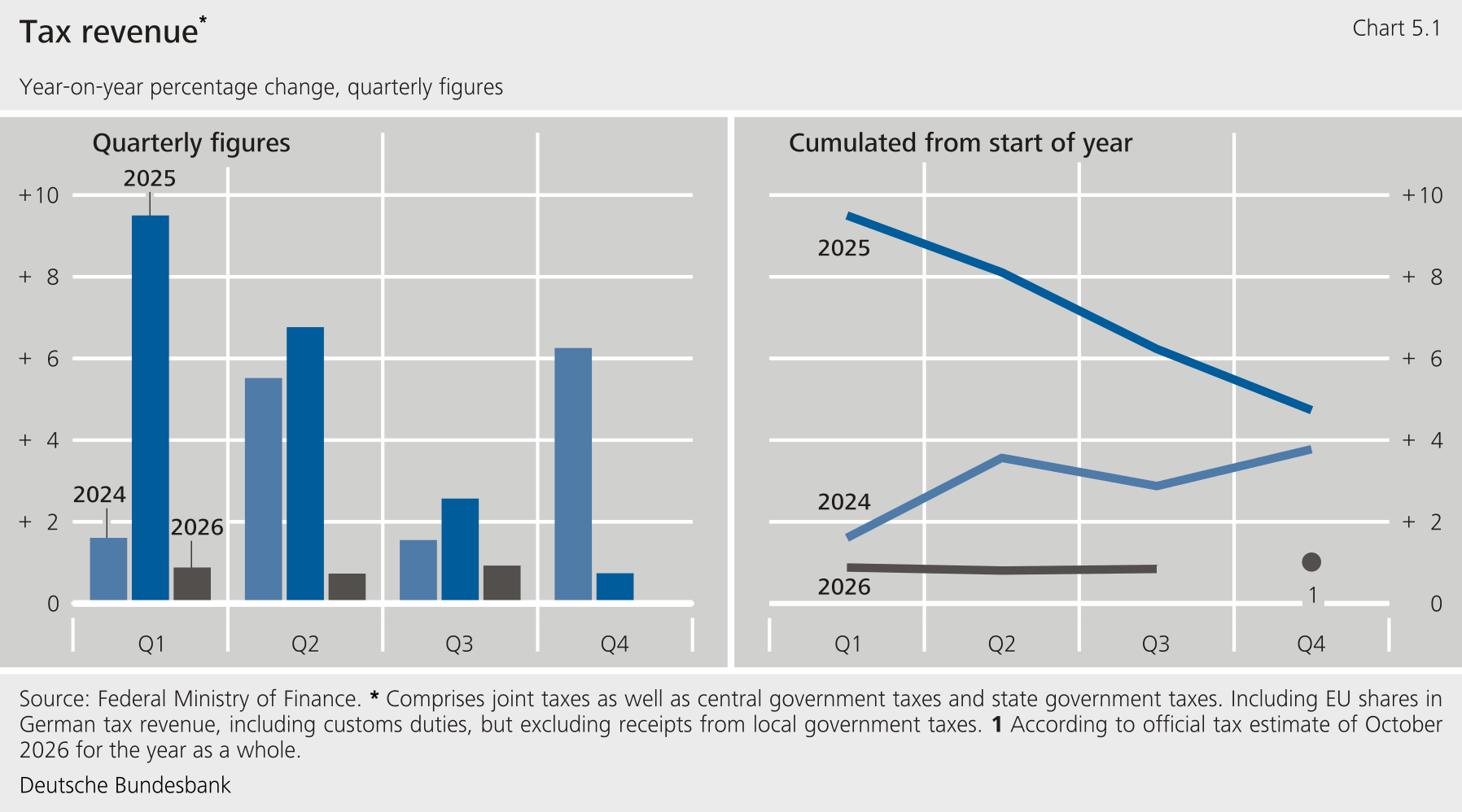
****In 2026, tax cuts and, independently of them, sluggish assessed taxes on earnings are dampening tax revenue growth: the new tax estimate expects only weak tax growth for the current year (just under 1 %;** see Chart 5.1 and Table 5.2). Tax cuts are curbing growth significantly: income tax bracket creep is offset, newly purchased movable assets and electric vehicles are eligible for higher depreciation rates, and the reduced rate applies to restaurant meals. In addition, the Federal Government has temporarily lowered energy tax rates on fuels for a total of five months ("fuel rebate"). However, energy tax receipts are also being dampened by curbs on consumption. Irrespective of any legislative changes, receipts from assessed income tax and corporation tax (assessed profit-related taxes) are also falling: the government has given enterprises more tax refunds so far this year than in the previous year, while back-payments of taxes have declined at the same time. This mainly concerns profits for 2024 and 2025. In addition, tax developments are being dampened by the fact that, for energy tax and inheritance tax, revenue-raising one-off effects from the previous year are now absent.**{#par-ee4i5o}
{#par-ou258u}
****
{#par-i2io9i}{#par-ei2936}
|----------------------------------------------------------|----------|-------|---------------|----------|-------------------------------|----------|-------|---------------|---------|
| **Table 5.1: Tax revenue** ||||||||||
| **Type of tax** | **to** |||| **Estimate for 2026^1^** | ||||
| **Type of tax** | **2025** | **2026** ||| **Estimate for 2026^1^** | **2025** | **2026** |||
| **Type of tax** | **€ billion** || **Year-on-year change** || **Year-on-year change** **%** | **€ billion** || **Year-on-year change** ||
| **Type of tax** | **€ billion** || **€ billion** | **in %** | **Year-on-year change** **%** | **€ billion** || **€ billion** | **%** |
| **Tax revenue Total^2^** | 665.0 | 670.6 | + 5.6 | + 0.8 | + 1.0 | 217.4 | 219.4 | + 2.0 | + 0.9 |
| **of which:** | |||||||||
| **Wage tax^3^** | 189.9 | 198.3 | + 8.4 | + 4.4 | + 4.5 | 62.8 | 65.3 | + 2.5 | + 4.0 |
| **Profit-related taxes** | 130.5 | 128.0 | -- 2.6 | -- 2.0 | -- 1.9 | 40.5 | 39.0 | -- 1.5 | -- 3.8 |
| | |||||||||
| **Assessed income tax^4^** | 56.8 | 53.1 | -- 3.7 | -- 6.5 | -- 5.5 | 19.9 | 17.4 | -- 2.6 | -- 12.9 |
| **Corporation tax^5^** | 29.4 | 26.9 | -- 2.5 | -- 8.7 | -- 7.4 | 9.7 | 8.7 | -- 1.0 | -- 10.1 |
| **Non-assessed taxes on earnings** | 25.2 | 27.8 | + 2.6 | + 10.5 | + 8.6 | 6.3 | 7.2 | + 0.9 | + 13.6 |
| **Withholding tax on interest income and capital gains** | 19.1 | 20.1 | + 1.0 | + 5.5 | + 4.8 | 4.6 | 5.7 | + 1.1 | + 24.8 |
| **^6^** | 231.4 | 238.5 | + 7.1 | + 3.1 | + 3.2 | 77.1 | 80.1 | + 3.0 | + 3.9 |
| **Other consumption-related taxes^7^** | 71.8 | 67.5 | -- 4.3 | -- 6.0 | -- 6.7 | 23.5 | 22.0 | -- 1.5 | -- 6.2 |
| Sources: Federal Ministry of Finance, Working Party on Tax Revenue Estimates and Bundesbank calculations. **1** According to official tax estimate of October 2026. **2** Comprises joint taxes as well as central government taxes and state government taxes. Including shares in German tax revenue, including customs duties, but excluding receipts from local government taxes. **3** Child benefits and subsidies for supplementary private pension plans deducted from revenue. **4** Employee refunds and research grants deducted from revenue. **5** Research grants deducted from revenue, minimum tax added. **6** and import . **7** Taxes on energy, tobacco, insurance, motor vehicles, electricity, alcohol, air traffic, coffee, sparkling wine, intermediate products, alcopops, betting and lotteries, beer and fire protection. ||||||||||
{#par-i6i171}
****According to the tax estimate, tax growth will accelerate in 2027 amid dynamic macroeconomic growth (+ 4½** **%).** Entrepreneurial and property income will rise significantly, which means that the assessed profit-related taxes will return to a growth path. The impact of tax cuts will be only moderate on balance, mainly due to accelerated depreciation options. By contrast, the discontinuation of the fuel rebate and the increase in tobacco tax will boost revenue. Income tax bracket creep will also enhance growth. It will no longer be offset under the current legislation governing the tax estimate.**{#par-ee8889}
****Between 2028 and 2031, revenue will rise thanks mainly to aggregate economic growth and progressive taxation (on average + 3½ %).** Legislative changes will still lead to tax losses, especially in 2028: the corporation tax rate will fall by one percentage point and the accelerated depreciation will cause revenue shortfalls. In addition, the significant rise in the contribution rate to the statutory pension insurance scheme will be a drag on revenue growth in 2028 because it will also increase insurees' and employers' deductible contributions. In each of the subsequent years, the corporation tax rate will also fall by one percentage point. The currently accelerated depreciation will only apply to purchases of equipment up to the end of 2027, which will lead to additional tax revenue in later years. This is because they will bring forward depreciation charges and thus essentially shift tax payments to the future.**{#par-o29136}
****Changes in tax law not yet included in the tax estimate, but for which specific plans already exist, will alter the picture only slightly on balance** (see Table 5.1). The tax estimate only takes account of already enacted changes. Higher or new taxes on alcoholic and sugary drinks are planned. In addition, the Federal Government has agreed on income tax reform in 2027 and 2028. Among other things, income tax allowances and child benefits are set to rise. At the same time, higher taxes on very high incomes are planned. On balance, these measures would probably reduce projected revenue by between €4 billion and €4½ billion per year beginning next year. Furthermore, it appears likely that the basic income tax allowances will be adjusted annually from 2029 onwards as well. This could lead to further revenue shortfalls in increments of around €2½ billion per year (see Table 5.1).**{#par-a6iiii}
### **2.2 Upward revision to May estimate** {#tar-7}
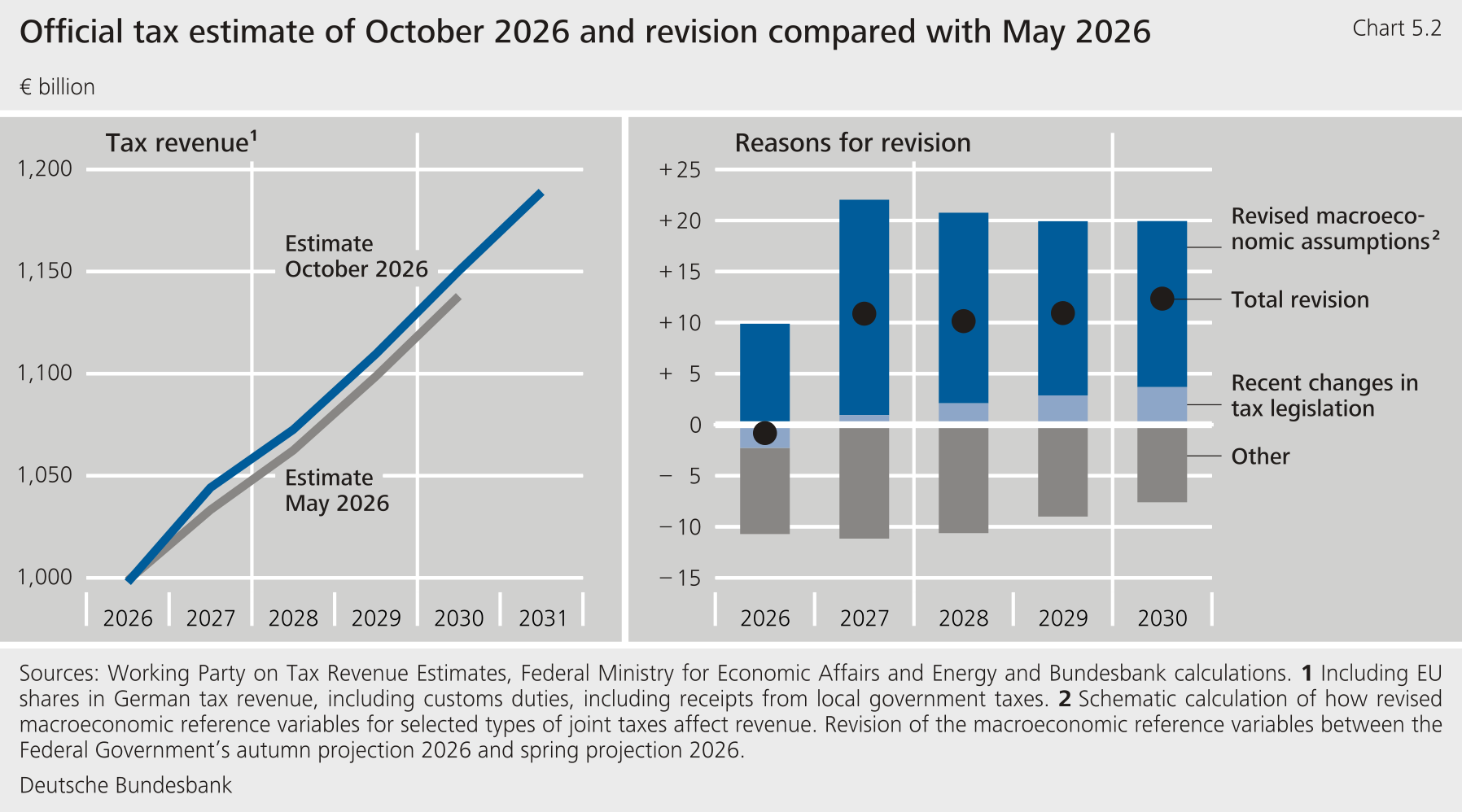
****Compared with the May 2026 tax estimate, revenue will rise moderately from 2027 onwards (+ 0.2 % of** ).**This is mainly due to higher projected aggregate economic growth** (see Chart 5.2). For the current year, the new tax estimate confirms the revenue expectations of May on the basis of previous cash developments. For 2027 onwards, it revises revenue upwards by between €10 billion and €12 billion. This revision can largely be explained by the following factors:**{#par-a17888}
* ****The macroeconomic tax reference variables are seeing significantly stronger growth, and this will be reflected in an upward revision from next year onwards.** The tax estimate is based on the respective macroeconomic projection by the Federal Government, the plausibility of which has been certified by the institutions involved in the Joint Economic Forecast. According to the forecast, profits in particular will grow more strongly than expected in the spring projection. This applies to both the current year and the year to come. However, the tax estimate for the current year's tax revenue is largely based on previous cash developments. Cash receipts from income tax and corporation tax are significantly lower than the dynamic growth in aggregate profits would suggest. This is why the tax estimate for these types of tax has not been revised upwards for the current year.**
* ****Revenue from the taxing of interest income has been revised substantially upwards in the tax estimate.** This is because receipts from withholding tax on interest income and capital gains have been markedly higher over the course of the year thus far than previously estimated. The upward revision is consistent with the fact that interest rates with fixation periods have risen significantly since mid-year. The tax estimate then also extrapolated the higher 2026 level into subsequent years.**
* ****Tax hikes will increase revenue.** The federal legislators recently passed a gradual increase in the tobacco tax for the years 2027 to 2030. This amended legislation will considerably increase the prices of certain tobacco products. Additional revenue of €4½ billion by 2030 is thus anticipated.**
{#par-ia7345}
****
{#par-iu67ao}{#par-a4aai8}{#par-i28145}
|------------------------------------------------------------------------------------------------------------------|----------|----------|----------|----------|----------|----------|
| **Table 5.2: Official tax estimate figures and the Federal Government's macroeconomic projections** |||||||
| Item | **2026** | **2027** | **2028** | **2029** | **2030** | **2031** |
| **Tax revenue^1^** | ||||||
| **€ billion** | 997.9 | 1,044.2 | 1,072.6 | 1,109.7 | 1,150.3 | 1,189.0 |
| **% of** | 21.2 | 21.3 | 21.3 | 21.4 | 21.6 | 21.7 |
| **Year-on-year change (%)** | 0.8 | 4.6 | 2.7 | 3.5 | 3.7 | 3.4 |
| **Revision compared with previous tax estimate (€ billion)** | -- 0.8 | 10.9 | 10.1 | 10.9 | 12.3 | . |
| **Memo item: Revenue shortfalls due to envisaged tax relief (€ billion)** | ||||||
| **Specifically planned changes in tax legislation^2^** | . | -- 4.2 | -- 4.7 | -- 4.4 | -- 4.4 | -- 4.3 |
| **Revenue shortfalls if the basic income tax allowance also shifts in line with annual inflation after 2028^3^** | . | . | . | -- 2.2 | -- 4.8 | -- 7.4 |
| **Real** **growth (%)** | ||||||
| **Autumn projection (October 2026)** | 1.3 | 1.1 | 0.6 | 0.9 | 0.9 | 0.9 |
| **Spring projection (April 2026)** | 0.5 | 0.9 | 0.9 | 0.9 | 0.9 | . |
| **Nominal** **growth (%)** | ||||||
| **Autumn projection (October 2026)** | 4.0 | 4.3 | 2.6 | 2.9 | 2.9 | 2.9 |
| **Spring projection (April 2026)** | 2.8 | 3.8 | 3.0 | 3.0 | 3.0 | . |
| Sources: Working Party on Tax Revenue Estimates, Federal Ministry for Economic Affairs and Energy and Bundesbank calculations. **1** Including shares in German tax revenue, including customs duties, including receipts from local government taxes. **2** Partly estimated by the Bundesbank: income tax reform, introduction of a tax on sugary drinks, and increases in alcohol tax, intermediate products tax and alcopop tax. **3** The figures shown here are the revenue shortfalls that will result if, from 2029 onwards, the basic income tax allowance also shifts each year in line with the previous year's inflation rate. The effects are roughly estimated and are based on the Federal Government's current autumn projection. |||||||
{#par-ooa58i}
**3 Central government finances** {#tar-8}
------------------------------------------
### **3.1 Overall deficit will rise sharply in 2026 but remain below planned figure** {#tar-9}
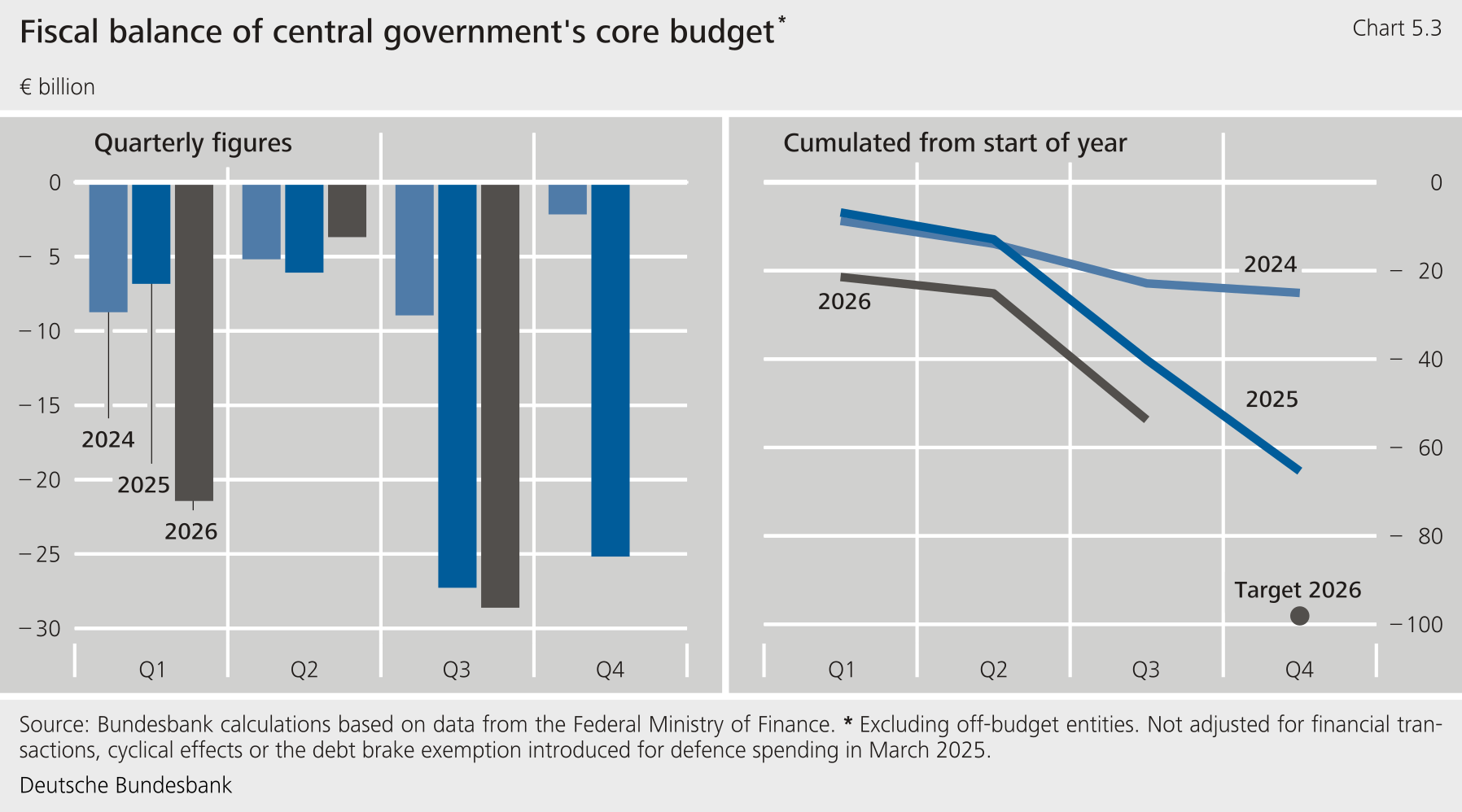
****The central government deficit including off-budget entities** [\[10\]](#_ftn_root_10)**will grow substantially in 2026. However, this growth is likely to be significantly lower than planned.**In the first three quarters, the deficit expanded by €40 billion on the year. An increase of €107 billion to €191 billion had been planned.**{#par-a43656}
****In the core budget, the deficit increased by €14 billion to €54 billion in the first three quarters** (see Chart 5.3). Revenue was down by a perceptible €7 billion. Declining tax revenue had a negative impact. In particular, central government had to transfer €7½ billion more from its tax revenue to the budget than in the previous year. Expenditure grew moderately by 1½ %. On balance, this increase is solely attributable to the defence sector, which falls under the debt brake exemption. As a whole, other expenditure did not increase. Higher current grants were compensated by lower investment grants. However, the latter amounts did not disappear altogether, but appear to have been shifted into the Infrastructure and Climate Neutrality Fund instead.**{#par-i96799}
****The planned deficit of €98 billion in the core budget will probably be significantly undershot. In the annual accounts, central government is likely to be compliant with the borrowing limit under the debt brake.**According to the new tax estimate, tax revenue will remain below the planned figure. On the expenditure side, however, there are signs of even greater relief compared with the budget estimates. In addition to the defence sector, this applies, not least, to personnel expenditure in the civilian sector. By contrast, central government will have to spend more than planned on its loans to the social security funds. Neither the lower defence sector spending nor the higher loans to the social security funds (financial transactions) will affect the debt brake. Given the foreseeable relief in other areas, the debt brake ceiling for net borrowing is likely to be adhered to.**{#par-a54uu7}
{#par-ia381u}
****
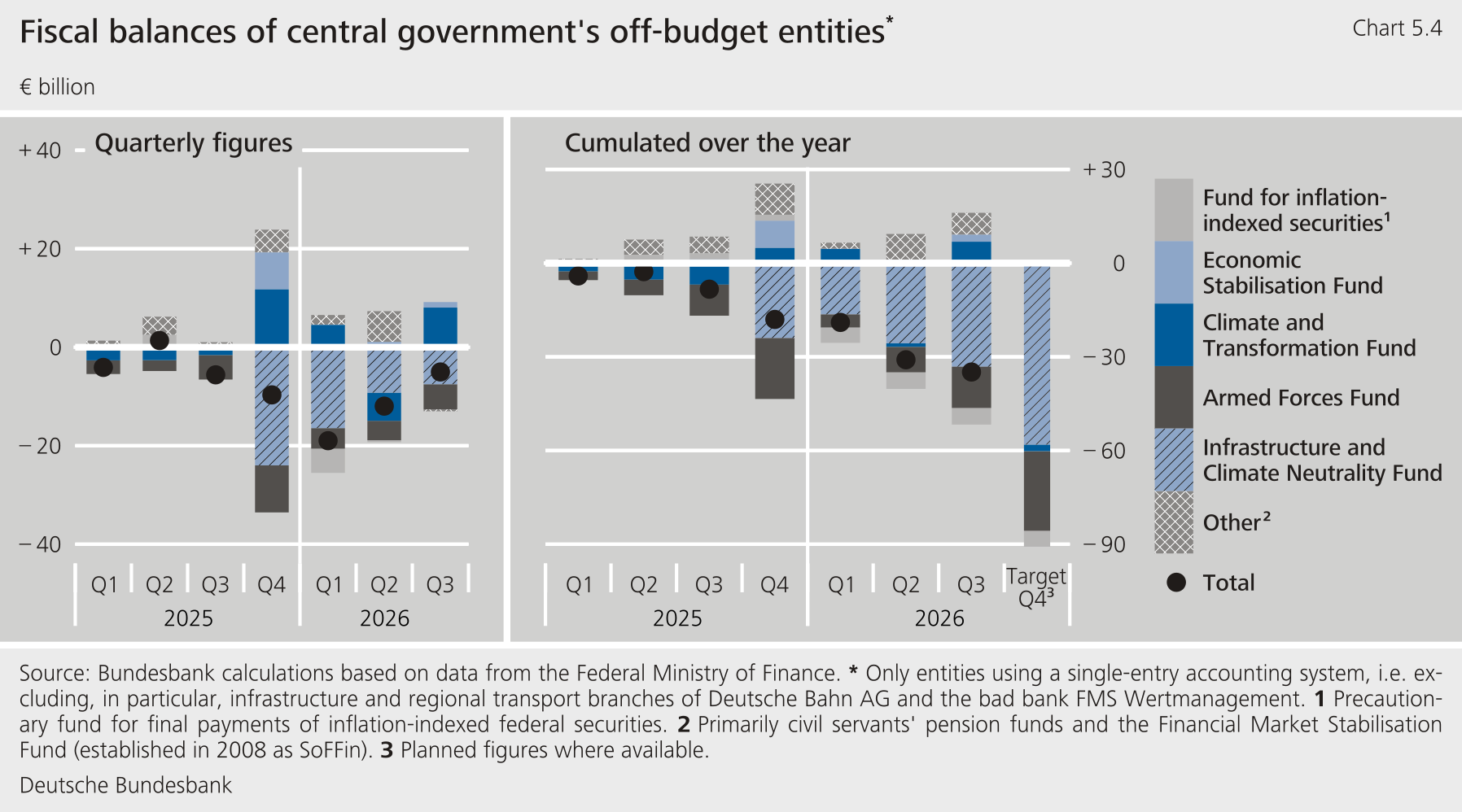
****The deficit recorded by the off-budget entities climbed by €27 billion in the first three quarters to €35 billion. Nevertheless, it, too, is likely to fall well short of the planned figure (€93 billion).****{#par-a66i34}
* **The Infrastructure and Climate Neutrality Fund alone posted a deficit of €33 billion. In the same period last year, it had not yet disbursed any funds. €16 billion of its deficit was attributable to payments to other special funds: in addition to a Climate Fund transfer, a total of €6 billion was channelled into the transformation fund and the health fund for use by hospitals. State governments received €1½ billion, including funds for their local governments. In addition, investment grants of €15 billion were distributed, chiefly for the railway network. Considerable fund outflows will probably continue up to the end of the year, particularly to state governments and their local governments. However, the planned deficit of €58 billion is likely to be significantly undershot.**
* **As things currently stand, the Climate Fund has a surplus of €7 billion. The result thus improved by €14 billion on the year. This is mainly attributable to two factors. First, the transfer from the Infrastructure and Climate Neutrality Fund was received earlier than in the previous year. Second, carbon emission allowances generated significantly greater revenue, particularly through earlier sales than in the previous year. At the same time, the fund's expenditure rose by a substantial €6½ billion. This was probably due, in particular, to the new subsidy to reduce electricity grid charges. Instead of the estimated deficit of €2 billion for the year as a whole, there could be a surplus, as investment expenditure is likely to remain below the planned figures. Nevertheless, the result will probably deteriorate year-on-year (2025: + €5 billion).**
* **For the Economic Stabilisation Fund, and the precautionary items for civil servants' pensions, the combined surpluses could be somewhat lower for 2026 as a whole than in the previous year (€18 billion). Central government does not release any planned figures for these entities.**
* **For the Armed Forces Fund established in 2022, the deficit in the first three quarters rose by €3 billion to €13 billion. The estimated deficit of €26 billion will only be recorded if expenditure in the fourth quarter is as high as in the first three quarters taken together.**
* **On an annual basis, central government pays interest burdens accrued through period-based inflation to the fund for inflation-indexed securities. The fund will only distribute these amounts, cumulated over the lifetime of the securities, to investors once the securities are redeemed. This is why the fund initially generates surpluses from central government payments during the lifetime of a bond. Repayments will then result in deficits. For the year thus far, the fund has recorded a deficit of almost €5½ billion, as planned (following a surplus of €2 billion a year earlier). As a security was redeemed, the fund made compensation payments of €5 billion.[\[11\]](#_ftn_root_11) Furthermore, the fact that the fund reimbursed central government sums for securities held in the latter's own portfolio had a burdening effect. The revenue accrued by the fund for this purpose was then repaid to central government on an ad hoc basis. In the core budget, this will reduce interest expenditure on a one-off basis. Next year, this relief will no longer be provided, with the result that interest expenditure in the core budget will rise more sharply.**
{#par-e626ai}
****
### **3.2 Outlook for 2027** {#tar-10}
****The central government budget is expected to record a very large deficit of €218 billion next year.** This is €27 billion higher than the planned value for 2026, with an increase of €32 billion to €130 billion envisaged in the core budget.[\[12\]](#_ftn_root_12)**{#par-ei6131}
****The planned core budget deficit is €4½ billion higher than in the Federal Government's draft from the summer.** [\[13\]](#_ftn_root_13)**Although the more favourable tax estimate drives down the deficit, there is only additional revenue of just over €1 billion on balance.**The tax estimate foresees an increase of €4 billion compared with budget estimates. However, the global revenue increases from tax hikes, contained in the draft budget, are not fully achieved, as the introduction of taxes on sugary drinks and plastics is postponed or cancelled respectively. This appears to weigh on subsequent budgets by just over €1 billion per year. In 2027, the draft law on income tax reform will cause €2 billion in additional tax revenue shortfalls; the draft budget did not yet contain provisions for these.**{#par-uu9i21}
****On the expenditure side, additional burdens of €5½ are estimated compared with the summer draft.****{#par-ae165a}
* **Particularly noteworthy here are sums of €4 billion for the acquisition of shares in an energy industry enterprise and €3 billion for higher loans to the Federal Employment Agency. These are financial transactions that fall outside the scope of the debt brake, and they require a corresponding build-up of financial assets. Most recently, the Chair of the Federal Employment Agency raised the possibility of a debt cancellation for at least part of these loans. Were this to occur, grants would have to be booked instead of loans. The grants would then fall under the debt brake.**
* **Other expenditure will include additional spending in other areas, for example because some social benefits will not be cut as previously planned, and because the global expenditure cuts estimated from efficiency gains are now expected to be €1 billion lower.**
* **By contrast, reduced investment grants to the Autobahn and reduced grants to the pension insurance scheme, in particular, will each provide relief of €2 billion. The Autobahn is set to receive a borrowing authorisation (see [below](https://preview.publikationen.bundesbank.de/publikationen-en/reports-studies/monthly-reports/monthly-report-november-2026-1016266?article=public-finances-1015938#par-ii9u4e) for more on this). In connection with the cut in grants, the pension insurance scheme is likely to be relieved by, amongst other things, larger haircuts for taking early retirement.**
****In the plans, the core budget continues to fully exhaust the debt brake. The planned deficit is broken down as follows:****{#par-o3uae5}
* ****The standard limit for structural net borrowing of 0.35 % of****results in deficit scope of just over €38 billion.** Of this amount, €16 billion is attributable to permissible structural borrowing, €10 billion to cyclical burdens (€2½ billion less than in the summer draft) and almost €13 billion to acquisitions of financial assets (€7½ billion more than in the draft). At €7 billion, central government makes only slightly more use of the remaining reserves than planned in the summer draft.**
* ****The impact of the exemption for defence spending comes in at just shy of €85 billion.**The starting point is spending by the Federal Ministry of Defence and expenditure to strengthen Ukraine's defence capabilities and for domestic security purposes. This amounts to €130 billion altogether. €45 billion (1 % of ), which falls under the regular new borrowing limit, is to be deducted from this sum. The usable scope for borrowing is €1 billion lower than in the draft budget, mainly owing to a larger deducted amount following the upward revision of .**
****Overall, the amendments made in the final deliberations are set to exacerbate the already tight fiscal situation of central government, now and in the years to come.** [\[14\]](#_ftn_root_14) This is primarily attributable to the above-mentioned amendments to tax law and social benefits (compared with the estimates in the summer draft).**{#par-ie9728}
****In the case of off-budget entities, the overall deficit is set to decrease slightly in 2027.**However, adjustments agreed in the final deliberations have only been published in part thus far.**{#par-eee1o9}
****Additional net borrowing by the Infrastructure and Climate Neutrality Fund and from the exemption for defence spending is now planned at €142 billion for 2027. It will thus be significantly higher than the additional expenditure on central government infrastructure and defence once again.** This is roughly estimated at around €75 billion relative to the base year 2024, with the core budget and Infrastructure and Climate Neutrality Fund taken together and adjusted for investment covered by the defence exemption.[\[15\]](#_ftn_root_15)**{#par-o46a35}
****The Federal Government is planning to grant the off-budget entity Autobahn** **a dedicated borrowing authorisation outside the debt brake from 2027 onwards. However, higher deficits jeopardise the objective of sound public finances and compliance with** **rules.** It appears that central government wants to be able to spend more money on federal motorways without having to create scope for this in the core budget[\[16\]](#_ftn_root_16) or tap the Infrastructure and Climate Neutrality Fund to a greater degree. This would increase the borrowing of central government including off-budget entities. In addition, the Federal Government intends to transfer a claim to a large part of truck toll revenue to the Autobahn from 2028 to 2057. This claim will replace the current toll-oriented transfers of more or less the same amount from the central government budget. With this revenue, the Autobahn will then initially be able to cover expenditure on federal motorways, as before. However, as its debt increases, it will have to use a growing share of its revenue to service this. The interest costs of the Autobahn are likely to be notably higher than they are for federal securities, initially on account of lower liquidity. Furthermore, there will probably be a risk premium to consider, as the Federal Government does not guarantee the Autobahn GmbH's debts. Driven by loans, the Autobahn GmbH's capacity for motorway construction is likely to increase notably in the short term. However, it will become increasingly narrow over time. This is because the Autobahn will have to use up toll revenue bit by bit to finance increasing interest burdens, and ultimately also redemptions, as its claim to this revenue is set to expire in 2057. Spending on federal motorways is unlikely to stabilise on a permanent basis, then. In addition, additional borrowing would lead to higher general government deficits over a longer transitional period. The existing discrepancy between the national scope for borrowing and the narrower limits set by the fiscal rules would thus be even greater (see [Chapter 1.3](https://preview.publikationen.bundesbank.de/publikationen-en/reports-studies/monthly-reports/monthly-report-november-2026-1016266?article=public-finances-1015938#1.3-Comply-with-EU-rules-and-safeguard-sound-public-finances)).**{#par-ii9u4e}
**4 State government finances[\[17\]](#_ftn_root_17)** {#tar-11}
----------------------------------------------------------------
****In 2026, the state government deficit is likely to rise somewhat from the previous year.** In the first half of the year, its budget outturn (including off-budget entities) deteriorated by €4 billion to a deficit of €2½ billion. This deterioration mainly reflects exceptionally high inheritance tax revenue in the previous year, which did not recur in 2026. Tax revenue therefore grew only slightly (+ 1 %). Inflows from central government's Infrastructure and Climate Neutrality Fund were also small (€½ billion by the end of June according to central government figures).[\[18\]](#_ftn_root_18) Towards the end of the year, however, state governments will probably significantly increase their withdrawals from the fund. This will reduce their deficit unless they pass the funds directly to their local governments or increase their investment accordingly. Overall, the deficit in the second half of 2026 will probably be lower than in 2025. However, this is unlikely to offset the budget deterioration in the first half of the year. [\[19\]](#_ftn_root_19)**{#par-u1eu25}
{#par-o2a52i}
**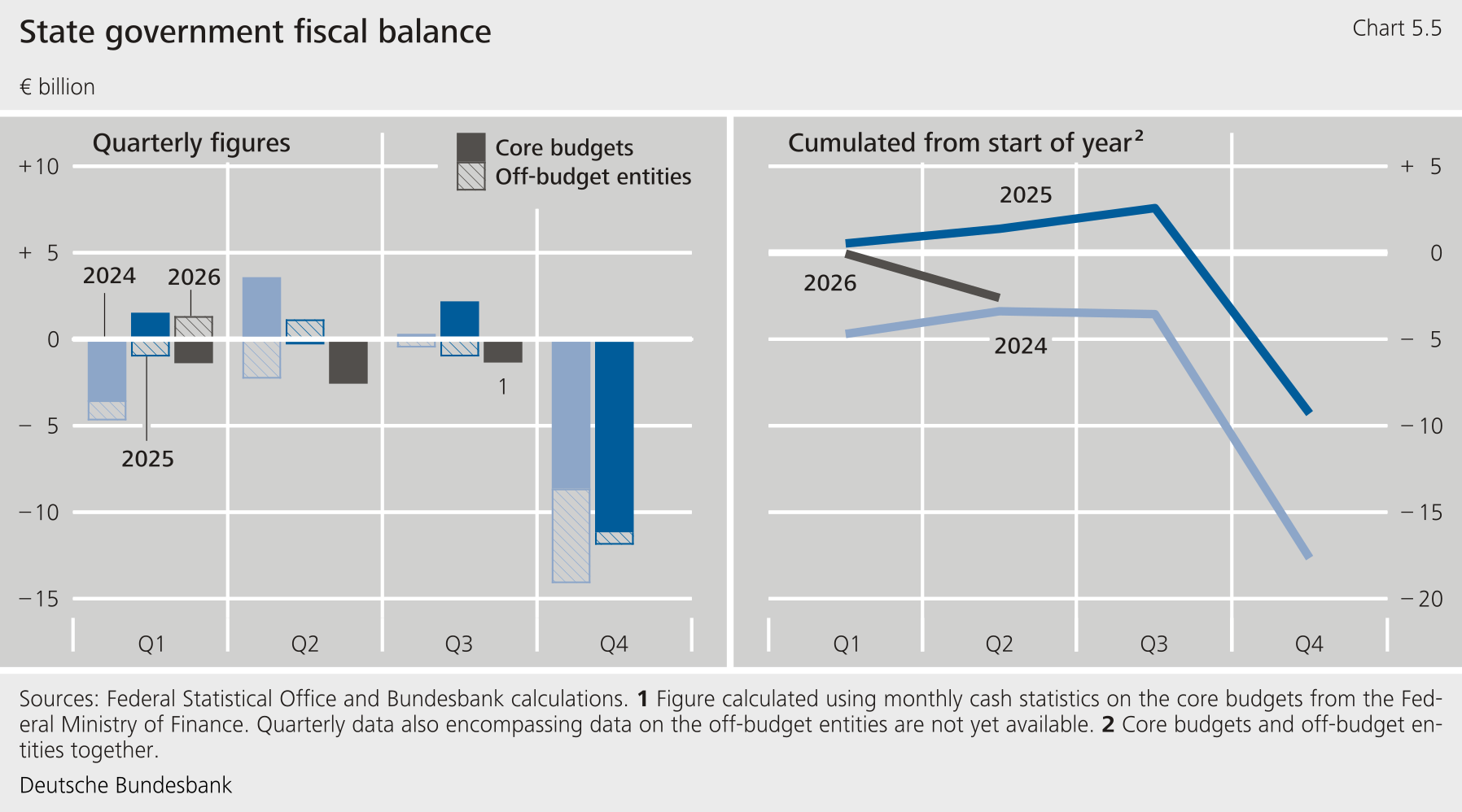**
****The state government deficit could remain broadly unchanged next year.**According to the new estimate, tax revenue, in particular, will rise much more sharply (+ 3½ %). Revenue will therefore be more likely to keep pace with expenditure. In addition, state governments will probably increase their withdrawals from the Infrastructure and Climate Neutrality Fund. It is uncertain how exactly they will use these funds. Of the total of €100 billion available to them, state governments plan to pass around two-thirds on to local governments. Of the remaining third, they are likely to use only part, if any, for additional investment.**{#par-iu8u38}
**5 Social security funds** {#tar-12}
-------------------------------------
### **5.1 Pension insurance scheme** {#tar-13}
#### **5.1.1 Significant deterioration in finances in 2026**
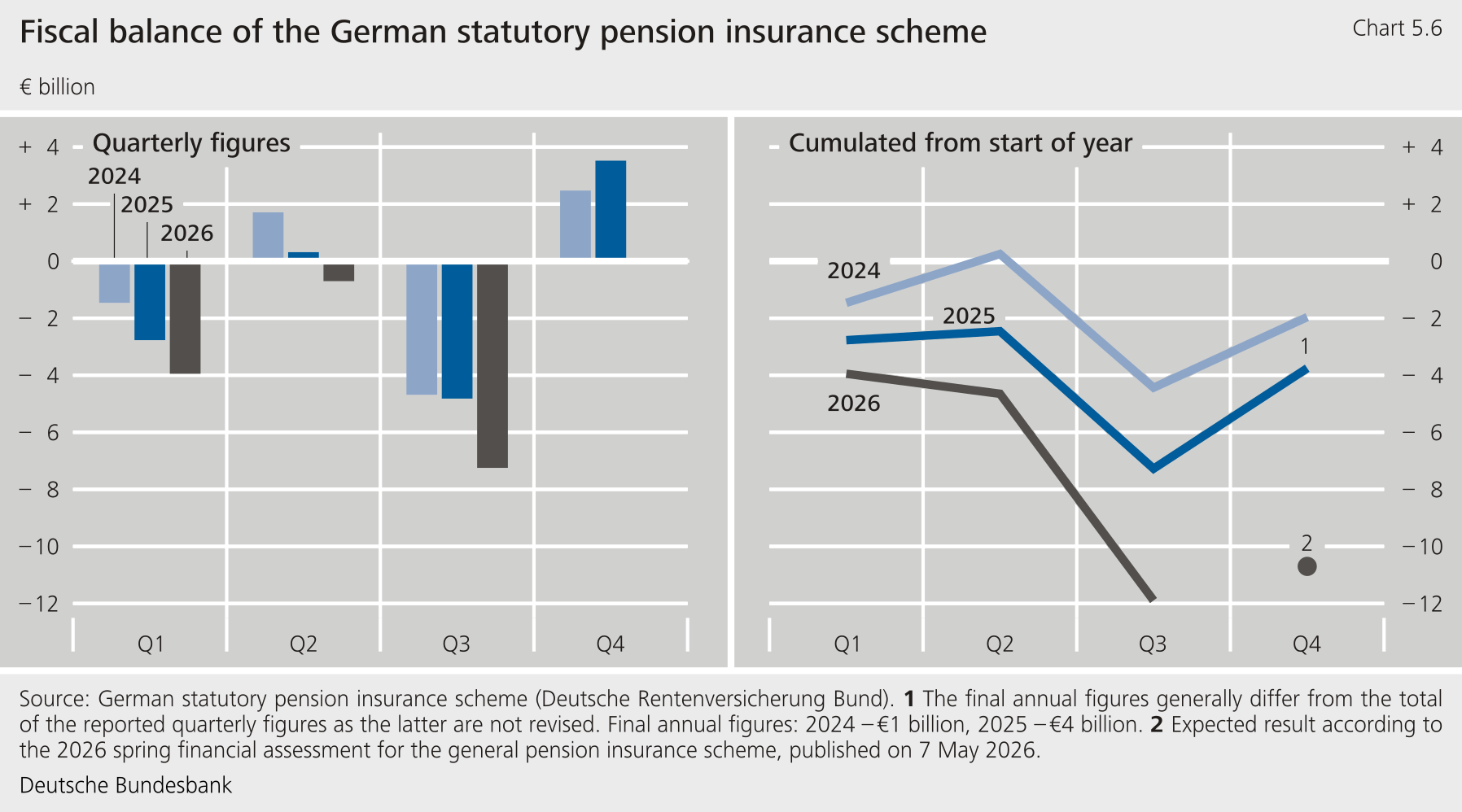
****The finances of the statutory pension insurance scheme deteriorated significantly in 2026.** **However, its reserves remain well above the statutory minimum.**After the first three quarters, the statutory pension insurance scheme recorded a sizeable deficit of €12 billion (previous year: almost €7½ billion). Nonetheless, the deficit will probably fall by the end of the year. This is because the statutory pension insurance scheme usually posts a surplus in the final quarter, mainly owing to higher contribution receipts from special payments. Revenue is therefore likely to rise by around 4 % in 2026 as a whole. However, expenditure will probably see a much sharper increase of around 5 %. The mid-year pension adjustments (2026: just over 4 %, 2025: just over 3½ %) are a major factor driving this growth. In addition, the number of pensions paid out has continued to rise. In the first three quarters, it was 0.7 % higher than in the previous year. Expenditure on pension recipients' health insurance is also projected to increase by 7¼ % owing to higher supplementary contribution rates.[\[20\]](#_ftn_root_20) A deficit of around €9 billion therefore appears likely for the year as a whole. Although the sustainability reserve will fall significantly as a result, it will remain around €23 billion above its statutory minimum.**{#par-e92ie6}
{#par-au2uea}
****
#### **5.1.2 High financing pressure over the next few years, comprehensive reform announced**
****In 2027, the deficit will probably double in size. Demographic factors will cause expenditure to rise much faster than revenue. The contribution rate will remain unchanged at 18.6 %.** Pensions could rise sharply again at mid-year, mainly because of the adjustment to reflect this year's sharp rise in earnings subject to compulsory contributions.[\[21\]](#_ftn_root_21) In addition, the number of pensions is likely to increase further. Central government is cutting its funding for the statutory pension insurance scheme by a total of €3 billion, reducing the scheme's revenue. Owing to the large deficit, the scheme's sustainability reserve will shrink substantially. It will probably reach its statutory minimum of around €10 billion at the end of 2027. In 2028, the contribution rate will need to rise sharply to largely eliminate the deficit and ensure compliance with the statutory minimum for the reserve. The contribution rate could increase from 18.6 % to almost 20 %.**{#par-i41259}
****The recommendations of the Pension Commission are suitable for reducing demographic pressures on the pension insurance scheme and public finances over the longer term. The Federal Government's intention to implement them in a timely manner and as an overall package is therefore welcome.** [\[22\]](#_ftn_root_22) Demographic pressures will remain high for many decades to come. This makes it all the more important to implement the planned reform swiftly and limit transitional periods. The recommendations could then already dampen the increase in financing burdens on contribution and tax payers in the medium term. The faster they take effect, the less sharply contribution rates and tax-funded central government grants will rise in the future.**{#par-ae4uue}
### **5.2 Federal Employment Agency** {#tar-14}
****The Federal Employment Agency will post a large deficit in 2026 and require significantly more central government loans than planned.** At the end of the first three quarters, its deficit stood at €7 billion (previous year: €4 billion). In the first three quarters, revenue grew by 3 %, significantly less than expenditure (+ 10½ %). Payments of unemployment benefits rose particularly steeply (by almost 16 %), mainly owing to an increase in benefit recipients. Expenditure on active labour market policy (+ 11½ %) and insolvency benefits (+ 8 %) also rose significantly. Like the pension insurance scheme, the Federal Employment Agency will see an improvement in its final quarter figures due to higher contribution receipts, as is usual for the time of year. The Federal Employment Agency's budgets for insolvency and winter employment benefits, which are financed by levies, are set to generate a combined surplus of almost €1 billion. By contrast, the contribution budget will probably be just over €8 billion in deficit. Central government will cover this deficit with loans. However, it is unlikely that the increased funds of up to €9 billion now earmarked for this purpose will be fully utilised.**{#par-u4i952}
{#par-ii45o2}
**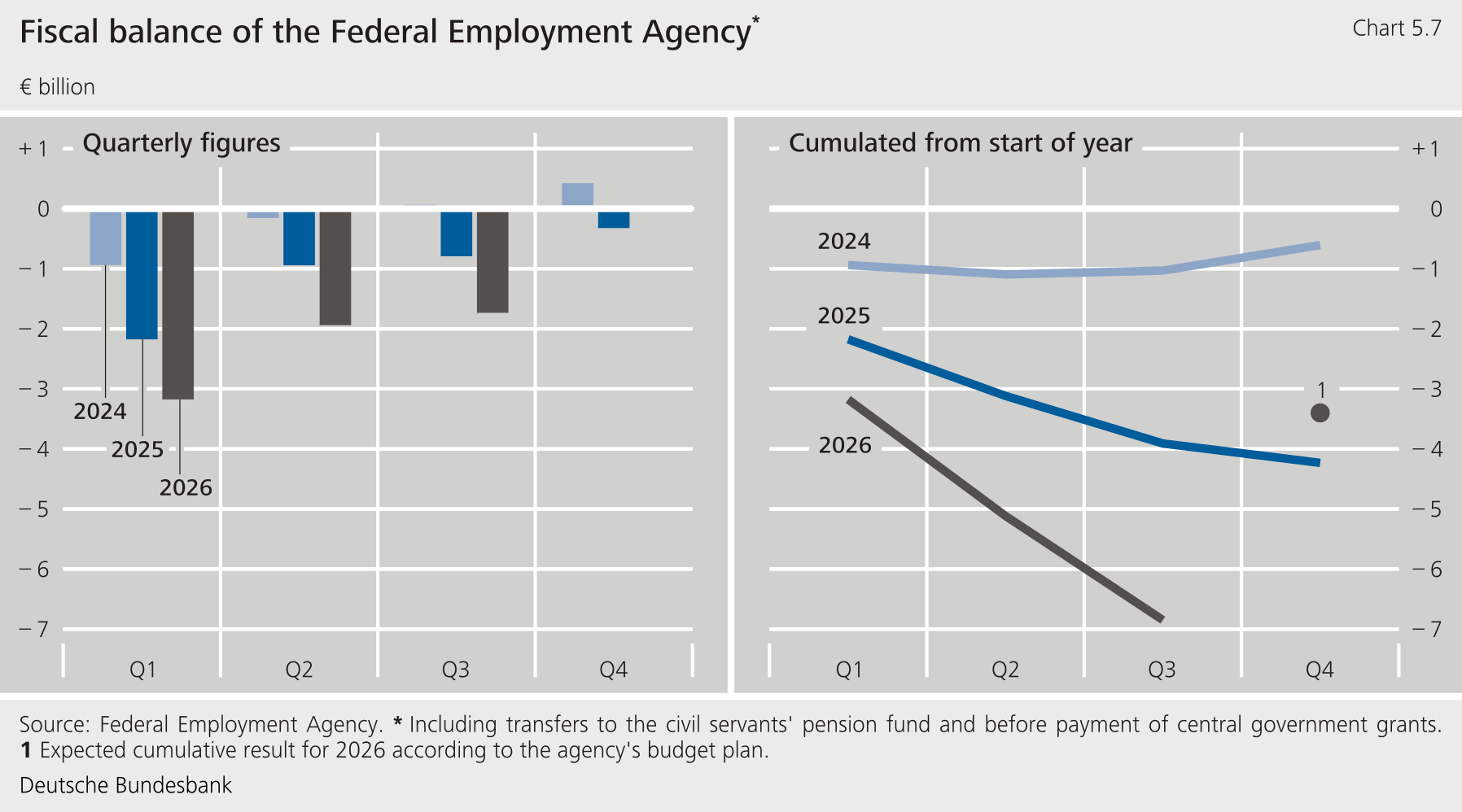**
****In 2027, the deficit is likely to decline somewhat but remain high.** The additional loans of just over €8 billion agreed during the final deliberations of the Bundestag's Budget Committee could be broadly sufficient to close the financing gap in the contribution budget. By granting these loans, central government can prevent a rise in the contribution rate. However, the Federal Employment Agency will later have to use its future surpluses to repay the loans. If the Federal Employment Agency's deficit turns out to be partly structural, the contribution rate would have to be raised.[\[23\]](#_ftn_root_23)**{#par-eu455a}
**6 Annex: A review of subsidies** {#tar-15}
--------------------------------------------
### **6.1 Why review subsidies?** {#tar-16}
****The government uses subsidies to support enterprises, as well as households, depending on the definition.**Subsidies impact the government in the form of higher expenditure or lower tax revenue. In some cases, there is debate as to which provisions specifically constitute subsidies and how their costs can be determined precisely.**{#par-oe7aeo}
****The justification for subsidies is that unsubsidised markets can lead to inefficient results. Subsidies are also used to pursue certain policy objectives.** Inefficient market results stem from factors such as external effects. For example, research results and, in particular, findings from publicly accessible basic research are not only beneficial to the companies conducting the research. They also benefit the general public and entities such as enterprises that do not contribute to the costs of research. Research institutions and firms do not take adequate account of these additional benefits. Thus, their investment in research may fall short of the level that is desirable for the overall economy. Subsidies can help to reduce this gap. They can also support other policy objectives. For example, the reduced rate on food and the home ownership subsidy for families and single parents are motivated by distributional policy objectives.**{#par-e8794a}
****Subsidies weigh on public finances. They can also have other negative side effects.** Subsidies usually affect relative prices in order to achieve their intended policy objective. This can also create inefficiencies. For example, one of the original goals of the preferential tax treatment of diesel fuel was to keep commercial freight transport competitive. However, the lower tax rate for diesel also cuts the cost of fuel consumption in privately owned diesel cars. Moreover, it makes them more attractive than other engine types, thereby undermining incentives to save fuel. This, in turn, conflicts with the objective of reducing carbon emissions.**{#par-e17e17}
****Subsidies frequently entail additional bureaucracy. Adapting to new policy priorities is often challenging, too.** Special rules increase enforcement costs for fiscal authorities. Compliance costs rise for households and enterprises. In the case of preferential fiscal provisions, there is also a tendency for well-organised interest groups to win out over less well-organised groups.**{#par-aeouau}
****For these reasons alone, the government should conduct a regular review of subsidies.** **Very tight general government budgets make this review even more urgent.**It would determine whether subsidies are still necessary and effective, and whether their individual design can be improved. Another aspect to weigh up is whether a particular subsidy should still take priority over other expenditure, reduced taxes or lower deficits. Among other things, the Federal Government's subsidy policy guidelines envisage regular evaluations of all subsidies. Direct subsidies should be temporary and declining-balance, and tax expenditures should be reviewed regularly to see whether they can be converted into more transparent and direct subsidies. This is difficult to implement in practice, however.[\[24\]](#_ftn_root_24) Removing subsidies tends to spark resistance among the affected parties.**{#par-eiu734}
### **6.2 How large is the subsidy volume?** {#tar-17}
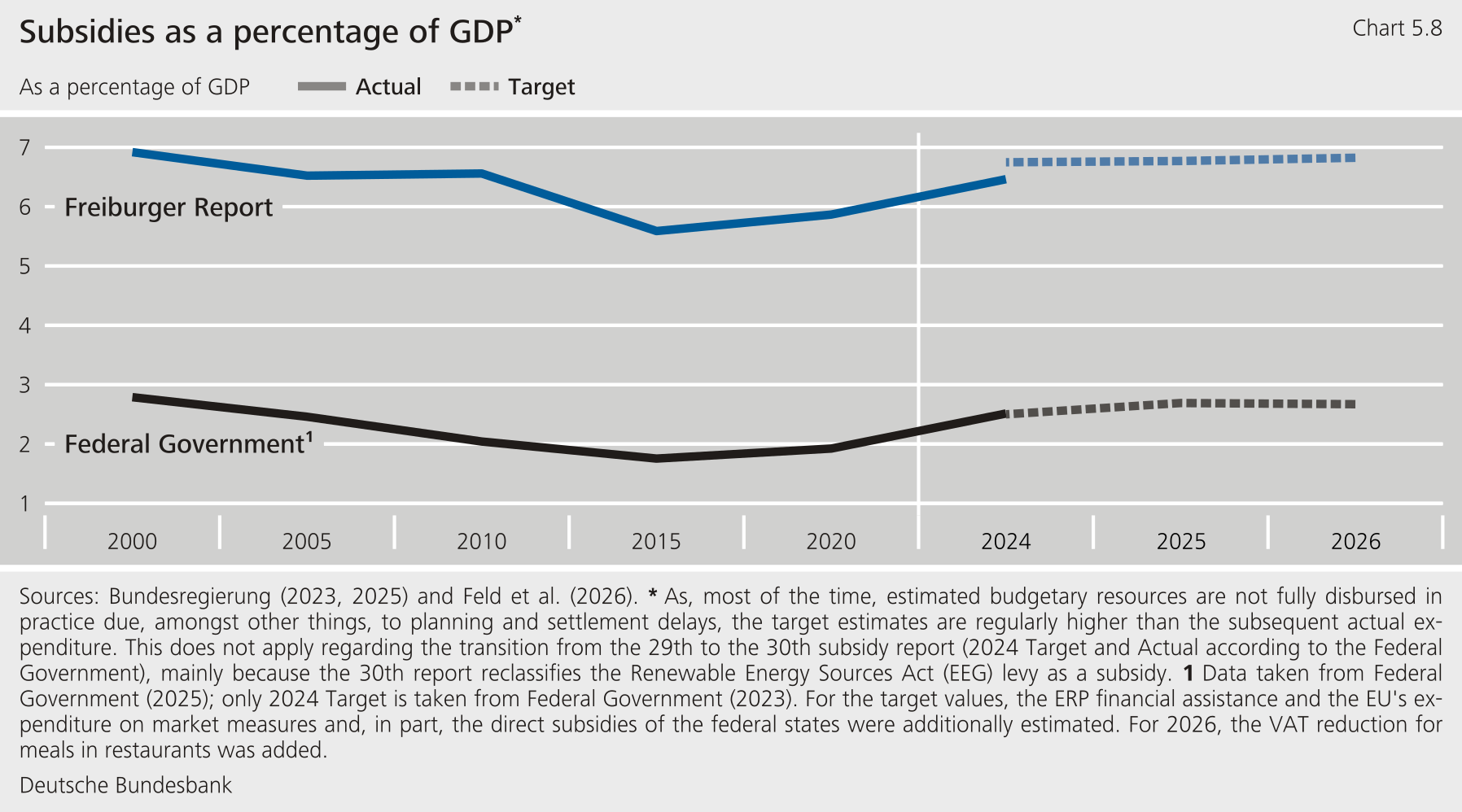
****Subsidies vary in terms of scope and scale. They are narrowly defined by the Federal Government. According to its estimates, the volume of general government subsidies will be €126 billion or 2.7 % of** **in 2026.** [\[25\]](#_ftn_root_25)[\[26\]](#_ftn_root_26)The Federal Government's definition is based on the Stability and Growth Act of 1967. According to this law, subsidies are "grants and special tax provisions that directly or at least indirectly benefit private enterprises and economic sectors".[\[27\]](#_ftn_root_27) According to the Federal Government's definition, subsidies for central government alone amount to a figure of €80 billion (1.7 % of ) in 2026. The Federal Government also includes figures for state governments, local governments and market regulation expenditure in its general government calculations.**{#par-oai5a5}
****The definition used in the Freiburg Subsidy Report is much broader and more economically motivated. According to the report, the planned volume for 2026 will be €321 billion, or 6.8 % of** .[\[28\]](#_ftn_root_28) Besides the Federal Government's definition, the main areas covered in this report are special tax provisions that benefit non-profit organisations, associations, churches and political parties, as well as the healthcare sector and social security funds. This is in addition to the standard travel allowance and other financial assistance from central government, its off-budget entities as well as state and local governments, including central government transfers to the hospitals' transformation fund.[\[29\]](#_ftn_root_29)**{#par-o368u3}
****The volume of subsidies reported comprises direct government expenditure on subsidies, as well as revenue lost due to tax expenditures.**It does not include indirect effects -- for example, due to changes in relative prices or additional administrative costs.**{#par-u33oo1}
****Direct subsidies are concentrated relatively highly in some policy areas, while tax expenditures focus on some major concessions.** The largest amounts of central government's comprehensive direct subsidies, as defined in the Freiburg Report, are allocated to environment and energy policy as well as transport policy. These areas are followed by healthcare, including hospitals, statutory health insurance and long-term care insurance. With regard to tax expenditures, the largest revenue shortfalls stem from the exemption for healthcare and social services, the exemption of business assets from inheritance and gift tax and the distance-based commuting allowance.**{#par-a32521}
****The volume of subsidies as a percentage of** **initially declined after the turn of the millennium and has increased since 2015 (see Chart 5.8).** This is mainly because central government has increased direct subsidies from the Climate and Transformation Fund and the Infrastructure and Climate Neutrality Fund. Federal legislators have also bolstered tax expenditures markedly since 2020. Target values for direct subsidies are only available for 2025 and 2026. Experience shows that these figures will be higher than the results reported at a later date.**{#par-o2ea7i}
{#par-u9678i}
****
### **6.3 What approaches to reducing subsidies are being discussed?** {#tar-18}
****Subsidies can be reduced either in a targeted manner or across the board.** Implementing targeted cuts or removing individual subsidies will create scope for the government to align its policies more closely with current priorities. Not all subsidies are likely to be prioritised equally. However, in this case, political resistance is particularly high among those affected by a targeted subsidy cut. It is therefore generally easier to agree on cuts across the board. This would allow consolidation to be more broadly based.**{#par-o26oa4}
****The savings generated by cuts across the board largely depend on what provisions are included, when the cuts are made and at what rate.** In arithmetical terms, the relief generated by a 25 % reduction across the board, for example, would amount to between €32 billion and €80 billion per year based on the subsidy definitions above (see [Chapter 6.2](https://preview.publikationen.bundesbank.de/publikationen-en/reports-studies/monthly-reports/monthly-report-november-2026-1016266?article=public-finances-1015938#6.2-How-large-is-the-subsidy-volume-)). In the initial period at least, the savings are likely to be significantly smaller. This is because in some cases, the government is bound by contractual agreements for direct subsidies, for example due to multi-year funding commitments. Moreover, transitional provisions are often considered in order to ease the transition for the affected parties.**{#par-a629oe}
****Targeted cuts or the removal of individual subsidies can also generate large savings.**Of the roughly 250 subsidies defined by the Federal Government, the ten largest jointly account for around one-half of the total subsidy volume (see Table 5.3).**{#par-u9o43o}
| Table 5.3: The ten largest subsidies in 2024 according to the Federal Subsidy Report |||||
| Rank | Subsidy | Type | 2024 volume (€ bn) | Share of volume |
|---------|----------------------------------------------------------------------------------------------------------------|-----------------|--------------------|-----------------|
| **1** | Electricity price relief grants | Direct subsidy | 18.5 | 17 % |
| **2** | Promotion of energy efficiency and renewable energy measures for buildings | Direct subsidy | 14.1 | 13 % |
| **3** | Benefit for purchasers of business assets in the event of inheritance or gift | Tax expenditure | 8.8 | 8 % |
| **4** | Reduced rate for cultural and entertainment services, as well as on works of art and collectors' items | Tax expenditure | 4.1 | 4 % |
| **5** | Income tax exemption for statutory or negotiated supplements for work on Sundays, public holidays and at night | Tax expenditure | 3.2 | 3 % |
| **6** | Grants to electricity-intensive firms to compensate for emissions-related increases in electricity prices | Direct subsidy | 2.4 | 2 % |
| **7** | Income tax relief for spending on tradesmen's services for renovation, maintenance and modernisation measures | Tax expenditure | 2.4 | 2 % |
| **8** | Reduced rate for local and long-distance rail passenger transport | Tax expenditure | 2.3 | 2 % |
| **9** | Reduced rate for accommodation services | Tax expenditure | 1.8 | 2 % |
| **10** | Social housing | Direct subsidy | 1.7 | 2 % |
| Overall | Volume of central government direct subsidies and general government tax concessions plus direct subsidies from state and local governments as well as expenditure on market measures and financial assistance || 110.3 | 100 % |
| Source: Federal Government (2025). Individual measures take into account direct subsidies from central government and general government tax expenditures. The overall sum includes direct subsidies from state and local governments as well as expenditure on market measures and financial assistance. |||||
{#par-uo8286}
****Unlike cuts made across the board, targeted subsidy reductions can take the different advantages of individual subsidies into account.** For example, priority can be given to maintaining effective and economic support to correct market failures. Abolishing individual subsidies and special rules can also reduce bureaucracy significantly:[\[30\]](#_ftn_root_30) as a result, requests and reviews of special rules would become unnecessary, for example. This would curb bureaucracy, information and compliance costs, as well as the potential for undesirable configurations. However, combining the targeted withdrawal of special rules with other government measures can also generate benefits.**{#par-i35458}
* **To make the tax mix more growth-friendly, a given financial need can be covered by cutting tax expenditures in the case of taxes that are less damaging to growth -- rather than increasing the burdens elsewhere. Economic studies suggest that consumption taxes, such as value added tax, are less detrimental to economic growth than income tax, for example.[\[31\]](#_ftn_root_31) With regard to distributional policy objectives, needs-based or income-related assistance seems to be more effective and efficient than broad-based tax incentives.**
* **Decarbonisation could be geared more heavily towards broadly and consistently applied carbon pricing. Generally speaking, this would allow emissions to be reduced more efficiently than through specific subsidies.[\[32\]](#_ftn_root_32)**
* **The tax and transfer system can be made more efficient if it does not include conflicting measures. Simultaneous concessions for both fossil fuels and low-carbon transport, for example, represent one such contradiction.**
****It is worth noting that the actual budgetary relief derived from cutting subsidies is likely to be lower on balance than the fiscal impact, according to the subsidy report.**For example, provisions and transfers that safeguard the minimum subsistence level have to be adapted to the reductions. Policymakers are also likely to adopt accompanying measures on a more targeted basis in some cases. Finally, stakeholders will probably adapt their behaviour to lower subsidies. This is not factored into the fiscal impact.**{#par-u95866}
****The German Council of Economic Experts (2026), for example, is discussing approaches for targeted subsidy reductions.** The Council recommends a targeted reduction of inefficient and environmentally harmful subsidies. The focus is on tax expenditures that offer annual relief potential of up to €40 billion (0.9 % of ) for central government. Specifically, the Council is talking about abolishing reduced rates on cultural services, restaurants, accommodation and animal products. The same would apply to the environmentally damaging preferential tax treatment of diesel, agricultural diesel and jet fuel. The commuting allowance and the preferential tax treatment of company cars could therefore be reformed in order to reduce ecologically harmful incentives in particular. As concerns direct subsidies, the Council sees a potential for consolidation of up to €21 billion (0.5 % of ). The Council sees starting points here, for example, in a more targeted design of central government funding for efficient buildings. It also recommends reviewing the subsidies concerned in terms of their objectives, impact and interactions. In its view, consolidation efforts should keep harmful effects on growth to a minimum, while taking distributional effects into account.**{#par-oau9o5}
***This article reflects data up to 17 November 2026, 11:00.***{#par-u1u4o7}
**List of references** {#tar-19}
--------------------------------
**Acosta-Ormaechea, S. and A. Morozumi (2021), [The value-added tax and growth: design matters](https://link.springer.com/article/10.1007/s10797-021-09681-2), International Tax and Public Finance, Vol. 28, pp. 1211‑1241.**{#par-u8671i}
**Attinasi, M.-G., D. Prammer, N. Stähler, M. Tasso and S. van Parys (2019), [Budget-neutral labor tax wedge reductions: A simulation-based analysis for the euro area](https://ideas.repec.org/a/ijc/ijcjou/y2019q4a1.html), International Journal of Central Banking, October 2019, pp. 1-54.**{#par-uo4i9u}
**Deutsche Bundesbank (2026a), [State and local government finances in 2025: local government finances still in critical shape](https://publikationen.bundesbank.de/publikationen-en/reports-studies/monthly-reports/monthly-report-october-1010726?article=state-and-local-government-finances-in-2025-local-government-finances-still-in-critical-shape-1010736), Monthly Report, October 2026.**{#par-e64466}
**Deutsche Bundesbank (2026b), [Public finances](https://publikationen.bundesbank.de/publikationen-en/reports-studies/monthly-reports/monthly-report-august-2026-1004736?article=public-finances-1004734), Monthly Report, August 2026.**{#par-i925aa}
**[Deutsche Bundesbank (2026c), Bureaucratic burdens in Germany's corporate sector: causes and effects, Monthly Report, July 2026.](https://publikationen.bundesbank.de/publikationen-en/reports-studies/monthly-reports/monthly-report-july-2026-1003480?article=bureaucratic-burdens-in-germany-s-corporate-sector-causes-and-effects-1001558)**{#par-u8e23a}
**Deutsche Bundesbank (2025a), [A Bundesbank contribution to the reform debate: How the debt brake could be developed further](https://publikationen.bundesbank.de/publikationen-en/reports-studies/how-the-debt-brake-could-be-developed-further-972500), Reports and studies, November 2025.**{#par-aa428e}
**Deutsche Bundesbank (2025b), [Public finances](https://publikationen.bundesbank.de/publikationen-en/reports-studies/monthly-reports/monthly-report-august-2025-962902?article=public-finances-962900), Monthly Report, August 2025.**{#par-o49359}
**Deutsche Bundesbank (2023), [The growing significance of central government's off-budget entities](https://www.bundesbank.de/resource/blob/912872/0d125114f70966ec6467151fc367fba5/472B63F073F071307366337C94F8C870/2023-06-extrahaushalte-data.pdf), Monthly Report, June 2023, pp. 63‑82.**{#par-iai782}
**Federal Court of Auditors (2026), [30. Subventionsbericht der Bundesregierung -- Steuervergünstigungen](https://bundesrechnungshof.de/fileadmin/import/___Alte_Struktur/Downloads/DE/Berichte/2026/steuerverguenstigungen-volltext-steuerverguenstigungen-volltext.pdf?utm_source=chatgpt.com), Bericht nach §88 Absatz 2 , June 2026.**{#par-u5264i}
**Federal Government (2025), [Bericht der Bundesregierung über die Entwicklung der Finanzhilfen des Bundes und der Steuervergünstigungen für die Jahre 2023 bis 2026 (30. Subventionsbericht)](https://dserver.bundestag.de/btd/21/016/2101600.pdf), Deutscher Bundestag, Drucksache 21/1600, 15 September 2025.**{#par-o681u4}
**Federal Government (2023), [Bericht der Bundesregierung über die Entwicklung der Finanzhilfen des Bundes und der Steuervergünstigungen für die Jahre 2021 bis 2024 (29. Subventionsbericht)](https://dserver.bundestag.de/btd/20/083/2008300.pdf), Deutscher Bundestag, Drucksache 20/8300, 6 September 2023, pp. 1-624.**{#par-e4415o}
**Feld, L. P., A. Freytag, C.-F. Laaser, M. Langer, A. Rosenschon and M. Thomas (2026), [Der Freiburger Subventionsbericht 2025/2026](https://www.familienunternehmen.de/media/pages/publikationen/freiburger-subventionsbericht-2026/b4e02fcd2c-1785516351/freiburger_subventionsbericht_2026_stiftung_familienunternehmen.pdf), Stiftung Familienunternehmen and Walter Eucken Institut**{#par-e8e4e9}
**Fischer, C. and R. G. Newell (2008), [Environmental and technology policies for climate mitigation](https://ideas.repec.org/a/eee/jeeman/v55y2008i2p142-162.html), Journal of Environmental Economics and Management, Vol. 55(2), March 2008, pp. 142‑162.**{#par-u5ae93}
**German Council of Economic Experts (2026), [Finanzpolitik vor harten Entscheidungen](https://www.sachverstaendigenrat-wirtschaft.de/fileadmin/dateiablage/gutachten/jg202627/JG202627_Gesamtausgabe.pdf), Jahresgutachten, November 2026.**{#par-ai81ua}
**Gillingham, K. and J. H. Stock (2018), [The cost of reducing greenhouse gas emissions, Journal of Economic Perspectives](https://www.aeaweb.org/articles?id=10.1257/jep.32.4.53), Vol. 32(4), pp. 53‑72.**{#par-i39e2a}
**Goulder, L. H. and I. W. H. Parry (2008), [Instrument choice in environmental policy](https://papers.ssrn.com/sol3/papers.cfm?abstract_id=1117566), Review of Environmental Economics and Policy, Association of Environmental and Resource Economists, Vol. 2(2), pp. 152‑174.**{#par-i1o7o6}
**Independent Advisory Board to the Stability Council (2026), 26. Stellungnahme zur Sitzung des Stabilitätsrates am 12. Oktober 2026, October 2026, accessed at: [Unabhängiger Beirat des Stabilitätsrates, Dokumente](https://www.stabilitaetsrat.de/DE/Beirat/Dokumente/Dokumente_node.html).**{#par-u5u375}
**Laaser, C.-F., A. Rosenschon and K. Schrader (2025), [Kiel Subsidy Report 2024: High subsidies despite budget bottlenecks](https://www.kielinstitut.de/publications/kiel-subsidy-report-2024-high-subsidies-despite-budget-bottlenecks-18009/), ifw, Kieler Beiträge zur Wirtschaftspolitik, No 48, March 2025.**{#par-o9o847}
**Nguyen, A. D. M., L. Onnis and R. Rossi (2021), [The macroeconomic effects of income and consumption tax changes](https://www.aeaweb.org/articles?id=10.1257/pol.20170241), American Economic Journal: Economic Policy, Vol. 13(2), pp. 439‑466.**{#par-iiiao2}
**Social Advisory Council (2025), [Jahresgutachten 2025](https://sozialbeirat.de/media/jahresgutachten_2025_end_m-u-barrierefrei_1.pdf), November 2025.**{#par-u269u3}
**Stability Council (2026), Beschluss des Stabilitätsrates zur Einhaltung des Nettoausgabenpfades gemäß §2 Abs. 1 Nr. 4 Stabilitätsratsgesetz, October 2026, accessed at: [Stabilitätsrat, Beschlüsse und Beratungsunterlagen](https://www.stabilitaetsrat.de/DE/Beschluesse-und-Beratungsunterlagen/Beschluesse-und-Beratungsunterlagen_node.html).**{#par-ue363o}
1. **{#_ftn_root_1} Chapter 1 relates to general government, data from the national accounts and Maastricht debt. It is followed by reporting on budgetary developments (government finance statistics) and budget planning (in line with the budget accounts).**
2. **{#_ftn_root_2} The planned changes to the long-term care insurance scheme have not yet been adopted.**
3. **{#_ftn_root_3} For more information on local government finances, see also [Deutsche Bundesbank (2026a)](https://publikationen.bundesbank.de/publikationen-en/reports-studies/monthly-reports/monthly-report-october-1010726?article=state-and-local-government-finances-in-2025-local-government-finances-still-in-critical-shape-1010736).**
4. **{#_ftn_root_4} For a description and assessment of the German Finance Ministry's projection, see Independent Advisory Board to the Stability Council (2026). At the end of November, on the basis of its autumn projection, the European Commission will explain whether or not it sees a conflict with the rules for Germany. Based on its spring projection, the European Commission had expected Germany to comply with the 3 % limit in 2026 if the exemption were taken into account.**
5. **{#_ftn_root_5} The Stability Council is composed mainly of those responsible for the ministries of finance in the state and federal governments.**
6. **{#_ftn_root_6} See Stability Council (2026).**
7. **{#_ftn_root_7} See Independent Advisory Board to the Stability Council (2026).**
8. **{#_ftn_root_8} See Deutsche Bundesbank (2026a), Chapter 4: "[Challenges: restore local government finances to a sound footing, increase spending on infrastructure](https://publikationen.bundesbank.de/publikationen-en/reports-studies/monthly-reports/monthly-report-october-1010726?article=state-and-local-government-finances-in-2025-local-government-finances-still-in-critical-shape-1010736#4-Challenges-restore-local-government-finances-to-a-sound-footing-increase-spending-on-infrastructure)".**
9. **{#_ftn_root_9} For a proposal to reform the debt brake, see Deutsche Bundesbank (2025a).**
10. **{#_ftn_root_10} Only off-budget entities for which data are already regularly available as the reports go to press are included. Major off-budget entities that are not included are infrastructure and regional transport branches of Deutsche Bahn , Autobahn , the bad bank FMS Wertmanagement and the German Nuclear Waste Disposal Financing Fund. For information on the off-budget entities included in the reporting group, see Deutsche Bundesbank (2023), pp. 78 ff.**
11. **{#_ftn_root_11} In the national accounts, these charges are recorded as additional interest payments year by year. The core budget records these just like the national accounts, but central government accumulates the payments in the fund until redemption.**
12. **{#_ftn_root_12} This report illustrates what is expected following the Budget Committee's adjustment meeting. The Bundestag usually adopts this version of the budget plan. Results from the Coalition Committee's meeting on 17 November 2026 that could potentially affect the budget are thus not taken into account.**
13. **{#_ftn_root_13} For more details on this government draft, see Deutsche Bundesbank (2026b).**
14. **{#_ftn_root_14} For more on this, see Deutsche Bundesbank (2026b).**
15. **{#_ftn_root_15} For more details on the design of the original draft budget and the definitions used here, see [Deutsche Bundesbank (2026b).](https://publikationen.bundesbank.de/publikationen-de/berichte-studien/monatsberichte/monatsbericht-august-2026-1003902?article=oeffentliche-finanzen-1003914)As a complete budgetary overview was not yet available at the time this report went to press, some data are still based on the draft budget from July.**
16. **{#_ftn_root_16} In net terms, the core budget spending of the federal motorways budget item group is expected to be €1 billion lower than the estimates for 2026.**
17. **{#_ftn_root_17} For information on state government finances, see also Deutsche Bundesbank (2026a).**
18. **{#_ftn_root_18} No funds had yet been transferred from the Infrastructure and Climate Neutrality Fund to the state governments in the previous year.**
19. **{#_ftn_root_19} After three quarters, state governments' core budgets had even deteriorated slightly more sharply than in the first half of the year. Results for state government's off-budget entities are not yet available for the third quarter of 2026.**
20. **{#_ftn_root_20} The pension insurance scheme pays one-half of the contributions to the statutory health insurance scheme for pensions paid out. The sharp increase of just over 1 percentage point in average supplementary contributions at the beginning of 2025 was still having an effect in the first quarter of 2026. The new supplementary contributions only applied from March 2025 to pension recipients.**
21. **{#_ftn_root_21} Besides significant wage growth in 2026, the elimination of tax and social contribution-exempt inflation compensation bonuses in 2025 will also push up the pension adjustment. For more detailed information, see [Social Advisory Council](https://sozialbeirat.de/media/jahresgutachten_2025_end_m-u-barrierefrei_1.pdf) (2025), p. 14.**
22. **{#_ftn_root_22} For a detailed assessment of selected aspects of the pension reform, see Deutsche Bundesbank (2026b), Chapter 6, "[Pension reform](https://publikationen.bundesbank.de/publikationen-en/reports-studies/monthly-reports/monthly-report-august-2026-1004736?article=public-finances-1004734#6-Pension-reform)".**
23. **{#_ftn_root_23} As things stand, the cumulative stock of loans could reach just over €15 billion by the end of 2027. This corresponds to around one-third of the Federal Employment Agency's current contribution receipts, or just under 60 % of the unused reserves accrued from surpluses in previous years by the end of 2019. This is when the unused reserves last reached their maximum.**
24. **{#_ftn_root_24} See, for example, Federal Court of Auditors (2026).**
25. **{#_ftn_root_25} In the Federal Government's latest subsidy report, the figures for 2025 and 2026 are based on planned approaches (target figures). The report shows the (actual) results for earlier years. As most of the subsidies envisaged in the target figures are not fully utilised due to factors such as delays in planning and execution, the actual expenditure reported at a later date tends to be lower.**
26. **{#_ftn_root_26} For this estimate, the value from the 30th Federal Government subsidy report (Federal Government (2025), overview 5) was supplemented by estimated direct subsidies relating to the federal states, expenditure on market measures and financial assistance. This also includes the fiscal impact of the reduction for meals in restaurants that has been adopted in the meantime. A volume of €110 billion is reported for 2024 (the most recent actual figure in the report). See also Table 5.3.**
27. **{#_ftn_root_27} See Federal Government (2025), p. 603.**
28. **{#_ftn_root_28} See Feld et al. (2026). The report was previously published as the Kiel Subsidy Report (most recently in March 2025; see Laaser et al. (2025)).**
29. **{#_ftn_root_29} The authors of the report also classify other provisions as subsidies, but do not include them due to a lack of data. This is because continuous, methodologically consistent datasets on their fiscal impact are not available.**
30. **{#_ftn_root_30} For more information on bureaucratic burdens in the business sector, see Deutsche Bundesbank (2026c).**
31. **{#_ftn_root_31} See, for example, Attinasi et al. (2019), Nguyen et al. (2021), and Acosta-Ormaechea and Morozumi (2021). The latter article also suggests that the harmonisation of rates, in particular, can support long-term growth.**
32. **{#_ftn_root_32} See, for example, Fischer and Newell (2008), Goulder and Parry (2008), and Gillingham and Stock (2018).**
*[**Q1**]: first quarter
*[**GmbH**]: Gesellschaft mit beschränkter Haftung
*[**Q3**]: third quarter
*[**VAT**]: value added tax
*[ERP]: Enterprise-Resource-Planning
*[e. V.]: eingetragener Verein
*[AG]: Arbeitsgruppe
*[VAT]: value added tax
*[BHO]: Bundeshaushaltsordnung
*[**GDP**]: gross domestic product
*[**EU**]: European Union
*[GmbH]: Gesellschaft mit beschränkter Haftung
*[EU]: European Union
*[GDP]: gross domestic product
*[SoFFin]: Sonderfonds Finanzmarktstabilisierung