# Monetary policy and banking business
* [*1 Monetary policy and money market developments*](#tar-1 "1 Monetary policy and money market developments")
* *[*2 Monetary developments in the euro area*](#tar-2 "2 Monetary developments in the euro area")*
* **[*3 German banks' deposit and lending business with domestic customers*](#tar-3 "3 German banks’ deposit and lending business with domestic customers")**
****Non-final working translation****{#par-eo6oui}
***1 Monetary policy and money market developments*** {#tar-1}
--------------------------------------------------------------
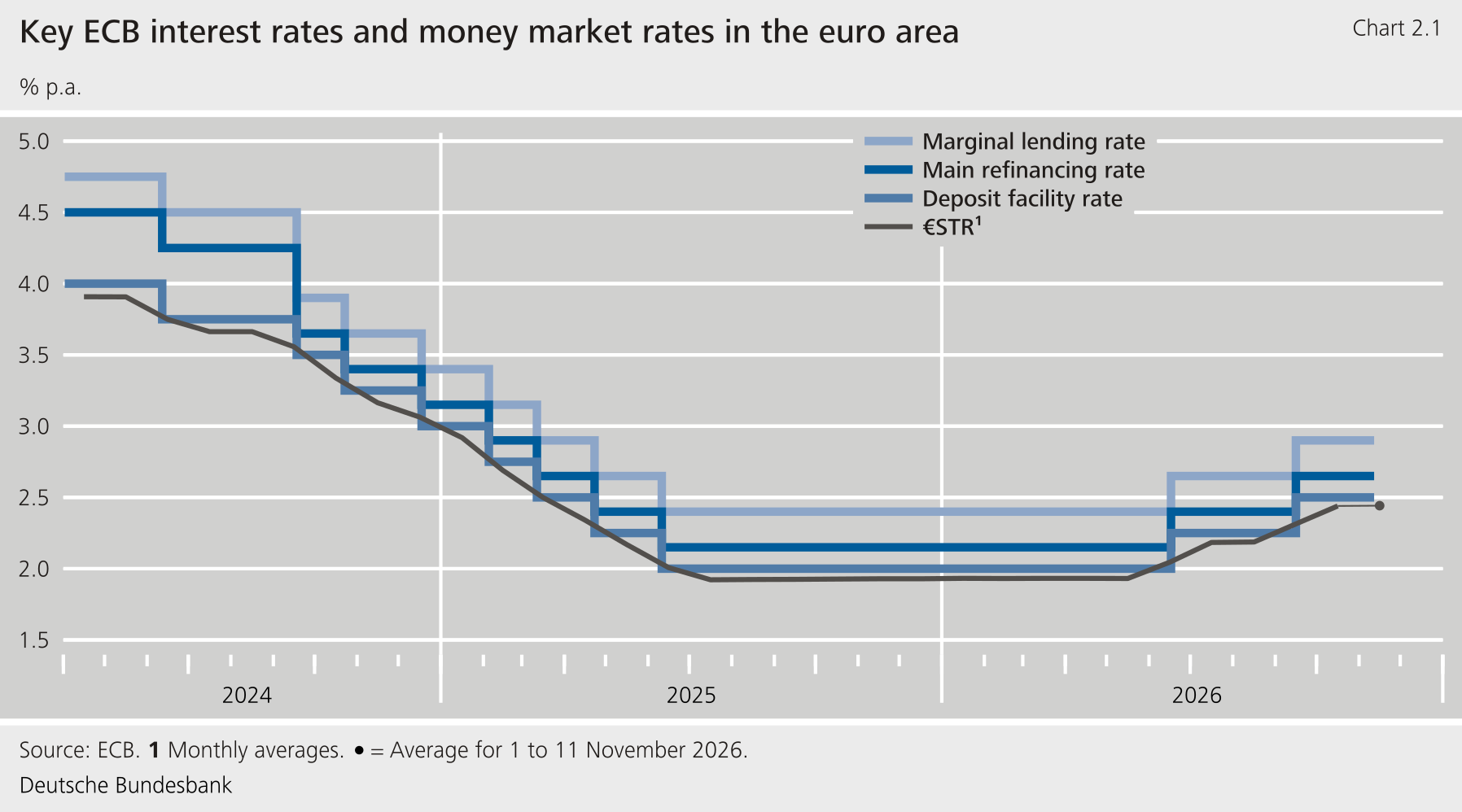
*****At its monetary policy meeting in September 2026, the** **Governing Council decided to raise its three key interest rates by 25 basis points each.** This means that the interest rate on the deposit facility, which the Governing Council uses to steer the monetary policy stance, stands at 2.5 %. This decision was driven by ongoing inflationary pressures and the expectation that inflation would remain well above target for an extended period of time. According to the baseline of staff projections from September, headline inflation is expected to average 3.0 % in 2026, 2.5 % in 2027 and 2.1 % in 2028. Compared with June, the inflation prospects for 2027 and 2028 have been revised upwards. The outlook remains highly uncertain, with upside risks for inflation and downside risks for economic growth.***{#par-e49741}
*****The Governing Council decided to keep the key** **interest rates unchanged in October 2026.** Headline inflation increased to 3.8 % in September from 3.2 % in August. Energy prices continued to increase and were, at the time of the council meeting, close to the adverse scenario in the September projections. The greater scale and longer duration of the rise in energy prices, as well as its impact on indirect and second-round effects, are expected to amplify upward pressures on inflation. However, underlying inflation has remained broadly stable so far. In addition, financing conditions had tightened since the September meeting, which the Governing Council estimated was likely to dampen both growth and inflation. Risks to inflation remain tilted to the upside. However, the Governing Council pointed out that the direction of key interest rate developments was clear if the data inputs up to the December meeting did not lead to a marked change in the assessment of the inflation picture.***{#par-e5a93i}
*****Short-term money market rates moved almost completely in line with the September increase in key interest rates.** The euro short-term rate () closed the reporting period at [2.44 %](https://www.ecb.europa.eu/stats/financial_markets_and_interest_rates/euro_short-term_rate/html/index.de.html), around 6 basis points below the level of the deposit facility rate.***{#par-ua7u39}
****Surveys conducted shortly before the October meeting showed that market participants were expecting another hike in interest rates before the end of 2026.** All participants in the Eurosystem's Survey of Monetary Analysts conducted ahead of the meeting in October were expecting key interest rates to remain unchanged in October. By contrast, almost all participants (97 %) expected the deposit facility rate to increase by 25 basis points to 2.75 % in December. The money market forward rates recently also largely priced in a further policy rate hike in December, followed by at least one further increase in the first half of 2027.**{#par-e6i164}
{#par-ui3i1i}
****
**2 Monetary developments in the euro area** {#tar-2}
-----------------------------------------------------
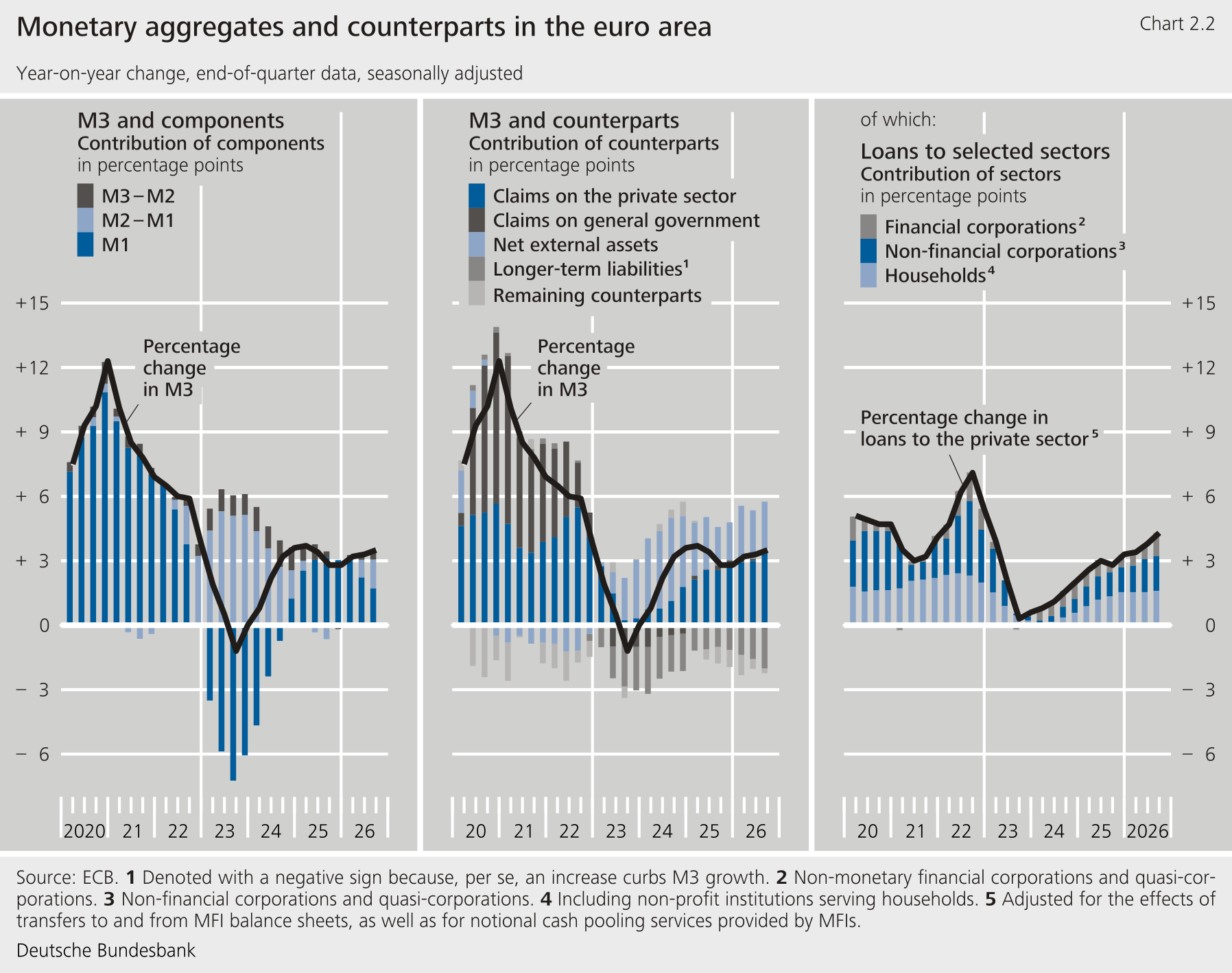
****Growth in the broad monetary aggregate** **slowed in the euro area in the second quarter of 2026.** The annual growth rate of rose again slightly to 3.5 % at the end of September (see Chart 2.2). However, inflows into weakened significantly compared with the three preceding quarters. This was partly due to the rise in yields in the global financial markets, which strengthened the attractiveness of less liquid investments remunerated at close to market rates. Euro area bank lending to the domestic private sector slowed in the third quarter of 2026 compared with the previous quarter, but remained on an overall expansionary path (see Table 2.1).This slowdown was mainly due to lower lending to non-financial corporations, especially in the longer-term maturity segment. By contrast, loans to households increased at a virtually unchanged rate despite the continued rise in lending rates. The results of the latest Bank Lending Survey () indicate that banks tightened their credit standards for loans to enterprises, consumer credit and other lending, while credit standards for loans to households for house purchase remained unchanged on balance.**{#par-i29e9i}
{#par-o79i7e}{#par-oe9235}{#par-oo42ia}{#par-iioao1}{#par-ei86a9}{#par-uao8i2}{#par-i2aiuu}{#par-ue7ae3}{#par-u462ie}{#par-e6e1i5}
| **Table 2.1: Consolidated balance sheet of the** **sector in the euro area^1^** Quarter-on-quarter change in € billion, seasonally adjusted ||||||
| Assets | 2026 | Q3 2026 | Liabilities | 2026 | Q3 2026 |
|-----------------------------------------------|---------|---------|--------------------------------------------------------|---------|---------|
| Claims on private non- in the euro area | 118.1 | 132.4 | Liabilities to central government^2^ | -- 26.1 | -- 18.5 |
| Of which: ||| |||
| Loans | 161.2 | 118.2 | Monetary aggregate | 150.6 | 97.8 |
| Loans, adjusted^3^ | 163.6 | 120.3 | Components | ||
| Securities | -- 43.1 | 14.2 | Currency in circulation and overnight deposits () | 31.9 | 9.8 |
| ||| Other short-term deposits (‑) | 94.3 | 64.7 |
| Claims on general government in the euro area | -- 26.9 | -- 26.2 | Marketable instruments (‑) | 24.4 | 23.3 |
| Of which: ||| |||
| Loans | 7.5 | 4.4 | Longer-term liabilities to other non- in the euro area | 74.1 | 84.6 |
| Securities | -- 34.4 | -- 30.6 | Of which: |||
| ||| Capital and reserves | 29.3 | 36.9 |
| Net external assets | 93.5 | 85.0 | Other longer-term liabilities | 44.8 | 47.7 |
| Other counterparts of | 13.9 | -- 27.2 | |||
{#par-o65ie4}
{#par-i32ioe}
****
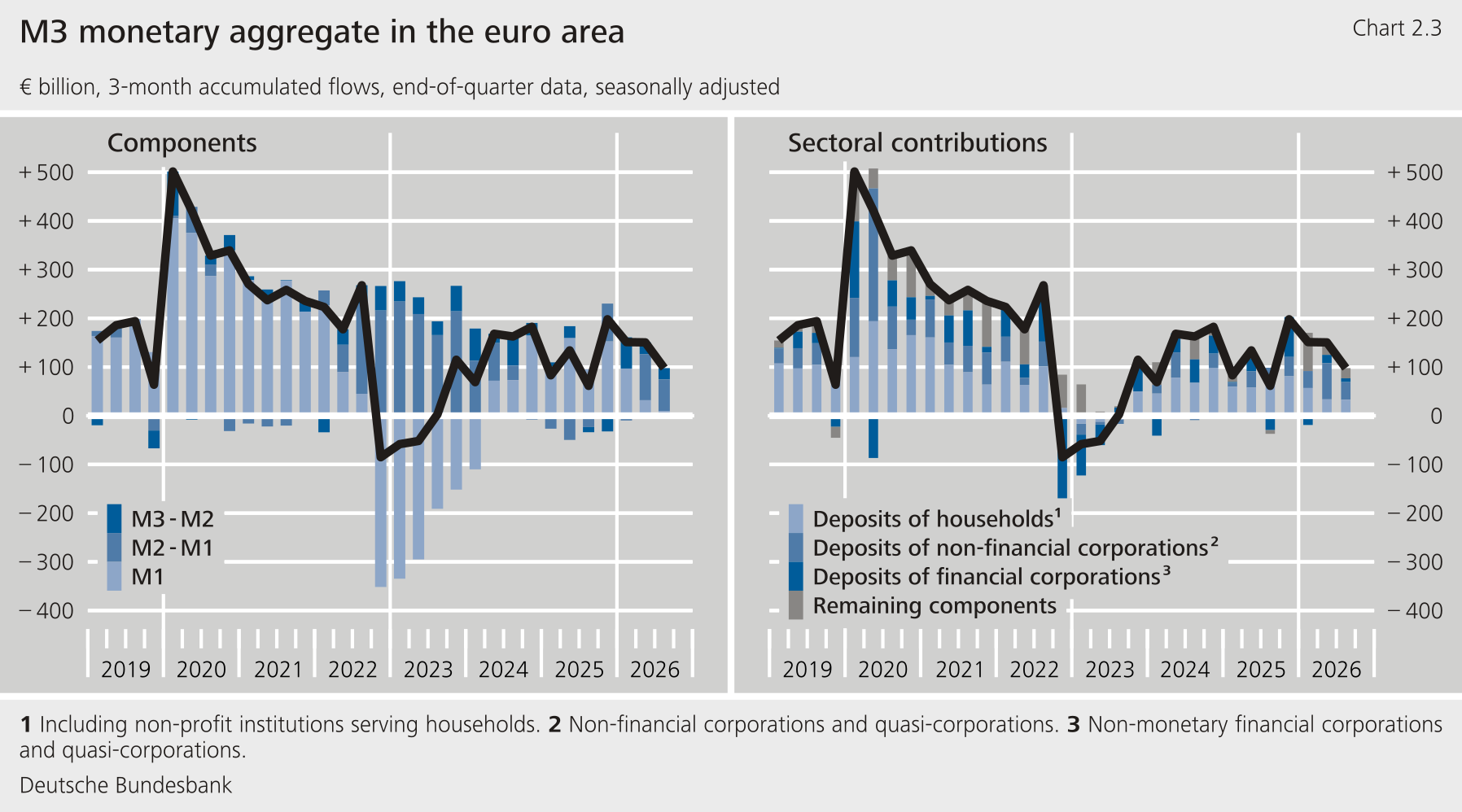
****Investors responded to the growing yield differentials by shifting into higher-yielding forms of investment.** As in the previous quarter, households and non-financial corporations shifted within the broad monetary aggregate to higher-yielding short-term time deposits (see Chart 2.3). Due to the interest rates on time deposits rising more quickly, households decreased their holdings of overnight deposits on balance, while non-financial corporations increased their holdings of the same at a slower pace. At the same time, the increase in longer-term capital market yields increased the attractiveness of non- forms of investment. This was reflected in an increased build-up of monetary capital, especially in the form of longer-term bank debt securities. Taken in isolation, this dampened monetary growth.**{#par-uoai76}
{#par-a223e8}
****
****Lending to non-financial corporations lost significant momentum compared with the exceptionally strong previous quarter, but remained solid overall.** Among the four largest Member States, net lending weakened in France and Germany in particular, and to a lesser extent in Italy. In Spain, where economic activity remained more positive than in the other large Member States, lending continued to increase. The slowdown in loan growth in the euro area as a whole was mainly due to weaker long-term lending with an original maturity of over five years (see Chart 2.4). In the previous quarter, this segment had benefited in particular from catch-up effects in business investment. The weaker longer-term lending coincided with a further increase in lending rates for firms. While interest rates on new bank loans with short interest rate fixation periods rose only slightly in the third quarter, interest rates on loans with longer interest rate fixation periods rose significantly in some cases.**{#par-oa3u95}
{#par-o97aa5}
**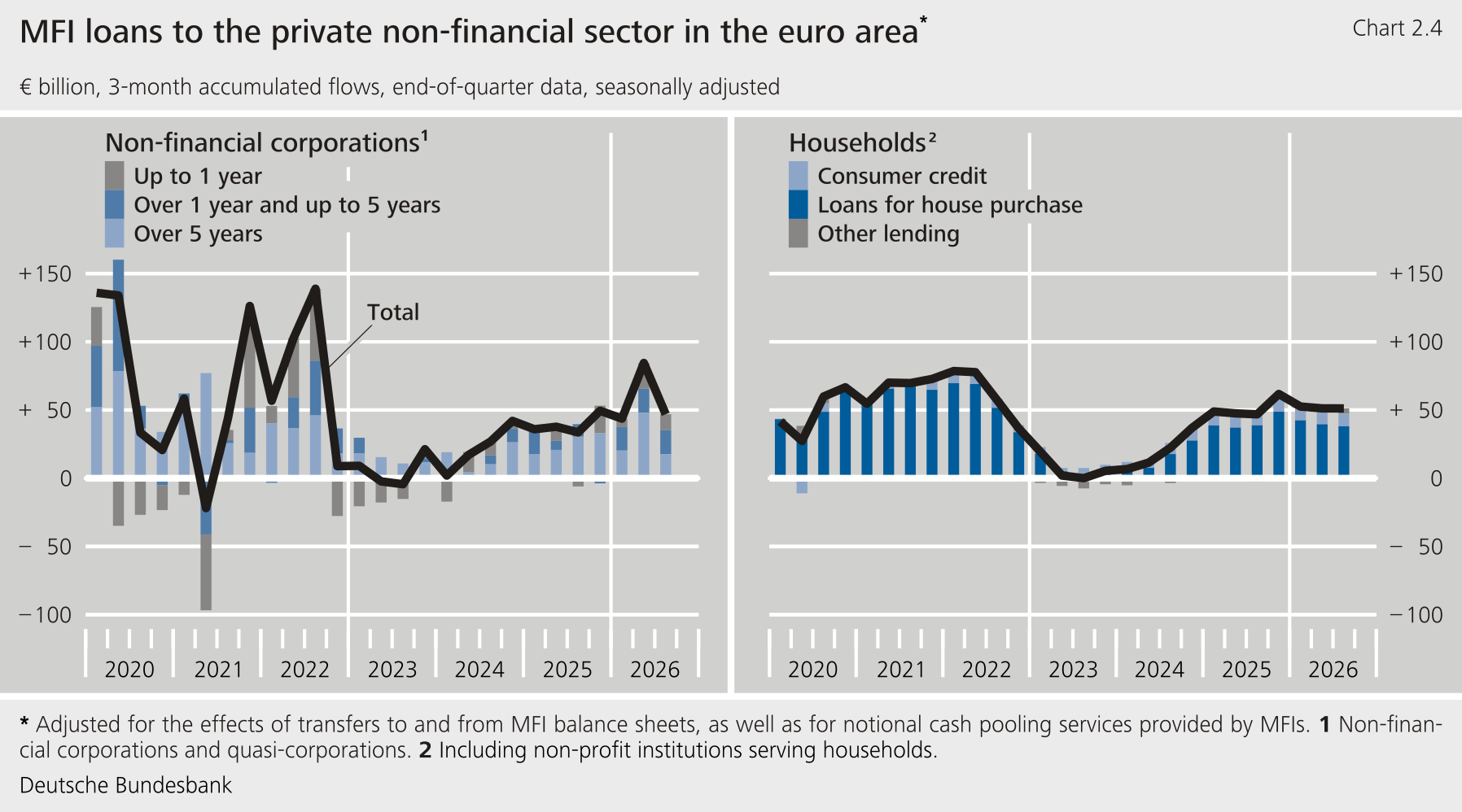**
****According to the** ,**euro area banks tightened their credit standards for loans to enterprises again in the third quarter.** The banks justified the tightening mainly on the grounds of increased credit risk and their reduced risk tolerance. Credit terms and conditions also tightened. At the same time, banks noted a net decline in demand for loans to enterprises, with demand for longer-term loans weakening, in particular. This was mainly due to the higher general level of interest rates and, to a lesser extent, the decline in funding needs for fixed investment, while financing needs for inventories and working capital buoyed demand. The latest Survey on the Access to Finance of Enterprises confirms this picture, with respondents also reporting reduced availability of bank loans, higher financing costs and a slight decline in needs for bank loans.**{#par-a43529}
****Loans to households grew almost unchanged in the third quarter, despite higher lending rates.** However, lending to households for house purchase weakened somewhat. By contrast, consumer credit continued to expand strongly, although interest rates in this credit segment rose more strongly than interest rates for new housing loans. Other lending to households also gained momentum.**{#par-o58o99}
****Banks again tightened credit supply conditions for euro area households overall in the third quarter of 2026, according to the** . Credit standards for housing loans remained unchanged on balance. However, the surveyed banks significantly tightened their terms and conditions, mainly their lending rates, owing to less favourable funding conditions in the money and capital markets. At the same time, as in the previous quarter, they reported that pressure from competition had led to margin requirements for average loans being eroded. Demand for loans for house purchase also fell significantly according to the . The surveyed banks cited the higher general level of interest rates as the main reason. In the case of consumer credit and other lending, the surveyed banks tightened their credit standards in addition to their lending rates. This was mainly due to increased credit risk, especially with regard to borrowers' creditworthiness, and lower risk tolerance among banks.**{#par-oau1a9}
**3 German banks' deposit and lending business with domestic customers** {#tar-3}
---------------------------------------------------------------------------------
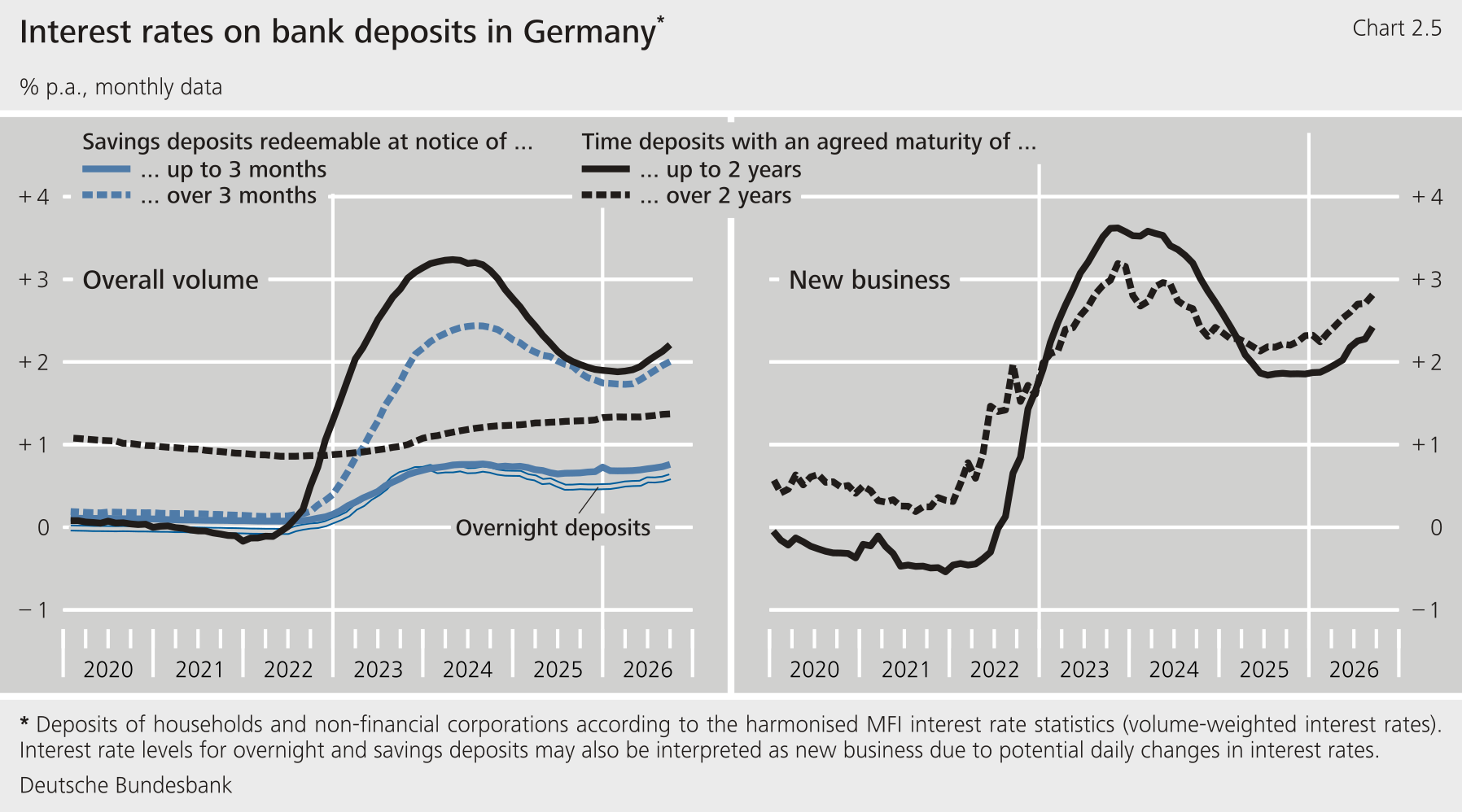
****German banks' deposit business with domestic non-banks lost steam in the third quarter of 2026.**Bank customers reduced their holdings of overnight deposits for the first time since 2024, and they also stepped up their reduction in savings deposits (see Table 2.2). At the same time, they built up fixed-term deposits. Here, the largest inflows once again came from households. As in the euro area, yield considerations are likely to have shaped their investment decisions (see Chart 2.5). On balance, non-financial and financial corporations reduced short-term deposits, especially overnight deposits, which had a dampening effect on deposit business. The increased opportunity costs of holding money are likely to have played a role, especially for financial corporations.**{#par-euia7u}
{#par-o869a7}
****
****In the third quarter, German banks' lending business with domestic customers grew noticeably more weakly than in the previous quarter.** Claims on general government, enterprises and households recorded lower inflows. The strong expansion in lending business in the second quarter did not continue as a result. Loans to the domestic general government sector increased more strongly than in the previous quarter. At the same time, holdings of domestic government bonds held by domestic banks declined on balance, following some strong gains in previous quarters. The higher capital market yields are likely to have prompted individual general government entities to replenish their financing needs with loans. In lending business with enterprises and households, the growth was entirely attributable to loans; securitised lending remained virtually unchanged.**{#par-e51624}
{#par-i449u2}{#par-uu1ea7}{#par-o6u57e}{#par-o1141i}{#par-iu456u}{#par-a4i377}{#par-ue8725}{#par-i3o764}{#par-i87e5a}{#par-uiu5i8}
| **Table 2.2: Banks in Germany: Changes in lending and deposits^1^** Quarter-on-quarter change in € billion, seasonally adjusted |||
| | 2026 | 2026 |
| | | |
|-------------------------------------------|--------|--------|
| Deposits of domestic non-^2^ | ||
| Overnight | 10.0 | − 7.3 |
| With an agreed maturity of | ||
| up to 2 years | 25.5 | 18.4 |
| over 2 years | 4.3 | 9.2 |
| Redeemable at notice of | ||
| up to 3 months | -- 6.6 | -- 7.6 |
| over 3 months | 2.6 | 0.9 |
| Lending | ||
| to domestic general government | ||
| Loans | 4.9 | 9.3 |
| Securities | 14.1 | -- 3.9 |
| to domestic enterprises and households | ||
| Loans^3^ | 24.4 | 11.0 |
| of which: to households^4^ | 9.4 | 9.2 |
| of which: to non-financial enterprises^5^ | 6.9 | -- 0.5 |
| Securities | 3.0 | -- 0.1 |
{#par-u945i2}
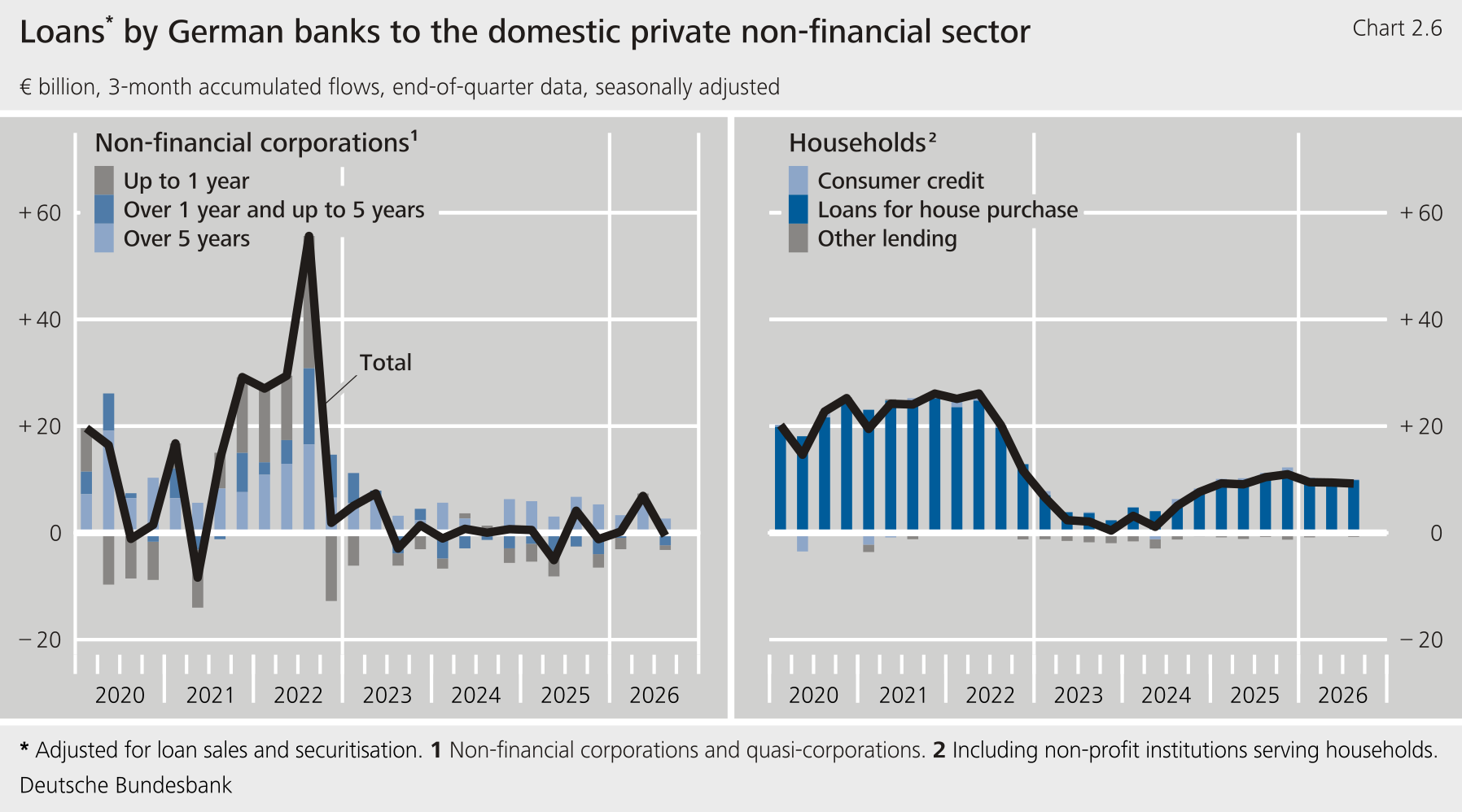
****Loans to households recorded virtually unchanged net inflows, despite higher lending rates.** Growth in this loan segment continued to be driven by loans for house purchase. These increased to a similar extent as in the first and second quarters (see Chart 2.6). Consumer credit was expanded only marginally, and thus significantly less than in previous quarters. At the same time, the reduction in other loans, which include loans to self-employed persons, became entrenched.**{#par-a32ui7}
{#par-a3uuo2}
****
****results show a weaker picture of households' financing needs than bank statistics.** According to banks surveyed in the , household demand for housing loans as well as consumer credit and other lending fell significantly again. Banks attributed the decline in demand mainly to the higher general level of interest rates and weaker consumer confidence. The fact that housing loans, on aggregate across all banks, nevertheless increased at a virtually unchanged pace can be related to lags between loan requests and disbursements. For example, the disbursements recorded in the banking statistics can also come from contracts concluded earlier. In addition, the 's demand assessment also includes informal financing requests, the decline in which is interpreted as a weakening of demand for credit.**{#par-a1uu7a}
{#par-o1ie53}
**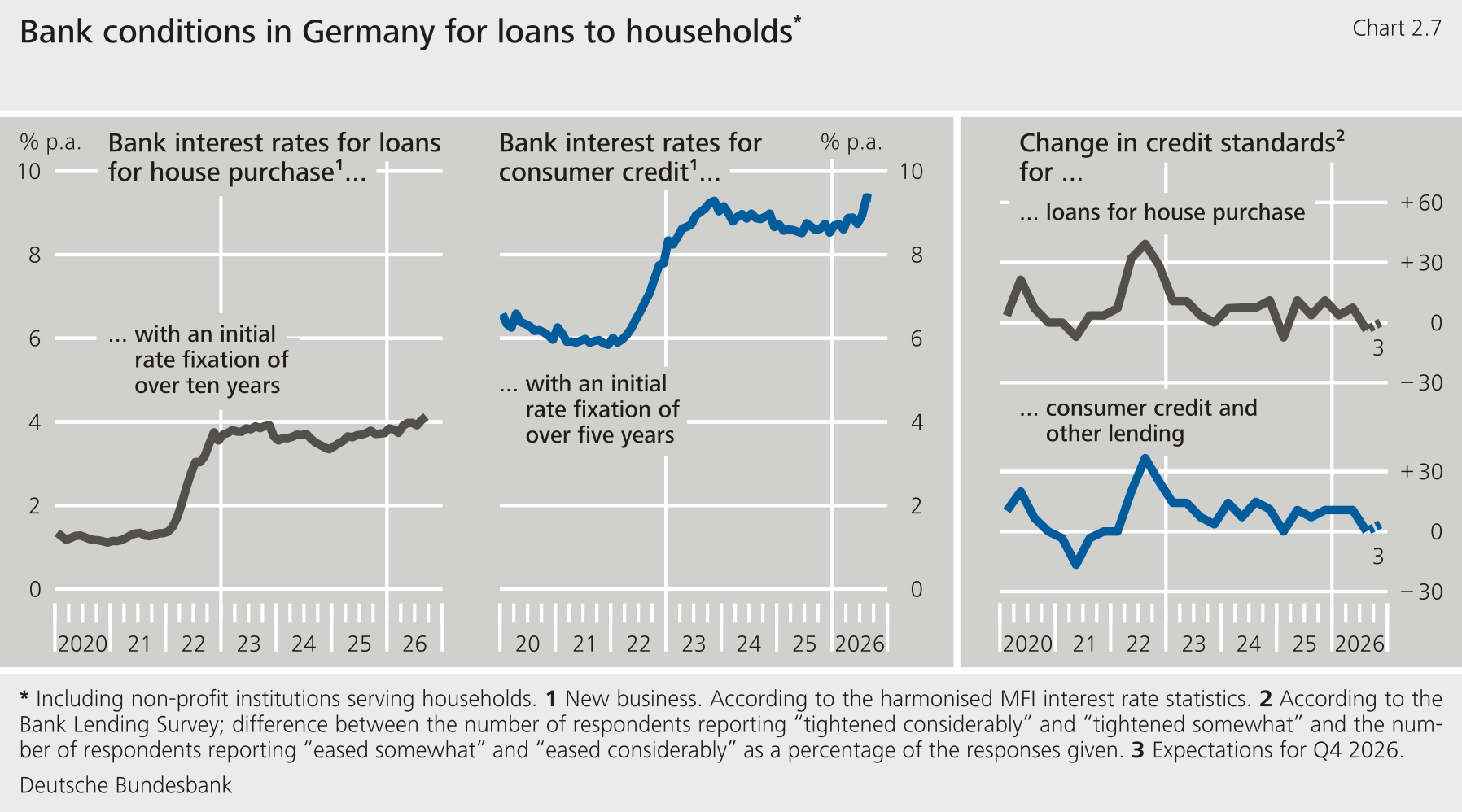**
****Banks' lending conditions supported loans to households for house purchase on balance.** According to data, the surveyed banks eased their credit standards for housing loans slightly after tightening them in the previous quarter. This was mainly due to institutions' increased risk tolerance. Actual terms and conditions agreed for housing loans, on the other hand, remained unchanged on balance. These overall unchanged credit terms and conditions for housing loans are the result of countervailing adjustments: while banks increased lending rates, they also narrowed their margins on average-risk loans and increased the loan-to-value ratio.**{#par-e79eu9}
****For consumer credit and other lending, banks kept their credit standards unchanged, but made terms and conditions more restrictive.** According to data, risk tolerance also increased in this segment, but a deterioration in the creditworthiness of consumers and the subdued economic situation prevented any easing of credit standards. However, banks made credit terms and conditions for consumer credit and other lending more restrictive on balance, raising lending rates and limiting loan sizes more sharply, while reducing margins. Rejection rates continued to rise in both loan categories.**{#par-i9615i}
****The upturn in loans to non-financial corporations seen in the previous quarter did not continue.** Following the marked inflow in the second quarter, loans to non-financial corporations were scaled back slightly on balance in the third quarter. Current lending business thus returned to the weak course of development that had already shaped the past few years. The interim increase in the previous quarter, which was mainly driven by higher demand for long-term loans, has so far not proved to be the beginning of a sweeping recovery.**{#par-e8i1ia}
****The slowdown in corporate lending extended to all maturity categories.** The number of short-term loans with maturities of up to one year decreased again following the slight increase in the previous quarter. In medium-term loans of over one to five years, the reduction increased significantly. The number of long-term loans with maturities of more than five years -- typically used to finance longer-term investment projects -- continued to increase. However, their inflow was significantly lower than in the second quarter and also fell short of the inflows in 2025.**{#par-e257i2}
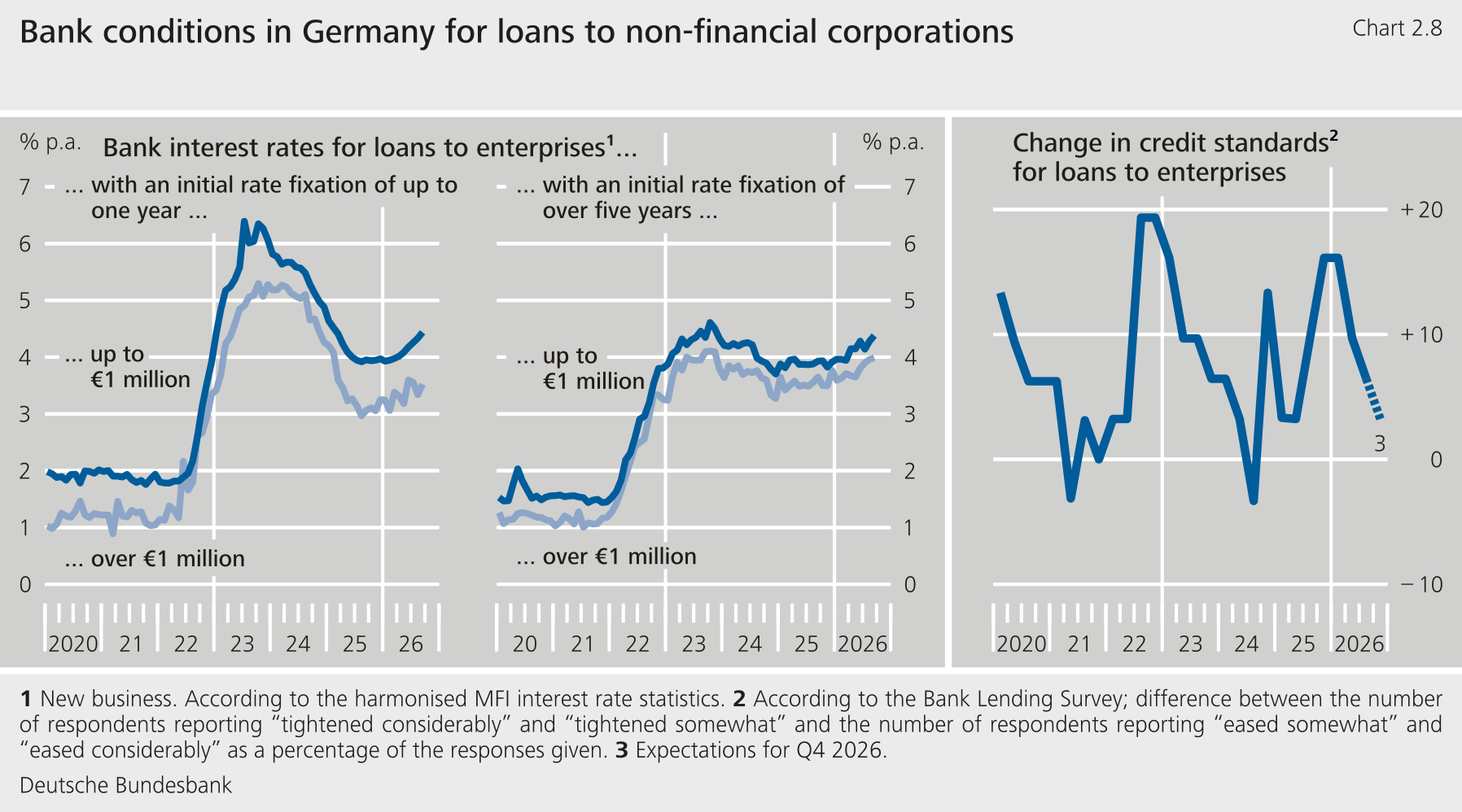
****Weak developments in loans to enterprises are in line with firms' continued subdued propensity to invest.** The results confirm this assessment. The surveyed banks reported a decline in demand for loans to enterprises for the first time in more than two years, after having previously expected an increase. The decline mainly concerned small and medium-sized enterprises and long-term loans. Institutions cited the higher general level of interest rates as their main reason. In contrast to the previous quarter, financing needs for fixed investment no longer provided any positive stimulus to demand overall.**{#par-ou18a8}
****In addition to subdued loan demand, banks' supply policies also dampened lending to firms.** Banks tightened their credit standards again, albeit somewhat less than in the previous quarter. This was mainly due to higher industry and firm-specific credit risk as well as the subdued economic situation and the economic outlook. Furthermore, banks reported that the non-performing loans ratio and other indicators of credit quality had had a restrictive effect. However, there were also factors that counteracted this tightening: as in the previous quarter, banks reported increasing competition in the banking sector. For the first time in more than two years, banks also reported having tolerated somewhat more risks. Credit terms and conditions were also made more restrictive overall. Banks raised lending rates and increased margins on riskier loans, while reducing margins on average loans. At the same time, according to the , deteriorating funding conditions in the money and bond market had an additional restrictive effect on credit terms and conditions.**{#par-a24648}
{#par-e2e7uo}
****
{#par-a8e246}
{#par-e68eii}
{#par-euu51o}
*[Q2]: second quarter
*[Q3]: third quarter
*[M1]: monetary aggregate 1
*[ECB]: European Central Bank
*[M2]: monetary aggregate 2
*[M3]: money supply M3
*[MFIs]: monetary financial institutions
*[BLS]: Bank Lending Survey
*[**ECB**]: European Central Bank
*[**M3**]: money supply M3
*[€STR]: euro short-term rate
*[**BLS**]: Bank Lending Survey
*[**MFI**]: monetary financial institution