# At a glance
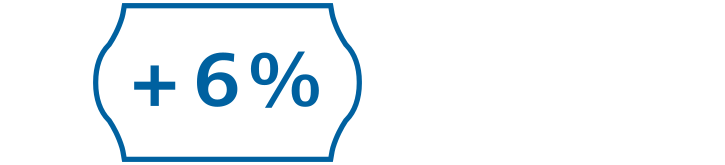
### Increase in consumer prices
Price pressures in Germany weakened in 2023. As measured by the Harmonised Index of Consumer Prices (), the annual average inflation rate was 6%, after consumer prices had risen by 8.7% in 2022. Falling energy prices contributed substantially to this reduction in inflation.
### Interest rate staircase
The Governing Council raised key interest rates six times in 2023. Between July 2022 and September 2023, it raised interest rates by a total of 4.5 percentage points, its largest interest rate hiking cycle since the introduction of the euro.
### Economy treading water
Last year, high inflation, weak foreign demand and tight monetary policy were a drag on German economic output. Price and calendar-adjusted gross domestic product fell slightly by 0.1%.
### Balance sheet length
The Eurosystem's balance sheet has contracted by over €1,800 billion, or just over one-fifth, since the beginning of the latest monetary policy tightening cycle. This was mainly attributable to euro area banks, which repaid a large volume of loans from targeted longer-term refinancing operations ().
### Public finances
Germany's deficit ratio fell from 2.5% to 2% in 2023. The main reason for the decline was the expiry of temporary crisis measures. The debt-to- ratio likewise declined and continued to approach 60%. In its ruling of 15 November, the Federal Constitutional Court strengthened the binding effect of the debt brake.
### Digital euro
In November 2023, the Governing Council decided to continue working on the digital euro in a two-year preparation phase.
*[GDP]: gross domestic product
*[ECB]: European Central Bank
*[TLTROs]: targeted longer-term refinancing operations
*[HICP]: Harmonised Index of Consumer Prices