# Forecast for Germany: US tariffs initially weigh on economic growth; fiscal policy provides impetus with a delay
* [*1 Key aspects of the macroeconomic outlook*](#tar-1 "1 Key aspects of the macroeconomic outlook")
* *[*2 Risk assessment*](#tar-2 "2 Risk assessment")*
* **[*The potential impact of a more restrictive US trade policy on the German economy*](#tar-3 "The potential impact of a more restrictive US trade policy on the German economy")**
* ***[*3 More detailed information on the Forecast for Germany*](#tar-4 "3 More detailed information on the Forecast for Germany")***
* ***[*4 List of references*](#tar-5 "4 List of references")***
****The recovery of the German economy is being delayed by the turmoil caused by international trade policy. Only gradually will economic activity be boosted by additional fiscal measures.****{#par-e81ai2}
****The new tariffs and the uncertainty surrounding policy are set to weigh on economic growth both this year and the next. In connection with this, the rise in will be weakened by the imposed tariffs themselves and the associated general uncertainty. By the end of 2027, macroeconomic growth is estimated to be around ¾ percentage point lower solely on account of these factors.****{#par-ei1auu}
****From next year onwards, the expansionary fiscal policy stance will contribute to the significant economic recovery that is set to begin then. The demand effects from increased defence and infrastructure spending are estimated to support the cumulative increase in by ¾ percentage point over the forecast horizon. The general government deficit ratio will rise to just over 4 % by 2027, partly owing to other measures. In the wake of strong growth in spending by the social security fund, contribution rates will rise steeply.****{#par-e22524}
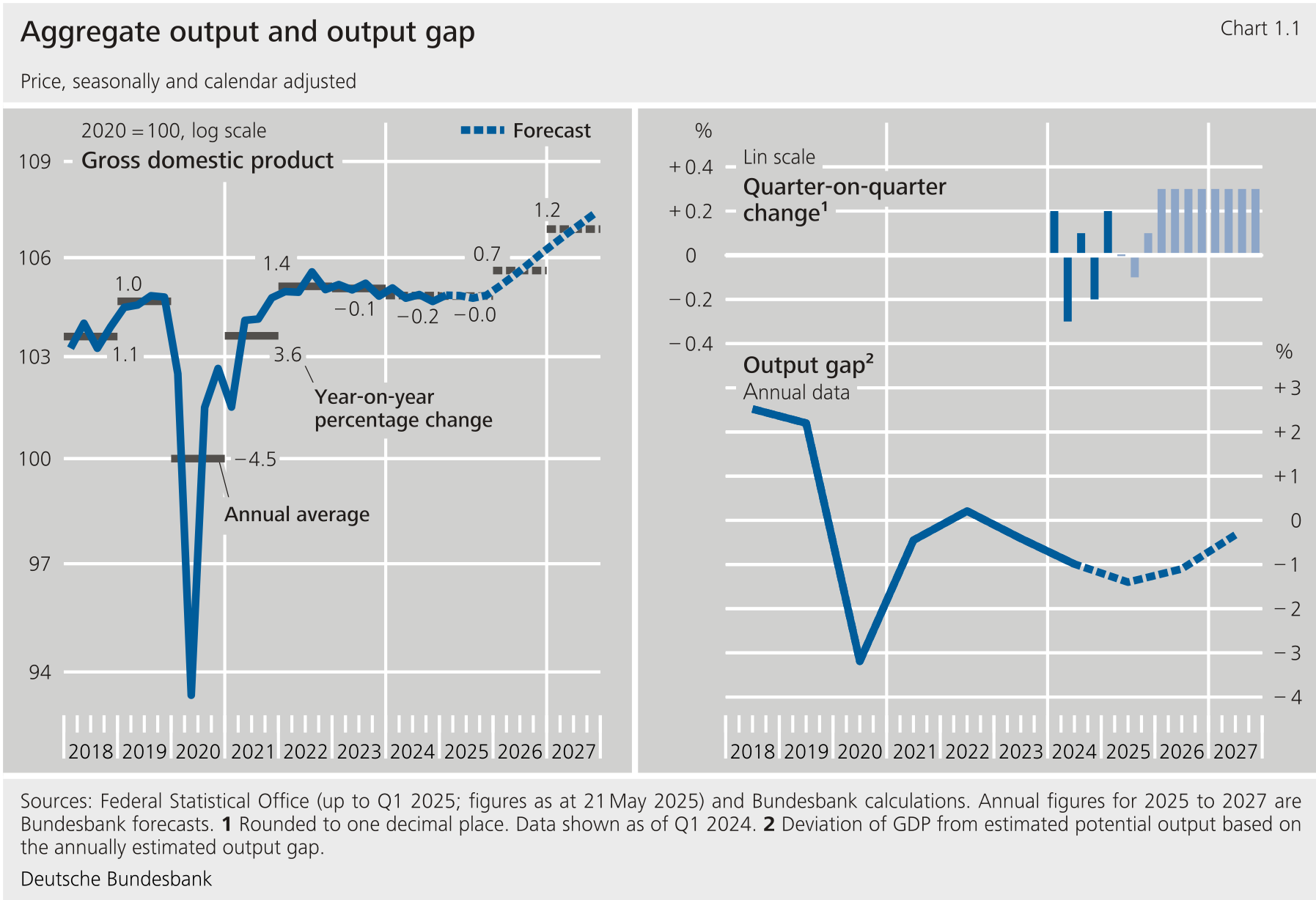
****Overall, real in 2025 is likely to tread water in calendar-adjusted terms, but will then see strong growth again, at 0.7 % in 2026 and 1.2 % in 2027. In view of this, the growth outlook has mainly been revised downwards for 2025 and upwards for 2027 relative to last December's Forecast for Germany.****{#par-eua7u8}
****The inflation rate as measured by the will fall to 2.2 % this year before temporarily dropping to 1.5 % in 2026 and rising again to 1.9 % in 2027. The temporarily lower inflation rate in the coming year will be driven by lower energy commodity prices and the appreciation of the euro against the dollar as well as directly energy price-lowering fiscal measures. Core inflation (excluding energy and food) will stabilise around 2 % from 2026 onwards.****{#par-ie661o}
****The inflation outlook for 2025 and 2026 has thus been revised significantly downwards compared to the Forecast for Germany from last December.****{#par-aa559o}
****The outlook around this baseline is shaped by major uncertainties surrounding trade disputes, geopolitical conflicts and the specifics of German fiscal policy. There are risks to economic growth and inflation in both directions.****{#par-e69eau}
{#par-i93ea8}{#par-ei3295}{#par-aeu35u}{#par-a21i78}
| **Table 1.1: June 2025 forecast** Year-on-year percentage change |||||
| Item | **2024** | **2025** | **2026** | **2027** |
| Real , calendar adjusted | − 0.2 | 0.0 | 0.7 | 1.2 |
| Real , unadjusted | − 0.2 | − 0.1 | 1.0 | 1.3 |
| Harmonised Index of Consumer Prices | 2.5 | 2.2 | 1.5 | 1.9 |
| Excluding energy and food | 3.2 | 2.6 | 1.9 | 2.0 |
|-------------------------------------|---------:|---------:|---------:|---------:|
{#par-ou9u8a}
*****Preliminary remark:**For ease of reading, the structure of the articles about the Forecast for Germany has been changed in the Monthly Report. Beginning with this article, the first section will, in future, explain the key macroeconomic aspects of the new forecast. The risks surrounding these will follow in a second section. A third section will lay out more in-depth information on individual parts of the forecast, which will be linked to the corresponding parts of the first section.***{#par-i3uei1}
***1 Key aspects of the macroeconomic outlook*** {#tar-1}
---------------------------------------------------------
*****The bout of weakness in the German economy persisted into the last winter half-year.** Real virtually stagnated in the 2024‑25 winter half-year after seasonal adjustment.[\[1\]](#_ftn_root_1) Overall, this is broadly in line with the Bundesbank's December 2024 Forecast for Germany.[\[2\]](#_ftn_root_2) However, the rate, at − 0.2 % in the fourth quarter of 2024 and 0.4 % in the first quarter of 2025, was respectively somewhat lower and markedly higher than expected. While the tightening of trade policy had already cast a pall over the economy, it did not stall it yet, but instead triggered anticipatory effects. Exports saw an unexpectedly sharp decline at the end of 2024. However, they then recovered strongly in the first quarter of 2025. In anticipation of higher tariffs, some exports to the United States, such as pharmaceutical products, were brought forward. This is also likely to have contributed to the stabilisation of industrial output in the first quarter of 2025.[\[3\]](#_ftn_root_3) In addition, business investment picked up somewhat and declined only slightly in the winter half-year, even though capacity utilisation in industry rose minimally from a very low level, the competitive position remained poor and economic policy uncertainty remained heightened. Private housing investment saw marked growth. Private consumption was somewhat more dynamic than expected in December. This was partly due to consumers proving more willing to spend, the labour market being more robust and inflation being weaker than anticipated. Consumer sentiment even improved slightly in spite of the uncertainties caused by the restrictive trade policy.[\[4\]](#_ftn_root_4) The number of persons in employment declined only slightly in the winter half-year, and the unemployment rate increased just minimally. Consumer prices for energy fell more steeply and food prices rose considerably less than expected. According to the flash estimate, the overall inflation rate as measured by the was 2.1 % in May, which was 0.1 percentage point lower than in the December Forecast for Germany.***{#par-ui83eo}
****The further outlook for the German economy will be largely influenced by the United States' protectionist trade policy and the realignment of domestic fiscal policy.** [\[5\]](#_ftn_root_5) The fiscal realignment follows on from the easing of the debt brake in March. As a result, spending on defence and government infrastructure, but probably also other new measures, is now likely to be financed extensively via loans.[\[6\]](#_ftn_root_6)**{#par-ia1aei}
****Particularly in the current year, the new** **economic policy is set to dampen German economic growth.** It is assumed here that the tariffs entering into force when this forecast is finalised on 21 May 2025, and retaliatory tariffs in some cases, will remain unchanged over the forecast horizon (see the section entitled "[Assumptions regarding the international environment, exchange rates, commodity prices and interest rates](#3.1-Assumptions-regarding-the-international-environment-exchange-rates-commodity-prices-and-interest-rates)". The significantly higher tariffs since April and the heightened uncertainty about the future of economic policy, not only in terms of trade, are hitting the export-oriented German industrial sector at a time when its general tendency had begun to stabilise following a long period of weakness. Overall, is expected to merely stagnate in the second quarter of this year and to decline slightly in the third quarter (see the section entitled "[Details of the short-term GDP forecast](#3.4-Details-of-the-short-term-GDP-forecast)"). In the second quarter, certain anticipatory effects are still likely in exports as enterprises reckon with the possibility of even higher tariffs from July onwards. By the third quarter, however, the corresponding rebound effects should have already fully passed through. Moreover, economic policy did not lead to an appreciation of the dollar, as would have been expected (at least based on tariffs), but rather of the euro. The financial markets appear to have lost confidence in the dollar and the persistent strength of the economy in light of the administration's policies (see the section entitled "[Assumptions regarding the international environment, exchange rates, commodity prices and interest rates](#3.1-Assumptions-regarding-the-international-environment-exchange-rates-commodity-prices-and-interest-rates)"). As a result of the associated appreciation of the euro, the German economy's price competitiveness in international trade has declined, putting an additional strain on the already difficult competitive situation of the industrial sector, in particular. Overall, then, exports will decline significantly this year and increase only slightly next year. Capacity utilisation in industry will thus remain considerably underutilised for even longer. Coupled with the high level of economic policy uncertainty, this will have a dampening effect on business investment, which will therefore decline significantly this year and slightly more in 2026. Combining the effects of economic policy via tariffs and the associated general uncertainty, model estimates show a cumulative reduction in growth of around ¾ percentage point over the forecast horizon. It is concentrated in the years 2025 and 2026. Lower capacity utilisation will have a dampening effect on consumer price inflation here, albeit to a fairly small extent.[\[7\]](#_ftn_root_7) Reduced momentum in industrial production due to tariffs will contribute to the slowdown in the labour market this year, weighing on wage growth. Against this backdrop, a small decline in real household income is expected in 2025. Private consumption, however, will grow somewhat, not least because consumer sentiment has barely been affected by the trade disputes thus far, and consumers are saving a slightly smaller proportion of their income this year. Housing construction will also be depressed by the slight decline in real incomes in 2025. It will therefore increase only slowly at first (see the section entitled "[Forecasts of expenditure components of GDP](#3.5-Forecasts-of-expenditure-components-of-GDP)").**{#par-i25924}
****The expansionary fiscal policy and the lessened growth-dampening impact of** **economic policy will lead to a marked economic recovery from 2026 onwards.** Fiscal policy is increasingly utilising the greater scope for borrowing under the eased debt brake. Owing to additional defence and infrastructure expenditure, government consumption will continue to rise steeply, whilst its investment will see a sharp increase. The cumulative overall effect of additional defence and infrastructure expenditure on growth from the second quarter of 2025 to the end of 2027 is estimated to be around + ¾ percentage point. It is concentrated in the years 2026 and 2027. By contrast, the impact on consumer price inflation triggered by higher demand will probably be minimal, as expenditure on infrastructure and defence will barely affect consumer prices directly. In addition, fiscal policy will bolster the income of enterprises and households through tax cuts, expanded subsidies and transfers (see the section entitled "[Fiscal assumptions](#3.2-Fiscal-assumptions)"). These factors will, together with a renewed marked pick-up in exports from mid-2026 onwards, support the recovery of the labour market and wage growth. As consumer price inflation temporarily declines significantly at the same time, disposable real household income will rise again considerably, and private consumption will increase somewhat more markedly. Housing investment, too, will then continue to recover, with stronger growth rates. Government measures providing relief will also improve investment conditions, in particular through lower electricity costs and more favourable write-off provisions. Moreover, as capacity utilisation in the economy rises and economic policy uncertainty recedes, business investment will pick up significantly in 2027, even if financing costs are then somewhat higher again (see the section entitled "[Forecasts of expenditure components of GDP](#3.5-Forecasts-of-expenditure-components-of-GDP)").**{#par-ea54ui}
{#par-ua588u}
****
{#par-o1io12}{#par-eei448}{#par-a45296}{#par-i26529}{#par-a99a24}
| **Table 1.2: Technical components of the** **growth forecast** % or percentage points |||||
| Item | **2024** | **2025** | **2026** | **2027** |
| Statistical carry-over at the end of the previous year^1^ | − 0.2 | − 0.2 | 0.0 | 0.5 |
| Fourth-quarter rate^2^ | − 0.2 | 0.2 | 1.2 | 1.2 |
| Average annual growth rate, calendar adjusted | − 0.2 | 0.0 | 0.7 | 1.2 |
| Calendar effect^3^ | 0.0 | − 0.1 | 0.3 | 0.1 |
| Average annual growth rate^4^ | -- 0.2 | − 0.1 | 1.0 | 1.3 |
|-----------------------------------------------------------|---------:|---------:|---------:|---------:|
{#par-o9i446}
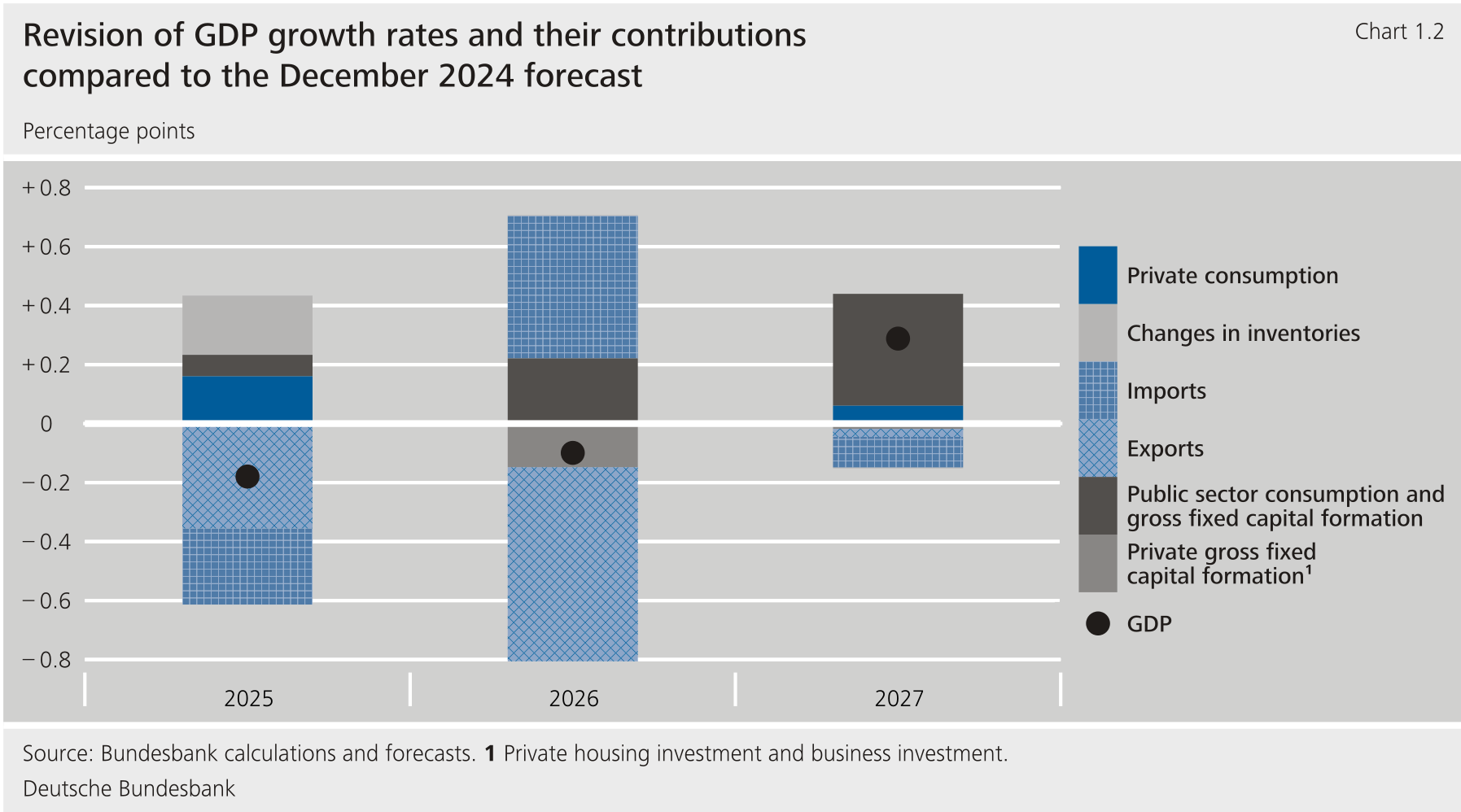
****All in all, then, the German economy will tread water this year, but will see strong growth again in 2026 and, above all, in 2027.** Calendar-adjusted real will stagnate this year, then rise by 0.7 % in 2026 and 1.2 % in 2027. Compared with the December Forecast for Germany, the growth outlook is thus revised downwards for 2025 and upwards for 2027. This is due to the fact that, compared with the December forecast, the burdens stemming from economic policy predominate initially, followed by the additional boost from expansionary fiscal policy. Exports and business investment were revised downwards accordingly, while government consumption and investment expenditure were revised upwards.**{#par-u4ouoo}
{#par-e61i9a}{#par-ao19uo}{#par-oo9594}
| **Table 1.3a: Revisions since the December 2024 forecast** Year-on-year percentage change |||||
| Item | **2024** | **2025** | **2026** | **2027** |
| (real, calendar adjusted) | ||||
| June 2025 forecast | − 0.2 | 0.0 | 0.7 | 1.2 |
| December 2024 forecast | − 0.2 | 0.2 | 0.8 | 0.9 |
| Difference (in percentage points) | 0.0 | − 0.2 | − 0.1 | 0.3 |
|-----------------------------------|---------:|---------:|---------:|---------:|
{#par-u1413a}
{#par-o6e57a}
****
****Aggregate production capacities will not return to more or less normal levels of utilisation until 2027.** Overall, the impact of economic policy and the assumed fiscal package will hardly affect potential output over the forecast horizon.[\[8\]](#_ftn_root_8) This is set to grow by a mere 0.4 % per year.[\[9\]](#_ftn_root_9) At the current end, aggregate production capacities are significantly underutilised. This is also shown by the survey data on capacity utilisation and on the shortage of orders. , set to merely stagnate in 2025, will result in the output gap sinking deeper into negative territory relative to 2024. It will not start to close before the beginning of 2026, when economic activity regains momentum, and will almost have closed by the end of the forecast horizon.**{#par-oae15e}
****The government deficit ratio will continue to fall this year and will rise significantly from 2026 onwards as a result of expansionary fiscal policy.** Tax revenue will grow considerably this year. In addition, social contribution rates will rise steeply as the health insurance institutions and long-term care insurance scheme exhausted their disposable reserves last year. The deficit-increasing fiscal measures, on the other hand, will need some lead time, meaning that the deficit only rises significantly from 2026 onwards. Accordingly, the deficit ratio will initially fall to 2.2 % this year (from 2.8 % last year). In 2026 and 2027, it will then rise to 3.6 % and 4.2 % respectively (see the section entitled "[Outlook for public finances](#3.3-Outlook-for-public-finances)"). The Maastricht debt ratio will rise from 62.5 % at end-2024 to 66.1 % by the end of 2027.**{#par-o8923o}
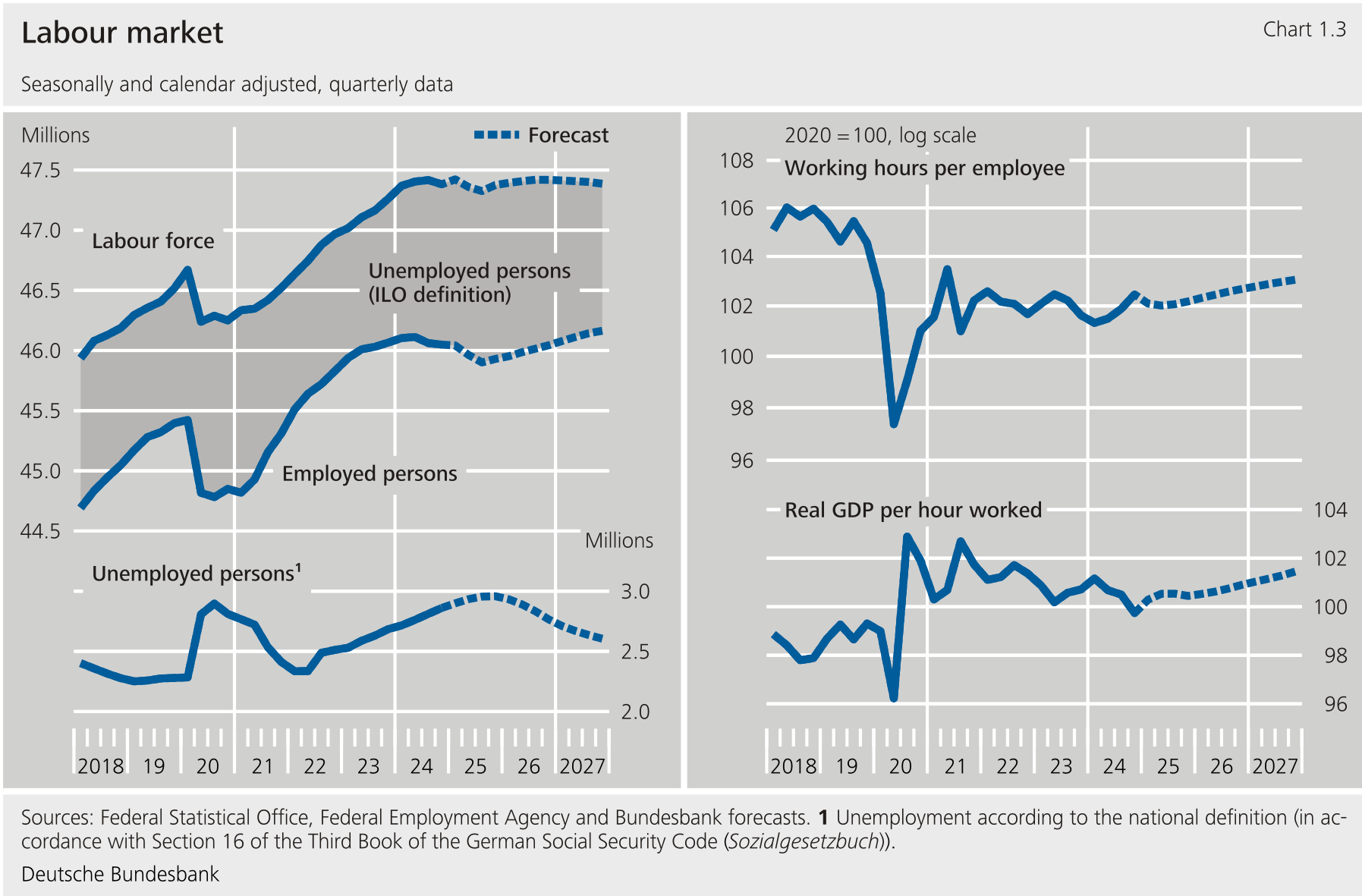
****The labour market will weaken initially, recovering from 2026 onwards as economic activity improves.** No improvement in the labour market is expected in the short term. The moderate decline in employment and the slow rise in unemployment in the winter half-year are likely to persist for the time being owing to the difficult economic environment and structural challenges, particularly for the manufacturing sector (see the section entitled "[The forecast for the labour market this year](#3.6-The-forecast-for-the-labour-market-this-year)"). However, many enterprises have retained their staff despite the long period of weakness.[\[10\]](#_ftn_root_10) From the end of 2025 onwards, the economic recovery will gradually result in rising employment, falling unemployment and an increasing shortage of skilled workers once again. However, existing staff will also be deployed more intensively, and the still depressed working hours and level of productivity will rise anew. The labour market will concurrently be faced with a challenging situation in which, starting in 2026, the total labour supply shrinks for demographic reasons, even though individual labour force participation continues to rise and the assumed level of immigration is significant.[\[11\]](#_ftn_root_11) At the same time, structural change will result in less of a match between the skills on offer and those in demand on the labour market over the entire forecast period. Unemployment will therefore not return to its low level of the beginning of 2022 by end-2027.**{#par-e24a14}
{#par-oi6a3u}
****
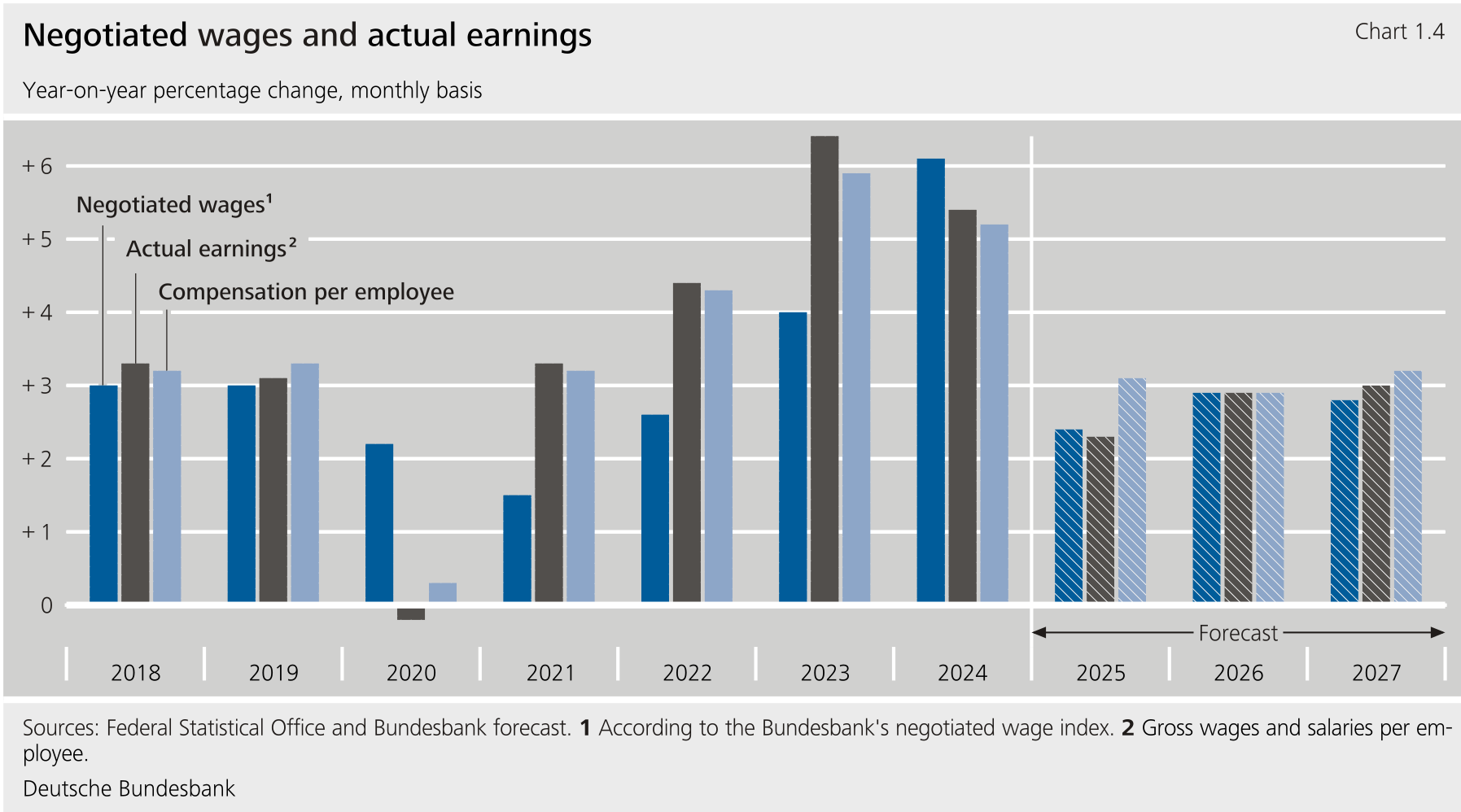
****Wage growth will be considerably weaker in 2025 than in the previous two years, but will become somewhat stronger again as of 2026.** Lower rates of inflation, the more prolonged economic slowdown, and the cooling labour market will dampen negotiated wages this year (see the section entitled "[The forecast for negotiated wages this year](#3.7-The-forecast-for-negotiated-wages-this-year)"). Next year, it is likely that slightly higher increases in negotiated wages will be agreed as underlying economic conditions gradually improve. The economic upswing will gain momentum in 2027, meaning that new agreements will be somewhat higher still. However, due to the varying lengths of contractual terms amongst individual sectors, this will not be reflected directly in higher year-on-year rates of change. For example, smaller incremental increases from older agreements from 2025 will continue to have an impact. Nevertheless, at 2.8 %, their annual average growth rate in 2027 will be well above their long-term average. In 2025, actual earnings[\[12\]](#_ftn_root_12) will still see weaker growth than negotiated wages. This is mainly a result of lower performance bonuses, especially for employees in the manufacturing sector, owing to sluggish industrial activity. Furthermore, the amount of paid overtime is in decline. Wage drift[\[13\]](#_ftn_root_13) will therefore be slightly negative in 2025.[\[14\]](#_ftn_root_14) In 2026, it will enter neutral territory. Alongside longer working hours, this is also attributable to the increase in the statutory general minimum wage.[\[15\]](#_ftn_root_15) In 2027, actual earnings will again show slightly stronger growth than negotiated wages, rising by 3 %. Labour costs, as measured by compensation per employee, will rise more strongly than actual earnings during the forecast period, especially this year. This is due to the additional costs for employers, which are included in compensation per employee, caused by considerable hikes in social security contribution rates. During the forecast period, the overall social security contribution rate will rise to more than 43 % (see the section entitled "[Fiscal assumptions](#3.2-Fiscal-assumptions)").**{#par-io4aa5}
{#par-ou59o6}
****
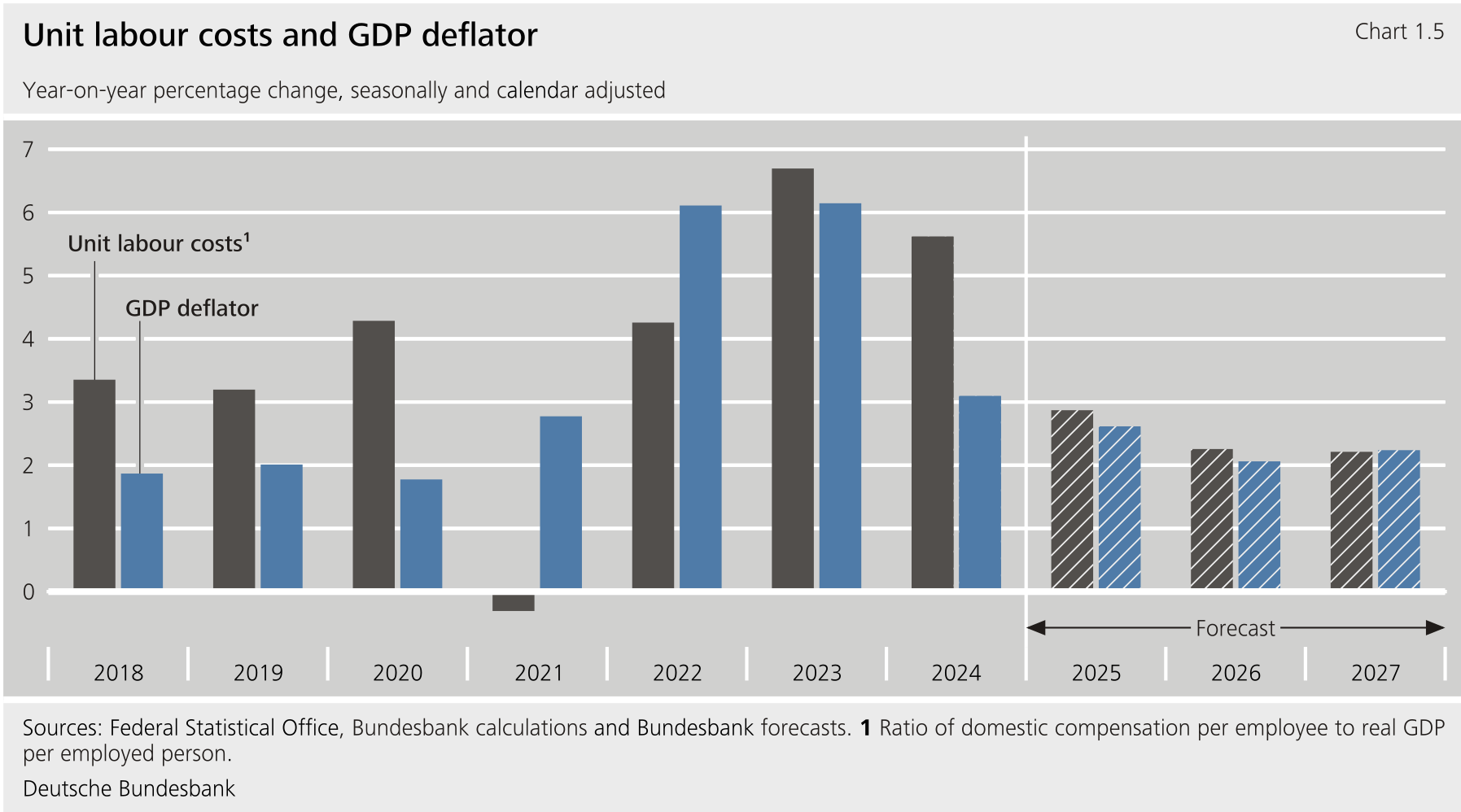
****Pressure from unit labour costs will ease during the forecast period and domestic inflation, as measured by the** **deflator, will decline to 2.2 % by 2027.** Against the backdrop of declining employment, considerably lower wage growth, and stagnating , the price pressure from unit labour costs will ease significantly this year. Nevertheless, it will remain at an above average level of almost 3 %. In contrast to the previous year, narrowing macroeconomic profit margins will contribute only little to disinflation in 2025. At present, they are already roughly at their pre-pandemic levels. In 2026, the expansionary fiscal policy will even provide a slight boost to growth in profit margins by increasing demand. Domestic inflation will then fall, mainly owing to weaker growth in unit labour costs. Wage growth will remain above average over the forecast horizon. However, labour productivity will increasingly recover and the growth in unit labour costs will continue to slow. Despite roughly normal capacity utilisation, domestic inflation will remain at a slightly elevated level of 2.2 % in 2027. A contributing factor here is above-average price increases for strongly rising government consumption and investment expenditure.**{#par-ie2i42}
{#par-o3oa69}
****
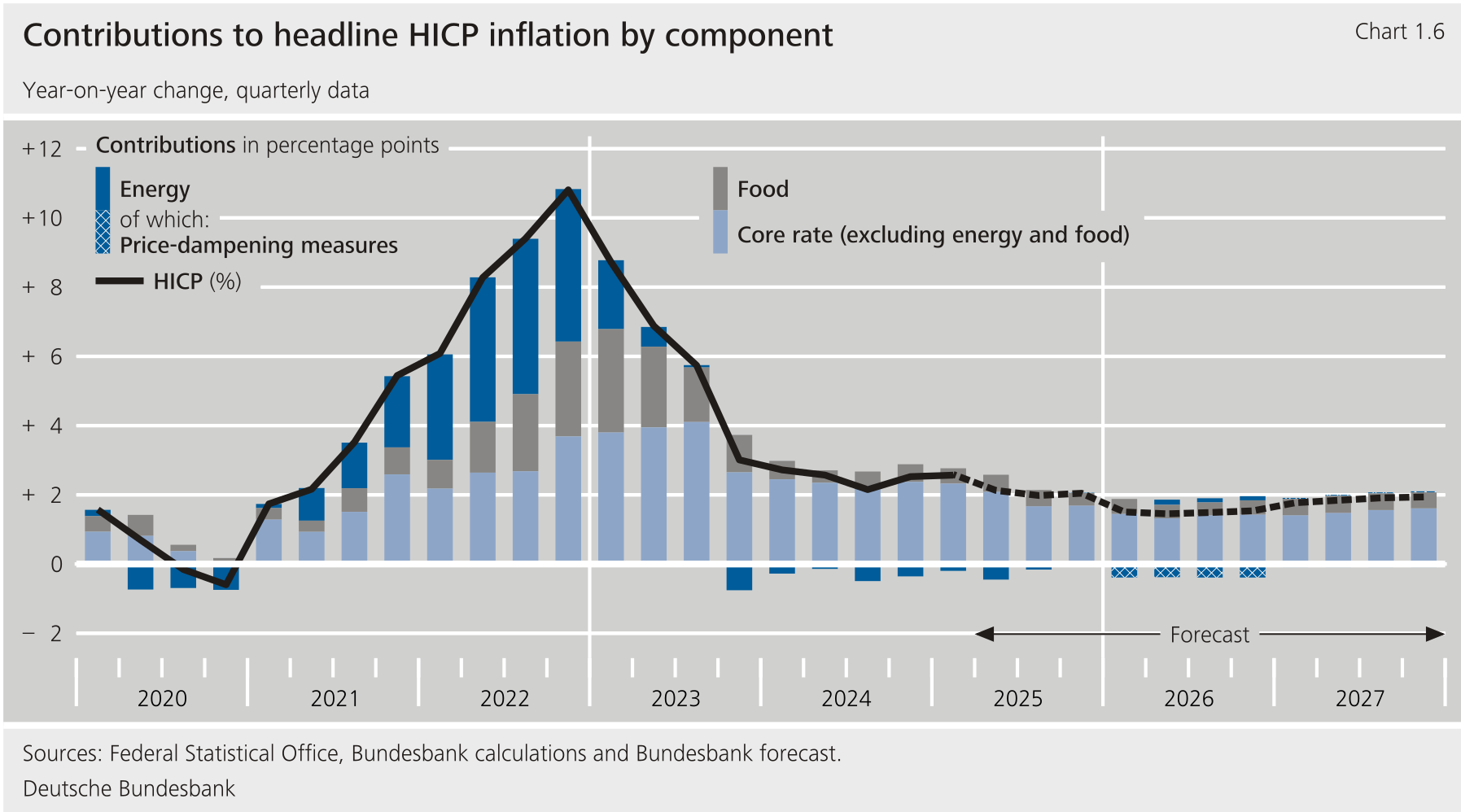
****inflation will decline further on annual average in 2025 and 2026, before rising to around 2 % again in 2027.** The rate will fluctuate around 2 % over the next few months, but will only fall to 2.2 % on annual average for 2025. The core rate (excluding energy and food) will also fall, but will remain noticeably higher at 2.6 %. Next year, the rate of inflation will see a marked temporary decrease to 1.5 %, mainly due to lower energy prices. The core rate will also drop to 1.9 % owing to diminishing price pressure from labour costs as well as to continually weak demand, which is also a result of the lagged impact of the restrictive monetary policy up to 2024 (see the section entitled ["Inflation forecast up to 2026"](#3.8-Inflation-forecast-up-to-2026)). The dampening effect of energy prices during the forecast period is attributable, on the one hand, to lower futures prices for crude oil in the energy markets (see the section entitled "[Assumptions regarding the international environment, exchange rates, commodity prices and interest rates](#3.1-Assumptions-regarding-the-international-environment-exchange-rates-commodity-prices-and-interest-rates)"). This price decline is amplified further by the appreciation of the euro against the dollar. On the other hand, the fiscal measures factored into the forecast reduce inflation: the most important factor is the reduction in electricity prices, but energy prices will also be lowered through the abolition of the gas storage levy. The changeover from national carbon prices to the European system will likewise dampen price inflation somewhat in 2027.[\[16\]](#_ftn_root_16) Food price inflation will fall considerably below its historical average at the end of this year and then remain there until rising again gradually in 2027. Non-energy industrial goods are expected to become only marginally more expensive by the middle of next year, owing partly to the dampening impact from the appreciation of the euro. Prices will only pick up somewhat more strongly again as economic capacity utilisation increases. The significant inflation in services prices will abate markedly given the weaker wage growth, and also due to the absence of inflationary one-off effects, but will remain at a notably elevated level. Overall, the rate of inflation will rise again to 1.9 % in 2027, and the core rate will also rise slightly to 2.0 %. Compared with the Forecast for Germany from last December, the current forecast for the inflation rate has thus been revised downward for 2025 and 2026, mainly due to energy prices, but remains unchanged for 2027. The forecast for core inflation has been revised slightly upward for 2025 only.**{#par-i88o45}
{#par-i263e4}
****
{#par-u3i772}{#par-i6u76o}{#par-u39ua1}
| **Table 1.3b: Revisions since the December 2024 forecast** Year-on-year percentage change |||||
| **Item** | **2024** | **2025** | **2026** | **2027** |
|-----------------------------------|----------|----------|----------|----------|
| **Harmonised Index of Consumer Prices** |||||
| June 2025 forecast | 2.5 | 2.2 | 1.5 | 1.9 |
| December 2024 forecast | 2.5 | 2.4 | 2.1 | 1.9 |
| Difference (in percentage points) | 0.0 | − 0.2 | − 0.6 | 0.0 |
{#par-a85o28}
**2 Risk assessment** {#tar-2}
------------------------------
****Economic forecasts are always subject to uncertainty: at present, however, the prevailing uncertainty is exceptionally high, with risks to economic growth and inflation in both directions.** In particular, the situations concerning international trade disputes arising from tariff policy as well as global geopolitical conflicts could escalate or de-escalate. Assumptions had to be made regarding the fiscal package and the expedited implementation of government plans for infrastructure and defence. Only little information was available here at the time the forecast was finalised. In this respect, the extent of fiscal easing may be larger or smaller than assumed in the baseline of the forecast.**{#par-u141u2}
****If the United States were to further harden its tariff policy towards its trading partners, there is a risk not only of protectionist countermeasures, but also of severe macroeconomic repercussions for the economies involved, the global economy as a whole, and the German economy as well.** Taken in isolation, higher tariffs have an inflationary effect in the country imposing the tariffs and also dampen demand for goods. If the trade dispute were to escalate -- similarly to what was seen in April -- and this were to lead to a further loss of confidence in both the dollar and the economy at the same time, the dollar could depreciate. Furthermore, prices in global commodity markets could decline as a result of heightened concerns regarding demand. German economic output would then be dampened by weaker foreign demand, an appreciation of the euro, and heightened uncertainty (see the supplementary information entitled "[The potential impact of a more restrictive trade policy on the German economy](#Supplementary-information-The-potential-impact-of-a-more-restrictive-US-trade-policy-on-the-German-economy)"). At the same time, inflation would also be weaker, as lower energy commodity prices and a higher external value of the euro against the dollar would dampen inflation, especially in the energy and non-energy industrial goods sectors. According to the simulation calculations, this would not be offset by the inflationary effects of potential retaliatory tariffs on imports from the United States at the upstream stages. However, it is also possible that the parties involved could resolve their trade disputes, global tariffs could be lower than assumed in the forecast, and Germany's export economy could ultimately face weaker headwinds than expected. If the dollar were to regain its former strength and global demand prospects were to brighten to a greater extent, a weaker euro and higher global energy commodity prices could create additional price pressures in Germany.**{#par-a27iuo}
****While further escalation of international geopolitical conflicts cannot be ruled out, there are now also hopes of de-escalation.**If, for example, Russia's war against Ukraine or the conflict in the Middle East were to escalate or expand, global commodity markets and international supply chains could be adversely affected, for instance. This would dampen economic activity in Germany and push up inflation, especially in the event of rising prices for energy commodities. However, more favourable scenarios are conceivable here, too. Conversely, these could lead to a better course of economic activity and lower inflation.**{#par-i77e85}
****The future fiscal policy stance is still uncertain at present.**Germany's new Federal Government has not yet presented any budget plans. Of particular importance for this forecast are the assumptions regarding government expenditure on defence and infrastructure.**{#par-e83ua9}
* **Fiscal expansion could ultimately be weaker: the fiscal rules and German debt brake could be more tightly binding and the general provision from the Federal Government's coalition agreement that all measures must be adequately funded could be applied more stringently. Furthermore, expenditure on defence and public infrastructure could grow less than assumed. The latter largely depends on the extent to which non-financial obstacles can be overcome, for instance with regard to regulation and approval processes.**
{#par-u862aa}
* **However, fiscal expansion could also be stronger: first, compared with the fiscal policy assumptions made in this forecast, the coalition agreement provides for additional measures that affect the deficit. Second, expenditure on defence and public infrastructure could also rise more sharply than expected.**
{#par-uo53oe}
* **If fiscal expansion were weaker, there would be less expansion of aggregate activity and price pressures would be lower. Conversely, if the extent of fiscal easing were even greater, this could boost economic activity more than expected. Price pressures could then turn out to be higher, especially if individual sectors -- such as defence or civil engineering -- reach their capacity limits and are unable to raise them quickly enough.**
{#par-aoa672}
* **Furthermore, it should be noted that the inflation forecast also depends on the assumed government measures that have a direct impact on prices. For example, the timing and scope of the reduction in electricity tax and transmission grid charges may deviate from the baseline assumptions made here. Consumer prices would be dampened to a greater degree if, for instance, taxes and levies on electricity were lowered more sharply. The forecast assumes a reduction of 5 cent/kWh, but, according to the coalition agreement, this is the minimum intended amount of relief. On the other hand, there could be a higher carbon price as of 2027, which would amplify inflation. This forecast assumes that the switch from national to -wide emissions allowances trading () would involve a reduction in the carbon price from €65 to the target price cap of €59. However, this cap could also be higher, as the price is, in principle, intended to be set based on the market. In addition, simulation calculations suggest that emissions need to be reduced to a greater extent in order to achieve climate protection objectives.[\[17\]](#_ftn_root_17)**
{#par-ieo5a1}
**The potential impact of a more restrictive trade policy on the German economy** {#tar-3}
------------------------------------------------------------------------------------------
****The size of the tariff hikes announced by the** **President at the beginning of April 2025 caught most market observers by surprise.** Even before taking office, the President had already threatened to tighten trade policy.[\[1\]](#_ftn_4b06aa89_1) However, the size and scope of the tariffs announced at the beginning of April significantly exceeded expectations. Customs duties on most imports of goods from the are set to rise by 20 percent. Rates of at least a similar magnitude were slapped on most other trading partners. Following a spiral of reciprocal retaliation, products from China were, at one point, subject to additional tariffs in excess of 100 %.[\[2\]](#_ftn_4b06aa89_2) This triggered strong reactions in the global financial markets, Shares sustained considerable losses amid high financial market volatility. In addition, government bond prices declined and the dollar depreciated markedly. These responses bucked the pattern usually seen in times of financial stress that the prices of government bonds go up and the dollar tends to appreciate.[\[3\]](#_ftn_4b06aa89_3) The decline in the value of the currency was also unusual in light of the fact that, taken in isolation, an increase in import tariffs would have suggested an appreciation of the dollar. This suggests that the observed developments are a sign not only of a tariff shock but also of a partial loss of confidence in the currency. The hikes in tariffs on many countries have now been partially suspended while negotiations with the United States on bilateral trade agreements are in progress.**{#par-a592e3}
****Uncertainty about future** **trade policy remains high.** Most trading partners face the risk of higher tariffs being reimposed from as early as July. Against this background, the risk scenario below illustrates possible effects on the German economy if the trade policy situation -- comparable to the beginning of April -- were to re-intensify and to once again trigger severe financial market reactions.**{#par-eaao4u}
****The scenario analysis assumes that the tariff hikes announced at the beginning of April, some of which are currently suspended, will fully enter into force, followed by renewed strong financial market responses and persistently high uncertainty regarding** **economic policy.** It is assumed that the trade policy negotiations with the United States will fail and that, from the third quarter of 2025, the United States will call for the so-called "reciprocal" tariffs on nearly all imports at the level announced on 2 April 2025.[\[4\]](#_ftn_4b06aa89_4) An additional 20 % tariff would be imposed on imports of goods from the , instead of the current additional 10 %. It is also assumed that the will retaliate with tariffs on a similar scale. The high tariffs reached at the end of the most recent tit-for-tat spiral are used as the baseline for bilateral China- trade. The scenario additionally assumes that economic and trade policy uncertainty will remain high throughout the entire forecast horizon. In keeping with observations following the tariff announcements on 2 April, it is further assumed that these developments will trigger considerable upheaval in the financial markets.**{#par-oi114e}
****This scenario would weigh heavily on the global economy.** The impact of the underlying conditions in the scenario on the global setting is based on analyses by the staff.[\[5\]](#_ftn_4b06aa89_5) The broad-based import tariffs would drive up inflation in the United States, yet also dampen economic output there quite considerably. In addition to the retaliatory measures taken by trading partners, the high level of uncertainty and the loss in confidence in the economy would play a role. In financial markets, particularly in the United States, equity prices would fall sharply and bond yields would rise, meaning that deteriorating financing conditions would additionally hamper investment. Owing to the close international interconnectedness between the goods markets and the financial markets, trade policy turmoil, high uncertainty and financial market responses would weigh heavily on global economic activity and, in particular, global trade. Reduced demand in commodity markets would drive down oil prices.**{#par-u55e37}
****Countervailing effects are at play regarding the** **dollar's exchange rate.** All else being equal, higher tariffs on imports would create upward pressure on the dollar. On the other hand, the deteriorating growth outlook and loss of confidence would cause the dollar to trend downward. The calculations presented here initially assume that the two effects largely cancel each other out, leaving the bilateral dollar/euro exchange rate, in particular, unchanged. Below, we look at the hypothetical additional impact should the dollar continue to depreciate against the euro on the scale observed in the wake of tariff announcements at the beginning of April.[\[6\]](#_ftn_4b06aa89_6)**{#par-e91633}
****The model calculations show a considerable downside risk to economic growth in Germany.** Based on the impact on the global setting and financial markets described above, the implications for the German economy are estimated using the Bundesbank's macroeconometric model ().[\[7\]](#_ftn_4b06aa89_7) The effects triggered by the heightened uncertainty in Germany are quantified using a satellite model and integrated into the analysis.[\[8\]](#_ftn_4b06aa89_8) Overall, the German economy is under considerable strain in the risk scenario. In this scenario, German exports suffer a sharp setback caused by global growth losses and lower import demand from trading partners. Although the clearly muted aggregate demand is also due to the direct impact of the trade policy turmoil unleased by tariffs and and Chinese retaliatory tariffs, a large part of this is also a result of heightened uncertainty worldwide. Firms would probably be increasingly inclined to defer their investment decisions owing to the lack of planning certainty.[\[9\]](#_ftn_4b06aa89_9)**{#par-iio2o8}
{#par-e8a69o}
**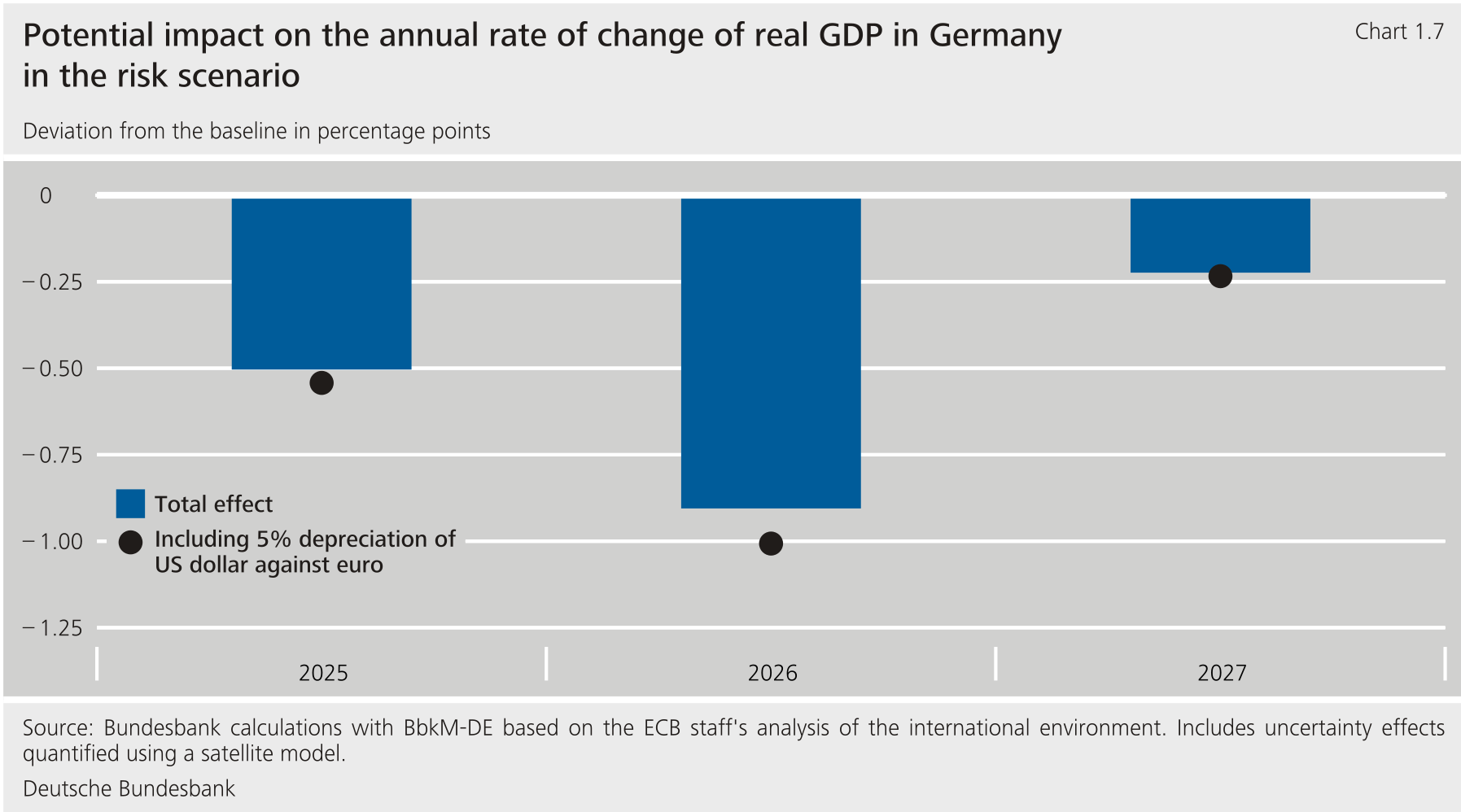**
****Overall, losses in real** **growth by 2027 are expected to add up to a little over 1½ percentage points compared with the baseline.** The loss in growth, at 0.5 percentage point, will already be distinct in the current year. It will peak next year, with growth down by around 0.9 percentage point. Yet even in 2027, the dampening impact on growth will still be 0.2 percentage point. Moreover, if -- similar to what was observed in April -- the euro were to appreciate against the dollar by 5 %, this would amplify the dampening effect on growth by a cumulated 0.2 percentage point up until 2027. In such a scenario, the recovery in the German economy, as assumed in the baseline of the forecast, would be delayed until 2027. would decline this year and next.**{#par-oa94u3}
{#par-u64934}
**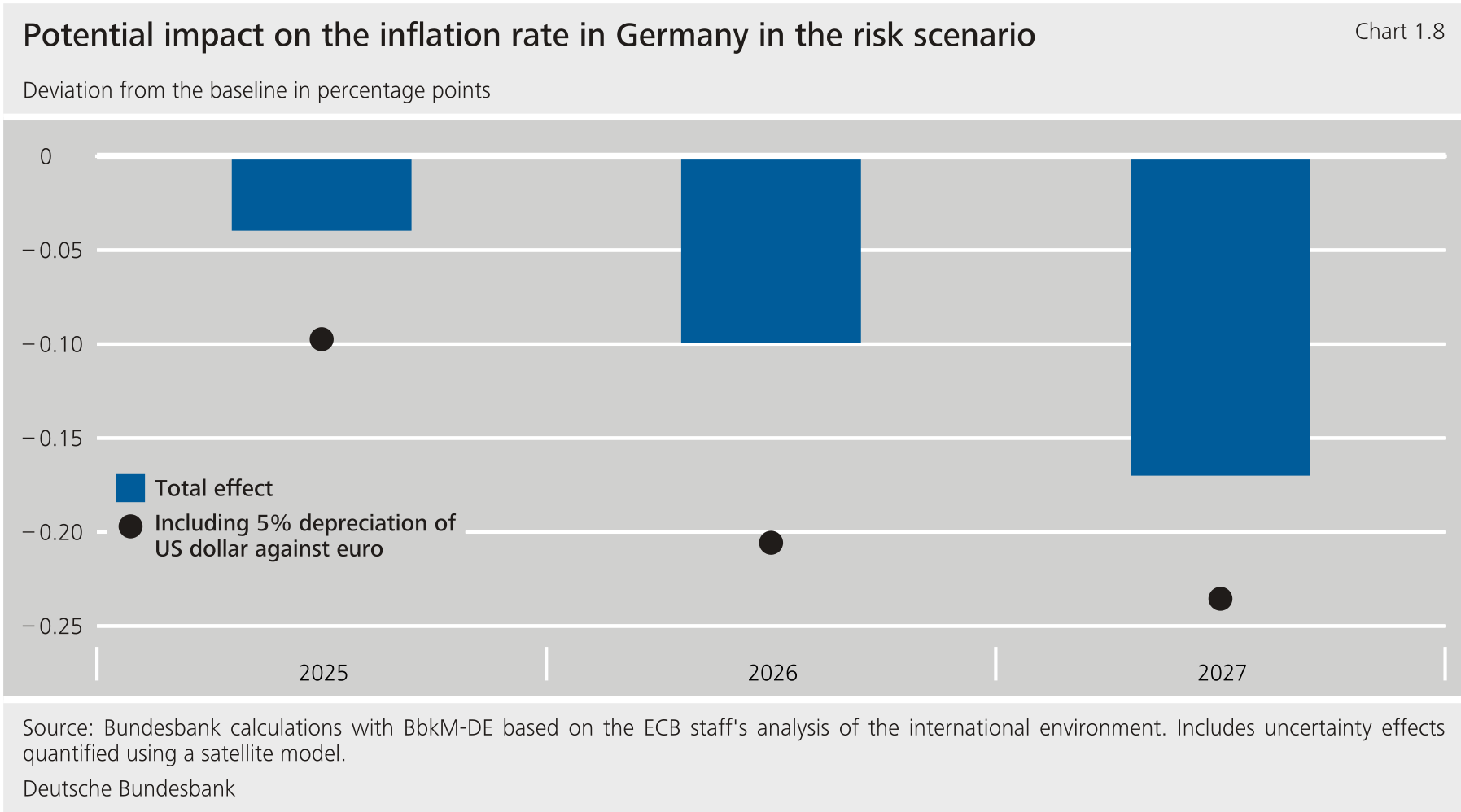**
****In the risk scenario, the** **rate falls slightly below the baseline of the forecast, although the decline could also be somewhat stronger if the** **dollar depreciates against the euro.** On the price side, on the one hand, the retaliatory import tariffs would have a price-increasing effect, all other things being equal. However, weaker economic activity in Germany would dampen inflation. In addition, the decline in oil prices caused by the weakness in global growth would be reflected in lower consumer prices. Overall, the inflation rate would be slightly lower than in the baseline, though the negative overall effect would actually increase over the forecast horizon. If the dollar were to depreciate permanently by 5 % against the euro, the inflation rate could decline additionally by around 0.1 percentage point each year.**{#par-u4i464}
****Many of the assumptions made to calculate the risk scenario are highly uncertain** . For example, the tariffs ultimately imposed by the United States and any retaliatory tariffs imposed in the event of an escalation of the conflict could exceed the assumptions in the risk scenario. The President's recent threats to the point in this direction. The extent to which the financial and forex markets respond to the higher additional tariffs is also uncertain. A renewed tightening of trade policy could conceivably trigger even stronger upheaval in the financial markets than that observed in April, which could cause confidence in the dollar to erode even more sharply. It is equally possible, however, that the reaction could be milder and regionally significantly more nuanced since the markets may be less surprised by the tariff escalation than at the beginning of April. As regards the dollar, appreciation tendencies against the euro could even potentially prevail owing to the higher tariffs. However, in such a risk scenario, international trade linkages could also be affected more significantly, leading to disruptions to global value chains. The attendant supply side disruptions could result in considerable price increases -- as was observed during the -19 pandemic. Moreover, in a significantly more protectionist world, major productivity losses and thus stronger rises in production costs over the medium term are conceivable. Finally, the results of such scenario analyses always depend on the chosen model framework as well.**{#par-a1ua82}
1. **{#_ftn_4b06aa89_1} For an earlier assessment of the impact of possible tariffs and other economic policy measures by the new administration -- communicated in the run-up to the election -- see Deutsche Bundesbank (2024c).**
2. **{#_ftn_4b06aa89_2} For an analysis of the -China trade dispute and the impact of the reciprocal tariffs in force between mid-April and mid-May, see Deutsche Bundesbank (2025d).**
3. **{#_ftn_4b06aa89_3} See Deutsche Bundesbank (2025e).**
4. **{#_ftn_4b06aa89_4} In the risk scenario, exemptions for certain categories of products such as electronics, semiconductors or pharmaceuticals are no longer in effect. In addition, special sectoral tariffs that have already been introduced remain in force. This will affect, in particular, cars and car parts as well as steel and aluminium, exports of which to the United States are assumed (as this forecast was finalised) to be subject to additional tariffs of 25 %.**
5. **{#_ftn_4b06aa89_5}See Box 2 in European Central Bank (2025).**
6. **{#_ftn_4b06aa89_6} On average over the period from 11 April 2025 to 7 May 2025 (i.e. the day before the - trade agreement was reached), the bilateral exchange rate of the dollar against the euro was around 5 % below its level on 1 April, i.e. the day before tariff announcements.**
7. **{#_ftn_4b06aa89_7} The is a semi-structural macroeconometric model used for the Bundesbank's macroeconomic projections; see Haertel et al. (2022).**
8. **{#_ftn_4b06aa89_8} The satellite model is a structural vector autoregression () model, which, amongst other things, provides a measure of financial uncertainty following Jurado et al. (2015) and has already been applied at the Deutsche Bundesbank (2024c).**
9. **{#_ftn_4b06aa89_9} See Deutsche Bundesbank (2025f).**
**3 More detailed information on the Forecast for Germany** {#tar-4}
--------------------------------------------------------------------
### **3.1 Assumptions regarding the international environment, exchange rates, commodity prices and interest rates**
****The Forecast for Germany is based on joint assumptions by Eurosystem experts about the global economy, exchange rates, commodity prices and interest rates.** These assumptions are based on information that was available as at 14 May 2025.**{#par-ia975e}
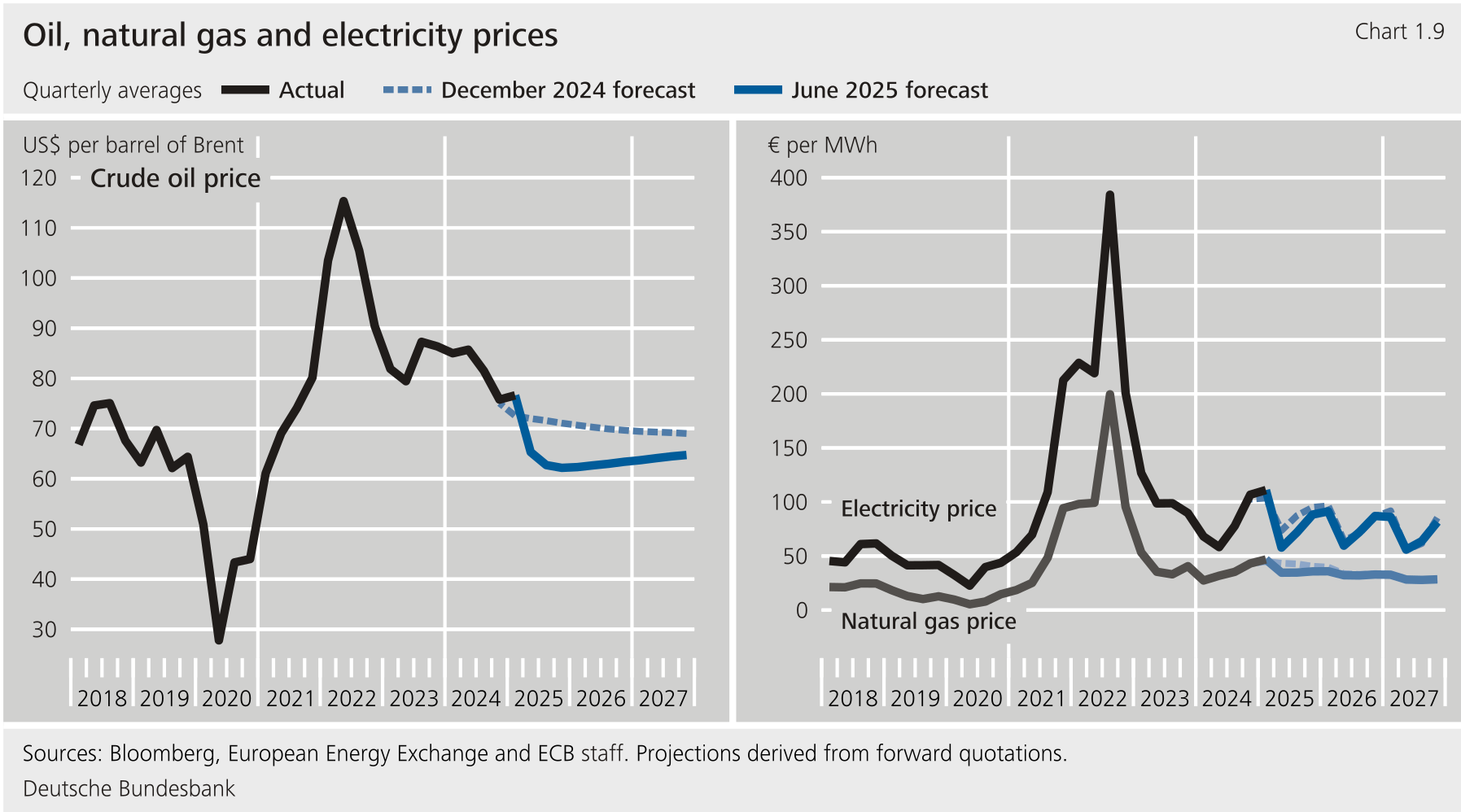
****trade policy and the associated uncertainty are weighing on global economic growth.** [\[18\]](#_ftn_root_18) Overall, over the past winter half-year, the global economy saw solid growth that was broadly in line with the assumptions made in the Forecast for Germany from last December. However, the first quarter of 2025 was already influenced significantly by protectionist trade policy. Expectations of threatened additional tariffs led to anticipatory effects. As a result, there was a considerable increase in imports to the United States and thus exports from certain trading partners. As early as February, the United States introduced additional tariffs on imports from individual countries and for different categories of products. Subsequently, some tariffs were granted exemptions or were temporarily suspended again. Further additional tariffs were announced. Against this backdrop, there was a significant rise in trade policy uncertainty.[\[19\]](#_ftn_root_19) This forecast assumes that the additional tariffs of at least 10 % imposed on all trading partners since April will remain in effect, as will the tariffs on steel and aluminium as well as on cars and car parts that were in place at the time the forecast was finalised. In the case of bilateral trade between the United States and China, it is assumed that the tariffs agreed by both countries in mid-May following a spiral of escalation will also remain in place.[\[20\]](#_ftn_root_20) The same applies to any retaliatory tariffs imposed by trading partners that are already in effect.[\[21\]](#_ftn_root_21) The significant rise in tariffs since the beginning of the year and the uncertainty in trade policy, which is also likely to hamper global investment, will weigh on global economic growth. It is therefore estimated to be significantly lower this year and next year than it was in the December Forecast for Germany. Following growth of 3.1 % in 2025 and 2.9 % in 2026, a rate of 3.2 % is expected for 2027.**{#par-a7469i}
****Economic growth in the other euro area countries will also be lower than assumed in the Forecast for Germany from last December.** The economic growth figures in the other euro area countries used in the forecast are derived from the forecasts of the national central banks, which were incorporated into the projection for the euro area published by the on 5 June 2025.[\[22\]](#_ftn_root_22) Accordingly, economic growth in the euro area excluding Germany is also lower than was forecast in December. After rates of 1.3 % this year and next year, only slightly greater momentum compared with the preceding years is expected for 2027, which will see growth of 1.4 %.**{#par-a2i96e}
****Against the backdrop of the trade disputes, the prospects for global trade and growth in German sales markets have deteriorated considerably.** In the first quarter of 2025, global trade continued to see strong growth as a result of the surge in imports caused by anticipatory effects. This demand is now lacking in the subsequent quarters and, in addition to the significantly higher import costs caused by the higher tariffs, is dampening demand for imports, especially in the United States. Due to the close interlinkages in global production and trade, this turbulence stemming from tariff policy is weighing on global trade as a whole. At rates of 3.1 % in 2025 and 1.7 % in 2026, considerably weaker growth is therefore expected for global trade in goods and services compared with the Forecast for Germany from last December. For 2027, growth of 3.1 % is assumed, which is slightly lower than was forecast in December. As bilateral trade between the United States and China is being strained to a comparatively greater degree due to the tariffs, the growth of German sales markets for next year was not revised as significantly downwards as the growth of global trade overall. Following growth of 2.5 % this year, an increase of 2.2 % is expected for 2026, before sales markets -- like global trade and largely in line with global economic growth -- see expansion of 3.0 % in 2027.**{#par-e356o6}
****Contrary to the expected consequences of higher** **tariffs, the euro has appreciated against the** **dollar. As a result, this forecast takes as its foundation a significantly higher exchange rate level than last December's forecast.** In a theoretical model approach, higher import tariffs would lead to a marked increase in inflation in the United States, resulting in expectations of significantly tighter monetary policy. This would likely have seen the dollar appreciate immediately.[\[23\]](#_ftn_root_23) However, the model does not assume that tariff policy is accompanied by a sustained decline in confidence in the dollar and the performance of the economy. However, this is precisely what the financial markets are likely to have been worried about following the announcement and partial introduction of the new tariffs, especially the "reciprocal" tariffs. Given the above, the euro did not depreciate against the dollar after 2 April, but instead appreciated markedly. In the period relevant to the exchange rate assumptions, the euro thus stood some 6 % higher against the dollar than in the assumptions made in the December 2024 Forecast for Germany. Compared with 41 currencies important for German foreign trade, the euro appreciated by around 3 %.**{#par-uuu594}
****The assumptions relating to exchange rates, commodity prices and interest rates as well as changes thereto since the December forecast are shown in the following table and chart.****{#par-ei89i7}
{#par-u7889a}{#par-euo398}{#par-i1e8e1}{#par-ou79u3}{#par-o62ue4}{#par-i91iio}{#par-e657a4}{#par-i49499}{#par-ae76eu}{#par-ai788e}
| **Table 1.4: Major assumptions of the projection** |||||
| Item | 2024 | 2025 | 2026 | 2027 |
|------------------------------------------|-------|-------|-------|-------|
| **Euro exchange rates** | ||||
| dollar/euro | 1.08 | 1.11 | 1.13 | 1.13 |
| Effective^1^ | 124.1 | 126.1 | 127.1 | 127.1 |
| **Interest rates** | ||||
| Three-month | 3.6 | 2.1 | 1.9 | 2.2 |
| Yield on government bonds outstanding^2^ | 2.3 | 2.7 | 2.9 | 3.1 |
| **Prices** | ||||
| Crude oil^3^ | 82.0 | 66.7 | 62.8 | 64.2 |
| Natural gas^4^ | 34.4 | 38.0 | 33.2 | 29.3 |
| Electricity^4, 5^ | 77.7 | 82.3 | 77.5 | 71.8 |
| Other commodities^6, 7^ | 9.2 | 6.8 | − 0.4 | 0.6 |
| Food^7, 8^ | − 1.3 | 4.9 | 1.0 | 2.2 |
| German exporters' sales markets^7, 9,10^ | 1.9 | 2.5 | 2.2 | 3.0 |
{#par-u8u561}
{#par-e8i31u}
****
**[*Key aspects of the macroeconomic outlook*](#par-i25924)**{#par-i16e4i}
### **3.2 Fiscal assumptions**
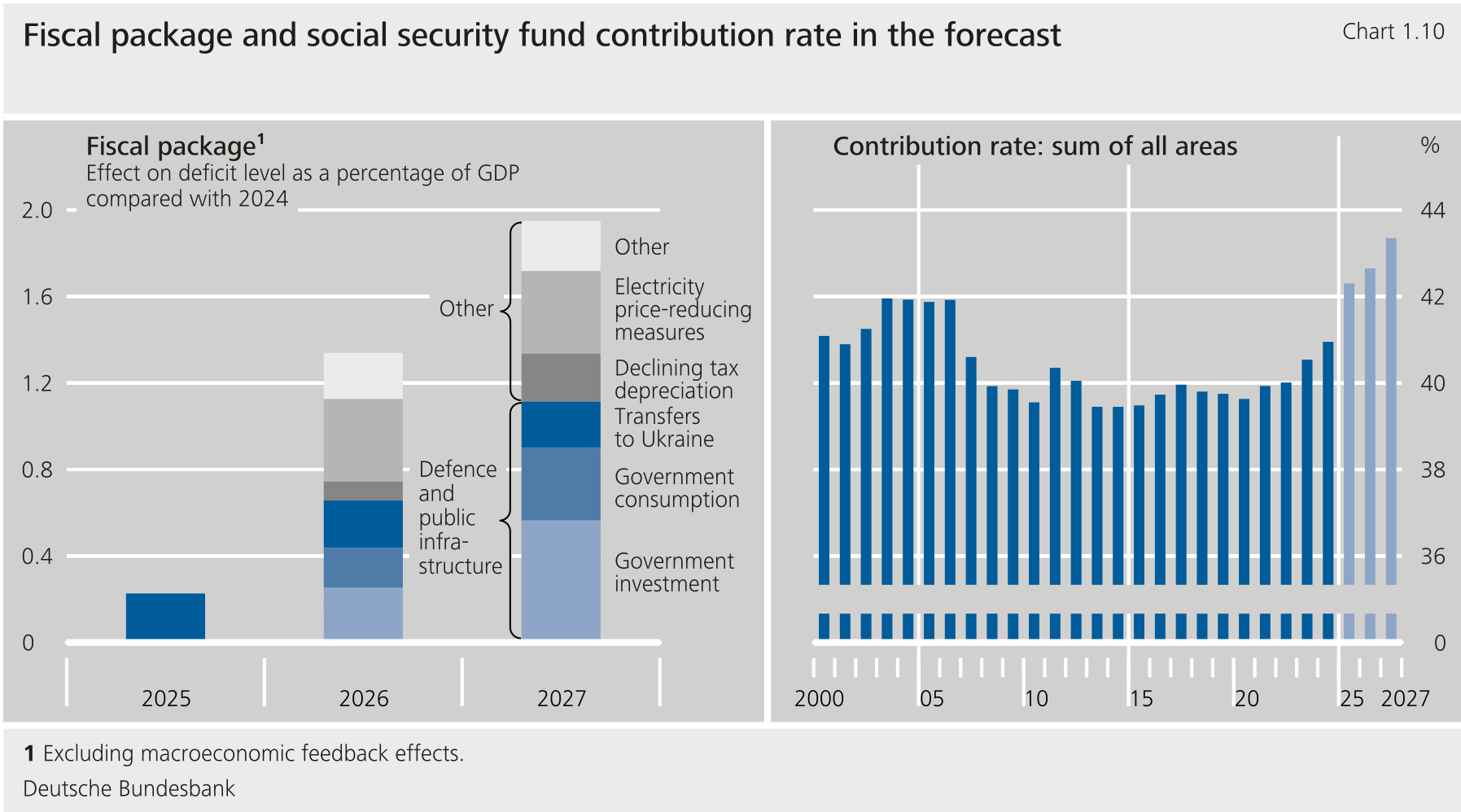
****The forecast includes significant additional expenditure on defence and government infrastructure.** The forecast incorporates fiscal policy measures as soon as they are sufficiently specified and their implementation is considered likely. Germany's fiscal rules were eased and its scope for borrowing increased considerably. The coalition agreement sets out a significant increase in spending on defence and infrastructure. No specific budget plans have yet been produced. The forecast assumes that plans will be implemented relatively quickly and that there will be largely sufficient production capacity for the additional government investment. Specifically, by 2027, defence expenditure as a share of will rise by ¾ percentage point compared with 2024. Over the same period, the infrastructure investment share will increase by ½ percentage point. Only defence-related transfers to Ukraine are likely to already see growth this year. From 2026, defence expenditure will then also increase significantly for military weapons systems, ammunition and personnel. Infrastructure expenditure will also rise considerably from 2026 onwards, especially construction investment.**{#par-i2oo9o}
****In addition, the forecast contains individual specific fiscal measures taken from the coalition agreement. These tax cuts, transfers and subsidies will mostly materialise from 2026 onwards.** They will increase the government deficit by just under ¾ % of in 2026, and they will continue to grow slightly in size in 2027. Significant additional expenditure is mainly due to the subsidisation of transmission grid charges and the expanded mothers' pension. Significant revenue shortfalls arise from accelerated depreciation of investment in machinery and equipment. Cutting the electricity tax to the European minimum and cutting on food and beverage service activities to the reduced rate also have a larger weight. In addition, the increase in the standard travel allowance, the tax exemption for overtime bonuses and the reintroduction of full favourable tax treatment for agricultural diesel lead to lower tax revenue. The continued rise in tobacco tax will lead to small revenue increases from 2027 onwards.**{#par-o726uu}
****The overall contribution rate to the statutory social security schemes will rise to 43 % over the forecast horizon.**This is mainly due to the contribution rates of the health and long-term care insurance scheme, which rose significantly at the beginning of 2025. They will continue to increase in subsequent years, as expenditure on benefits will grow strongly. The statutory pension insurance scheme generates deficits that are initially financed by depleting free reserves. The contribution rate will only need to be raised slightly in 2027. It is assumed that the Federal Employment Agency bridges temporary cyclically-induced financing gaps via multi-year loans from central government.**{#par-uea6ai}
{#par-i82iii}
****
****Further measures have only a small net impact on the government budget.** It is assumed that bracket creep will be offset retroactively over the forecast horizon. In addition, income tax allowances for 2024 will rise retroactively. However, these measures essentially prevent the tax burden from rising automatically due to price-related income tax bracket creep. Revenue from the 's Next Generation programme will end in 2026. Germany will then finance the associated expenditure from its own revenue. Revenue from CO2 allowances will gradually increase, financing expenditure from the Climate Fund.**{#par-ie34a7}
**[*Key aspects of the macroeconomic outlook*](#par-ea54ui)**{#par-a5eea4}
### **3.3 Outlook for public finances**
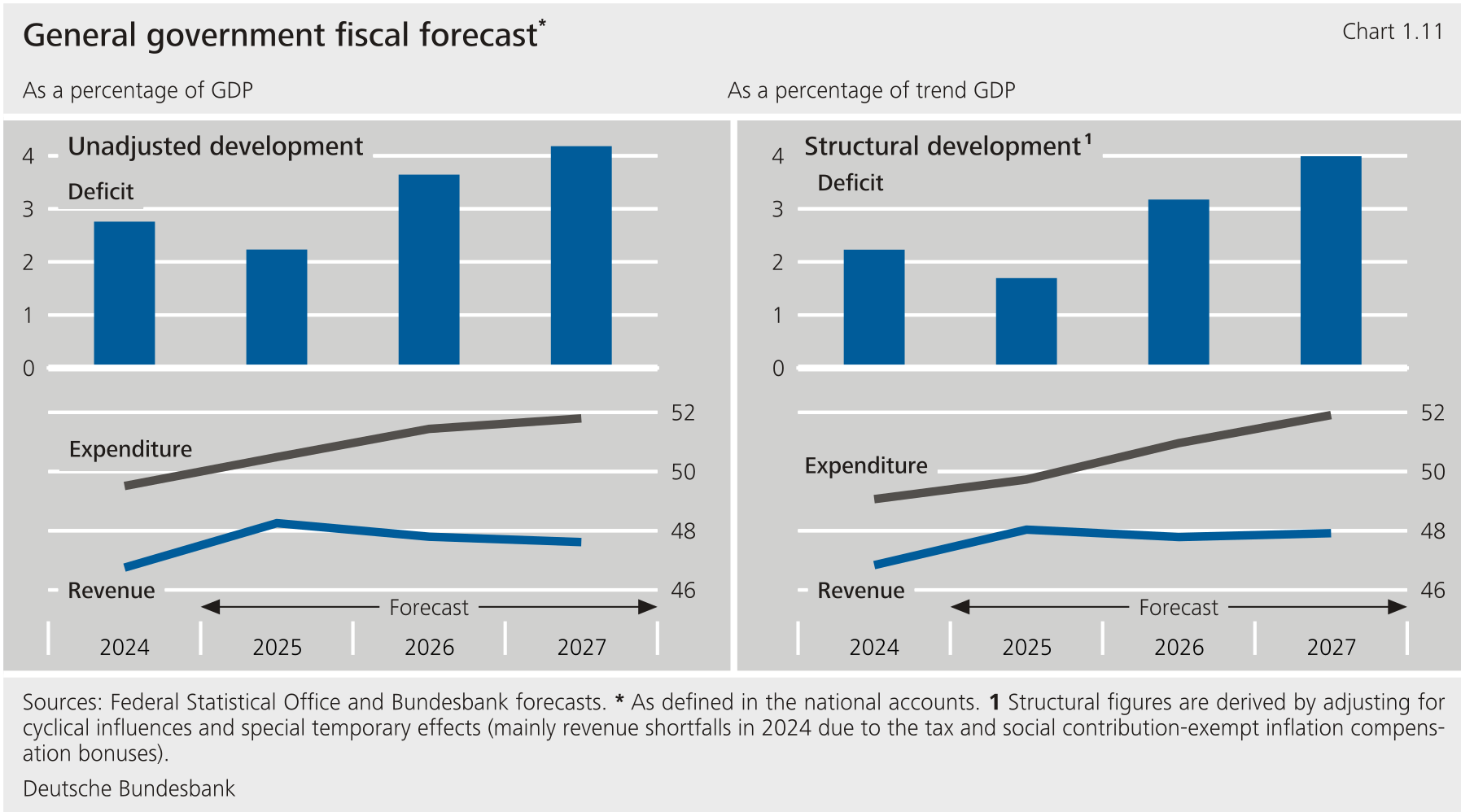
****The deficit ratio will fall markedly this year to 2.2 % (2024: 2.8 %).** On the one hand, the weakness in economic activity will increase the deficit ratio markedly. On the expenditure side, spending on pensions, health care and long-term care will rise significantly. On the other hand, there will be various positive effects on revenue. First, tax-exempt inflation compensation bonuses will partly be replaced by wage components subject to taxes and social contributions. Second, one-off developments are increasing tax revenue: capital gains have made no small contribution to strong growth in flat rate withholding tax. Inheritance tax will rise sharply due to a one-off effect. And revenue from the energy tax will increase significantly as a result of lagged payments from 2024. Third, social contribution rates rose steeply at the beginning of the year (see the section entitled "[Fiscal assumptions](#3.2-Fiscal-assumptions)").**{#par-i3ueee}
****The deficit ratio will rise significantly to 3.6 % in 2026 and 4.2 % in 2027, mainly due to the underlying fiscal package.**In particular, direct government demand will increase due to higher spending on national defence and government infrastructure. In addition, firms and households will benefit from tax cuts and new subsidies and transfers. Social spending on pensions, health and long-term care will continue to grow strongly, partly counterfinancing rising contribution rates. In 2027, the negative cyclical influence will decline again somewhat.**{#par-ou63e2}
****The structural deficit ratio will increase from just over 2 % in 2024 to 4 % in 2027.**This excludes temporary effects and cyclical influences. The main reason for this increase is the additional deficits for defence expenditure and infrastructure investment, as well as those for tax cuts, subsidies and transfers. In addition, central, state and local governments are assumed to be more economical in their fiscal stance. The structural fiscal positions of the social security funds will also deteriorate somewhat, mainly owing to increasing funding gaps in the pension insurance scheme.**{#par-oi88oo}
{#par-eoe6o6}
****
****The large deficits of local government mean that the Maastricht debt ratio will rise from 62.5 % at the end of 2024 to around 66 % at the end of 2027.** The deficit in the social security funds does not increase government debt, as it is financed from reserves (that are not invested in government debt instruments). At the end of 2027, the share of debt which Germany ultimately has to pay stands at around 2½ % of . This share is not included in the Maastricht debt ratio.**{#par-a98173}
**[Key aspects of the macroeconomic outlook](#par-o8923o)**{#par-i6ia84}
### **3.4 Details of the short-term forecast**
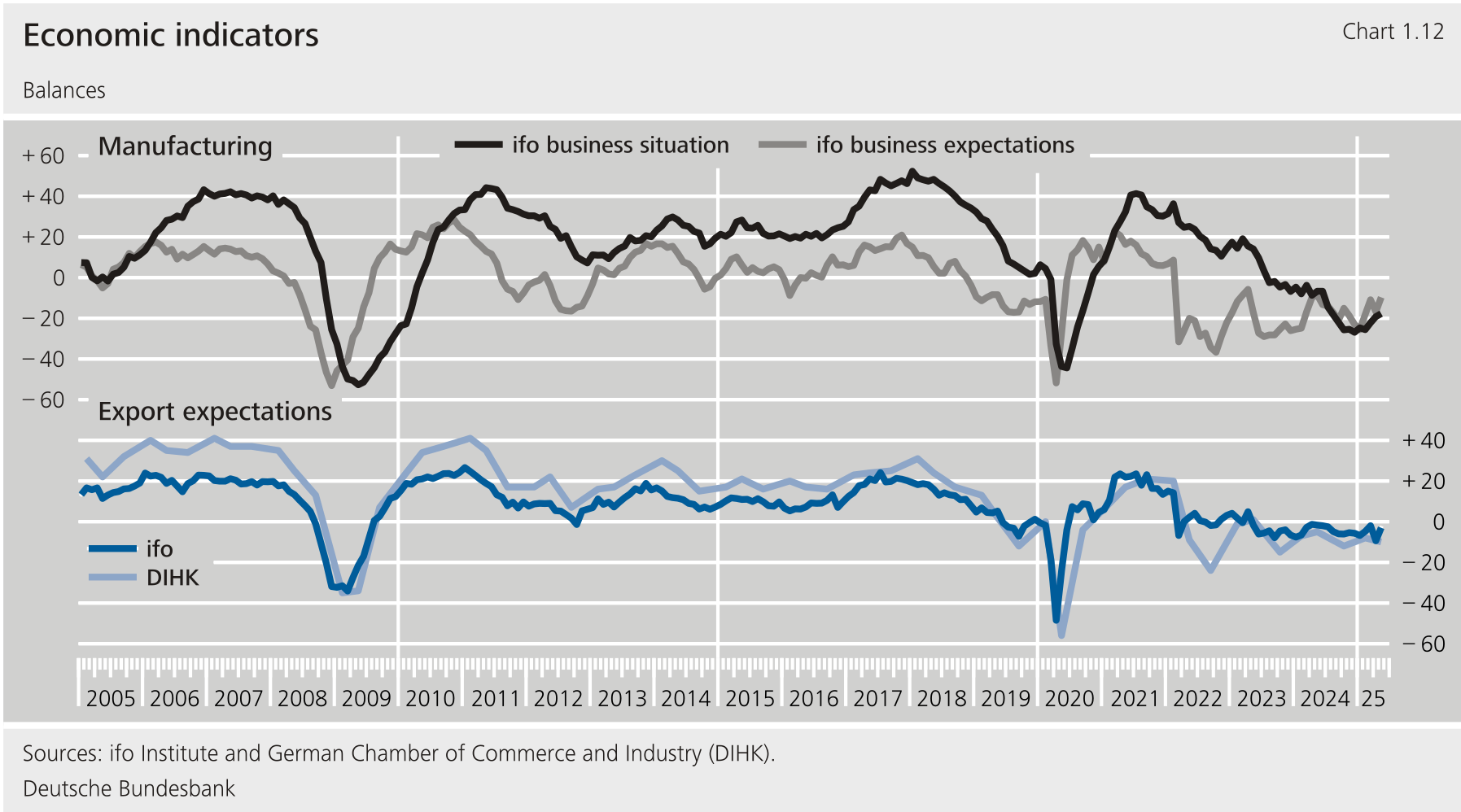
****Economic output is likely to decline slightly over the course of the summer half-year 2025.** The stabilisation that began in the winter will therefore be interrupted for the time being. German export-oriented industry, in particular, is suffering from the changeable economic policies of the administration and the associated high degree of economic policy uncertainty. Accordingly, industrial enterprises' business and, in particular, export expectations -- according to both the Institute and the German Chamber of Commerce and Industry () -- remain pessimistic. Exports and business investment are therefore likely to decline markedly in the current summer half-year, although anticipatory effects may well still counteract a stronger decline in exports in the current quarter. The recent slight improvement in the assessment of the situation in the manufacturing sector indicates that the start of the second quarter is still quite strong. Against the backdrop of past real income gains, a further decline in inflation and an improved consumer climate according to the , private consumption is likely to provide at least small growth impulses. Meanwhile, housing investment has bottomed out. However, it is unlikely that the pace of expansion in the winter half-year will be maintained. The temporary decline in real incomes and the slowdown in the labour market are likely to weigh on residential investment in the short term. However, the underlying trend is tilted to the upside. Overall, economic output is thus likely to more or less stagnate in the current quarter.[\[24\]](#_ftn_root_24) Beyond the still subdued underlying economic trend, the burden from tariffs is likely to become more visible in the third quarter, in which more significant counteraction of the anticipatory effects in foreign trade from the first half of the year is to be expected. This is likely to lead to a slight decline in economic output. Fiscal policy is not yet expected to provide any significant stimulus in the summer half-year.**{#par-eu6e28}
{#par-o89ao7}
****
**[*Key aspects of the macroeconomic outlook*](#par-i25924)**{#par-ui4983}
### **3.5 Forecasts of expenditure components of**
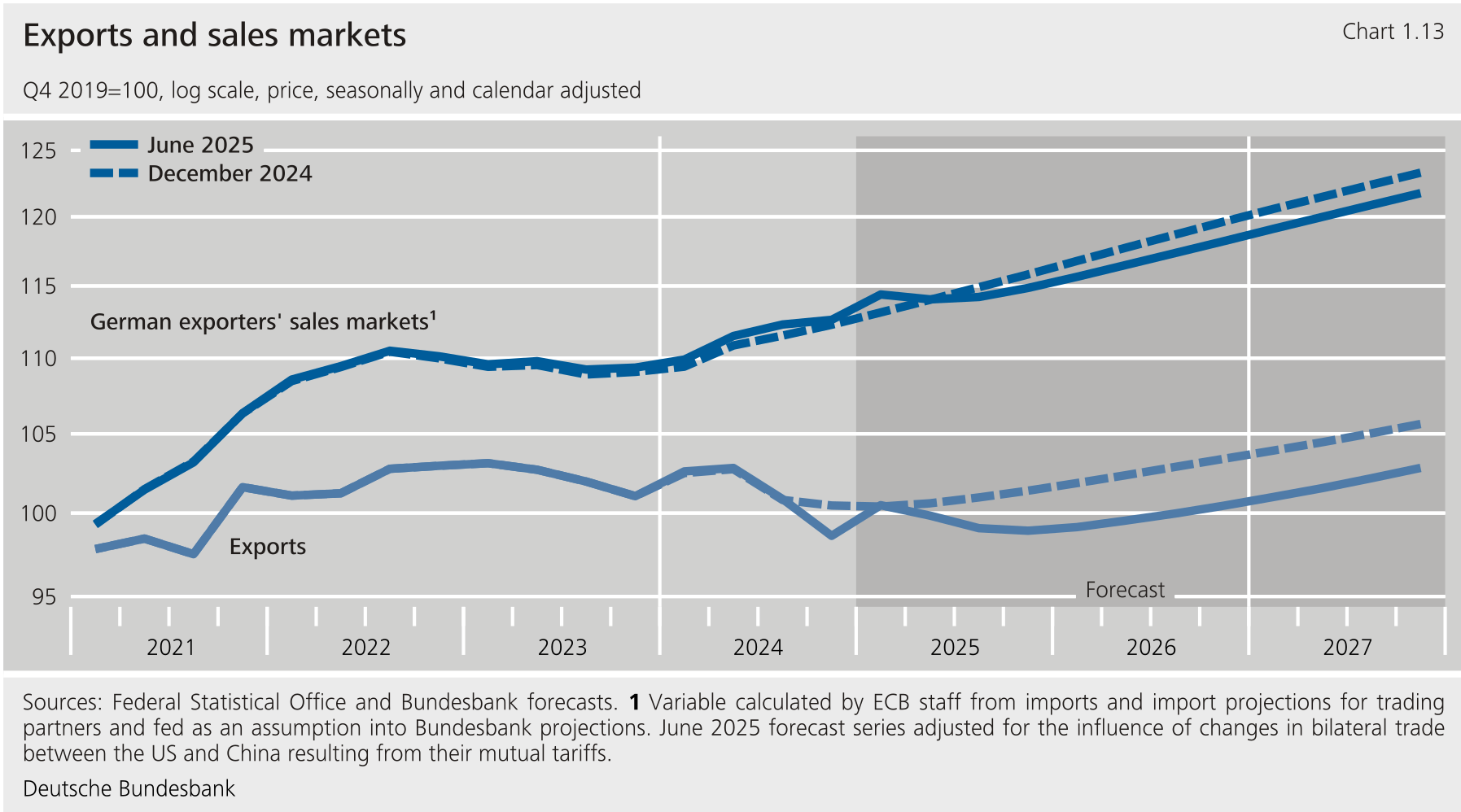
****Exports will decline significantly in 2025 owing to** **economic policy and will slowly return to a moderate expansion path from next year onwards.** After expanding sharply in the first quarter, exports will decline significantly over the remainder of the year. The main reason for this is the new, partially introduced tariffs. These will significantly dampen international trade in goods (see the section entitled "[Assumptions regarding the international environment, exchange rates, commodity prices and interest rates](#3.1-Assumptions-regarding-the-international-environment-exchange-rates-commodity-prices-and-interest-rates)"). In addition, changeable policy has sharply increased economic policy uncertainty and reduced capital markets' confidence in the strength of the economy. This led the euro to appreciate considerably against the dollar, with the price competitiveness of the German export industry outside the euro area deteriorating as a result. Although industrial new orders from abroad have improved significantly of late, anticipatory effects are likely to have played a role here. The temporary suspension of some announced tariffs could lead to further anticipatory effects in the second quarter and reduce the corresponding rebound effects or shift them into subsequent quarters.[\[25\]](#_ftn_root_25) This is also indicated by the export expectations for the next three months. They initially declined significantly in April, but almost fully recovered in May. Nevertheless, they remain at a pessimistic level. This also applies to export expectations, which are based on a period of 12 months. Overall, the negative impact of the new trade barriers will have a marked impact in the second quarter. This will continue in the second half of the year -- even more so due to rebound effects following the anticipatory effects of the first half of the year. In addition, heightened uncertainty is dampening investment worldwide, which disproportionately affects Germany's export portfolio. Overall, this means that the negative impact of tariffs on exports is stronger in Germany than implied by the weaker sales markets as a whole. In addition, the German economy continues to face a difficult competitive environment. As a result, growth in exports remains below growth in export sales markets beyond 2025. Nevertheless, exports will start to recover slowly from 2026 onwards. This is because the cyclical headwinds tied to tariffs and economic policy uncertainty are easing. Export demand has also stabilised. Finally, some of the government measures -- such as the reduction in electricity costs -- will improve the competitive position of German industry, thereby supporting its exports.**{#par-a17o29}
{#par-oe6a2o}
****
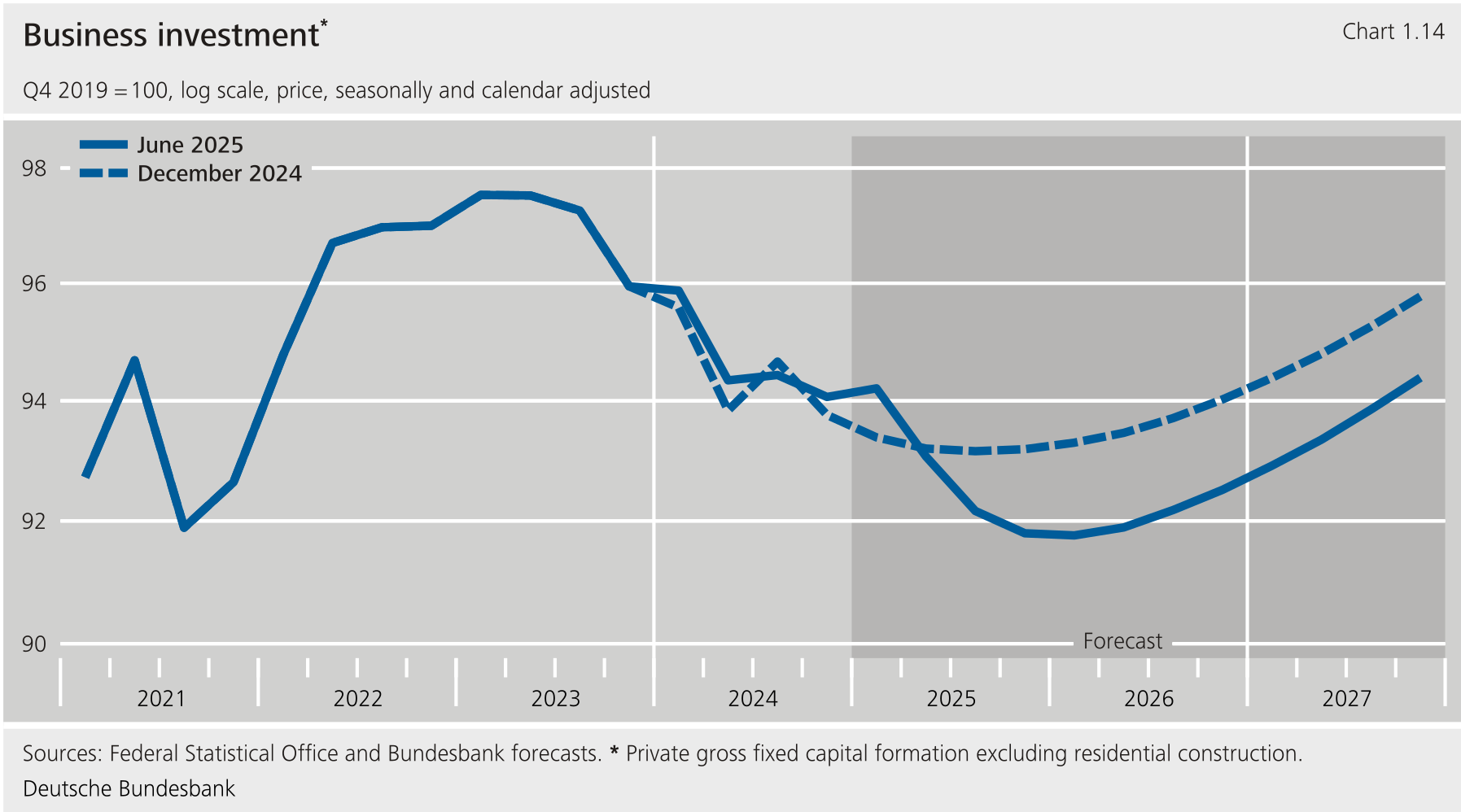
****Business investment is suffering from the bout of economic weakness and persistently high uncertainty and will only make a significant contribution to** **growth again in 2027.** The extremely difficult investment environment that had already been in place last winter has once again deteriorated significantly as a result of the trade policy. Although business investment started 2025 with a slight increase, it is likely to decline sharply from the current quarter onwards. This is indicated by the slight decline in the already low level of new orders for capital goods in the first quarter, as well as the still rather pessimistic business expectations for capital goods producers. As a result of the turmoil and uncertainties surrounding tariff policy, firms are likely to postpone or even completely cut their investment. In addition, tighter lending standards have a distinctly dampening effect. On top of all this is the competitive environment, which has been difficult for German industry for some time now. As a result, capacity utilisation in the manufacturing sector will remain significantly underutilised. This, in turn, will also depress domestic demand for capital goods. Even if, as assumed, the tariff dispute between the United States and the does not intensify from the beginning of July, business investment is expected to decline further in the remainder of 2025. This is because it will probably take some time before the uncertainty surrounding changeable policy has dissipated and firms have adapted their investment plans to the changed international trading environment. Only in the course of 2026 will business investment gradually expand again. This is supported by the recovery in exports, easing uncertainty and perhaps some of the measures in the adopted fiscal package, such as improved write-off provisions and supportive measures regarding energy costs. Capacity utilisation will then also gradually regain strength. Business investment will thus make a significant contribution to growth again in 2027, even though interest rates on loans to enterprises will rise again slightly from mid-2026.**{#par-ii8e82}
{#par-uou5a4}
****
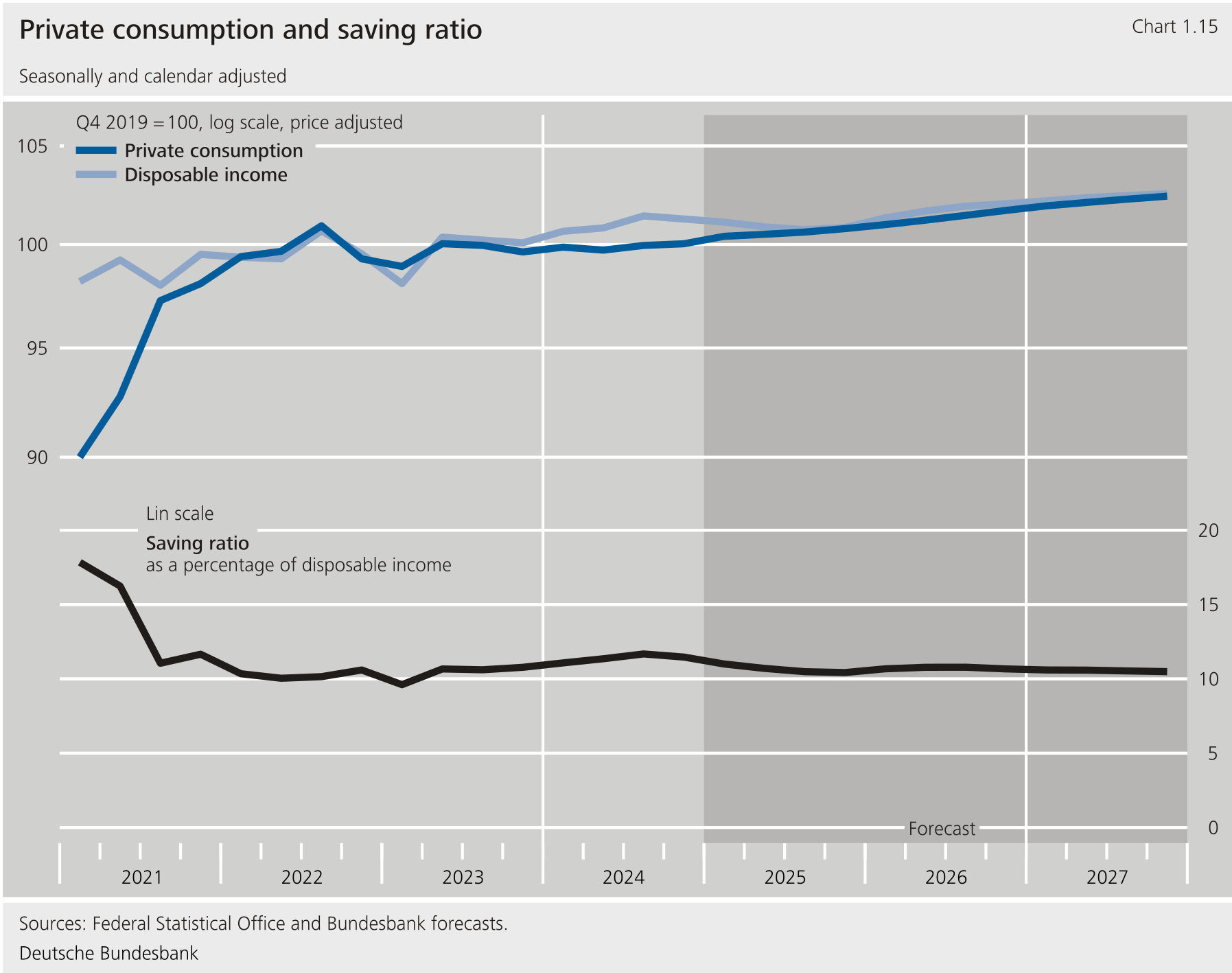
****Private consumption will grow moderately over the entire forecast horizon.** Last year, households did not utilise their relatively large real income gains entirely for consumption purposes. The likely reasons for this are that consumers still perceived inflation as elevated and the price level as high, that wages initially saw only a temporary rise due to inflation compensation bonuses and that the employment outlook had worsened.[\[26\]](#_ftn_root_26) Furthermore, the significant rise in interest rates triggered by the tightening of monetary policy had increased incentives to save. To some extent, high economic and geopolitical uncertainty probably also resulted in greater consumption restraint. On balance, this increased the household saving ratio. However, in the 2024‑25 winter half-year, households had already reduced their saving ratio again somewhat in order to maintain their rising consumption as far as possible despite falling real disposable income. This consumption smoothing is likely to continue this year, and the saving ratio will keep declining. That is because real incomes will continue to fall up to the end of the year, as growth in wages will be hardly any stronger than that in consumer prices, and social contribution rates will rise sharply. At the same time, the formation of the new Federal Government has eliminated a key source of uncertainty from the consumer perspective. The consumer climate indicator rose for the third consecutive time at last report. However, some burdens -- most notably, the period of economic weakness -- are initially set to continue, and the changeable policy has added a new source of uncertainty. Overall, therefore, private consumption will see fairly muted growth from the second quarter of 2025 onwards. In 2026, it will experience somewhat stronger growth -- more or less in line with real disposable income, which will then rise perceptibly. While real disposable income will lose some momentum again in 2027, employment concerns and uncertainty will ease. The saving ratio will then decline somewhat further towards its longer-term average. Accordingly, private consumption will grow somewhat more strongly than real disposable income again in 2027.**{#par-uu8i11}
{#par-u3246u}
****
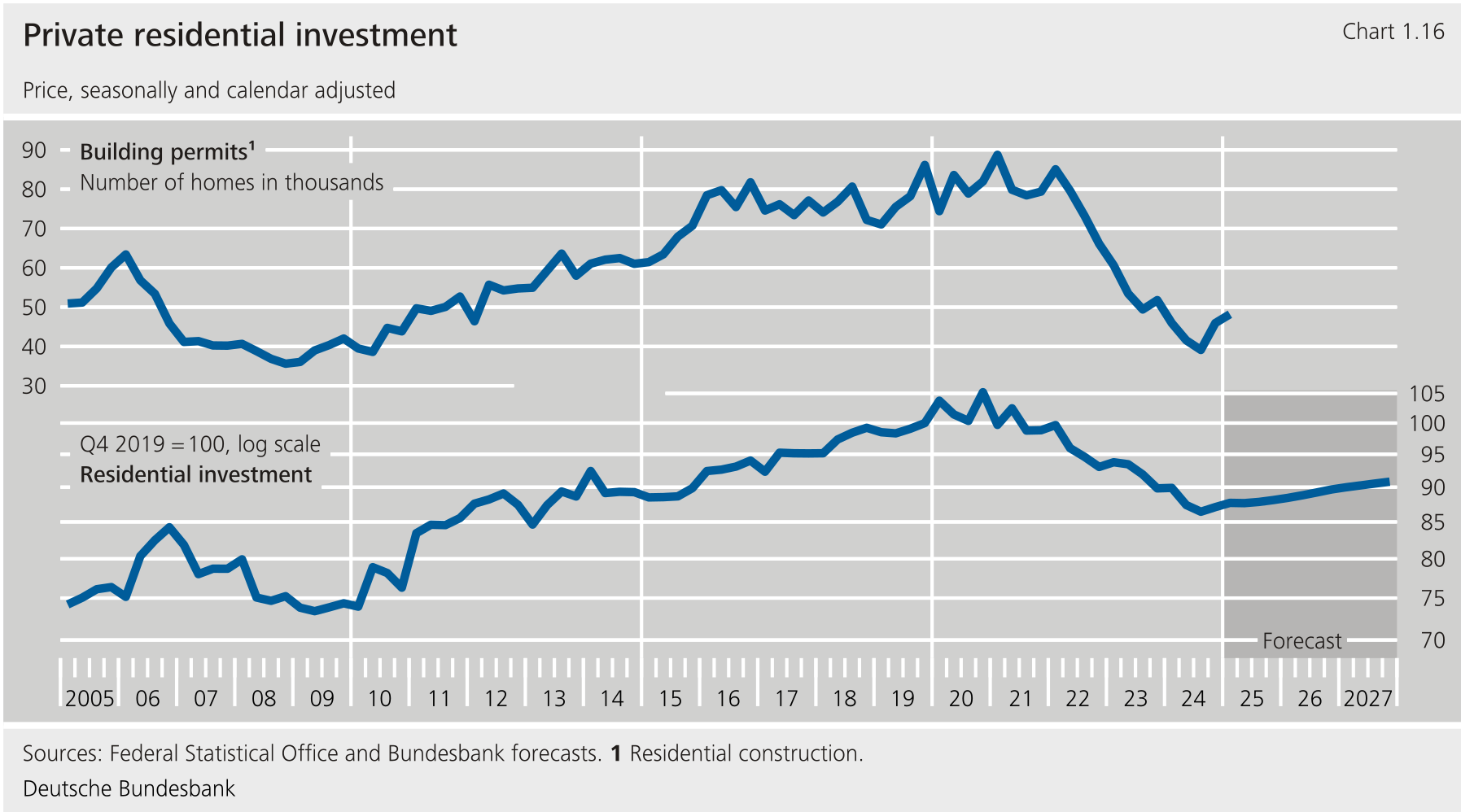
****Housing investment will continue to recover from the second half of 2025 onwards.** There was a turnaround in household construction at the end of 2024, thanks in part to lower financing costs due to monetary policy easing and to the recovery in real household incomes. This occurred somewhat earlier than was predicted in last December's Forecast for Germany. Nevertheless, at last report around two in every five firms in the main construction sector were still reporting a shortage of orders, and equipment utilisation remained significantly below the average of the last ten years. In addition, households' real disposable income has shrunk again somewhat since the end of 2024, and the heightened economic policy uncertainty associated with the changeable policy has worsened investment conditions. Consequently, housing investment will probably only broadly stagnate in the current quarter. However, it will then continue to recover. This is suggested by the fact that demand for construction work has now recovered somewhat from its very low level, and that building permits for housing construction rose sharply in the previous winter half-year. Furthermore, the underlying demand for new housing or home modernisation is high -- not least in light of the heating transition led by climate policy. The pace of growth in housing investment will gradually increase up to mid-2026. This is due to more favourable financing conditions. Beginning in the final quarter of 2025, households' income situation will also improve again. At the end of the forecast horizon, the rise in housing investment will then lose some momentum. This is because, first, long-term interest rates on loans for house purchase will rise again from 2026 onwards and, second, household incomes will increase somewhat more slowly in 2027 than before. In addition, government infrastructure investment will raise demand for non-housing construction investment. This could trigger some crowding-out effects in private housing investment.**{#par-aue2i5}
{#par-ia3476}
****
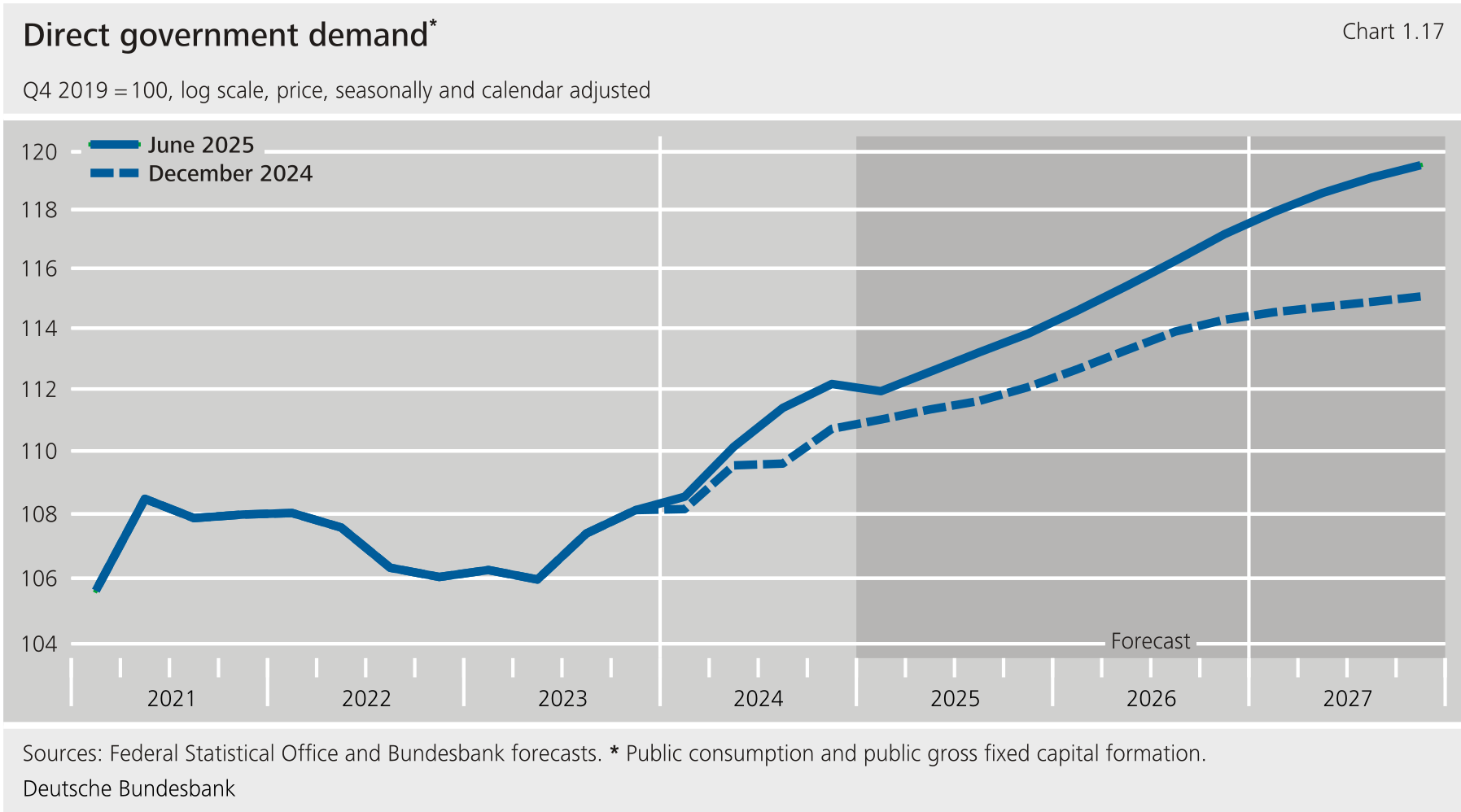
****Real government demand will grow steeply until 2027, as spending on defence and infrastructure will rise significantly.** Government demand will initially rise moderately in 2025. On the one hand, government consumption will continue to rise sharply owing to higher non-cash benefits for healthcare and long-term care. On the other hand, construction investment will grow only marginally owing to the financial constraints of local governments. Projects financed by the Infrastructure Fund will not yet play a role in 2025. Non-cash benefits for healthcare and long-term care will continue to rise dynamically in 2026. Furthermore, expenditure on defence and government infrastructure will then rise sharply (see the section entitled "[Fiscal assumptions](#3.2-Fiscal-assumptions)"). High government demand for military goods and for infrastructure, in areas such as civil engineering, will lead to significantly higher capacity utilisation, and consequently to marked price increases in these areas. This, in turn, will dampen the real volume of goods resulting from the (nominal) additional government expenditure. However, it is assumed that production capacities will still be able to largely meet the higher demand for the amounts assumed here. The price effects on the deflator are therefore limited.**{#par-o39665}
{#par-ou3i5o}
****
****Real imports will increase markedly over the forecast horizon and contribute to a significant decline in the current account balance.** Following a probable slight decline in the 2025 summer half-year in keeping with weak domestic demand, imports will rise sharply by the end of the forecast horizon -- especially in 2027. This is due, first, to the strengthening of demand among households and enterprises as the economy recovers. Second, government demand will rise sharply. In particular, rising government investment in machinery and equipment will be accompanied by increased imports. Exports will grow at a slower pace than imports throughout. In addition to the subdued competitiveness of German exporters, the tariff dispute with the United States will also initially play a role here. As the terms of trade will improve only slightly at the same time, the trade balance (as a share of nominal ) will fall significantly in 2025 and will continue to decline somewhat thereafter. The current account surplus will also decrease considerably over the forecast horizon, from 5.7 % last year to 4.1 % in 2027.**{#par-oii8iu}
**[*Key aspects of the macroeconomic outlook*](#par-i25924)**{#par-a9u72u}
### **3.6 The forecast for the labour market this year**
****The labour market is likely to continue weakening somewhat this year.** The labour market has recently been more robust than was expected in the December Forecast for Germany.[\[27\]](#_ftn_root_27) This, however, conceals a considerable dichotomy in demand for labour. While demand was weak primarily in the manufacturing sector, it remained high in the services sector. Staffing cuts in the manufacturing sector and temporary agency work even intensified. Staffing levels in construction and trade were reduced further, too. In recent months, this fall has been largely offset by rising demand for labour in the services sector. The moderate decline in employment is expected to continue over the next few months.[\[28\]](#_ftn_root_28) The employment barometer for trade and industry remains deep in negative territory. However, as the sectors benefiting from structural change are continuing to hire new staff, the decline in employment should remain limited overall. Nevertheless, the number of reported vacancies continues to decline, and the probability of taking up a new job from a situation of unemployment is low by historical standards. At the same time, there are also signs that the labour market is bottoming out. Neither the labour market barometer nor the employment barometer have fallen any further recently. Against this backdrop, working hours per worker are also likely to remain close to the current subdued level for the time being, as the amount of overtime being worked is only small and balances on working time accounts are being reduced. In addition, the general trend towards more part-time employment is continuing. Labour productivity, having risen only a little since the coronavirus pandemic (in contrast to the previous trend), is also unlikely to recover much this year. Only when the economic recovery begins towards the end of the year will working hours per worker and labour productivity grow. Employment will then also rise again slightly.**{#par-oa561a}
**[*Key aspects of the macroeconomic outlook*](#par-e24a14)**{#par-o351io}
### **3.7 The forecast for negotiated wages this year**
****The rise in negotiated wages is significantly lower in 2025 than in the previous two years.** Since last December's Forecast for Germany, the majority of new wage agreements have entailed lower wage increases than expected at that time. In addition to weak economic activity and lower price increases, wage growth was dampened, in particular, by the "zero months" at the start of the new public sector collective wage agreement for central and local government. Trade unions' wage demands and demand achievement rates are markedly lower than when inflation was at its height. In the wage negotiations affecting around 4½ million employees that are still pending in 2025, lower inflation rates, the continued weak economic activity and lower labour demand are contributing to moderate deals.[\[29\]](#_ftn_root_29) Moreover, the discontinuation of inflation compensation bonuses is dampening wage growth.[\[30\]](#_ftn_root_30) On average over the current year, the expected increase in negotiated wages is therefore only 2.4 %. The Forecast has been revised downwards slightly compared with last December's Forecast for Germany.**{#par-a3o69a}
**[*Key aspects of the macroeconomic outlook*](#par-io4aa5)**{#par-iuae1u}
### **3.8 Inflation forecast up to 2026**
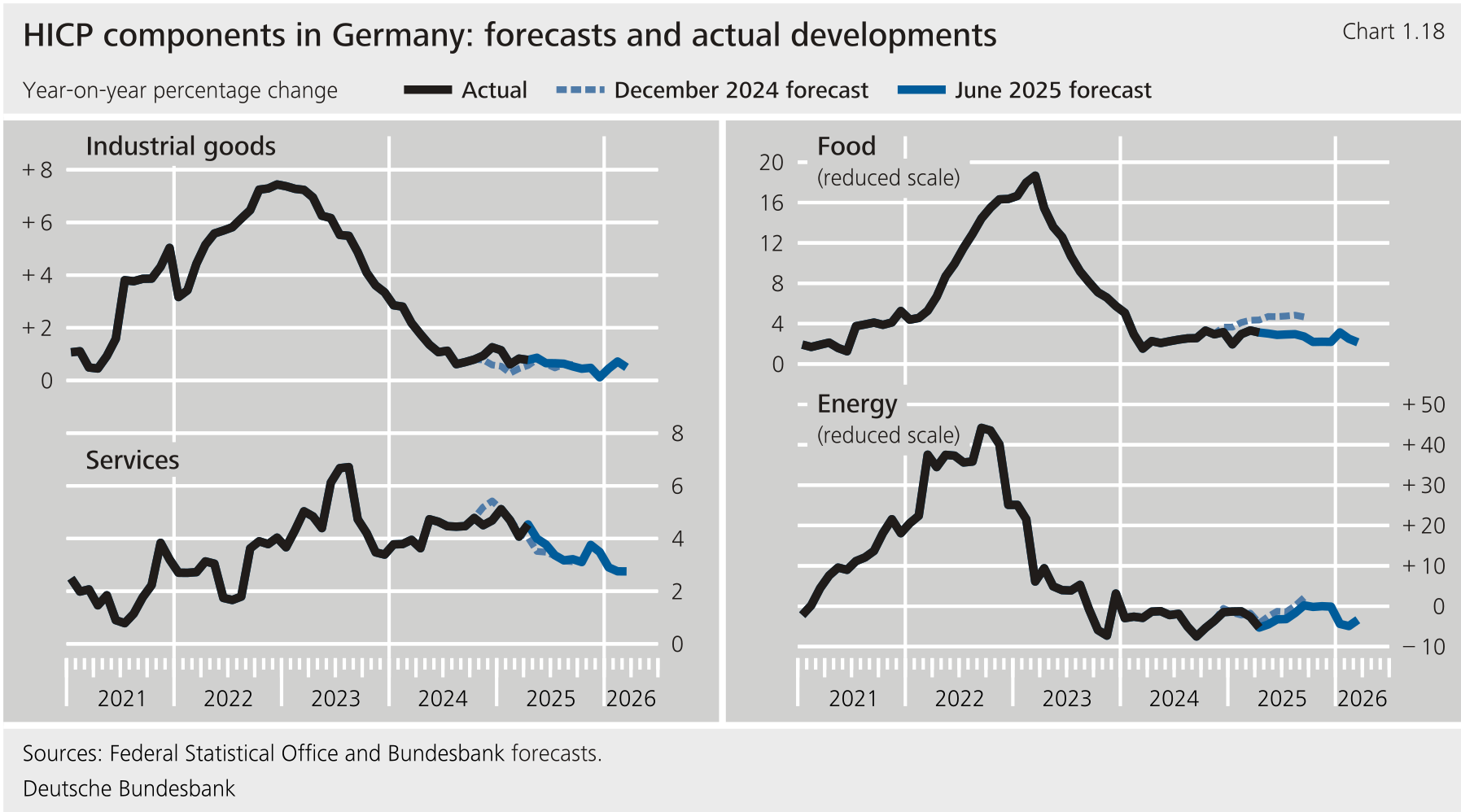
****The rate of inflation has been somewhat lower in recent months than was projected in December.** In May, a flash estimate by the Federal Statistical Office put inflation at 2.1 %, which was 0.1 percentage point below the figure in the December Forecast for Germany. In particular, energy prices, especially for fuel and gas, fell more sharply than expected, as commodity market prices were surprisingly low. Food price inflation was also weaker than expected, however. This was true of both processed and unprocessed foods. By contrast, inflation excluding energy and food (the core rate) rose more sharply than projected. Services, in particular, defied expectations with a significant rise in prices. Administered services prices rose much more sharply than was assumed in December. Additionally, the increase in rents was unexpectedly high.**{#par-ee2a73}
****The inflation rate will fall perceptibly in 2025 and significantly in 2026.** Energy prices for consumers will continue to decline, mainly because forward quotations point to falling crude oil prices. Next year, new price-dampening measures will then push energy prices down. It is assumed that electricity prices will be lowered by 5 ct/kWh at the beginning of 2026 and that the gas storage levy will be abolished. Overall, energy prices will therefore fall even more sharply in 2026 than in 2025 despite the further increase in the carbon price.[\[31\]](#_ftn_root_31) The rise in food prices will decelerate markedly at the end of 2025 and remain below average in 2026. This development is primarily due to processed food. It also reflects the assumed decline in agricultural producer prices for dairy products. By contrast, prices of unprocessed products will continue to rise sharply into next year, as it is assumed that agricultural producer prices for meat will increase. In the services sector, the inflation rate will fall perceptibly this year and substantially in 2026. Here, prices are generally being dampened by weak economic activity. Furthermore, the rise in the price of the Deutschlandticket in January 2025 will no longer be driving up the inflation rate from the beginning of 2026. The pass-through of past cost increases in government services will then probably be largely complete. However, the previously sharp rise in wages will still have repercussions, with a certain time lag.[\[32\]](#_ftn_root_32) Declining wage growth and rising labour productivity are therefore only contributing to lower price pressures with a delay. Rent rises are also expected to ease off, but remain above average by historical standards. This is because existing rents are only slowly being adjusted to the cost surges of recent years. Travel prices are likely to rise slightly this year, driven by demand, before weakening next year owing partly to lagged effects from the appreciation of the euro and the decline in oil prices. Inflation for non-energy industrial goods will fall again markedly this year and rise slightly in 2026 to its average up to 2019. Weak demand and the appreciation of the euro will have a price-dampening effect here. Overall, the rate is expected to decline to 2.2 % in 2025; taking account of the announced government measures to reduce energy prices, it is set to fall to around 1.5 % in 2026. The core rate will decrease from 2.6 % in 2025 to 1.9 % in 2026.**{#par-u2o846}
{#par-e2oua9}
****
**[Key aspects of the macroeconomic outlook](#par-i88o45)**{#par-ooe384}
### **3.9 Key figures of the macroeconomic forecast**
{#par-o25eo3}{#par-o92599}{#par-e12a91}{#par-i2u4a6}{#par-eoi594}{#par-a1i165}{#par-eo12ia}{#par-i6e673}{#par-u6eoi7}{#par-e2667o}{#par-i698i6}{#par-o8aa92}{#par-eu872e}{#par-a27e8u}{#par-uiea4o}{#par-e15a45}{#par-iue474}{#par-e76945}{#par-au27uo}{#par-e89674}{#par-u25322}{#par-au598u}{#par-u92465}{#par-i332e6}{#par-o7i8ia}{#par-i5ioo3}{#par-i17753}{#par-u149aa}{#par-u6iu3u}{#par-ei876i}{#par-ea8o13}{#par-i7i5u5}
| **Table 1.5: Key figures of the macroeconomic forecast** Year-on-year percentage change, calendar adjusted^1^ |||||
| **Item** | **2024^2^** | **2025** | **2026** | **2027** |
|---------------------------------------------|-------------|----------|----------|----------|
| (real) | − 0.2 | 0.0 | 0.7 | 1.2 |
| (real, unadjusted) | − 0.2 | − 0.1 | 1.0 | 1.3 |
| **Components of real** | ||||
| Private consumption | 0.3 | 0.7 | 0.8 | 0.8 |
| Memo item: Saving ratio | 11.4 | 10.7 | 10.7 | 10.6 |
| Government consumption | 3.5 | 2.0 | 1.7 | 1.6 |
| Gross fixed capital formation | − 2.6 | − 0.6 | 1.5 | 2.8 |
| Business investment^3^ | − 2.5 | − 2.0 | − 0.8 | 1.7 |
| Private housing construction investment | − 4.9 | 0.1 | 1.4 | 1.5 |
| Public sector gross fixed capital formation | 2.7 | 3.0 | 9.9 | 9.0 |
| Exports | − 1.0 | − 1.6 | 0.2 | 2.1 |
| Imports | 0.3 | 1.7 | 1.1 | 2.7 |
| Memo item: Current account balance^4^ | 5.7 | 5.1 | 4.4 | 4.1 |
| **Contributions to** **growth^5^** | ||||
| Domestic final demand | 0.4 | 0.6 | 1.1 | 1.4 |
| Changes in inventories | 0.0 | 0.7 | 0.0 | 0.0 |
| Exports | − 0.4 | − 0.7 | 0.1 | 0.8 |
| Imports | − 0.1 | − 0.7 | − 0.4 | − 1.0 |
| **Labour market** | ||||
| Total hours worked^6^ | − 0.1 | 0.0 | 0.5 | 0.7 |
| Employed persons^6^ | 0.2 | − 0.3 | 0.1 | 0.3 |
| Unemployed persons^7^ | 2.8 | 2.9 | 2.9 | 2.7 |
| Unemployment rate^8^ | 6.0 | 6.3 | 6.1 | 5.7 |
| Memo item: unemployment rate^9^ | 3.4 | 3.7 | 3.6 | 3.3 |
| **Wages and wage costs** | ||||
| Negotiated wages^10^ | 6.1 | 2.4 | 2.9 | 2.8 |
| Gross wages and salaries per employee | 5.3 | 2.3 | 2.9 | 3.0 |
| Compensation per employee | 5.2 | 3.1 | 2.9 | 3.2 |
| Real per employed person | − 0.4 | 0.3 | 0.7 | 0.9 |
| Unit labour costs^11^ | 5.6 | 2.9 | 2.3 | 2.2 |
| Memo item: deflator | 3.1 | 2.6 | 2.1 | 2.2 |
| **Consumer prices^12^** | 2.5 | 2.2 | 1.5 | 1.9 |
| Excluding energy | 3.1 | 2.6 | 2.0 | 2.1 |
| Energy component | − 3.2 | − 2.0 | − 3.3 | − 1.1 |
| Excluding energy and food | 3.2 | 2.6 | 1.9 | 2.0 |
| Food component | 2.8 | 2.7 | 2.4 | 2.8 |
{#par-a94118}{#par-a7u922}{#par-o82923}{#par-e9a3e7}{#par-ueuu23}{#par-oe6619}{#par-ia61uo}{#par-uii5u9}{#par-i62841}{#par-ia3o63}{#par-u2475e}{#par-o35a86}{#par-a119u6}{#par-i1ue66}{#par-e75o64}{#par-ea3753}{#par-u9euei}{#par-i525ia}{#par-aa6752}{#par-i52i96}{#par-iu9e27}{#par-o935ia}{#par-eiu85e}{#par-e69397}{#par-aoaa35}{#par-oieoa8}{#par-eo9aao}{#par-u9264u}{#par-o9912u}{#par-iue292}{#par-ou8969}{#par-au49ie}{#par-o8oau1}
| **Table 1.6: Key figures of the macroeconomic forecast -- non-calendar adjusted** Year-on-year percentage change |||||
| **Item** | **2024^1^** | **2025** | **2026** | **2027** |
|---------------------------------------------|-------------|----------|----------|----------|
| (real) | − 0.2 | − 0.1 | 1.0 | 1.3 |
| (real, calendar adjusted) | − 0.2 | 0.0 | 0.7 | 1.2 |
| **Components of real** | ||||
| Private consumption | 0.3 | 0.6 | 0.9 | 1.0 |
| Memo item: Saving ratio | 11.4 | 10.7 | 10.7 | 10.5 |
| Government consumption | 3.5 | 2.0 | 1.7 | 1.6 |
| Gross fixed capital formation | − 2.7 | − 0.7 | 2.1 | 3.1 |
| Business investment^2^ | − 2.7 | − 2.1 | − 0.2 | 2.1 |
| Private housing construction investment | − 5.0 | 0.0 | 2.0 | 1.9 |
| Public sector gross fixed capital formation | 2.7 | 3.2 | 10.6 | 8.9 |
| Exports | − 1.1 | − 1.8 | 0.8 | 2.4 |
| Imports | 0.2 | 1.6 | 1.6 | 2.8 |
| Memo item: Current account balance^3^ | 5.7 | 5.1 | 4.4 | 4.2 |
| **Contributions to** **growth^4^** | ||||
| Domestic final demand | 0.3 | 0.6 | 1.3 | 1.5 |
| Changes in inventories | 0.0 | 0.6 | 0.0 | − 0.1 |
| Exports | − 0.5 | − 0.7 | 0.3 | 1.0 |
| Imports | − 0.1 | − 0.6 | − 0.6 | − 1.1 |
| **Labour market** | ||||
| Total hours worked^5^ | − 0.1 | − 0.1 | 0.8 | 0.8 |
| Employed persons^5^ | 0.2 | − 0.3 | 0.1 | 0.3 |
| Unemployed persons^6^ | 2.8 | 2.9 | 2.9 | 2.7 |
| Unemployment rate^7^ | 6.0 | 6.3 | 6.1 | 5.7 |
| Memo item: unemployment rate^8^ | 3.4 | 3.7 | 3.6 | 3.3 |
| **Wages and wage costs** | ||||
| Negotiated wages^9^ | 6.1 | 2.4 | 2.9 | 2.8 |
| Gross wages and salaries per employee | 5.3 | 2.3 | 2.9 | 3.0 |
| Compensation per employee | 5.2 | 3.1 | 2.9 | 3.2 |
| Real per employed person | − 0.4 | 0.1 | 0.9 | 1.1 |
| Unit labour costs^10^ | 5.6 | 3.0 | 2.0 | 2.1 |
| Memo item: deflator | 3.1 | 2.6 | 2.1 | 2.2 |
| **Consumer prices^11^** | 2.5 | 2.2 | 1.5 | 1.9 |
| Excluding energy | 3.1 | 2.6 | 2.0 | 2.1 |
| Energy component | − 3.2 | − 2.0 | − 3.3 | − 1.1 |
| Excluding energy and food | 3.2 | 2.6 | 1.9 | 2.0 |
| Food component | 2.8 | 2.7 | 2.4 | 2.8 |
{#par-a94118}
**4 List of references** {#tar-5}
---------------------------------
**Benzarti, Y. and D. Carloni (2019), [Who really benefits from consumption tax cuts? Evidence from a large reform in France](https://www.aeaweb.org/articles?id=10.1257/pol.20170504), American Economic Journal: Economic Policy, Vol. 11 (1), pp. 38‑63.**{#par-o5i1ua}
**Deutsche Bundesbank (2025a), [The German economy](https://publikationen.bundesbank.de/content/957532), The German Economy, Monthly Report, May 2025.**{#par-a8u79i}
**Deutsche Bundesbank (2025b), [Public finances](https://publikationen.bundesbank.de/content/957534), Monthly Report, May 2025**{#par-u42oa1}
**Deutsche Bundesbank (2025c), [The German economy](https://publikationen.bundesbank.de/content/957532), The German Economy, Monthly Report, May 2025.**{#par-aoi978}
**Deutsche Bundesbank (2025d), [Global and European setting](https://publikationen.bundesbank.de/content/957526), Global and European Setting, Monthly Report, May 2025.**{#par-e99642}
**Deutsche Bundesbank (2025e), [Financial market environment](https://publikationen.bundesbank.de/content/957530), Monthly Report, May 2025.**{#par-e92a53}
**Deutsche Bundesbank (2025f), [Global and European setting](https://publikationen.bundesbank.de/content/957526), Global and European Setting, Monthly Report, May 2025.**{#par-e16u3a}
**Deutsche Bundesbank (2025g), [The German economy](https://publikationen.bundesbank.de/content/957532), The German Economy, Monthly Report, May 2025.**{#par-uu5ue1}
**Deutsche Bundesbank (2025h), [The German economy](https://publikationen.bundesbank.de/content/957532), The German Economy, Monthly Report, May 2025.**{#par-ai9i97}
**Deutsche Bundesbank (2024a), [Forecast for Germany: Significantly gloomier growth outlook -- inflation decreases to 2%](https://publikationen.bundesbank.de/content/947278), Monthly Report, December 2024.**{#par-e91i23}
**Deutsche Bundesbank (2024b), [Energy efficiency improvements: implications for carbon emissions and economic output in Germany](https://publikationen.bundesbank.de/content/929588), Monthly Report, April 2024.**{#par-ooea53}
**Deutsche Bundesbank (2024c), [Forecast for Germany: Significantly gloomier growth outlook -- inflation decreases to 2%](https://publikationen.bundesbank.de/content/947278), Monthly Report, December 2024.**{#par-e1i193}
**Deutsche Bundesbank (2019), [Outlook for the German economy -- macroeconomic projections for 2020 and 2021 and an outlook for 2022](https://www.bundesbank.de/content/818798), Monthly Report, December 2019, pp. 29‑33.**{#par-u1a3o2}
**European Central Bank (2025), [Eurosystem staff macroeconomic projections for the euro area](https://www.ecb.europa.eu/press/projections/html/ecb.projections202506_eurosystemstaff~16a68fbaf4.en.html), June 2025.**{#par-o75o45}
**European Central Bank (2024), [What explains the high household saving rate in the euro area?](https://www.ecb.europa.eu/press/economic-bulletin/focus/2025/html/ecb.ebbox202408_04~a3209ff6c2.en.html), Economic Bulletin, Issue 8/2024.**{#par-oe12i8}
**Haertel, T., B. Hamburg and V. Kusin (2022), [The macroeconometric model of the Bundesbank revisited](https://www.bundesbank.de/content/888376), Deutsche Bundesbank Technical Paper No 01/2022.**{#par-a5u99i}
**Harju, J. and T. Kosonen (2013). [Restaurant cut: Cheaper meal and more service?](https://papers.ssrn.com/sol3/papers.cfm?abstract_id=2338434), Government Institute for Economic Research Working Papers No 52.**{#par-u7o54i}
**Jurado, K., S. C. Ludvigson and S. Ng (2015), [Measuring uncertainty](https://pubs.aeaweb.org/doi/pdfplus/10.1257/aer.20131193), American Economic Review, Vol. 105(3), pp. 1177‑1216.**{#par-o2632o}
1. **{#_ftn_root_1} Seasonal adjustment here and in the remainder of this text also includes adjustment for calendar variations, provided they can be verified and quantified. On average over the fourth quarter of 2024 and the first quarter of 2025, was only slightly above the level of the 2024 summer half-year.**
2. **{#_ftn_root_2} In the December 2024 Forecast for Germany, a quarter-on-quarter stagnation was expected in both the fourth quarter of 2024 and the first quarter of 2025 (see Deutsche Bundesbank (2024a)).**
3. **{#_ftn_root_3} For more on developments in industry in the first quarter of 2025, see Deutsche Bundesbank (2025a).**
4. **{#_ftn_root_4} Following three consecutive increases at last count, the latest consumer climate indicator, calculated for June, is now markedly above its March level.**
5. **{#_ftn_root_5} The Bundesbank finalised this Forecast for Germany on 21 May 2025. It was incorporated into the projection for the euro area published by the on 5 June 2025. This means that the projection was completed before the latest detailed national accounts data were published on 23 May 2025. Revisions to the national accounts compared with the previous figures published on 25 February 2025 as well as detailed data for the first quarter were therefore not included in the forecast. Similarly, the upward revision of by 0.2 percentage point, in contrast to the flash estimate of 30 April 2025, was not taken into account for the first quarter-on-quarter growth rate. This was presumably mainly due to the surprisingly strong industrial and export data for March that were published at the beginning of May. However, it is hard to determine the extent to which these results are attributable to anticipatory effects in connection with tariffs or a generally stronger underlying cyclical tendency. This makes it difficult to assess future developments.**
6. **{#_ftn_root_6} See Deutsche Bundesbank (2025b).**
7. **{#_ftn_root_7} It should be noted that from the second quarter of 2025 to the end of 2027, the impact also includes rebound effects, which follow on from anticipatory effects in the first quarter of 2025. In addition, in order to determine an overall effect on and inflation, further transmission channels would have to be taken into account, particularly the financial market, the exchange rate and energy commodity prices. However, it would only be possible to identify and avoid the double-entry of data via other transmission channels by making highly restrictive assumptions. These transmission channels are therefore disregarded here.**
8. **{#_ftn_root_8} Although economic policy is having a marked cyclical impact, it will barely hamper potential output growth at all, viewed from the current perspective. The assumed fiscal package will tend to increase estimated growth in potential output (for example, through improved government infrastructure). However, its impact will be small, and in some cases, the positive effects will only materialise after the end of the forecast period. That said, some potentially growth-enhancing measures (to reduce bureaucracy, for instance) have not yet been taken into account, as they are not yet sufficiently fleshed out.**
9. **{#_ftn_root_9} The estimate for potential output growth is thus unchanged from the December 2024 Forecast for Germany.**
10. **{#_ftn_root_10} For more information on labour hoarding developments, see Deutsche Bundesbank (2025c).**
11. **{#_ftn_root_11} Net immigration in 2024 was lower than expected in the Forecast for Germany last December. As there are indications that immigration may decrease further, the assumed figure for 2025 was lowered to 350,000 persons. However, the assumption of a net 300,000 immigrants per year from 2026 onwards was retained.**
12. **{#_ftn_root_12} Monthly actual earnings comprise remuneration for all forms of paid employment. Actual earnings cover both negotiated and non-negotiated wages. In the national accounts, they are recorded as gross wages and salaries per employee.**
13. **{#_ftn_root_13} Wage drift is the deviation between increases in actual earnings and increases in negotiated wages. It is calculated using an index.**
14. **{#_ftn_root_14} Actual earnings for the first quarter of 2025 were published after this forecast was finalised. At + 3.9 % on the year, their growth rate was significantly higher than assumed in the forecast. The main reason for this is likely to be the discontinuation of inflation compensation bonuses in 2025, which apparently dampened negotiated wages to a considerably greater degree than non-negotiated wages and wages outside of collective agreements, which are also included under actual earnings. The unexpectedly sharp rise in wages at the beginning of the year poses a short-term upside risk to wages. As a result, wage drift could also be neutral or slightly positive this year.**
15. **{#_ftn_root_15} It is assumed that -- as was the case with the previous increase -- the statutory general minimum wage will be raised in two steps on 1 January 2026 and 1 January 2027, respectively.**
16. **{#_ftn_root_16} It is assumed that the carbon price in Germany will fall from €65 per tonne under the national system in 2026 to €59 per tonne under the system in 2027. This 2027 price corresponds to the price cap of €45 per tonne in 2020 prices intended for the launch of the system.**
17. **{#_ftn_root_17} If the planned carbon price path remains unchanged and the energy efficiency gains over the past 30 years are extrapolated, the Bundesbank's model simulations from April 2024 conclude that emissions reductions will not meet the intended targets; see Deutsche Bundesbank (2024b).**
18. **{#_ftn_root_18} All of the following data on global economic growth and global trade refer to global aggregates excluding the euro area.**
19. **{#_ftn_root_19} See Deutsche Bundesbank (2025f).**
20. **{#_ftn_root_20} For more information on the trade policy dispute between the United States and China, see also Deutsche Bundesbank (2025d).**
21. **{#_ftn_root_21} Overall, potential failures of current negotiations between the or other countries and the United States on new bilateral trade relationships pose a considerable downside risk to global economic growth and global trade (see also the section entitled "[Risk assessment](#2-Risk-assessment)"). For example, while negotiations are ongoing, the significantly higher tariffs on imports from the are suspended until 8 July. The lower bilateral tariffs between the United States and China are time-limited until 10 August. See also the supplementary information entitled "[The potential impact of a more restrictive US trade policy on the German economy](#Supplementary-information-The-potential-impact-of-a-more-restrictive-US-trade-policy-on-the-German-economy)".**
22. **{#_ftn_root_22} See European Central Bank (2025).**
23. **{#_ftn_root_23} See Deutsche Bundesbank (2024c).**
24. **{#_ftn_root_24} Economic indicators for April that became known after the forecast was finalised support this expectation. Overall industrial output (and also capital goods output) in April was slightly below the level seen in the first quarter of 2025.Price-adjusted goods exports in April fell markedly compared with a strong March, but were still distinctly above the average of the previous quarter. Real retail sales were slightly lower in April, while construction output was significantly higher than in the first quarter.**
25. **{#_ftn_root_25} The administration suspended the "reciprocal" tariffs announced on 2 April 2025, for 90 days starting 9 April. China's corresponding agreement was not made until 12 May 2025.**
26. **{#_ftn_root_26} The recovery in households' real disposable income was driven not only by labour income but also by capital income. The latter tends to be accrued by wealthier households, which, in turn, use a smaller share of their income for consumption purposes. See European Central Bank (2024).**
27. **{#_ftn_root_27} See Deutsche Bundesbank (2025g).**
28. **{#_ftn_root_28} Unemployment figures published after this Forecast was finalised have risen more strongly than expected. However, this is mainly because of smaller-scale labour market policy measures. By contrast, total underemployment, as calculated by the Federal Employment Agency, remained broadly constant in May.**
29. **{#_ftn_root_29} See Deutsche Bundesbank (2025h).**
30. **{#_ftn_root_30} It was possible to pay out tax-free inflation compensation bonuses up to and including 31 December 2024.**
31. **{#_ftn_root_31} See Deutsche Bundesbank (2019).**
32. **{#_ftn_root_32} Very little of the cut on food consumed outside the home planned for January 2026 is likely to be passed on to consumers. This is indicated by past experience with the cut in Germany during the coronavirus pandemic, but also with tax cuts in the food service or hospitality industry elsewhere in the world. See Benzarti and Carloni (2019) or Harju and Kosonen (2013).**
*[EURIBOR]: euro interbank offered rate
*[ECB]: European Central Bank
*[VAT]: value added tax
*[DIHK]: Deutsche Industrie- und Handelskammer
*[**GDP**]: gross domestic product
*[IAB]: Institute for Employment Research
*[GfK]: market research institution
*[ILO]: International Labour Organization
*[ETS2]: Emissions Trading System
*[HICP]: Harmonised Index of Consumer Prices
*[EU]: European Union
*[COVID]: coronavirus disease
*[GDP]: gross domestic product
*[ifo]: economic research institution
*[SVAR]: structural vector autoregression
*[**HICP**]: Harmonised Index of Consumer Prices
*[UK]: United Kingdom
*[**US**]: United States
*[US]: United States