# Public finances
* [*\[1\]*](#tar-1 "[1]")
* *[*1.1 Expansionary fiscal policy adopted*](#tar-2 "1.1 Expansionary fiscal policy adopted")*
* **[*1.2 Higher deficits only partially focused on infrastructure and defence*](#tar-3 "1.2 Higher deficits only partially focused on infrastructure and defence")**
* ***[*1.3 EU rules: Germany has submitted plan*](#tar-4 "1.3 EU rules: Germany has submitted plan")***
* ***[*\[1\]*](#tar-5 "[1] ")***
* ***[*EU rules need to be strictly applied*](#tar-6 "EU rules need to be strictly applied")***
* ***[*\[9\]*](#tar-7 "[9]")
* *[*2.1 Dynamic growth in the first half of 2025 will become more moderate over the remainder of the year*](#tar-8 "2.1 Dynamic growth in the first half of 2025 will become more moderate over the remainder of the year")*
* **[*2.2 Tax relief for enterprises*](#tar-9 "2.2 Tax relief for enterprises")*****
* ***[*3 Central government finances*](#tar-10 "3 Central government finances")
* *[*3.1 Steeply rising deficits planned for 2025*](#tar-11 "3.1 Steeply rising deficits planned for 2025")****
* ***[*Additional debt not focused on defence and infrastructure*](#tar-12 "Additional debt not focused on defence and infrastructure")
* *[*3.2 Deficit in 2025 probably lower than planned*](#tar-13 "3.2 Deficit in 2025 probably lower than planned")****
* ***[](#tar-14 "")
* *[*3.3 Further significant increase in deficit planned for 2026*](#tar-15 "3.3 Further significant increase in deficit planned for 2026")*
* **[*3.4 Fiscal plan up to 2029 contains large deficits and major additional need for action*](#tar-16 "3.4 Fiscal plan up to 2029 contains large deficits and major additional need for action")*****
* ***[*4 State government budgets*](#tar-17 "4 State government budgets")***
* ***[*5 Pension insurance scheme*](#tar-18 "5 Pension insurance scheme")
* *[*5.1 Outlook for 2025 and 2026*](#tar-19 "5.1 Outlook for 2025 and 2026")*
* **[*5.2 Pension policy plans weighing on central government budget*](#tar-20 "5.2 Pension policy plans weighing on central government budget")*****
* ***[*6 Federal Employment Agency*](#tar-21 "6 Federal Employment Agency")***
* ***[*List of references*](#tar-22 "List of references")***
***1 General government budget[^\[1\]^](#_ftn_root_1)*** {#tar-1}
-----------------------------------------------------------------
### **1.1 Expansionary fiscal policy adopted** {#tar-2}
****German fiscal policy is set to enter an expansionary phase following a significant relaxing of the debt brake by legislators. In the current year, however, the deficit looks set to decline initially.** [\[2\]](#_ftn_root_2)Central and state governments will probably still be able to make only limited use of the new fiscal scope, as many measures will require lead time to implement. Spending on pensions, healthcare and long-term care will continue to climb steeply. However, higher contribution rates for the health insurance institutions and the long-term care insurance scheme mean that their revenue will also rise sharply. In addition, revenue from taxes and social contributions will be boosted considerably as tax and social contribution-exempt inflation compensation bonus payments cease and are replaced in part by wages that are subject to regular contributions. Taxes are also subject to other one-off developments, such as the sharp rise in revenue from withholding tax. On balance, the deficit ratio is likely to decline towards 2 % this year (2024: 2.7 %), while the debt ratio will probably increase somewhat (2024: 62.5 %).**{#par-e2631i}
****From 2026 onwards, the deficit and debt ratios will then increase significantly.** **In 2026, the deficit ratio could rise to around 3½ %. In 2027, it could stand at around 4 % in both unadjusted and structural terms.****{#par-oa52e5}
* **Revenue growth will be substantially weaker as the bolstering effect of non-recurring tax-related developments come to an end and tax cuts are made. However, contribution rates to the social security funds are likely to rise further in order to fund additional spending on healthcare, long-term care and pensions. On balance, the structural tax and social contribution ratio could therefore remain more or less stable (at around 42 %) up to and including 2027.**
{#par-i6e3u2}
* **On the expenditure side, the aforementioned additional social security spending will be compounded by growing expenditure on defence, non-military investment and subsidies (e.g. for grid fees). The structural expenditure ratio was already high in 2024, at 49 %, and could rise further by 2027, to 52 %.**
{#par-oa7ou2}
* **The debt ratio could go up to 66 % by end-2027.**
{#par-ia68ie}
****Thus far, there are no signs of a decline in the general government deficit from 2028 onwards.** Central government's fiscal plans still envisage significant additional expenditure on defence (see Table 5.2 below). Aside from this, demographic developments will exert upward pressure on central government social spending, contribution rates and pension grants. The debt ratio is likely to remain on an upward path for the time being. Higher debt and rising average interest rates mean that interest burdens increase step by step.**{#par-a79aao}
### **1.2 Higher deficits only partially focused on infrastructure and defence** {#tar-3}
****A higher deficit will be well manageable for a few years. Persistently high deficits and rising debt ratios would be problematic, however.** This would further restrict future fiscal leeway and would not be compatible with rules.**{#par-a61567}
****Legislators expanded their scope for borrowing in order to strengthen defence capacities and government investment in infrastructure and climate protection. However, a significant part of this scope is now set to be put to other use** (see the section entitled "[Central government finances](#3-Central-government-finances)"). The fact that the expanded scope for borrowing will seemingly be used to plug existing budget gaps and finance projects not related to defence or infrastructure shows that it appears difficult to actually use earmarked funds only for their intended purpose.**{#par-au2uoi}
****Irrespective of this, the deficit and debt ratios will have to fall again in due course following a transitional period in order to safeguard sound public finances.** In particular, the rules require that the debt ratio be brought back to the 60 % reference value in the future. Germany's exemption for defence spending within the framework of the rules ends in 2028. After that, it will be necessary to lower the deficit to reverse the upward trend in the debt ratio.**{#par-oe62o7}
****The announced debt brake reform can be used to derive clear prospects for sound government finances again and to protect government investment on a lasting basis.** The reform elements put forward by the Bundesbank lay out a path that leads back to a rules-based national fiscal policy and preserves the scope for investment.[\[3\]](#_ftn_root_3) To this end, they utilise borrowing limits to head towards a moderate structural general government deficit ratio of around 1 % to 1½ %. This would bring the debt ratio back to the reference value of 60 %. According to the proposals, the scope for borrowing is predominantly reserved for additional government fixed asset formation (measured against a comparable figure from 2024). Other elements will facilitate steady fiscal policymaking without weakening the binding effect of the rules.**{#par-i49iue}
### **1.3 rules: Germany has submitted plan** {#tar-4}
****In addition to the national fiscal rules, Germany must comply with the new fiscal rules at the European level.** To this end, the Federal Government has submitted its medium-term fiscal-structural plan ()[\[4\]](#_ftn_root_4)and has requested use of the exemption for defence spending (national escape clause). The competent European bodies appear to have indicated their agreement to both (the supplementary information entitled "[The EU fiscal guidelines for Germany explained](#The-EU-fiscal-guidelines-for-Germany-explained%5B1%5D-)" supplements the following).**{#par-e3e4a7}
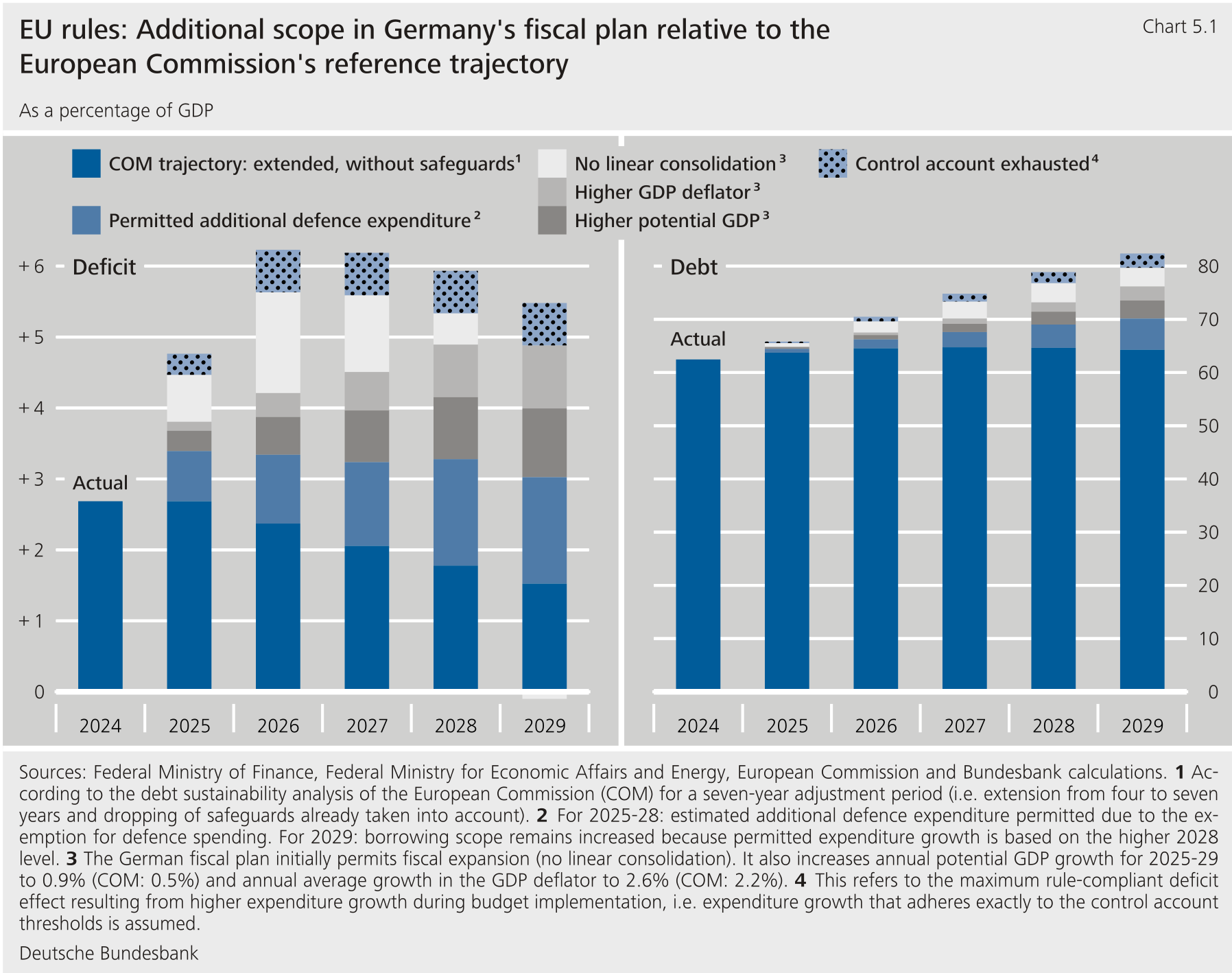
****With its** ,**Germany is requesting extensive fiscal (expenditure) leeway, which will initially permit a very expansionary policy stance** (see Chart 5.1 below).Factors contributing to the considerable leeway are that the :**{#par-o4973i}
* **extends the adjustment period from four to seven years;**
{#par-io21u4}
* **initially assumes increased growth in potential output and the deflator (relative to the European Commission's reference trajectories);**
{#par-u495uu}
* **plans to expand net spending in the first instance and to postpone the necessary consolidation to later years;**
{#par-i644o2}
* **suspends the safeguards that are intended, amongst other things, to ensure a minimum decline in the debt ratio.**
{#par-ui193u}
****Furthermore, Germany is making recourse to the exemption for defence spending, facilitating additional debt-financed defence spending.** The defence exemption is designed (for all Member States) in such a way that it continues to increase the scope for expenditure after the end of 2028: the agreed expenditure growth rates are based on the higher expenditure level. The does not yet take into account the sectoral exemption for defence spending, neither does it provide any information on defence expenditure planned on top of this. In this respect, the reported deficit and debt ratios are too low.**{#par-i85614}
{#par-iu8e27}
****
****In view of the particular challenges that it is currently facing, it is understandable that Germany has turned to the exemption for defence spending.** [\[5\]](#_ftn_root_5) Under the rules, the additional defence expenditure permitted under this exemption will be appropriately defined and time-limited (which contrasts with the German debt brake).**{#par-ouua15}
****Germany's extension of the adjustment period to seven years also makes sense.** However, this extension requires a reform package to justify it. Key parts of this package have yet to be fleshed out. It remains to be seen whether the targets for investment, employment and the reduction of bureaucracy, for example, will be achieved.[\[6\]](#_ftn_root_6)**{#par-uae538}
****In other areas, the rules are being stretched to a critical extent in order to create much greater fiscal scope.****{#par-i5euu2}
* ****Over the term of the****(2025 to 2029), estimated growth in potential****and the****deflator is implausibly high,** at 0.9 % (throughout) and 2½ % (on average) for the . These figures are significantly higher than in the current central government plan and in the assumptions on which the European Commission bases its reference trajectories. A transitional provision in the rules allows potential growth to be smoothed out. However, there is no convincing case for using this provision in such a way.**
{#par-i4i441}
* ****Defence spending aside, consolidation is being put on the back burner.**Generally, the rules in place envisage consolidation taking place linearly in annual steps. The , by contrast, initially goes so far as to adopt an expansionary stance and shifts the planned consolidation to the back end of the adjustment period. By then, it will already be the responsibility of the next Federal Government to enact this consolidation during budget implementation. If governments continue to postpone taking the steps towards achieving sound government finances, fiscal rules will become meaningless.**
{#par-eioo1o}
****On the basis of the** ,**the deficit ratio could, in the meantime, reach around 6 % in line with the rules if Germany makes use of the expanded scope for expenditure. The debt ratio could then rise to 80 % by 2029** (see [Chart 5.1](#par-i85614) above).[\[7\]](#_ftn_root_7)The additional (estimated) scope for deficits arising from the defence exemption and the higher nominal growth compared with the Commission's assumptions[\[8\]](#_ftn_root_8) will build up over time. The scope resulting from the postponed consolidation is temporary, reaching its peak in 2026 and 2027. Additional deficits are also possible during budget implementation, provided that they do not exceed the limits of the control account.**{#par-i58eo4}
****Overall, the** **and the defence exemption give such a great amount of fiscal scope that the current central government plan could be compatible with them by 2029** (for more information on the plan, see the section entitled "[Central government finances](https://preview.publikationen.bundesbank.de/publikationen-en/reports-studies/monthly-reports/monthly-report-august-2025-962902?article=public-finances-962900#3-Central-government-finances)"). On the basis of the Commission's original figures for the requirements, central government planning would not have been compatible -- not even with the exemption for defence spending. Deficit ratios would there probably have peaked at 3½ % to adhere to the rules. The debt ratio would then have reached around 70 %.**{#par-o92562}
**The fiscal guidelines for Germany explained[\[1\]](#_ftn_42df9864_1)** {#tar-5}
---------------------------------------------------------------------------------
****With its medium-term fiscal-structural plan** ()**and exemption for defence spending, the Federal Government is requesting significant flexibility to build up debt and deficits under the** **rules.** This supplementary information explains how the provides greater flexibility than the calculations of the European Commission (hereinafter referred to as the Commission). [Chart 5.1](#par-iu8e27) shows the Commission's starting calculations and this additional scope.**{#par-aoa169}
****Introduction to****guidelines****{#par-a2591o}
****First, the Commission issues reference trajectories.**These trajectories spell out maximum net expenditure[\[2\]](#_ftn_42df9864_2) growth rates with which countries must comply over an adjustment period. At the end of the period, the aim is for a budget target to be achieved for the structural primary balance. Put simply, the target is set in such a way that, given certain assumptions, certain requirements are met in a debt sustainability analysis (). The budget target ensures that safeguard requirements are also met. Safeguards are minimum requirements for developments in the debt ratio and structural primary balance over the adjustment period. As a general rule, the reference trajectories cover an adjustment period of four years. This can be extended to up to seven years, provided the country commits to major reforms.**{#par-e169a3}
****Based on their reference trajectories, Member States submit an**.**If it is endorsed by the Council, the net expenditure growth ceiling in the****is considered binding.** The Member States initially negotiate their bilaterally with the Commission. They may deviate from the reference trajectories, but they must justify this. The does not necessarily span the entire adjustment period; instead, it covers the first four or five years of it.**{#par-ia178u}
****The exemption for defence spending allows for a certain level of deviation from the** **ceilings.****{#par-o68e13}
* **This deviation for the purpose of defence spending is kept in check in two ways: (1) it is capped at 1.5 % of per year, usually compared with the 2021 spending level; (2) it only applies to defence spending according to the "classification of the functions of government" () definition in the national accounts. In contrast to the German debt brake, the additionally permitted debt-financed defence spending is thus appropriately defined.[\[3\]](#_ftn_42df9864_3)**
{#par-u533a1}
* **The escape clause exempting defence spending is activated from 2025 to 2028. However, it accommodates higher general deficits and expenditure (not just for defence) not only up to 2028, but also beyond: starting in 2029, the maximum net expenditure growth rates will be based on 2028 expenditure levels, which will have been elevated due to the exemption for defence spending.**
* **Furthermore, the Commission and the Council provide additional flexibility for countries with activated escape clauses: the maximum net expenditure growth rates in their (excluding the exemption for defence spending) no longer have to respect the safeguards. This means that, up to 2028, escape clause activation for higher defence spending may also result in higher non-defence spending.[\[4\]](#_ftn_42df9864_4)**
{#par-e95eo8}
****How the** **rules are applied in the German****{#par-ui55i9}
**The starting point for showing how the rules are applied in the German is the Commission's reference trajectory for the standard case of a four-year adjustment period including safeguards.**{#par-e19iue}
****The extension of the adjustment period to seven years and recourse to of the exemption for defence spending** [\[5\]](#_ftn_42df9864_5)**increase scope for spending:****{#par-i691o8}
****1. The seven-year adjustment period** lowers the budget target that is being pursued for the structural primary balance[\[6\]](#_ftn_42df9864_6) and prolongs the consolidation timeline. In the Commission's reference trajectories, the annual consolidation steps decrease from 0.94 % of for a four-year adjustment period to 0.46 % for seven years. Such an extension requires a package of reform and investment commitments, which must meet various criteria. To this end, the government pointed to elements of reforms that are planned or have already been adopted.**{#par-ou65iu}
****2. Due to the dropping of the safeguards,** consolidation steps shrink further to 0.26 % per year. Here, Germany makes use of the additional flexibility offered to countries that have activated their escape clauses (see above).**{#par-u2o7oo}
****3. The exemption for defence spending itself** enables the net expenditure growth ceilings agreed in the to be exceeded to the extent described above.**{#par-u1oo8o}
****Chart 5.1 shows the scope for deficits with an extended adjustment period and no safeguards as a starting point. The deficit ratio is thus below the reference value of 3 %.** This chart element (" trajectory") shows the relevant values provided by the Commission to Germany.**{#par-ou6eoi}
****Added to this are estimated effects of permitted additional defence spending. This raises the deficit ratio and, in some years, it is slightly over 3 %.** In the scenario calculation with additional permitted defence expenditure, the debt ratio rises to 70 % by 2029.**{#par-ue4727}
****Further deviations of the** **from the Commission's reference trajectory substantially increase the scope for spending again:****{#par-a68779}
****4. The estimated potential****growth rates for 2025 to 2029 are significantly higher in the****than in the reference trajectory (0.9 % instead of 0.5 % on average).**[\[7\]](#_ftn_42df9864_7) The Federal Government makes use of a transitional provision in the European rules, under which the Member States may use "more stable series" for potential growth in their first . They are supposed to justify this with economic arguments. The government justifies it by pointing to the positive effects of new measures on investment and capital stock, referring to more recent assessments. Comparative estimates for potential growth rates using conventional methods and with similarly high values do not appear to be available. In addition, the budgetary and fiscal plan for the budget recently adopted by the Federal Government contains lower figures. According to the plan, too, potential growth will only increase by an average of 0.5 % between 2025 and 2029. The potential growth rates calculated by the Bundesbank for these years are similar.[\[8\]](#_ftn_42df9864_8)**{#par-ue373o}
****5. The estimated GDP deflator growth rates for 2025 to 2029 are significantly higher than in the reference trajectory (2.6 % instead of 2.2 % on average).** In its Forecast for Germany for 2026 and 2027, the Bundesbank expects deflator rates similar to those of the Commission (just over 2 %).[\[9\]](#_ftn_42df9864_9)**{#par-aa7i32}
****6. The****not only postpones consolidation, but even allows for an initially expansionary stance through 2026** (without this being due to permitted additional defence spending). The required consolidation commences at a later stage and then also needs to be more ambitious -- ultimately, it was shifted to the next legislative period. By contrast, the rules generally provide for linear consolidation. In addition, the rules require that cumulative consolidation over the period covered by the be proportional to the total consolidation over the (four to seven-year) adjustment period. According to the rules, the duration of the must be matched to the duration of the legislative period. However, Germany only achieves the required proportionality by drafting the not for four years, but for five.**{#par-oa4574}
****With the last three deviations, the deficit ratio could temporarily reach around 6 % in line with the rules. The debt ratio could thus rise to around 80 % by 2029 (see Chart 5.1).** These calculations assume that Germany exhausts its spending capacity, but that the Commission's more plausible assumptions for potential and the deflator materialise.**{#par-i2a41i}
****The flexibility outlined so far relates to the** .**Further leeway may arise during budget implementation.** [\[10\]](#_ftn_42df9864_10)Chart 5.1 also illustrates this (element labelled "Control account exhausted"): a country may exceed the limits to a certain extent during budget implementation without having to correct the budget effect of this deviation later. To this end, the Commission maintains a control account for each country: deviations of up to 0.3 % of in a single year or 0.6 % cumulatively do not trigger a course correction. If the country makes full use of this flexibility, deficits can be 0.6 % of higher than assumed in the from the second year of the onwards. This is because the permitted net expenditure growth rates are based on the respective previous year's figures, which are inflated during budget implementation. If Germany were to exhaust its control account, this would, taken by itself, raise the debt ratio by 2½ percentage points by 2029.**{#par-ia18e6}
1. **{#_ftn_42df9864_1} The rules are very complex. This supplementary information does not attempt to give a precise and detailed explanation of these rules and guidelines. Instead, terms, guidelines and methods are presented in a simplified manner where they give context to Germany's .**
2. **{#_ftn_42df9864_2} Net expenditure is government expenditure net of several expenditure categories and the revenue effects of discretionary revenue measures.**
3. **{#_ftn_42df9864_3} The definition is narrower than the budgetary areas referenced by the defence-related debt brake exemption. In addition, the exemption for defence spending adequately ensures that only additional defence spending is exempted from the regular provisions of the fiscal framework. See Deutsche Bundesbank (2025a), supplementary information entitled "[Public finances](https://publikationen.bundesbank.de/content/957534)".**
4. **{#_ftn_42df9864_4} This applies to Germany. For most other Member States, it is not the safeguards that limit net expenditure growth, but other requirements. One reason for this is that the safeguards are suspended as long as a country is under an .**
5. **{#_ftn_42df9864_5} In this context, the lacks transparency, or is at the very least misleading: it does not disclose the deficit and debt effects of defence spending additionally permitted by the exemption -- even as a memo item. As a result, it paints a far too favourable picture of deficits and debt. It would be helpful to outline the net expenditure growth ceilings plus all planned defence spending, as well as the corresponding deficit and debt ratios.**
6. **{#_ftn_42df9864_6} This is due to the sharp rise in ageing-related expenditure in the coming years. In the case of a seven-year adjustment period, a fairly large part of this increase occurs within the adjustment period and needs to be financially offset during this time. Therefore, a lower structural primary balance at the end of the adjustment period is sufficient to achieve the necessary subsequent decrease in the debt ratio.**
7. **{#_ftn_42df9864_7} Under the new rules, the higher the assumed nominal growth (all else being equal), the higher the net expenditure growth ceilings. Nominal growth is derived from assumptions about potential , the deflator and the output gap.**
8. **{#_ftn_42df9864_8} In relation to the overall period covered by the , the potential growth rates assumed by the Commission when calculating its reference trajectories also appear very ambitious: the annual average rates are 0.9 % (2025‑29: 0.5 %, 2030‑41: 1.0 %). In its latest estimates, the Bundesbank expects 0.4 % per year up to 2034, with sufficiently concretised parts of announced measures already taken into account. For more information on the included fiscal package, in particular, see Deutsche Bundesbank (2025b). Further measures, such as lower administrative costs and accelerated processes, would therefore have to have very significant effects on potential growth.**
9. **{#_ftn_42df9864_9} See Deutsche Bundesbank (2025b).**
10. **{#_ftn_42df9864_10} In addition, leeway may arise in the ex post evaluation of compliance with the rules. See the supplementary information entitled " rules need to be strictly applied" for recommendations on limiting this scope.**
11. {#_ftn_42df9864_11}
****Initial experience with the reformed** **rules confirms that they are very complex and lack transparency.** The rules leave a great deal of room for manoeuvre when it comes to deriving country-specific fiscal limits. It is very difficult to understand how this scope is used, as the rules are complex and information is not easily accessible. It is equally difficult to assess whether a country's plans are compatible with the rules, and how the European Commission will assess compliance with the rules in concrete terms. With regard to the latter, there is, again, considerable room for manoeuvre. As before, it remains crucial that plans and rules are strictly applied and monitored going forward. Otherwise, the reformed rules will become meaningless and will fail to achieve their objective of promoting sound public finances (see the supplementary information "[EU rules need to be strictly applied](#EU-rules-need-to-be-strictly-applied)").**{#par-i29ua7}
**rules need to be strictly applied** {#tar-6}
----------------------------------------------
****The existing** **fiscal rules need to be consistently geared towards sound government finances.**The following measures could help in this regard:**{#par-a472e6}
* ****Member States implement their plans rigorously -- and the Commission is rigorous in monitoring them. Key considerations here include the following: i)** Fiscal surveillance does not give an optimistic assessment of the budget effects of revenue-related measures in order to comply with budget limits. **ii)** If, in its fiscal surveillance, the Commission identifies deviations, it will actually take the procedural steps that have been set out. In other words, it will not attempt to exploit exemptions, and it will increase the pressure to make adjustments.**
{#par-aoio42}
* ****Future plans will be drawn up in strict compliance with the existing rules: i)** The national escape clauses that have now been activated will not be extended. Escape clauses are an important feature of fiscal rules. However, they must not be a permanent fixture, or else sound government finances would be put at risk. The current escape clause should therefore only serve to facilitate the transition to higher defence spending. It is important to finance what will probably be higher structural spending in the future without borrowing. Defence capabilities and sound government finances are not diametrically opposed. Both are needed to ensure a country's resilience. **ii)** The safeguards apply as agreed. This means that, once the escape clause has been deactivated, the constraints for the net expenditure path will become binding again. It was, in any case, inappropriate to use the escape clause for defence spending to also allow scope for additional general spending. **iii)** Net expenditure growth ceilings spread the planned adjustment steps evenly. A government cannot postpone consolidation requirements past its term. **iv)** Key macroeconomic assumptions, such as potential and the deflator, are verified as plausible by an independent institution -- and this is done for each individual year. The assumptions are rather conservative, especially where debt ratios are high.**
{#par-e185oi}
****The binding force of the rules also increases with greater transparency and less fiscal space.** This can be achieved by making changes in various areas, including:**{#par-a8i1iu}
* ****Member States publish their reference trajectories as soon as they receive them from the Commission.****
{#par-a2eae2}
* ****The Member States' plans disclose expected deficit and debt developments.** They explain what scope for spending results from which deviations from the reference trajectory. This information is updated if conditions change (e.g. if the escape clause was activated after the plan was drawn up).**
{#par-e74419}
* ****The Commission makes all assumptions available in a public database.** Data from the Commission and from the Member States that are used to derive respective adjustment paths are publicly accessible.**
{#par-i4568o}
* ****The Commission updates the assumptions whenever it conducts fiscal surveillance.** It provides a clear picture of how deficit and debt ratios will develop based on current assumptions if a Member State hits its net expenditure ceilings.**
{#par-ui4iu4}
* ****Inaccurate estimates are corrected at an earlier stage:** As part of ongoing fiscal surveillance, the assumptions on which plans were based are also assessed. In the event of major revisions to the assumptions, the net expenditure growth ceilings for the following years are adjusted with the aim of at least partially correcting the budget effects of inaccurate estimates.**
{#par-i2ie78}
* ****The control account is maintained permanently.** It is not set to zero with a new . It remains open until the budget target has been achieved.**
{#par-a3a484}
**2 Tax revenue[^\[9\]^](#_ftn_root_9)** {#tar-7}
-------------------------------------------------
### **2.1 Dynamic growth in the first half of 2025 will become more moderate over the remainder of the year** {#tar-8}
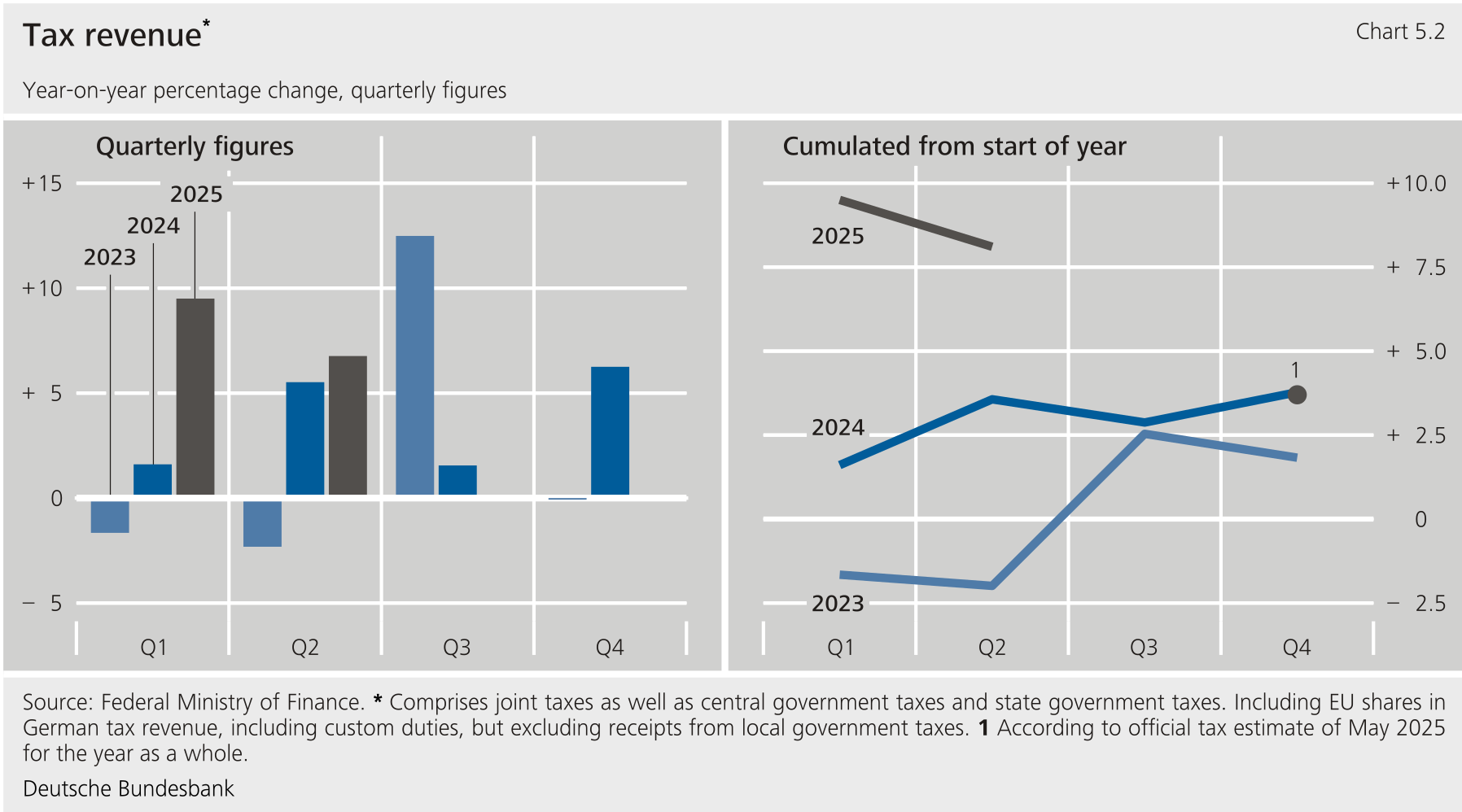
****Up to the end of June 2025, tax revenue rose by a dynamic 8 %** **(+€34 billion)****compared with the first half of the previous year. However, growth rates are likely to weaken substantially in the second half of the year.****{#par-o41651}
* ****Wage tax** grew by 6 % in the first half of the year, partly because taxable wage elements replaced tax-free wage elements (inflation compensation bonuses) to some extent. This effect is likely to ease up in the second half of the year.**
{#par-eooeo5}
* **receipts likewise increased significantly (+6½ %). Lower growth is now expected here, too: for one thing, in a year-on-year comparison, legislative changes last affected revenue positively in the first half of 2025. In particular, a reduced tax rate on natural gas and district heating was applicable until the end of March 2024. For another, extensive back payments were received in the second half of 2024. Such extensive back-payments are unlikely to be made in 2025.**
{#par-oe3o3e}
* ****Revenue from the taxing of interest income and capital gains** rose sharply. This is likely to have been attributable in particular to capital gains. In the second half of the year, the tax estimate did not anticipate any further growth compared with the same period of the previous year.**
{#par-u79u42}
* ****Inheritance tax** also contributed to the strong half-year growth (+€4 billion on the first half of 2024). This was evidently due to a one-off effect in Bavaria.**
{#par-oa18e2}
****For 2025 as a whole, from today's perspective, it appears possible that tax revenue will slightly exceed the official tax estimate of May (+3½ %, excluding local government taxes).** [\[10\]](#_ftn_root_10) The May estimate did not include the newly adopted tax relief measures for enterprises (see the section "[Tax relief for enterprises](#2.2-Tax-relief-for-enterprises)"). In practice, however, these measures will not yet dampen revenue this year anyway.**{#par-o8o9a8}
{#par-a49149}
****
{#par-e447oe}{#par-ea7e99}{#par-i425a2}{#par-o86i6e}{#par-a484i8}{#par-e55317}{#par-ao63uu}{#par-ue1385}{#par-e31553}{#par-e63e7i}{#par-a48896}{#par-ie9a3e}{#par-u41e4a}
|-----------------------------------------------------------|----------|-------|---------------|--------|------------------------------------------|
| **Table 5.1: Tax revenue** ||||||
| {#par-i2ea2a} {#par-i2ea2a} {#par-i2ea2a} **Type of tax** | |||| {#par-a8i81e} **Estimate for 2025 ^1)^** |
| {#par-i2ea2a} {#par-i2ea2a} {#par-i2ea2a} **Type of tax** | **2024** | **2025** ||| {#par-a8i81e} **Estimate for 2025 ^1)^** |
| {#par-i2ea2a} {#par-i2ea2a} {#par-i2ea2a} **Type of tax** | {#par-aouee9} **€ billion** || **Year-on-year change** || **Year-on-year change** |
| {#par-i2ea2a} {#par-i2ea2a} {#par-i2ea2a} **Type of tax** | {#par-aouee9} **€ billion** || **€ billion** | **%** | **%** |
| ||||||
| Total^2^ | 414.0 | 447.6 | + 33.6 | + 8.1 | + 3.7 |
| of which: | |||||
| Wage tax^3^ | 119.8 | 127.1 | + 7.4 | + 6.2 | + 4.4 |
| Profit-related taxes | 83.6 | 90.1 | + 6.4 | + 7.7 | − 0.7 |
| | |||||
| Assessed income tax ^4^ | 33.9 | 36.9 | + 3.0 | + 8.8 | + 0.3 |
| Corporation tax^5^ | 20.5 | 19.8 | − 0.7 | − 3.5 | − 10.0 |
| Non-assessed taxes on earnings | 19.4 | 18.9 | − 0.5 | − 2.5 | − 4.9 |
| Withholding tax on interest income and capital gains | 9.8 | 14.5 | + 4.7 | + 47.6 | + 22.0 |
| ^6^ | 144.9 | 154.2 | + 9.4 | + 6.5 | + 3.2 |
| Other consumption-related taxes^7^ | 43.8 | 48.3 | + 4.5 | + 10.2 | + 7.8 |
| Sources: Federal Ministry of Finance, Working Party on Tax Revenue Estimates and Bundesbank calculations. **1** According to official tax estimate of May 2025. **2** Comprises joint taxes as well as central government taxes and state government taxes. Including shares in German tax revenue, including customs duties, but excluding receipts from local government taxes. **3** Child benefits and subsidies for supplementary private pension plans deducted from revenue. **4** Employee refunds and research grants deducted from revenue. **5** Research grants deducted from revenue. **6** and import . **7** Taxes on energy, tobacco, insurance, motor vehicles, electricity, alcohol, air traffic, coffee, sparkling wine, intermediate products, alcopops, betting and lotteries, fire protection and beer. ||||||
{#par-u49o72}
### **2.2 Tax relief for enterprises** {#tar-9}
****Legislators have adopted various measures to improve investment conditions for firms.** Corporation tax will thus fall in increments of 1 percentage point per year from 2028 onwards. As from 2032, the corporation tax rate will then be 10 %. For corporate profits subject to income tax, the tax on retained earnings will decline in steps from 2028 onwards. Furthermore, enterprises can make use of accelerated depreciation options for movable assets -- provided that they purchase them by the end of 2027. Accelerated allowances are also available for electric vehicles (75 % depreciation rate in the year of purchase). In addition, legislators are expanding tax funding for research grants.**{#par-aii943}
****The planned measures are generally suited to making Germany more attractive as a corporate investment location.** The fact that the corporation tax rate will only fall from 2028 onwards puts the initial focus on promoting investment with accelerated write-downs. This means that some depreciation deductions can be made on investments while tax rates are higher, and future profits will be subject to the lower tax rates. The more generous research allowance will increase incentives to invest in innovation in Germany -- with limited revenue losses.[\[11\]](#_ftn_root_11)**{#par-e3461a}
****The legislative package will result in significant but, in part, only temporary tax shortfalls.** In the years 2026 to 2028, this means that tax revenue will grow by ½ percentage point less on an annual average. The revenue shortfalls resulting from lowering the corporation tax rate will then continue to rise significantly. In its final stage in 2032, the corporation tax rate will be 5 percentage points lower than at present. Currently, 5 percentage points is equivalent to annual revenue of €23 billion (including the solidarity surcharge, 2½ % of total tax revenue in 2025). Accelerated write-downs will initially reduce revenue significantly: shortfalls will peak in 2028, reaching €12½ billion. From 2029 onwards, they will decline again, and in the long term, subsequent additional revenue will largely compensate for the initial revenue shortfalls. This is because in the event of higher write-downs, tax-relevant profits are initially lower, but become later higher. Permanent tax relief for enterprises classified as corporations follows from the interplay of accelerated write-downs and lower corporate tax rates.**{#par-a83127}
**3 Central government finances** {#tar-10}
-------------------------------------------
### **3.1 Steeply rising deficits planned for 2025** {#tar-11}
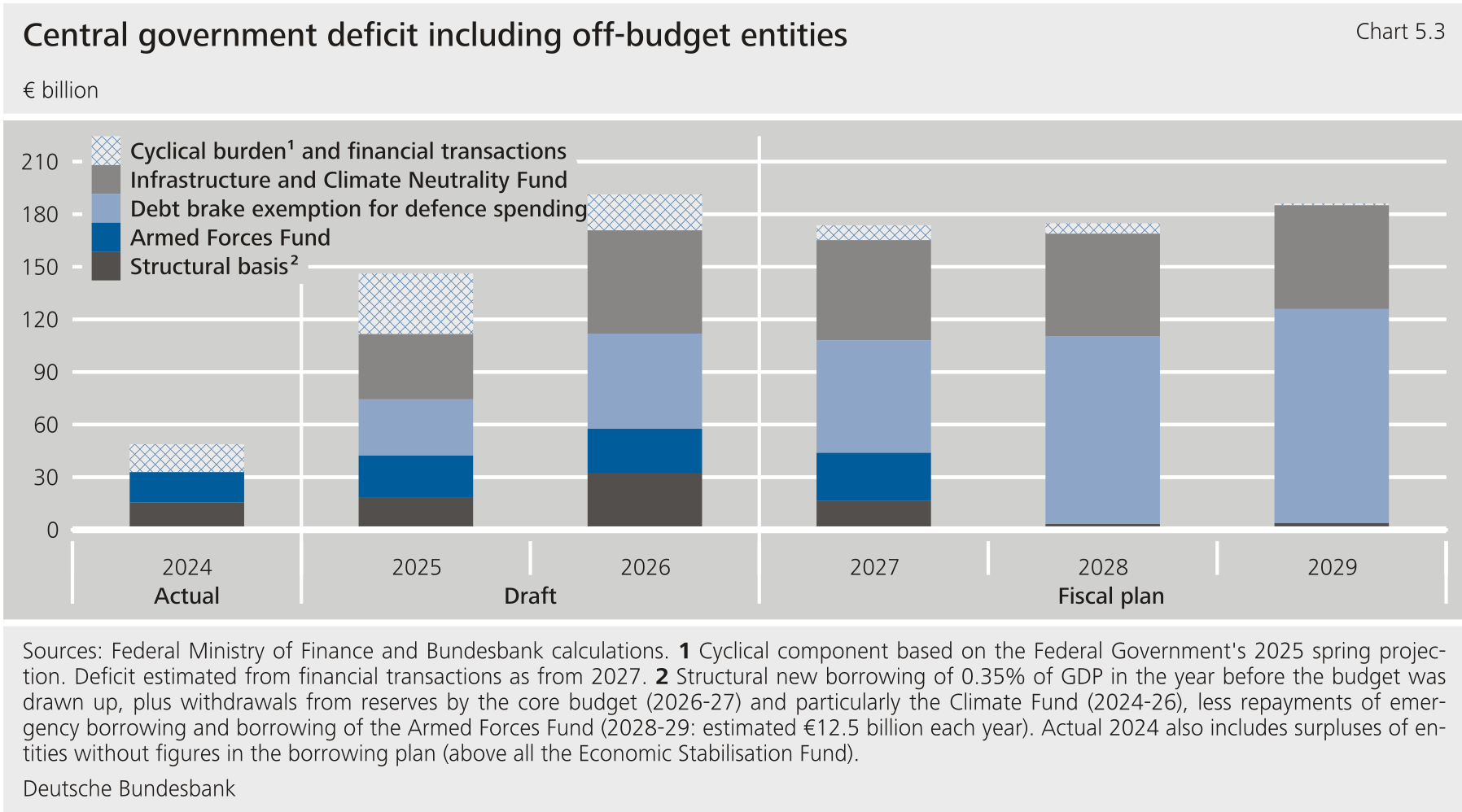
****The new Federal Government is planning to see steeply rising deficits in the core budget and off-budget entities in 2025.** [\[12\]](#_ftn_root_12) The overall deficit is expected to increase from €49 billion in 2024 to €146 billion in the current year (see [Table 5.2](#par-ao5u5o) for these and the subsequent figures, overall deficit: item 1.d). Central government deficits are thus considerably higher than planned by the previous Federal Government in the summer of 2024 (total deficit at that time: around €90 billion).**{#par-iu42i4}
****The high deficits are possible because legislators eased the debt brake considerably in March.** [\[13\]](#_ftn_root_13) With the aim of strengthening defence capabilities and government investment, they expanded the scope for borrowing: with the sectoral exemption for defence spending, central government can now make unlimited use of debt financing to finance defence spending exceeding 1 % of [\[14\]](#_ftn_root_14) in the core budget (and in addition, the Armed Forces Fund still had a remaining borrowing authorisation of €77 billion at the beginning of the year (see Table 5.2, item 3.b); apparently in view of commitments already made, this will be used up by the end of 2027). There is an additional debt financing volume of €500 billion for the Infrastructure and Climate Neutrality Fund, which will extend over 12 years.**{#par-a53993}
****The deficit for the 2025 financial year is structured as follows.****{#par-o1a1i8}
* ****The net borrowing limit, which is taken from the original debt brake, is tied to a deficit of €50 billion.** Debt-financed deficits of €15 billion are thus permissible in line with the structural net borrowing limit of 0.35 % of , together with €18 billion for calculated cyclical burdens and just over €16 billion for financial transactions (see Table 5.2, items 2.f2, 2.d and 2.e).**
{#par-ai8435}
* ****Added to this is the deficit from the expanded scope for defence spending: the government plans to use this in the core budget with an additional deficit of €32 billion (see Table 5.2****, item 2.f1).** It calculates a total figure of €75 billion for spending by the Federal Ministry of Defence, military support for Ukraine and other domestic security-related purposes. Of this, it deducts €43 billion (1 % of 2024 ) to be financed within the regular borrowing limits.**
{#par-o6uu93}
* ****The Armed Forces Fund envisages a borrowing-financed deficit of €24 billion (see Table 5.2****, items 3.a and 1.b2).****
{#par-i5o17e}
* ****The new Infrastructure and Climate Neutrality Fund envisages a borrowing-financed deficit of €37 billion (see Table 5.2****, items 3.c and 1.b1).****
{#par-u2io9i}
* ****The other special funds will be less of a consideration, according to the plan (Table 5.2****, items 1.b3 and 1.b4).****
{#par-e48oia}
{#par-o28u14}
****
{#par-u76126}{#par-oo254i}{#par-i21585}{#par-u5a146}{#par-ooa52a}{#par-eooeao}{#par-ea9173}{#par-i17ou3}{#par-u192u3}{#par-e69832}{#par-i28447}{#par-e35562}{#par-i964a8}{#par-a1u112}{#par-ui6e34}{#par-o78oee}{#par-e6597a}{#par-o61aoa}{#par-o93315}{#par-ao287o}{#par-e18io5}{#par-i1u68u}{#par-oo51i9}{#par-ei2192}{#par-ooo4aa}{#par-e14258}{#par-ua31oa}{#par-u92ii3}{#par-ae137e}{#par-aa9o59}{#par-uo6oai}{#par-e17a37}{#par-iiu6io}{#par-uao433}{#par-i657e6}{#par-a18848}{#par-o54867}{#par-u4a1ui}{#par-u77a36}{#par-oe6ouu}{#par-io5882}{#par-oo5a85}{#par-eu9i13}{#par-ooa333}{#par-o6272a}{#par-uuu154}{#par-ue238e}
|-----------|---------------------------------------------------------------------------------------|-----------------|-------------|------------|----------|----------|----------|
| **Table 5.2: Key central government budget data\*** € billion (unless otherwise indicated) ||||||||
| **Item** || **Actual 2024** | **2025 D2** | **2026 D** | **2027** | **2028** | **2029** |
| **1.** | **Fiscal balances** (surplus: +, deficit: -) | ||||||
| **1.a** | **Core budget** | − 25.0 | − 81.9 | − 99.7 | − 89.3 | − 116.7 | − 127.1 |
| **1.b** | **Off-budget entities with borrowing plan figures¹** | − 43.2 | − 64.4 | − 91.6 | − 84.6 | − 58.4 | − 59.2 |
| | of which: | ||||||
| 1.b1 | Infrastructure and Climate Neutrality Fund | - | − 37.2 | − 58.9 | − 57.1 | − 58.4 | − 59.2 |
| 1.b2 | Armed Forces Fund | − 17.2 | − 24.1 | − 25.5 | − 27.5 | . | . |
| 1.b3 | Climate and Transformation Fund | − 23.1 | − 3.9 | − 2.1 | . | . | . |
| 1.b4 | Other^2^ | − 3.0 | 0.8 | − 5.2 | . | . | . |
| **1.c** | **Off-budget entities without borrowing plan figures^1,3^** | 19.5 | . | . | . | . | . |
| **− 1.d** | **Central government total** (1.a + 1.b + 1.c) | − 48.7 | − 146.3 | − 191.4 | − 173.9 | − 175.1 | − 186.3 |
| **2.** | **Balances relevant to the debt brake (core budget)** | ||||||
| 2.a | Transfer to (-)/withdrawal from reserves (+) (as from 2027: e) | - | - | 9.7 | 1.0 | - | - |
| 2.a-n | Memo item: Level of general reserves | 10.7 | 10.7 | 1.0 | - | - | - |
| 2.b | Coin seigniorage (as from 2027: e) | 0.2 | 0.1 | 0.2 | 0.2 | 0.2 | 0.2 |
| 2.c | Net borrowing (-)/repayment (+)^4^ (1.a + 2.a + 2.b) | − 24.8 | − 81.8 | − 89.9 | − 88.1 | − 116.5 | − 126.9 |
| 2.d | Balances relevant to the debt brake (core budget) | − 20.6 | − 18.2 | − 12.9 | − 8.2 | − 3.9 | - |
| 2.d-n | *nachrichtlich: Konjunkturkomponente Bundesbank* | 1.5 | − 6.1 | − 5.4 | − 3.2 | . | . |
| 2.e | Balance of financial transactions (as from 2027: e)^6^ | − 1.4 | − 16.4 | − 7.6 | − 0.3 | − 2.1 | − 1.1 |
| 2.f | Structural net borrowing (-)/repayment (+)^7^ (2.c. -- 2.d. -- 2.e) | − 18.7 | − 47.1 | − 69.4 | − 79.6 | − 110.5 | − 125.9 |
| 2.f1 | Sectoral exemption for defence spending | - | − 32.1 | − 54.3 | − 64.2 | − 107.2 | − 122.1 |
| 2.f1-n | *Memo item: Additional defence spending vis-à-vis Actual 2024^8^ (e)* | - | 11 | 29 | 39 | 80 | 94 |
| 2.f2 | Structural net borrowing (-)/repayment (+) excluding sectoral exemption (2.f -- 2.f1) | − 18.7 | − 15.1 | − 15.1 | − 15.4 | − 3.3 | − 3.8 |
| 2.g | Standard limit of 0.35 % of ^9^ | − 5.9 | − 15.1 | 15.1 | − 15.4 | − 3.3 | − 3.8 |
| 2.g-n | *Memo item: Overshoot (+)/undershoot (-)* | − 3.1 | - | - | - | - | - |
| 2.h | Balance on control account^10^ | 55.7 | 55.7 | 55.7 | 55.7 | 55.7 | 55.7 |
| 2.i | Total outstanding repayment amount including Armed Forces Fund (as from 2028: e)^11^ | 349.4 | 373.5 | 398.9 | 426.4 | 413.9 | 401.4 |
| 2.i-n | *Memo item: Total outstanding repayment amount from grants (e)^12^* | 65 | 92 | 118 | 118 | 114 | 111 |
| **3.** | **Net borrowing of off-budget entities (outside the debt brake)** | ||||||
| 3.a | Net borrowing of Armed Forces Fund | − 17.2 | − 24.1 | − 25.5 | − 27.5 | - | - |
| 3.b | Borrowing authorisation remaining thereafter | 77.0 | 52.9 | 27.5 | - | - | - |
| 3.c | Net borrowing of Infrastructure and Climate Neutrality Fund | - | − 37.2 | − 58.9 | − 57.1 | − 58.4 | − 59.2 |
| 3.c-n | Memo item: Increase in infrastructure investment vis-à-vis Actual 2024^13^ | - | 4.7 | 17.2 | . | . | . |
| 3.d | *Borrowing authorisation remaining thereafter* | - | 462.8 | 403.9 | 346.8 | 288.4 | 229.2 |
| **4.** | **Additional core budget figures** | ||||||
| 4.a | Expenditure^14^ | 465.7 | 503.0 | 520.5 | 507.5 | 546.4 | 572.1 |
| | of which: | ||||||
| 4.a1 | Investment | 56.7 | 62.7 | 56.1 | 48.6 | 46.9 | 46.5 |
| 4.a2 | Investment (excluding financial transactions, as from 2027: e) | 50.8 | 45.4 | 47.7 | 46.6 | 46.4 | 44.7 |
| 4.a3 | Investment in central government infrastructure^13^ | 30.9 | 20.8 | 23.9 | . | . | . |
| 4.a4 | Investment ratio (relevant for Infrastructure and Climate Neutrality Fund)^15^ | 11.6 | 10.0 | 10.4 | 10.6 | 10.6 | 10.0 |
| 4.a4-n | Memo item: of which financed via sectoral exemption for defence | - | 2 | 3 | . | . | . |
| 4.a5 | Interest | 34.2 | 30.2 | 30.3 | 41.3 | 55.3 | 66.5 |
| 4.a6 | Global spending increases/cuts (as from 2027: action required according to the media) | - | − 5.7 | − 8.4 | − 34 | − 64 | − 74 |
| 4.b | Revenue^14,16^ | 440.6 | 421.1 | 420.8 | 418.3 | 429.8 | 445.1 |
| | of which: | ||||||
| 4.b1 | Tax revenue^17^ | 375.0 | 386.8 | 383.8 | 400.6 | 412.3 | 423.9 |
| 4.b2 | From | 13.5 | . | 10.6 | . | . | . |
| 4.b3 | Global revenue increases/shortfalls | - | − 1.1 | − 4.2 | . | . | . |
| \* Sources: Federal Ministry of Finance and Bundesbank calculations. For methodological notes, see Deutsche Bundesbank (2016).**1** Only the off-budget entities for which central government publishes monthly cash data are included. In particular, corporations such as Autobahn and the infrastructure and regional transport branches of Deutsche Bahn are thus excluded. Budgeted figures in accordance with borrowing plan. **2** In particular, the Fund to Promote Municipal Investment, Fund for Primary School-Age Childcare Provision and (up to 2024) the Digitalisation Fund. **3** In particular, the Economic Stabilisation Fund and civil servants' pension funds. **4** For Actual 2024, in deviation from the figure in the budget accounts: excluding supplement for repaid emergency borrowing (deficit also accordingly lower than in the budget account). **5** For 2024, according to the budget accounts (as at March 2025), thereafter according to the Federal Government's 2025 spring forecast. **6** As from 2027, estimated in such a way that the reported net borrowing fully exhausts the limits of the debt brake; as from 2028, taking into account repayment of emergency borrowing and Armed Forces Fund borrowing of €12.5 billion per year. **7** In deviation from the budget accounts: including cyclical component in accordance with the 2025 spring forecast to prevent a distorted depiction of structural development. **8** Expenditure growth in core budget derived from planned rise in target quotas to 2.4 % in 2025, 2.8 % in 2026 and 3.5 % in 2029 vis-à-vis reported Actual 2024 of 2.0 %, after deduction of Armed Forces Fund. **9** Based on the of the year before the budget was drawn up (for the 2025 and 2026 draft budgets: 2024). In 2024 minus repayments of emergency borrowing of €8.5 billion. As from 2028: minus repayments of emergency borrowing and Armed Forces Fund borrowing totalling €12.5 billion (e). **10** Prior-year level less amount by which the standard limit is overshot (2.g-n), provided that the escape clause was not activated. **11** Prior-year level plus amount by which the standard limit is overshot (2.g-n), provided that the escape clause was activated, plus net borrowing of the Armed Forces Fund (-3.a), from 2028 onwards minus repayments in accordance with the repayment plan. **12** budgeted figures and estimates (as from 2025), each multiplied by Germany's share of 25 % in gross national income. From 2028 onwards, minus equal repayments over 31 years. 13 Investment in central government infrastructure, financed from the core budget and for 3.c-n also from the Infrastructure and Climate Neutrality Fund: all non-financial asset formation and investment grants to federal enterprises such as Deutsche Bahn and Autobahn and public sector institutions such as for the expansion of Germany's broadband network (from the classification scheme: main category 7, groups 81 and 82, items 891 and 894). **14** Excluding transfers to/withdrawals from reserves and excluding the deductibles listed in footnote 17. **15** The Federal Government deems the additionality of credit-financed expenditure of the Infrastructure and Climate Neutrality Fund to be fulfilled if the budgeted figure amounts to at least 10 %. **16** Excluding coin seigniorage. **17** After deduction of supplementary central government transfers, state government shares of energy tax revenue, state government compensation under the 2009 reform of motor vehicle tax and budgetary recovery assistance to federal states (Bremen and Saarland). ||||||||
{#par-ao5u5o}
{#par-eia6oe}
**Additional debt not focused on defence and infrastructure** {#tar-12}
-----------------------------------------------------------------------
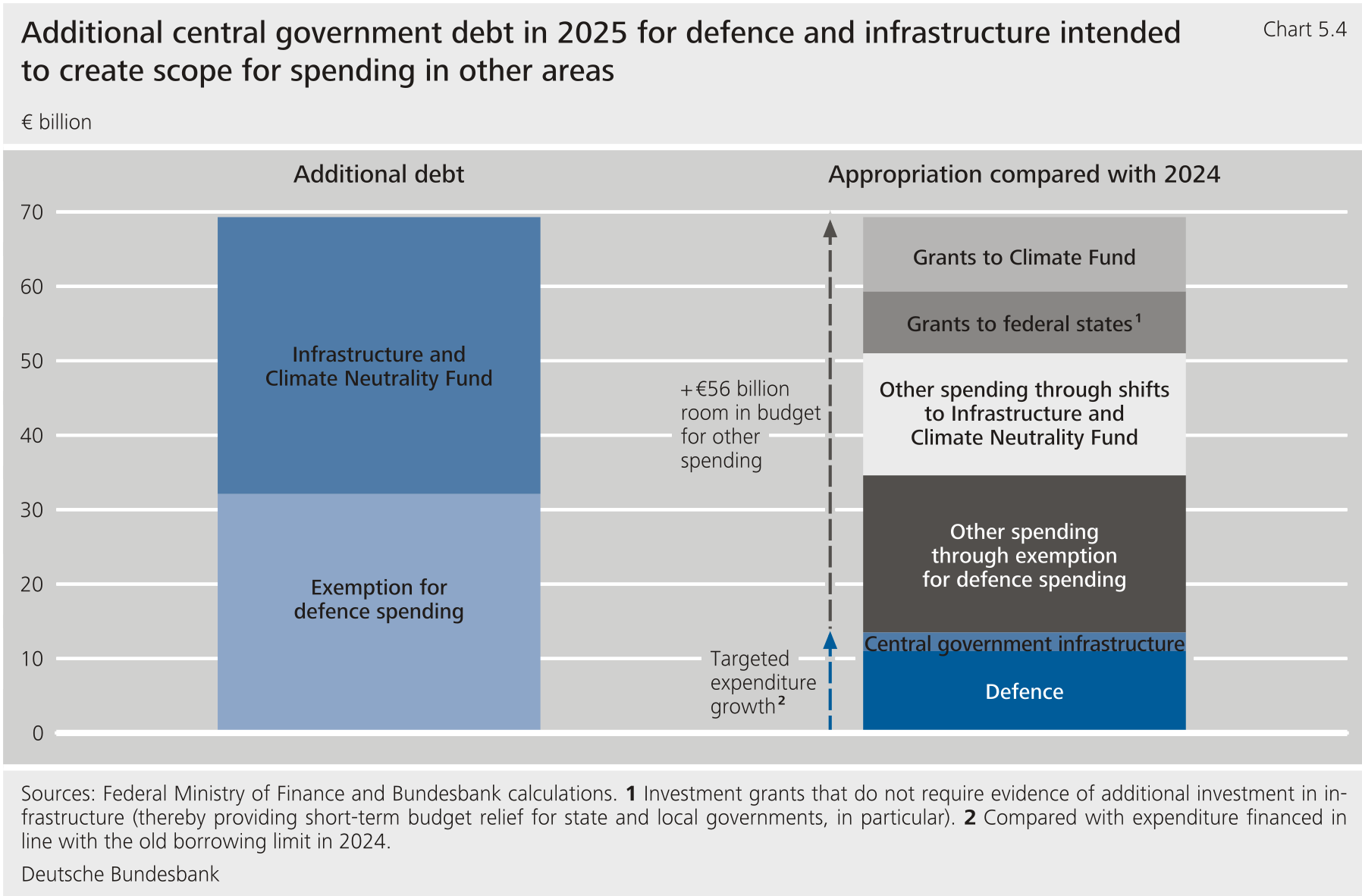
****Given the current situation, it makes sense to bolster defence capabilities and infrastructure through borrowing. However, it appears that the new scope for borrowing is being used to a considerable degree to create other fiscal leeway** (see Chart 5.4).**{#par-ei3e99}
****This is possible, in particular, because the additionality criteria for defence and investment spending have not yet been adequately formulated.** Neither the thresholds (10 % minimum investment ratio in the core budget and the "1 % of " threshold for defence spending) nor the expenditure taken into account in each case are an exact fit for this. Ultimately, central government can use additional borrowing to fund extensive expenditure items that it had already financed in the 2024 budget from the scope of the old debt brake, or additional expenditure less tied to the two objectives. However, this then does not represent additional expenditure intended to address the present challenges (for more details on how specifically this can create leeway, see Deutsche Bundesbank (2025a), "Stability-oriented adaptation of relaxed debt brake"). The following examples also illustrate how scope for borrowing is intended to be used in different ways:**{#par-u18552}
* **In the draft budget for 2025, the minimum investment ratio of 10 % in the core budget is achieved precisely (see Table 5.2, item 4.a4), and central government can therefore spend funds from the Infrastructure and Climate Neutrality Fund. To calculate the ratio, spending on the sectoral exemption for defence is deducted (from total expenditure) in the denominator, resulting in a higher ratio. It would make sense to deduct the investment budgeted for the sectoral exemption (especially in the defence budget) from the numerator as well. However, there is no intention to do this. Consequently, this investment is financed by debt through the sectoral exemption. Since it is nonetheless included in the 10 % minimum investment ratio, corresponding scope for other purposes is created (see Table 5.2, item 4.a4-n).**
{#par-u96814}
* **In addition, the planned figures for investment in the 2025 draft appear exaggerated. Not least, the government has set up a new precautionary item for investment in the amount of €1½ billion. It intends to use this to finance investment budgeted for in previous years that has not yet been disbursed. Up to now, the norm has been lower general provisioning not classified as being for investment purposes. To prevent investment from being included in the minimum ratio multiple times in a row or from being overbudgeted, the investment disbursed in the respective year should ultimately be the decisive factor.**
{#par-o69auo}
* **In the wake of the recent tax cuts for firms, state governments asked for compensation for their tax revenue shortfalls. Central government promised them a further €8 billion from the Infrastructure and Climate Neutrality Fund. However, the state governments do not have to use these funds for additional investment, but can instead use funds already reserved for the respective investment items in other ways.**
{#par-u7e7uo}
****Overall, then, there is a risk that debt will mount without an equivalent increase in defence capabilities and infrastructure.****{#par-e4i395}
* ****Improving defence capabilities: compared with the actual 2024 level,****expenditure within the scope of the sectoral exemption is expected to increase by around €20 billion less than the related borrowing.** The planned increase in expenditure is used here (pragmatically) as a benchmark for additional defence spending. expenditure will only increase by around €11 billion (after deducting the additional expenditure of the Armed Forces Fund, which will also be financed by debt; see Table 5.2, item 2.f1-n). By contrast, central government is planning on additional scope for borrowing of €32 billion for the defence spending sectoral exemption (see Table 5.2, item 2.f1). Revenue of the defence ministry, which is expected to amount to €1½ billion, would in fact also have to be deducted from this. It appears that there are no plans as yet to make such a deduction.**
{#par-eao834}
* ****Improving infrastructure: the difference between expenditure growth and borrowing is likely to be even greater for the Infrastructure and Climate Neutrality Fund.** Its borrowing is expected to amount to €37 billion (see Table 5.2, item 3.c). However, central government's planned investment spending for infrastructure[\[1\]](#_ftn_40a4b882_1) (core budget and special fund combined) will rise only slightly compared with the 2024 result, by around €2½ billion (see Table 5.2, item 3c-n less 4a4-n). The special fund's investment transfers to state government (€8½ billion) are not intended to be conditional on additional infrastructure improvements. Given the sizeable deficits in the budgets of state and local governments, it is to be feared that they will instead use the funds reserved for them in the special fund to plug existing financing gaps. The Climate Fund will receive €10 billion from the special fund without any major new measures being envisaged to strengthen infrastructure or reduce greenhouse gas emissions. Instead, it plans mainly to close a financing gap in the gas storage levy, thereby lowering prices for gas consumption.**
{#par-oi9u93}
{#par-ui8269}
****
****If the additional debt is really meant to be used to strengthen defence and infrastructure, it would make sense to have much better safeguards than currently planned.**To this end, the envisaged implementation rules for the new borrowing scope would have to be adjusted. To start with, the sectoral exemption for defence spending could be applied only to expenditure above the 2024 level (excluding the Armed Forces Fund). Central, state and local governments should only be able to get funds from the Infrastructure and Climate Neutrality Fund if an appropriately defined investment ratio increases on balance from the 2024 figure (see footnote 13 in the main article for a suitable definition for central government). The laws on the special fund have not yet been passed, and budget plans can still be modified. If the debt were only used for additional spending on defence and infrastructure, scope for other expenditure and tax relief would have to be created in the budget -- or these measures would have to be forgone. This is politically ambitious. However, it would be consistent with the objectives formulated when the scope for borrowing was significantly expanded.**{#par-e16589}
****The above commentary also illustrates how opaque and incomprehensible central government finances have become.** Considerable improvements could readily be made by shifting expenditure from special funds back to the core budget,[\[2\]](#_ftn_40a4b882_2) more clearly defining metrics for the debt brake, and making documentation on this clear and understandable.**{#par-u4766u}
1. **{#_ftn_40a4b882_1} Included as infrastructure investment: all construction work and acquisitions of non-financial assets (based on the budget classification table: main category 7 and groups 81 and 82) as well as investment grants to central government enterprises such as Deutsche Bahn and Autobahn (recorded via classification number 891) and to public institutions such as for the expansion of the mobile network (recorded via classification number 894). Excluded: financial transactions (capital injections and lending, groups 83 as well as 85 and 86 -- also excluded in central government's account), as well as calls on guarantees, investment grants under development aid, to private enterprises and other government authorities (classifications 87, 896, 892 and 88). Also deducted: investment in the core budget which is now being financed by borrowing for the sectoral exemption (around €2 billion, not reported as an aggregate in the planning documents).**
2. **{#_ftn_40a4b882_2} From an operational budgetary perspective, too, there is no good justification for shifting expenditure to special funds; see Deutsche Bundesbank (2023).**
### **3.2 Deficit in 2025 probably lower than planned** {#tar-13}
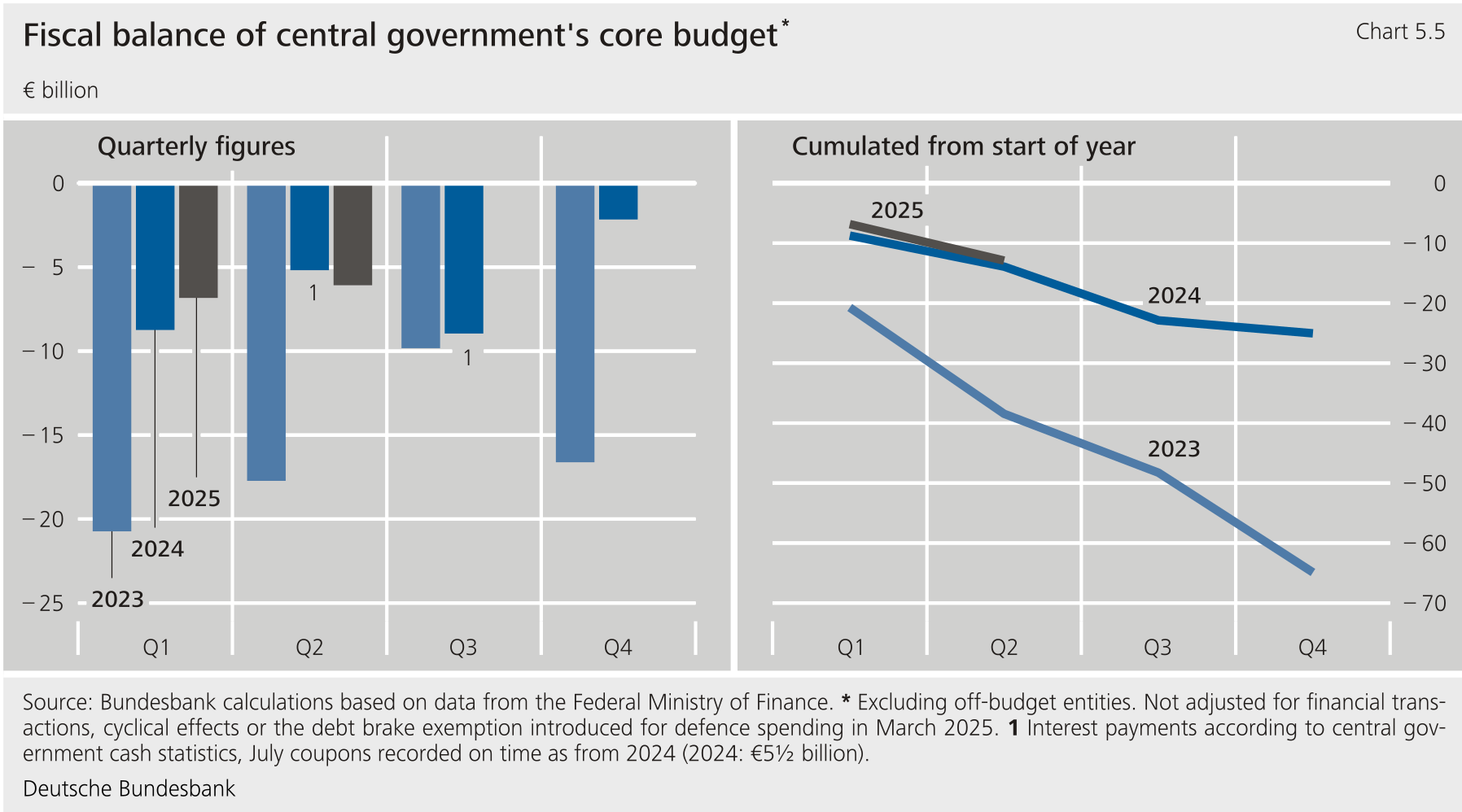
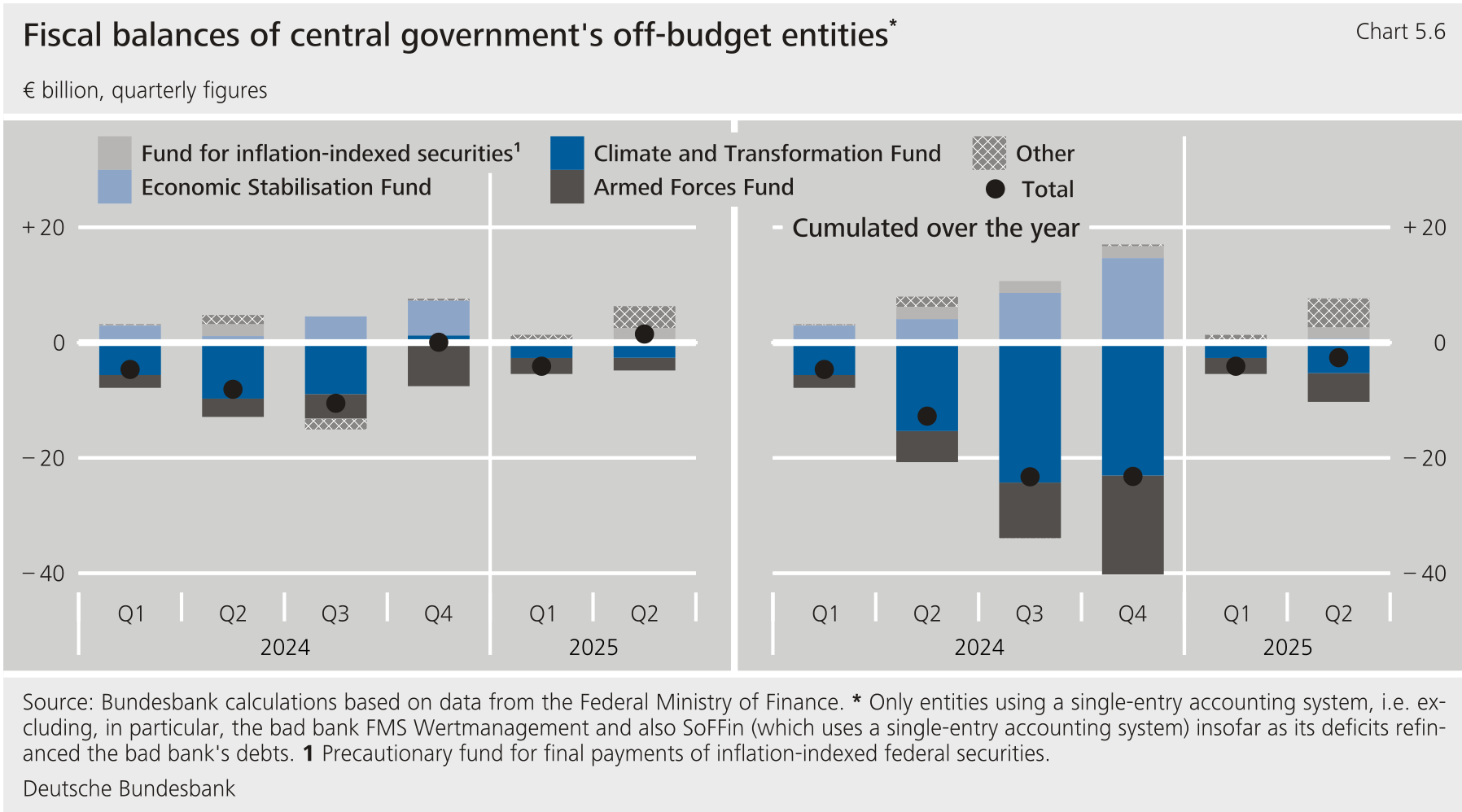
****The deficit of central government including off-budget entities was markedly lower in the first half of 2025 than in the same period of the previous year.** It contracted from €27 billion to just under €16 billion. This was due, in particular, to dynamic growth in tax revenue. However, the fact that central government now records discounts on an accruals basis, thus reducing interest expenditure booked in the budget, also played a role.**{#par-u6o93u}
{#par-oa9488}
****
**** {#tar-14}
---------------------------------------------------------------------------------------------------------------------------------------------------------------------------------------------------------------------------
****In the core budget, the deficit is likely to be significantly higher in the second half of the year than in the previous year.** The previous year's balance was buoyed by almost €14 billion in funds from the NextGenerationEU () fund (see Table 5.2, item 4.b2) and €8½ billion in repayments of crisis assistance funds. This type of revenue is likely to be less significant in the current year. In addition, growth in tax revenue is likely to weaken significantly and further increases in expenditure are likely to have a negative impact on the deficit.**{#par-u27777}
****For the year as a whole, the deficit in the core budget is nevertheless likely to remain considerably below the planned €82 billion.**Tax revenue could develop more favourably than planned. In addition, ample provisions appear to have been made for expenditure-side burdens in the draft budget. Defence spending, in particular, could rise less sharply. Budgeted amounts for personnel and investment, for example, also seem high, both in terms of the half-year result and the 2024 result.**{#par-uii6ee}
****The deficit of the off-budget entities is also likely to be considerably lower than planned (€64 billion).** [\[15\]](#_ftn_root_15) In the first half of the year, it stood at €2½ billion. In the Armed Forces Fund, expenditure and thus the deficit even declined somewhat. The planned deficit increase of €7 billion for the year as a whole is not on the cards. As the Infrastructure and Climate Neutrality Fund has not yet been established, it seems unlikely that the estimated €37 billion will be fully disbursed by the end of the year. In addition, €10 billion of these overall funds will be apportioned to the Climate Fund, meaning that the deficit there could be lower than planned.**{#par-u3294i}
### **3.3 Further significant increase in deficit planned for 2026** {#tar-15}
****The Federal Government is planning to further significantly increase its deficit next year to a total of €191 billion** (see Table 5.2, item 1.d)**.**The increase of €45 billion compared with the 2025 plans is spread across both the core budget and off-budget entities.**{#par-i61939}
****The deficit in the core budget is set to expand by a further €18 billion to €100 billion compared with the plan for the current year.** Revenue will decline slightly. Tax revenue will be €3 billion lower than the planned figure for 2025. Central government is expecting a sharp rise in transfers to the budget and is planning tax cuts. This will be alleviated by an inflow of almost €11 billion from the 's fund in 2026. Because of a delayed partial drawdown, the funds will not be received as revenue in 2025. On the expenditure side, central government is expecting growth of 3½ % (+€17½ billion). This is due to rising expenditure in connection with the sectoral exemption for defence spending (+€22 billion). To this extent, this also allows for greater debt financing. By contrast, central government is planning to significantly reduce its net acquisition of financial assets as against the current year. It does not intend to provide Deutsche Bahn with any additional capital or any more loans to repay the enterprise's higher-interest loans.[\[16\]](#_ftn_root_16) Instead, Deutsche Bahn is set to receive additional investment grants from the Infrastructure and Climate Neutrality Fund as of 2026.**{#par-e9e243}
****With regard to the debt brake, the planned deficit of €100 billion in the core budget is structured as follows:****{#par-o9o9ao}
* ****The government's planning infers scope for a deficit of just over €45 billion from the old net borrowing limit.** Of this amount, €15 billion is attributable to permissible structural borrowing of 0.35 % of , €13 billion to cyclical burdens, €7½ billion to the acquisition of financial assets, and almost €10 billion to withdrawals from remaining reserves.**
{#par-ie3aoe}
* ****The government is using the new scope for deficits in the core budget for defence policy, in the amount of just over €54 billion.**The starting point is spending by the Federal Ministry of Defence, to strengthen Ukraine's defence capabilities and for other domestic security purposes. Together, these amount to €97 billion. From this, 1 % of is to be deducted (€43 billion).**
{#par-a7oa4u}
****Overall, as things now stand, the core budget could, in the coming year as well, have a better closing balance than estimated in the draft.** Some of the budget estimates appear to be deliberately cautious. In particular, this is the case for the contributions (even when offsetting against the estimated global revenue increases of €4 billion) and defence spending. In addition, the estimates for investment and personnel costs seem fairly high in some cases.**{#par-uu48u6}
****For the off-budget entities, the government is still reckoning with a significantly growing overall deficit in 2026. This is driven mainly by the estimates for the Infrastructure and Climate Neutrality Fund.****{#par-uu5344}
* ****Infrastructure and Climate Neutrality Fund:** The deficit is set to climb from €37 billion this year to €59 billion next year. One contributing factor is that the fund is taking on a total of €6 billion in expenditure from the Climate Fund. This is for the promotion of microelectronics (investment grants to private enterprises) in addition to promoting the expansion of heating grids (investment grants to other government budgets). The rest of the additional expenditure is mostly budgeted for central government. A large part of it is intended for higher investment grants to Deutsche Bahn. These will essentially replace capital injections previously financed from the core budget.[\[17\]](#_ftn_root_17) Unlike this year, a marked increase in infrastructure investment is thus envisaged for 2026 (core budget and special fund combined; see Table 5.2, item 3c-n less 4a4-n). However, it remains to be seen whether central government will actually achieve this in view of the short lead time. To do so, it would seem necessary to swiftly simplify and speed up the planning and approval processes for such measures.**
{#par-eo4a76}
* ****Armed Forces Fund:** The deficit is set to rise by €1½ billion to almost €26 billion. This means that the budgeted figure will use up just under half of the scope for borrowing that is scheduled to remain at the end of 2025. In addition to military procurements, €1 billion is also budgeted for interest expenditure on the debt accumulated by the fund to date.**
{#par-o6o198}
* ****Climate Fund:** The Climate Fund's planned deficit will be halved to €2 billion. The remaining reserves are intended to plug this funding gap. Compared with the current year, there will be added expenditure of €6½ billion for grid fee subsidies. By contrast, expenditure of €3½ billion to offset the gas storage levy will be absent. Grants for energy efficient buildings are also set to be much lower. The government intends to shift spending on promoting microelectronics and heating grids to the Infrastructure and Climate Neutrality Fund. Revenue from that special fund will remain stable at €10 billion, and revenue from greenhouse gas emission allowances will see barely any growth.**
{#par-e51333}
* ****Fund for inflation-indexed federal securities:** Central government is planning a deficit of €5 billion in 2026, following a surplus of €2 billion in 2025. This is because, next year, one inflation-indexed federal security is due for redemption.[\[18\]](#_ftn_root_18)**
{#par-o8658a}
### **3.4 Fiscal plan up to 2029 contains large deficits and major additional need for action** {#tar-16}
****The government's fiscal plan envisages very large deficits up to 2029, the final year of the fiscal plan. The combined deficit of the core budget and off-budget entities is set to reach €186 billion in the final year. Central government's structural deficit will gradually climb to almost 4 % of** . Overall, the government has budgeted for net borrowing by central government, including the special funds, to the tune of €850 billion in the period from 2025 to 2029, based on a debt level of roughly €1,730 billion at the end of 2024. Central government debt as a percentage of would rise from around 40 % to 52 %.**{#par-e2uoeo}
****In the core budget,** **total revenue will grow only moderately up to 2029.****{#par-aoa4i7}
* **In structural terms, tax revenue will be only 2 % higher, dampened by tax cuts. Nominal growth will be higher. However, it partly offsets the decline in the still fairly high cyclical burden in 2026.**
{#par-iii4ae}
* **Revenue will be dampened by the fact that large temporary inflows from in 2026 will cease after that (almost €11 billion).**
{#par-u2a196}
****The sharp increase in the core budget deficit is due to rising defence spending, which is no longer subject to the borrowing constraints of the debt brake.****{#par-uu7uu3}
****By contrast, total (structural) expenditure excluding defence spending will not increase up to 2029.** **Spending by the Ministry of Labour and Social Affairs and for debt service will go up sharply.**In the pension insurance scheme, the costs of planned increases in benefits will be borne by central government (increase in the "mothers' pension" and extension of the 48 % minimum threshold for the replacement rate; see "[Pension policy plans weighing on central government budget](https://preview.publikationen.bundesbank.de/publikationen-en/reports-studies/monthly-reports/monthly-report-august-2025-962902?article=public-finances-962900#5.2-Pension-policy-plans-weighing-on-central-government-budget)"). Aside from this, central government grants are largely linked to growth in gross wages and salaries per employee and in the pension contribution rate. The contribution rate will rise sharply before the end of this decade. Interest expenditure (see Table 5.2, item 4.a5) will be affected by multiple adverse factors. The high level of new borrowing will increasingly have an effect, for example. In addition, the Armed Forces Fund's debt service will weigh on the core budget from 2028 onwards. Before then, central government will have covered these burdens from the fund's borrowing scope, which will at that time have been fully utilised. On top of that, average interest rates will go up as long-dated debt instruments from the low interest rate period still need to be refinanced. Finally, there will be extensive repayment obligations for emergency funds borrowed by central government to combat the -19 pandemic.**{#par-ae45u4}
****Overall, this gives rise to a strongly growing need for action in the core budget from 2027 onwards, in order to comply with the debt brake.**This still needs to be achieved so as not to exceed the already very high planned deficits. In the final year of 2029, it is set to reach around €74 billion (see Table 5.2, item 4.a6). Overall, this amount corresponds to roughly 17 % of estimated tax revenue. An even larger cut would be needed on the expenditure side, especially because adjustments to defence spending would only affect borrowing scope in the sectoral exemption and some expenditure, such as interest, is not available for budget relief measures.**{#par-a3a235}
****It seems almost inconceivable for the action that is required to be even close to being covered by a structural acceleration of** **growth.** [\[19\]](#_ftn_root_19) Prudent fiscal planning should find a path towards sound finances that is not predicated on optimistic growth assumptions. In any case, given the action required in its fiscal plan up to 2029, the Federal Government will need to adjust its fiscal stance significantly as time progresses.**{#par-ue59i8}
****Irrespective of the action required in the plans, the expanded scope for borrowing is not sustainable and is not compatible with** **rules in the longer term.** Exempting large-scale defence spending from the borrowing limit over the longer term does not appear sustainable, nor does it seem to have a sound economic justification. It would cause the debt ratio to rise further, and growing debt service would make the available fiscal scope smaller and smaller. At the same time, demographic challenges are having more and more of an impact on government finances. As a central anchor of stability in the euro area, Germany also has a particular duty to comply with the 's fiscal rules without stretching their limits too much. The borrowing limit under the current debt brake is obviously too broad for this. There is a prospect of rules for the years up to 2029 that could be compatible with current central government plans (see "[EU rules: Germany has submitted plan](#1.3-EU-rules-Germany-has-submitted-plan)"). In future, however, the rules will require significantly lower deficits than the debt brake rules, as well as a declining debt ratio.**{#par-ueo155}
****It is therefore important to align the national fiscal rules with sound government finances once more. The announced further reform of the debt brake provides an opportunity to do so.** [\[20\]](#_ftn_root_20)Further reform would be inadequate if it essentially established a successor to the temporary Infrastructure and Climate Neutrality Fund. Instead, it must also aim to bring debt financing back within sustainable confines in the future. To do this, the threshold of 1 % of , from which defence spending can be financed by borrowing, would have to be gradually raised and ultimately fully phased out. The proposals made by the Bundesbank in early March still appear well suited for further developing the debt brake.[\[21\]](#_ftn_root_21)**{#par-ui3557}
**4 State government budgets** {#tar-17}
----------------------------------------
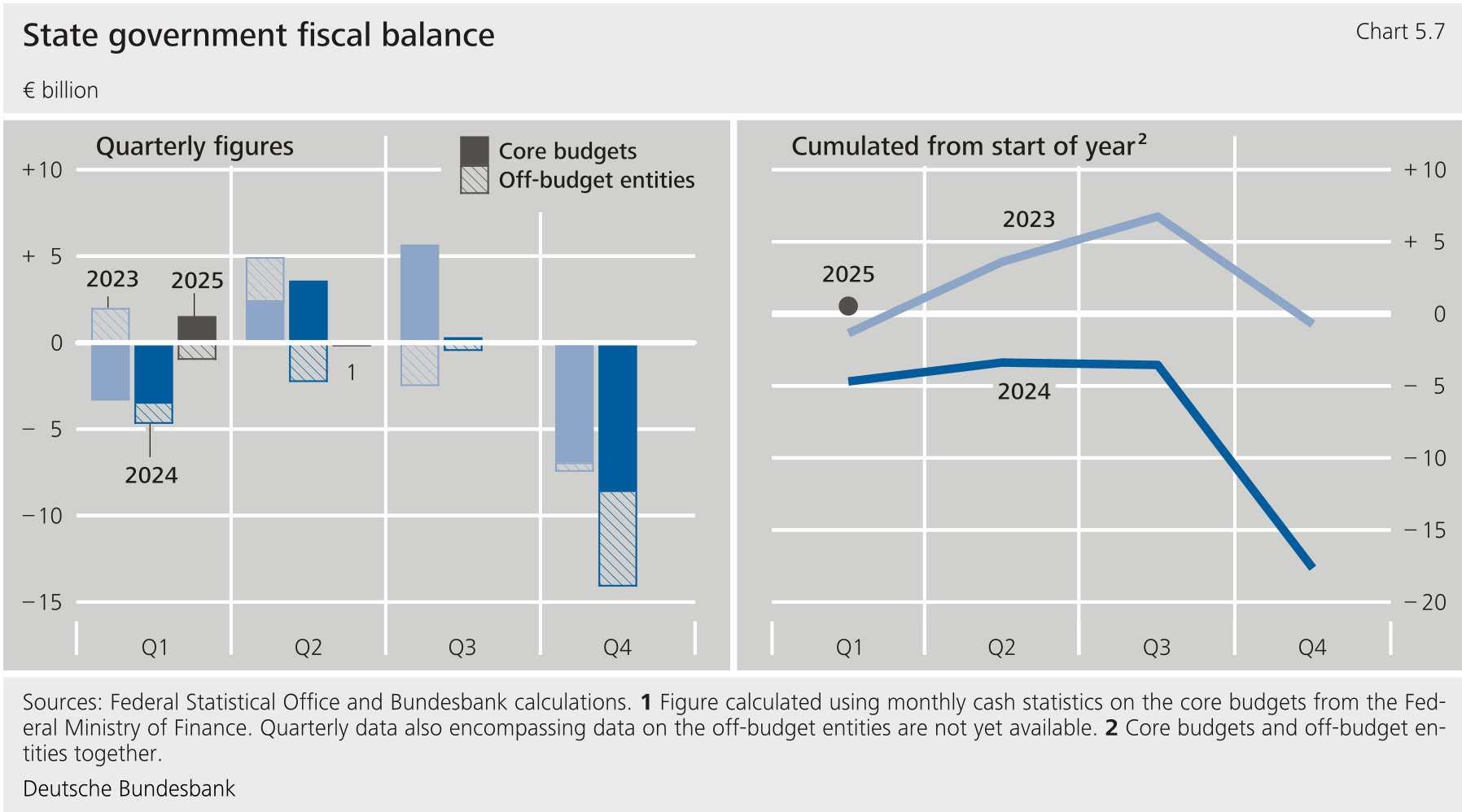
****State government budgets could have a better closing balance this year than in the previous year. Last year, they closed with a deficit of €18 billion (core budgets and off-budget entities).** As usual, the current intra-year state government figures are difficult to interpret, but are already pointing to an improvement. While the core budgets were balanced when closing out the first half of 2024, they posted a surplus of €1½ billion in the first half of 2025. The off-budget entities also had a slightly improved result in the first quarter (data for the second quarter are not yet available). A year-on-year improvement for state government as a whole also appears possible over the remainder of the year. On the one hand, growth in tax revenue is likely to be slower in the second half of the year than in the first half. On the other hand, significant deficit-increasing special factors from the previous year will not be present in the second half of the year.[\[22\]](#_ftn_root_22) In addition, central government intends to transfer the first €8½ billion from the Infrastructure and Climate Neutrality Fund to state governments over the course of the year. State governments will likely pass on some of these funds to local governments and use some for their own new projects. However, some of the amount will probably also reduce their deficit, because in the short term they will probably only be able to implement new projects on a smaller scale at best. For this reason, they are also unlikely to be able to use the new structural borrowing scope of 0.35 % of (around €15 billion)[\[23\]](#_ftn_root_23) for new projects in the short term. The greater scope is most likely to cover deficits that were expected anyway[\[24\]](#_ftn_root_24) or to enable additional reserves to be built up.[\[25\]](#_ftn_root_25)**{#par-eo2e94}
{#par-iiiuaa}
****
****In the coming years, too, state governments will gain additional fiscal leeway from grants from the Infrastructure and Climate Neutrality Fund and greater scope for their own borrowing (0.35 % of** ).**There are no signs at present that they will use this space to significantly strengthen their investment.** State and local governments are not legally obligated to use their shares in the Infrastructure and Climate Neutrality Fund exclusively for additional investment. A number of state governments apparently placed explicit emphasis on this during negotiations on the legislation. There is thus no guarantee that the existing infrastructure challenges will be tackled swiftly and urgently. As is the case for central government, it would therefore be advisable to better safeguard the additionality of resources from this special fund going forward.**{#par-o742i3}
****The broader scope for borrowing by state governments is likely to be accompanied by higher state government debt, which will narrow future fiscal space and increase the likelihood of difficulties.** This is particularly critical for federal states already carrying excessive debt, such as Bremen or Saarland. Overall, the new scope for borrowing increases the risk of state governments becoming overburdened. Effective fiscal surveillance by the Stability Council is more important than ever to identify any difficulties at an early stage. Transparent state government finances are therefore urgently needed.[\[26\]](#_ftn_root_26)**{#par-e1a549}
**5 Pension insurance scheme** {#tar-18}
----------------------------------------
### **5.1 Outlook for 2025 and 2026** {#tar-19}
****The financial situation of the statutory pension insurance scheme is likely to deteriorate significantly in 2025, and a considerable deficit is expected** (2024: deficit of almost €1 billion).The pension insurance scheme already posted a deficit of €2½ billion in the first half of 2025. That deficit is likely to be significantly larger by the end of the year. Over the year as a whole, revenue is likely to be distinctly higher year on year. It helps that earnings subject to compulsory contributions are to some extent replacing tax and contribution-exempt inflation compensation bonuses (which were paid in the first half of 2024, in particular). However, expenditure is likely to go up much more. First, pensions will rise sharply by an annual average of just over 4 % (mid-2025 adjustment of just over 3½ %). Second, the number of pensions is rising markedly. Third, there are the much higher supplementary contributions[\[27\]](#_ftn_root_27) to the statutory health insurance scheme.[\[28\]](#_ftn_root_28)**{#par-iui5o4}
{#par-u88487}
**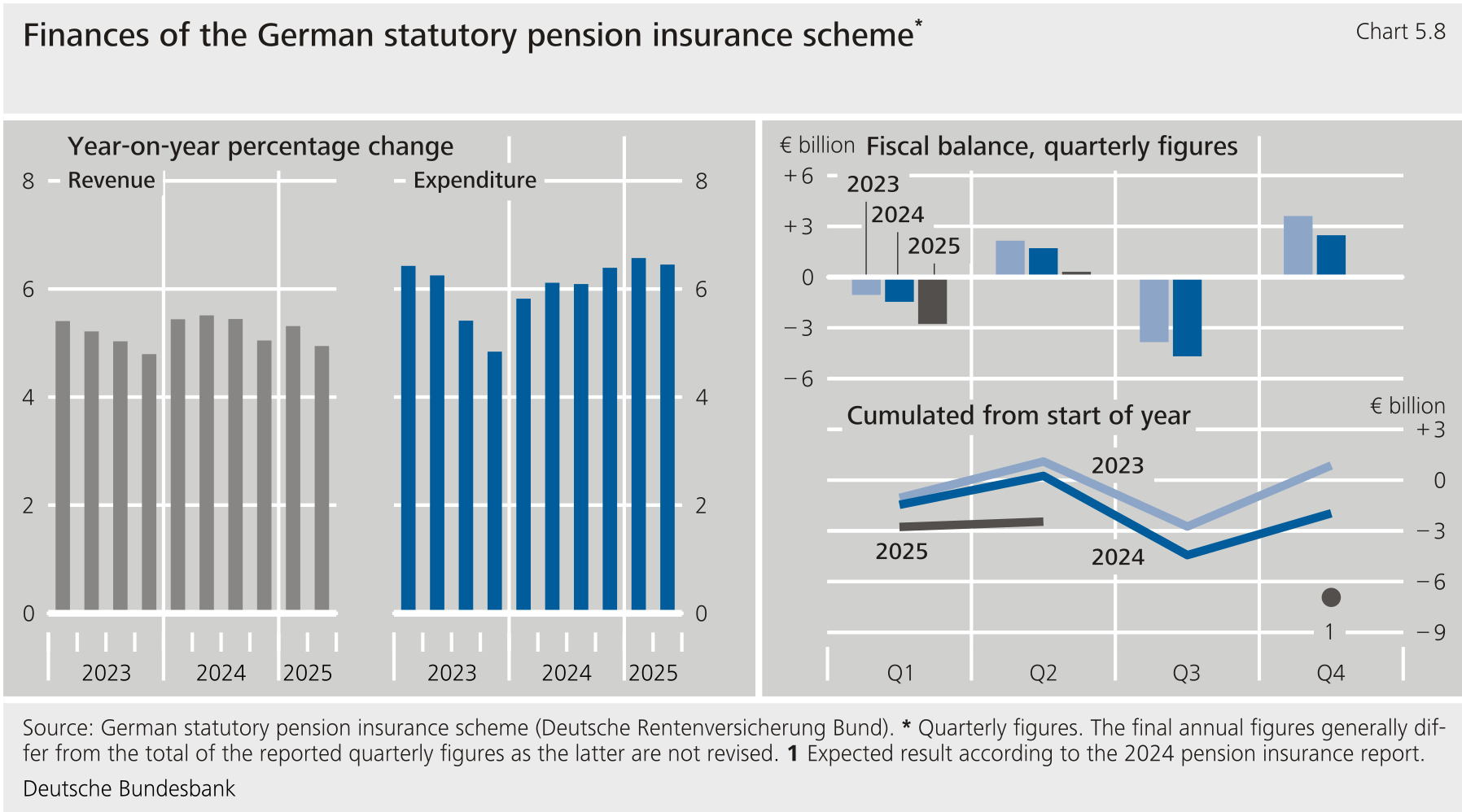**
****Next year, the deficit is likely to see a further significant expansion.** Expenditure will probably continue to grow more strongly than the revenue base. The contribution rate will remain unchanged until the pension insurance scheme has brought its sustainability reserve back down to the statutory minimum. At mid-year, the reserve amounted to just under 1.4 times the scheme's monthly expenditure (€41½ billion). The Federal Government is planning to raise this lower limit from 0.2 to 0.3 times the scheme's monthly expenditure to better safeguard the pension insurance scheme's liquidity throughout the year. The reserve will then amount to €9½ billion. As things currently stand, it may be necessary to increase the contribution rate in 2027.**{#par-e6959a}
### **5.2 Pension policy plans weighing on central government budget** {#tar-20}
****The Federal Government intends to extend the 48 % threshold for the replacement rate beyond the end of the year up to 2031 and to increase the "mothers' pension".** [\[29\]](#_ftn_root_29)**Central government is expected to cover the additional expenditure and make additional transfers.** This appears logical in the case of the mothers' pension,[\[30\]](#_ftn_root_30) as these payments are not covered by contributions. In the case of the threshold, however, a central government grant fits less well with the system. This is a general pension increase that does not actually have to be funded by central government in an equivalent pay-as-you-go system.**{#par-o1o253}
****Overall, there is a strong case for creating a clearer and more understandable framework for central government grants in future**. The current framework gives the impression that financing burdens are distributed between central government and the statutory pension insurance scheme mainly based on budgetary situations rather than objective criteria. To make these financial relationships more transparent in future, central government should indicate which benefits of the pension insurance scheme it classifies as non-insurance-related and thus not covered by contributions, and why. It should then finance these benefits via grants (from its tax funds) in a rule-based manner.**{#par-a1768e}
****The grants for the extended threshold will mean a permanent extra burden of considerable size for the central government budget.** The current plan is for the threshold to stay at 48 % until 2031. Without the extension, the replacement rate would be just under 47 % in 2031. Once the threshold ceases to apply, the sustainability factor will dampen pension adjustments again.[\[31\]](#_ftn_root_31) However, as the starting level will be higher, central government will bear permanent additional burdens after 2031 as well (see Chart 5.9).**{#par-u4eui5}
{#par-ua7ii4}
**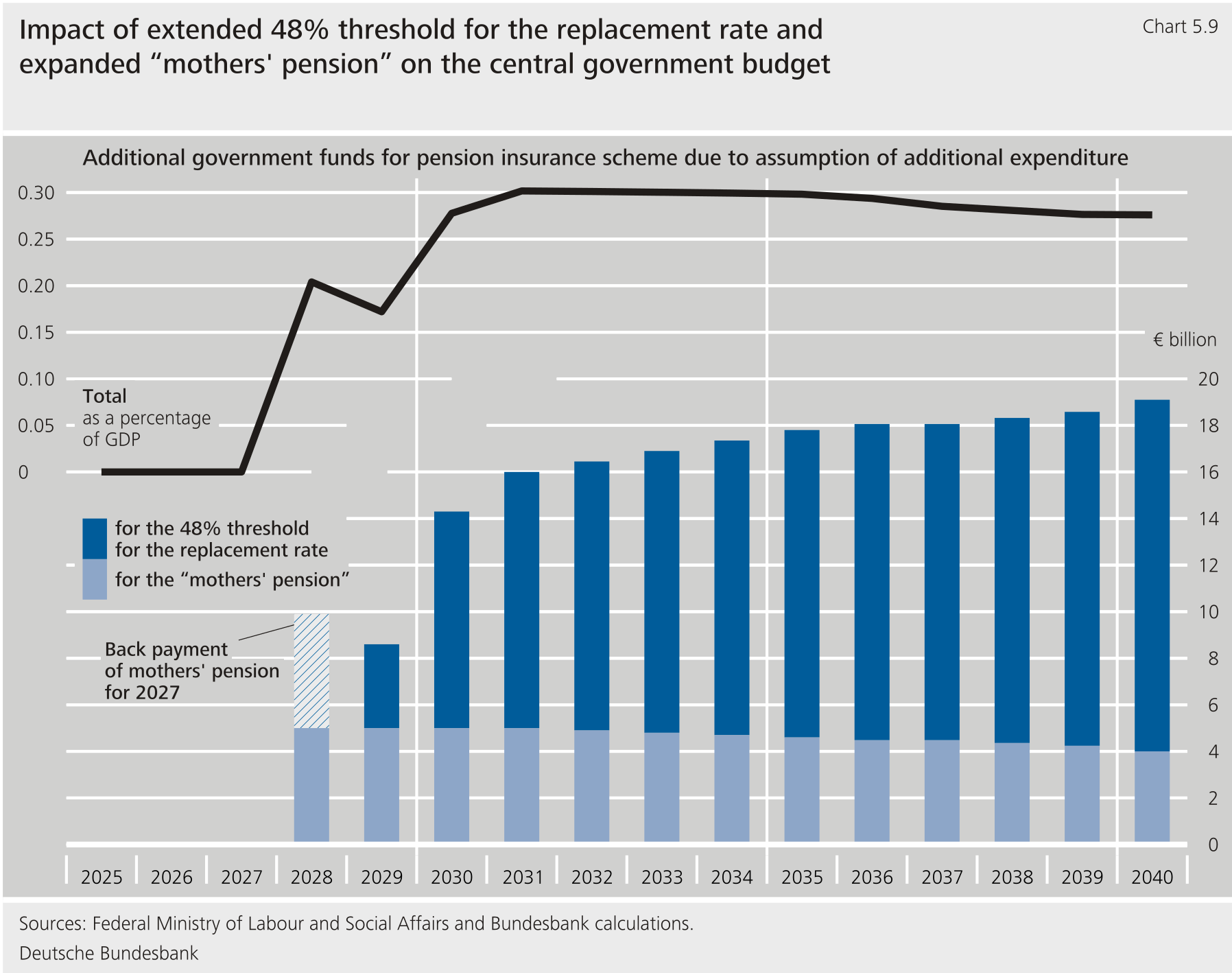**
****The Federal Government wants to make it easier for people to work beyond the statutory retirement age. To do this, it is lifting the ban on temporary contracts for people previously employed on a permanent basis by the same employer. Taken in isolation, this is likely to provide positive impetus for the labour market.** Lifting the ban makes it possible for people to go from a previous permanent contract to a temporary contract after reaching the standard retirement age. This has not been possible before now.[\[32\]](#_ftn_root_32)**{#par-u59u41}
****On the other hand, the planned tax break for income earned after the statutory retirement age seems to make less sense.** In many cases, financial considerations are not the reason why people work after reaching retirement age. There are thus likely to be free-rider effects, which will put a strain on the already tight central government budget. Depending on their design, studies identify losses in general government tax revenue of between €1½ billion and €3 billion per year.[\[33\]](#_ftn_root_33) In addition, special tax rules open up opportunities for creative tax accounting. This also runs counter to the Federal Government's objective of reducing administrative burdens. A more convincing way to make working beyond the statutory retirement age more financially attractive would be ending the burden of pension contributions during this phase of life. So far, the employer contribution has been a special levy, as it does not give rise to any additional entitlements in the statutory pension insurance scheme.[\[34\]](#_ftn_root_34)**{#par-u5i137}
****It would seem logical to adjust the age limits as a way of increasing employment and easing the burden on pension finances.** The minimum age for the earliest possible entry into retirement and, after 2031, the statutory retirement age as well could be linked to life expectancy.[\[35\]](#_ftn_root_35) The special rule that enables employees with an exceptionally long employment history to retire earlier while still drawing a reduction-free pension could also be scrapped. As well as providing positive impetus for older people to participate in the labour force, such measures would dampen the demographic pressure on government finances.**{#par-oooo16}
****Aside from this, it would be advisable to review the reductions and increases in the pension insurance scheme and adapt them to changed conditions.** [\[36\]](#_ftn_root_36) The aim would be for the decision to retire early or late not to be distorted by financial incentives.**{#par-aa8813}
**6 Federal Employment Agency** {#tar-21}
-----------------------------------------
****The Federal Employment Agency posted a deficit of €3 billion in the first half of 2025 (first half of 2024: €1 billion). A significant deficit is likely to be recorded for the year as a whole, too, as payments for unemployment benefits will go up significantly.**This deficit is likely to be higher than planned (€1½ billion) because of less favourable labour market developments. This year it could exceed the available reserves (end-2024: €3 billion). In its budget plans for 2025, central government has made provision for a multi-year loan of up to €2½ billion in case of need. And for the coming year, central government's draft budget contains a loan of almost €4 billion. The Federal Employment Agency is then expected to repay all the loans out of surpluses over the coming years as the anticipated wider economic recovery gets under way. After that, it will have to build up reserves again.**{#par-u15i64}
{#par-u97ee5}
**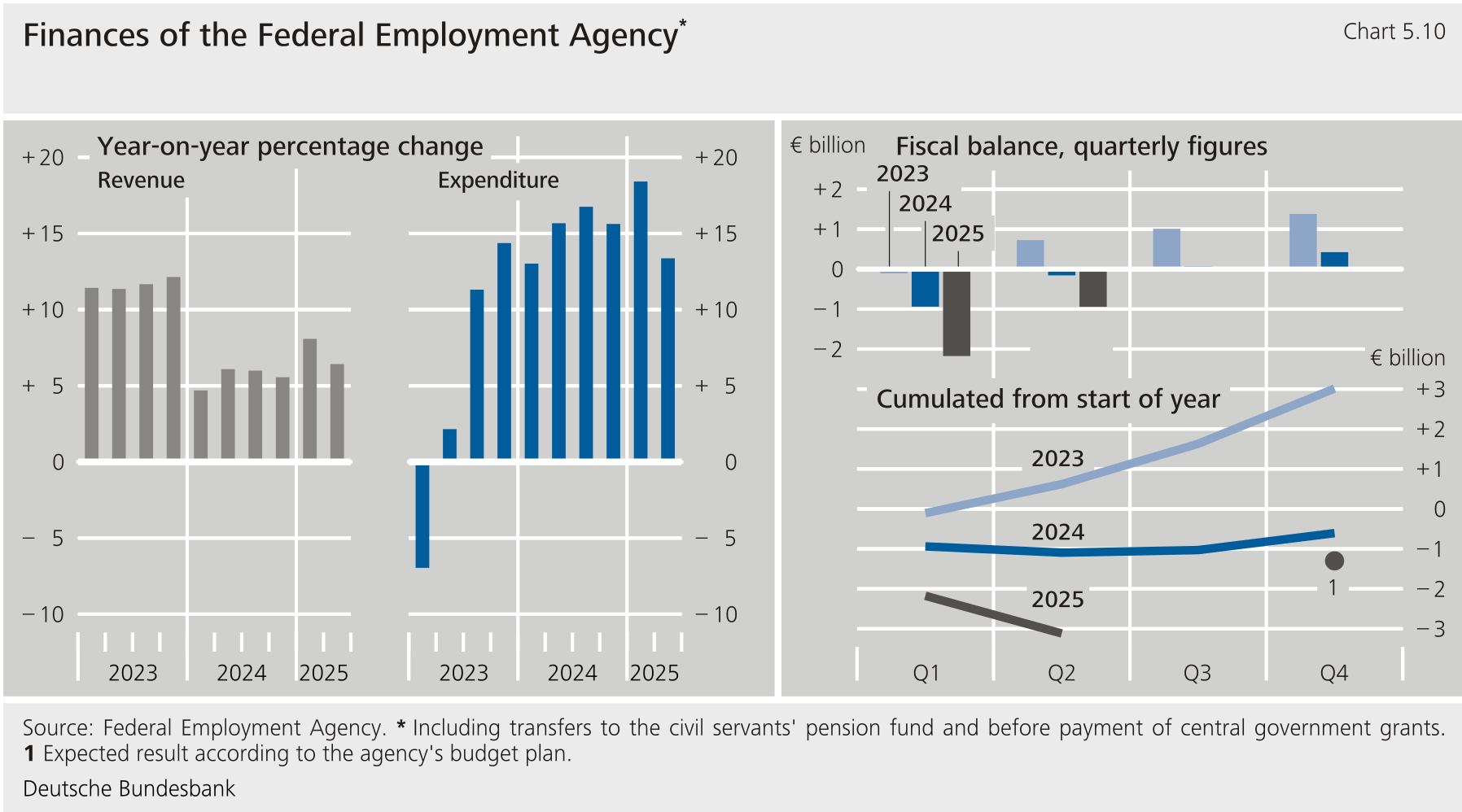**
***This article is based on data available up to 20 August 2025, 11:00.***{#par-i2i74a}
**List of references** {#tar-22}
--------------------------------
**Bach, S., H. Buslei, J. Geyer, P. Haan and J. Pieper (2025), [Active pension mainly relieves higher-earning pensioners; employment effects are uncertain](https://www.diw.de/documents/publikationen/73/diw_01.c.966701.de/dwr-25-25-1.pdf), Wochenbericht, No 25/2025, June 2025.**{#par-a3i3i2}
**Beznoska, M., R. M. Schüler and S. Seele (2025), [Aktivrente: 2,8 Mrd € steuerliche Mindereinnahmen](https://www.iwkoeln.de/fileadmin/user_upload/Studien/Kurzberichte/PDF/2025/IW-Kurzbericht_2025-Aktivrente.pdf), -Kurzbericht No 69/2025, August 2025.**{#par-oa817a}
**Bloom, N., J. Van Reenen and H. Williams (2019), [A toolkit of policies to promote innovation](https://www.aeaweb.org/articles?id=10.1257/jep.33.3.163), Journal of Economic Perspectives, 33(3), pp. 163‑184.**{#par-o239ao}
**Brüll E., F. Pfeiffer and N. Ziebarth (2024), [Analyse der Einkommens- und Beschäftigungswirkungen einer Einführung des CDU-Konzepts der „Aktiv-Rente"](https://www.degruyterbrill.com/document/doi/10.1515/pwp-2024-0022/html), Perspektiven der Wirtschaftspolitik, Vol. 25, No 3‑4, pp. 227‑232, November 2024.**{#par-a2a7i4}
**Federal Ministry of Finance, Federal Ministry for Economic Affairs and Energy (2025), [German medium-term fiscal-structural plan 2025‑2029](https://www.bundesfinanzministerium.de/Content/EN/Standardartikel/Press_Room/Publications/Brochures/medium-term-fiscal-structural-plan.pdf?__blob=publicationFile&v=5), August 2025.**{#par-e4uo12}
**Deutsche Bundesbank (2025a), [Public finances](https://publikationen.bundesbank.de/content/957534), Monthly Report, May 2025.**{#par-u32a9a}
**Deutsche Bundesbank (2025b), [Forecast for Germany: US tariffs initially weigh on economic growth; fiscal policy provides impetus with a delay](https://publikationen.bundesbank.de/content/958718), Monthly Report, June 2025.**{#par-aue161}
**Deutsche Bundesbank (2025c), [Sound public finances, stronger investment: a proposal to reform the debt brake](https://publikationen.bundesbank.de/content/952322), Monthly Report, March 2025.**{#par-ou7858}
**Deutsche Bundesbank (2025d), [Early, standard, late: when insurees retire and how pension benefit reductions and increases could be determined](https://publikationen.bundesbank.de/content/958722), Monthly Report, June 2025.**{#par-a72u9o}
**Deutsche Bundesbank (2024a), [State government finances in 2023: situation worsens, but structural balance still in surplus](https://publikationen.bundesbank.de/content/938988), Monthly Report, October 2024.**{#par-i98e59}
**Deutsche Bundesbank (2024b), [Public finances](https://publikationen.bundesbank.de/content/933614), Monthly Report, August 2024.**{#par-u2149o}
**Deutsche Bundesbank (2023a), [The growing significance of central government's off- budget entities](https://www.bundesbank.de/content/912872), Monthly Report, June 2023.**{#par-oa7231}
**Deutsche Bundesbank (2023b), [Public finances](https://www.bundesbank.de/content/817430), Monthly Report, November 2023.**{#par-e19i57}
**Deutsche Bundesbank (2019), [Long-term outlook for the statutory pension insurance scheme](https://www.bundesbank.de/content/811966), Monthly Report, October 2019.**{#par-o1ui14}
**Deutsche Bundesbank (2016), [Monthly Report - February 2016](https://www.bundesbank.de/content/667048), Monthly Report, February 2016, pp. 68‑69.**{#par-ue64a7}
**dpa (2025), [Angespannte Haushaltslage: Landtag beschließt ersten Nachtragshaushalt für 2025](https://www.sueddeutsche.de/wirtschaft/angespannte-haushaltslage-landtag-beschliesst-ersten-nachtragshaushalt-fuer-2025-dpa.urn-newsml-dpa-com-20090101-250723-930-831961), Süddeutsche Zeitung, dpa:250723‑930‑831961/3, July 2025.**{#par-i86341}
**Schleswig-Holstein State Parliament (2025), [Land beschließt ersten Nachtragshaushalt](https://www.landtag.ltsh.de/parlament/plon-newsticker/?year=2025&month=7,%20Juli%202025), Plenum-Online: Newsticker, 23 July 2025.**{#par-a79864}
**Santoleri, P., A. Mina, A. Di Minin and I. Martelli (2024), [The causal effects of grants: Evidence from a regression discontinuity](https://direct.mit.edu/rest/article/106/6/1495/112422/The-Causal-Effects-of-R-amp-D-Grants-Evidence-from), Review of Economics and Statistics, 106(6): pp. 1495‑1510, November 2024.**{#par-oaa885}
**Schleswig-Holstein State Constitutional Court (2025), [Urteil vom 14. Februar 2025 -- 1/24 -- Verfassungsmäßigkeit von Notkrediten im Landeshaushalt 2024](https://www.schleswig-holstein.de/DE/justiz/gerichte-und-justizbehoerden/LVG/Entscheidungen/Dokumente/Urteil_1_24.pdf?__blob=publicationFile&v=4), February 2025.**{#par-aa623e}
1. **{#_ftn_root_1} This article relates to data from the national accounts and Maastricht debt. This is followed by reporting on budgetary developments (government finance statistics) and budget planning.**
2. **{#_ftn_root_2} For more information on planned measures and the Bundesbank's latest fiscal forecast, see Deutsche Bundesbank (2025a, 2025b). Compared with the forecast, the outlook has changed only moderately. The following sections of this chapter will also provide information on current developments.**
3. **{#_ftn_root_3} For information on the proposals, see Deutsche Bundesbank (2025c). The rules are likely to set a somewhat less ambitious stance for the future fiscal plans than expected for the first fiscal plan: the requirements for the structural deficit will fall (ceteris paribus) if the age-related expenditure increases are increasingly counterfinanced.**
4. **{#_ftn_root_4} See Federal Ministry of Finance and Federal Ministry for Economic Affairs and Energy (2025).**
5. **{#_ftn_root_5} For information on the exemption for defence spending and its general use, see Deutsche Bundesbank (2025a).**
6. **{#_ftn_root_6} For more information on the measures, see also Deutsche Bundesbank (2025a) and the following sections of this article.**
7. **{#_ftn_root_7} An excessive deficit procedure () could be launched if a deficit ratio exceeding 3 % is not the result of additional defence spending. The European bodies have to decide whether or not to declare an excessive deficit, even if Germany adheres to the agreed expenditure limits.**
8. **{#_ftn_root_8} The calculations relating to a higher assume that Germany exhausts its spending capacity, but that the European Commission's more plausible assumptions for potential and the deflator materialise.**
9. **{#_ftn_root_9} This and the following chapters discuss budgetary developments (government finance statistics) and budget plans. These differ from reporting pursuant to the national accounts in the previous general government analysis.**
10. **{#_ftn_root_10} For information on the official tax estimate, see Deutsche Bundesbank (2025a), [Public finances](https://publikationen.bundesbank.de/content/957534).**
11. **{#_ftn_root_11} For example, empirical evidence usually indicates that government research grants attracts private research and development spending (see, for example, Bloom et al. (2019)). Santoleri et al. (2024) suggest that private returns from investment in research and development exceeds the level of government funding. In addition, there are possible positive external effects for other enterprises or households.**
12. **{#_ftn_root_12} The quarterly reports include the off-budget entities for which central government publishes monthly cash data. This means that data are lacking for, in particular, entities such as Autobahn and the parts of Deutsche Bahn that belong to the government sector (InfraGO and Regio). However, central government does not publish any budgeted figures for some of the entities with monthly cash data, such as the Economic Stabilisation Fund and the special funds for pension provisions. These entities are therefore disregarded here too (for the overall result for 2024, see item 1.c of Table 5.2).**
13. **{#_ftn_root_13} For more details on the easing of the debt brake, see Deutsche Bundesbank (2025a).**
14. **{#_ftn_root_14} The from the previous year when the respective budget was drawn up is relevant in each case. As it is planned to pass the budgets for both 2025 and 2026 in the current year, for 2024 is used in both cases.**
15. **{#_ftn_root_15} As usual, the draft budget does not contain borrowing plan figures for some special funds in which a surplus is expected. This applies to the Economic Stabilisation Fund and the special funds for pension provisions. In the previous year, these entities posted a surplus of almost €20 billion. This year, the surplus is likely to be significantly lower owing to declining repayments of assistance loans to the Economic Stabilisation Fund.**
16. **{#_ftn_root_16} The capital injections are recorded as financial transactions and hence not counted towards the borrowing limit under the debt brake.**
17. **{#_ftn_root_17} By giving Deutsche Bahn investment grants instead of capital, central government is providing relief for Deutsche Bahn's profit and loss account. Deutsche Bahn does not have to generate any income on the grants to offset write-downs, nor does it have to generate returns. This means that, unlike with capital injections, there is no further pressure to raise track access charges for use of the rail network.**
18. **{#_ftn_root_18} In addition, central government intends to make a one-off reduction in appropriations for 2026 by the amount it had paid in as a precaution over previous years for its entire own portfolio. The regular central government payment will thus come to an end, and the fund will have to repay just under €½ billion on balance to the core budget. This will provide one-off relief for the core budget in the amount of €2 billion.**
19. **{#_ftn_root_19} To reduce the need for action by means of economic growth, potential will have to increase. The plans promise expansionary fiscal policy. So far, however, the probable impact on potential is uncertain or does not appear to be very large. The documentation of central government's plans gives the misleading impression that the need for action can be reduced by a purely economic recovery. In addition, when looking at government budgets, it should be borne in mind that many government expenditures are indirectly linked to economic developments. For example, if wages rise more sharply on the back of increased productivity, the same generally also applies to central government grants to the pension insurance scheme and government's personnel costs.**
20. **{#_ftn_root_20} An expert commission is currently developing reform proposals; see [Federal Ministry of Finance, Federal Ministry for Economic Affairs and Energy (2025)](https://www.bundesfinanzministerium.de/Content/DE/Pressemitteilungen/Finanzpolitik/2025/07/2025-07-25-expertenkommission-schuldenregel.html).**
21. **{#_ftn_root_21} See Deutsche Bundesbank (2025c).**
22. **{#_ftn_root_22} In the previous year, major financial transactions of around €10 billion were recorded in investment, most of which were non-recurring effects in the form of acquisitions of participating interests (see Deutsche Bundesbank (2025a), ["2.3 State government finances"](https://publikationen.bundesbank.de/publikationen-en/reports-studies/monthly-reports/monthly-report-may-2025-957960?article=public-finances-957534%232.3.1-2024-result-and-outlook)).**
23. **{#_ftn_root_23} As before, state governments can exclude cyclical factors and financial transactions. With that in mind, the respective debt brakes of the state governments may, in principle, remain unchanged -- despite the now greater scope for new borrowing.**
24. **{#_ftn_root_24} In Schleswig-Holstein, for example, the state parliament adopted a first supplementary budget for 2025 (see Schleswig-Holstein State Parliament (2025)). The federal state had previously planned on taking out emergency borrowing, which the government now no longer needs. It has also announced a second supplementary budget for the autumn. Its plan with this budget is to close a funding gap from the 2024 budget, in particular by using the new structural borrowing scope from 2025 onwards (see dpa (2025)). The gap had arisen retroactively on account of a ruling by the state's constitutional court, in which the court had declared parts of the 2024 state budget to be invalid (see Schleswig-Holstein State Constitutional Court (2025)).**
25. **{#_ftn_root_25} Reserves established in the core budget do not affect the deficit as defined in the national accounts (net lending/net borrowing), which is the relevant variable under the rules. This also applies if state governments make transfers to off-budget entities and set aside the funds there. When looking at the core budgets and off-budget entities as a whole, this is consolidated.**
26. **{#_ftn_root_26} See Deutsche Bundesbank (2024a), "[State government finances in 2023: situation worsens, but structural balance still in surplus](https://publikationen.bundesbank.de/content/938988)".**
27. **{#_ftn_root_27} The pension insurance scheme pays half of pension recipients' contributions to the statutory health insurance scheme. In 2025, the average supplementary contribution rates are just over 1 percentage point higher than in the previous year. This puts an added burden of €1½ billion on the pension insurance scheme.**
28. **{#_ftn_root_28} The new supplements to pensions for reduced earning capacity have an uneven impact on the intra-year growth rates for expenditure. This is because, in the previous year, the statutory pension insurance scheme started paying them out from the second half of the year, in some cases retroactively.**
29. **{#_ftn_root_29} The pension policy plans of the new Federal Government are discussed in more detail in Deutsche Bundesbank (2025a), "[Public finances](https://publikationen.bundesbank.de/content/957534)" and [Deutsche Bundesbank (2025d)](https://publikationen.bundesbank.de/publikationen-en/reports-studies/monthly-reports/monthly-report-june-2025-958724?article=early-standard-late-when-insurees-retire-and-how-pension-benefit-reductions-and-increases-could-be-determined-958722%232-Pension-policy-discussion-and-the-new-Federal-Government-s-plans) "[Monthly Report -- June 2025](https://publikationen.bundesbank.de/content/958724)".**
30. **{#_ftn_root_30} Many recipients of the "mothers' pension" already benefit from pensions according to minimum entitlement points or minimum income, for which low incomes receive a higher valuation. This arrangement was scrapped with the introduction of pension-boosting child-raising periods for children born after 1991. This can therefore result in double preferential treatment.**
31. **{#_ftn_root_31} The Federal Government intends to present a report in 2029 setting out how a permanent threshold could be afforded. A reform commission is also set to draw up proposals for the period after 2031 during this legislative period.**
32. **{#_ftn_root_32} There is to be a maximum period of 8 years for continued temporary employment or a maximum of 12 temporary contracts.**
33. **{#_ftn_root_33} See Bach et al. (2025), Beznoska et al. (2025) or Brüll et al. (2024).**
34. **{#_ftn_root_34} See Deutsche Bundesbank (2024b), "[Public finances](https://publikationen.bundesbank.de/content/933614)".**
35. **{#_ftn_root_35} The Bundesbank has already presented comprehensive simulations on this subject in previous reports. See Deutsche Bundesbank (2019, 2023b, pp. 79 ff.).**
36. **{#_ftn_root_36} See Deutsche Bundesbank (2025d).**
*[**VAT**]: value added tax
*[LVerfG]: Landesverfassungsgericht
*[MTP]: medium-term fiscal-structural plan
*[VAT]: value added tax
*[NATO]: North Atlantic Treaty Organization
*[NGEU]: NextGenerationEU
*[GmbH]: Gesellschaft mit beschränkter Haftung
*[R\&D]: research and development
*[EDP]: excessive deficit procedure
*[COVID]: coronavirus disease
*[GDP]: gross domestic product
*[DSA]: debt sustainability analysis
*[**MTP**]: medium-term fiscal-structural plan
*[COM]: Communication from the Commission
*[**NATO**]: North Atlantic Treaty Organization
*[AG]: Aktiengesellschaft
*[COFOG]: Classification of the Functions of Government
*[**MTPs**]: medium-term fiscal-structural plan
*[**GDP**]: gross domestic product
*[**EU**]: European Union
*[MTPs]: medium-term fiscal-structural plan
*[IW]: Institut der deutschen Wirtschaft
*[EU]: European Union
*[DIW]: Institut der deutschen Wirtschaft
*[**H1**]: first half-year