# Public finances
* [*\[1\]*](#tar-1 "[1]")
* *[*1.1 Expansionary fiscal policy from next year*](#tar-2 "1.1 Expansionary fiscal policy from next year")*
* **[*1.2 Gear fiscal rules to sound government finances again*](#tar-3 "1.2 Gear fiscal rules to sound government finances again")**
* ***[*2 Tax revenue*](#tar-4 "2 Tax revenue")
* *[*2.1 2025: considerable growth overall, despite slowing momentum as the year goes on*](#tar-5 "2.1 2025: considerable growth overall, despite slowing momentum as the year goes on")*
* **[*2.2 Tax estimate up to 2030: moderate growth overall*](#tar-6 "2.2 Tax estimate up to 2030: moderate growth overall")*****
* ***[*3 Central government finances*](#tar-7 "3 Central government finances")
* *[*3.1 Deficit sees year-on-year rise in 2025 but is set to remain significantly lower than estimated*](#tar-8 "3.1 Deficit sees year-on-year rise in 2025 but is set to remain significantly lower than estimated")*
* **[*3.2 Deficit will continue to rise significantly in 2026*](#tar-9 "3.2 Deficit will continue to rise significantly in 2026")**
* ***[*3.3 High need for consolidation from 2027 onwards -- lower borrowing limit also advisable*](#tar-10 "3.3 High need for consolidation from 2027 onwards – lower borrowing limit also advisable")******
* ***[*4 State government budgets*](#tar-11 "4 State government budgets")***
* ***[*5 Social security funds*](#tar-12 "5 Social security funds")
* *[*5.1 Pension insurance scheme*](#tar-13 "5.1 Pension insurance scheme")*
* **[*5.2 Federal Employment Agency*](#tar-14 "5.2 Federal Employment Agency")*****
* ***[*List of references*](#tar-15 "List of references")***
***1 General government budget [\[1\]](#_ftn_root_1)*** {#tar-1}
----------------------------------------------------------------
### **1.1 Expansionary fiscal policy from next year** {#tar-2}
****An expansionary fiscal policy is planned for the coming years. The deficit ratio and the debt ratio will rise significantly.**Next year, the deficit ratio is expected to rise above 3 % initially and probably to over 4 % thereafter. This means that the debt ratio will steadily increase.**{#par-u3o376}
****The deficit-to-** **ratio could fall this year, though.**The deficit ratio is edging down towards 2 % (previous year: 2.7 %). Although expenditure has been increasing substantially, revenue growth has been even stronger. First, the contribution rates of the health insurance institutions and long-term care insurance scheme have risen sharply. Second, the payout period for tax-free and social contribution-exempt inflation compensation bonuses has ended, and wage components subject to regular taxes and social contributions have been taking their place. Third, various one-off developments have been having a positive impact. In particular, receipts from withholding tax on interest income and capital gains as well as from inheritance tax have been recording strong growth. On the expenditure side, spending on pensions, healthcare and long-term care has been rising significantly. The debt ratio was up slightly as at mid-2025, standing at 62.4 % (end-2024: 62.2 %). It could be somewhat higher by the end of the year.**{#par-o83uua}
****In the coming years, the revenue side will see additional revenue from rising contribution rates to the social security funds alongside revenue shortfalls resulting from tax relief.** Looking ahead, the contribution rates for the health, long-term care and pension insurance schemes will have to be raised in order to finance rapidly growing expenditure. By contrast, shortfalls in corporation tax revenue will arise due to temporarily more favourable depreciation options and, starting in 2028, a reduction in the corporation tax rate. Individual groups will benefit from and income tax relief (for example, for meals in restaurants and through the "active pension" for employees working after retirement age). Compensation for bracket creep, which has generally been the norm since 2013, has been extended through 2026. As a minimum, the basic tax allowance will need to be raised further in later years, too, because the minimum subsistence level has to be kept tax-free.**{#par-e58eia}
****Spending is likely to go up sharply, especially on defence and infrastructure, pensions, healthcare and long-term care, and interest.**It is therefore foreseeable that the structural expenditure ratio will rise significantly over the medium-term planning horizon. This is due to central government's growing use of debt financing for defence spending. As things stand, expenditure on pensions, healthcare and long-term care by the social security funds will altogether have a similar ratio-increasing effect. Additional spending on non-defence infrastructure investment is likely to lag significantly behind this. A particular issue regarding spending on defence and infrastructure investment, however, is that it is difficult to predict how quickly and to what extent it will increase over time. The interest expenditure ratio is likely to go up initially, primarily due to higher average interest rates. Compared with this, the increase in the debt ratio has a lesser weight.**{#par-e879o1}
****Central government, in particular, will record a large deficit. It is likely to make extensive use of its new scope for borrowing, thus pursuing an expansionary fiscal stance.** Specifically, it is planning to borrow on a considerable scale through its exemption for defence spending and via the Infrastructure and Climate Neutrality Fund. It is also expected to fully utilise the regular debt brake. In its medium-term plan, there is still a major need for consolidation in order to comply with the debt brake -- even though debt brake requirements were eased significantly in March. How the budget gaps will be closed remains to be seen. The federal states will experience moderate structural deficits if they exploit at least some of their new leeway for structural borrowing. Local governments are likely to scale back their overall large deficit, probably with support from state governments and resources from the Infrastructure and Climate Neutrality Fund. The pension insurance scheme's deficits will expand significantly before the contribution rate to it rises sharply (see the paragraph starting with "[The pension insurance scheme initially finances deficits from its sustainability reserve](#par-oiou12)").**{#par-a361o8}
### **1.2 Gear fiscal rules to sound government finances again** {#tar-3}
****The reformed German fiscal rules have opened up substantial scope for borrowing.** Temporarily high deficits make sense given the major challenges in defence and infrastructure as well as the comparatively low German debt ratio. For now, a significant increase in the general government structural deficit ratio is also compatible with the requirements for Germany: these grant broad scope for the duration of the current fiscal-structural plan up to 2029.[\[2\]](#_ftn_root_2)**{#par-ia9293}
****However, in order for German government finances to remain sound, the deficit ratio will have to fall again in the future.**This does not mean refraining from spending that is necessary for security policy purposes. However, after a transitional phase, it should be financed within the regular borrowing limits again.**{#par-o5ioie}
****In addition, it is important for Germany to stringently apply the** **fiscal rules in its next fiscal-structural plan.** The rules are intended to reliably safeguard sound government finances in all Member States, including as the foundation for a stable monetary union. For Germany, this means bringing the deficit and debt ratios back down with the new fiscal-structural plan. The next plan is expected to run from 2030.**{#par-u175ie}
****Against this background, the Bundesbank recommends a new debt brake reform in three stages.** [\[3\]](#_ftn_root_3) In the current phase (stage 1), the fiscal rules remain unchanged. However, the high level of new debt is focused more strongly on acute additional needs for defence and infrastructure. This phase could run until 2029. This is followed by a transitional phase (stage 2). In this phase, central government gradually increases the use of current revenue to finance defence spending. The general government structural deficit ratio thus declines in relatively steady steps towards 1 %. The target zone (level 3) starts in 2036 and will apply permanently. From that point on, the fundamentals of the debt brake are in line with the Bundesbank's proposals from early 2025:[\[4\]](#_ftn_root_4) it safeguards sound government finances, allows for limited additional debt-financed infrastructure investment, takes account of rules and supports steady fiscal policy.**{#par-i187e6}
**2 Tax revenue** {#tar-4}
--------------------------
### **2.1 2025: considerable growth overall, despite slowing momentum as the year goes on** {#tar-5}
****Up to the end of September 2025, tax revenue** [\[5\]](#_ftn_root_5)**was rising considerably, up by 6 % compared with the first nine months of the previous year.** This was due to a strong performance in the first half of the year, partly due to one-off factors. Growth slowed markedly in the third quarter (+ 2½ %).Specifically, withholding tax on interest income and capital gains lost significant momentum in the third quarter. The fact that the strong interest rate developments of the previous year were still reflected in the important first quarter of 2025 is likely to have played a role in the way revenue from that tax behaved throughout the year. Revenue from rose significantly in the first half of the year, in part because tax relief measures had expired. Additionally, inheritance tax revenue grew exceptionally steeply in the first half of the year due to a one-off effect.**{#par-a8uaiu}
{#par-o685ia}
**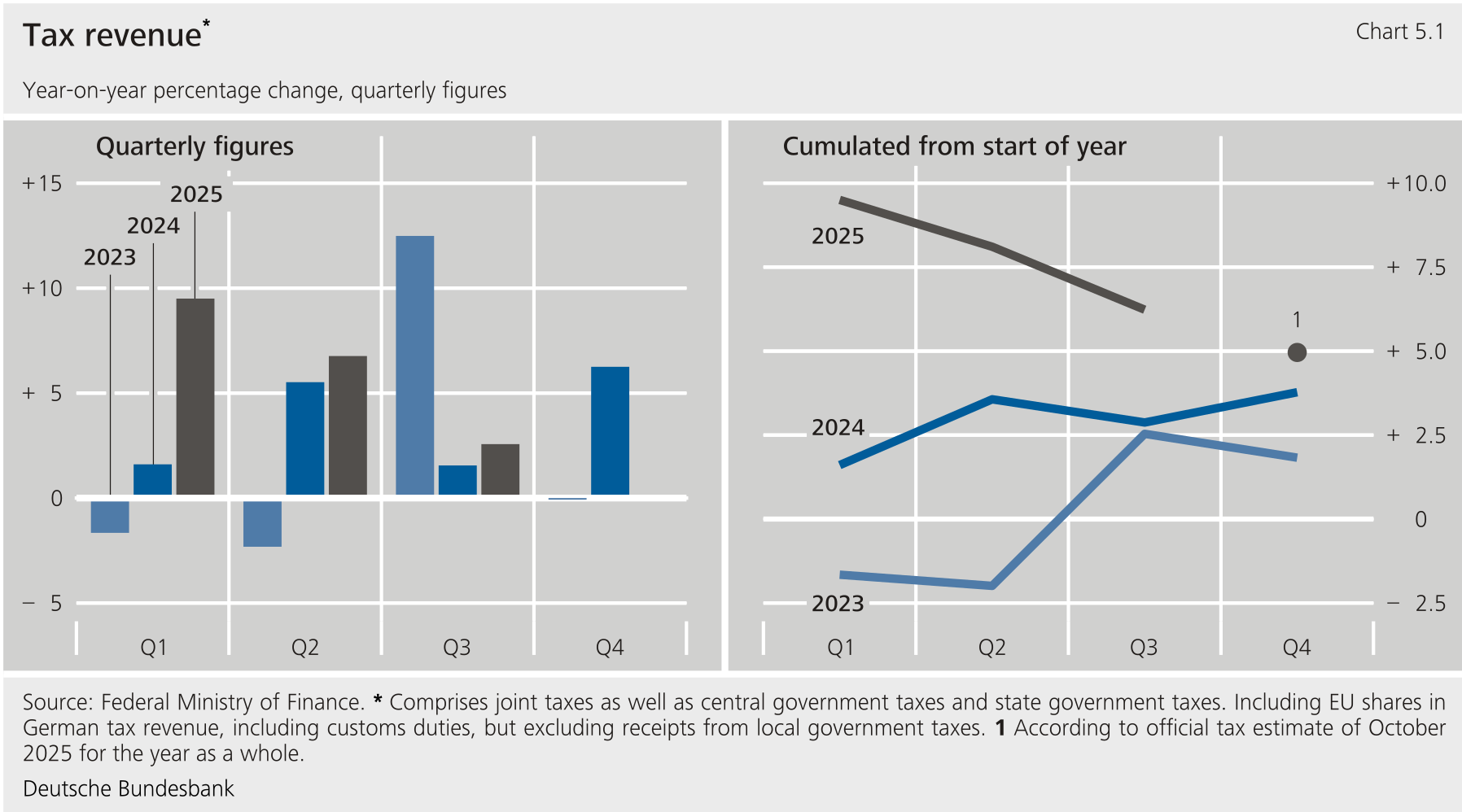**
****For 2025 as a whole, the latest official tax estimate from October expects growth of 4½ %** (including local government taxes).Owing to the aforementioned factors, taxes collected have been growing at a markedly faster pace than anticipated based on changes in the nominal macroeconomic reference variables and fiscal drag.**{#par-u4ua9o}
****Wage tax revenue will also grow considerably in 2025 as a whole.**The 5½ % increase is significantly stronger than that of gross wages and salaries (3½ %). The first reason for this is the progressive income tax scale. Second, taxable wage elements have been replacing tax-free inflation compensation bonuses. Larger revenue shortfalls are due to compensation for the effect of bracket creep and the sharp rise in health insurance contributions. The employee contribution reduces the tax burden as a special expense.**{#par-eo8oi3}
****Profit-related taxes will still see marked growth overall in 2025, at 2½ %.**This is being buoyed by the sharp rise in receipts from withholding tax (excluding this, growth is only ½ %) and the considerable increase in assessed income tax. In the latter's case, it is likely to reflect that the earnings growth of smaller firms has been more stable than that of larger firms in recent months. In addition, pension taxation is increasingly being deferred -- and this income is recorded under assessed income tax.**{#par-a647o7}
{#par-ee8u39}{#par-ei56a1}{#par-ou53iu}{#par-e91769}{#par-o19624}{#par-e6o87o}{#par-oi911i}{#par-i996ui}{#par-i6o91a}{#par-ao8733}{#par-a84197}
|----------------------------------------------------------|----------|-------|---------------|--------|--------------------------------------------|----------|-------|---------------|--------|
| **Table 5.1: Tax revenue** ||||||||||
| **Type of tax** | **to** |||| **Estimate for 2025^1^** | ||||
| **Type of tax** | **2024** | **2025** ||| **Estimate for 2025^1^** | **2024** | **2025** |||
| **Type of tax** | **€ billion** || **Year-on-year change** || **Year-on-year change**{#par-o72ia9} **%** | **€ billion** || **Year-on-year change** ||
| **Type of tax** | **€ billion** || **€ billion** | **%** | **Year-on-year change**{#par-o72ia9} **%** | **€ billion** || **€ billion** | **%** |
| **Tax revenue** **Total^2^** | 626.0 | 665.0 | + 39.0 | + 6.2 | + 5.0 | 212.0 | 217.4 | + 5.4 | + 2.6 |
| **of which:** | |||||||||
| **Wage tax^3^** | 179.8 | 189.9 | + 10.1 | + 5.6 | + 5.3 | 60.1 | 62.8 | + 2.8 | + 4.6 |
| **Profit-related taxes** | 122.6 | 130.5 | + 8.0 | + 6.5 | + 3.9 | 39.0 | 40.5 | + 1.5 | + 3.9 |
| **Assessed income tax^4^** | 52.7 | 56.8 | + 4.1 | + 7.8 | + 6.1 | 18.8 | 19.9 | + 1.1 | + 6.1 |
| **Corporation tax^5^** | 29.2 | 29.4 | + 0.2 | + 0.8 | − 1.9 | 8.7 | 9.7 | + 1.0 | + 11.1 |
| **Non-assessed taxes on earnings** | 26.7 | 25.2 | − 1.5 | − 5.6 | − 6.4 | 7.3 | 6.3 | − 1.0 | − 14.0 |
| **Withholding tax on interest income and capital gains** | 13.9 | 19.1 | + 5.1 | + 36.7 | + 25.6 | 4.2 | 4.6 | + 0.4 | + 10.8 |
| **^6^** | 221.2 | 231.4 | + 10.1 | + 4.6 | + 3.0 | 76.4 | 77.1 | + 0.8 | + 1.0 |
| **Other consumption-related taxes^7^** | 66.6 | 71.8 | + 5.2 | + 7.8 | + 8.2 | 22.7 | 23.5 | + 0.7 | + 3.2 |
| Sources: Federal Ministry of Finance, Working Party on Tax Revenue Estimates and Bundesbank calculations. **1** According to official tax estimate of October 2025. **2** Comprises joint taxes as well as central government taxes and state government taxes. Including shares in German tax revenue, including customs duties, but excluding receipts from local government taxes. **3** Child benefits and subsidies for supplementary private pension plans deducted from revenue. **4** Employee refunds and research grants deducted from revenue. **5** Research grants deducted from revenue. **6** and import . **7** Taxes on energy, tobacco, insurance, motor vehicles, electricity, alcohol, air traffic, coffee, sparkling wine, intermediate products, alcopops, betting and lotteries, beer and fire protection. ||||||||||
{#par-ua8232}
### **2.2 Tax estimate up to 2030: moderate growth overall** {#tar-6}
****For 2026, the tax estimate expects revenue to rise by only 2½ % -- curbed by tax cuts and the disappearance of one-off effects.** Looking at tax cuts, the main drivers are that bracket creep will be offset once again and that the immediate investment programme ("Investitionssofortprogramm") will accelerate the depreciation rates for movable fixed assets and newly purchased electric vehicles. In addition, receipts from withholding tax and inheritance tax will fall significantly.**{#par-o7ua67}
****Revenue growth will pick up somewhat more strongly again in the following years 2027 to 2030, going up by an average of 3½ % -- mainly due to the assumptions regarding nominal macroeconomic variables and fiscal drag.** In 2028, revenue will rise at a markedly slower pace. This is partly due to the fact that the corporation tax rate will fall by 1 percentage point because of the immediate investment programme.[\[6\]](#_ftn_root_6) In addition, it is assumed that the contribution rate to the statutory pension insurance scheme will be raised significantly in 2028. This will reduce taxable income.**{#par-oa9o6u}
****The tax estimate does not yet take account of the further tax cuts that are only in the planning stages at this time. These could reduce tax revenue by just under 1 % per year from 2027.** Specifically, there are plans to lower the rate on meals in restaurants to the reduced rate, cut the electricity tax for firms in the manufacturing sector and agriculture, and raise the commuter allowance.**{#par-ue53ui}
{#par-a38i3a}{#par-a94632}{#par-i63264}{#par-oe9oio}{#par-e82a96}{#par-i58118}{#par-a57171}{#par-e3589u}{#par-o5o6e3}{#par-a914i3}{#par-o1uua4}{#par-u312ei}{#par-i66o5u}
|------------------------------------------------------------------------------------------------------|----------|----------|----------|----------|----------|----------|
| **Table 5.2: Official tax estimate figures and the Federal Government's macroeconomic projections** |||||||
| **Item** | **2025** | **2026** | **2027** | **2028** | **2029** | **2030** |
| **Tax revenue^1^** | ||||||
| **€ billion** | 990.7 | 1,016.5 | 1,051.0 | 1,079.8 | 1,115.9 | 1,155.4 |
| **% of** | 22.2 | 21.9 | 21.9 | 21.9 | 22.0 | 22.1 |
| **Year-on-year change (%)** | 4.5 | 2.6 | 3.4 | 2.7 | 3.3 | 3.5 |
| **Revision compared with previous tax estimate (€ billion)** | 11.0 | 10.6 | 8.1 | 1.0 | 2.9 | . |
| **Memo item: Revenue shortfalls due to envisaged tax relief (€ billion)** | ||||||
| **Selected legislative changes^2^** | 0.4 | − 6.1 | − 8.9 | − 9.4 | − 9.1 | − 8.8 |
| **Revenue shortfalls if bracket creep is compensated for in same manner as previously from 2027^3^** | . | . | − 6.1 | − 13.1 | − 19.5 | − 26.1 |
| **Real** **growth (%)** | ||||||
| **Autumn projection (October 2025)** | 0.2 | 1.3 | 1.4 | 0.9 | 0.9 | 0.9 |
| **Spring projection (April 2025)** | 0.0 | 1.0 | 1.0 | 1.0 | 1.0 | . |
| **Nominal** **growth (%)** | ||||||
| **Autumn projection (October 2025)** | 3.0 | 3.9 | 3.7 | 2.9 | 2.9 | 2.9 |
| **Spring projection (April 2025)** | 2.0 | 3.0 | 3.0 | 3.0 | 3.0 | . |
| Sources: Working Party on Tax Revenue Estimates, Federal Ministry for Economic Affairs and Energy and Bundesbank calculations. **1** Including shares in German tax revenue, including customs duties, including receipts from local government taxes. **2** Bundesbank calculations in part (on the basis of the coalition agreement): 2025 Tax Amendment Act (*Steueränderungsgesetz 2025* ), Third Act Amending the Energy Tax Act and the Electricity Tax Act (*Drittes Gesetz zur Änderung des Energiesteuer- und des Stromsteuergesetzes* ), Active Pension Act (*Aktivrentengesetz* ), Act to Abolish the Free Port of Cuxhaven and Amend Further Provisions (*Gesetz zur Aufhebung der Freizone Cuxhaven und zur Änderung weiterer Vorschriften* ), Act Amending the Motor Vehicle Tax Act (*Kraftfahrzeugsteuer-Änderungsgesetz* ), tax exemption for overtime bonuses, gradual tobacco tax hikes as from 2027. **3** Since 2014, the income tax scale has been shifted year after year, usually in line with the estimated inflation of the previous year. The figures shown here are the revenue shortfalls that will result if this practice is continued and the basic income tax allowance also shifts in line with the inflation rate of the previous year in each case. The effects are roughly estimated and are based on the Federal Government's current autumn projection and wage tax receipts based on the current tax estimate. They are stated as defined in the national accounts. |||||||
{#par-a854i1}
****Additionally, there would be larger revenue shortfalls if bracket creep were to continue being offset as usual.** Tax revenue would then be even lower from 2027 and, in 2030, revenue would be just under 2½ % lower than shown in the tax estimate due to this factor alone.**{#par-i4iua9}
****Compared with the May 2025 tax estimate, there is marked additional revenue between 2025 and 2027 (¼ % of** **in each year).** [\[7\]](#_ftn_root_7) However, the tax estimate revises revenue only slightly upwards for 2028 and 2029. There are two overlapping factors at play here. On the one hand, the tax estimate has revised the underlying revenue path upwards. The main reason for this is that the nominal macroeconomic assumptions are markedly more favourable. On the other hand, the estimate now factors in the immediate investment programme adopted in the summer. This will result in marked shortfalls starting next year, and these will rise significantly up to 2029 (to ¼ % of ).**{#par-aaoauo}
**3 Central government finances** {#tar-7}
------------------------------------------
### **3.1 Deficit sees year-on-year rise in 2025 but is set to remain significantly lower than estimated** {#tar-8}
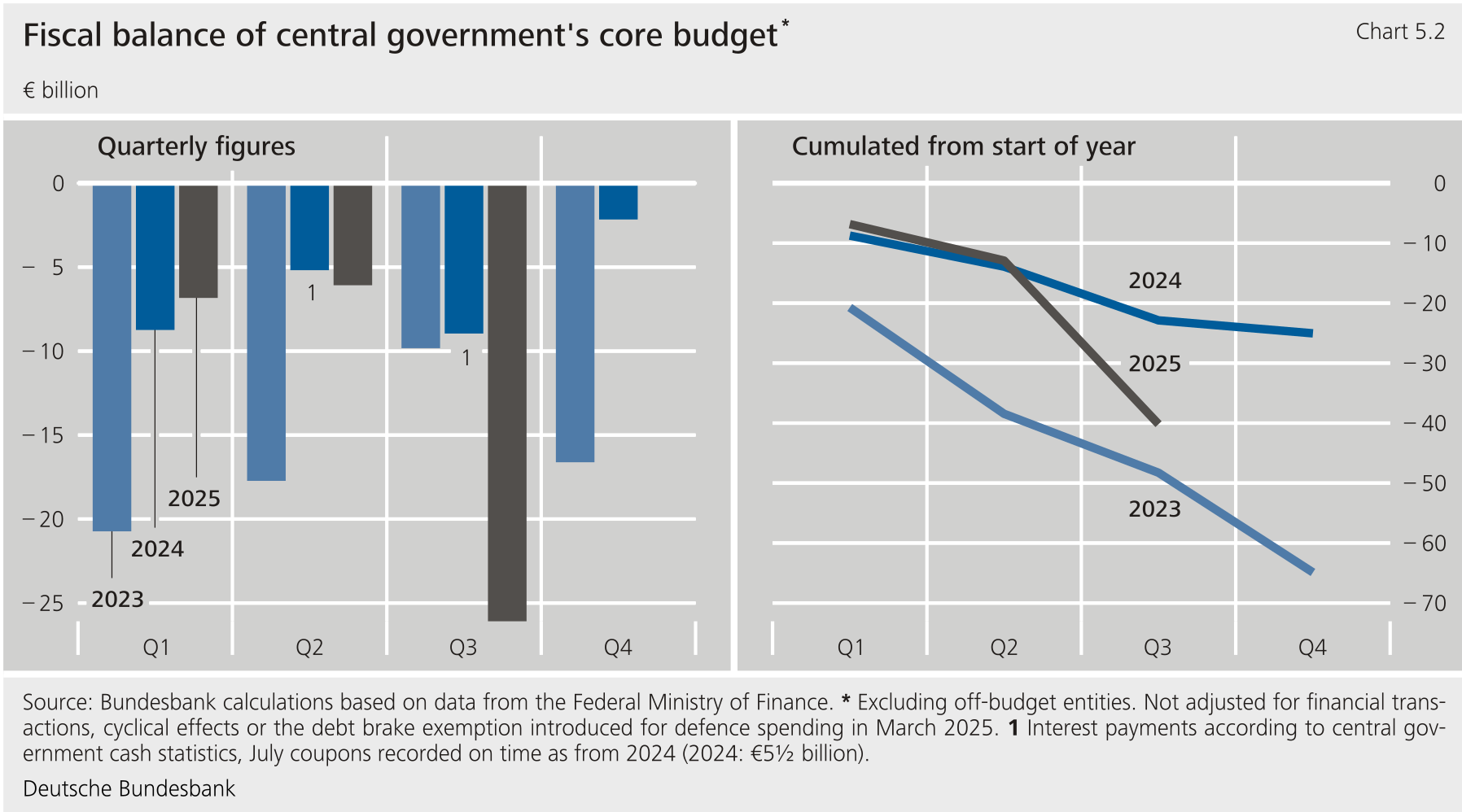
****Central government's financial result, including off-budget entities, has been steadily worsening in year-on-year terms over the course of 2025.** In the first half of the year, the overall deficit had declined while tax revenue had risen sharply.[\[8\]](#_ftn_root_8) However, tax revenue barely increased in the third quarter, whereas expenditure grew at an accelerated pace.[\[9\]](#_ftn_root_9) In the first three quarters combined, the deficit had thus risen slightly (+ €3 billion). In the final quarter, the balance is likely to be significantly less favourable than it was a year ago.One reason for this is that spending by the new Infrastructure and Climate Neutrality Fund will not start until the final quarter (including investment expenditure that was moved over from the core budget). High extraordinary revenue recorded by the core budget at the end of 2024 will also disappear: at that time, it had received almost €14 billion from the Next Generation fund and the bulk of the repayments of crisis assistance transfers (€9 billion for the year as a whole). The latest tax estimate implies little growth for the fourth quarter, too.**{#par-e81u34}
****For the year as a whole, the deficit in the core budget is thus likely to rise sharply on the year (2024: €25 billion). However, it is likely to remain well below the planned deficit of almost €82 billion.** According to the latest tax estimate, tax revenue is likely to be €5 billion higher than envisaged in the central government budget.[\[10\]](#_ftn_root_10) On the expenditure side, too, it seems likely that actual figures will be better than the target ones. This applies, in particular, to defence spending. Actual growth has thus far amounted to 5 %, with a target figure of + 24 % for the year as a whole. If outflows do not accelerate, defence spending will remain almost €10 billion lower than budgeted. Due to the debt brake exemption for this spending, such a deviation would have no effect on debt brake settlement. However, what is relevant for the debt brake is that nominal is likely to grow more strongly than assumed during budget planning. The additional tax revenue is thus recorded more or less as cyclical. This therefore does not improve the structural balance within the debt brake.**{#par-ui9e28}
****
**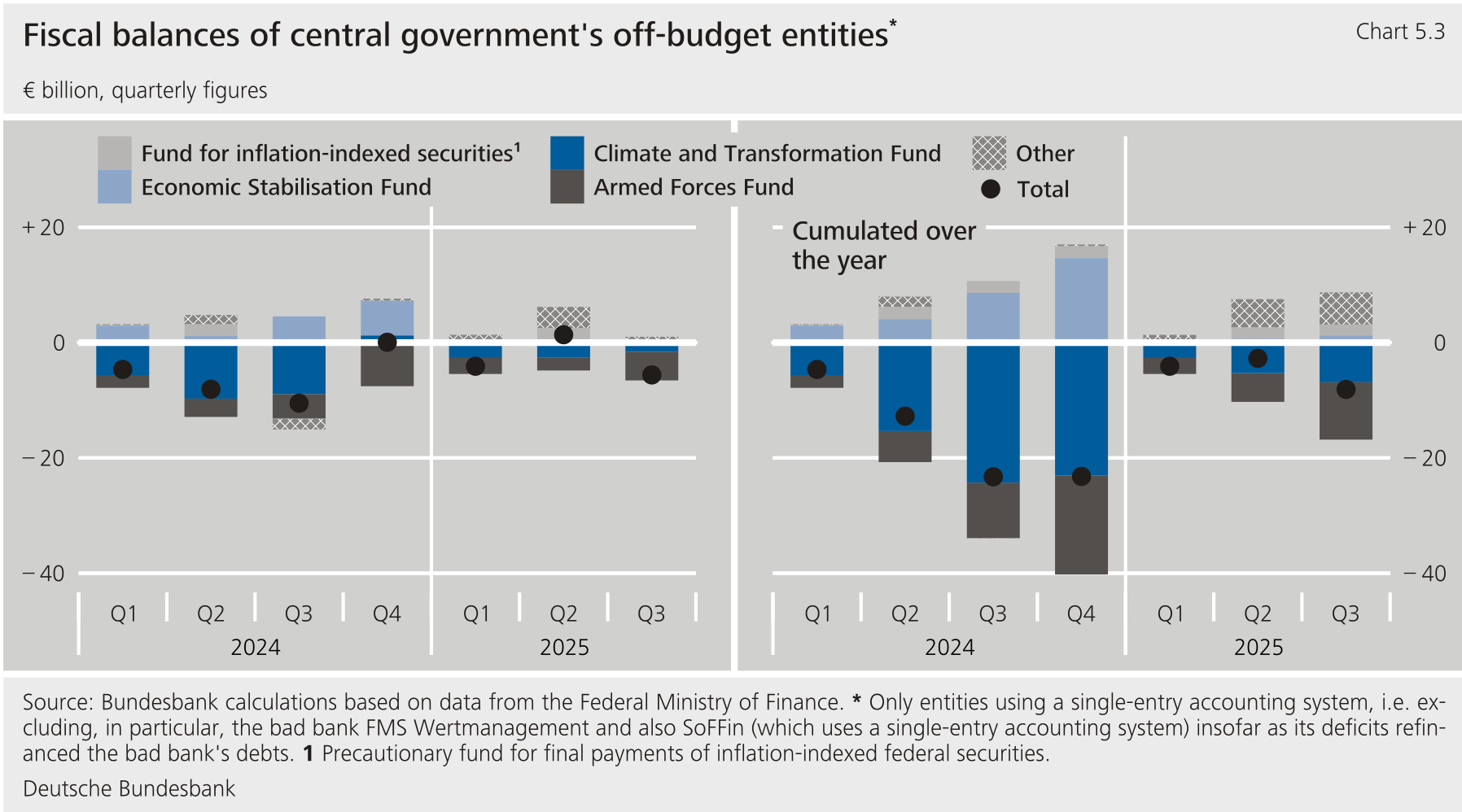**
****The off-budget entities' deficit will rise compared with 2024 (€24 billion), but will also remain lower than planned (€64 billion).** [\[11\]](#_ftn_root_11) After the first three quarters, the deficit stood at almost €9 billion. At €10 billion, spending by the Armed Forces Fund, and thus the deficit, roughly matched the previous year's level. There are no signs so far of the planned deficit increase of €7 billion for the year as a whole. It is also difficult to estimate the expenditure of the Infrastructure and Climate Neutrality Fund. Its funds have only been available for disbursement since October. Central government plans to use €37 billion of these by the end of the year. Of this amount, €8½ billion is for state governments. Disbursement requires steps such as formal administrative agreements. There are likely to be swift outflows from the Infrastructure and Climate Neutrality Fund mainly for expenditure that it has taken over from the core budget. By contrast, additional investment in infrastructure tends to require a longer lead time. The Climate Fund is to receive €10 billion. In return, it will use €3½ billion on a one-off basis to assume the gas storage levy. All in all, the off-budget entities' deficit could be around half as high as planned.**{#par-i673i9}
### **3.2 Deficit will continue to rise significantly in 2026** {#tar-9}
****The central government budget is expected to record a very large deficit next year.** Based on the results of the final deliberations published so far, it is set to amount to €189 billion. This is €43 billion higher than what was planned for 2025 -- most of which is attributable to the off-budget entities. In the core budget, an increase of €16 billion to €98 billion is envisaged.[\[12\]](#_ftn_root_12) Compared with what is set to be a significantly lower actual deficit for 2025, the increase would be much larger still.**{#par-ue7o18}
****The planned core budget deficit is €2 billion lower than in the Federal Government's draft from the summer. The more favourable tax estimate was the main factor driving down the deficit.** According to the estimate, tax revenue will be €3½ billion higher. Central government is already factoring in reductions for changes in tax legislation that have not yet been taken into account in the tax estimate but have since been specified in more detail. At the same time, central government reduced its supplementary provision for further projects (non-tax global revenue shortfalls) by just under €3 billion to €1½ billion.**{#par-eo68u2}
****On the expenditure side, loans to the social security funds, with which central government will ultimately stabilise social contribution rates, are expected to be €2 billion higher than in the summer draft. Additional Ukraine aid will be somewhat more extensive and falls under the defence spending exception.** Slightly higher repayable funds to the Federal Employment Agency to bridge the period of economic weakness without raising contribution rates make sense. Significantly higher loans to the long-term care insurance scheme are planned. Unlike at the Federal Employment Agency, the financial problems here are structural, and rates are rising in trend terms. In granting loans to the long-term care insurance scheme -- as well as those to the health insurance scheme already budgeted for in the summer -- central government is therefore only pressing pause on raising rates. And in order to repay the loans, contribution rates will then have to be temporarily raised even more than otherwise necessary in the future. Should these loans become grants further down the road because central government wants to prevent this, payments would have to be counted towards the debt brake. Overall, therefore, central government is putting off financing decisions and increasing the need for action in the future.**{#par-ae8o57}
****Looking at the debt brake, the planned deficit in the core budget can be broken down as follows:****{#par-ouu499}
* ****The threshold for structural net borrowing of 0.35 % of****will result in deficit scope of just over €40 billion.** Of this amount, €15 billion is attributable to permissible structural borrowing, just under €16 billion to cyclical burdens, and €9½ billion to acquisitions of financial assets. Central government will make no further use of the remaining reserves (instead of using €9½ billion as outlined in the summer draft).**
* ****The exemption for defence spending will cost just shy of €58 billion.**The starting point is spending by the Federal Ministry of Defence, to strengthen Ukraine's defence capabilities and for certain domestic security purposes. Altogether, this amounts to €101 billion. From this, €43 billion (1 % of ), which falls under the regular new borrowing limit, is to be deducted.**
****Overall, as things now stand, the core budget could, in the coming year as well, have a better closing balance than estimated.**This is because outflows are likely to be much smaller than planned this year, especially for defence spending. In this respect, the starting point for 2026 is lower.**{#par-aa3116}
****In the case of off-budget entities, the overall deficit is set to continue rising significantly in 2026. Adjustments agreed in the final deliberations have only been published in part thus far.** The deficit of the Infrastructure and Climate Neutrality Fund is set to be almost €1 billion lower than in the plans made in summer.[\[13\]](#_ftn_root_13) Adjustments to the Armed Forces Fund have not yet been made known. The prospect of a planned steep rise in the deficit thus remains unchanged.**{#par-uu9965}
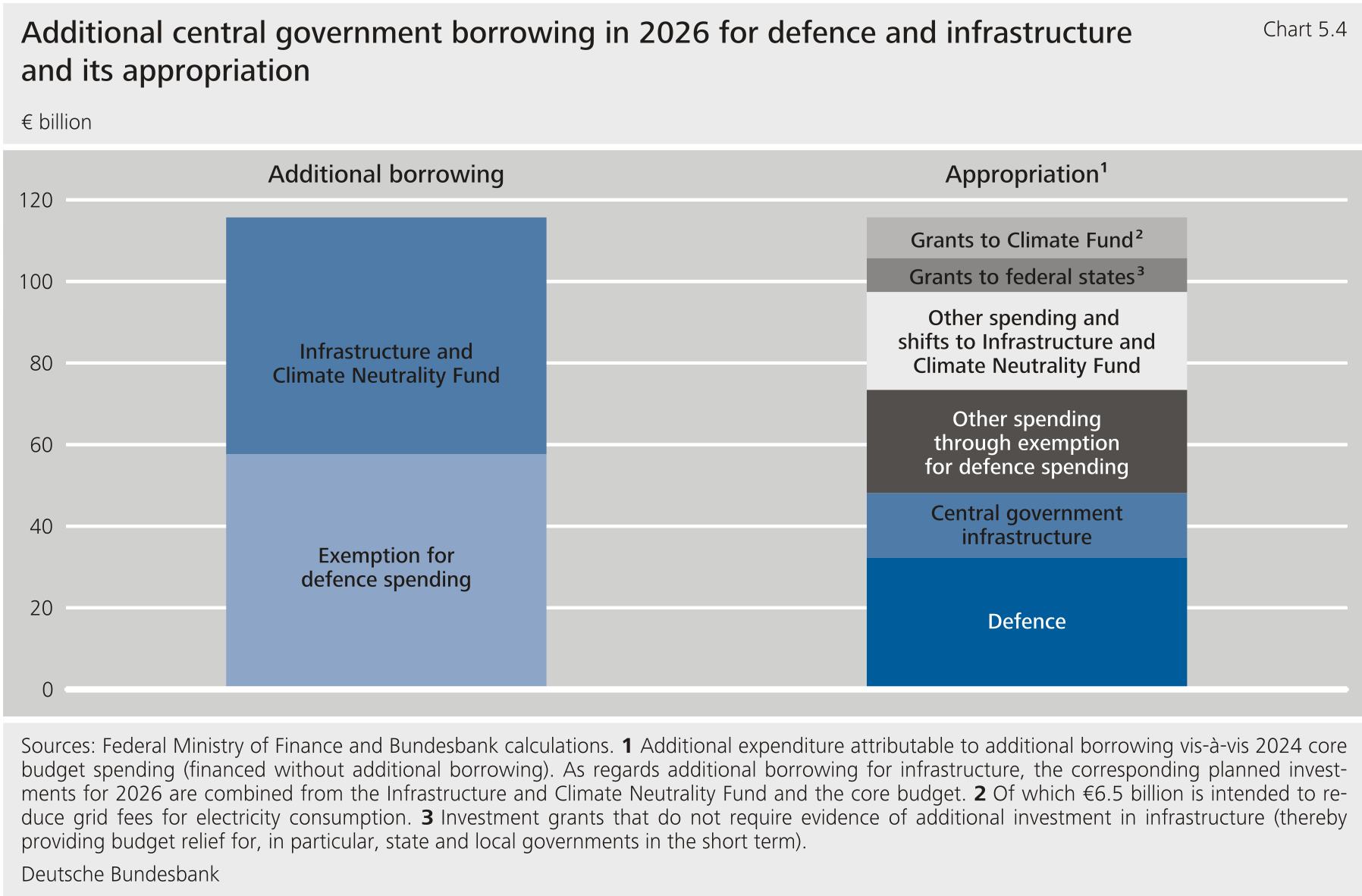
****Additional net borrowing due to the exemption for defence spending and by the Infrastructure and Climate Neutrality Fund will significantly exceed additional expenditure on central government infrastructure and defence in 2026, too.** Net borrowing here is planned to come in at almost €116 billion. By contrast, additional expenditure on central government infrastructure (core budget and Infrastructure and Climate Neutrality Fund taken together)[\[14\]](#_ftn_root_14) and defence is estimated at roughly + €50 billion on the base year 2024.[\[15\]](#_ftn_root_15) Furthermore, the debt-financed funds from the Infrastructure and Climate Neutrality Fund will flow out, in the form of grants, to the federal states (which have not committed to any additional investment expenditure, meaning that very limited additional spending on infrastructure can be expected at most), to the Climate Fund (which will largely use these funds to finance the newly agreed reduction in the electricity grid fee) and to entities outside the government sector (particularly private enterprises). The core budget will also gain scope for other expenditure as central government shifts budget items into the Infrastructure and Climate Neutrality Fund[\[16\]](#_ftn_root_16) and due to the fact that the included defence expenditure in the starting year 2024 significantly exceeded the 1 % threshold above which debt financing is now possible.**{#par-ei691e}
****
### **3.3 High need for consolidation from 2027 onwards -- lower borrowing limit also advisable** {#tar-10}
****From 2027 onwards, persistently high deficits are accompanied by a considerable need for consolidation in the central government budget in order to comply with the debt brake requirements.** Although the debt brake reform considerably expanded central government's scope for borrowing, central government's summer fiscal plans contain a high need for consolidation in the core budget ("need for action"). This increased from €34 billion in 2027 to €74 billion (1½ % of ) in 2029.**{#par-a31a99}
**The new tax estimate does not significantly reduce the need for consolidation. Adjusted for burdening changes in tax legislation, which appear to have been accounted for in the fiscal plan, the need for action could fall by around €7 billion per year. Though it is now planned to refrain from using reserves to finance the budget in 2026, this will only shrink the gap on a one-time basis, in the order of €10 billion. However, no further notable relief is apparent. Significant policy adjustments will therefore remain necessary.**{#par-ou18i2}
****This need for action aside, such large deficits are unsustainable.** A reform of the debt brake is therefore warranted to safeguard sound central government finances once more. The Bundesbank has made reform proposals to this effect.[\[17\]](#_ftn_root_17)**{#par-u614a9}
**4 State government budgets** {#tar-11}
----------------------------------------
****After the third quarter, state government budgets as a whole have recorded surpluses in the current year. This improvement on last year reflects positive one-off effects and the absence of non-recurring burdens.** In the first half of the year, core budgets and off-budget entities improved significantly on the previous year. Following a deficit of €3½ billion, they now recorded a surplus of €1½ billion. At + 5 %, revenue rose significantly more strongly than expenditure (+ 3 %). One-off effects played a key role in this. These included, but were not limited to, a one-off effect in inheritance tax. Additionally, tax and social contribution-exempt inflation compensation bonuses had expired at the end of 2024. Results for the third quarter are already available for the core budgets. The surplus of just under €2½ billion is €2 billion higher than a year earlier. However, adjusted for one-off effects, particularly from declining acquisitions of participating interests, this represents a deterioration on the year. The main reason for this was the considerable slowdown in tax revenue growth.**{#par-o94e36}
**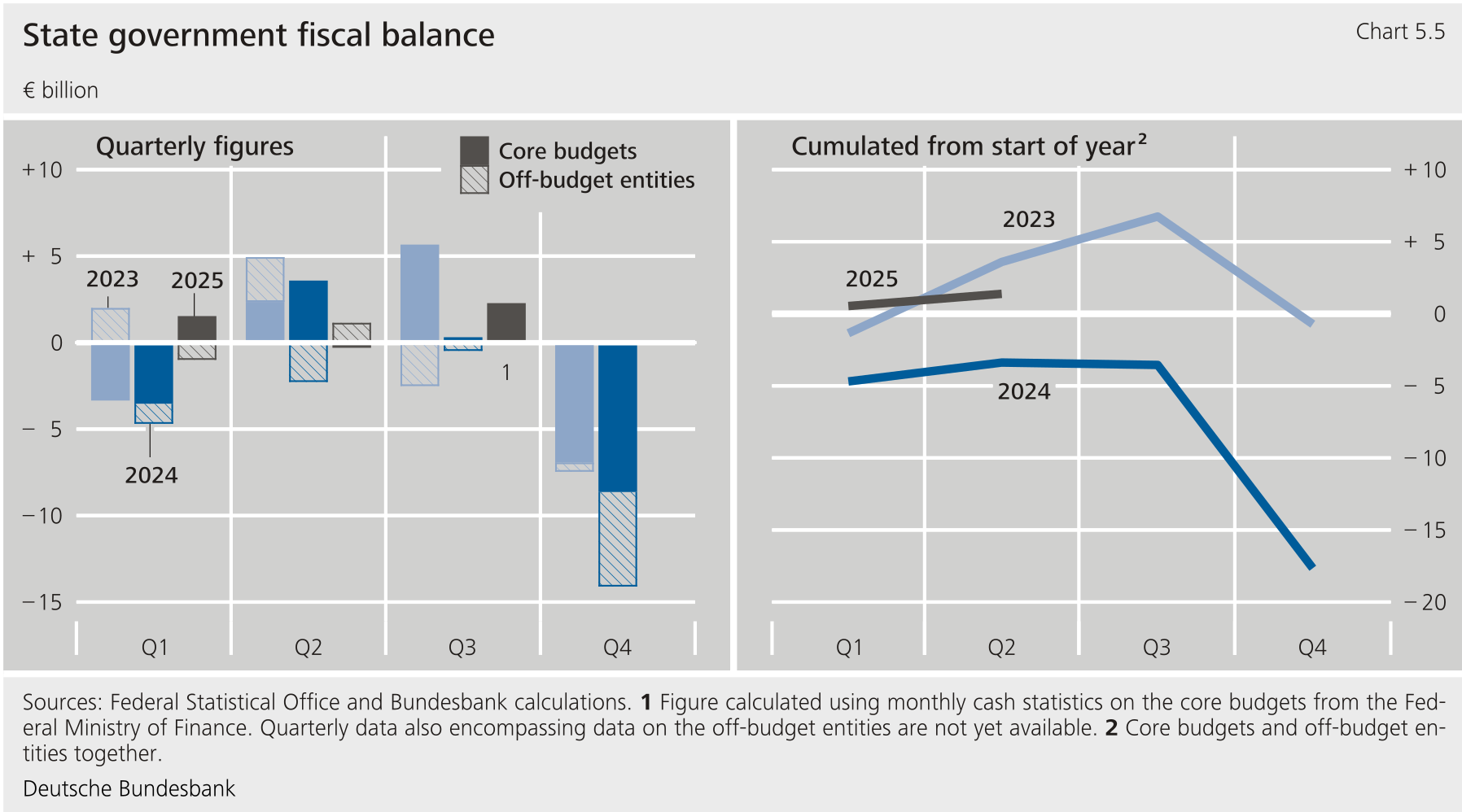**
****For 2025 as a whole, state government budgets are expected to see a marked decline in deficits, bolstered by the aforementioned one-off factors (2024: deficit in core budgets and off-budget entities of €18 billion).** Developments over the remainder of the year, however, remain uncertain. This is because, at present, it is difficult to predict the impact of the Infrastructure and Climate Neutrality Fund and the newly adopted state government borrowing ceilings of 0.35 % of . For example, funds for investment could still flow to the federal states from this Fund. These would ease the burden on the balance, as these funds would probably be used primarily to refinance payments already made. However, for this to happen, the administrative agreement between central government and the federal states still has to be enacted. It is therefore uncertain whether there will be large fund flows in the current year. The extent to which the federal states will use their borrowing scope under the reformed debt brake in a manner that affects the deficit (i.e. not parking funds in reserves or in special funds) also remains to be seen. It would seem plausible for state governments to make even higher transfers to their local governments, as the former bear partial responsibility for the financial resources of the latter. Without such assistance, large local government deficits can be expected on aggregate.**{#par-ea7a8o}
****Next year, the state governments could make greater use of fiscal scope afforded by the debt brake reform.** They are likely to implement more deficit-affecting measures. However, the increase in the deficit will be dampened if they use funds from the Infrastructure and Climate Neutrality Fund without increasing their investment on the year to the same extent (additional grants without additional investment).**{#par-i969u1}
**5 Social security funds** {#tar-12}
-------------------------------------
### **5.1 Pension insurance scheme** {#tar-13}
#### **5.1.1 Outlook for 2025 and the period up to 2028**
****The financial situation of the statutory pension insurance scheme deteriorated significantly in 2025. A deficit of just over €4 billion is expected** (2024: deficit of almost €1 billion). After the first three quarters of 2025, the pension insurance scheme recorded a cumulated deficit of almost €7½ billion (2024: €4½ billion). It will sink towards the end of the year if there is a surplus in the final quarter, as is usual for this time of year. This surplus is the result of higher contribution receipts from one-off payments. Looking at the year as a whole, revenue is likely to be distinctly higher than in 2024. In addition to significant wage increases, this is due to the fact that earnings subject to compulsory contributions have been replacing tax-free and social contribution-exempt inflation compensation bonuses from the previous year. However, expenditure will increase somewhat more strongly than revenue. First, pensions, in particular, are rising at a steep annual average of 4 % (pension adjustment of just over 3½ % at mid-2025).[\[18\]](#_ftn_root_18) Second, the number of pensions paid out is increasing. Third, the supplementary contributions to the statutory health insurance scheme rose sharply at the start of the year.[\[19\]](#_ftn_root_19)**{#par-u14uu5}
**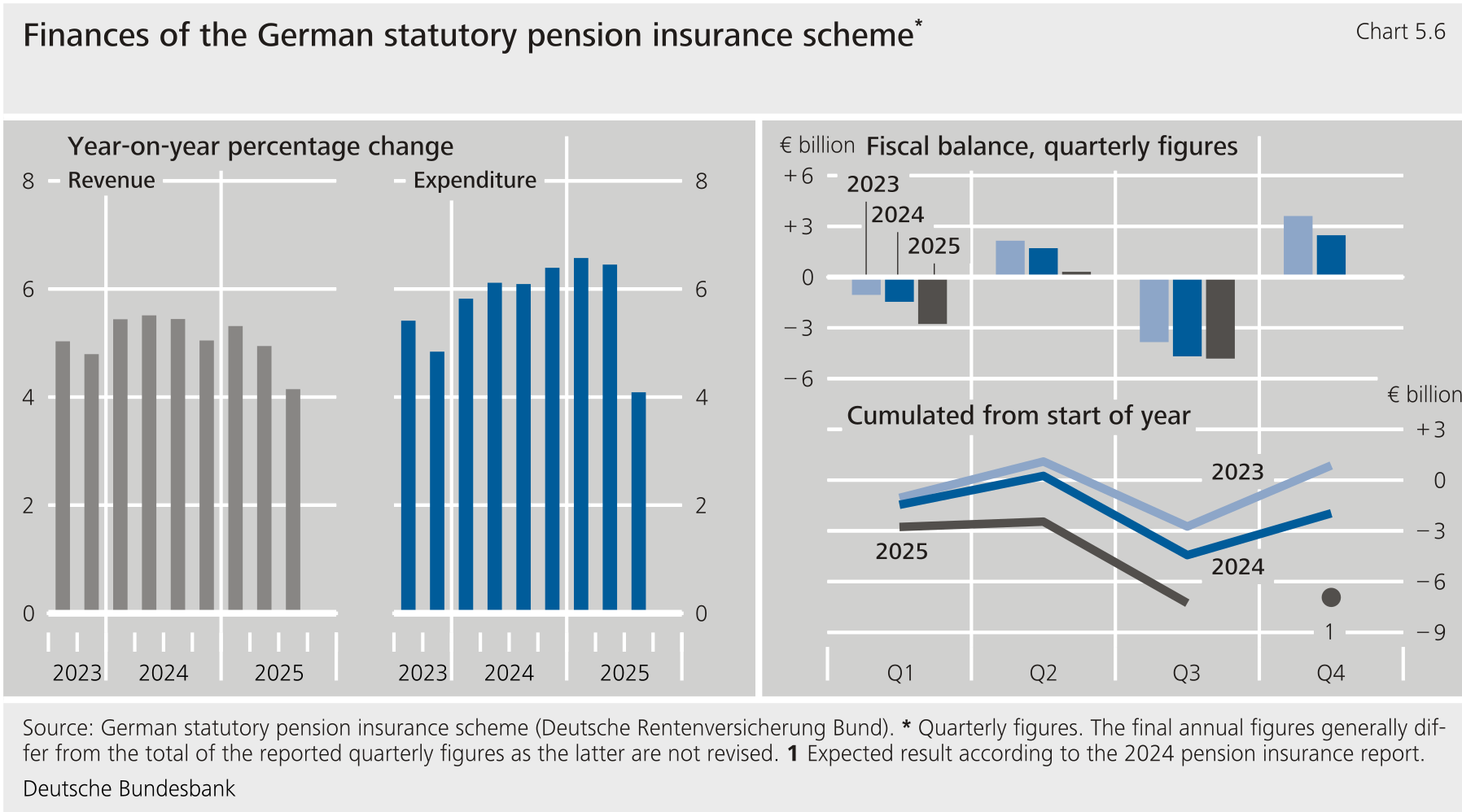**
****In 2026, the deficit is likely to expand considerably.**Lower wage increases are expected to have a marked dampening effect on growth in contribution receipts. Furthermore, the positive effect of tax and social contribution-exempt inflation compensation bonuses no longer being paid that was felt in 2025 will taper off. Expenditure will probably also increase less steeply in the current year as a result of the stable health insurance contribution rates next year and in the absence of the boost from supplements to pensions for reduced earning capacity. However, the growth in spending is likely to remain significantly stronger than the increase in revenue.**{#par-a2uu54}
****The pension insurance scheme initially finances deficits from its sustainability reserve.** The contribution rate only rises if the sustainability reserve would otherwise fall below its statutory minimum amount. The Federal Government wants to raise this lower limit from 0.2 to 0.3 times the scheme's monthly expenditure to better safeguard the pension insurance scheme's liquidity throughout the year. The minimum reserve will then amount to around €10 billion (with an expected stock of €40 billion at the end of 2025). In 2028, limited access to reserves will still be possible. However, as things stand, the contribution rate will have to rise in a larger step from its current 18.6 % to almost 20 % in order to not fall below the statutory minimum in 2028. This means that no more reserves will be available in the following year, and another -- albeit more moderate -- rate increase will thus be on the cards, irrespective of further demographic pressure.**{#par-oiou12}
#### **5.1.2 Extended threshold planned, central government budget to permanently bear the burden**
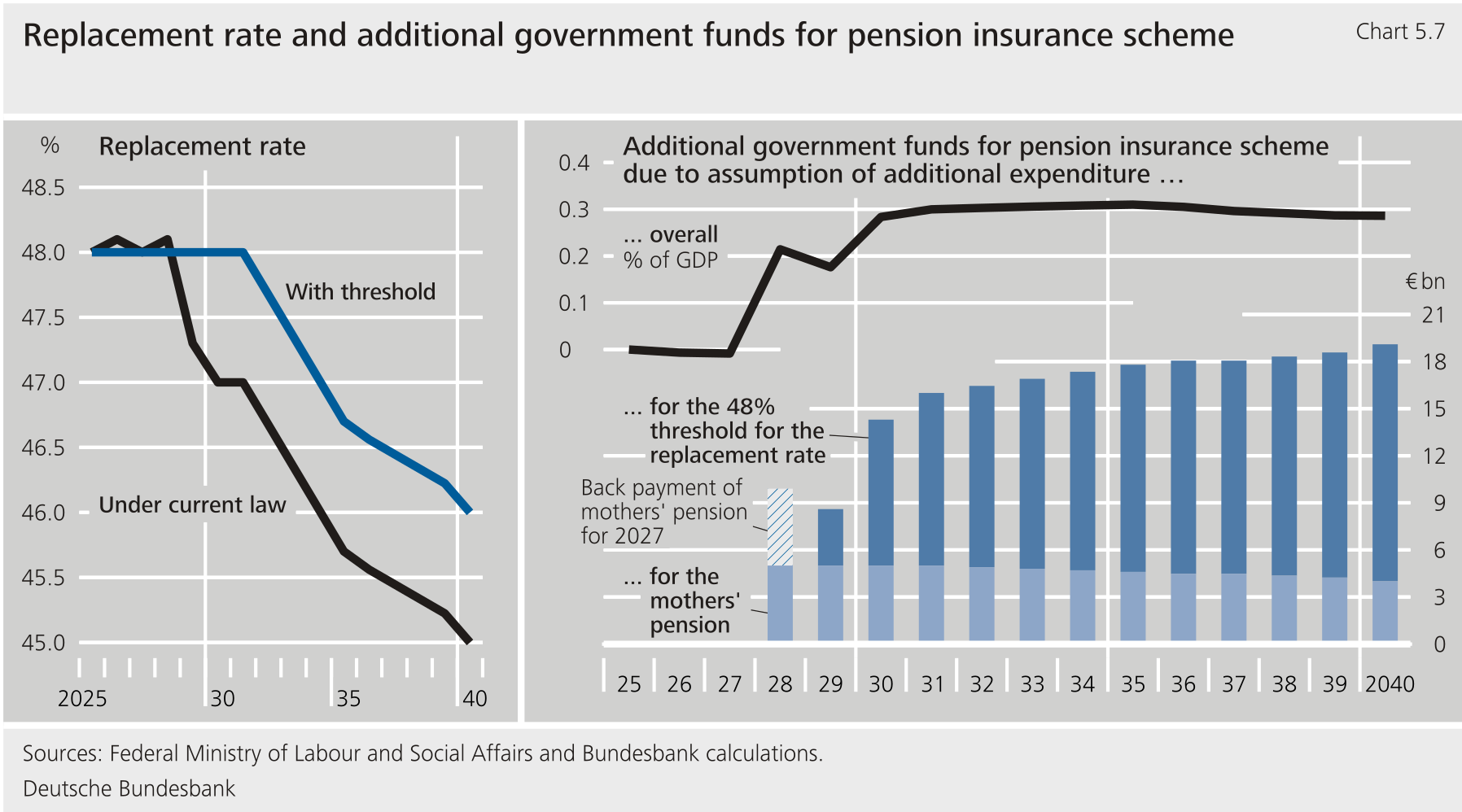
****The Federal Government is planning to extend the minimum threshold for the replacement rate up to 2031. The additional costs are to be covered by central government. The Federal Government does not clarify how the resulting permanently higher pension expenditure is to be financed.**[\[20\]](#_ftn_root_20)Under the current legal framework, the sustainability factor would take effect again from 2026 onwards and pension adjustments would thus be lower. The replacement rate would gradually decline (see the left-hand panel of Chart 5.7 below). The sustainability factor resulted in a broader distribution of burdens, which had been agreed upon in previous pension reforms.[\[21\]](#_ftn_root_21) However, the draft legislation for the 2025 pension package now anticipates that the replacement rate will remain at 48 % until 2031. The additional costs incurred by central government in connection with this are to be financed by higher central government transfers. According to the draft law, the sustainability factor will dampen pension adjustments again from 2032 onwards. However, as the starting level will then be significantly higher than it would have been without a threshold, pension expenditure will remain structurally higher after 2031 (see the right-hand panel of Chart 5.7). The effect would be mitigated if, for example, a catch-up factor were to scale back the difference in the replacement rate through subsequent pension adjustments. Ultimately, as of 2029, the extended threshold will widen the financing gap in the fiscal plan for the central government budget and will continue to weigh quite heavily on central government finances even after 2031. To ensure that decisions are made transparently and consistently, it would be advisable to agree on such benefit increases only in conjunction with concrete compensatory financing measures.[\[22\]](#_ftn_root_22)**{#par-oo98u2}
****
****The "active pension****"** **is intended to increase the amount of dependent employees working past the statutory retirement age, but is likely to have large free-rider effects.**The Federal Government has now presented a draft law for the announced "active pension", which is intended to provide financial support for employees working beyond the statutory retirement age. However, people are already working beyond retirement age at present, which means that there will be free-rider effects. These could also be larger than was estimated in the draft law.[\[23\]](#_ftn_root_23)Special tax rules such as these make tax law more complex and bureaucratic. In addition, there are indications that financial incentives are often not the reason behind people continuing to work beyond retirement age. In view of the already strained central government budget, it would make sense, first of all, to wait for the effects of the planned lifting of the ban on temporary contracts for people previously employed on a permanent basis by the same employer.[\[24\]](#_ftn_root_24)**{#par-io94e8}
### **5.2 Federal Employment Agency** {#tar-14}
****The Federal Employment Agency posted a deficit of €4 billion following the first three quarters of 2025 (deficit in 2024: €1 billion). A significant deficit is therefore expected for the year as a whole and is also likely to be higher than planned (€1½ billion).** [\[25\]](#_ftn_root_25) The significant deficit for the year as a whole is mainly due to developments in the labour market. In the first three quarters, payments for unemployment benefits rose quite steeply (+ 19½ %). This is particularly attributable to a substantially higher number of recipients (+ 12 %). Overall, expenditure rose by 15½ %. Although a surplus is usually generated in the final quarter due to contributions paid on seasonal bonuses, this could be rather small due to the strong growth in expenditure.**{#par-ii831u}
**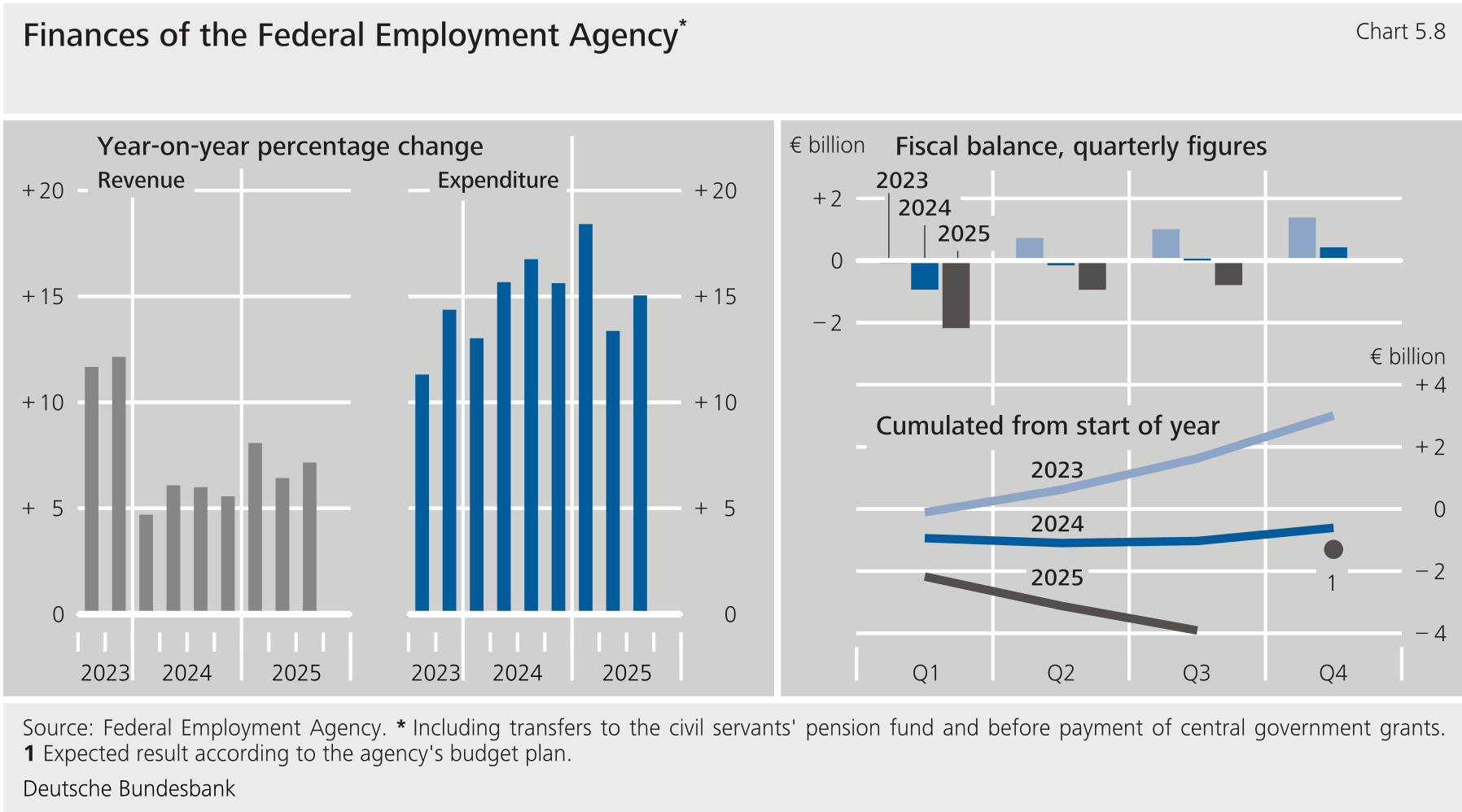**
****Central government loans prevent the contribution rate from having to be raised this year and next year.**The deficit could exceed available reserves in the current year (end-2024: €3 billion). Central government is planning to bridge a financing gap with a multi-year loan of up to €2½ billion. Next year, the Federal Government is expecting economic activity and labour market conditions to improve. Notwithstanding, the Federal Employment Agency foresees a deficit of almost €4 billion, which central government will, in turn, bridge with a loan. As the anticipated wider economic recovery gets under way, the Federal Employment Agency will repay the loans granted by central government out of surpluses at a later point in time. After that, it is expected to replenish its reserves. According to the current assessment, however, surpluses should not be expected until 2028.**{#par-o29132}
***This article reflects data up to 19 November 2025, 11:00.***{#par-o983ia}
**List of references** {#tar-15}
--------------------------------
**Bach, S., H. Buslei, J. Geyer, P. Haan and J. Pieper (2025), [Active pension mainly relieves higher-earning pensioners; employment effects are uncertain](https://www.diw.de/documents/publikationen/73/diw_01.c.966701.de/dwr-25-25-1.pdf), Wochenbericht, No 25/2025, June 2025.**{#par-ooa85a}
**Beznoska, M., R. M. Schüler and S. Seele (2025), [Aktivrente: 2,8 Mrd € steuerliche Mindereinnahmen](https://www.iwkoeln.de/fileadmin/user_upload/Studien/Kurzberichte/PDF/2025/IW-Kurzbericht_2025-Aktivrente.pdf), -Kurzbericht No 69/2025, August 2025.**{#par-u8667o}
**Brüll, E., F. Pfeiffer and N. Ziebarth (2024), [Analyse der Einkommens- und Beschäftigungswirkungen einer Einführung des CDU-Konzepts der „Aktiv-Rente](https://www.degruyterbrill.com/document/doi/10.1515/pwp-2024-0022/html)", Perspektiven der Wirtschaftspolitik, Vol. 25, No 3‑4, pp. 227‑232, November 2024.**{#par-e821o6}
**Deutsche Bundesbank (2025a), [Public finances](https://publikationen.bundesbank.de/content/962900), Monthly Report, August 2025.**{#par-uu8oa8}
**Deutsche Bundesbank (2025b), [How the debt brake could be developed further](https://publikationen.bundesbank.de/content/972500), November 2025.**{#par-u25869}
**Deutsche Bundesbank (2025c), [How the debt brake could be reformed: FAQs on the Bundesbank contribution to the reform debate](https://www.bundesbank.de/content/972508), November 2025.**{#par-e59121}
**Deutsche Bundesbank (2025d), [Sound public finances, stronger investment: a proposal to reform the debt brake](https://publikationen.bundesbank.de/content/952322), Monthly Report, March 2025.**{#par-uuue74}
**Deutsche Bundesbank (2025e), [Early, standard, late: when insurees retire and how pension benefit reductions and increases could be determined](https://publikationen.bundesbank.de/content/958722), Monthly Report, June 2025.**{#par-i56949}
**Federal Employment Agency (2025a), [-Haushalt 2026: Wirksame Investitionen für schnellen Schub bei wirtschaftlicher Erholung](https://www.arbeitsagentur.de/presse/2025-46-ba-haushalt-2026), Presseinfo No 46, November 2025.**{#par-e39i54}
**[German Council of Economic Experts (2025), Perspektiven für morgen schaffen -- Chancen nicht verspielen, Jahresgutachten 2025/26, November 2025.](https://www.sachverstaendigenrat-wirtschaft.de/fileadmin/dateiablage/gutachten/jg202526/JG202526_Gesamtausgabe_Barrierefrei.pdf)**{#par-oi9628}
1. **{#_ftn_root_1} This chapter relates to data from the national accounts and Maastricht debt. This is followed by reporting on budgetary developments (government finance statistics) and budget planning.**
2. **{#_ftn_root_2} For more information on the in parts criticised application of the rules, see Deutsche Bundesbank (2025a), Section 1.3 "[Public finances](https://publikationen.bundesbank.de/content/962900)".**
3. **{#_ftn_root_3} For more information on the recommendation and for questions and answers, see Deutsche Bundesbank (2025b, 2025c).**
4. **{#_ftn_root_4} See Deutsche Bundesbank (2025d).**
5. **{#_ftn_root_5} Excluding local government taxes. Revenue data are not yet available for the third quarter of 2025.**
6. **{#_ftn_root_6} This will still be the case in 2029 and 2030. At the same time, however, the immediate investment programme will support tax growth from 2029. Enterprises will have depreciated the applicable investments more quickly -- meaning that their taxable profits are higher from 2029.**
7. **{#_ftn_root_7} This corresponds to an upward revision of €11 billion in 2025 and 2026 respectively and of €8 billion in 2027.**
8. **{#_ftn_root_8} The switch to accruals-based accounting of discounts took some pressure off here: in 2024, discounts of €4½ billion were recorded in the first half of the year (2024 as a whole: just under €7 billion). Interest expenditure is now booked on an accruals basis, and discounts (and premia) are distributed over bonds' terms.**
9. **{#_ftn_root_9} This was primarily to do with capital injections into Deutsche Bahn and loans to some social security funds. Central government records these payments as financial transactions outside the scope of the debt brake.**
10. **{#_ftn_root_10} The estimated global revenue shortfall is included as a provision for tax shortfalls.**
11. **{#_ftn_root_11} As usual, the draft budget does not contain borrowing plan figures for off-budget entities in which a surplus is expected. The main entities here are the Economic Stabilisation Fund and the special funds for pension provisions. In 2024, this group's surplus stood at almost €20 billion. However, declining repayments of assistance loans to the Economic Stabilisation Fund indicate a lower figure for 2025.**
12. **{#_ftn_root_12} This is what is expected following the Budget Committee's adjustment meeting. The Bundestag usually adopts this version of the budget plan. For more information on the Federal Government's summer draft, see Deutsche Bundesbank (2025a), Section 3.3 "[Public finances](https://publikationen.bundesbank.de/content/962900)".**
13. **{#_ftn_root_13} See Deutsche Bundesbank (2025a), Section 3.3 "[Public finances](https://publikationen.bundesbank.de/content/962900)".**
14. **{#_ftn_root_14} Infrastructure investment is defined here as expenditures recorded as fixed asset formation or investment grants to central government enterprises or public institutions (based on the budget classification table: main category 7, groups 81 and 82 as well as classification numbers 891 and 894). Deducted from the total are expenditures assigned to the exemption for defence spending, which are therefore already debt-financed in another capacity.**
15. **{#_ftn_root_15} As a complete budgetary overview was not yet available at the time this report went to press, some data are still based on the draft budget from July.**
16. **{#_ftn_root_16} For more details and transparency on the underlying approach with regard to additionality and reasons behind deviations from additional net borrowing as envisaged, see [Public finances](https://publikationen.bundesbank.de/content/962900). [The German Council of Economic Experts (2025)](https://www.sachverstaendigenrat-wirtschaft.de/fileadmin/dateiablage/gutachten/jg202526/JG202526_Gesamtausgabe_Barrierefrei.pdf), for example, has a partially different understanding of the additionality of investments (in terms of the definition of investment and benchmarks). However, it also finds that a large part of the Infrastructure and Climate Neutrality Fund's additional net borrowing does not flow into additional investment.**
17. **{#_ftn_root_17} For more information on the recommendation, see Section 1.2 "[Gear fiscal rules to sound government finances again](#1.2-Gear-fiscal-rules-to-sound-government-finances-again)" and, for a more detailed description and , see also Deutsche Bundesbank (2025b, 2025c).**
18. **{#_ftn_root_18} Year-on-year expenditure growth in 2025 is stronger in the first half of the year than in the second for another reason: in 2024, supplements to pensions for reduced earning capacity were introduced. The statutory pension insurance scheme did not pay out the first supplements until the second half of 2024, and even then, these were retroactive for the first half of 2024.**
19. **{#_ftn_root_19} The pension insurance scheme pays one-half of pension recipients' contributions to the statutory health insurance scheme. In 2025, the average supplementary contribution rates are just over 1 percentage point higher than in the previous year, putting a burden of €1½ billion on the pension insurance scheme.**
20. **{#_ftn_root_20} A more detailed discussion and evaluation of the new Federal Government's pension policy plans can be found in Deutsche Bundesbank (2025a), Section 5.2 "[Public finances](https://publikationen.bundesbank.de/content/962900)" and Deutsche Bundesbank (2025e), Section 2 "[Early, standard, late: when insurees retire and how pension benefit reductions and increases could be determined](https://publikationen.bundesbank.de/content/958722)".**
21. **{#_ftn_root_21} The aim of the reforms was for pension recipients to cover a share of financing needs up to 2030 by means of a lower replacement rate and by raising the retirement age up until this date. This was intended to reduce the financing burdens for contribution payers and taxpayers, who are impacted by higher contribution rates and the associated rise in central government funds.**
22. **{#_ftn_root_22} In 2029, the Federal Government intends to present a report setting out how a permanent threshold could be afforded -- a further continuation of the threshold after 2031, in other words. A reform commission is also set to draw up proposals for the period after 2031 during this legislative period.**
23. **{#_ftn_root_23} See Bach et al. (2025), Beznoska et al. (2025) and Brüll et al. (2024).**
24. **{#_ftn_root_24} For more information on other recommendations to support the employment of older persons, see [Early, standard, late: when insurees retire and how pension benefit reductions and increases could be determined](https://publikationen.bundesbank.de/content/958722), Section 2 "[Early, standard, late: when insurees retire and how pension benefit reductions and increases could be determined](https://publikationen.bundesbank.de/content/958722)".**
25. **{#_ftn_root_25} Most recently, the Federal Employment Agency predicted a deficit of just over €5 billion for 2025. See Federal Employment Agency (2025a). As things currently stand, this scope is unlikely to be fully utilised.**
*[EU]: European Union
*[**Q1**]: first quarter
*[**Q3**]: third quarter
*[**VAT**]: value added tax
*[GDP]: gross domestic product
*[DIW]: German Economic Institute
*[VAT]: value added tax
*[**GDP**]: gross domestic product
*[**EU**]: European Union
*[FAQs]: frequently asked questions
*[IW]: German Economic Institute
*[BA]: Bundesagentur für Arbeit