# German balance of payments in 2025
* [*1 Current account*](#tar-1 "1 Current account")
* *[*1.1 Underlying trends in the current account*](#tar-2 "1.1 Underlying trends in the current account")*
* **[*Latest developments in German export market shares and their driving forces*](#tar-3 "Latest developments in German export market shares and their driving forces")**
* ***[*The impact of US tariffs on German firms*](#tar-4 "The impact of US tariffs on German firms")
* *[*1.2 Goods flows and balance of trade*](#tar-5 "1.2 Goods flows and balance of trade")****
* ***[*German exports to the United States down in 2025 due to US tariff hikes*](#tar-6 "German exports to the United States down in 2025 due to US tariff hikes")
* *[*1.3 Invisible current transactions*](#tar-7 "1.3 Invisible current transactions")****
* ***[*2 Capital account*](#tar-8 "2 Capital account")***
* ***[*3 Capital flows*](#tar-9 "3 Capital flows")
* *[*3.1 Underlying trends in capital flows*](#tar-10 "3.1 Underlying trends in capital flows")*
* **[*3.2 Direct investment*](#tar-11 "3.2 Direct investment")*****
* ***[*Venture capital deals involving German firms*](#tar-12 "Venture capital deals involving German firms")
* *[*3.3 Portfolio investment*](#tar-13 "3.3 Portfolio investment")*
* **[*3.4 Other investment*](#tar-14 "3.4 Other investment")**
* ***[*3.5 Reserve assets*](#tar-15 "3.5 Reserve assets")******
* ***[*List of references*](#tar-16 "List of references")***
****Germany's current account surplus decreased significantly in 2025, falling by €52 billion to €203 billion. As a share of , the balance declined by 1½ percentage points to 4½ %, its second-lowest level in 20 years. This was mainly due to a smaller surplus in the goods account.****{#par-a64319}
****Exports remained virtually unchanged in price-adjusted terms, while sales markets grew significantly. Exports to the United States fell sharply following the introduction of import tariffs in 2025. In addition, exports to China contracted strongly, partly owing to a considerable decline in exports of motor vehicles and parts. By contrast, demand from euro area member states increased at a solid pace.****{#par-a1e5iu}
****The smaller surplus in the goods account was mainly due to a significant broad-based increase in goods imports. Imports from outside the euro area -- including China -- rose particularly strongly. Germany's goods trade deficit with China rose by €28 billion to €72 billion. Trade in goods with China thus accounted for the largest share of the decline in the current account balance.****{#par-e917ei}
****More in-depth analyses show that the German export sector once again lost global market share. In addition to a further deterioration in competitiveness, the composition of the product range also proved to be a drag on export growth. According to a new Bundesbank survey of firms, tariffs are weighing on large parts of the manufacturing sector, although survey responses indicate that the costs of the tariffs are borne largely by importers. At the same time, many firms are feeling the effects of intensifying competition from China, especially in the international sales markets.****{#par-ueo8e8}
****Germany's current account surplus was accompanied by net capital exports in 2025, too. Persistent geopolitical risks, uncertainty about future economic policy in the United States and the depreciation of the dollar against the euro influenced capital movements. As a result, German capital flows shifted towards the euro area. At the same time, gross transactions increased. These two developments applied to both direct investment flows and portfolio investment. New debt securities issued to finance Germany's off-budget special fund for infrastructure and defence increased the supply of Bunds. As particularly safe assets, these were highly sought-after among foreign investors, too. In return, liquidity flowed into the German banking system. For the Bundesbank, this meant that its claims on the did not fall as sharply as the reduction in the Eurosystem's monetary policy securities portfolio would actually suggest.****{#par-ui1aa4}
***1 Current account*** {#tar-1}
--------------------------------
### ***1.1 Underlying trends in the current account*** {#tar-2}
*****Germany's current account surplus decreased significantly in 2025.** It fell by €52 billion to €203 billion. As a share of , the balance declined by 1½ percentage points to 4½ %, the second-lowest level in 20 years. Only in 2022 was it lower, amid the energy crisis.***{#par-aua479}
{#par-uia79o}
***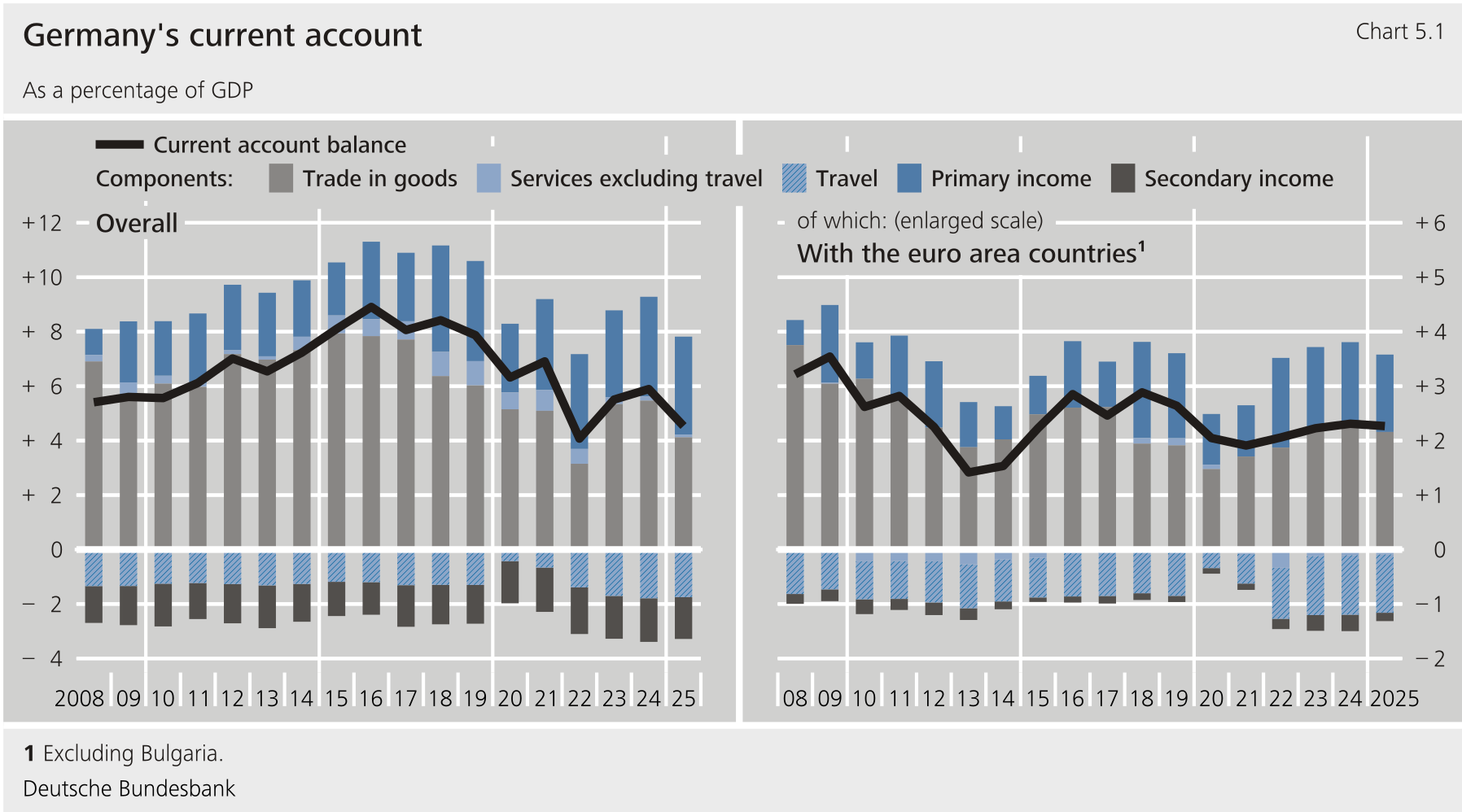***
*****The decline in the current account surplus is due mainly to the smaller surplus in goods trade.** In nominal terms, exports of goods grew only slightly in 2025 and thus more slowly than world trade. This was due to a further decline in the competitiveness of Germany's export sector, as well as weak global demand for several goods that are important for Germany's export basket (see the supplementary information entitled "[Latest developments in German export market shares and their driving forces](#Latest-developments-in-German-export-market-shares-and-their-driving-forces)"). Exports to China fell sharply again, mainly due to substantially lower exports of motor vehicles and parts. In addition, the new tariffs strongly dampened German exports to the United States (see the supplementary information entitled "[The impact of tariffs on German firms](#The-impact-of-US-tariffs-on-German-firms)"). Higher exports to euro area countries boosted Germany's exports.***{#par-oeoo37}
**Latest developments in German export market shares and their driving forces** {#tar-3}
----------------------------------------------------------------------------------------
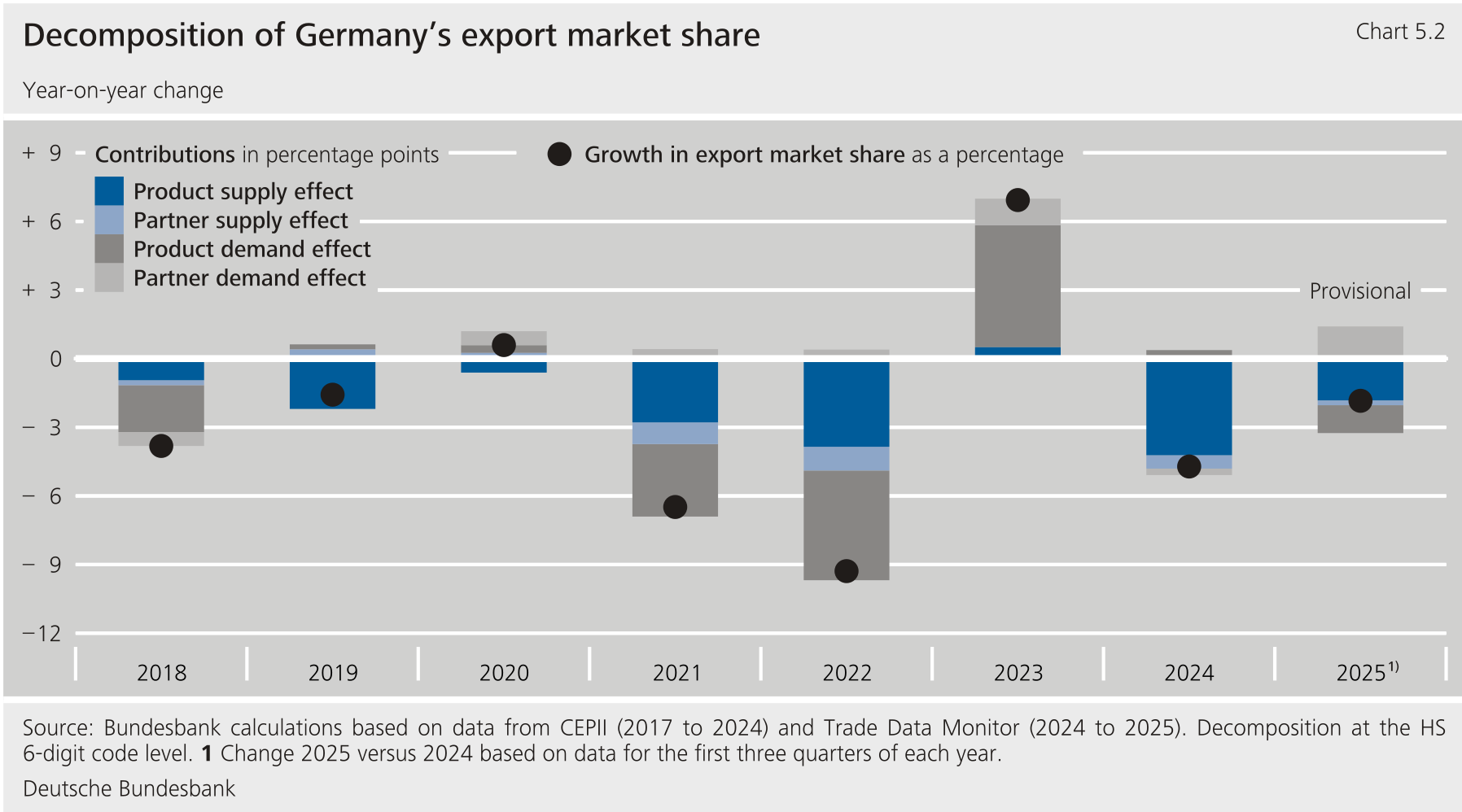
****Between 2017 and 2023, the German export industry lost significant market share worldwide.** [\[1\]](#_ftn_4c9690a9_1) This was mainly attributable to a deterioration in competitiveness. These competitiveness problems occurred in many sectors and thus point to fundamental structural weakness in the German economy. Germany also lost export market shares because global demand for passenger cars was weak and this product group plays a major role in Germany's export portfolio. Overall, the losses in export market shares contributed markedly to the sluggish growth of the German economy in recent years.[\[2\]](#_ftn_4c9690a9_2)**{#par-e2i1au}
****The losses in export market shares can be broken down into supply-side and demand-side effects.** For example, weak demand can hit the German export industry particularly hard owing to its specific product mix or trading partner profile. Such developments are captured in the decomposition as product or partner demand effects. Losses in market shares can also arise from supply-side problems. These are reflected in a deterioration in the competitive position, which includes both price and non-price factors. Competitiveness can develop differently across products, sectors, and trading partners. In the decomposition, these influences are captured as product or partner supply effects.[\[3\]](#_ftn_4c9690a9_3)**{#par-i75e5a}
****The German export sector also lost market share in 2024 and 2025, although last year the decline was less pronounced than before.** [\[4\]](#_ftn_4c9690a9_4) In 2024 and, according to preliminary data, in 2025, Germany's export market share fell by just under 5 % and 2 %, respectively. On balance, these declines were driven almost exclusively by supply-side factors. By contrast, demand effects played virtually no role overall. On the one hand, in 2025, as in the period from 2018 to 2022, weak global demand for products that are important for Germany weighed on market shares. On the other hand, the regional composition of German exports supported Germany's market share.**{#par-e2733a}
{#par-i46596}
****
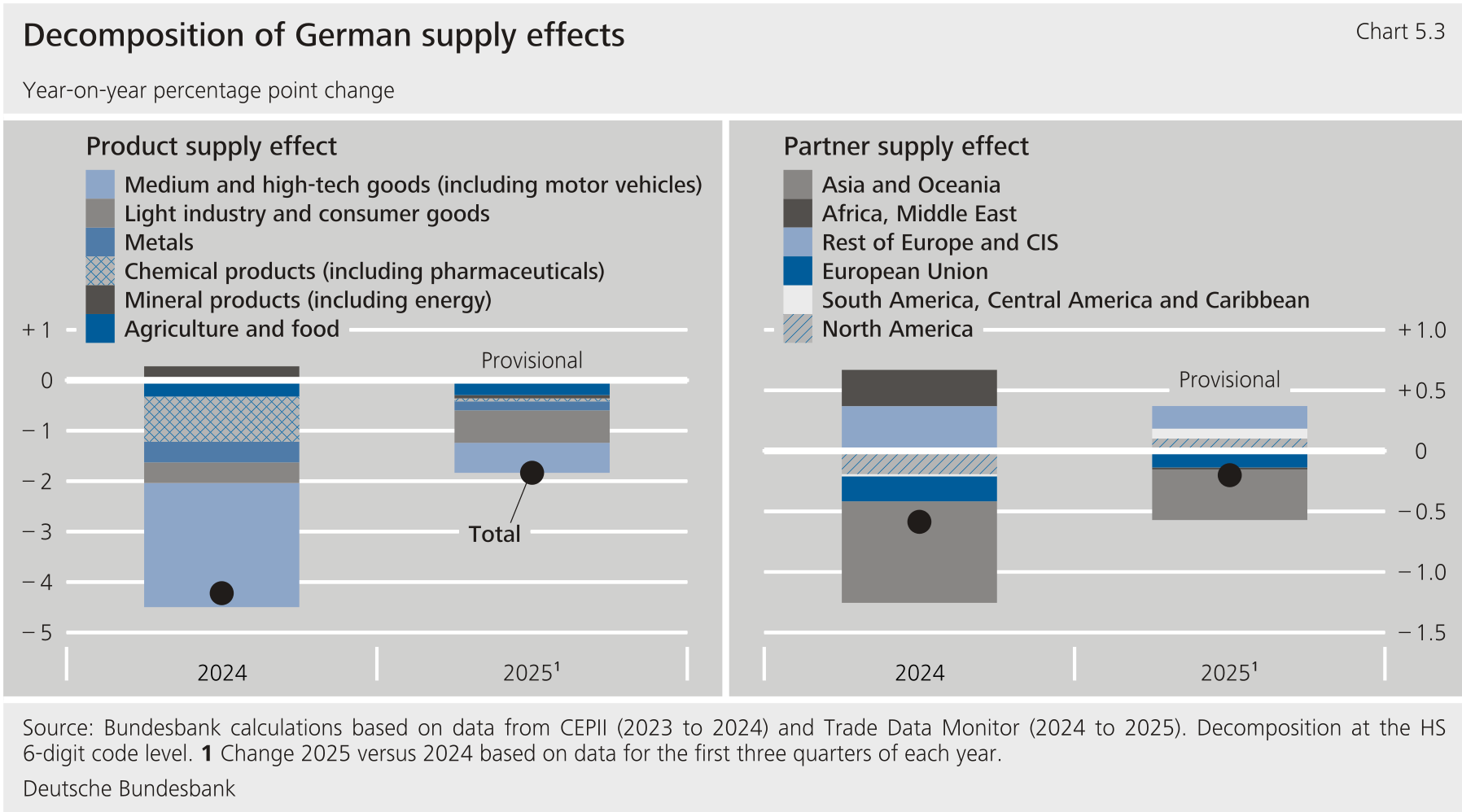
****As in previous years, competitiveness deteriorated across a broad range of sectors.** In 2024, around 80 % of the product categories recorded losses. Electrical engineering and mechanical engineering were particularly hard hit. The automotive industry also lost competitiveness as a result of the transformation towards electric mobility. This broad-based sectoral weakness, together with the persistently dampening supply effects in the results, underscores the continuing structural problems facing Germany as a place to do business. These include demographic change, which is accompanied by a shortage of skilled workers and pressure on unit labour costs, and increased red tape. In addition, there is the competitive pressure from China. According to preliminary assessments, there was no sign of any improvement in this regard in 2025. Mechanical engineering in particular remains under pressure.**{#par-ia7e88}
****In China, in particular, German exporters underperformed their global competitors in 2024.** This trend continued in 2025, albeit to a lesser extent. In the market, German exports in 2025 performed no worse than those of other supplier countries. In some cases, this was because, relative to the composition of their respective export baskets, those countries faced similar or even higher tariff burdens.**{#par-iaa518}
{#par-a3ou9a}
****
****Particularly in 2025, weak global demand for cars with internal combustion engines dampened German export market shares, while electric and hybrid vehicles provided slight support.** In 2024, too, weak global demand for cars had significantly dampened German market share. This means that the developments that were problematic for Germany from 2017 to 2022 continued over the past two years. By contrast, import demand within the European Union was robust overall in 2025. Demand from the United States was weak, partly owing to higher tariffs.**{#par-e6a21e}
{#par-ua3351}
**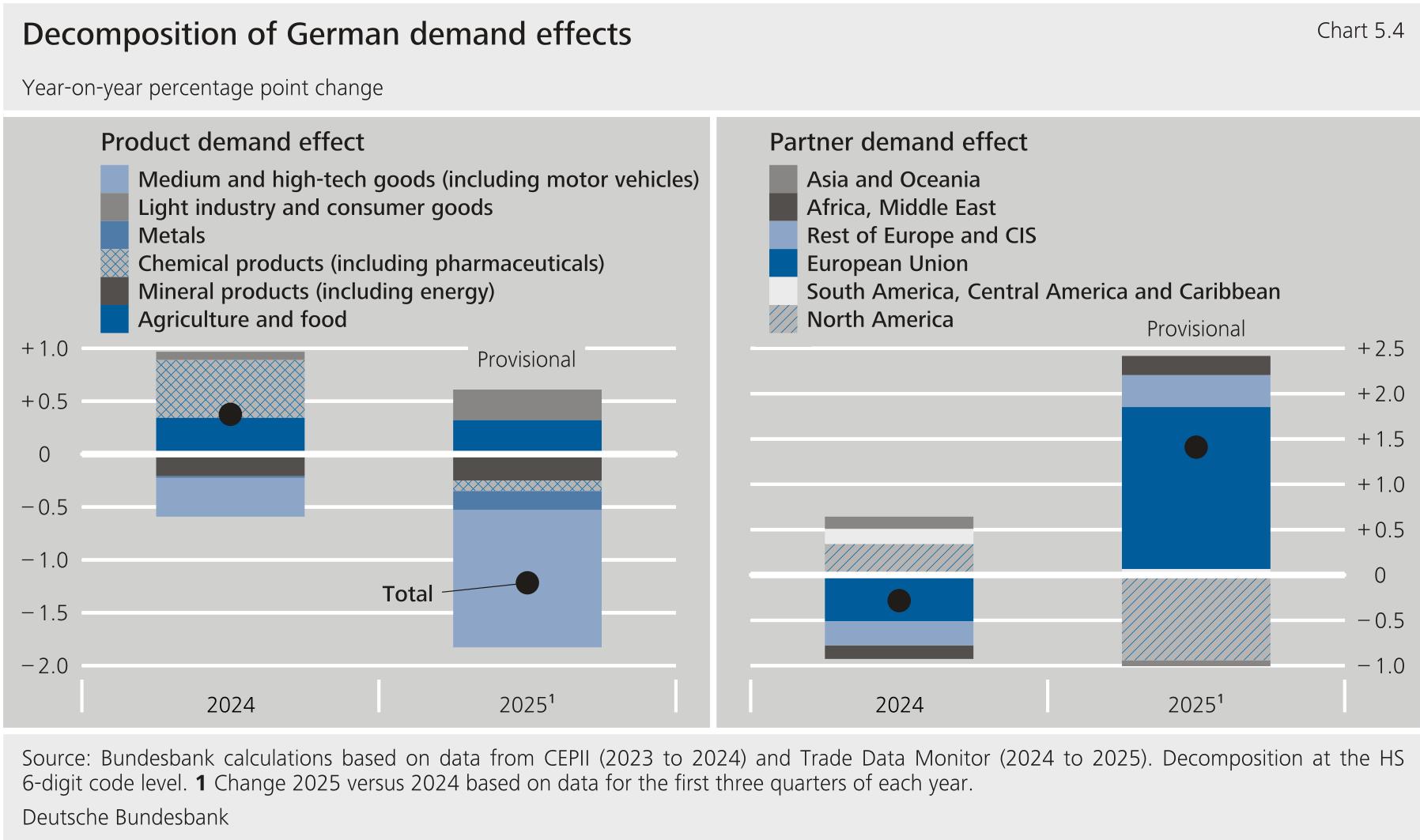**
****Subdued global demand for motor vehicles and parts is mainly evident in the major sales markets of Europe and the United States.** In the market, which is particularly important for German enterprises, demand for passenger cars remained very weak. In 2025, sales in the United States likewise remained below the level of 2018. By contrast, demand for passenger cars in China grew significantly.**{#par-u69o2i}
{#par-a7e1eo}
**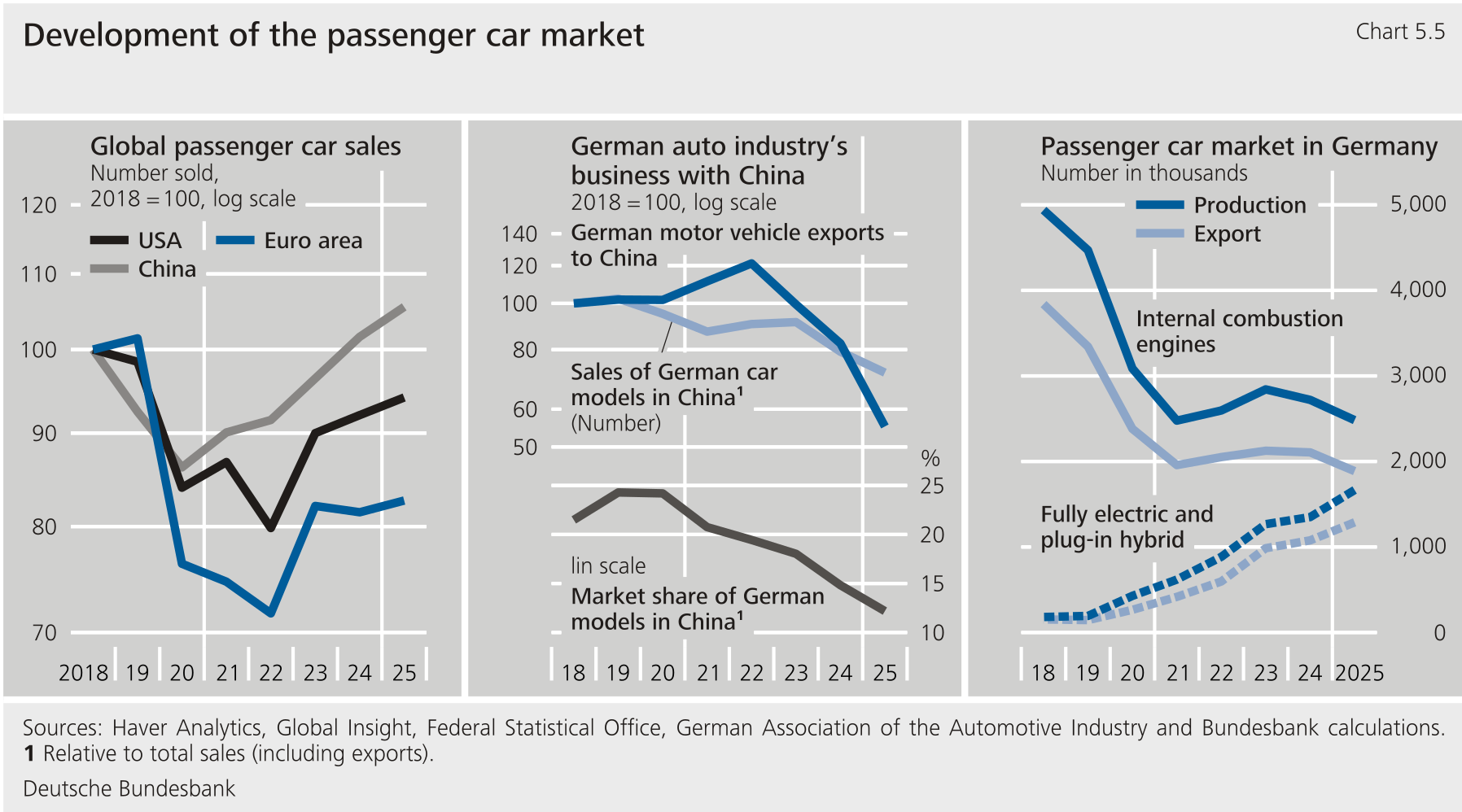**
****The German automotive industry has recently benefited only marginally from demand for passenger cars in China, as Chinese suppliers have increasingly served that market themselves.** German motor vehicle exports to China have fallen sharply, and the number of German-brand passenger cars sold in China has declined as well. As a result, German manufacturers lost substantial market share. Sales of electric vehicles and plug-in hybrids increased in China, while sales of cars with internal combustion engines fell. Chinese customers appear to increasingly prefer models produced by domestic manufacturers.[\[5\]](#_ftn_4c9690a9_5) A previously important source of earnings for the German automotive industry, which had long been strongly geared towards the Chinese market, is therefore drying up.**{#par-e73o51}
****In Germany, the production and export of electric vehicles increased in 2025, while that of vehicles powered solely by internal combustion engines declined.**According to data from the German Association of the Automotive Industry, electric vehicle production in Germany has increased significantly on balance since 2019. The same applies to the export of electric vehicles. By contrast, the production and export of vehicles powered solely by internal combustion engines have declined. These developments are in line with the model-based analysis, which shows that rising demand for electric vehicles supported Germany's export market share.**{#par-oo6au2}
1. **{#_ftn_4c9690a9_1} See Deutsche Bundesbank (2025a).**
2. **{#_ftn_4c9690a9_2} According to simulations performed using the Bundesbank's macroeconomic model (BbkM-DE), growth in Germany's would have been 2.4 percentage points higher overall between 2021 and 2024 if German exports had risen in line with sales markets -- that is, if there had been no loss in market share; see Deutsche Bundesbank (2025a).**
3. **{#_ftn_4c9690a9_3} For more information on the methodology, see Deutsche Bundesbank (2025a).**
4. **{#_ftn_4c9690a9_4} The updated estimates presented here are based on the 2017 Harmonized System (). On the one hand, use is still made of BACI data from the French research institute , which are currently available up to 2024 (latest data). This dataset undergoes extensive quality checks. On the other hand, trade data from Trade Data Monitor are available for the first three quarters of last year. The results for 2025 are provisional, as they do not yet reflect the entire year and also have a different data base.**
5. **{#_ftn_4c9690a9_5} As the Chinese market is increasingly being served by domestic manufacturers and exports of motor vehicles and parts to China declined overall, the model captures this development as a demand-side component. A comparison of the development of German exports with those of other countries is the decisive factor for supply-side effects in the model, while domestic production is not taken into account.**
****The main factor behind the smaller surplus in the goods account was a significant increase in imports.** Import growth was broad-based. Imports from countries outside the euro area -- including China -- expanded particularly strongly. This was partly due to the appreciation of the euro, which made foreign goods cheaper for German importers. In addition, in the reporting year, inventories in Germany were replenished and domestic consumption rose markedly.**{#par-u54ai4}
****The global economic environment in 2025 was shaped by the** **administration's tariff policy and the resulting increase in trade policy uncertainty.** The International Monetary Fund reported that global economic growth was stable, but below average by historical standards. Protectionist tendencies shaped cross-border trade in goods. According to the Centraal Planbureau, global trade volumes nevertheless rose significantly by 4½ %. The euro appreciated significantly, which dampened the price competitiveness of the German export sector. Global industrial activity was subdued and global commodity and energy prices declined. However, they remained above their long-term average levels.**{#par-u8aeo6}
{#par-o1i4u1}
**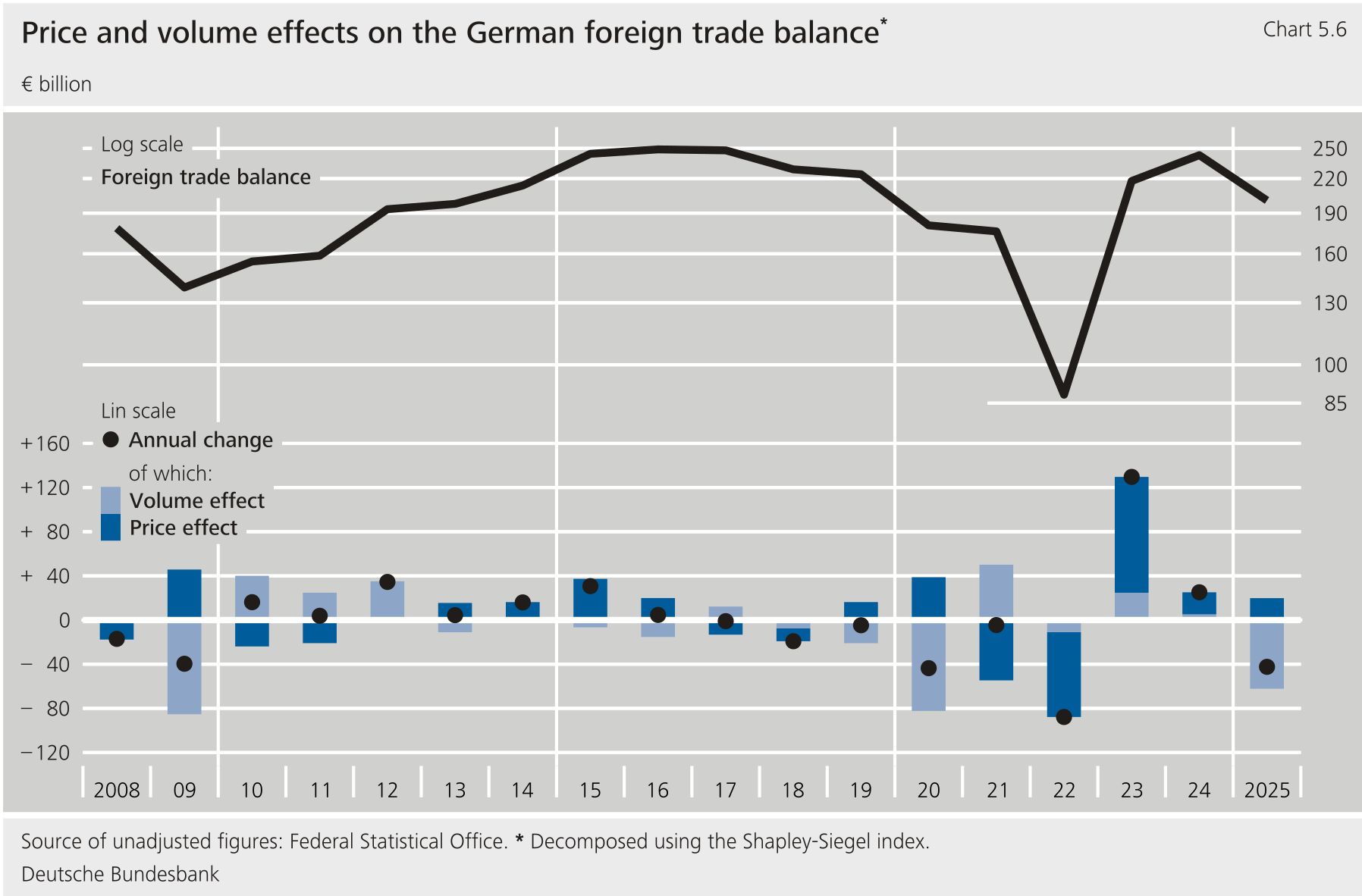**
****The nominal foreign trade surplus fell significantly in 2025 owing to volume effects.** Price-adjusted exports remained virtually unchanged. By contrast, price-adjusted imports expanded sharply. Price developments, however, mitigated the decline in the balance. Export prices rose moderately. At the same time, import prices decreased slightly, partly as a result of lower commodity prices. On balance, Germany's terms of trade improved.**{#par-o141a3}
****In regional terms, the current account surplus with non-euro area countries declined.** It decreased by 1¼ percentage points to 2¼ % of . This was mainly attributable to a smaller surplus in goods trade. The widening of the current account deficit with China by €30 billion to €54 billion accounted for more than half of the change in the current account balance. By contrast, the current account surplus vis-à-vis euro area countries remained largely unchanged, at 2¼ % of .**{#par-ua1599}
{#par-o96a88}
**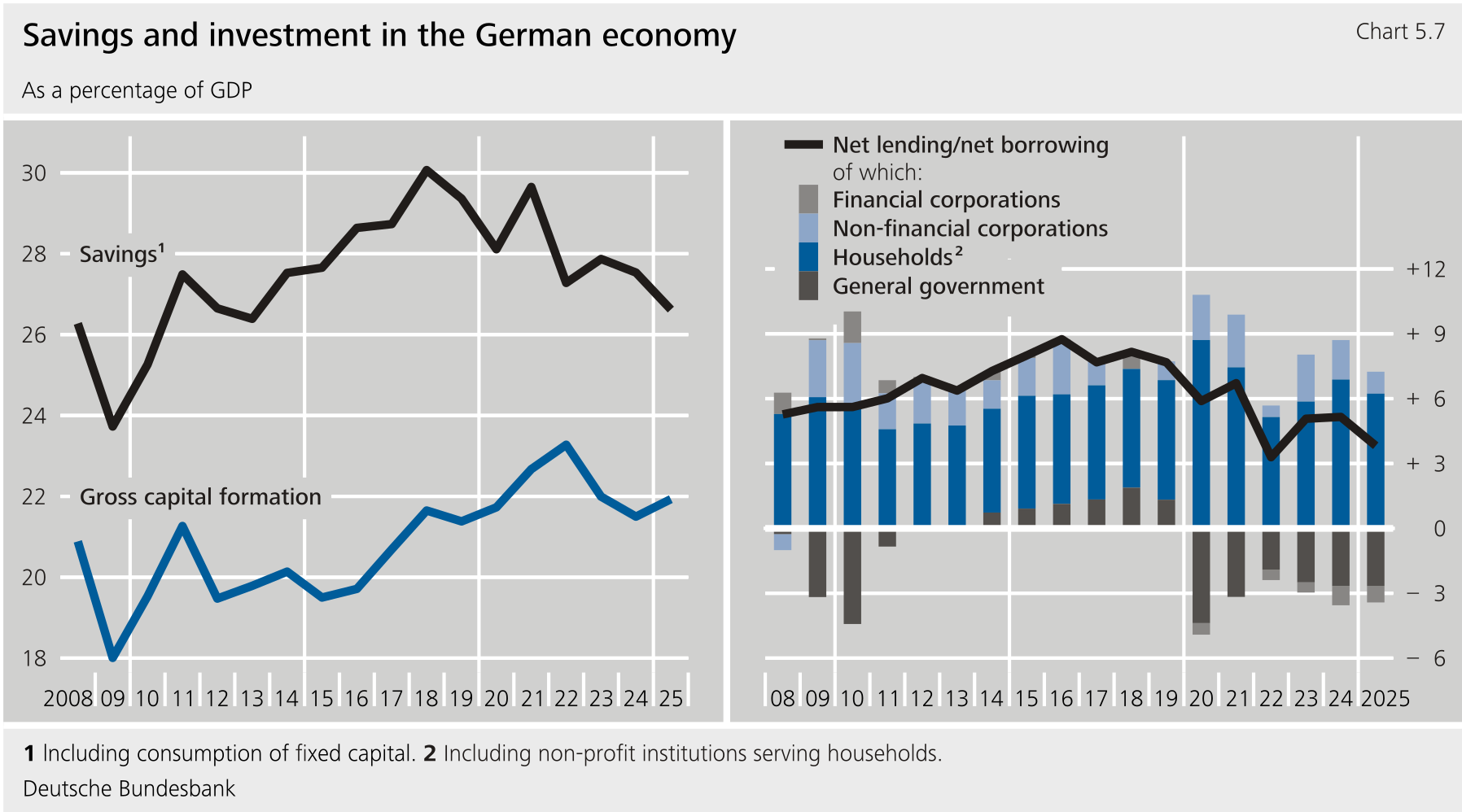**
****Aggregate net lending/net borrowing fell markedly in the reporting year.** [\[1\]](#_ftn_root_1)Aggregate saving declined substantially, while net investment picked up slightly again. Non-financial corporations' net lending fell significantly. Their savings decreased owing to higher employee compensation. At the same time, investment increased slightly. Households reduced their net lending. Their saving declined as private consumption increased markedly and the saving rate continued to normalise. Their consumption of fixed capital exceeded gross investment, consistent with the persistently subdued level of housing construction activity. General government continued to report net borrowing, which remained largely unchanged overall.**{#par-o9o935}
**The impact of tariffs on German firms** {#tar-4}
--------------------------------------------------
****Little is known so far about the impact of new** **tariff policy on firms in Germany.** [\[1\]](#_ftn_4d93aa27_1) The impact hinges crucially on whether firms export to the United States in the first place and how they respond to tariffs. Firms' adjustment strategies will decide how the burden of tariffs is distributed across importers and exporters and also whether stronger or milder impacts of tariffs on the German economy can be expected more over the long term than over the short term. A new Bundesbank survey of firms (the Bundesbank Online Panel -- Firms (-F)) from the fourth quarter of 2025 provides insights into this.[\[2\]](#_ftn_4d93aa27_2)**{#par-e27426}
****Firms not directly affected by** **tariffs via the foreign trade channel are likewise capable of being affected by** **trade policy.** For example, demand for their products can decline if directly affected firms cut their production and thus purchase fewer intermediate inputs. In addition, the increasing diversion of Chinese imports could heighten competition for firms that have not yet been affected.[\[3\]](#_ftn_4d93aa27_3)**{#par-oao51u}
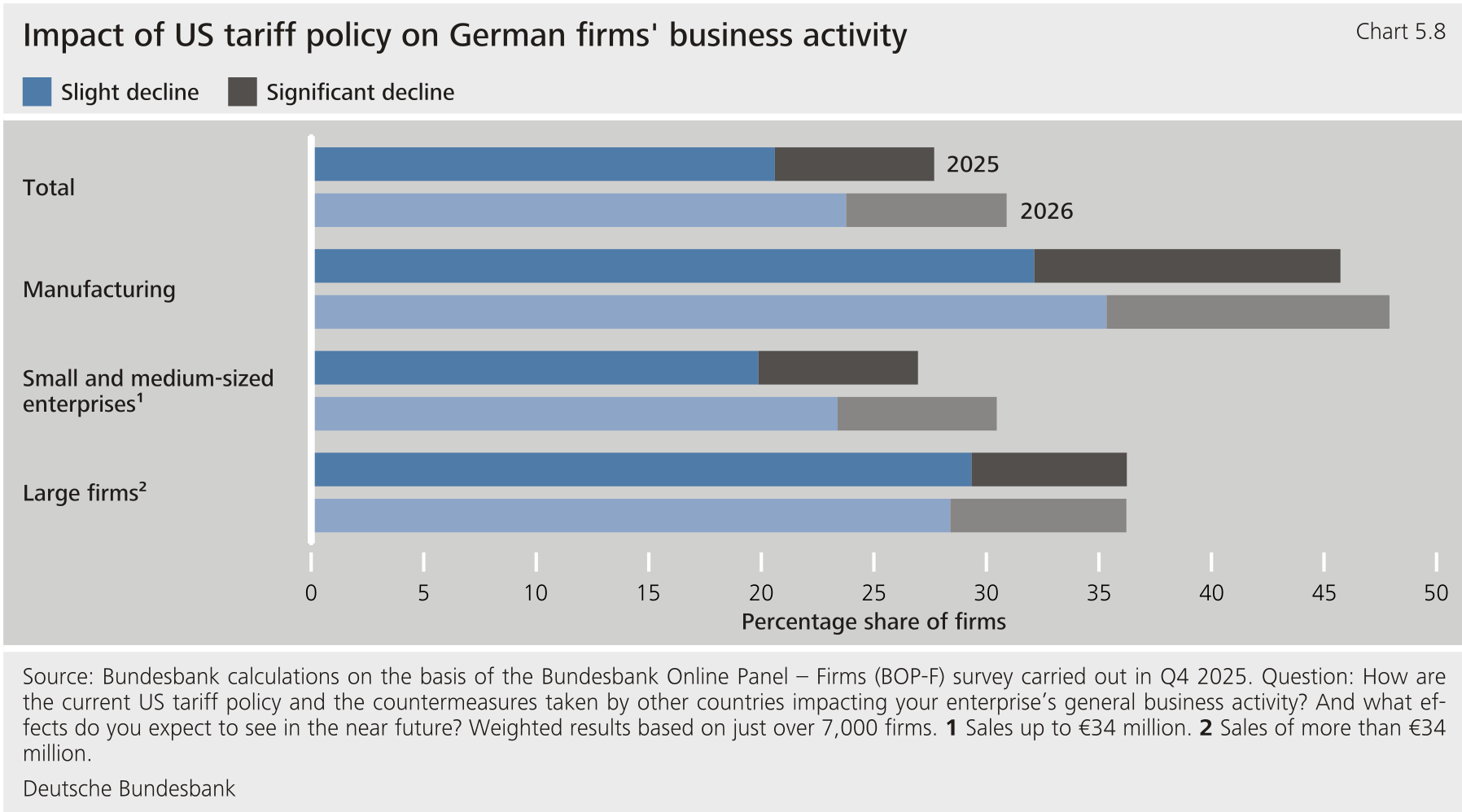
****Just over one-quarter of firms in Germany reported in the Bundesbank survey that their business activity was being dampened by** **tariffs.** These are many more than just the firms that export to the United States directly. However, most of these companies expected only a small impact on their business activities this year. Just under 7 % expected a significant decline. At the same time, it should be noted that the majority of firms in Germany -- around 70 % -- have not yet felt any impact from the tariffs.**{#par-ae2aa9}
****The impact of** **tariffs varies widely across sectors, with manufacturing firms suffering in particular under the strain.** In 2025, slightly more than 40 % of these firms reported weaker, if not significantly impaired, business owing to the new tariffs. This means that tariffs are hitting a sector that is already under considerable pressure for structural change.[\[4\]](#_ftn_4d93aa27_4) In addition, enterprises from the logistics and transport sector as well as from the wholesale trade sector are being hit disproportionately hard. Moreover, tariffs are turning out to hamper the business activity of larger firms more often than that of smaller firms. This is because larger firms are typically more active on international markets. Among the smaller firms, those who already have an export relationship with the United States are more frequently reporting significant declines in their business activity. Looking ahead to 2026, tariff restrictions will spill over to smaller firms.**{#par-o28ee5}
{#par-aaa961}
****
****Overall,** **demand is a factor (including indirectly) for just over one-tenth of firms in Germany.** Most companies do not export their goods directly to the United States. Only around 4 % of firms supply their goods directly to the United States, while more than 5 % of firms export their goods to the United States only indirectly, and around 2 % export their goods to the United States both directly and indirectly. Firms indirectly sell their goods in the United States via wholesalers, as one option (just over 2 % of firms). Indirect commitments via value chains are more significant. Just under 6 % of firms produce intermediate inputs that are processed by other companies in Germany or abroad and then exported to the United States. The focus on firms that export directly is therefore likely to understate the impact of tariffs on the German economy.**{#par-e38429}
{#par-o7u979}
**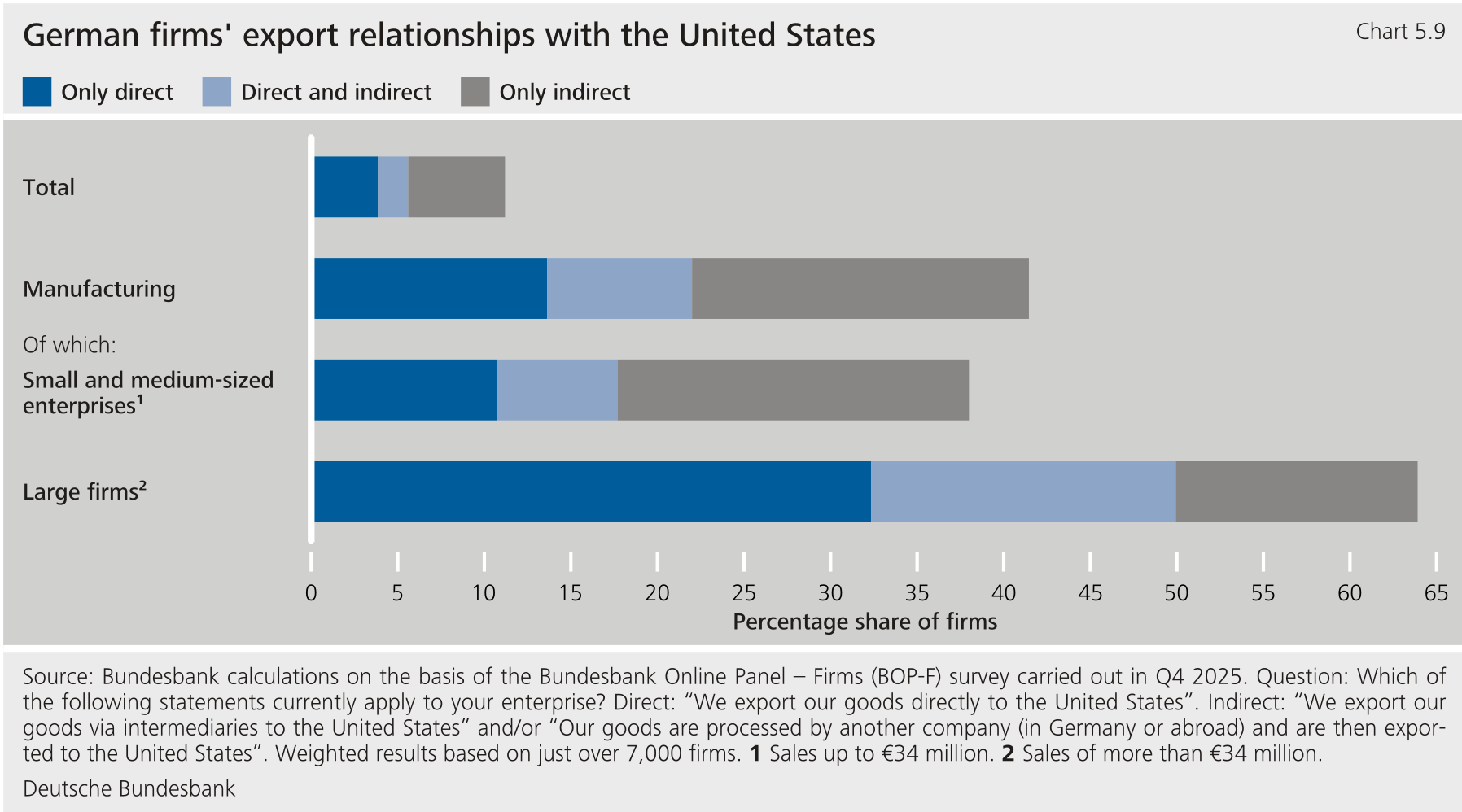**
****In the manufacturing sector, a particularly large number of firms are directly and/or indirectly exposed to** **demand.** This was the case for around two-fifths of firms in 2025. Direct exports play an important role in this sector, but here, too, a large proportion of firms export to the United States either additionally or exclusively indirectly. Interconnectedness via downstream levels of the value chain, in particular, is a key reason why many firms are indirectly dependent on the market. Larger manufacturing firms, in particular, export directly and/or indirectly to the United States.[\[5\]](#_ftn_4d93aa27_5)**{#par-ae8eu5}
****Most manufacturing companies exporting goods to the United States have not adjusted their export strategy.** This is due, in particular, to firms that indirectly export their goods to the United States via value chains. These firms either have less scope for active responses or they see less need for adjustment, as they are only indirectly affected or have sufficient pricing power. However, even among direct exporters, around one-third do not show any significant response. This could be partly related to limited optionality due to long-term relationships with suppliers. In addition, German exporters' specific product mix could also be a factor, for example in the case of high-end passenger cars or highly specialised precision equipment. For such products, customers are generally less sensitive to price changes. German manufacturers in these segments are therefore more likely to be able to pass on a larger share of the tariff hikes to customers through higher prices without fear of a considerable drop in demand.**{#par-i8a48o}
{#par-e2728i}
**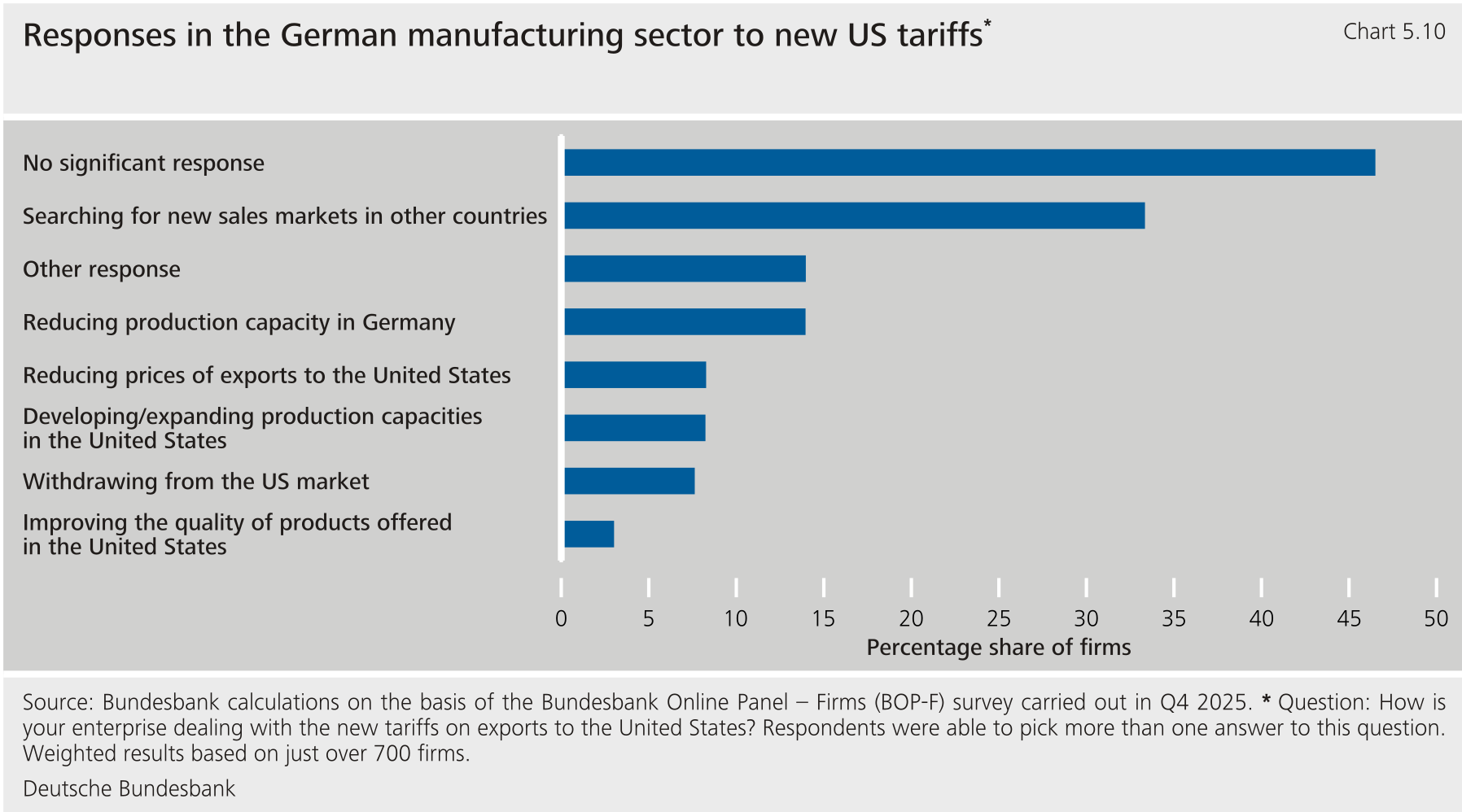**
****The most common active response by industrial firms is to find new markets for their goods.** This strategy is being pursued by around one-third of the firms affected. By contrast, costlier measures are less widespread. 14 % of firms said that they were cutting their production in Germany, and 8 % wish to expand their production capacity in the United States. Only just under one-tenth of firms are reducing their prices for exports to the United States and are thus bearing part of the tariff burden in order to maintain their competitiveness and market share in the market.[\[6\]](#_ftn_4d93aa27_6) A not-insignificant nearly 8 % of firms reported pulling out of the market altogether. Large firms react more decisively in one way or another, while smaller firms tend to wait and see.[\[7\]](#_ftn_4d93aa27_7)**{#par-e6uu7i}
****Around one-third of German firms reported an increase in the supply of products from countries such as China, which are being affected heavily by** **trade policy, in Germany and in export markets.** Just over one-tenth of firms reported a considerable increase in supply in 2025. 16 % of firms expect such supply growth this year. In this context, firms are probably unable to reliably assess whether the rising imports are attributable to tariffs. A look at trade data shows that German imports from China rose particularly sharply even before the introduction of the new tariffs.**{#par-i4397o}
{#par-o4a8e5}
**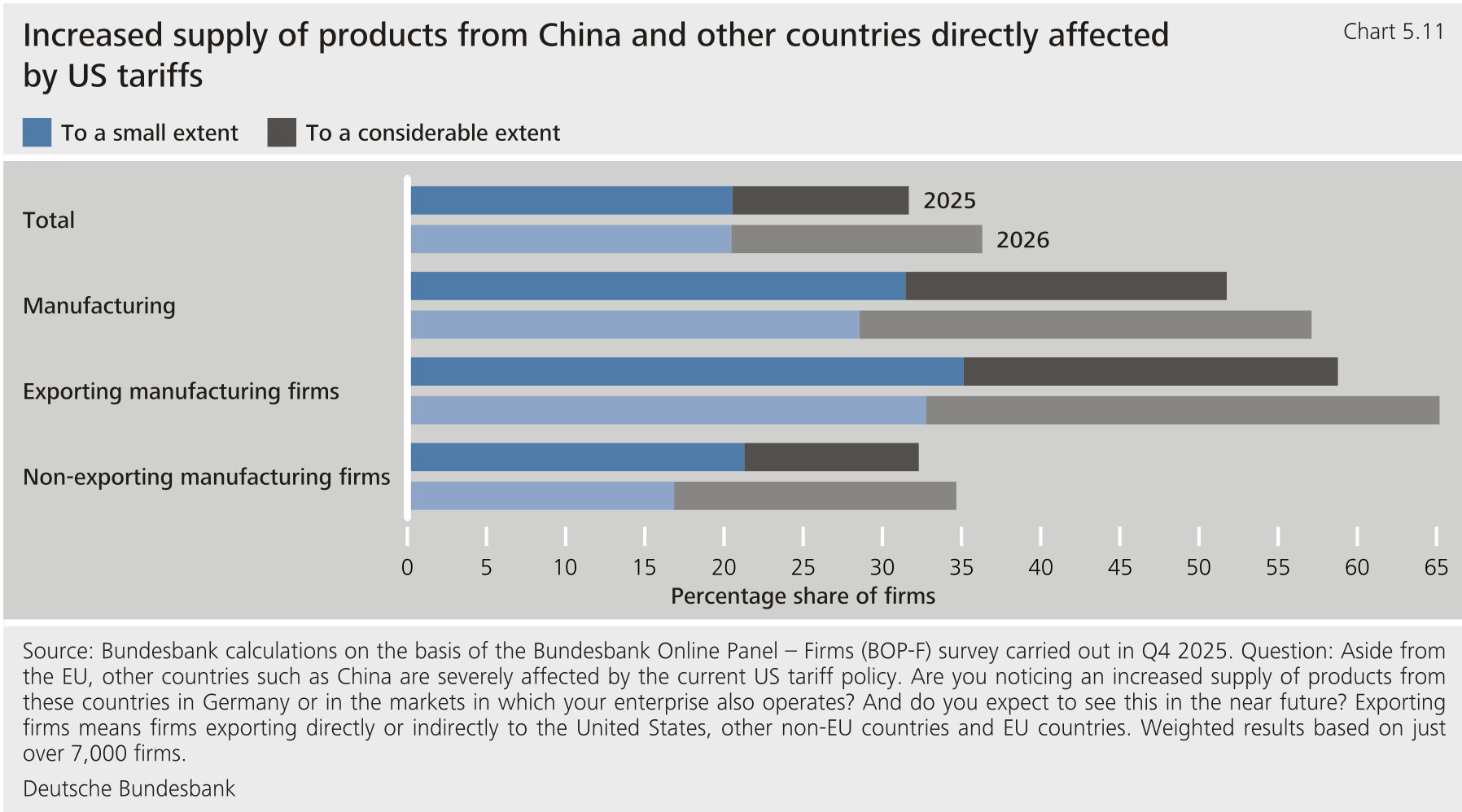**
****Manufacturing firms, in particular, reported seeing an increase in imports from third countries directly affected by** **tariffs, such as China, both in Germany and on export markets.** This was the casefor more than half of industrial firms in 2025 and slightly more firms in 2026. In addition, just under one-third of firms were expecting significant increases in imports from these countries in 2026.[\[8\]](#_ftn_4d93aa27_8) According to their survey responses, larger industrial firms, in particular, were facing growing competition on their markets.**{#par-e9u748}
****For more than two-thirds of industrial firms, the increased supply of products from countries such as China means increased competitive pressure.** This pressure is growing particularly strongly among companies that export themselves. This suggests that competitive pressure is particularly strong in third markets and in more hotly contested market segments.[\[9\]](#_ftn_4d93aa27_9)**{#par-uei511}
{#par-e2255i}
**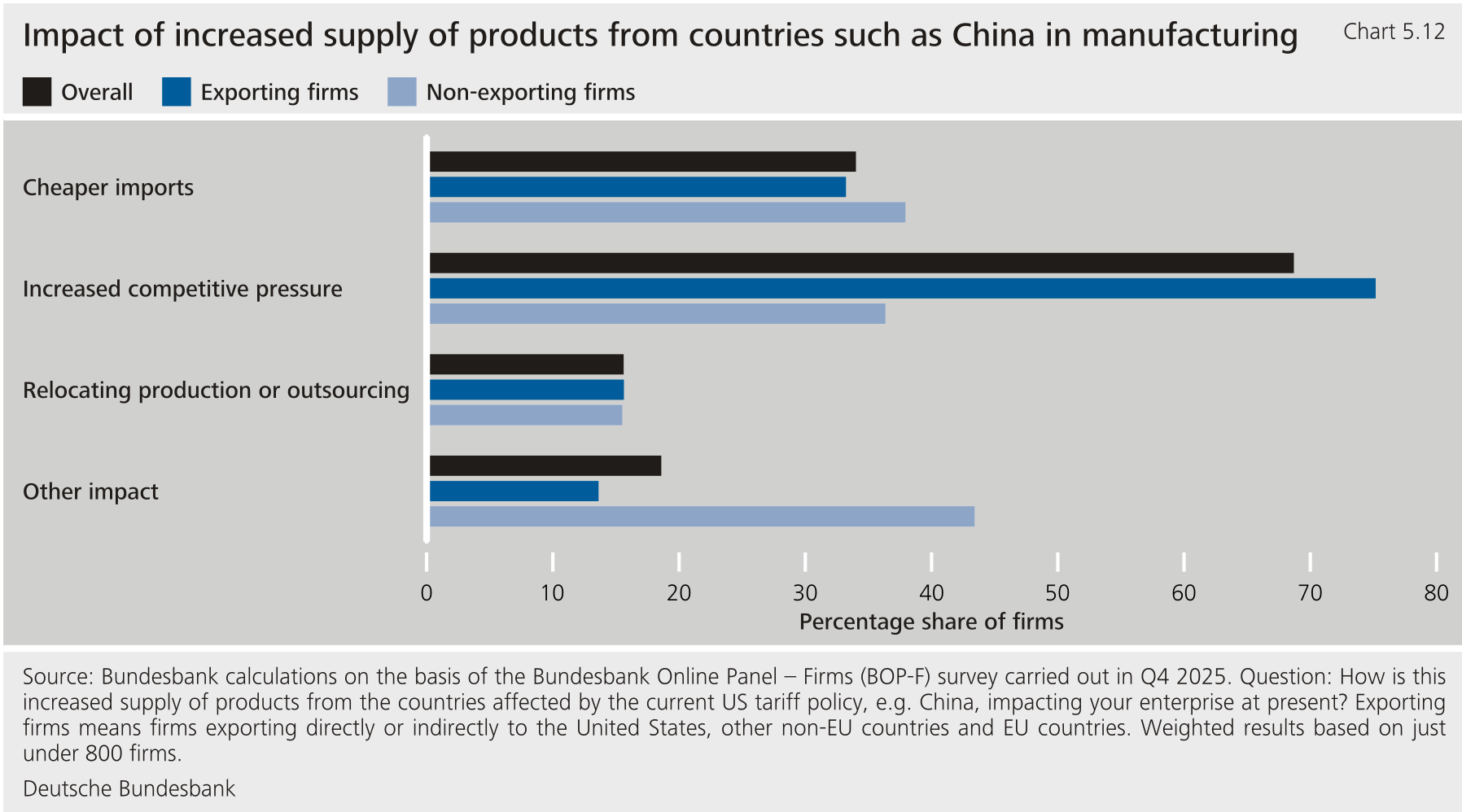**
****More than one-third of manufacturing firms reported being able to obtain intermediate inputs or goods more cheaply thanks to an increase in imports.** Among non-exporting firms, roughly the same number of firms reported increased competitive pressure and cheaper imports.[\[10\]](#_ftn_4d93aa27_10) The additional imports are thus a positive for a non-negligible minority. By contrast, increased outsourcing or production relocations were a virtual non-issue.**{#par-u8166a}
****Overall, the results show that German exporters are under considerable pressure to adapt.** In addition to the new protectionism, which is reflected, amongst other things, in the new tariffs since 2025, they are struggling with increasing pressure from Chinese competition. However, the adjustment strategies give some reason to hope that the impact of tariffs could dissipate over time. For example, if companies succeed in redirecting their products to alternative markets. For the macroeconomic assessment, it is important that larger firms, in particular, respond to the tariffs by searching for customers in other markets. However, building new trade relationships usually takes time. Economic policy could support efforts to diversify trading partners by ensuring a reliable trade policy framework and by stepping up efforts to secure new free trade agreements, or to implement agreements that have already been negotiated.[\[11\]](#_ftn_4d93aa27_11) The new agreements with the Mercosur countries and India deserve support in this respect.**{#par-uii586}
1. **{#_ftn_4d93aa27_1} Previous surveys of firms -- such as the June 2025 business survey -- provide initial evidence, but refer to a period of adjustment to the new tariffs before the trade agreement between the and the United States was concluded on 27 July 2025 (see Baur et al. (2025a)). For analyses of the macroeconomic effects of tariff policy in Germany, see Baur et al. (2025c), Deutsche Bundesbank (2025b), Kiel Institute for the World Economy (2025) and Lehmann et al. (2025).**
2. **{#_ftn_4d93aa27_2} For details on the -F survey see Boddin et al. (2023).**
3. **{#_ftn_4d93aa27_3} Moreover, generally elevated uncertainty could be a drag on business activity owing to erratic trade policy and its uncertain impact on the German economy.**
4. **{#_ftn_4d93aa27_4} See Deutsche Bundesbank (2025a).**
5. **{#_ftn_4d93aa27_5} Given their greater economic weight, this increases the potential macroeconomic damage caused by tariffs in Germany, all else being equal. At the same time, it should be borne in mind that larger firms typically export to many other countries and are thus better able to diversify. Nearly two-fifths of industrial firms in Germany deliver to markets outside the (excluding the United States), and almost three-fifths export to countries. These shares are significantly higher for large companies.**
6. **{#_ftn_4d93aa27_6} This finding is consistent with a recent analysis by Hinz et al. (2026), which finds that importers and consumers have so far borne pretty much the entire costs of tariffs.**
7. **{#_ftn_4d93aa27_7} According to the survey, large manufacturing firms (with sales of over €34 million) diversify their sales markets more frequently (two-fifths) and increase their production in the United States more frequently (one-quarter of the large firms affected). The differences in the adjustment responses to tariffs by export strategy remain when conditioning on firm size -- likewise, the differences by size category remain when conditioning on export strategy.**
8. **{#_ftn_4d93aa27_8} In wholesale and retail trade, too, an above-average number of firms reported seeing an increase in imports from third countries such as China.**
9. **{#_ftn_4d93aa27_9} See Deutsche Bundesbank (2025a).**
10. **{#_ftn_4d93aa27_10} Respondents were able to pick more than one answer. Only around one-quarter of firms reporting at least one of the two effects (increased competitive pressure or cheaper intermediate inputs/goods) chose both options. The rest of the firms largely cited either one or the other effect.**
11. **{#_ftn_4d93aa27_11} See Baur et al. (2025b) as well as Petersen et al. (2025).**
### **1.2 Goods flows and balance of trade** {#tar-5}
****Price-adjusted exports remained essentially unchanged, while imports picked up strong momentum.** In price-adjusted terms, goods exports were slightly lower, down by ¼ % on the year. By contrast, imports grew sharply, increasing by 4½ %. In terms of value, exports expanded slightly owing to a moderate rise in export prices. Imports did not increase by quite as much in nominal terms as in real terms because import prices were slightly lower overall. The marked increase in the price of imported consumer goods and the very sharp drop in energy prices played a role here. As a result, the foreign trade surplus narrowed by €42 billion to €201 billion.**{#par-e18ou2}
****In regional terms, revenue from exports to the euro area rose sharply, while revenue from exports to countries outside the euro area declined moderately.** Exports to non-euro area countries were also dampened by the appreciation of the euro. German enterprises recorded significant revenue growth overall in their exports to key euro area sales markets. Aerospace exports were a supporting factor.[\[2\]](#_ftn_root_2) Exports for other major trading partners in Europe also rose sharply. By contrast, sales to the United States fell by a considerable 9½ %, shaving around 1 percentage point off total German export growth. This was mainly attributable to the new import tariffs imposed by the Administration in 2025 (see the supplementary information entitled "[German exports to the United States down in 2025 due to tariff hikes](#German-exports-to-the-United-States-down-in-2025-due-to-US-tariff-hikes)"). Although the United States remained Germany's main export market, its share of total German exports fell from 10½ % in the previous year to 9¼ %.[\[3\]](#_ftn_root_3)**{#par-e1ao63}
| **Table 5.1:** Foreign trade by region in % |||||||||
| Country/group of countries | Exports |||| Imports ||||
| Country/group of countries | Percentage share | Annual percentage change ||| Percentage share | Annual percentage change |||
| Country/group of countries | 2025 | 2023 | 2024 | 2025 | 2025 | 2023 | 2024 | 2025 |
|-------------------------------------------------------|-----------------:|-----------:|-----------:|--------:|------------------|------------|------------|---------|
| **Euro area^1^** | 38.9 | -- 2.2 | -- 3.2 | 4.0 | 34.0 | -- 6.4 | -- 4.9 | 2.6 |
| **Other countries** | 61.1 | -- 0.5 | -- 0.6 | -- 1.0 | 66.0 | -- 11.6 | -- 3.1 | 5.1 |
| **of which:** |||||||||
| **United Kingdom** | 5.1 | 6.3 | 2.4 | -- 0.6 | 2.8 | -- 9.1 | -- 1.6 | 6.6 |
| **Central and eastern European** **countries^2^** | 13.6 | -- 1.8 | 0.3 | 4.1 | 15.0 | 3.9 | -- 4.4 | 4.5 |
| **Switzerland** | 4.7 | -- 5.4 | 1.8 | 8.7 | 4.1 | -- 7.1 | 1.6 | 5.6 |
| **Russia** | 0.4 | -- 38.8 | -- 14.9 | -- 9.1 | 0.1 | -- 90.1 | -- 49.2 | -- 30.6 |
| **United States** | 9.4 | 1.1 | 2.2 | -- 9.4 | 6.9 | 1.4 | -- 3.0 | 2.7 |
| **Japan** | 1.3 | -- 1.3 | 6.6 | − 2.6 | 1.6 | 0.6 | -- 11.6 | -- 2.3 |
| **Newly industrialised economies in Asia^3^** | 2.5 | -- 5.6 | -- 4.3 | -- 5.9 | 2.4 | -- 4.5 | -- 9.5 | -- 2.0 |
| **China** | 5.2 | -- 8.8 | -- 7.6 | -- 9.7 | 12.5 | -- 18.7 | 0.0 | 8.8 |
| **South and east Asian emerging market economies^4^** | 2.3 | 5.7 | 0.4 | -- 4.5 | 4.6 | -- 7.3 | 0.5 | 8.7 |
| | 1.8 | 11.1 | 8.8 | 8.4 | 1.0 | 19.2 | -- 28.0 | 0.4 |
| **All countries** | **100.0** | -- **1.2** | -- **1.6** | **0.9** | **100.0** | -- **9.9** | -- **3.7** | **4.3** |
{#par-u74531}
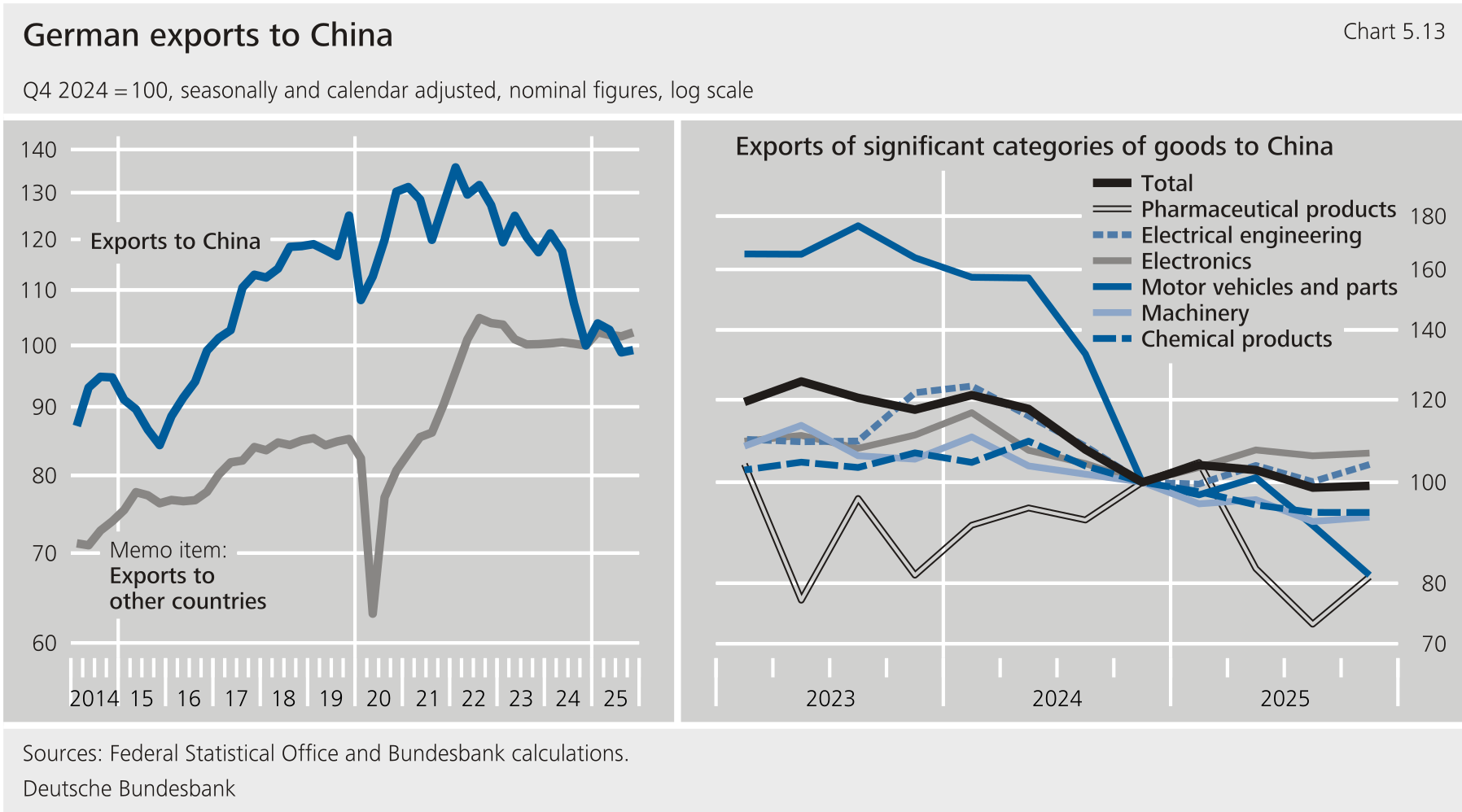
****Losses in revenue were recorded for exports to China, in particular.** This means that, once again, these exports fared far less favourably than total German exports.[\[4\]](#_ftn_root_4) This was due to an extraordinarily sharp drop in exports of motor vehicles and motor vehicle parts (− 33 %), which had already contracted quite considerably in the previous two years (− 18 % and − 17¼ %). This was partly due to Chinese buyers preferring electric vehicles. This segment is, at the same time, mainly served by Chinese producers. In addition, exports of other industrial goods declined sharply. Besides subdued economic activity in China, this is likely to have been due to the fact that Chinese products have already been more competitive than goods sourced from abroad for quite some time.**{#par-o2257u}
{#par-e7688u}
****
**German exports to the United States down in 2025 due to tariff hikes** {#tar-6}
---------------------------------------------------------------------------------
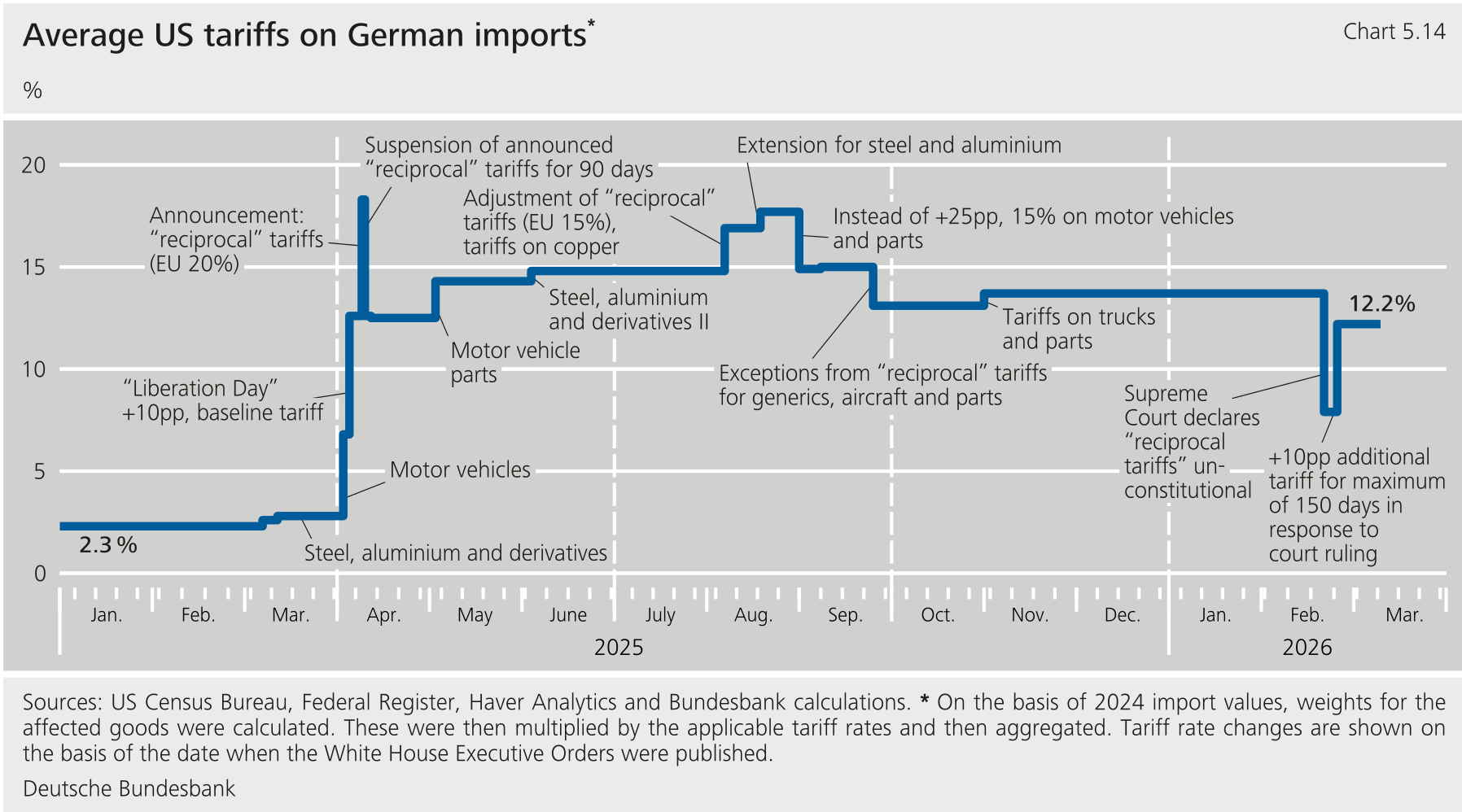
****In 2025, the new** **administration enacted massive tariffs on goods exports from the** **to the United States and thus also for German exports into the country.** The new tariffs, which were announced incrementally and entered into force beginning in March 2025, included additional tariffs on steel and aluminium products as well as motor vehicles and parts. In addition, there were additional tariffs of 10 percentage points on all goods imported into the United States from April 2025 onwards. The bilateral tariff agreement between the United States and the reached on 27 July 2025 stipulates that the United States will raise the tariff rate on most products (including motor vehicles and parts) to up to 15 % (see the chart below for the tariffs).[\[1\]](#_ftn_471384f3_1)**{#par-u68a45}
{#par-o65521}
****
****The mere announcement of tariffs already had a considerable impact on German exports to the United States.** In the first quarter of 2025, many major categories of goods experienced significant anticipatory effects, which were followed by sharp declines. Significant anticipatory effects were experienced, among other things, for pharmaceutical products, motor vehicles and parts, electronics and electrical engineering products. In the second quarter, there was a strong countermovement. The decline since the second quarter is likely to have been due not only to lapsing anticipatory effects but also to the appreciation of the euro against the dollar.**{#par-iu3oi2}
{#par-i9o456}
**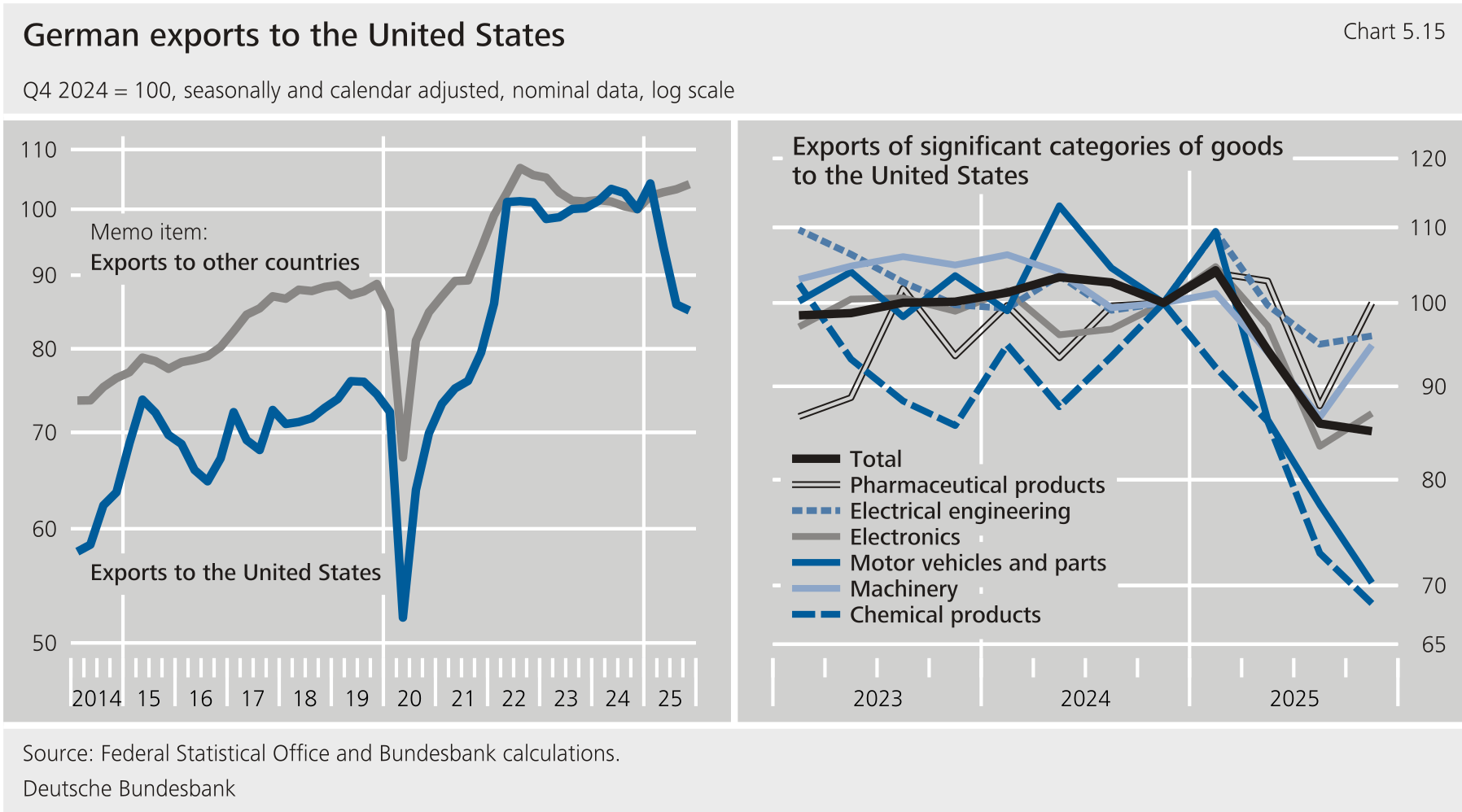**
****In the final quarter of the year, the decline in exports to the United States levelled off.** Exports in several categories of goods partly recovered, examples being machinery, electronics and electrical engineering products.[\[2\]](#_ftn_471384f3_2) However, deliveries to the United States continued to fall for some categories of goods, such as motor vehicles and parts as well as chemical products. Exports rose on a broad basis in December. In the final quarter of 2025, total deliveries to the United States were down by a considerable 15 % on their level from the previous year after seasonal and calendar adjustment. Annual average deliveries of motor vehicles and parts as well as chemical products fell particularly severely. In addition, exports of machinery and electronics were cut sharply. Exports of electrical engineering products came off more lightly, suffering only a slight decline. Exports of pharmaceutical products, which have tended to rise significantly in recent years, posted only a small increase. Whether or not the worst has passed for German exports to the United States in 2025 remains to be seen, not least given persistent uncertainty surrounding tariff policy.[\[3\]](#_ftn_471384f3_3)**{#par-ua2315}
1. **{#_ftn_471384f3_1} The tariff agreement is asymmetric inasmuch as the largely agreed to abolish tariffs on goods imported from the United States, improve market access and invest in the United States.**
2. **{#_ftn_471384f3_2} In the case of pharmaceutical products, a further factor may have been that additional tariffs were initially planned for certain products as from October 2025 and that inventories might have been gradually depleted. Exports of pharmaceuticals are comparatively volatile.**
3. **{#_ftn_471384f3_3} On 20 February 2026, the Supreme Court held that all reciprocal tariffs imposed by the administration were unconstitutional. President Trump subsequently imposed new additional tariffs of 10 percentage points on all countries; these tariffs are permitted to be in force for up to 150 days. Sector-specific tariffs on specific products were not affected by the Supreme Court's decision, as they are imposed based on other legal authorities.**
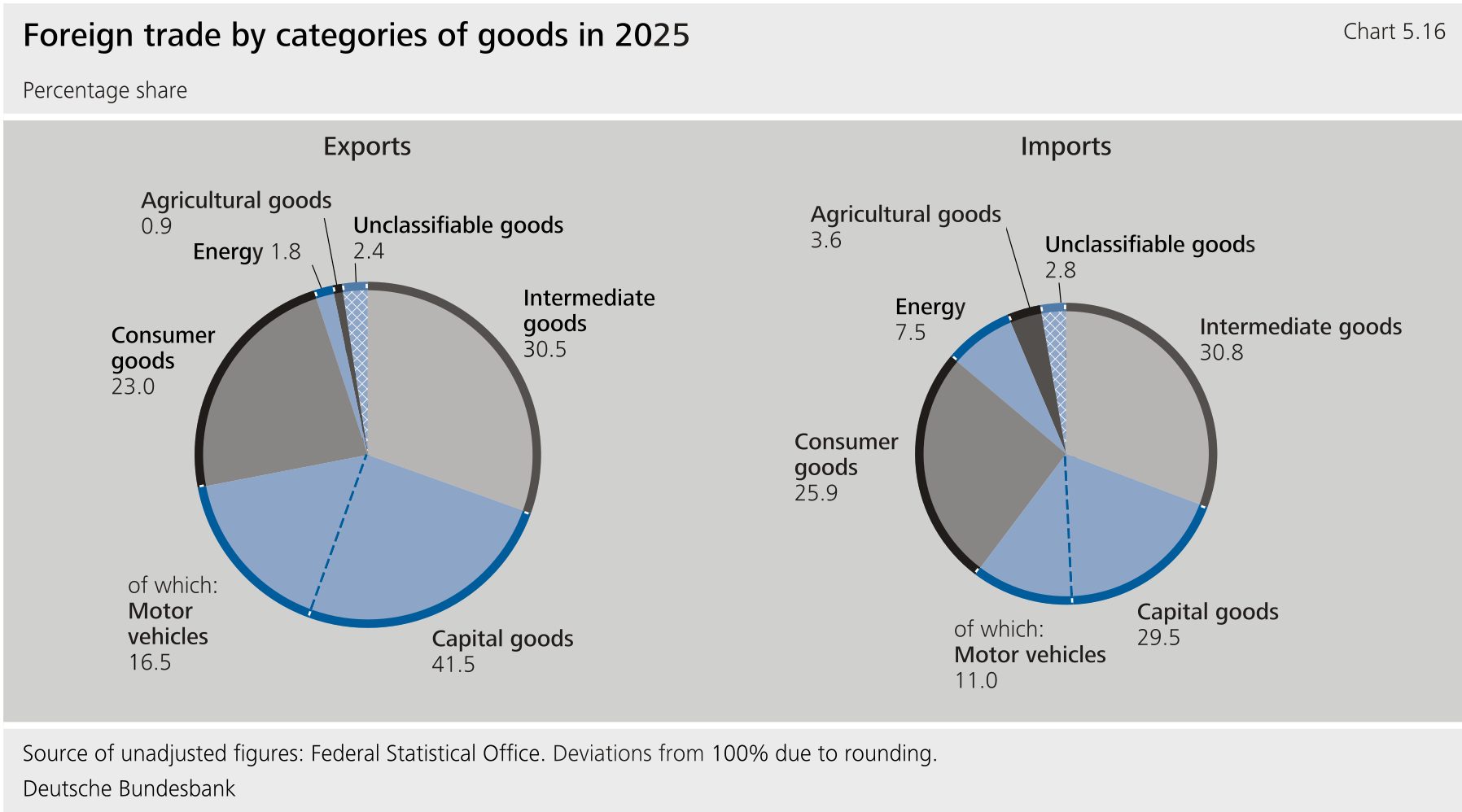
****In the export portfolio, exports of motor vehicles and machinery, as well as several energy-intensive intermediate goods, suffered in particular.** There was a dip in the volume of exports of iron and steel products and chemical products, which are energy-intensive to manufacture. The decline in exports of motor vehicles and motor vehicle parts was mainly due to plummeting export revenue in the important sales markets of China and the United States. Overall, motor vehicle exports to countries other than China and the United States increased only moderately. In addition, exports of traditional machinery and equipment remained distinctly lower than the previous year's level. Uncertainty among investors around the world due to geopolitical risks and the new tariffs imposed by the Administration is likely to have played a role here. In addition, German manufacturers of machinery came under increasing competitive pressure in foreign markets (see the supplementary information entitled "[Latest developments in German export market shares and their driving forces](#Latest-developments-in-German-export-market-shares-and-their-driving-forces)"). By contrast, exports of electrical engineering products increased markedly in price-adjusted terms, while exports of electronics rose particularly sharply. Sales of consumer goods to other countries, including pharmaceutical products, went up significantly.**{#par-i182u9}
{#par-u3o21i}
****
****From a regional perspective, imports from non-euro area countries grew significantly more strongly in value than the those from the euro area.** Euro area manufacturers benefited less overall from German orders, probably partly due to the appreciation of the euro. Moreover, close supply relationships meant that producers in other central and eastern European countries benefited from the fact that German customers were increasingly purchasing motor vehicles and motor vehicle parts there.[\[5\]](#_ftn_root_5)**{#par-e2o37o}
****Germany's imports from China rose very sharply in 2025.** This raised the question as to whether, given that tariffs on Chinese imports were sometimes very high in 2025, there was major redirection of Chinese exports towards Europe, including Germany. However, the pattern of German imports from China does not suggest that any major redirection of Chinese exports took place. Imports had begun to rise even before the first tariffs on imports from China to the United States were brought in. Specifically, imports from China for many categories of goods were ramping up significantly as early on as in the first quarter of 2025 when, certain frontloading effects aside, tariffs on Chinese goods could only have had a small impact. Imports in several categories of goods also saw particularly strong growth up to and during the fourth quarter of 2024 or weakened over the course of 2025. Apart from this, imports from other supplier countries also rose sharply for many categories of goods in the reporting year. Moreover, a stronger rise in Germany's imports from China than from other supplier countries is already a well-established pattern.**{#par-u42e6u}
{#par-oo19ua}
**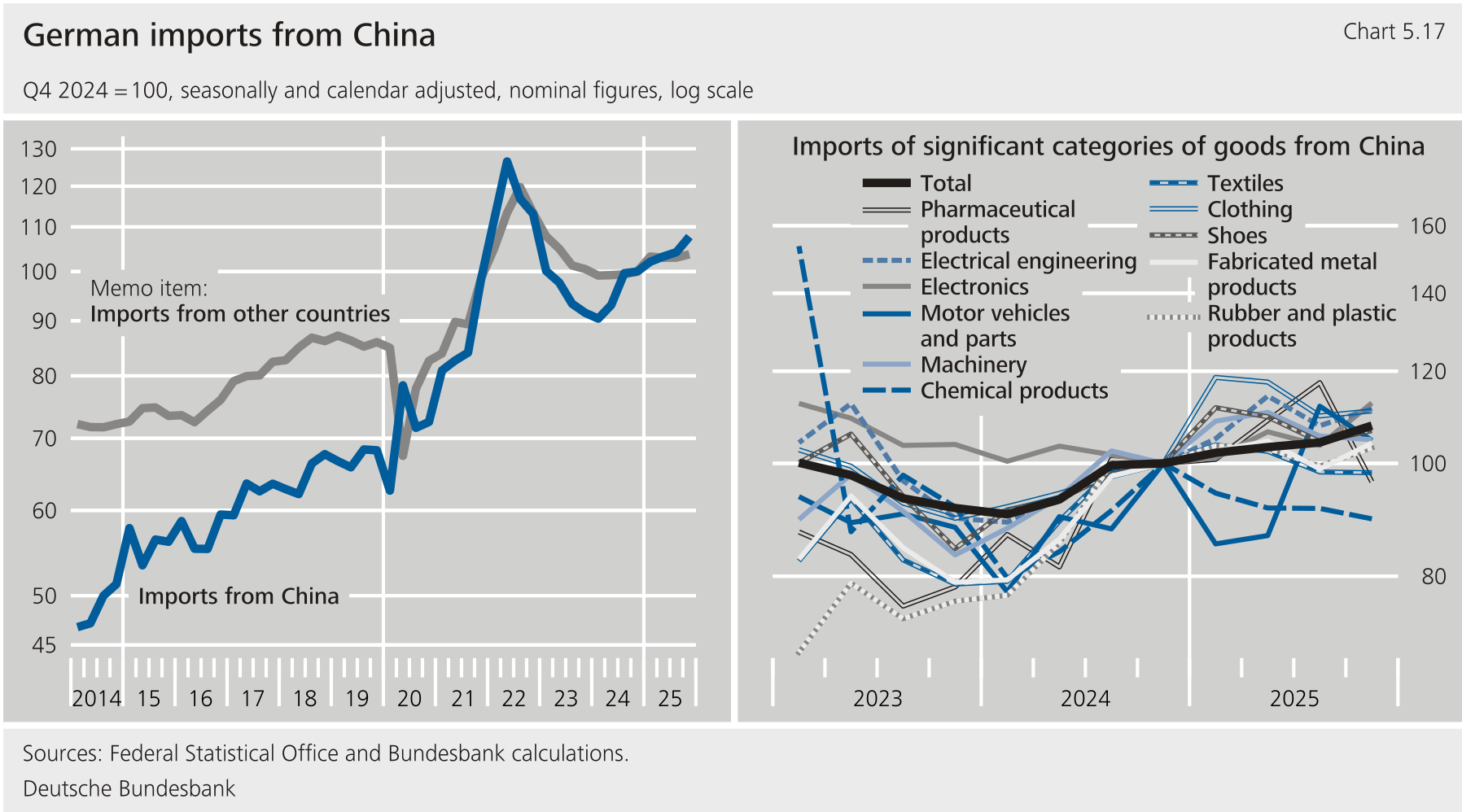**
****Imports rose on a broad basis across the product range.** In the reporting year, many foreign manufacturing sectors benefited from higher demand from Germany's industrial sector for imports of capital and intermediate goods. Imports of electrical engineering products and electronics, especially computer equipment, and of fabricated metal products rose particularly sharply. In addition, imports of other transport equipment experienced a considerably stronger increase than in recent years, with aircraft and spacecraft playing a key role. There was a steep rise in demand for imports of machinery, iron and steel products, as well as chemical products. Imports of motor vehicles and motor vehicle parts also picked up momentum. Purchases of foreign consumer goods surged, reflecting the distinct increase in consumer demand in Germany.**{#par-u59i1i}
****Compared with previous years, energy products had a smaller impact on the value of imports.** On the one hand, German energy importers were affected by a slight rise in the price of natural gas and a considerable hike in the price of electricity. On the other, they benefited from a substantial drop in the price of crude oil and refined petroleum products. Looking at energy products, imports of coal rose markedly in terms of volume.[\[6\]](#_ftn_root_6) The volume of imports grew very strongly for electricity and quite sizeably for natural gas.[\[7\]](#_ftn_root_7) From a regional perspective, nominal imports from Norway rose significantly overall, with a very steep rise in the volume of natural gas imports playing a role. The value of imports from countries expanded only marginally, as while the volume of imports of crude oil and petroleum products increased considerably, the fall in the prices of these products had a stronger dampening effect.[\[8\]](#_ftn_root_8) Imports from the United States grew more sluggishly overall than the average across all suppliers. One factor here was that imports of natural gas from the United States rose quite substantially in terms of volume, but imports of crude oil and petroleum products fell very sharply.[\[9\]](#_ftn_root_9)**{#par-eu2o25}
### **1.3 Invisible current transactions** {#tar-7}
****In the reporting year, the deficit in the cross-border services account increased to €74 billion.** International trade in services has become much more important for Germany over the past two decades. Revenue from the sale of services to other countries, in particular, has risen steeply over the past 20 years. In 2025, services accounted for one-quarter of income from total exports. In 1995, their share stood at just one-eighth. The significance of services also grew in the context of imports. Spending on these as a share of total expenditure on goods and services from abroad rose from 24¼ % in 1995 to 31¼ % in 2025. Although exports of services have grown significantly more strongly than imports over the past two decades, Germany's services account has remained in the minus.[\[10\]](#_ftn_root_10) The deficit widened in the reporting year, as expenditure rose by €3 billion more than revenue.**{#par-o32o3u}
****The large deficit in the services account is mainly driven by cross-border travel.** In 2025, this deficit rose again by €1 billion to reach €78 billion -- the highest nominal deficit since 1991. Residents' expenditure on foreign travel rose slightly on the high level recorded in the previous year. This was due to expenditure on business travel; meanwhile, spending on private travel declined somewhat. At €100 billion, however, German residents' expenditure on private travel abroad was only slightly lower than the record figure of the previous year. While spending on travel to countries remained virtually constant, it rose sharply for travel to Switzerland and Türkiye. Looking at long-haul destinations, spending on travel to Asia increased strongly, whereas expenditure on travel to the United States fell considerably. Revenue from travel, which Germany generates predominantly from travel for city trips, trade fairs, events and business trips, remained virtually unchanged in 2025, leaving it still only slightly higher than its pre-pandemic level of 2019.**{#par-ea317i}
****Commercial services accounted for the largest share of total assets in trade in services.** [\[11\]](#_ftn_root_11) The commercial services balance itself remained unchanged at €15 billion in 2025. However, individual sub-accounts saw marked shifts. For instance, the deficit in transport services increased by €2 billion. This was due to a decline in revenue that stemmed largely from developments in the maritime freight sector. The considerable drop in freight rates last year according to the Drewry Container Index was probably the main factor here. At the same time, the maintenance and repair services deficit contracted markedly owing to higher revenue. The aviation industry may have contributed to this, as German enterprises are well positioned worldwide in the field of aircraft maintenance.[\[12\]](#_ftn_root_12)**{#par-i529ii}
****The government services balance contributed markedly to the wider deficit in the services account.** The surplus in this traditionally small sub-account shrank by €2 billion to €1 billion. This was due to significantly higher government spending on cross-border services. In addition to goods and services for diplomatic missions abroad and certain transactions by international organisations, this sub-account also includes expenditure on goods and services procured from abroad for Germany's armed forces stationed abroad. The general increase in defence spending was also reflected in higher expenditure on government services in 2025.[\[13\]](#_ftn_root_13)**{#par-ou722e}
{#par-e22822}
**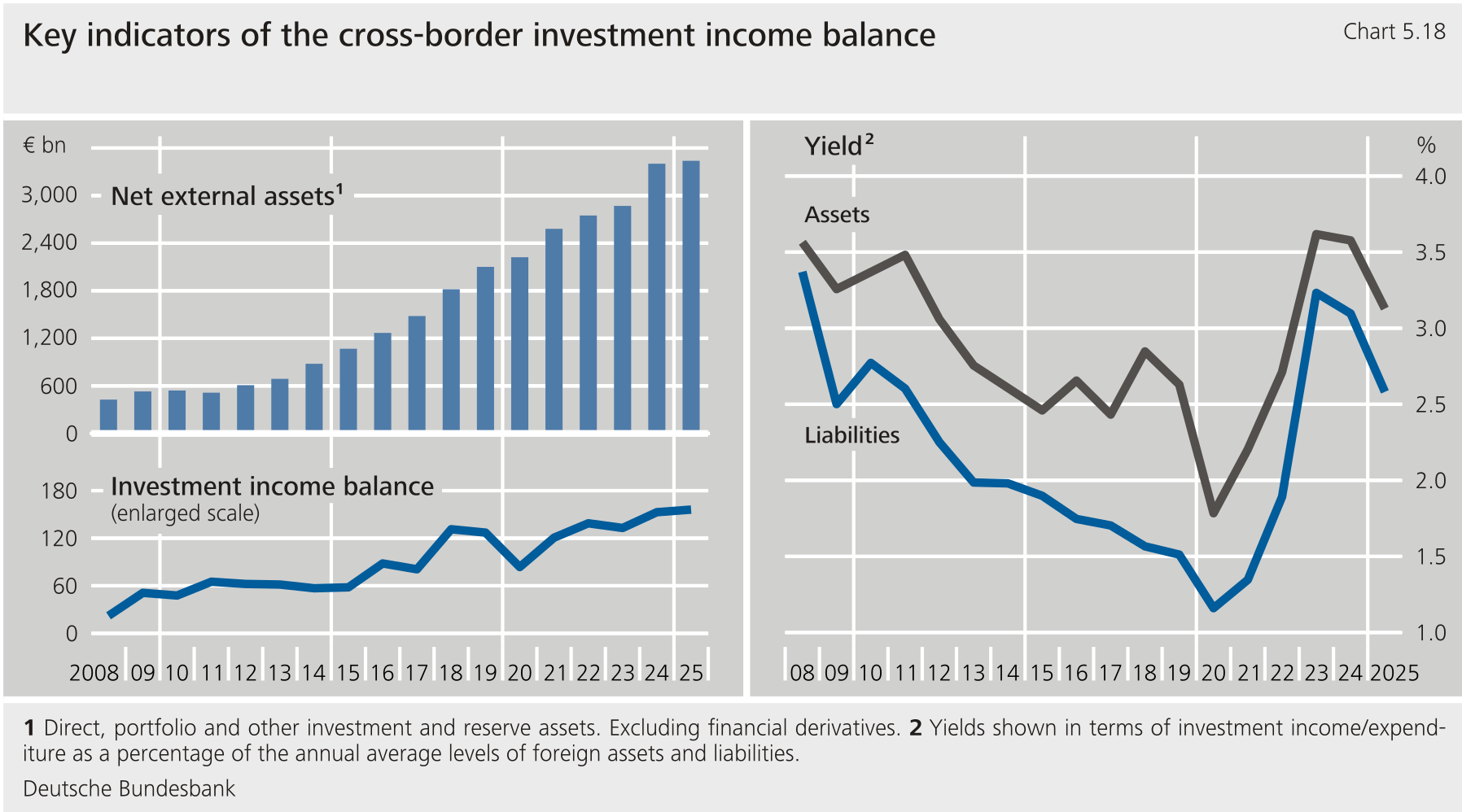**
****The primary income account contributed almost as much to Germany's current account surplus as trade in goods.** The surplus increased by €2 billion to stand at €161 billion in 2025. The primary income balance alone therefore came to 3.6 % of ; this was only slightly lower than that of trade in goods, which amounted to 4.1 % of . The high primary income surplus was mainly the result of net investment income. In 2025, residents' income from investment abroad declined significantly. However, payments by residents to foreign investors fell even more sharply, meaning that the surplus in the primary income account went up. The decline in interest rates in the reporting year played a role in the overall drop in income from and expenditure on investment. The fact that receipts fell less sharply than expenditure was also due to the significant increase in income from direct investment. This mainly stemmed from higher reinvested profits linked to the sound earnings situation of German enterprises in key investment locations.**{#par-o98i5a}
****The secondary income balance remained virtually unchanged in 2025.** The general government deficit rose markedly owing to significantly higher transfers to other countries. At the same time, the deficit in non-government secondary income declined perceptibly due to a considerable increase in revenue.**{#par-e88o4o}
{#par-a8e312}{#par-ui223o}{#par-ia229o}
| **Table 5.2:** Major items of the balance of payments € billion ||||
| Item | 2023^r)^ | 2024^r)^ | 2025^r)^ |
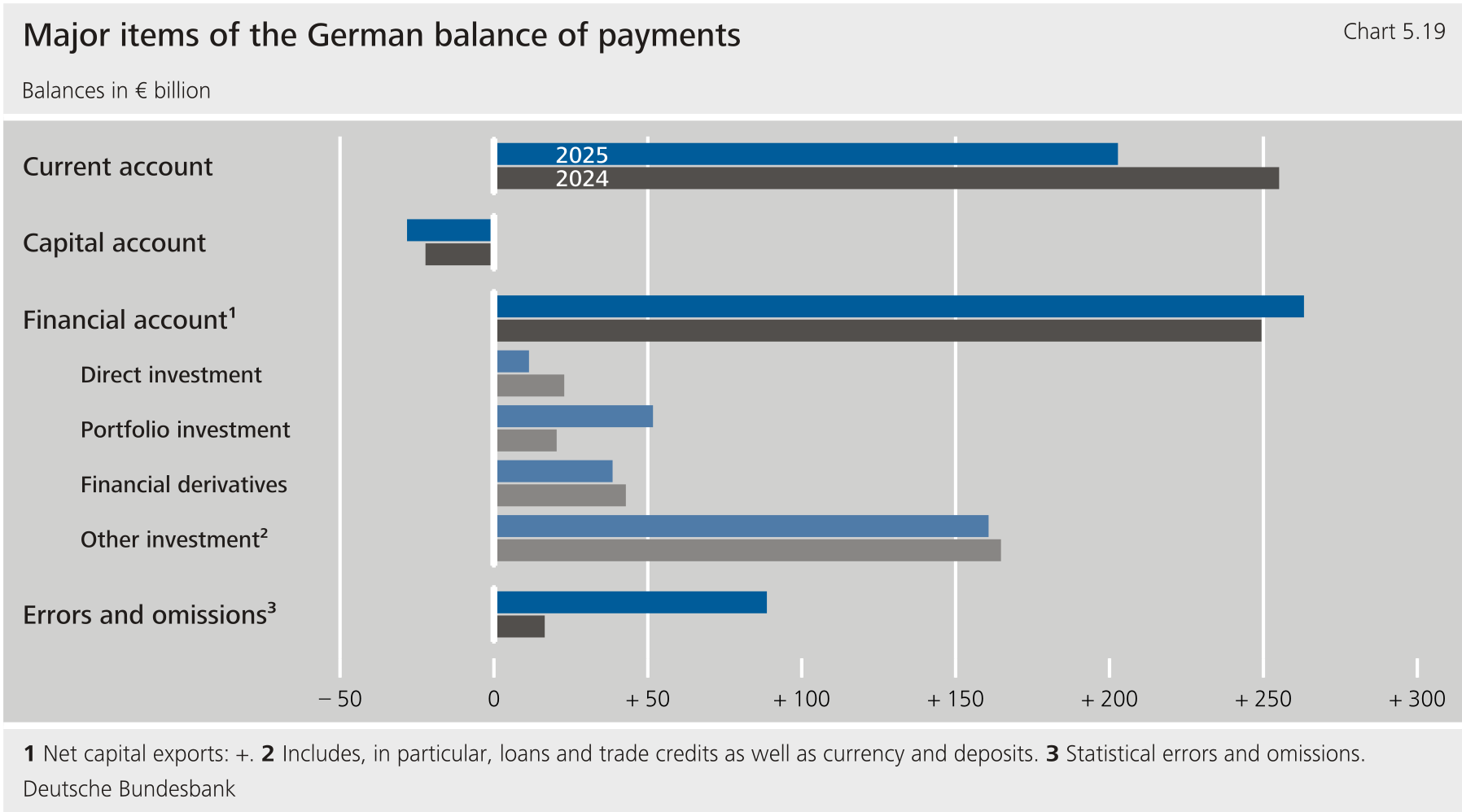
| I. Current account | + 232.4 | + 255.1 | + 202.7 |
| 1. Goods | + 225.4 | + 236.7 | + 184.2 |
| Receipts | 1 399.8 | 1 361.6 | 1 354.3 |
| Exepnditure | 1 174.4 | 1 124.8 | 1 170.1 |
| Memo item: | |||
| Foreign trade^1^ | + 217.7 | + 242.9 | + 200.5 |
| Exports | 1 575.2 | 1 549.6 | 1 563.0 |
| Imports | 1 357.5 | 1 306.7 | 1 362.5 |
| 2. Services | -- 60.9 | -- 70.7 | -- 73.5 |
| of which: | |||
| Travel | -- 71.8 | -- 77.4 | -- 78.0 |
| 3. Primary income | + 134.4 | + 158.4 | + 160.8 |
| of which: | |||
| Investment income | + 132.9 | + 152.8 | + 156.1 |
| 4. Secondary income | -- 66.4 | -- 69.3 | -- 68.7 |
| II. Capital account | -- 23.6 | -- 22.2 | -- 28.2 |
| III. Financial account^2^ | + 188.1 | + 249.4 | + 263.2 |
| 1. Direct investment | + 23.7 | + 22.8 | + 11.4 |
| 2. Portfolio investment | -- 7.6 | + 20.4 | + 51.7 |
| 3. Financial derivatives^3^ | + 35.4 | + 42.9 | + 38.6 |
| 4. Other investment^4^ | + 135.8 | + 164.7 | + 160.7 |
| 5. Reserve assets | + 0.9 | -- 1.4 | + 0.9 |
| IV. Errors and omissions^5^ | -- 20.7 | + 16.5 | + 88.7 |
|-----------------------------|---------:|----------|----------|
{#par-a121oe}
**2 Capital account** {#tar-8}
------------------------------
****The German capital account captures cross-border transactions of non-produced non-financial assets and capital transfers and closed 2025 with a deficit of €28 billion.** In the previous year, the deficit had amounted to €22 billion. Though the capital account is generally significantly smaller in transaction volume than the current account or the financial account, it has gained in importance in recent years with the expansion of the European Union Emissions Trading System ().**{#par-u24ei1}
****From a German perspective, cross-border transactions of non-produced non-financial assets closed 2025 with a deficit of €19 billion and thus somewhat higher than in 2024 (€15 billion).** The deficit in 2025 was solely attributable to emissions allowance trading in the , with this item also being the most important in the non-produced non-financial assets category in recent years. The category also includes transactions using unbacked crypto-assets such as bitcoins. However, the turnover from these assets recorded in the balance of payments is low. From a German perspective, it posted a small net revenue surplus of €61 million.**{#par-u6eoeu}
****In terms of capital transfers, Germany likewise recorded higher expenditure than revenue on balance in 2025 (€9 billion).**A year earlier, this deficit had amounted to €7½ billion. Alongside a large number of other types of transfer, insurance benefits for major losses accounted for €3½ billion of the deficit.**{#par-o2i4oe}
**3 Capital flows** {#tar-9}
----------------------------
### **3.1 Underlying trends in capital flows** {#tar-10}
****Germany's net capital exports amounted to €263 billion in 2025, slightly up on the previous year's level (€249½ billion).**The difference between the balances on the current account and the capital account on the one hand and the balance on the financial account on the other hand is attributable to statistical errors and omissions (€88½ billion).**{#par-ee1563}
****Direct investment flows to and from Germany recovered somewhat after several years of declining gross flows, but continued to be influenced by geopolitical tensions and increasing uncertainty surrounding the United States' economic policy stance.** According to preliminary data, global direct investment flows rose by 14 % in 2025. This represented a significant recovery compared with the weak pace of growth seen in previous years.[\[14\]](#_ftn_root_14) According to balance of payments data, transactions involving German investors were also higher in 2025 than in the previous year, in line with global developments. However, regional differences were apparent. The share of German direct investment in the European Union rose to more than one-third. The United States remained the key target outside the European Union, but its share in Germany's total direct investment outflows declined. At least in terms of German direct investment, the higher tariffs imposed by the United States on imports from Europe have so far not had the effect its government hoped for of bringing production to shores. German enterprises also held back on new investments in China. This development has been observed for several years, but it is masked by the high profits reinvested by these firms there. Conversely, Germany became more attractive to foreign investors again in 2025. The negative trend of previous years was temporarily halted and larger direct investment inflows were received than in 2024.**{#par-u828ai}
{#par-uu318u}
****
****In 2025, Germany's portfolio investment with non-residents was influenced by, amongst other factors, growing uncertainty surrounding policy developments abroad.** In 2025, German investors added almost no further foreign shares to their portfolios on balance. By contrast, their interest in foreign investment funds, which, for their part, invest a large part in equity securities, remained unchanged. This could be due to the fact that mutual fund shares also allow retail investors to diversify their assets broadly and thus reduce overall risk. Foreign bonds also attracted great interest, with the bulk of newly acquired securities denominated in euro. In regional terms, it is striking that German investors disposed of securities on balance in 2025. This was the case for shares and debt securities alike, while shares issued by investment funds remained in demand. German investors may be increasingly considering investments in the United States to be risky. In the case of shares, the high valuation of some American tech companies may have played a role in the decision to sell. In fact, profit-taking could be observed among German shareholders at the end of the year in particular. Regarding bonds, among other things, the controversial debate about the future stance of monetary policy in the United States and the significant depreciation of the dollar against the euro unsettled German investors. Conversely, demand from foreign investors focused mainly on German debt securities, preferably government bonds. This underscored their unbroken confidence in Germany as a safe asset issuer. At the same time, the German off-budget special fund for infrastructure and defence, which was launched in 2025, increased the supply of German debt instruments and, in turn, boosted cross-border trade in these. By contrast, non-residents were hesitant to purchase German shares and mutual fund shares, even though stock market values generated solid returns last year and the C- performance index increased by 22 % over the course of the year.[\[15\]](#_ftn_root_15)**{#par-u5au3e}
****Other investment is strongly affected by payment flows related to transactions elsewhere in the balance of payments.** Export revenue from trade in goods typically initially leads to net capital exports in other investment. Cross-border asset purchases are also accompanied by transactions in other investment. The sum of all these individual entries led to net capital exports in other investment in 2025. By contrast, the Bundesbank's claims on the , changes in which are also recorded under other investment, declined slightly.**{#par-u16473}
| **Table 5.3:** Financial account € billion ||||
| Item | 2023^r)^ | 2024^r)^ | 2025^r)^ |
| Financial account balance^1^ | + 188.1 | + 249.4 | + 263.2 |
| 1. Direct investment | + 23.7 | + 22.8 | + 11.4 |
| Domestic investment abroad^2^ | + 107.7 | + 80.2 | + 97.5 |
| Foreign investment in Germany^2^ | + 84.1 | + 57.4 | + 86.1 |
| 2. Portfolio investment | -- 7.6 | + 20.4 | + 51.7 |
| Domestic investment in foreign securities^2^ | + 154.5 | + 217.8 | + 281.1 |
| Shares^3^ | -- 4.9 | + 3.8 | + 0.9 |
| Investment fund shares^4^ | + 29.4 | + 111.3 | + 119.9 |
| Short-term debt securities^5^ | + 6.5 | + 8.9 | -- 11.1 |
| Long-term debt securities^6^ | + 123.5 | + 93.8 | + 171.4 |
| Foreign investment in domestic securities^2^ | + 162.1 | + 197.4 | + 229.4 |
| Shares^3^ | -- 14.1 | -- 5.2 | -- 15.6 |
| Investment fund shares | -- 2.2 | -- 1.0 | + 0.8 |
| Short-term debt securities^5^ | + 9.2 | -- 15.1 | + 48.2 |
| Long-term debt securities^6^ | + 169.2 | + 218.6 | + 196.1 |
| 3. Financial derivatives^7^ | + 35.4 | + 42.9 | + 38.6 |
| 4. Other investment ^8^ | + 135.8 | + 164.7 | + 160.7 |
| Monetary financial institutions^9^ | + 97.4 | + 107.4 | + 87.3 |
| Enterprises and households^10^ | + 64.2 | + 61.4 | + 83.4 |
| General government | + 8.4 | -- 7.3 | -- 6.1 |
| Bundesbank | -- 34.1 | + 3.2 | -- 3.9 |
| 5. Reserve assets | + 0.9 | -- 1.4 | + 0.9 |
|----------------------------------------------|---------:|----------|----------|
{#par-ooo96a}
### **3.2 Direct investment** {#tar-11}
****At the beginning of 2025, German industrial enterprises were still rather cautious about their plans for foreign investment.** [\[16\]](#_ftn_root_16) They were not only reacting to uncertain economic developments at home and abroad. Geopolitical factors and increasing trade barriers also made investment decisions more difficult. This rather defensive stance was also evident in the fact that only 30 % of enterprises surveyed cited market exploration as the most important reason for their foreign investment. Meanwhile, 35 % of respondents were focused on potential cost-cutting, putting this goal on par with setting up sales and customer services for the first time since 2008.**{#par-e9e354}
****In this economic environment, impacted as it is by uncertainty, cross-border direct investment flows to and from Germany resulted in net capital exports of €11½ billion in 2025, following €23 billion the previous year.** However, the decrease was driven by higher gross flows on both sides of the balance sheet. On balance, German direct investment outflows were somewhat higher than the previous year's figure, which had marked a long-term low. Direct investment flows into Germany increased more strongly, following weak inflows in previous years. Foreign investors may be expecting the German economy to regain momentum in the coming years.**{#par-iiu2uu}
****Enterprises domiciled in Germany provided affiliated group entities abroad with additional direct investment funds of €97½ billion last year.** This was €17½ billion more than in 2024. Specifically, they provided foreign enterprises with €78 billion in additional equity capital. However, only €11 billion of this was attributable to equity capital in the narrower sense. These new investments can provide indications of enterprises' future direction. By contrast, reinvested earnings, at €65 billion, (as a further component of equity capital) played a prominent role. German enterprises furthermore provided affiliated enterprises abroad with additional funds totalling €19½ billion net via intra-group lending.**{#par-i9951i}
{#par-a459i3}
**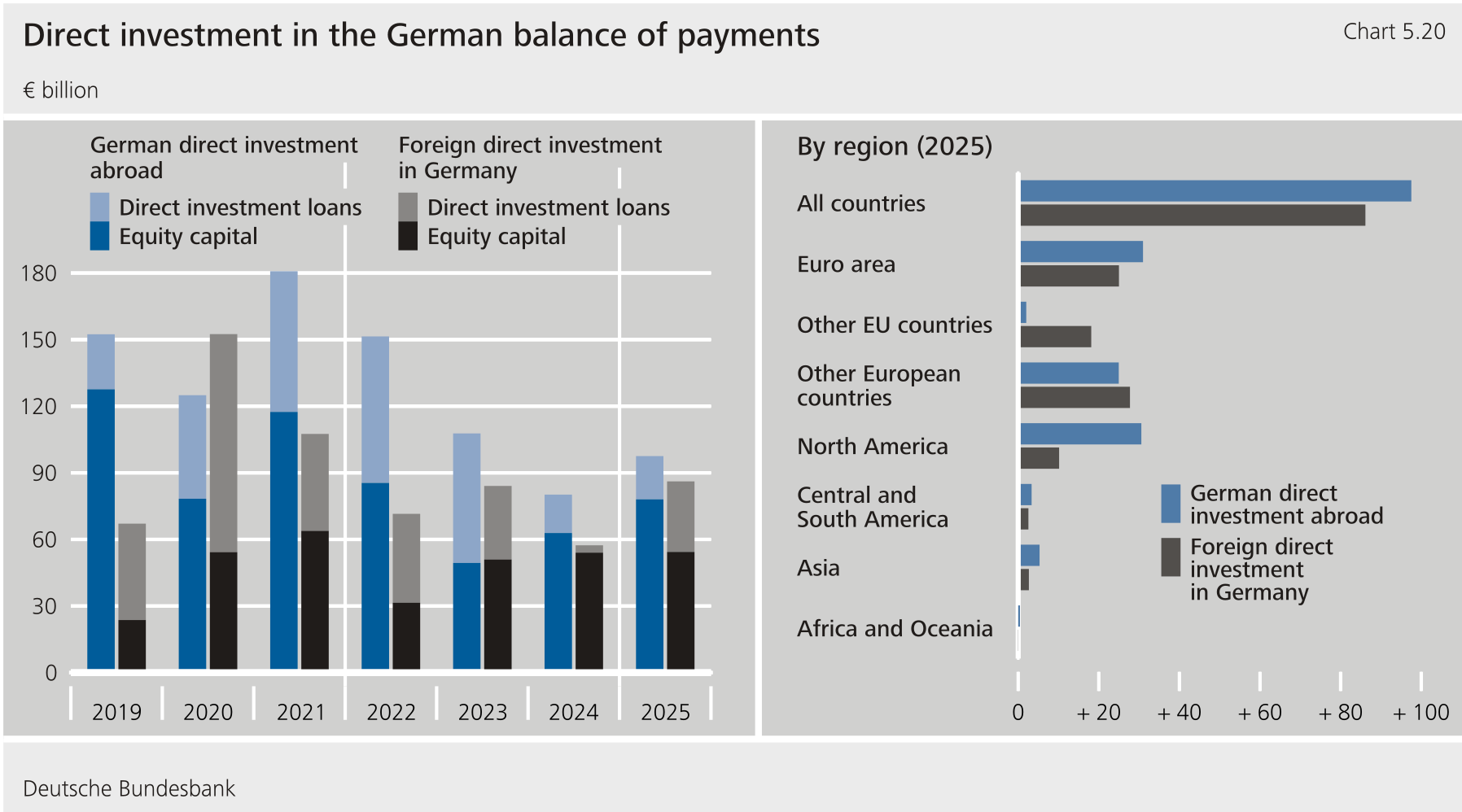**
****In 2025, partner countries in the European Union attracted one-third of Germany's direct investment outflows.** This once again underlined the importance of this region for German economic relations. However, within the European Union, two countries mainly known as holding company locations, the Netherlands and Luxembourg, were at the forefront of these statistics. A significant portion of the funds that flow to these countries are transferred from there to group units in other countries.[\[17\]](#_ftn_root_17)**{#par-e1a435}
****Outside the European Union, most of Germany's direct investment outflows last year were to the United States (€29 billion), the United Kingdom (€18½ billion) and China (€3½ billion).**Compared with the previous year, the regional structure of German direct investment flows has thus shifted somewhat. In 2024, the United States, at €37 billion, was by far the most important target for German direct investors ahead of the European Union. By comparison, measured in terms of total direct investment flows, German enterprises were now investing more heavily in China in 2025 than in the previous two years.**{#par-i6a338}
****However, German enterprises withdrew equity capital in the narrower sense from China.** The significant discrepancy between German direct investment flows to China as a whole and the withdrawal of equity capital in the narrower sense is due to high reinvested profits. Subsidiaries of German enterprises generated high profits in recent years, which largely remain in the country. In the current account, these funds are classified as investment income as retained earnings and recognised in the financial account as reinvested earnings. Apart from these local profits, German direct investors withdrew funds from China in 2025, including intra-group lending. This seemingly contradictory picture of high profits for German enterprises in China on the one hand and a lack of new investment on the other could be linked to mounting geopolitical tensions. These are encouraging enterprises to diversify their investment more strongly than in the past or to relocate to friendlier countries.[\[18\]](#_ftn_root_18)**{#par-uu5i63}
****In the United States, German enterprises held back on direct investment in equity capital, presumably also out of uncertainty about the future economic policy stance on the other side of the Atlantic.** Compared with the previous year, fresh direct investment funds (excluding reinvested profits) decreased from €14½ billion to €5 billion, while total equity investment also declined. However, the United States remained the most important target outside the European Union for German enterprises in this category and in terms of total direct investment.**{#par-i6e52e}
****In 2025, there was a net inflow of €86 billion of direct investment funds to Germany, both via equity capital and via intra-group lending.** This was markedly more than in the previous year (€57½ billion), but still less than at the beginning of the decade. Following the outbreak of the -19 pandemic, direct investment inflows to Germany had fallen steadily. The recovery last year halted this development, but this cannot yet be interpreted as a turnaround. Just under 40 % of the inflows were made available by foreign parent enterprises via equity capital in the narrower sense and intra-group lending, with reinvested earnings accounting for just over one-fifth.**{#par-oa1uuo}
****The source of direct investment inflows to Germany is similar to that of the target countries of German direct investment outflows -- the United Kingdom and the United States, followed the European Union as the most important region of origin.** In 2025, half of direct investment inflows to Germany (€43 billion) came from enterprises based in partner countries. The main sources were cross-border inflows of funds from Denmark, the Netherlands and France. Outside the European Union, enterprises from the United Kingdom (€26½ billion) and the United States (€12 billion) made the most direct investment funds available. Direct investment inflows to Germany were partly offset by larger return flows to some countries, such as Belgium and Ireland. This was due to the fact that intra-group lending was dominated by repayments of previously granted loans.**{#par-o1oa32}
****The market for cross-border mergers and acquisitions** ()**involving German enterprises picked up somewhat in 2025.** In 2025, enterprises domiciled in Germany acquired more foreign enterprises across borders than in the previous year. This applied in terms of both the number of transactions and the volume of completed takeovers.[\[19\]](#_ftn_root_19) Cross-border takeovers by foreign investors also rose slightly in 2025 compared with the previous year; likewise in terms of both the volume and number of agreements.[\[20\]](#_ftn_root_20)**{#par-u33e17}
****In the case of corporate takeovers, the venture capital segment is of particular interest despite its low volume, but it is still comparatively underdeveloped in Germany and Europe.** Venture capital refers to the financing of young, innovative enterprises with high growth potential. Measured in terms of volume, cross-border venture capital deals account for only a small part of the total volume. However, they are an indicator of a location's ability to provide both favourable conditions for innovative enterprises and the necessary risk capital. By international standards, Germany and Europe lag significantly behind other countries -- especially the United States -- in the area of venture capital financing.[\[21\]](#_ftn_root_21) The European Commission therefore sees expanding the European venture capital market within the framework of the Savings and Investments Union () as a primary objective.[\[22\]](#_ftn_root_22) A Bundesbank study shows that German enterprises play an important role in direct investment worldwide. This is not, however, reflected in international venture capital financing. There is some catching up to be done here.**{#par-u45349}
****Venture capital deals involving German firms**** {#tar-12}
--------------------------------------------------------------
****This text shows that German firms that have in the past been involved in cross-border deals on the provision of venture capital systematically differ from other firms in size and structure.** Young and innovative start-ups need venture capital () so they can grow and compete after being established (scale-up phase). Compared with the United States and the United Kingdom, in particular, the European market for the provision of ( deals) is underdeveloped, especially during the capital-intensive scale-up phase. The European Savings and Investments Union () aims to improve the framework for deals in Europe. The task force, which was set up at the joint initiative of France and Germany, developed important recommendations for how Europe can make the market more attractive to domestic and international investors.[\[1\]](#_ftn_455b8c58_1) This Bundesbank study has linked external Moody's data on deals with its own information on foreign direct investment and analysed the characteristics of German firms that have been involved in cross-border deals in the past.[\[2\]](#_ftn_455b8c58_2)**{#par-uu1iuu}
****deals are difficult to place within the statistical framework of balance of payments statistics and stock statistics for German** .One reason for this is that data from the balance of payments statistics and the foreign direct investment statistics do not differentiate between and other equity capital. Another reason is that the timing of a completed deal does not necessarily coincide with the time at which capital is actually provided and recorded in the balance of payments or foreign direct investment statistics. This classification problem exists not only for deals, but also for mergers and acquisitions (). The data on deals are based on Moody's Orbis M\&A between 2002 and 2025. In around 6,400 of the completed deals recorded in the dataset, at least one German firm was involved as either investor or target (or both). The information on whether a German firm was involved in a deal during this period is linked to the Bundesbank's Microdatabase Direct Investment (known as ).**{#par-iu8921}
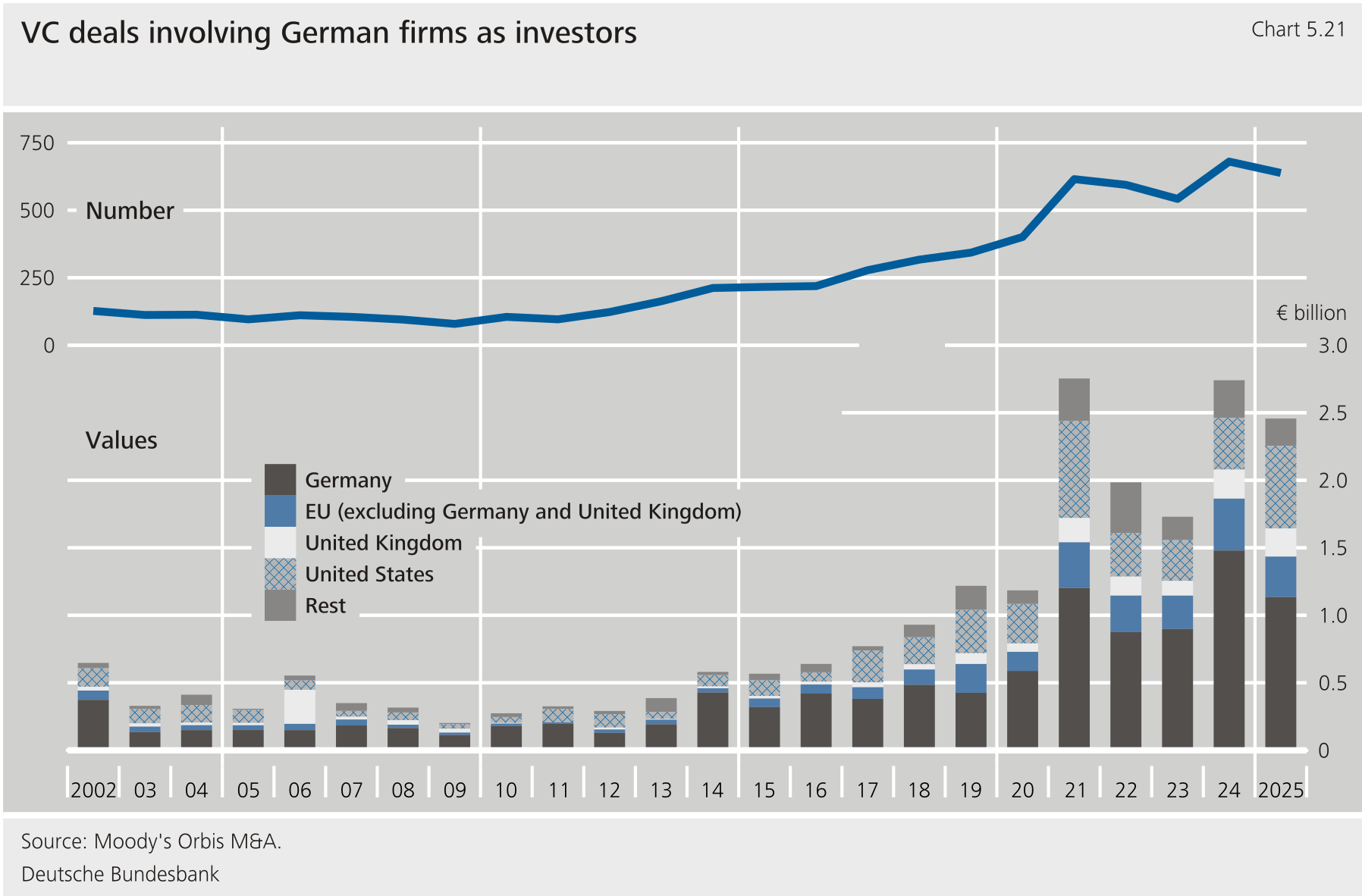
****Moody's Orbis M\&A data show that German firms invested mostly in Germany, the United States and the European Union** (). Chart 5.21 shows the evolution of deals in which (at least) one German firm acted as investor.[\[3\]](#_ftn_455b8c58_3) On balance, the number of deals has risen since 2010. German firms invested mainly in German firms, followed by firms in the United States, the (excluding Germany) and the United Kingdom. The lower level in 2022 and 2023 could reflect higher monetary policy rates in the euro area, the United States and the United Kingdom. It is likely that potential investors attained higher yields in bond markets during this period. The level of cross-border deals by German investors is relatively low compared to the total volume of German activity.[\[4\]](#_ftn_455b8c58_4)**{#par-e83887}
{#par-iua4uu}
****
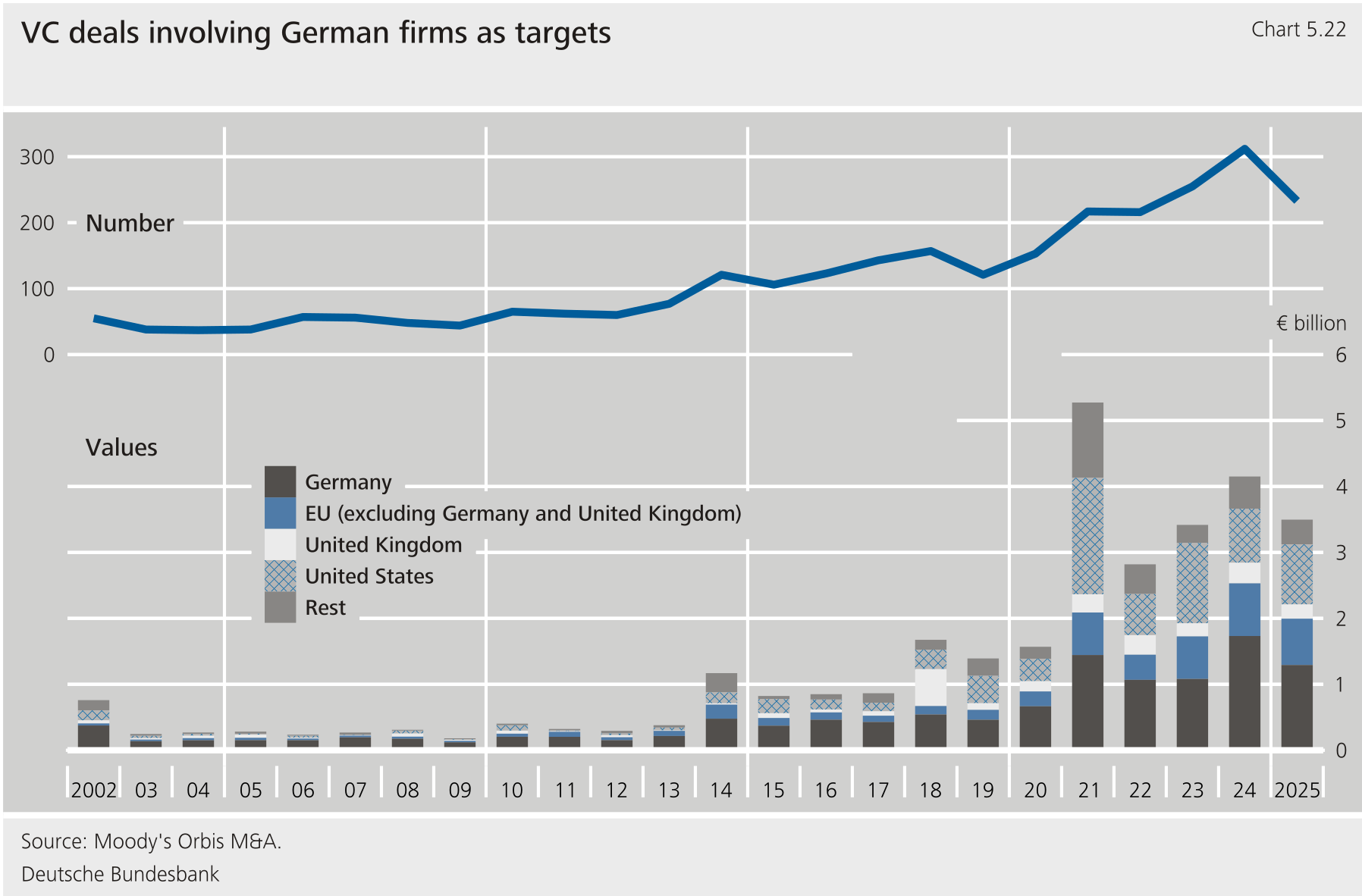
****A similar picture emerges when looking at the evolution of** **deals where a German firm is the target, but at different levels.** Chart 5.22 illustrates the deals where a German firm was the target.[\[5\]](#_ftn_455b8c58_5) Developments match those shown in Chart 5.21, with a similar regional breakdown and an increasing number of deals. Although the number of deals is less than half that of deals where German firms acted as investors, the aggregate value of the deals is roughly twice as high. The average value of the deals is thus considerably higher.**{#par-u36677}
{#par-o2ao89}
****
****German investors in** **deals predominantly come from the financial sector, while German start-ups as targets for** **deals often operate in the** **sector.** Among the 1,398 German firms that invested in deals between 2002 and 2025 according to Orbis M\&A data, 64 % were primarily active in the sector "financial service activities, except insurance and pension funding" and 13 % in "activities auxiliary to financial services and insurance activities". This means that mainly financial enterprises act as investors. Over the same period, 1,971 German firms were the target of a deal. Of these, 38 % belonged to the sector "information service activities", 18 % to "publishing activities", 10 % to "research and development", 7 % to "computer programming, consultancy and related activities" and 5 % to "manufacture of computer, electronic and optical products". In this case, then, is the main focus.**{#par-oeoae5}
****It is generally possible to link Orbis M\&A and the** **database, but** **deals only give a limited picture of the equity capital provided via foreign direct investment.** The cross-border deals concluded between 2002 and 2023 in Orbis M\&A involved 617 German firms as investors.[\[6\]](#_ftn_455b8c58_6) For 204 of these German firms, an identifier is available in the database, including information on the country in which the German firm invested. However, only 18 firms that invested in a given country according to Orbis M\&A also had a foreign affiliate there in the same year according to . The same applies to deals where a German firm was the target of a foreign investor. The econometric analyses therefore considered all 33 linked firms that actually had a foreign affiliate at the time of a deal. The location of the foreign affiliate or the foreign parent company did not play a role in the analysis. However, the deal had to be cross-border, meaning that deals where a German firm invests in a German firm could not be taken into account.**{#par-oo5622}
****Panel regressions examine whether German firms that were part of a cross-border** **deal systematically differ from those that were not involved in a** **deal.** The following regression equation is estimated using an ordinary least squares () model:[\[7\]](#_ftn_455b8c58_7)**{#par-o849ia}
**$$ Metric_{it} = \\beta VC-Deal_{it} + \\alpha_{s} + \\delta_{t} + \\varepsilon_{it} $$**{#par-i22uu7}
**Here, \\( metric_{it} \\) stands for an economic characteristic of German firm \\( i \\) in year \\( t \\). The binary variable \\( VC-Deal_{it} \\) takes the value of one if firm \\( i \\) was part of a cross-border deal at time \\( t \\). This information is linked from the Orbis M\&A data to the database. The fixed effects \\( \\alpha_{s} \\) and \\( \\delta_{t} \\) account for sector-specific and time-specific fixed effects.[\[8\]](#_ftn_455b8c58_8) Standard errors are computed at the firm level to ensure robust estimates.**{#par-o11145}
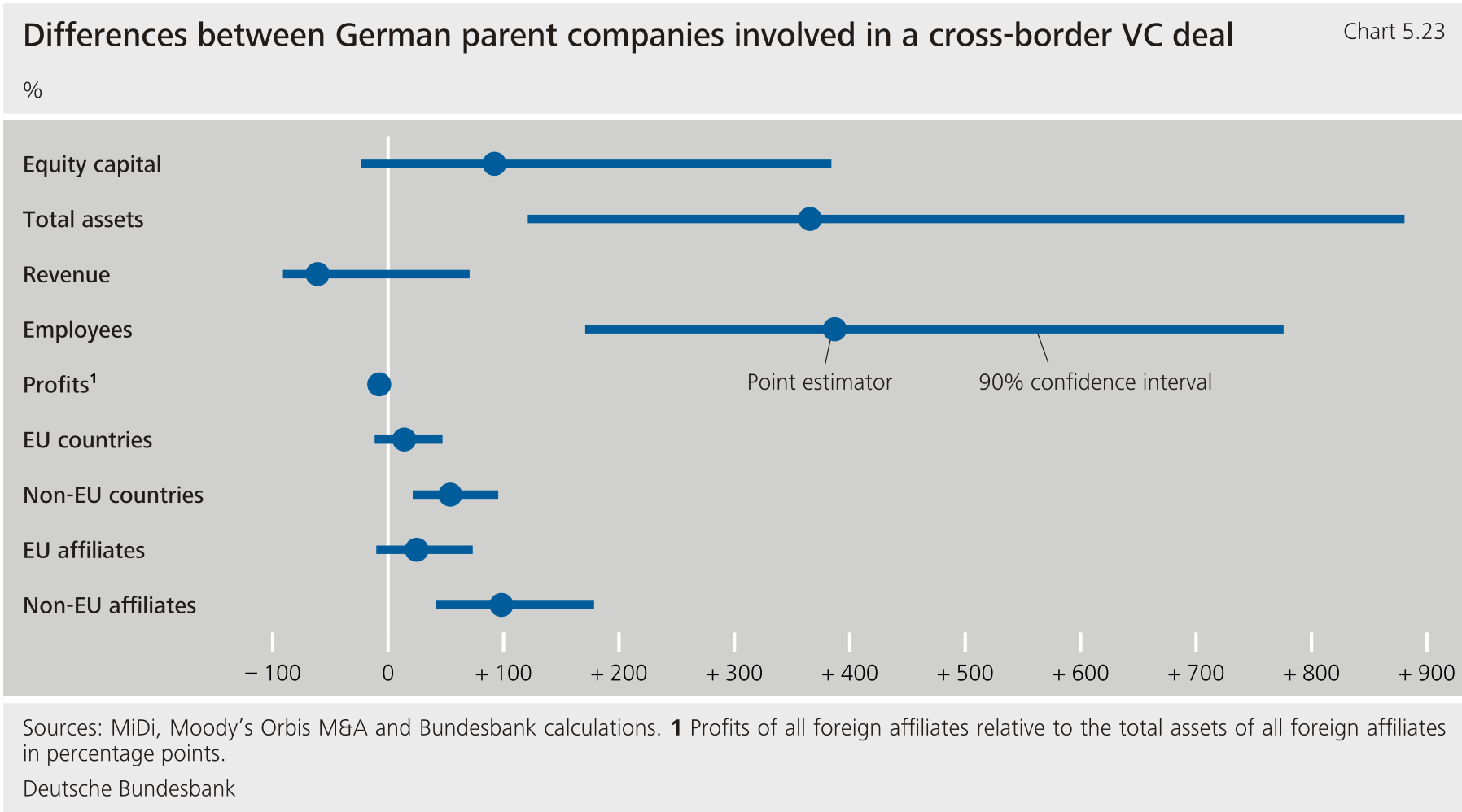
****German parent companies that were involved in cross-border** **deals tend to be larger, as measured by total assets and number of employees, and relatively active outside the** **in international terms.** Chart 5.23 presents the results (of \\( \\beta \\)) different regression models, with each model using a different dependent (usually logarithmic) variable.[\[9\]](#_ftn_455b8c58_9) All specifications include sector-specific and year-specific fixed effects. The results show that it tends to be large German firms, as measured by total assets and number of employees, that engage in deals. Furthermore, these German parent companies tend to invest more in countries and foreign affiliates outside the than other German groups that have not completed deals. Profits have (weakly) negative significance, indicating that especially high ongoing profitability abroad is not the primary driver of cross-border deals by German firms. Instead, strategic motives, pressure to innovate and a focus on growth could play a role.**{#par-euu12u}
{#par-uo5u37}
****
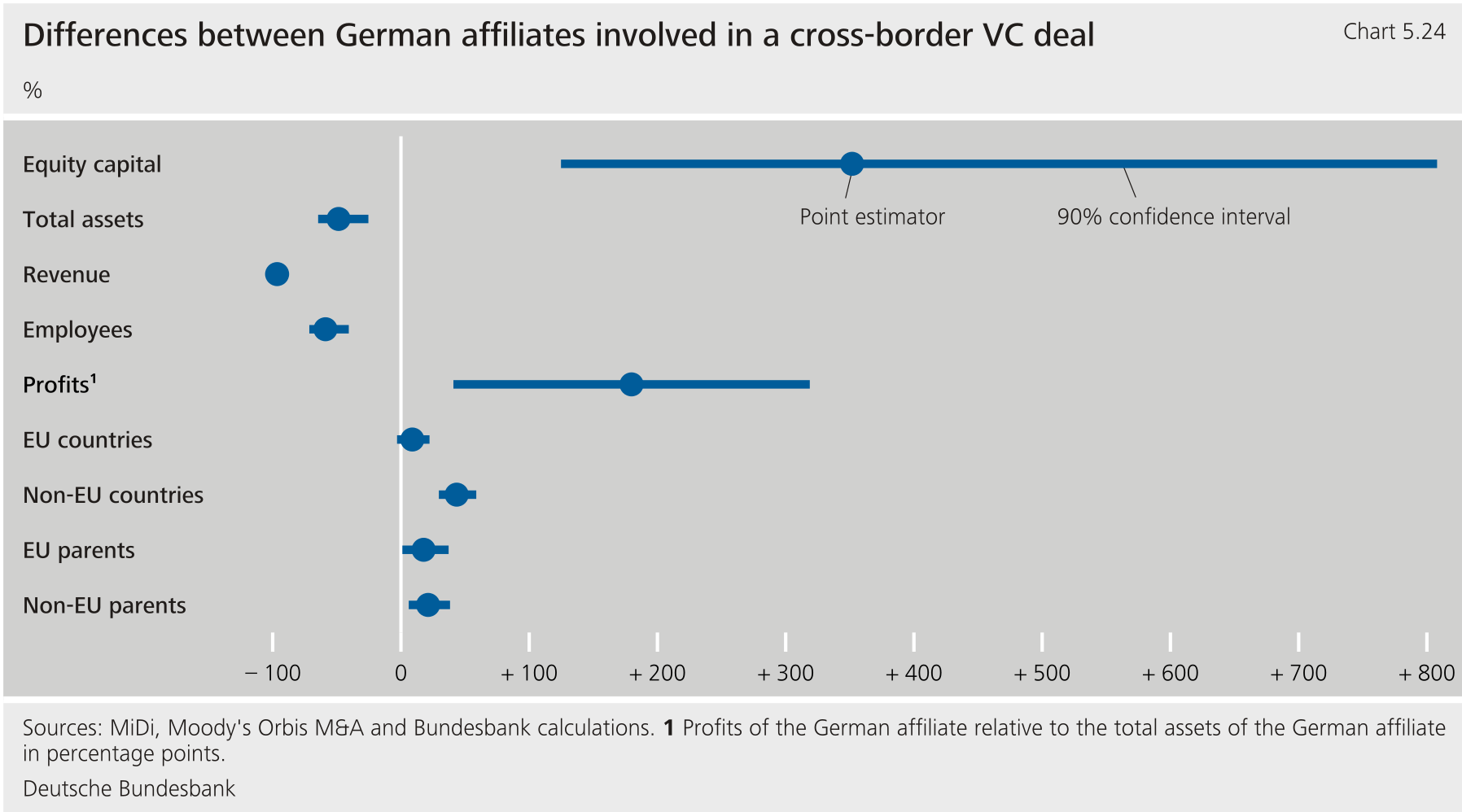
****Although German affiliates targeted by cross-border** **deals have a higher equity ratio, they tend to be smaller and the foreign parent companies tend to come from outside the** .Chart 5.24 provides the same estimated coefficients as in Chart 5.23, but this time for German affiliates which are the target of cross-border deals. The foreign parent companies tend to come from a country outside the . They tend to invest in small enterprises with growth potential. Given lower total assets, the equity capital invested in these German affiliates is greater than for German firms that are not part of a deal. The investment targets therefore have a comparatively high equity ratio. It is also interesting that they generate above average profits. This finding is surprising seeing as start-ups are often still making losses during the start-up phase. One possible explanation could be that, in the subsequent scale-up phase, the most profitable firms have the best chances of finding an investor.**{#par-ue2u37}
{#par-u259o4}
****
****Both the descriptive developments and the regression results provide empirical evidence that German firms that have been involved in** **deals in the past have a relatively strong presence outside the** . Although partner countries within the have become more relevant for deals over time, domestic deals and deals with the United States continue to dominate the market. Averaged across all German firms subject to reporting, investment relationships exist mainly with other countries within the . However, German firms that have been involved in cross-border deals in the past have greater than average capital ties with third countries outside the . The results confirm that the still has some catching-up to do in the space, despite the intensive foreign direct investment operations of German firms in the region.**{#par-ae3112}
{#par-ou7u4o}
1. **{#_ftn_455b8c58_1} See Financing Innovative Ventures in Europe (2026).**
2. **{#_ftn_455b8c58_2} The analysis takes into account German firms that have invested in a foreign enterprise in the segment or have themselves received from a foreign investor. We consider deals that have been completed and not announcements of deals.**
3. **{#_ftn_455b8c58_3} The Orbis M\&A data show that many deals involved multiple firms acting as investors. As there are also firms from different countries providing capital, we determine the respective shares of the German firms. For example, if 2 out of 14 investors in a deal come from Germany, we ascribe one-seventh of the total amount of the deal to German equity investment seeing as the actual investments in the deal are unknown.**
4. **{#_ftn_455b8c58_4} According to Orbis M\&A, in 2025 a total of around €63½ billion was attributable to realised takeovers of firms domiciled abroad -- and a German shareholding of at least 10 % after the transaction. Of that amount, deals accounted for €2½ billion. That represents roughly 4 % of transactions.**
5. **{#_ftn_455b8c58_5} In the raw data, only one firm is the target of in almost all cases.**
6. **{#_ftn_455b8c58_6} As the database currently contains data only up to and including 2023, observations from 2024 onwards cannot be included.**
7. **{#_ftn_455b8c58_7} The regressions do not estimate causalities, merely correlations. In other words, the regressions exclusively test whether firms with a deal differ significantly from those without a deal in terms of certain metrics. The estimation approach itself is based on Bernard et al. (2007).**
8. **{#_ftn_455b8c58_8} As only a few German firms were part of a deal, firm-specific fixed effects are technically possible but too restrictive in this specific context due to low variation. Robustness checks deliver insignificant results.**
9. **{#_ftn_455b8c58_9} By default, the transformation with \\( ln(1+metric) \\) is used in the estimations. The logarithm is not used only for the profits of foreign affiliates, because profits can also be negative. Profits are expressed as a percentage of the total assets of all foreign affiliates.**
### **3.3 Portfolio investment** {#tar-13}
****In 2025, the Eurosystem continued its phase, of gradual monetary policy easing, started in the previous year.** Both the and the cut key interest rates in several small steps over the course of the year. In the Eurosystem, the deposit facility rate fell from 3 % in the first half of the year to 2 % in the middle of the year and remained unchanged in the second half of the year. The economic environment was characterised by uncertainty. Geopolitical tensions, trade conflicts and the question of future inflation developments influenced expectations for growth and monetary policy.**{#par-e613a9}
****For Germany's cross-border portfolio investment, these factors resulted in net capital exports of €51½ billion in 2025, compared with €20½ billion in the previous year.** The intensive cross-border trade in long-term debt securities that had already been observed in the previous year continued, while equities were of lesser significance by comparison.**{#par-eu9ii9}
{#par-a1689u}
**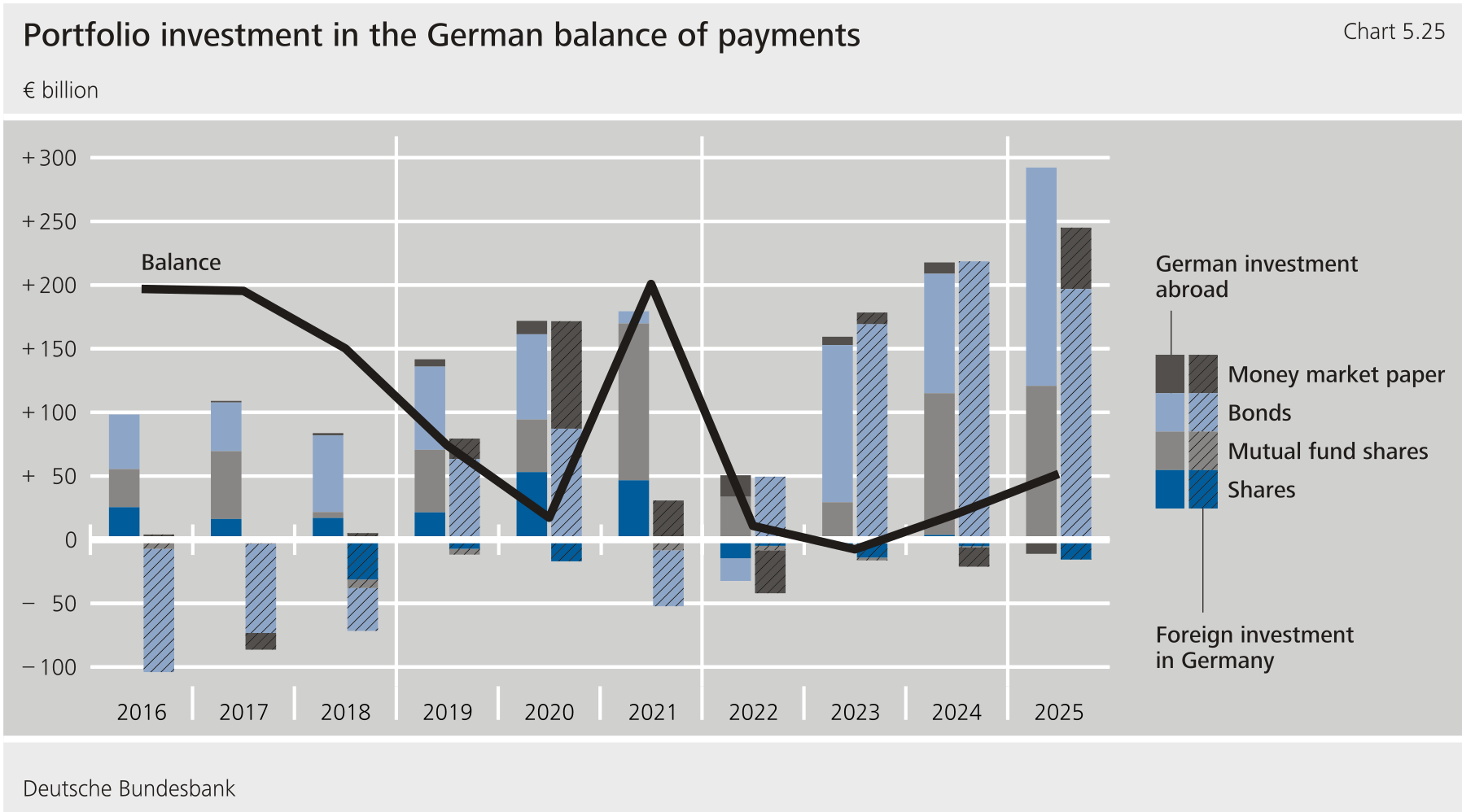**
****German investors acquired foreign securities worth €281 billion.** Of these, bonds alone accounted for €171½ billion, the majority of which were denominated in euro (€144½ billion). There was particular demand for bonds from France, Italy and Austria. However, domestic investors disposed of bonds, possibly out of concern about the independence of the central bank and the associated uncertainty about its monetary policy stance. One possible factor behind this might have been that the dollar depreciated by 11.6 % against the euro in the previous year. In view of increased geopolitical uncertainty, German investors also moved away bonds from other third countries, especially China, and shifted towards the euro area. They also purchased mutual fund shares (€120 billion). These offer retail investors, in particular, broader diversification compared with individual shares and thus reduce overall risk. In addition, German investors acquired a small volume of shares (€1 billion) while parting with shares. This could be due not only to uncertainty about the future economic policy stance in the United States but also to profit-taking. Technology shares, in particular, had seen strong value gains in the last few months of the year. In addition, German investors sold foreign money market paper (€11 billion). Liquidity shifts in favour of longer-term investments may have played a role here.**{#par-a4e79e}
****Foreign investors also significantly increased their holdings of German securities.** Transactions amounted to €229½ billion net, markedly higher than the previous year's figure of €197½ billion. The main focus was on bonds (€196 billion), predominantly from public issuers. While the Eurosystem accounted for a considerable share of demand up to the end of 2022, foreign investors increasingly added Bunds to their portfolios as of spring 2023 as monetary policy securities portfolios started to be reduced. This underscores the outstanding role of these securities as safe assets. In addition, the Federal Government issued additional debt securities in 2025 to cover increased financing needs in connection with the newly adopted off-budget special fund for infrastructure and defence. Supply in the capital market thus also increased. Non-residents also purchased German money market paper (€48 billion) in their search for a safe investment. Foreign investors added German mutual fund shares to their portfolios to a much smaller extent (€1 billion). By contrast, they parted with German shares (€15½ billion), reflecting increased risk aversion and a preference for safe investment.**{#par-u44779}
****Financial derivatives (which are aggregated to form a single item in the balance of payments) recorded net capital exports of a similar size to the previous year.**They amounted to €38½ billion, compared with €43 billion in the previous 12-month period. Options trades were the main factor contributing to the outflow of funds. They accounted for around three-quarters of the total balance of derivatives. Other derivatives transactions accounted for most of the remaining quarter. This included gas futures trading, which had at times recorded significant volumes following Russia's invasion of Ukraine in February 2022, but has now become somewhat less important.**{#par-u4a734}
### **3.4 Other investment** {#tar-14}
****Other investment recorded net capital exports of €160½ billion in 2025, roughly as high as in the previous year.** [\[23\]](#_ftn_root_23) The net claims of monetary financial institutions (excluding the Bundesbank) as well as enterprises and households rose, while general government and the Bundesbank recorded small net capital imports. Items in the other investment account are generally subject to strong fluctuations. This is particularly true of commercial banks' financial assets and liabilities. Their transactions are often accompanied by an extension or reduction in the balance sheet of individual institutions. That said, it is important to also keep an eye on their assets and liabilities; they can provide important information on the underlying payment flows and on possible changes in the financial infrastructure. Examples of this include the sharp increase in gross transactions following the United Kingdom's withdrawal from the European Union and the settlement of the Eurosystem's asset purchases via .[\[24\]](#_ftn_root_24)**{#par-ee1i37}
{#par-o3i352}
**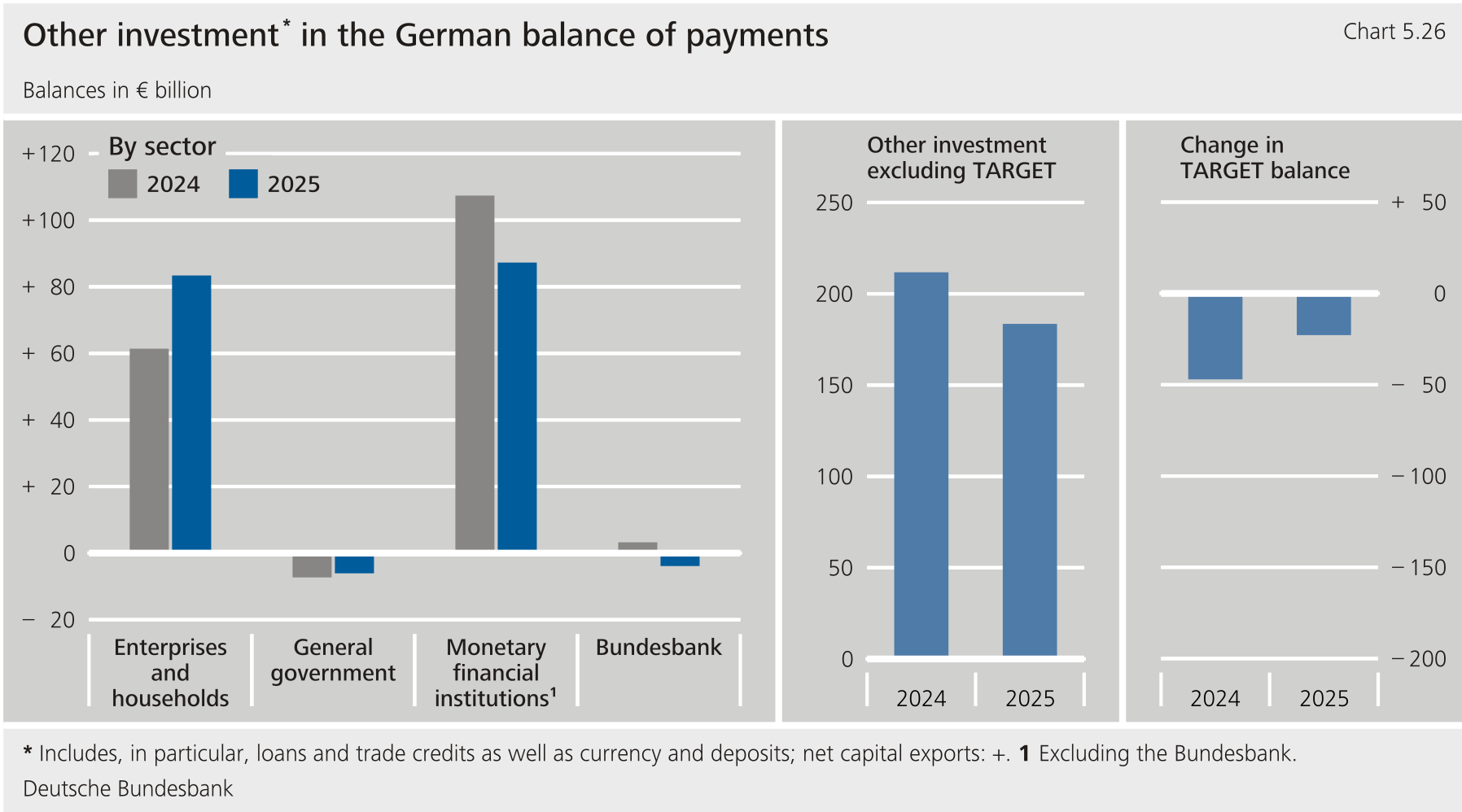**
****The net capital exports of monetary financial institutions (excluding the Bundesbank) to non-residents amounted to €87½ billion in 2025.** Claims on foreign institutions arising from currency and deposits rose particularly significantly. As in the previous year, claims on group-affiliated banks played a particular role here. Such arrangements are often based on business management decisions relating to liquidity management. Commercial banks' external claims also increased sharply as a result of financial loans being granted to enterprises and households. Conversely, foreign players increased their deposits with German institutions, consisting of deposits from banks abroad as well as enterprises and households domiciled abroad.**{#par-i72353}
****Bundesbank accounts recorded net capital exports of €4 billion last year.** The Bundesbank's financial assets and liabilities vis-à-vis non-residents fell by a similar magnitude in 2025. claims on the fell by €23 billion, which was less than in 2024 (€47 billion). The winding-down of monetary policy securities portfolios since spring 2023 has not reduced German claims as significantly as they had previously risen when the balance sheet was being built up under the asset purchase programmes.[\[25\]](#_ftn_root_25) One reason for this is a change in investor behaviour in the market for euro-denominated government bonds. In other euro area countries, domestic commercial banks often took the place of their national central banks, acquiring a large part of newly issued government bonds. Unlike with purchases by investors from third countries, which are often settled via Germany, no central bank liquidity flows out of Germany in this case. In addition, euro area investors purchased Bunds on a large scale and the Bundesbank received central bank money in return. Taken in isolation, this increased Germany's balance.**{#par-a354u5}
### **3.5 Reserve assets** {#tar-15}
****The Bundesbank's reserve assets rose by €1 billion in 2025 on account of transactions.** This was mainly due to purchases of foreign securities, which were mostly denominated in dollars. The international reserve holdings are also influenced by balance sheet adjustments which, in compliance with internationally agreed accounting standards, are not recorded in the balance of payments. The end-of-year revaluation of the reserve assets resulted in an increase of €117 billion in 2025. This reflected the year-on-year increase in the price of gold. On the reporting date of 31 December 2025, the value of Germany's reserve assets stood at €482 billion.**{#par-o8378a}
**List of references** {#tar-16}
--------------------------------
**Baur, A., L. Flach and S. Link (2025a), [Die deutsche Industrie im Strudel der -Handelspolitik: Wie blicken Unternehmen auf Trump 2.0?](https://www.ifo.de/publikationen/2025/aufsatz-zeitschrift/die-deutsche-industrie-im-strudel-der-us-handelspolitik), Schnelldienst Digital, Vol. 6(11), pp. 1--10.**{#par-u78153}
**Baur, A., L. Flach and I. Gourevich (2025b), [Global Europe 2.0 -- Ökonomische Potenziale einer neuen europäischen Freihandelsoffensive](https://www.ifo.de/publikationen/2025/monographie-autorenschaft/global-europe-20-oekonomische-potenziale-einer-neuen), study, November 2025.**{#par-oooeo8}
**Baur, A., L. Flach and L. Scheckenhofer (2025c), [Von Zolllücken und Zolleffekten: Trumps Handelspolitik 2.0 und ihre Folgen für die deutsche Wirtschaft](https://www.ifo.de/publikationen/2025/aufsatz-zeitschrift/von-zollluecken-und-zolleffekten), Schnelldienst, Vol. 78(6), pp. 4--11.**{#par-ue5975}
**Bernard, A., J. B. Jensen, S. J. Redding and P. K. Schott (2007), [Firms in International Trade, Journal of Economic Perspectives](https://doi.org/10.1257/jep.21.3.105), Vol. 21(3), pp. 105--130.**{#par-iaa353}
**Boddin, D., M. Köhler and P. Smietanka (2023), [Bundesbank Online Panel -- Firms (-F)](https://doi.org/10.12757/BBk.BOPF.2022Q2.01), Deutsche Bundesbank, Research Data and Service Centre, Data Report 2023--07.**{#par-u6u452}
**Brüggen, A., G. Georgiadis, and A. Mehl (2025), [Global trade invoicing patterns: new insights and the influence of geopolitics](https://www.ecb.europa.eu/press/other-publications/ire/article/html/ecb.ireart202506_02~a8e66f5ea3.en.html), in The international role of the euro (special feature), European Central Bank.**{#par-a2e65o}
**Deutsche Bundesbank (2025a), [What's behind the sustained decline in German export market shares?](https://publikationen.bundesbank.de/content/960442), Monthly Report, July 2025.**{#par-eao666}
**Deutsche Bundesbank (2025b), [Forecast for Germany: US tariffs initially weigh on economic growth; fiscal policy provides impetus with a delay](https://publikationen.bundesbank.de/content/958718), in Forecast for Germany: tariffs initially weigh on economic growth; fiscal policy provides impetus with a delay, Monthly Report, June 2025.**{#par-a358u9}
**Deutsche Bundesbank (2025c), [German balance of payments in 2024](https://publikationen.bundesbank.de/content/952336), Monthly Report, March 2025.**{#par-ai1787}
**Deutsche Bundesbank (2025d), [German balance of payments in 2024](https://publikationen.bundesbank.de/content/952336), Monthly Report, March 2025.**{#par-au14u8}
**Deutsche Bundesbank (2024), [German balance of payments in 2023](https://publikationen.bundesbank.de/content/926814), Monthly Report, March 2024.**{#par-o69225}
**Deutsche Bundesbank (2022), [German balance of payments in 2021](https://www.bundesbank.de/content/888904), Monthly Report, March 2022.**{#par-ii8321}
**Deutsche Bundesbank (2017), [TARGET2 balances - mirroring developments in financial markets](https://www.bundesbank.de/content/626824), Monthly Report, December 2017, pp. 75--76.**{#par-i89u45}
**(2026), [Recommendations to close the scaleup financing gap, deepen the Savings and Investments Union and strengthen Europe's competitiveness](https://www.bundesfinanzministerium.de/Content/DE/Downloads/Europa/abschlussbericht-five-taskforce.pdf?__blob=publicationFile&v=5), January 2026.**{#par-ai59oe}
**German Association of Energy and Water Industries (2025a), [Die Energieversorgung 2024 -- Jahresbericht](https://www.bdew.de/media/documents/Die_Energieversorgung_2025.pdf), 17 December 2025.**{#par-e4iu3i}
**German Association of Energy and Water Industries (2025b), [Erdgasdaten aktuell](https://www.bdew.de/media/documents/Erdgasdaten_aktuell_-_2026_01_08.pdf), updated on 8 January 2026.**{#par-e1e184}
**German Chamber of Commerce and Industry (2025), [Auslandsinvestitionen in der Industrie](https://www.dihk.de/resource/blob/129784/65374bd23a60b7d77aa8aa2276714490/international-auslandsinvestitionen-in-der-industrie-2025-data.pdf), business survey analysis.**{#par-eo4373}
**Hinz, J., A. Lohman, H. Mahlkow and A. Vorwig (2026), [America's Own Goal: Who Pays the Tariffs?](https://www.kielinstitut.de/publications/americas-own-goal-who-pays-the-tariffs-19398/) Kiel Policy Brief, 201**{#par-aie917}
**Kiel Institute for the World Economy (2025), [Kiel Trade and Tariffs Monitor](https://www.kielinstitut.de/de/themen/kiel-trade-and-tariffs-monitor/).**{#par-iau2aa}
**Research (2026), [Dashboard -Markt](https://www.kfw.de/PDF/Download-Center/Konzernthemen/Research/PDF-Dokumente-Dashboard/KfW-VC-Dashboard-Q4-2025.pdf), 2025.**{#par-au948e}
**Lagarde, C. (2025), [Turning openness into strength: the moment of the euro](https://www.ecb.europa.eu/press/key/date/2025/html/ecb.sp251007~4d6ccb7ddf.en.html), speech delivered on 7 October 2025 at the Business France event "Business en Européens".**{#par-oia941}
**Lehmann, R., M. Rose and M. Thum (2025), [Räumliche Auswirkungen der -Zollpolitik in Deutschland](https://www.ifo.de/publikationen/2025/aufsatz-zeitschrift/raeumliche-auswirkungen-der-us-zollpolitik-in-deutschland), Dresden berichtet, Vol. 32(6), pp. 38--40.**{#par-aiu8a6}
**Petersen, T., E. Höra, H. Mahlkow and J. Hinz (2025), [Wachstumseffekte von Freihandelsabkommen für Deutschland und die](https://www.bertelsmann-stiftung.de/de/publikationen/publikation/did/wachstumseffekte-von-freihandelsabkommen-fuer-deutschland-und-die-eu), Bertelsmann Stiftung, Nachhaltige Soziale Marktwirtschaft Focus Paper, No 30.**{#par-o9ei33}
**United Nations Conference on Trade and Development (2025), [Global Investment Trends Monitor](https://unctad.org/system/files/official-document/diaeiainf2026d1_en.pdf), January 2026.**{#par-oa91au}
1. **{#_ftn_root_1} Calculation differences between the current account balance (including capital transfers) and aggregate net lending/net borrowing may occur due to different statistical sources, calculation methods and revision dates.**
2. **{#_ftn_root_2} These are highly volatile and can heavily influence the bilateral foreign trade flows of the countries involved in the European production network.**
3. **{#_ftn_root_3} Germany mainly exports capital goods to the United States, including motor vehicles and motor vehicle parts as well as machinery. Electronics (computers, electronic and optical products), electrical engineering products (electrical equipment) as well as pharmaceutical and chemical products are also important.**
4. **{#_ftn_root_4} See Deutsche Bundesbank (2025c), supplementary information on China.**
5. **{#_ftn_root_5} In addition, exports from South and East Asian emerging market economies expanded considerably.**
6. **{#_ftn_root_6} One probable reason for this is that German coal-fired power plants increasingly used bituminous coal to generate electricity, especially when weather conditions were not ideal for producing wind power. See German Association of Energy and Water Industries (2025a).**
7. **{#_ftn_root_7} The rise in natural gas imports was mainly driven by Germany's growing importance as a gas transit country. Consumption also rose slightly, partly because there was a greater need for heating during the cold weather and because the use of natural gas in industry and in electricity production increased; see German Association of Energy and Water Industries (2025a).**
8. **{#_ftn_root_8} The percentage of total imports from Russia continued to decline fairly considerably. It had already fallen to very low levels in 2023 following sanctions in connection with the war in Ukraine, and no longer accounted for even 0.1 % of total German imports in 2025.**
9. **{#_ftn_root_9} Total imports of liquefied natural gas increased by more than half in 2025, with around 94 % originating from the United States. See German Association of Energy and Water Industries (2025b).**
10. **{#_ftn_root_10} Barring one exception during the -19 pandemic in 2020 and 2021, when trade in services recorded a small surplus. The main reason was the sharp decline in residents' expenditure on travel abroad, which usually contributes significantly to the large deficit.**
11. **{#_ftn_root_11} These include transport, manufacturing, maintenance and construction services, charges for the use of intellectual property, computer, telecommunications and information services and other business services.**
12. **{#_ftn_root_12} According to the European Organisation for the Safety of Air Navigation (Eurocontrol), the number of flights in Europe rose by 4 % in 2025 compared with the previous year.**
13. **{#_ftn_root_13} In other sub-accounts, especially financial and insurance services, net income barely changed.**
14. **{#_ftn_root_14} See United Nations Conference on Trade and Development (2025). Adjusted for double counting, which can result from the possible redirection of funds via financial corporations, the investment volume increased by 5 %. Using the same adjustment, global direct investment volumes had dropped in 2024.**
15. **{#_ftn_root_15} Source: Deutsche Börse via ARIVA.DE. The C- comprises all German shares listed on the Frankfurt Stock Exchange in the General Standard and Prime Standard market segments.**
16. **{#_ftn_root_16} See German Chamber of Commerce and Industry (2025).**
17. **{#_ftn_root_17} Regional balance of payments data for direct investment only take into account the first country border for cross-border activities. Stock data from the direct investment statistics render these holding structures transparent.**
18. **{#_ftn_root_18} See Deutsche Bundesbank (2025d).**
19. **{#_ftn_root_19} Realised takeovers of enterprises domiciled abroad -- with German shareholdings of at least 10 % after the transaction -- accounted for around €63½ billion in 2025, which was €8½ billion more than in 2024 (data based on Orbis , data retrieved on 10 February 2026). However, the figures shown here are not comparable to the values in the balance of payments statistics. For example, statistics also list purchases made by a foreign enterprise that was previously owned by a German investor. It also indicates the total value of an agreement, but foreign investors are often involved alongside German investors. Finally, the timing of corporate takeovers in the balance of payments may differ from the Orbis classification.**
20. **{#_ftn_root_20} Realised takeovers of German enterprises by foreign investors -- with foreign shareholdings of at least 10 % after the transaction -- accounted for around €58 billion in 2025, which was three times as much as in 2024 (€19½ billion; data based on Orbis , data retrieved on 10 February 2026).**
21. **{#_ftn_root_21} See Research (2026).**
22. **{#_ftn_root_22} See (2026).**
23. **{#_ftn_root_23} The other investment account comprises loans and trade credits (where these do not constitute direct investment) as well as bank deposits and other investment.**
24. **{#_ftn_root_24} See Deutsche Bundesbank (2022, 2017).**
25. **{#_ftn_root_25} See Deutsche Bundesbank (2024, 2017).**
*[TARGET]: Trans-European Automated Real-time Gross Settlement Express Transfer System
*[Q4]: fourth quarter
*[MiDi]: Microdatabase Direct investment
*[HS]: Harmonized Commodity Description and Coding System
*[**VC**]: venture capital
*[COVID]: coronavirus disease
*[GDP]: gross domestic product
*[FIVE]: Financing Innovative Ventures in Europe
*[OLS]: ordinary least squares
*[OPEC]: Organization of the Petroleum Exporting Countries
*[UNCTAD]: United Nations Trade and Development
*[US]: United States
*[CEPII]: Centre d’études prospectives et d'informations internationales
*[**FDI**]: foreign direct investment
*[BOP]: Bundesbank Online Panel
*[Fed]: Federal Reserve System
*[ECB]: European Central Bank
*[**MiDi**]: Microdatabase Direct investment
*[AG]: Aktiengesellschaft
*[DIHK]: Deutsche Industrie- und Handelskammer
*[IT]: information technology
*[**EU**]: European Union
*[VC]: venture capital
*[M\&A]: mergers and acquisitions
*[EU ETS]: European Union Emissions Trading System
*[EU]: European Union
*[**OPEC**]: Organization of the Petroleum Exporting Countries
*[ifo]: economic research institution
*[**M\&A**]: mergers and acquisitions
*[**IT**]: information technology
*[DAX]: Deutscher Aktienindex
*[**US**]: United States
*[KfW]: Kreditanstalt für Wiederaufbau
*[SIU]: savings and investments union