Simplification without deregulation: approaches to reforming European banking regulation Monthly Report – October 2026
Published on
Simplification without deregulation: approaches to reforming European banking regulation Monthly Report – October 2026
Monthly Report Published on
European banking regulation needs to be simplified in a targeted manner without jeopardising the stability of the banking system. The tightening of own funds and liquidity requirements in response to the global financial crisis, improved supervision and the European resolution framework have significantly strengthened the resilience of the banking sector. However, the proportionality, complexity and consistency of the regulatory framework are areas in which reforms are necessary.
Smaller and less complex institutions, in particular, are regulated and supervised out of proportion to their size and risk. The existing relief for these institutions is not sufficient to systematically reduce this burden. An independent European small banks regime with clear and simple eligibility requirements would improve proportionality. The lower risk sensitivity of simplified requirements should be offset by higher own funds requirements across the board.
The way in which own funds and resolution requirements are set out and interact also needs to be reformed. The overlapping coexistence of risk-weighted and unweighted requirements, various capital instruments, capital buffers and resolution requirements makes capital planning more difficult for institutions and reduces transparency for market participants and supervisory authorities. Moreover, this complexity can lead to undesirable interactions during periods of stress. In particular, the limited usability of macroprudential capital buffers can impair macroprudential capacity to act.
The European reform agenda ought to pursue three priorities: it should reduce administrative burdens across the board, ensure greater proportionality through an explicit and coherent regime for smaller institutions, and adjust own funds and resolution requirements to avoid overlaps in requirements and improve the usability of macroprudential capital buffers. Stronger integration of the European banking market can complement this agenda, but it requires a gradual approach and robust safeguards to protect financial stability. Simplification without deregulation means reducing complexity and improving the effectiveness of regulation without making any compromises in terms of the stability of the banking system.
1 Introduction
Simplifying banking regulation has become a major element of the European reform debate. The issue is how regulation can support Europe’s competitiveness and banks’ 1 role in financing the economy. A key contribution to this debate came from Mario Draghi’s September 2024 report on the future of European competitiveness. It highlights Europe’s high investment needs and the central role of a stable and efficient banking sector. Banks remain essential to the financing of European businesses, especially small and medium-sized enterprises. At the beginning of 2025, several European central bank governors, including the Bundesbank President, called in a joint letter to EU Commissioner Maria Luís Albuquerque for a comprehensive review and simplification of the European regulatory framework for banks. 2
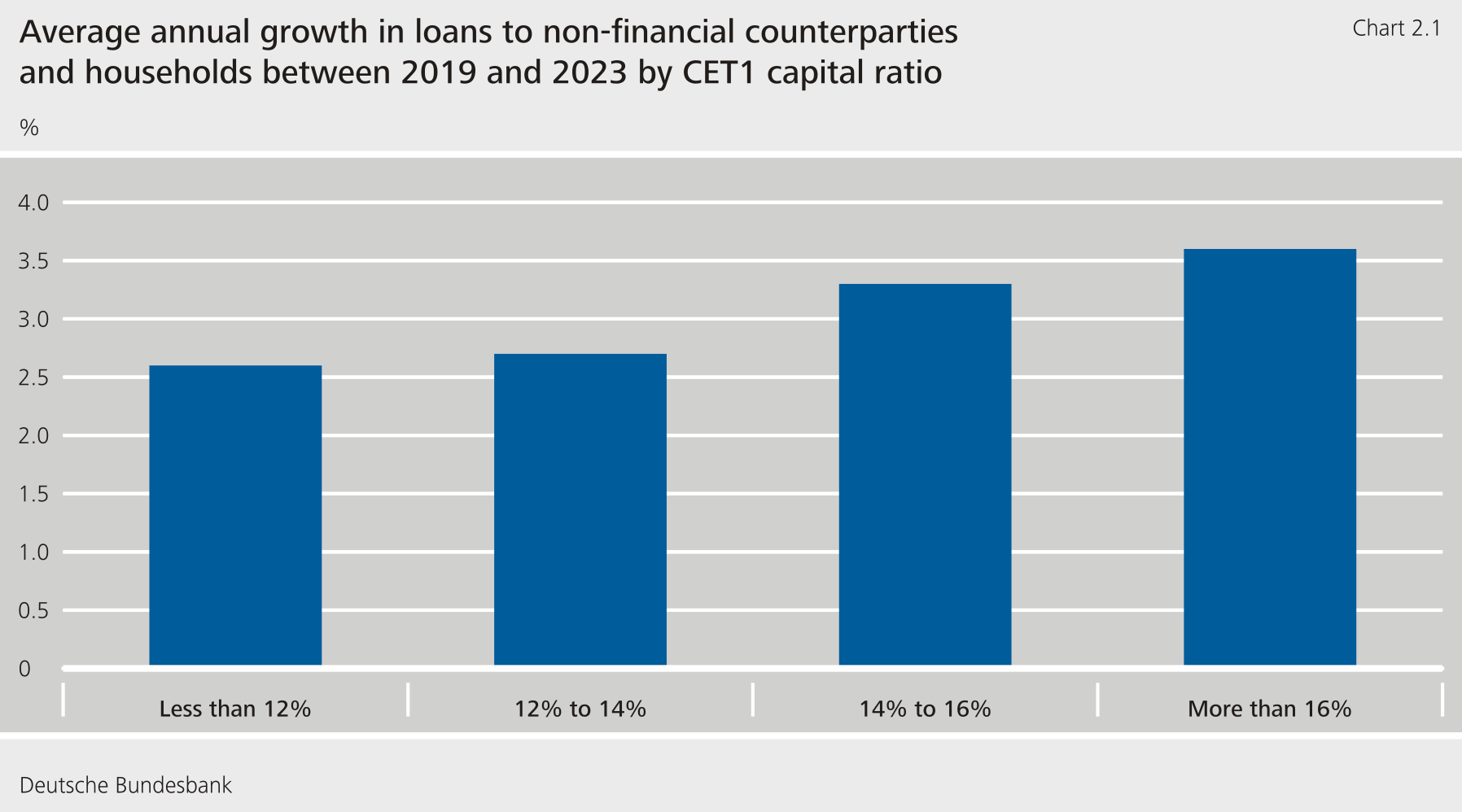
However, simplifying the framework in this way must not call into question the lessons learned from the global financial crisis of 2007‑08. One key lesson from the global financial crisis was that the soundness of individual institutions alone is not enough to ensure the stability of the financial system. Regulation must therefore take into account not only institution-specific risks but also system-wide risks and their interactions. This insight gave rise to the macroprudential perspective, which has been implemented, among other ways, through macroprudential capital buffers. The economic rationale is straightforward: financial crises generate substantial and long-lasting fiscal, economic and social costs that can be avoided or significantly reduced through a well-capitalised banking system (see Basel Committee on Banking Supervision (2011) and Jorda et al. (2021)). The tougher requirements introduced since the financial crisis have helped the European banking sector remain resilient in more recent periods of stress (see Basel Committee on Banking Supervision (2022a)) and continue reliably supplying credit to the real economy. German institutions’ outstanding loans to non-financial counterparties and households rose more strongly for institutions with higher Common Equity Tier 1 (CET1) capital ratios prior to the onset of the COVID‑19 pandemic and the crises that followed (i.e. in the final quarter of 2019) than for those that were less well capitalised (see Chart 2.1). Equity is evidently not a counterparty to lending, but rather an important foundation for it. 3
At the same time, the European regulatory, supervisory and reporting framework has become increasingly complex. International standards, European and national specificities, macroprudential requirements, resolution requirements and reporting obligations have created a rulebook that is sometimes difficult to understand and even inconsistent in some respects. This complexity ties up resources at institutions and supervisory authorities without necessarily making the banking system more stable.
Against this backdrop, the Bundesbank emphasised early on that simplification is necessary but must not be equated with deregulation. The aim should be to make regulation more effective, risk-oriented, transparent and proportionate without lowering the level of resilience achieved to date. This is particularly relevant where requirements impose high fixed costs relative to the size of smaller and less complex institutions, or where the interaction between different requirements undermines the requirements’ effectiveness. To this end, the Bundesbank and Bafin have developed specific proposals for setting up a European small banks regime and restructuring own funds requirements. They are aimed at simpler and more consistent regulation while maintaining a high level of resilience.
The European reform debate has gained considerable momentum since 2025. In 2025, the ECB Governing Council established a High-Level Task Force on Simplification (HLTF), with senior-level involvement from the Bundesbank, to develop proposals for simplifying the European regulatory, supervisory and reporting framework. Its final report, published in December 2025, identifies simplified own funds requirements, greater proportionality, reduced reporting burdens, fewer duplicative structures and clearer and harmonised supervisory practices as key areas of action. 4
The European Commission’s latest communication on the competitiveness of the EU banking sector gives greater substance to the debate that is now underway. 5 It builds on the Draghi report and the HLTF report, and at the same time marks the starting point for the legislative process planned for next year.Among other things, it focuses on fragmentation within the Single Market, taking into account European specificities in international standards and reducing unnecessary regulatory complexity.
This article puts these developments in context. It examines the principles that should guide the simplification agenda and how regulation can be simplified without lowering the level of resilience achieved to date. The focus is on greater proportionality for smaller and less complex institutions and on restructuring the capital framework for banks. Particular emphasis is placed on the usability of macroprudential capital buffers. The article goes on to consider the next steps in the European process. A concluding supplementary information text presents the Ninth Amendment to the Minimium Requirements for Risk Management (MaRisk) as a national example of regulatory simplification.
2 Simplification without deregulation
Since the global financial crisis, the banking sector has been subject to much more comprehensive regulation. The reforms have markedly increased the resilience of the banking system. As a result, the banking sectors in the EU and Germany have coped well with periods of stress in the recent past. Banks now hold more and higher-quality own funds, face stricter limits on liquidity risk and are subject to a resolution framework that provides instruments to resolve or stabilise larger institutions in an orderly manner without relying on public funds.
At the same time, the regulatory framework has become highly complex. Banks have to comply with a wide range of requirements, some of which serve similar purposes. These include various own funds and liquidity requirements, requirements for risk management, reporting and disclosure obligations, as well as provisions on anti-money laundering, consumer protection, operational resilience and IT security. This ties up substantial resources and creates a significant administrative burden for banks and supervisory authorities. Smaller institutions are especially affected by the increased complexity, as the cost of complying with the requirements is disproportionately high for them.
Regulation must be simplified without lowering the resilience of the banking sector. Reform initiatives must not weaken the banking system or result in across-the-board reductions in requirements. This would be counterproductive, especially as the empirical literature overwhelmingly shows that own funds requirements do not negatively affect banks’ profitability or competitiveness (see, for example, Behn and Reghezza (2025) and Buchholz et al. (2025)). Instead, regulation should be designed to achieve its objectives more easily, transparently and effectively. Such “simplification without deregulation” is of central importance. A resilient banking system ensures a reliable supply of credit to the real economy, even during periods of stress, thereby strengthening Europe’s competitiveness.
2.1 Strengthening proportionality
A diverse banking sector strengthens the resilience of European financial markets. Empirical research shows that greater institutional diversity in the banking sector is associated with greater stability at the bank level, particularly during periods of crisis. A diverse banking landscape can better smooth out fluctuations in earnings (see Baum et al. (2020)). Recent studies indicate that different business models in the banking sector contribute to systemic risk to varying degrees and are affected to varying degrees during periods of stress (see Ayadi et al. (2025)). A diversified banking sector comprising various business models and institution sizes thus makes an important contribution to reducing systemic risk and strengthening financial stability.
Smaller banks are essential for regional lending and for competition in the banking sector. While Europe undoubtedly needs large banks to compete in international markets and provide services to businesses and households worldwide, smaller regional banks also play a key role in the economy. They help ensure broad access to financial services, including in structurally weak regions, and expand the supply of credit.
Studies show, however, that smaller banks face disproportionately high compliance costs when meeting regulatory requirements (see Poshakwale et al. (2020) and Dia and VanHoose (2018)). The ever-growing scope and increasing complexity of the regulatory framework are exacerbating this problem. A disproportionate regulatory burden can hinder market entry and innovation and encourage market concentration. At the same time, supervisory authorities benefit from economies of scale, making the supervision of smaller institutions more costly than that of larger banks (see Eisenbach et al. (2022)). To address these challenges, the principle of proportionality is key in financial regulation and supervision.
The principle of proportionality is a central approach to global financial regulation and supervision. It aims to safeguard banks’ financial stability and resilience, ensure a balanced cost-benefit ratio of compliance burdens, promote market entry, competition and innovation, and ensure the efficient use of scarce resources in supervision (see Basel Committee on Banking Supervision and World Bank (2021)). Despite having a common objective, different jurisdictions vary significantly in how they apply this principle (see Beissinger et al. (2026)). In the United States, the Basel framework is applied primarily to large and internationally active banks, while the EU implements the Basel standards for all banks in a single set of rules, referred to as the EU Single Rule Book. In Germany, the principle of dual proportionality has proved effective in the area of risk management requirements: regulatory obligations and supervisory practices vary depending on banks’ size, complexity and risk profile. Smaller and less complex institutions are subject to less extensive and complex requirements than large and internationally active banks (see Basel Committee on Banking Supervision (2022)). At the same time, banks need to manage their risks appropriately, taking into account their size, complexity and risk profile.
The European regulatory framework already provides simplifications for smaller banks in the form of various exemptions. The principle of proportionality is reflected in the European regulatory framework through simplified rules for small and non-complex institutions (SNCIs). However, these simplifications are often insufficient, do not form a coherent system and are spread across different areas of regulation. This results in a limited and fragmented system of simplifications and exemptions. The European Commission’s latest communication on the competitiveness of the banking sector identifies this disproportionate burden on smaller institutions as a key area of concern. Unlike its approach to cross-border banking groups, however, the Commission has not specified exactly what relief will be provided for smaller and less complex institutions. As a result, the European framework remains disproportionately complex for smaller banks. Other countries, such as Switzerland, the United Kingdom and the United States, have introduced dedicated regulatory frameworks for smaller banks, with requirements that differ significantly in some respects from the requirements for large and internationally active banks. These frameworks provide significant simplifications without compromising the conservative orientation of regulation or banks’ resilience.
The Bundesbank and Bafin are advocating for a dedicated regulatory framework for smaller banks. Both institutions support simplifying the framework in a consistent, comprehensive and targeted manner. A standalone framework that goes beyond the existing framework for SNCIs would achieve this and could strengthen the productivity of these institutions by enabling them to devote more of their resources to their core business. By contrast, in its opinion on the European Commission’s consultation, the ECB Governing Council underlines the importance of market integration and economies of scale for competitiveness. A dedicated small banks regime is not at odds with this perspective but rather complements it by taking into account the needs of smaller and less complex institutions.
The aim of the German supervisory authorities is to establish a proportionate framework for smaller banks that reduces the bureaucratic burden on institutions and supervisory authorities without diminishing resilience or financial stability or creating competitive distortions. Smaller banks that meet the eligibility requirements (namely classification as an SNCI pursuant to Article 4(1) point 145 of the CRR) could transition to a separate regulatory regime. This regime would contain significantly simpler and less detailed requirements. For example, granular risk-based own funds requirements could be replaced with a uniformly higher leverage ratio requirement for institutions, or European guidelines could, by default, not apply directly but instead be implemented in a manner specifically tailored to these institutions. Further simplifications could include the option of replacing the structural liquidity ratio with a significantly easier-to-calculate loan-to-deposit ratio requirement or specifically adapting remuneration requirements for smaller institutions. The loss of granularity and risk sensitivity should be offset by uniformly higher own funds requirements. A simple framework for macroprudential capital buffers should also be retained, as the failure of many small banks – the “too many to fail” problem – could have significant implications for financial stability (see Acharya and Yorulmazer (2007)). The principle of proportionality is primarily intended to reduce the administrative compliance burden on institutions. It is crucial to calibrate this regime carefully, particularly the threshold for eligibility and the higher own funds requirements, so as to avoid competitive distortions and adverse incentives. In addition, participation in such a regime would have to be voluntary, and both institutions and supervisory authorities (for example, in the case of higher-risk institutions) would need to be able to object to participation in an EU small banks regime. The German supervisory authority has developed a concept based on these principles. The concept has been presented at both the national and European levels to various legislative bodies and supervisory authorities as well as associations, institutions and NGOs.
A proportionate regulatory framework strengthens diversity and resilience in the European banking sector. It is crucial that measures to implement the principle of proportionality significantly reduce the compliance burden on smaller institutions without amounting to deregulation. A principles-based and more proportionate regulatory framework for smaller institutions is needed to preserve diversity in the banking sector and facilitate market entry, thereby promoting competition and innovation. At the same time, such a framework would enable supervisory authorities to conduct more risk-based supervision and use their resources more efficiently. The discussions and initiatives taking place in European institutions and bodies show that the importance of a proportionate regulatory framework has been recognised. The European Commission’s legislative proposals for the review of European banking regulation, announced for the first quarter of 2027, are expected to provide a concrete solution.
2.2 Simplifying the capital framework
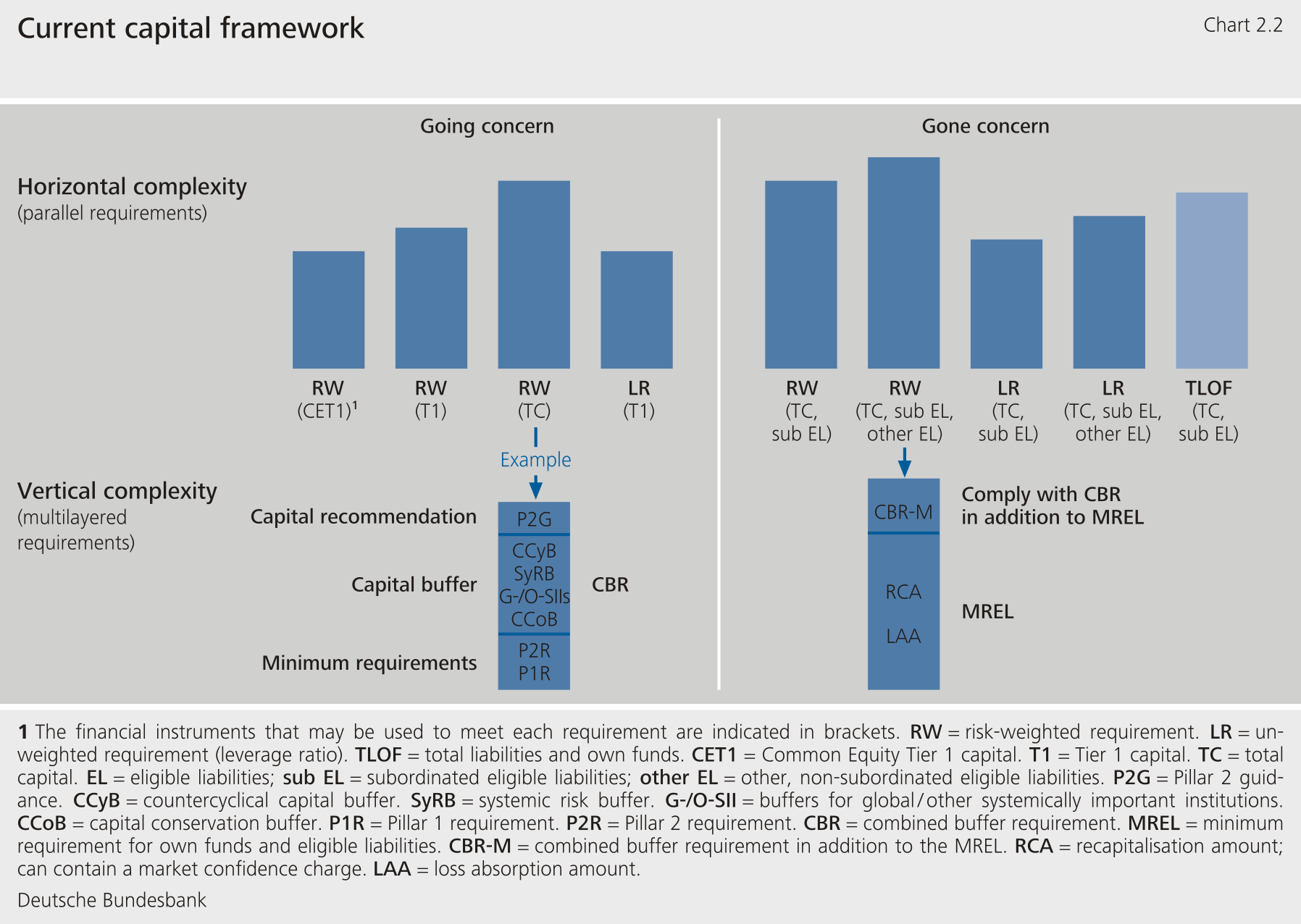
Simplifying the capital framework is another key focus of the Bundesbank’s work. The capital framework defines the composition of own funds requirements and the level at which they must be met. It comprises microprudential and macroprudential provisions as well as rules governing the resolution of distressed banks. The capital framework pursues several objectives. It protects the solvency of individual banks, limits systemic risk, mitigates procyclicality in periods of stress and ensures that funds are available for loss absorption and recapitalisation in a resolution event. A capital framework is inherently multidimensional, as it must take into account various risks and regulatory objectives. At the same time, this multidimensionality has led in practice to the creation of a complex system characterised by high degree of horizontal and vertical complexity, which can limit supervisory and macroprudential capacity to act (see Chart 2.2).
Horizontal complexity arises from the fact that banks have to meet multiple parallel regulatory requirements. First, own funds requirements for ordinary business operations (going concerns) must be met. In addition, institutions for which resolution is envisaged under their resolution plan 6 are subject to additional loss absorption and recapitalisation requirements (gone concerns). These requirements are intended to ensure that, in the event of resolution, an institution’s shareholders and creditors bear losses and that the institution can subsequently be recapitalised without jeopardising financial stability or drawing on public funds. Second, the requirements are defined both relative to their risk-weighted assets (RWAs) and in unweighted terms in the form of the leverage ratio. The unweighted requirements are intended to prevent risks from being undercounted owing to very low risk weights. Third, the risk-weighted and unweighted capital ratios contain, in some cases, different capital components.
Vertical complexity results from the fact that these requirements sometimes consist of multiple layers. The going concern risk-weighted requirements consist of minimum requirements (P1R and P2R), multiple capital buffers (CBR) and institution-specific own funds recommendations (Pillar 2 guidance (P2G)). These elements differ in terms of their objectives, calibration, competent authority and the consequences of failing to meet them. The resolution framework likewise contains multiple layers. It comprises requirements for loss absorption, recapitalisation and restoration of market confidence. In some cases, own funds components can be counted twice in both the capital framework and the resolution framework. This leads to overlaps between going concern and gone concern requirements.
The complexity of the capital framework can reduce its transparency and effectiveness. The large number of parallel requirements makes the framework confusing and difficult to apply. For banks and supervisors, this complexity leads to increased administrative burdens, especially in institutions’ capital planning. Other market participants or observers often find it difficult to identify the relevant and binding requirements. In addition, there may be unwanted interactions between the various requirements. During periods of stress, there is a risk that certain requirements may not fully achieve their intended effect. This could impair the overall effectiveness of the capital framework and destabilise the financial system.
A key example of this is the limited usability of macroprudential capital buffers. Capital buffers are intended to enable banks to absorb losses during periods of stress without excessive constraints on lending. However, if the same capital is counted towards meeting capital buffers and parallel minimum requirements, such as the leverage ratio or resolution framework requirements, banks can use their buffers only to a limited extent to absorb losses without breaching other minimum requirements (see European Systemic Risk Board (2021), Basel Committee on Banking Supervision (2022) and European Banking Authority (2024)). In such cases, banks may be forced to shrink their balance sheets to comply with regulatory requirements instead of maintaining lending. At the systemic level, this constraint can result in capital buffers no longer fulfilling their function: instead of cushioning shocks, the banking system could amplify them in a procyclical manner. In periods of stress, this could considerably undermine the stability of the financial system.
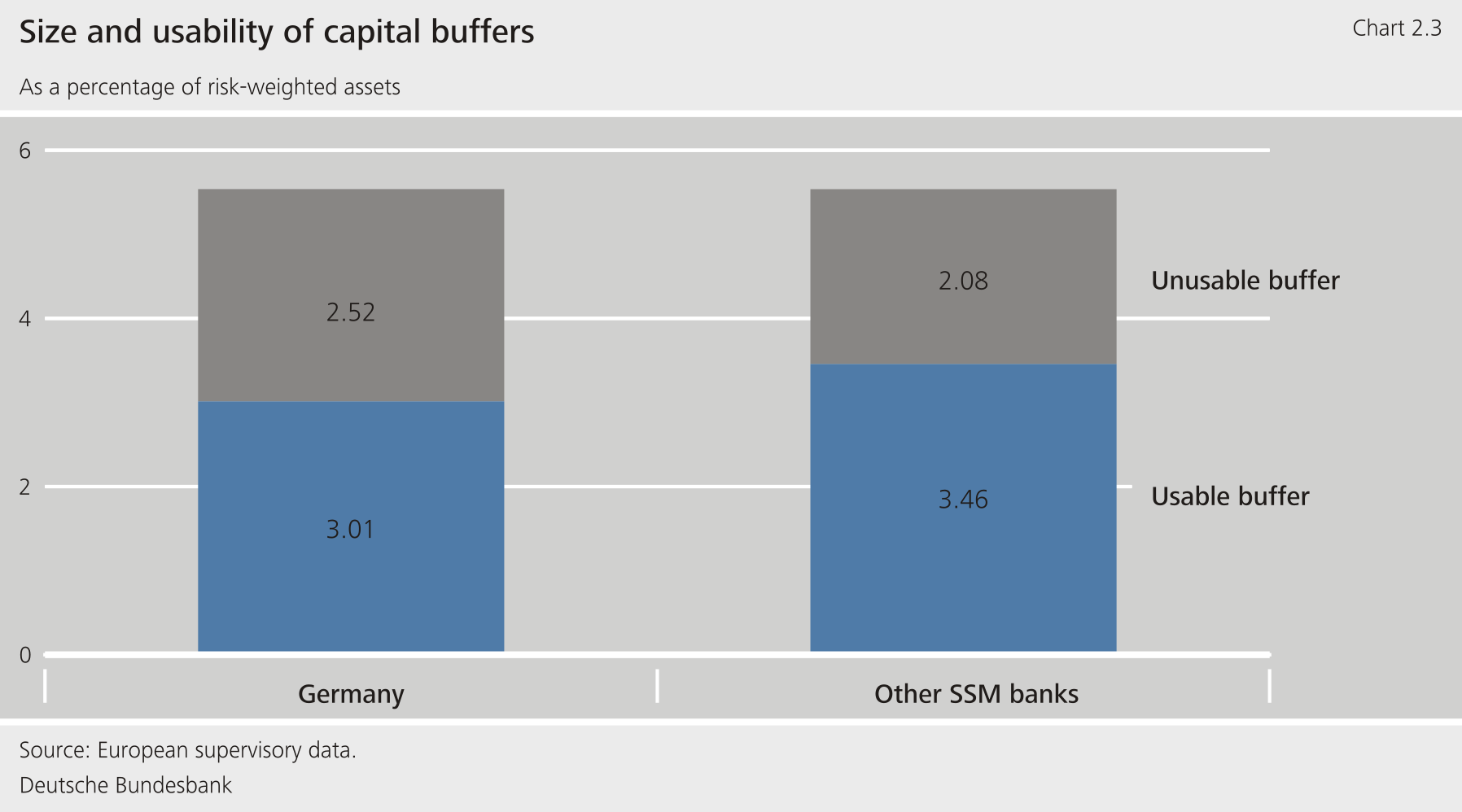
The limited usability of capital buffers affects large banks, in particular. Only slightly over one-half of the buffers available to German institutions under SSM supervision can be used effectively. Effective use means that these buffers can be used without overlapping with other requirements (see Chart 2.3). For SSM banks in other countries, the usable share is only slightly higher. Buffer usability is restricted to varying degrees. While some banks are able to use their buffers (almost) fully, others have next to no effectively usable buffers – despite complying fully with regulatory requirements.
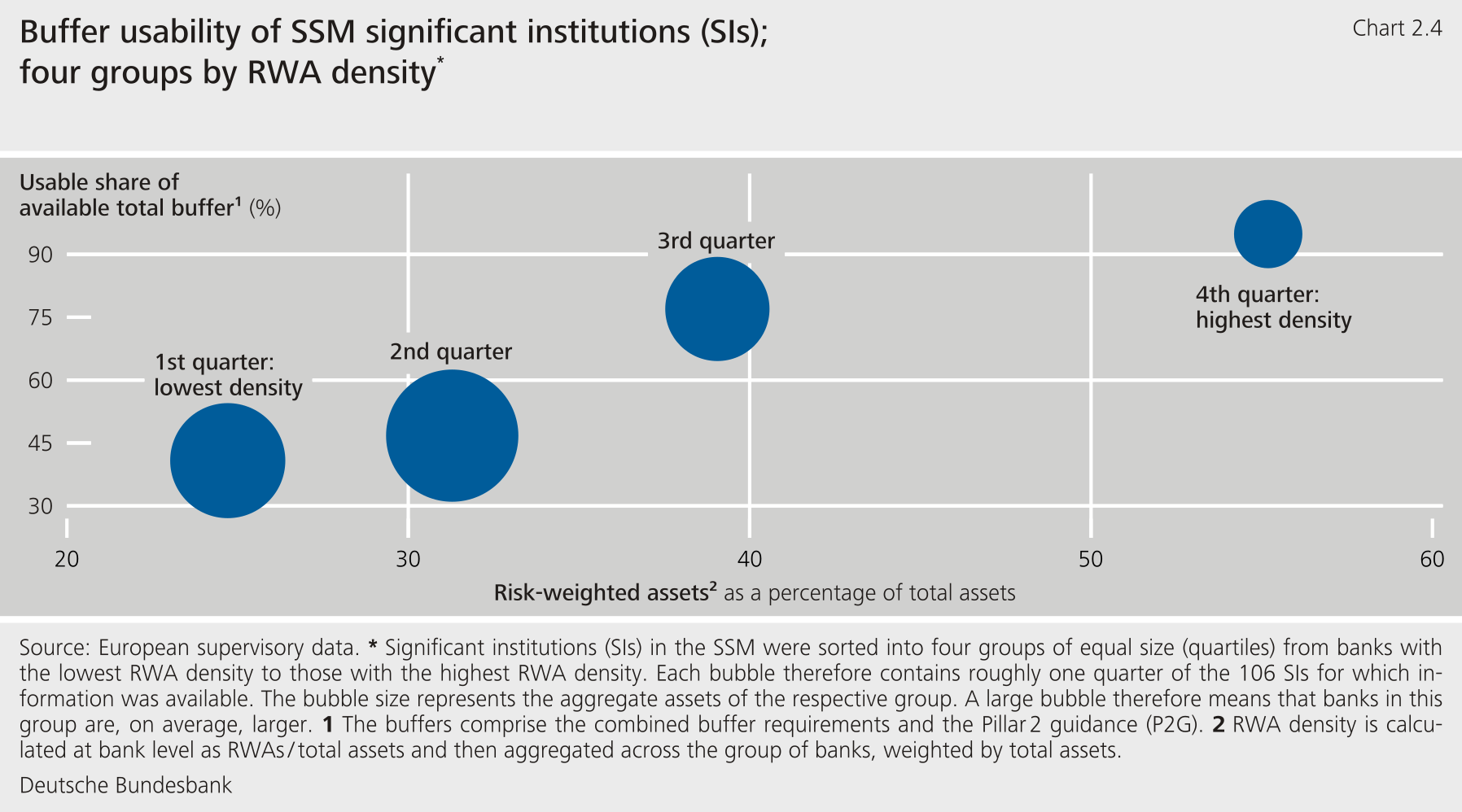
Low risk density is a key factor in the limited usability of macroprudential capital buffers. Capital buffers are currently defined predominantly within the risk-weighted framework. If a bank’s RWAs are low relative to unweighted total assets, they have a low risk density. This increases the likelihood that the absolute minimum own funds requirements from the leverage ratio or the resolution framework become binding before the risk-weighted capital buffers are fully utilised – the usability of the capital buffers is limited because of the bank’s low level of capitalisation. Chart 2.4 illustrates the relationship between risk density and buffer usability for European significant institutions (SIs). Banks with low risk densities also tend to have lower buffer usability.
One fundamental solution would be to limit the double counting of own funds for buffers and minimum requirements. Own funds used to meet buffer requirements should not be counted simultaneously towards meeting unweighted minimum capital or resolution requirements. Resolution requirements, such as the minimum requirement for own funds and eligible liabilities (MREL), could be established separately from own funds requirements for going concerns. Common Equity Tier 1 (CET1) capital not already being used to meet buffer requirements, as well as Additional Tier 1 (AT1) capital, Tier 2 capital (T2) and eligible – preferably subordinated – liabilities would be available for this purpose. In a going concern framework, however, the focus would primarily be on CET1 capital. This clear separation would simplify the capital framework and more clearly define the functions of the individual components. CET1 capital would primarily be used to absorb losses on a going concern basis, while MREL would ensure loss absorption and recapitalisation in a resolution event. This would prevent the use of capital buffers from conflicting with compliance with other requirements. At the same time, the horizontal complexity of the capital framework would be significantly reduced.
Translating the risk-weighted capital buffers into the leverage ratio framework would also increase the usability of the buffers. One possible solution would be to systematically convert risk-weighted buffer requirements into an unweighted buffer requirement that complements the leverage ratio. This could be done using a fixed conversion factor, as is already the case for the leverage ratio buffer for global systemically important institutions (G-SIIs). Banks whose risk-weighted buffers are blocked by the minimum requirement for the leverage ratio could thus obtain a usable buffer based on the leverage ratio. The leverage ratio has so far performed a backstop function for risk-weighted minimum requirements. With this modification, it would also assume this role for risk-weighted buffers.
Even without the fundamental reform described above, the full implementation of the output floor would at least improve the usability of the buffers. The output floor limits the extent to which banks can reduce their RWAs using internal models compared with the standardised approach. This increases affected institutions’ RWAs and risk density. In addition to the primary intended effect of limiting excessive benefits from own funds and differences arising from model variations, this also means that unweighted minimum requirements would be less likely to constrain the use of risk-weighted capital buffers. In the EU, the output floor will be phased in up until 2030. Transitional arrangements for certain components will apply until the end of 2032. Full implementation of the output floor is crucial to ensure that its positive impact on the usability of the buffers can be fully realised.
Macroprudential buffer requirements could also be made simpler and clearer by consolidating their components. The countercyclical capital buffer (CCyB) and the (sectoral) systemic risk buffer (SyRB) could be merged into a single releasable buffer. This buffer would be built up at an early stage and would be available for release during periods of stress in order to preserve macroprudential capacity to act (see Deutsche Bundesbank (2024)). Releasing the buffer would provide banks with additional capacity for loss absorption and lending. Targeted sectoral applicability should also be retained in the new instrument. Its calibration could be harmonised more extensively across the EU, provided that national differences in the financial and business cycles allow for this. This simplification would reduce vertical complexity, make the buffer architecture more transparent and tractable, and simplify reciprocity provisions. However, this measure alone is insufficient to eliminate overlap with other own funds requirements and would thus not resolve the limitations on buffer usability.
3 Outlook for the European process
In its Communication of 17 July 2026, the European Commission launched a process to further develop the European regulatory framework for banking, which is expected to culminate in concrete legislative proposals in the first quarter of 2027. The “Communication on the Competitiveness of the Banking Sector and the Single Market in Banking” addresses key issues of recent years. These issues were highlighted in the Draghi report, in the work of the ECBHLTF and in the European Commission’s consultation. The European Commission identifies three key challenges: the fragmentation of the European banking market, the transposition of international standards taking into account European specificities, and the undue complexity of the regulatory framework and the attendant administrative burden on banks and supervisory authorities.
The European Commission’s initiative fundamentally makes sense. It covers key issues such as simplification and competitiveness without comprehensive deregulation. The aim should be to make the existing rules more effective, proportionate and tractable without weakening the resilience of the European banking sector. In particular, there is considerable potential for simplification regarding proportionality, the complexity of own funds requirements and the reduction of needless administrative burdens.
Under the current framework, the administrative burden on smaller and less complex institutions is particularly high. An independent European regime for small banks could go beyond the relief currently available to SNCIs. It could align regulatory requirements more closely with institutions’ size, business model and risk profile. However, any potential loss of risk sensitivity in the requirements for these banks should always be offset by more conservative own funds requirements.
With regard to capital and resolution requirements, the framework could be simplified, especially to improve the usability of macroprudential capital buffers. The European Commission addresses this issue in its communication, yet has remained vague on the announced measures. Better usability of existing macroprudential buffers and a clearer structure of capital and resolution requirements could enhance the effectiveness of the macroprudential framework (see European Central Bank and European Systemic Risk Board (2026) and European Banking Authority (2026)). At the same time, the loss-absorbing capacity and resilience of the banking sector must be preserved.
Greater integration of European banking markets requires a coordinated and iterative approach. The European Commission has announced, among other things, relief for cross-border capital and liquidity flows and a new proposal for a European deposit insurance scheme (EDIS). Greater integration could, in principle, improve efficiency and risk sharing in the European banking sector. In this context, financial stability, the actual availability of capital and liquidity in a crisis, as well as depositor protection and national safety nets all need to be ensured. In addition, the ESM Treaty should be ratified as a common backstop for the Single Resolution Fund (SRF) and the sovereign-bank nexus needs to be curbed effectively (see Deutsche Bundesbank (2026b)) in order to further strengthen the banking union. At the same time, the functioning of additional voluntary deposit guarantee schemes and institutional protection schemes must be preserved.
The primary barriers to cross-border banking do not stem from prudential regulation. Differences in national legislation, such as in laws governing insolvency and consumer protection, can also make cross-border business models more difficult. These aspects should therefore be taken into account in further integration efforts. The European Commission is right to address this issue and is also addressing non-prudential obstacles.
The European Commission has announced that it will present concrete legislative proposals in the first quarter of 2027 and complete the process by the end of 2027 under the “One Europe, One Market” Roadmap. The timetable is ambitious given the breadth and complexity of the proposed changes. The announced legislation offers an opportunity to simplify European banking regulation structurally and to address existing vulnerabilities. In particular, the momentum behind the process should be harnessed to make substantial progress on proportionality, simplification and the improved usability of macroprudential capital buffers.
Supplementary information
The Ninth Amendment to the Minimum Requirements for Risk Management (MaRisk) to simplify the regulatory framework
The purpose of the Ninth Amendment to MaRisk published by the Bundesbank and Bafin is to simplify these requirements from the ground up and highlight their principles-oriented nature. To this end, the circular, which will only be addressed to LSIs in future, has been comprehensively revised to strengthen the principle of proportionality and reduce regulatory complexity. Instead of detailed individual requirements, the amended MaRisk features streamlined regulatory text and clearly formulated principles. This gives institutions greater leeway in designing their risk management and allows them to adapt requirements more closely to their particular business model, size, complexity and risk situation.
This approach strengthens institutions’ self-responsibility. Supervisory practice is increasingly shifting away from detailed prescriptions; the appropriateness and effectiveness of institution-specific risk management are now the primary focus. What remains crucial is that institutions implement the principles formulated in MaRisk in a demonstrable manner and appropriately identify, manage and monitor their risks.
The Ninth Amendment to MaRisk is not intended to be viewed as deregulation. The fundamental standards for effective risk management remain in place; the primary change is that the path to fulfilling them has been made more flexible. Institutions must therefore continue, especially during on-site inspections, to be able to demonstrate that their tailored solutions meet prudential requirements and thus ensure appropriate risk management.
Overall, the amended MaRisk helps simplify the regulatory framework and strengthen the principle of proportionality. This benefits, in particular, small and very small institutions without watering down the supervisory standards for stability, risk transparency and governance. The reform is thus about creating a more principles-based banking supervision regime that combines simplification with institutional responsibility.
Dia, E. and D. VanHoose (2018), Fixed costs and capital regulation: Impacts on the structure of banking markets and aggregate loan quality, Journal of Financial Stability, Vol. 36, pp. 53‑65.
Eisenbach, T.M., D.O. Lucca and R. M. Townsend (2022), Resource Allocation in Bank Supervision: Trade-Offs and Outcomes, The Journal of Finance, Vol. 77(3), pp. 1685‑1736.
European Banking Authority (2026), EBA Report on Simplifying the Stacking Orders of the EU Prudential and Resolution Framework, June 2026.
European Banking Authority (2024), Stacking orders and capital buffers: Reflections on management buffer practices in the EU, July 2024.
European Commission (2026b), Competitiveness of the Banking Sector and the Single Market in Banking, Communication from the Commission to the European Parliament, the Council, the European Central Bank, the European Economic and Social Committee and the Committee of the Regions, COM(2026) 615 final, 17 July 2026.
Poshakwale, S., D. Aghanya and V. Agarwal (2020), The impact of regulations on compliance costs, risk-taking, and reporting quality of the EU Banks, International Review of Financial Analysis, Vol. 68, Article 101431.