Fragile investment funds amplify monetary policy transmission 87th edition – November 2026

Research Brief Published on

Falko Fecht, Moritz Kellers

87th edition – November 2026

Fragile investment funds amplify monetary policy transmission

— Falko Fecht, Moritz Kellers

doi.org/10.71734/RB‑87-en

Open-end investment funds form an important part of the financial system. We show that unexpected monetary tightening substantially reduces net flows into German funds. So-called fragile funds – funds whose investors react excessively to weak performance – experience outflows about three times as large as their non-fragile peers. To meet redemptions, fragile funds reduce their bank deposits. This constitutes a spillover from funds to the banking sector that amplifies the monetary policy impulse.

The impact of global economic events on investment markets – Source: Chantip (AI) – stock.adobe.com
The impact of global economic events on investment markets
Source: Chantip (AI) – stock.adobe.com

Open-end investment funds (OEIFs) have become a central part of the global financial system. In Germany, the euro area’s third-largest fund domicile, OEIFs invest in a broad range of asset classes on behalf of their retail shareholders. Their open-end structure allows investors to subscribe and redeem shares daily at the net market value of the assets held.

This open-end structure harbours an inherent fragility: if investors expect large-scale redemptions by other investors – for example because of weak performance – they must fear that the associated asset sales by the fund lead to trading costs and even price discounts that the remaining investors then have to bear. They therefore have an incentive to avoid these costs through early redemption (Chen et al., 2010). This mechanism is particularly pronounced for OEIFs with less liquid assets, since liquidating part of the portfolio entails higher trading costs.

In a new study (Fecht and Kellers, 2026), conducted as part of the ChaMP Research Network, we examine how European monetary policy affects OEIF flows and the role of OEIFs’ fragility in spillovers to the banking sector.

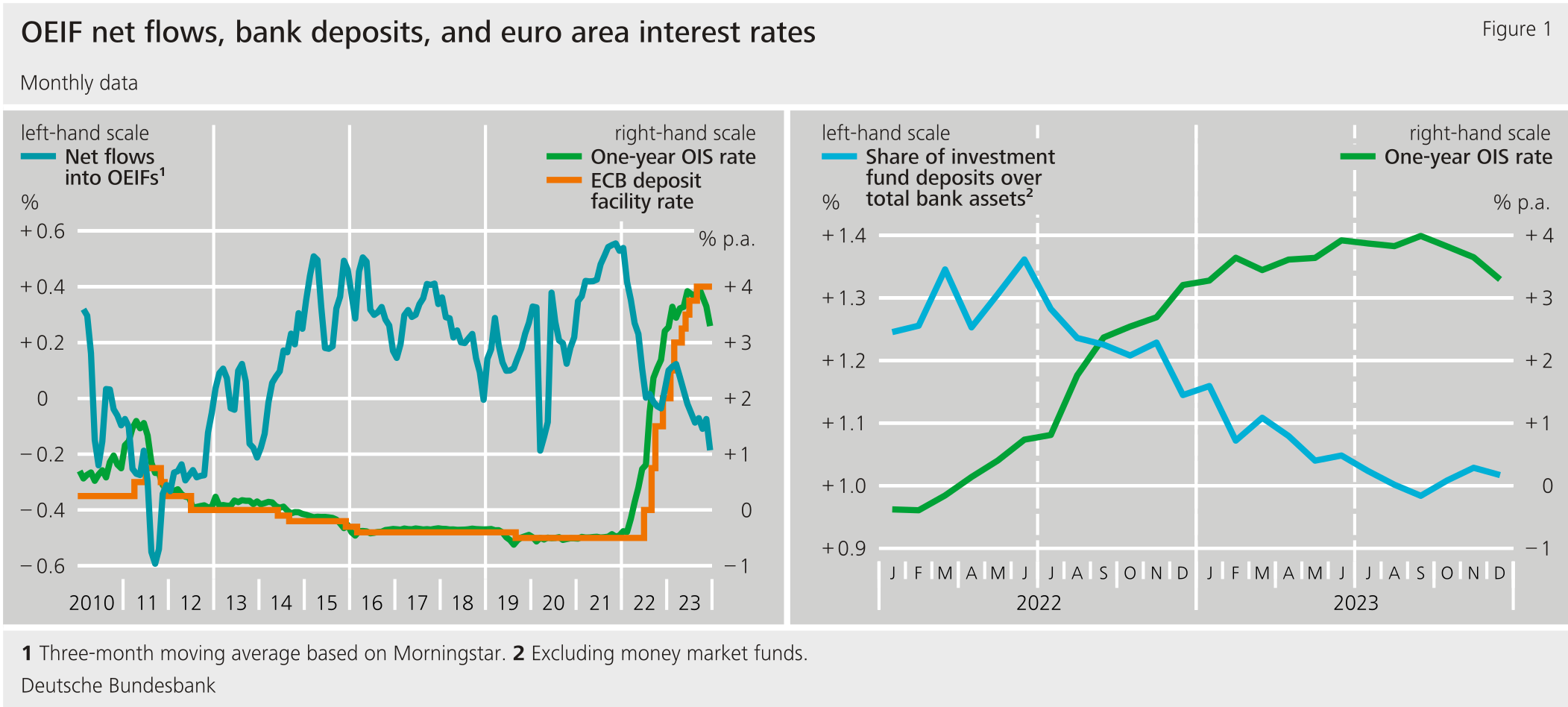
Aggregate fund data point to a close link between monetary policy and OEIF flows. The correlation between monthly net inflows and monetary policy expectations, measured by the one-year OIS rate, is −⁠ 0.4 over the full sample period. During the European Central Bank’s (ECB) sharp tightening cycle in 2022 and 2023, monthly net inflows into German OEIFs fell from roughly 0.5 % to −⁠ 0.2 % of their assets. At the same time, investment funds’ deposits at German banks declined by about a quarter (see Figure 1).

Figure 1: OEIF net flows, bank deposits, and euro area interest rates

Unexpected monetary tightening triggers fund outflows
For the econometric analysis, we combine fund-specific daily data on retail securities OEIFs domiciled in Germany from 2010 to 2023 with monetary policy surprises (Jarociński and Karadi, 2020). These surprises capture the unexpected component of interest rate decisions in a narrow window around the respective press conference of an ECB Governing Council meeting and therefore allow a causal interpretation of the effects.

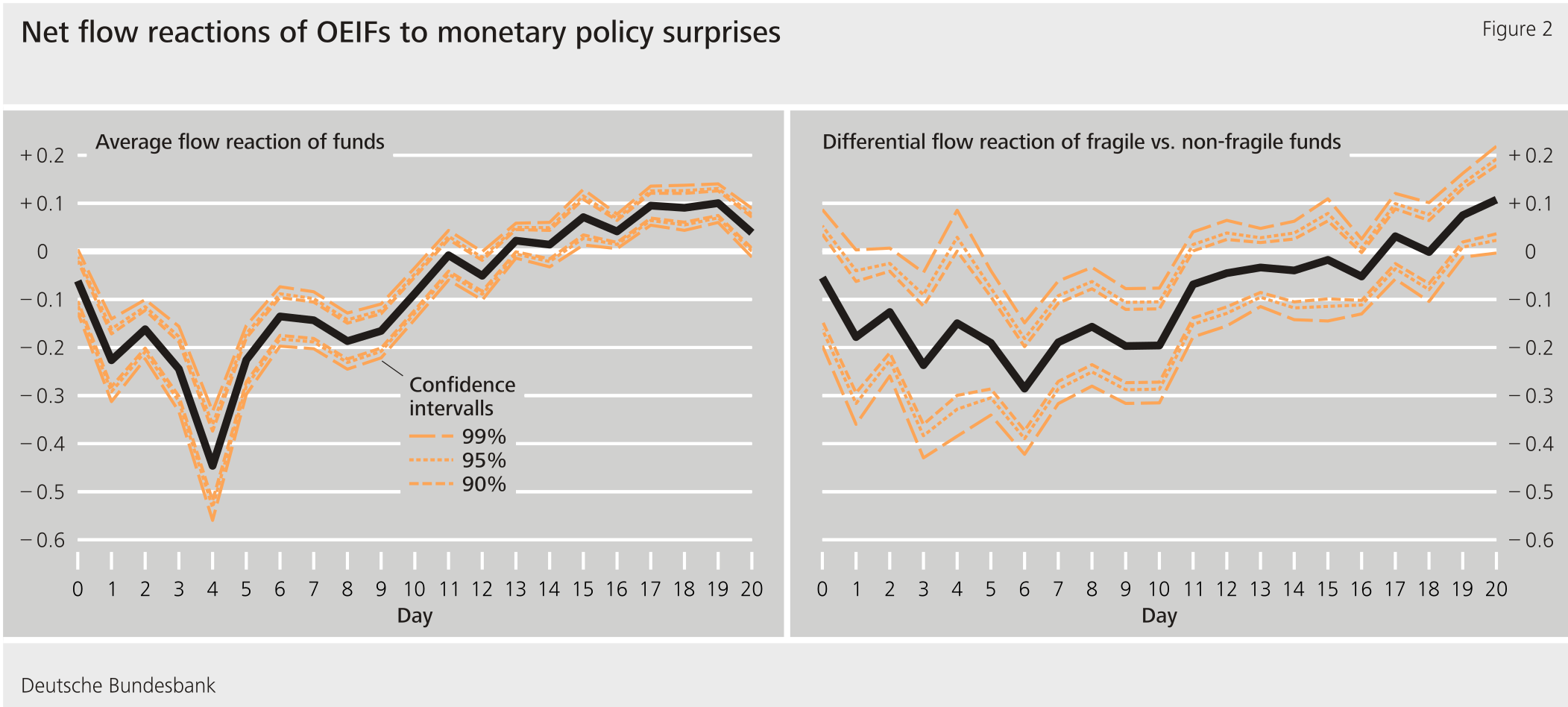
The results show that an unexpected 10 basis point (bp) rate increase reduces cumulative net inflows into OEIFs by more than 0.2 percentage points (pp, see Figure 2, left panel, where the cumulative net outflows following a surprise monetary tightening of 1 pp correspond to the area between the curve and the zero line). This result is not immediately expected: since fund assets are marked to market, monetary-policy-induced price changes pass through to share prices instantaneously. Why further share redemptions occur in the wake of these price adjustments requires an additional explanation. 

Figure 2: Net flow reactions of OEIFs to monetary policy surprises

Fund fragility as a driving factor

A first hint comes from the observation that outflows peak only after four business days. One explanation for this dynamic is that the reaction to monetary policy surprises results from the inherent fund fragility. After all, a monetary tightening shock comes with a loss in funds’ net market value, which can prompt investors to redeem their shares in order to avoid the costs resulting from other shareholders’ redemptions.

Prior work on monetary policy transmission through OEIFs has centred on US corporate bond funds: Kuong, O’Donovan and Zhang (2024) show that interest rate changes, combined with delayed price formation in illiquid corporate bonds, create incentives for share redemptions. Asset liquidity is only one driver of fragility. Other fund characteristics also matter, including liquidity buffers (Morris et al., 2017), affiliation with a banking group (Bagattini et al., 2023; Fecht et al., 2026), and liquidity management tools (LMTs) such as swing pricing (Jin et al., 2021; Dunne et al., 2024), which can dampen runs by shifting redemption costs onto departing investors. We use a fund-specific fragility measure that is applicable across fund types and captures the interplay of the characteristics noted above.

Fragile funds dominate the response – with spillovers to the banking sector

For this purpose, we use the well-known flow-performance relationship: investors frequently respond to a fund’s performance by adding money after good performance and withdrawing money after poor performance. If this investor reaction to poor performance is markedly stronger, it suggests that investors additionally fear other investors’ redemptions and therefore liquidate their shares pre-emptively. We measure, for each fund, the “overreaction” of net flows to underperformance relative to the reaction to outperformance and use this as a measure of fund-specific fragility.

We show that fragility is a key determinant of investors’ response to the monetary policy surprise. Following a surprise tightening of 10 bp, fragile funds suffer an additional cumulative outflow of around 0.2 pp relative to non-fragile peers (Figure 2, right panel). This implies a total outflow of 0.3 pp for fragile funds versus 0.1 pp for non-fragile peers. Consistent with the proposed mechanism, fragile funds “overreact” only to surprise monetary tightenings.

Fund-level outflows have consequences for the banking sector. While non-fragile funds increase their bank deposits after a monetary policy surprise, fragile funds draw down deposits to meet redemptions. This contributes to the shrinking of their liquidity buffers. Deposit outflows at banks holding large deposits from fragile funds could therefore amplify the deposit channel of monetary policy – that is, the mechanism by which a monetary tightening reduces the attractiveness of low-interest deposits and raises customers’ incentives to withdraw (Drechsler et al., 2017).

Policy implications

From a monetary policy perspective, a larger share of fragile OEIFs amplifies the transmission of a monetary tightening to fund investment volumes and these funds’ bank deposits. Potential macroprudential measures that reduce fund fragility would dampen this channel. This becomes particularly relevant as the Financial Stability Board (FSB) has recommended mandatory LMTs and EU legislation is currently phasing these in. Germany introduced the new instruments as of April 2026.

From a macroprudential policy perspective, our findings suggest that not only acute financial market dislocations but also monetary policy surprises can be associated with elevated redemptions and a stronger use of liquidity buffers at fragile OEIFs, which can entail further spillover effects.

Financial intermediaries outside the banking sector are growing, and monitoring fund fragility is thus becoming important both for financial stability analyses and for the calibration of monetary policy.

References

Bagattini, G., F. Fecht and A. Maddaloni (2023), Liquidity support and distress resilience in bank-affiliated mutual funds, ECB Working Paper, No. 2799.

Chen, Q., I. Goldstein and W. Jiang (2010), Payoff complementarities and financial fragility: Evidence from mutual fund outflows, Journal of Financial Economics, 97(2), 239–262.

Drechsler, I., A. Savov and P. Schnabl (2017), The deposits channel of monetary policy, The Quarterly Journal of Economics, 132(4), 1819–1876.

Dunne, P., L. Emter, F. Fecht, R. Giuliana and O. Peia (2024), Financial Fragility in Open-ended Mutual Funds: The Role of Liquidity Management Tools, Deutsche Bundesbank Discussion Paper No. 36/2024.

Fecht, F., E. Genc, Y. Karabulut and P. Weber (2026), Liquidity Support in Financial Institutions, Management Science (forthcoming).

Fecht, F. and M. Kellers (2026), Monetary policy, fragility, and fund flows, Deutsche Bundesbank Discussion Paper No. 09/2026.

Jarociński, M. and P. Karadi (2020), Deconstructing monetary policy surprises – the role of information shocks, American Economic Journal: Macroeconomics, 12(2), 1–43.

Jin, D., M. Kacperczyk, B. Kahraman and F. Suntheim (2021), Swing pricing and fragility in open-end mutual funds, The Review of Financial Studies, 35(1), 1–50.

Kuong, J. C.-F., J. O’Donovan and J. Zhang (2024), Monetary policy and fragility in corporate bond mutual funds, Journal of Financial Economics, 161, 103931.

Morris, S., I. Shim and H.S. Shin (2017), Redemption risk and cash hoarding by asset managers, Journal of Monetary Economics, 89, 71–87.

Authors

Falko Fecht

Deutsche Bundesbank | Research Crentre

Moritz Kellers

Deutsche Bundesbank | Financial Stability

Disclaimer

The views expressed here do not necessarily reflect the opinion of the Deutsche Bundesbank or the Eurosystem.