The Banking Directive Implementation and Bureaucracy Relief Act Monthly Report – April 2026
Published on
The Banking Directive Implementation and Bureaucracy Relief Act Monthly Report – April 2026
Monthly Report Published on
The EU banking package transposed the global Basel III regime into European law in 2024. One key element of that package is the amendments to the Capital Requirements Directive (CRD VI). The German Banking Directive Implementation and Bureaucracy Relief Act (Bankenrichtlinienumsetzungs- und Bürokratieentlastungsgesetz, or BRUBEG) 1 transposes these extensive changes to the CRD VI into Germany’s national supervisory regime. The stated aim is to implement the requirements with a minimum of bureaucracy and to not go beyond the European supervisory requirements. At the same time, the BRUBEG also includes targeted regulatory relief, which means it takes into account the principle of proportionality in supervision without lowering prudential standards.
One major aspect of the CRD VI is the amendments that improve how banks address environmental (particularly climate-related), social and governance risks (ESG risks). In addition, the CRD VI contains a set of harmonised European requirements that deal with regulatory topics that were previously regarded as being too heterogeneous at the national level. The introduction of a harmonised European supervisory regime governing third-country branches is one such piece of legislation. To address this topic, the BRUBEG contains new national provisions to replace the regime already enshrined in Germany’s Banking Act (Kreditwesengesetz, or KWG). The BRUBEG furthermore adds new supervisory powers with corresponding notification requirements for institutions to the Banking Act: these concern the rules governing acquisitions or divestitures of material assets or liabilities and of “material holdings” as well as regulations governing mergers and divisions. Other harmonised requirements concern assessments of the suitability of management board members and key function holders as well as requirements for the output floor. The BRUBEG also gives supervisors the power to impose periodic penalty payments as an enforcement instrument.
1 Introduction
The BRUBEG transposes the extensive amendments to the Capital Requirements Directive into German law. The EU banking package, as it is known, was published in the European Union’s Official Journal on 19 June 2024. It is made up of the amended Capital Requirements Regulation (CRR III) and the amended Capital Requirements Directive (CRD VI). 2 While the amendments to the CRR have mostly been in force since 1 January 2025, those resulting from the CRD VI first need to be transposed into national law for them to be applicable to credit institutions. Transposition in Germany took place by means of the BRUBEG, which generally entered into force on 1 April 2026. 3
The BRUBEG is an omnibus act and mostly involves amendments to the Banking Act. Besides containing accompanying adjustments to existing statutory orders, the BRUBEG includes further changes that presented themselves because it was a convenient or appropriate opportunity to update the legislation.
Overall, the new provisions that the BRUBEG adds to national supervisory law are very extensive. For that reason, the regulations discussed in this article cover only those aspects of the BRUBEG that seem particularly relevant from a supervisory perspective.
2 Key amendments to the Banking Act
2.1 New supervisory powers
In transposing the CRD VI into German law, the BRUBEG adds a number of new supervisory powers to the Banking Act. Under Section 2h of the Banking Act, credit institutions within the meaning of the Capital Requirements Regulation (CRR credit institutions) 4 and (mixed) financial holding companies that intend to acquire, directly or indirectly, a “material holding” are required to notify the competent authorities. Section 1(9b) of the Banking Act states that a holding in another undertaking is “material” where it is equal to or more than 15 % of the eligible capital. Notification shall indicate the size of the proposed acquisition and the information required to carry out the assessment. By way of an exception, Section 2h(6) of the Banking Act allows the supervisory authority to refrain from carrying out an assessment in cases where the proposed acquisition of a material holding is conducted between undertakings of the same group or between undertakings within the same institutional protection scheme. The requirement to notify the competent authorities is not affected by this exception.
Another new addition to the Banking Act is the requirement under Section 2i for CRR credit institutions and (mixed) financial holding companies to notify the competent authorities of a proposed merger or division, after the adoption of the draft terms of the proposed merger or division and in advance of the completion of the proposed operation. Section 2i(2) of the Banking Act allows the supervisor to refrain from carrying out the assessment where the proposed operation is a merger that only involves CRR credit institutions or (mixed) financial holding companies from the same group or where the proposed operation requires an authorisation under Sections 32 or 2f of the Banking Act. The information that must be submitted to enable the supervisory authority to carry out the assessment shall be appropriate to the nature and significance of the merger or division. Consideration shall also be given to the particular features of mergers or divisions in which all the undertakings involved are members of the same institutional protection scheme (see Section 2i(1) in fine of the Banking Act).
Furthermore, Section 1(9a) and Section 24(1f) and (3a) sentence 1 number 8 of the Banking Act require CRR credit institutions and (mixed) financial holding companies to also provide notification of transfers of “material assets or liabilities”. Under Section 1(9a) sentence 1 of the Banking Act, a transfer of assets or liabilities shall be deemed “material” for an undertaking where it is at least equal to 10 % of its total assets or liabilities. An exception is made here, too, for transfers between undertakings of the same group. In such a case, Section 1(9a) sentence 2 of the Banking Act deems the transfer to be material for an undertaking where it is at least equal to 15 % of its total assets or liabilities.
Article 21c of CRD VI enshrines the principle that credit institutions from a third country are prohibited from directly providing core banking services – that is, lending business, deposit business and guarantee business – into a Member State of the EU, and must instead establish a CRD third-country branch in that Member State. Article 21c(2) of CRD VI allows exceptions to be made for intra-bank and intra-group transactions, ancillary services related to MiFID activities 6 and cases of reverse solicitation – that is, where a client approaches an undertaking established in a third country at said client's own exclusive initiative for the provision of banking services.
The CRD VI establishes, for the first time, a framework containing minimum requirements for the supervision of CRD third-country branches across the EU. These minimum requirements have been transposed into German law in Section 53(7) and (8) and Sections 53c to 53cq of the Banking Act. For CRD third-country branches already situated in Germany, this means a change in supervisory regime. Starting on 11 January 2027, this will entail, amongst other things, an assessment of the home country as well as enhanced cooperation between the Federal Financial Supervisory Authority (Bafin) and the Bundesbank with the competent supervisory authorities of the third country. In future, CRD third-country branches will generally be classified as either class 1 7 or class 2 third-country branches in accordance with Section 53ca of the Banking Act. This classification determines the minimum requirements a third-country branch is expected to meet. Section 53ce of the Banking Act requires a CRD third-country branch to maintain at all times a minimum capital endowment that is at least equal to 2.5 % of its average liabilities for the last three years or a minimum of €10 million (class 1), or 0.5 % of its average liabilities for the last three years or a minimum of €5 million (class 2). That capital endowment shall be deposited in a "settlement account" (Abwicklungskonto) held with a German credit institution that is not part of the branch’s head undertaking’s group or with the Bundesbank. 8 Liquidity requirements for class 1 CRD third-country branches are largely identical to those for CRR credit institutions. Class 2 CRD third-country branches are required to maintain at all times a volume of unencumbered and liquid assets sufficient to cover liquidity outflows over a minimum period of 30 days. Unlike the minimum capital requirements, liquidity requirements may be waived for qualifying CRD third-country branches. 9 An addition to Section 53ci of the Banking Act gives Bafin the power to require the establishment of a subsidiary where the indicators of systemic importance referred to in Section 10g(2) or Section 53ci(2) of the Banking Act are met, where the amount of the third-country branch’s assets on its books in Germany is equal to or greater than €10 billion and/or where the CRD third-country branch has operated without authorisation across national borders in another Member State. This power should generally be exercised after applying other possible measures, such as restructuring orders or, where applicable, capital add-ons. An assessment of systemic importance will also take place under Section 53cj of the Banking Act where the aggregate amount of all assets held by CRD third-country branches which belong to the same third-country group in the EU is equal to or greater than €40 billion.
A new reporting framework will be introduced in this regard for CRD third-country branches (“Implementing Technical Standards on the supervisory reporting of Third Country Branches”). The new reporting requirements apply to both the third-country branch itself and its head undertaking, and cover both quantitative data (financial and regulatory information) and qualitative data (including supervisory reviews and assessments, recovery plans and business strategy of the head undertaking). The first reporting reference date for the new reporting requirements is expected to be 31 March 2027. 10
2.3 Periodic penalty payments as an enforcement measure
The updated Banking Act contains a new provision in Section 50 governing the imposition of periodic penalty payments. This provision gives Bafin the power to impose periodic penalty payments in the event of an ongoing breach of the Banking Act or the statutory orders adopted in connection therewith, of the CRR or of enforceable orders issued by Bafin. Periodic penalty payments are imposed on a basis of daily rates in order to ensure that banks return to compliance with supervisory requirements as soon as possible. In the case of natural persons, the legislation provides for periodic penalty payments of up to €50,000, which may be imposed per day of breach. For a legal person, periodic penalty payments of up to 5 % of the average daily net turnover may be imposed. This figure is derived from annual total turnover, calculated on the basis of Section 50(5) of the Banking Act.
2.4 Corporate governance
The BRUBEG also leads to updates of the governance-related provisions of the Banking Act. These amendments aim, inter alia, to strengthen the authority and independence of internal control functions 11 as well as the role of the management board in its supervisory function. In future, the heads of internal control functions shall have sufficient authority and be able, where appropriate, to report directly to the management board in its supervisory function, independently of the management board in its management function. In addition, the heads of internal control functions may not be removed without prior approval of the management board in its supervisory function (Section 25c(4a) number 3 letters (h) and (i) of the Banking Act). Furthermore, the updated Banking Act clarifies that the internal audit function may not be combined with any other business line or control function; previously, this matter was only covered by the Minimum Requirements for Risk Management (MaRisk 12 ). Amendments have also been made to the prudential suitability assessments. An early notification procedure for members of the management board in its management function and the chair of the management board in its supervisory function at “large undertakings” requires notifications to be made at the latest 30 working days before the prospective members take up their position (Section 24(1) number 1 and number 15 of the Banking Act). In addition, all institutions and superordinated undertakings are now required to ensure the suitability of key function holders; Bafin may otherwise take corrective actions in the case of key function holders (Section 25c(4a) number 7 and (4b) sentence 2 number 7 in conjunction with Section 25e of the Banking Act). The BRUBEG furthermore introduces a prudential suitability assessment procedure based on appropriate notification requirements for certain key functions at large undertakings (Section 24(1) number 15b of the Banking Act). Also, institutions are required to draw up statements setting out the individual duties and responsibilities of members of the management board in its management function, senior management and key function holders (Section 25c(4a) number 8 of the Banking Act). Lastly, the BRUBEG introduces a minimum frequency of two years for reviewing and updating business and risk strategies, taking into consideration the principle of proportionality (Section 25a(1) sentence 3 number 1 of the Banking Act).
2.5 Output floor
The output floor newly introduced in Article 92(3) of the CRR limits the extent to which risk-weighted assets calculated with the aid of internal models are allowed to deviate from the own funds requirements calculated using the Standardised Approach. As from 2030, 13 the output floor will be set at 72.5 %. 14 As agreed in negotiations on the Basel Committee on Banking Supervision (BCBS), setting the output floor at that level will bring about a global convergence of capital requirements (see the supplementary information entitled “Global banking regulation – local credit markets: a look at the United States, the EU and Germany”). In addition, the CRD VI requires competent authorities to review the adequacy of the additional Pillar 2 requirements in the context of the supervisory review process, the systemic risk buffer and the capital buffer for other systemically important institutions for institutions bound by the output floor. The intention is to avoid the double-counting of identical risks, which can happen when these requirements interact with the output floor. This approach is incorporated into Germany’s Banking Act by the BRUBEG. Concerning the Pillar 2 requirements, Sections 6c and 6d of the Banking Act in particular clarify the prudential treatment of institutions bound by the output floor to the effect that double-counting is eliminated and arithmetic effects on the existing Pillar 2 requirements from the output floor are reviewed. Review clauses have also been added to Section 10e (systemic risk buffer) and Section 10g (capital buffer for other systemically important institutions). The BRUBEG thus confines itself to consistently incorporating the requirements under EU law into German supervisory legislation and follows the principle of implementation without additional national tightening.
Supplementary information
Global banking regulation – local credit markets: a look at the United States, the EU and Germany
The minimum standards laid down in the Basel framework are being implemented through the introduction of the output floor in the Capital Requirements Regulation III (CRR III) and in the BRUBEG. In the European Union, transitional arrangements for the phase-in of the output floor will apply through 2032, giving institutions sufficient time to adapt to the new requirements.
In the United States, global systemically important institutions (G-SIIs) are currently subject to capital requirements that, in some instances, go beyond the Basel standards. On 19 March 2026, the Federal Reserve published proposals on how to implement the revised Basel framework. 1 Under these proposals, some elements of this “gold-plating” are to be withdrawn. This would be in addition to the relief announced back in 2025, for instance lowering the leverage ratio requirement to the Basel level. The latest consultation paper proposes adjustments that include greater alignment with international standards, such as changes to the methodology for determining capital add-ons for G-SIIs. However, it also contains proposals that go well beyond reducing gold-plating. Based on initial assessments it cannot yet be concluded that capital requirements for G-SIIs in the United States will, overall, fall below the level of the Basel standards in future.
A direct comparison of the capital requirements for European G-SIIs with those for their US competitors has limitations. In addition to regulatory differences, structural factors also come into play (see Table 4.1). Naturally, banks optimise their portfolios, not least with regard to regulatory requirements. Subject to this constraint, the following conclusions can be drawn from comparative analyses: the Pillar 1 capital requirements for G-SIIs currently tend to be higher in the United States than in the EU. This is due, amongst other things, to the Collins floor, which equates to an output floor of 100 % for market and credit risk. By contrast, the EU’s output floor, which applies to all types of risk, will gradually rise from 50 % to 72.5 % between 2025 and 2030. 2 The capital buffers that supervisors demand for global systemically important institutions tend to be higher in the United States than those applying to European G-SIIs. This is the case even if the review proposed on 19 March is applied. 3 At the same time, the European framework includes, for example, relief measures for capital requirements on loans to small and medium-sized enterprises and on infrastructure financing. This relief is intended to safeguard the provision of financing to these economically important areas. By contrast, the overall Pillar 2 requirements in the EU tend to be higher. Another structural difference relates to the regulatory architecture. In the EU, a single rulebook with principles of proportionality applies to all institutions. The United States, by contrast, applies a more tiered system, in which the size and complexity of the requirements depend more strongly on an institution’s size and systemic importance. As a result, only a few institutions in the United States fall within the scope of the Basel rules.
Appropriate capital requirements contribute to sustainable lending and help prevent capital misallocations. Well-capitalised banks are more resilient and more competitive in the long term. 4 A stable and reliable regulatory framework and soundly capitalised banks are therefore in the public interest. Consequently, the key to international competitiveness is not so much the absolute level of individual requirements as the consistency and reliability of the regulatory framework. In the current period of high political and economic uncertainty, in particular, a high degree of resilience in the banking sector is a great asset.
Table 4.1: Selected elements of the regulatory frameworks in the United States and the EU that influence current capital requirements for G-SIIs
Rule
United States
European Union
Collins or output floor1
100 % (credit and market risk)
50 % in 2025 to 72.5 % in 2030 with transitional arrangements until the end of 2032
Capital buffers for global and other systemically important institutions
1 %-4.5 %
0.25 %-2 %
Countercyclical capital buffer
Not activated
0.5 %-2 % (for countries with G-SIIs)
(Sectoral) systemic risk buffer
-
0 %-1 % (for countries with G-SIIs)
Pillar 2 add-ons
Stress test capital buffer
Total SREP capital requirement, Pillar 2 guidance
Other selected (structural) differences
Sale of residential real estate loans to government-sponsored enterprises; capital market-based financing of enterprises
Supporting factor for small and medium-sized enterprises and for infrastructure projects; exceptions in credit valuation adjustment
1 The consultation paper that the Federal Reserve published on 19 March proposes replacing the Collins floor with an expanded risk-based approach. For US G-SIIs, this would result in a slight increase in risk-weighted assets, on aggregate, according to the Federal Reserve.
To assess the potential impact of different regulatory regimes in the United States and the EU on competition in the banking sector, cross-border ties have to be analysed. Specifically, one has to ask oneself to what degree German banks and US institutions actually compete directly with each other and whether regulatory differences can distort competition.
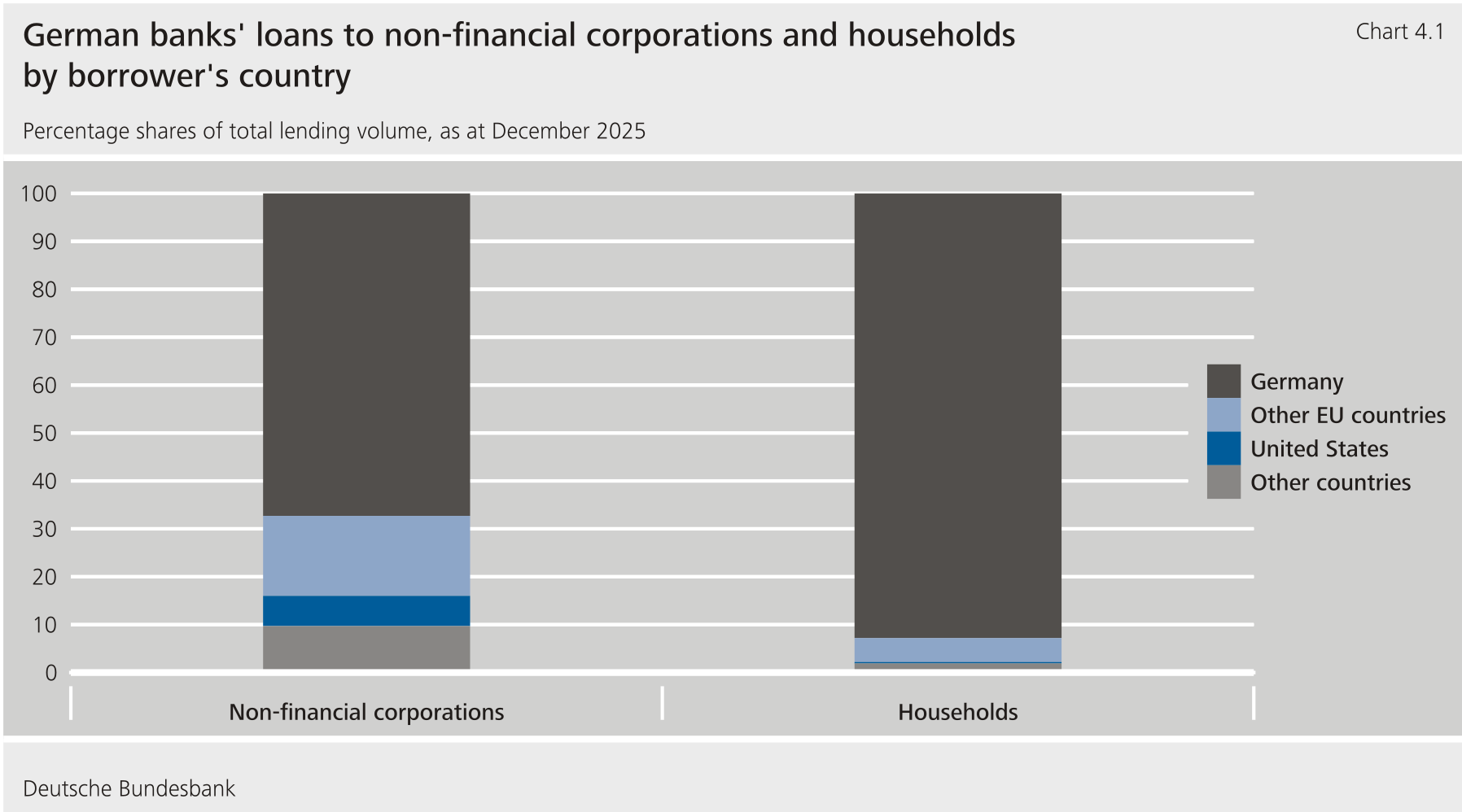
In terms of lending, the German banking sector’s ties with the US market exist primarily at the level of larger German commercial banks and Landesbanken. For most German institutions, by contrast, the US market has no role to play. German banks’ lending to households is strongly concentrated on domestic households, which account for 93 % of the aggregate lending volume, while US households do not feature at all (see Chart 4.1). By contrast, foreign borrowers are significantly more relevant in lending to non-financial corporations (NFCs), accounting for 33 % of German banks’ aggregate NFC portfolio. Among foreign borrowers, the United States is the most important individual country with a share of 6 %. On aggregate, however, other EU countries are the more significant market for German institutions.
The lending volume of large US banks that grant loans to German households and NFCs via subsidiaries in the German domestic market is of minor importance.US subsidiaries' share of German banks' aggregate lending volumes to German households and to NFCs is well below 1 % in each case. As with all European institutions, these subsidiaries are subject to the CRR and the BRUBEG regulations. In investment banking and trading business, internationally active large banks compete across a wide range of activities worldwide. In terms of the share of capital requirements, though, trading business lags far behind lending business.
In their lending business, the German subsidiaries of US banks focus on working with international wholesale customers, especially from the financial sector. Their lending conditions are no lower than those of German institutions. This means that they tend to incur higher financing costs than German institutions. This is because they conduct very little deposit business and intra-group financing must be priced at close to market value under tax law. Only in specific credit markets do they play a more significant role, for example in revolving wholesale loans (including from the private equity sector) or in USD syndicated loans.
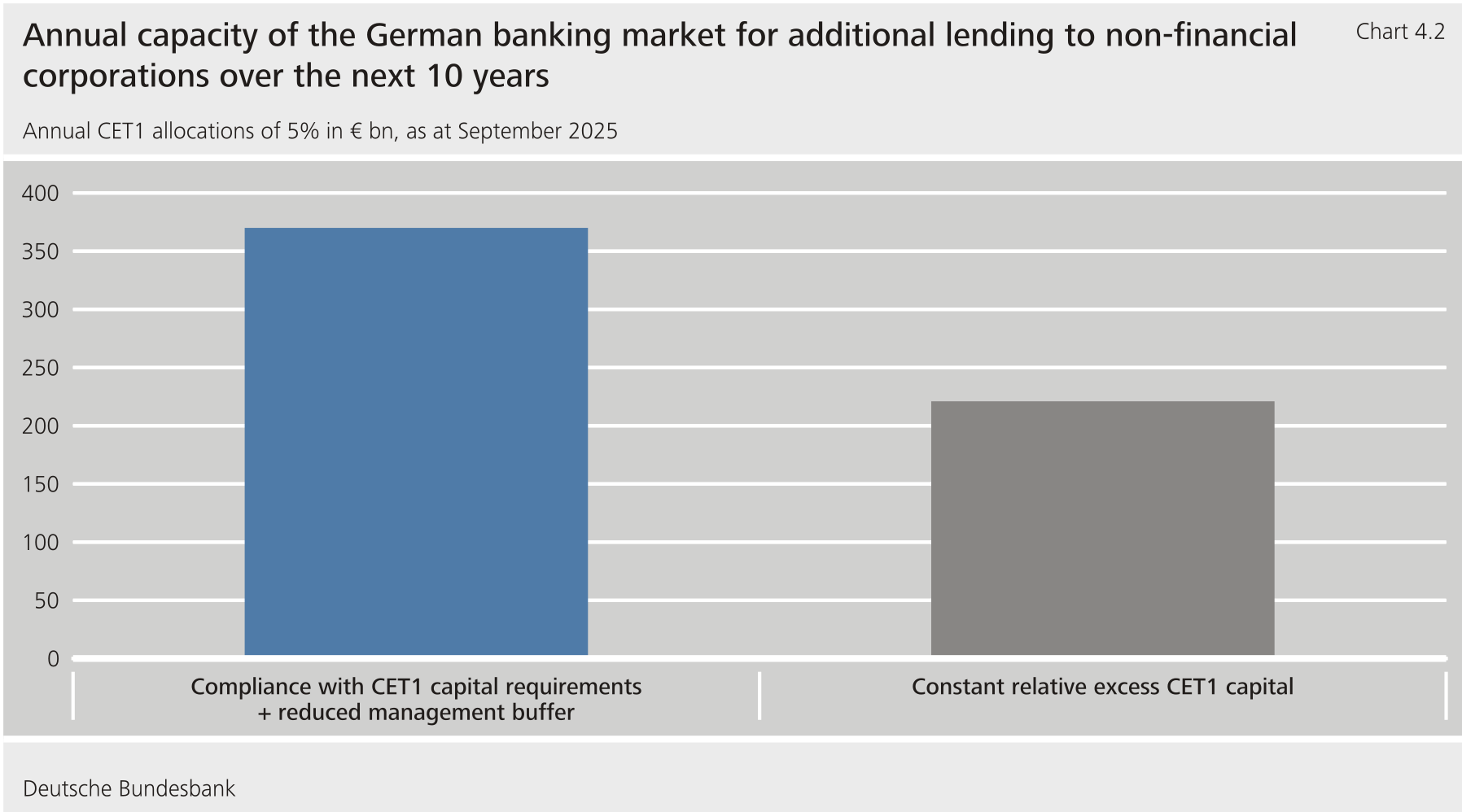
The introduction of CRR III reduces the available lending capacity of the German banking market as it raises capital requirements; nonetheless, no financing bottlenecks are expected in principle. For example, simulations show that that there is sufficient lending capacity in the German banking market to finance the upcoming challenges arising from digitalisation, rearmament and climate change. These simulations take into account the introduction of the gradual increase in the output floor factor until the end of 2029, and the expiry of all transitional arrangements on the output floor by the end of 2032. (See also the supplementary information entitled “Financing the transition to greenhouse gas neutrality in Germany: Is the German banking system prepared?" in the article entitled "Sustainability risks in banking supervision"). At present, the German banking market has CET1 excess capital of around €180 billion above all capital requirements and guidance. Assuming that this is kept constant (as a percentage of risk-weighted assets), the German banking market could, given annual CET1 allocations of 5 %, issue additional loans to the tune of up to €221 billion annually over the next ten years 5 (see Chart 4.2). By comparison, the average annual CET1 allocations in the German banking market over the past five years amounted to around 5.7 %. If it is further assumed that parts of the excess capital are also used to expand lending, CET1 allocations of 5 % per year could even result in additional loans of up to €370 billion being issued. 6
Firms’ access to loans has not worsened since mid-2022 despite interest rates having risen. 7 According to the Bundesbank’s survey of firms of March 2026, firms do not generally see access to loans as a challenge. Their main focus is on the availability of skilled workers, high costs and government rules. 8
These analyses underline that the Federal Reserve’s proposals to implement the revised Basel framework lead, overall, to a significant reduction in the capital requirements for US institutions compared with the status quo. At the same time, the interconnectedness of German and US banks is relatively small. This means that the reduction in capital requirements in the United States is unlikely to have a significant impact on competition. The existence of substantial excess capital in the German banking system illustrates that there are no supply-side credit constraints that foreign competitors could use to their advantage.
Overall, there is therefore no reason to reduce regulatory capital requirements in the EU, either implicitly or explicitly. Instead, the focus should be on simplifying procedural requirements in a targeted way, for instance by eliminating bureaucracy, with the aim of ensuring the competitiveness and stability of the European banking market in equal measure.
2.6 ESG risks
The CRD VI harmonises the requirements for banks to take ESG risks into account in their risk management. ESG risks are closely linked with the concept of sustainability, as ESG factors represent the three main pillars of sustainability: environmental, social and governance aspects. 15 Key aspects of the amendments to the Banking Act concerning ESG risks are the provisions set forth in Sections 26c and 26d on the management of ESG risks and on the ESG risk plan, which entered into force on 1 April 2026 (Article 29(1) of the BRUBEG). The main provisions in Section 26c of the Banking Act concerning the management of ESG risks are not new to banks, given that banks were already required under the 7th Amendment of the MaRisk of June 2023 to incorporate ESG into their overall risk management.
The introduction of Section 26c of the Banking Act ensures that ESG risks are comprehensively accounted for in risk management as risk drivers of general risks in banking. This process extends all the way from identifying and measuring risks to senior management’s overall responsibility for taking ESG risks into account and providing the resources needed to manage them. In addition, the institution’s risk appetite in relation to ESG risks should also be an integral part of its remuneration policies for managers and employees. Given the uncertain transmission channels and the long-term nature of the changes associated with climate change, ESG risks also need to be incorporated into risk management over medium and long-term horizons (that is, including for periods of at least 10 years). Small and non-complex institutions (SNCIs) 16 are expected to review their strategies and processes under Section 25a(1) number 1 of the Banking Act, in which they are also required to consider the risks resulting from the short, medium and long-term impacts of ESG factors, every two years and adjust them as necessary. All other institutions must do so at regular intervals, but at least every two years, depending on the nature, scale, complexity and riskiness of their business activities.
Corresponding with the requirement to fully integrate ESG risks into their risk management, banks also have to draw up ESG risk plans addressed to supervisors (Section 26d of the Banking Act). Banks are supposed to use those ESG risk plans to explain how, in light of national legislation aimed at reducing greenhouse gas emissions, they intend to manage ESG risks. To keep this risk plan up to date, banks also have to establish processes for planning, implementing, assessing and adjusting the plan. The ESG risk plan must set quantifiable targets and metrics for managing financial risks that are appropriate in light of the ESG risks of the business model and the scale of the institution’s activities. Ultimately, the risk plan is a systematic description of implementation of Section 26c of the Banking Act. ESG risk plans should be kept consistent with transition plans under the Corporate Sustainability Reporting Directive (CSRD). 17 When banks assess the impact of ESG risks on their counterparties, they should confine their assessment to published data and established market standards.
SNCIs have been granted relief in terms of their ESG risk plans. For one thing, the obligation for them to draw up an ESG risk plan will not enter into force until January 2027. For another, SNCIs will be permitted, for a transitional period ending in 2029, to prepare ESG risk plans that only cover the financial risks arising from climate change. Also, they will be allowed to provide only a qualitative description of their targets. The latter relief applies in particular in cases where it is impossible or unreasonably time-consuming for an institution to set quantitative targets and metrics. All the same, ESG risks have to be managed and monitored adequately over the short, medium and long term on the basis of that qualitative management.
To bring the implementation of risk plans and the adjustments to risk management to the supervisor’s attention, external auditors are required to report, in their audit report on annual accounts, on compliance with the requirements of Sections 26c and 26d of the Banking Act (Section 29(1) sentence 2 number 2 letter (a) of the Banking Act). It is also possible, as appropriate, to define areas of emphasis for audits under Section 30 of the Banking Act in relation to ESG risks.
Mirroring the requirements for banks, as part of the supervisory review and evaluation process (SREP) (Section 6b(2) number 15 of the Banking Act), supervisors are now required to assess the ESG risk plan as well as institutions’ progress towards addressing ESG risks in their business organisation, particularly in their business and risk strategy and in risk management. The European Banking Authority (EBA) is currently drafting guidelines 18 on this topic. Furthermore, within the scope of the SSM Regulation, 19 consideration will need to be given to the manner in which these requirements are imposed on less significant institutions (LSIs). 20 . In addition, where the conditions under Section 45 of the Banking Act are met, supervisors may also require an institution to reduce short, medium or long-term ESG risks, mainly those relating to the targets of the “European Climate Law”, 21 by adjusting its business organisation, in particular in terms of its business strategy, risk strategy and risk management, or by toughening up the ESG risk plan it is required to draw up under Section 26d(1) (Section 45(2) number 15 of the Banking Act).
Concerning capital buffers, specifically the scope of capital buffer for systemic risks (SyRB), Section 10e(2) of the Banking Act makes it clear that the SyRB may also be applied to address systemic or macroprudential risks arising from climate change. In January 2026, EBA published a consultation paper on the use of the SyRB for risks arising from climate change. 22
2.7 Transactions with related parties
Amendments have been made to Section 15 of the Banking Act, which previously governed loans to related parties. The title of Section 15 has now been changed to “Transactions with related parties” in order to cover not only the “loans to related parties” governed by Section 15 but also “business with related parties” under Section 15(6), which was added in 2020 by the Risk Reduction Act. Relief is provided, inter alia, in the shape of de minimis thresholds below which the provisions are not applicable. Hence, the de minimis threshold for loans to, and business with, related undertakings governed by Section 15(3) has been increased to €100,000, while a new de minimis threshold of €100,000 has been introduced in Section 15(6) for business with related natural persons. In addition, loans of up to €20,000 to the natural persons referred to in Section 15(1) are now exempt from the provisions governing loans to related parties on two conditions: the loans are granted exclusively by way of fully automated credit decisions, and the relationship with the related party is guaranteed not to have any influence on the terms and conditions of such loans. The option of deciding in advance on loans to related undertakings is another new feature.
2.8 Loan documentation under Section 18 of the Banking Act
Transposition of the BRUBEG raised the threshold above which a borrower creditworthiness assessment pursuant to Section 18 sentence 1 of the Banking Act is required to €1,500,000. This threshold was last amended in 2005. This amendment is intended to relieve the economy of national requirements, particularly concerning documentation obligations.
3 Material changes to accompanying statutory orders
3.1 Amendments to the Remuneration Regulation for Institutions 23
The amendment to the Remuneration Regulation for Institutions (Institutsvergütungsverordnung, or InstitutsVergV) expands upon Section 26c(1) number 6 of the Banking Act by requiring ESG risks to be explicitly accounted for when setting remuneration parameters in accordance with Section 4 of the InstitutsVergV. In addition, some aspects have been clarified and a number of errors from earlier implementations of the CRD have been rectified.
Concerning credit risk, permanent partial use of the Standardised Approach for institutions that are permitted to use the Internal Ratings Based (IRB ) Approach no longer applies to the overall portfolio as hitherto but to individual exposure classes. The technical provisions governing permanent partial use that had previously been enshrined in the Solvency Regulation have now been deleted. These are going to be replaced, on the basis of the CRR III, by provisions in Bafin’s administrative practice. The aim here is to establish an approach that is geared to the administrative practice of the European Central Bank (ECB) with a view to achieving supervisory convergence within the EU. In addition, EBA has been mandated to issue guidelines on permanent partial use by 10 July 2028.
The approaches previously listed in Section 22 of the Solvency Regulation for calculating the mortgage lending value, which were eligible for the recognition of immovable property collateral according to the requirements of the CRR, have been repealed. This is because the CRR III no longer makes a distinction between the market value and the mortgage lending value, and Article 4(1) point (74a) of the CRR defines “property value” as the common term for immovable property collateral.
4 Further action
The CRD VI confers numerous mandates on EBA to draft implementing and regulatory technical standards. These standards are intended to flesh out the provisions of the CRD VI and create a level playing field for implementing them. Some draft standards have already been released by EBA. Others, meanwhile, are still under development and will later be adopted by the European Commission as regulations directly applicable within the Union.
5 Further amendments to the Banking Act alongside the BRUBEG
The German Location Promotion Act (Standortfördergesetz, or StoFöG) was published in the Federal Law Gazette on 9 February 2026 and entered into force on 10 February 2026. 25 This Act will discontinue the reporting of loans of €1 million or more under Section 14 of the Banking Act with effect from 30 December 2026. Bafin and the Bundesbank proposed this reform in August 2025.
Under the existing legislation, credit institutions, insurers and other reporting agents are required to report any loans granted to borrowers or borrower units that are equal to or more than €1 million each quarter. At present, around 3,200 enterprises are still subject to this reporting obligation, the last reporting reference date of which will be 30 September 2026. At the same time, banks report highly granular data on their loan portfolios to the Bundesbank as part of the ECB’s analytical credit datasets (AnaCredit 26 ).
The data obtained by means of the supervisory reporting system are a key source of information for supervisors looking to identify and analyse credit risk in the banking sector. AnaCredit, the Securities Holdings Statistics and the reporting system for large exposures give German supervisors meaningful alternatives to the reporting system for loans of €1 million or more.