Climate change and the ongoing loss of nature are among the most important challenges faced by today’s society. The effects are already being felt: more frequent and intense extreme weather events – such as heatwaves, floods and droughts – and a decline in the availability of vital natural services – such as clean water and fertile soil – are weighing on economies around the world. The impact of climate change is expected to intensify further in future, and climate-induced economic damage is on the rise in Germany. 1 At the same time, the transition to a climate-neutral economy will require far-reaching adjustments in almost all sectors of the economy and bring its own challenges and opportunities. 2
Why is the Bundesbank addressing climate change and nature loss?
The macroeconomic impact of the transition and climate change is directly relevant to the fulfilment of the Bundesbank’s mandate. As part of the Eurosystem, the Bundesbank’s primary objective is to maintain price stability. In line with the Eurosystem’s monetary policy strategy, it takes climate-related inflation and growth effects into account in its macroeconomic analyses. Nature-related risks, such as water scarcity, can also have macroeconomic effects, and the Bundesbank takes these into consideration as it works to achieve the objective of price stability. As part of its mandate, the Bundesbank therefore looks into the impact of climate change, nature loss and policy measures to contain these developments on inflation and growth.
Climate change and nature loss affect not only the real economy, but also the financial system. Physical risks arise if, for example, businesses or assets are damaged by extreme weather events. Transition risks arise as part of the transition to a climate-neutral and resource-efficient economy. Measures such as significantly increasing the cost of greenhouse gas emissions are likely to trigger far-reaching economic adjustment processes. 3
By fulfilling its monetary policy mandate, the Eurosystem contributes to a reliable economic environment. This is also important for the transition to a climate-neutral economy. For example, relative prices, and thus climate-related price signals, can have a steering effect when prices are relatively stable.
In fulfilling its tasks, the Bundesbank is committed to ensuring that climate and nature-related risks to price and financial stability are appropriately measured, assessed and disclosed. Within its mandate, it contributes to safeguarding financial stability in Germany as a member of the Financial Stability Committee. The Bundesbank fulfils its supervisory mandate together with the Federal Financial Supervisory Authority (Bafin) and within the framework of the Single Supervisory Mechanism (SSM). Risks arising from climate change and nature loss as well as the transition can impair the stability of individual financial institutions and the financial system as a whole. The materialisation of these risks can weaken macroeconomic growth, alter asset valuations or impair the functioning of financial markets. 4 The Bundesbank therefore takes these risks into consideration in its financial stability analyses and, in banking supervision, ensures that institutions take adequate account of key climate and nature-related risks in their business strategy, governance, risk management and disclosures.
Risks arising from climate change, nature loss and the transition also affect the Bundesbank’s own balance sheet. The Bundesbank aims to take these aspects into account in its own investment decisions, in order to adequately assess and limit financial risks to its own balance sheet. By taking these aspects into account, it also contributes to achieving the goals of the Paris Climate Agreement and the climate neutrality goals of the EU and the Federal Republic of Germany. It takes sustainability aspects into consideration in the management of its non-monetary policy portfolio, alongside the primary investment criteria of security, liquidity and return – in line with the Federal Climate Action Act.
Through its analyses, supervisory activities, advisory services and international cooperation, the Bundesbank also contributes to the creation of a stable enabling environment, which is a prerequisite for the transition to a climate-neutral and resource-efficient economy. The Bundesbank is also examining its own business operations in terms of “double materiality”. It regularly publishes information and data on this topic in its environmental report. 5 A Bundesbank-wide sustainability vision and mission provide guidance to all Bundesbank staff and encourage sustainable action.
Vision, Mission, Goals
Our sustainability vision
“We act sustainably and advocate for a sustainable economic and financial system.”
Our sustainability mission
“We take systematic account of sustainability considerations in the fulfilment of our mandate and incorporate them into our actions: through our analysis and our active participation in forums, we are improving the management of sustainability risks. By doing so, we are contributing to sustainable structural change.”
In this climate roadmap, the Bundesbank focuses in its sustainability assessment on climate and nature-related factors 6 in the context of its core tasks. 7 This focus reflects the relevance of these risks to the economy as a whole.
How does the Bundesbank manage and coordinate its work on climate change and nature loss?
For several years now, the Bundesbank has been working intensively to analyse the risks that climate change poses for the economy and the financial sector. The interdisciplinary Green Finance Expert Group was set up in 2019 to pool the Bundesbank’s internal expertise and intensify its work in this area. In 2021, the Green Finance Steering Committee was established as a bank-wide, central steering committee. The Committee steers work examining the impact of climate change, nature loss and climate policy on the fulfilment of the Bundesbank’s mandate, and provides strategic impetus. The Bundesbank’s core services and functions are represented on the Committee by the heads of their corresponding Directorates General. 8 The meetings are chaired by Dr Sabine Mauderer, the Bundesbank’s First Deputy Governor. Other members of the Executive Board regularly join the meetings.
Since 2023, a separate Sustainability Hub has reported directly to the Bundesbank’s First Deputy Governor. The Hub coordinates and promotes bank-wide activities on the impact of climate change, nature loss and climate policy. It serves as a central point of contact for cross-cutting issues, projects and analyses, and contributes to the visibility of bank-wide activities. The underlying responsibilities still lie with the core services and functions, however. This ensures that sustainability aspects are effectively integrated into the various processes of the Bundesbank wherever they are relevant for its tasks, whilst allowing synergies to arise from the coordination and interdisciplinary exchange between the core services and functions.
Four overarching climate and nature-related objectives have been defined for the current strategy cycle, in order to provide consistent and long-term guidance. Based on these priorities, the Bundesbank has defined business-unit-specific objectives and measures in its climate roadmap to ensure systematic and effective implementation.
What are the Bundesbank’s objectives related to climate change and nature loss?
Shared targets related to climate change and nature loss create clear guidance and strengthen joint responsibility. The four climate and nature-related targets ensure that climate and nature-related risks are not considered in isolation; they are addressed holistically where relevant for fulfilling the Bundesbank’s mandate.
Vision, Mission, Goals
The Bundesbank’s climate and nature-related targets
With its high-quality analyses, the Bundesbank contributes to the academic, political and public debate as an independent and credible voice. In particular, it is an important voice on questions relating to financing the transition to a climate-neutral and resource-efficient economy.
The Bundesbank promotes and advocates the management of climate and nature-related risks, especially among financial institutions. Within its mandate, it also contributes to the transition to a climate-neutral and resource-efficient economy.
(a) Within its mandate, the Bundesbank embraces the Paris Agreement and advocates for it to be respected within the Eurosystem. (b) The Bundesbank takes sustainability aspects into account in its own business operations, in particular by reducing its own ecological footprint. 9
The Bundesbank enables its staff to develop a sound understanding of the importance of climate and environmental aspects in the context of their work.
Which climate and nature-related areas are of relevance to the Bundesbank?
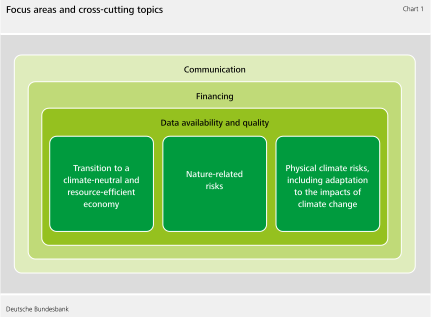
In its climate and nature-related analytical work, the Bundesbank is currently concentrating on three key focus areas: (i) the transition to a climate-neutral and resource-efficient economy, (ii) nature-related risks and (iii) physical climate risks, including adaptation to the impacts of climate change. TheBundesbank’s four overarching climate and nature-related targets set the strategic direction for the Bank’s work in these areas. The focus areas, meanwhile, form the basis for deriving technical objectives and measures in the Bundesbank’s core services and functions. They thereby ensure a targeted and coordinated implementation of the climate roadmap throughout the Bank.
Focus area 1: Transition to a climate-neutral and resource-efficient economy
The transition to a climate-neutral and resource-efficient economy, the subject of the European Climate Law 10 and the Federal Climate Change Act 11 , implies far-reaching economic changes. The financial system is at the same time a stakeholder and an actor – and plays a pivotal role in climate policy: for example, it allows capital to be mobilised for the required projects and investments. The spread of new technologies and the implementation of climate and energy policy objectives, including the transition of energy infrastructure, are leading to structural changes throughout the economy and in the financial system; these may give rise to risks. The Bundesbank is closely monitoring technological, regulatory and market developments and analysing risks and implications for monetary policy, financial stability and financial supervision. The objective of these activities is to ensure the Bundesbank has a comprehensive understanding, in particular of developments in the energy markets, climate policy and regulation, so that it is well placed to ensure price and financial stability.
Focus area2: Nature-related risks
The loss of natural resources and ecosystem services, and the risks associated with increasing water scarcity, have economic and financial repercussions. Over the coming years, the Bundesbank will step up its efforts to enhance its understanding of nature-related risks and their potential impact on the German economy and financial system. One focus will be on improving data availability and quality in order to facilitate measurement and comparison of nature-related risks. In addition, methods for identifying and assessing these risks will be refined and integrated into economic analysis, supervision and regulation. The aim is to gain insights into which forms of nature-related risk (for example water scarcity) could have severe impacts on the economy and the stability of the financial system, and to what extent such risks vary from region to region. This knowledge can be key to strengthening the stability and resilience of the financial system.
Focus area 3: Physical climate-related risks, including adaptation to the impacts of climate change
The physical impacts of climate change include extreme weather events, which are likely to increase in frequency and severity. These developments pose growing challenges for both the real economy and the financial system – in Germany, Europe and globally. At the same time, capital is needed for targeted adaptation investment in order to make infrastructure and supply chains more resilient. The Bundesbank is therefore deepening its understanding of physical climate risks, their transmission channels and measures to adapt to climate change. This is the basis for strengthening the resilience of the German financial system to climate risks, ensuring sufficient transmission of monetary policy and improving the information available to decision-makers and market participants.
The cross-cutting topics “data availability and quality”, “financing” and “communication” are included in all three focus areas (see Chart 1).
Data availability and quality: An adequate assessment of climate and nature-related risks and opportunities is possible only where data availability and quality are sufficient. These data are necessary to make informed decisions and quantify the required investment. In addition to information that helps with the assessment of the macroeconomic impact of climate policy, the Bundesbank believes it is crucial to complete and improve data on physical and nature-related risks. The Bundesbank will use new technologies and innovative data sources to improve data quality and availability in a targeted manner.
Financing: The Bundesbank analyses how the transition is financed. This financing is crucial to unlock the necessary investment in green technologies, nature-based solutions 12 and infrastructure. It plays a key role in mitigating risk and allowing adaptation to the impact of climate change. It does so by enabling private sector actors to adapt to changes in environmental conditions and become more resilient. 13 Financing is also needed to achieve the target of climate neutrality. The proper functioning of financial markets, especially financial stability, is a prerequisite for sufficient financing. Financing the transition requires substantial investment, especially from the private sector. Targeted government measures can also support the transition.
Communication: In addition to its three focus areas, the Bundesbank attaches particular importance to fact-based communication of the economic and financial impacts of climate change and nature loss. This knowledge is essential for policy and society to make informed decisions, for raising public awareness, effectively managing risks, fostering international cooperation and ensuring economic stability.
Business unit-specific objectives and measures set out in the Climate Roadmap 2026‑2027
2026‑2027
Business unit-specific objectives and measures for the core services Monetary Policy, Money, Financial Supervision and Stability and Financial Market Services and Statistics
Monetary Policy
Supporting monetary policy decision-making processes through in-depth analysis of the interactions between monetary policy, the economy as a whole and transition processes, including the impact on Germany as a business location and financial centre.
Actively and constructively contributing to and shaping the Eurosystem’s committee work on incorporating climate-related aspects.
Strengthening and deepening institutional knowledge of market and regulatory developments, Germany as a financial centre, and climate and sustainability risks through active dialogue with stakeholders.
Money
Studies and initiatives to reduce the ecological footprint of the cash cycle.
Incorporating sustainability aspects into the technical development and future operation of the digital euro and in the settlement of cash payments.
Active involvement and participation in international bodies and Eurosystem studies to promote sustainability in payments and securities settlement.
Comprehensive analysis to identify potential ways to apply sustainability principles to payments and securities settlement and the systematic discontinuation of cheques as a payment method in Germany.
Financial Supervision and Stability
Improving and expanding methods and models for sustainability-related financial stability analysis while identifying and using new data sources. Adding forward-looking indicators to sustainability-related financial stability analysis. Making new technologies an integral part of collecting and evaluating sustainability data.
Integrating climate change risks more fully into the supervisory process. Providing off-site supervisors with targeted information from a central source for use in their daily work. Providing off-site supervisors and on-site examiners with further training on these risks.
Financial Market Services and Statistics
Enhancing and evolving the sustainability concept for the Bundesbank’s own portfolio, incorporating the objectives of the Paris Agreement.
As part of asset management for central government, regional governments and public institutions, continuing to support clients in developing sustainability strategies and preparing climate-related portfolio reports.
Providing internal and external users with customised sustainability data in order to close specific data gaps.
2026‑2027
Business unit-specific objectives and measures for the functions Communication, Policy Advice and Research and Sustainability
Communications,
Policy Advice
and Research
Strengthening the Bundesbank’s academic reputation through high-quality sustainability research and active participation in international academic exchanges. Firmly embedding the topic of sustainability in the research programme and addressing it in individual research projects.
Publishing Bundesbank research on climate change, climate policy and nature loss. Building on this: regularly communicating research findings and their policy implications internally and externally.
Sustainability
Strengthening the Bundesbank’s image as a trusted point of contact on climate and environmental risks, transition and sustainable structural change through a targeted expansion of dialogue and cooperation with relevant sustainability stakeholders.
Actively contributing to strategic sustainability issues through work in committees and other fora, for example in the European System of Central Banks, the G7 and the Network for Greening the Financial System.
Systematically incorporating sustainability aspects across the Bundesbank and continuously expanding staff knowledge of sustainability topics.
Annex: The Bundesbank’s activities
Over the past few years, the Deutsche Bundesbank has embarked on certain activities in order to analyse climate and nature-related risks more comprehensively and, within its mandate, contribute to the transition to a climate-neutral and resource-efficient economy. The figure below contains information on important committees, key Bundesbank projects and results, and relevant monetary policy decisions from the past year.