Effects of global uncertainty on international portfolio flows Monthly Report – October 2025
Published on
Effects of global uncertainty on international portfolio flows Monthly Report – October 2025
Monthly Report Published on
Uncertainty had a major influence on investor behaviour and capital market dynamics during past events such as the global financial crisis in 2008 and the Covid-19 pandemic. This analysis shows that heightened global uncertainty had a much greater impact on portfolio flows in emerging markets than those in advanced economies. Thus, in periods of elevated uncertainty, investors tended to disproportionately reduce their exposure to emerging market economies. This was reflected by outflows from investment funds: across all countries under review, outflows from emerging markets were around three times higher on average than those from the advanced economies. These figures highlight the fact that emerging economies were more prone to external shocks in the past than their developed market counterparts. Another striking aspect is that bond funds witnessed significantly higher outflows as a percentage of total holdings than equity funds.
In economic literature, various measures of uncertainty and different approaches are used to identify additional unease among market participants. This analysis uses a method that is based on short-term changes in the price of gold. The latter plays a particularly important role for emerging economies and has a high-frequency dataset. Gold price movements are linked to previous events that triggered uncertainty.
Emerging markets is a collective term for a wide range of economies. As countries in this group have different production landscapes, institutions and financial markets, it is worth examining the role of country-specific factors in determining how far the respective cross-border portfolio flows were impacted by past uncertainty. The results reveal significant differences within the group of countries under review: in particular, high investments in research and development, along with developed financial markets, were associated with lower outflows stemming from uncertainty shocks. These factors therefore serve as a proxy for underlying conditions that support greater stability in portfolio flows.
1 Introduction
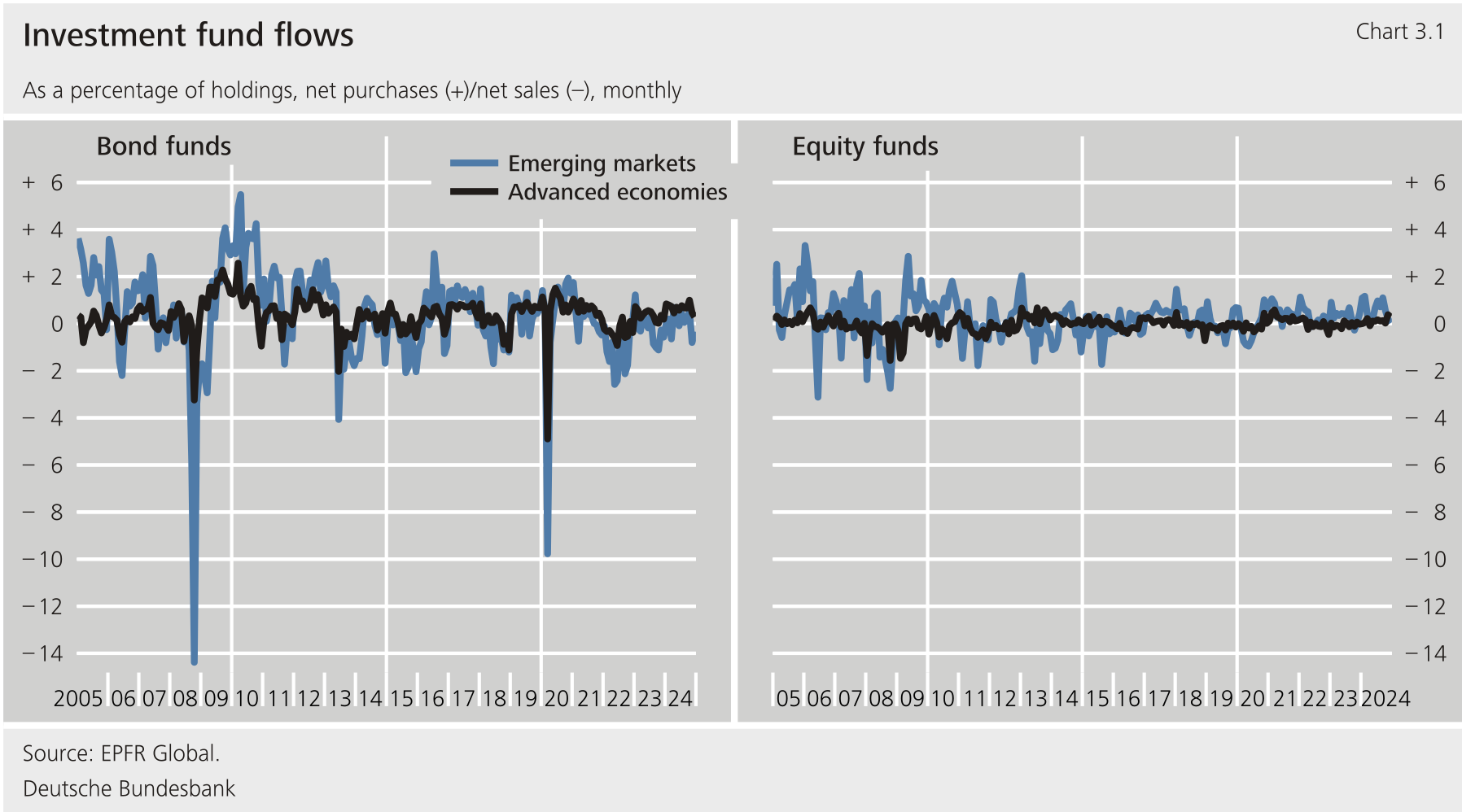
In recent decades, the international financial markets have been shaped by events that resulted in high uncertainty. The most striking examples are the global financial crisis in 2008 and the outbreak of the Covid-19 pandemic across the world in spring 2020. Both events took most people by surprise and markedly increased the unpredictability of future developments. The high uncertainty had a pronounced impact on the dynamics of international portfolio flows. As shown in Chart 3.1, investment funds suffered significant outflows during both of the aforementioned crises. Bond funds that were invested in emerging market instruments were hit particularly hard, with international investors withdrawing more than 14 % of their holdings from these funds in October 2008. This analysis focuses on the role of uncertainty as a driving force behind these trends.
Uncertainty has a pronounced influence on cross-border investor decisions regarding investment funds, with asymmetrical global effects. This study shows that past uncertainty impacted global portfolio flows, though the intensity of the reaction varied from region to region and – in relative terms – was particularly strong in emerging markets. The results of this analysis are important not only for investors and financial institutions, but policymakers as well. The latter are responsible for taking measures to ensure stability in financial markets and cushion the economic repercussions of shocks. This analysis therefore focuses on examining how uncertainty influences investor behaviour and how the impact of uncertainty on portfolio flows can be mitigated.
2 What is uncertainty and how can it be measured?
Differentiating between uncertainty and risk is a key aspect in understanding economic decision-making processes. In economic literature, this difference was predominantly defined by the economist Frank Knight, who suggested making a distinction between the two concepts. 1 According to Knight, risk denotes situations in which the outcome of an event is uncertain, though the probabilities of the possible outcomes are known. Conversely, uncertainty arises when probabilities are impossible to determine. Tossing a fair coin is a classic example of risk in which the probability of heads or tails is 0.5. In contrast, uncertainty occurs when the probabilities of possible repercussions cannot be defined precisely, such as during the pandemic of a novel and largely unexplored virus.
Risk and uncertainty are distinct concepts in theory, but are difficult to separate in practice. Due to the problem of distinguishing risk from uncertainty, both concepts are interlinked in empirical studies. This makes it harder to isolate the concept of uncertainty. Accordingly, there is no single scientific method for this purpose: instead, a variety of approaches are used in economic literature to capture specific facets of uncertainty. 2 These approaches can be subdivided into the following categories:
News-based measures usually focus on how frequently certain key words such as “uncertainty” or “crisis” feature in the media. These measures therefore reflect societal perceptions of uncertainty and are more or less available in real time. For example, the Economic Policy Uncertainty (EPU) index uses key words in news articles to measure policy-related uncertainty. 3 In addition, uncertainty regarding the Fed’s monetary policy can be gauged using measures such as the Monetary Policy Uncertainty (MPU) index. 4
Survey-based measures capture perceived uncertainty directly from economic agents and provide insights into specific dimensions of uncertainty. Survey-based measures offer a direct means of recording how uncertainty is perceived among various economic agents. One prominent example is the Survey of Business Uncertainty (SBU) from the Federal Reserve Bank of Atlanta, which measures firms’ uncertainty regarding their future employment and sales situation.
Market-based measures use financial market data to capture uncertainty in near real time. Market-based measures allow uncertainty to be derived directly from financial market data. They include, amongst others, the realised volatility of asset prices as a direct reflection of market fluctuations. One well-known example is the CBOE Volatility Index (VIX) for the US equity market based on option prices in the S&P 500. The VIX usually climbs in tandem with uncertainty. However, it primarily only reflects financial market uncertainty in terms of expectations for the S&P 500. Generally speaking, the volatility of financial market prices can be an appropriate tool for spotting uncertainty. 5 It is also possible to use measures of risk appetite as uncertainty indicators. 6 These measures are useful as they are available in real time and provide a reliable picture of market participants’ perceptions.
Econometric measures are based on statistical methods and often paint a broader picture of uncertainty. Macroeconomic uncertainty can be measured by the extent to which variables fluctuate in ways that models fail to predict. 7 In addition, it is possible to extract uncertainty from data via models. Econometric methods can also be used to identify unexpected uncertainty shocks.
Aspects such as high-frequency gold price movements in response to specific events are also used in the literature to identify uncertainty. Gold price movements can be a useful external instrument for identifying global uncertainty shocks in isolation from country-specific effects. 8 The global aspect plays a particularly significant role in the international portfolio flows considered in our analysis.
3 How can uncertainty affect the economy?
Uncertainty can impact the economy via various channels. It is a pervasive phenomenon that influences the consumption and investment decisions of households and government institutions, as well as financial and non-financial firms. 9 These decisions are interlinked and also have repercussions on the international capital markets. In addition, the effectiveness of monetary policy can be impacted by uncertainty. Some of the effects are discussed below. 10
In times of heightened uncertainty, individuals tend to increase their propensity to save and scale back their consumption. They do so as precautionary measures to protect themselves from future economic volatility or adversity. Economic agents can mitigate the potential negative impact of uncertainty by creating financial reserves. However, this shrinks overall demand, which in turn can hamper economic activity.
Uncertainty has multi-faceted effects on companies’ output that are not entirely predictable. How firms react to uncertainty shocks depends on a multitude of factors such as storage costs, production and cost structures, decision-makers’ risk appetite and the overall labour market. Uncertainty often leads companies to take precautionary action, such as reducing or postponing investments, or cutting production to minimise potential losses. 11 Yet in other scenarios, uncertainty can foster growth in production. Companies therefore respond to uncertainty in different ways, which largely depend on their individual circumstances and the prevailing economic setting.
Governments also usually react – and are not immune – to phases of elevated uncertainty. In the long term, governments can strengthen the resilience of the economy via stability-oriented macro and fiscal policy, while ensuring a stable financial infrastructure (see also the supplementary information entitled “Empirical measurement of the impact of uncertainty on portfolio flows”). In the short term, they can counter the negative effects of unexpected events by deploying an anticyclical economic policy, as well as targeted interventions in severe cases. However, systemic shocks can even undermine governments and, in extreme cases, limit their ability to act, especially if they were already in a precarious situation beforehand. 12
Uncertainty affects not only the real economy, but also monetary policy. Operational monetary policy in the euro area factors the entire transmission process into its decision-making, including financing conditions in the capital markets. Adjustments to monetary policy are therefore particularly necessary if uncertainty impacts the transmission and effectiveness of monetary policy measures. 13
The impact of uncertainty is usually apparent on the capital markets before it is reflected in the real economy. 14 This is because market participants anticipate the effects on the real economy and respond accordingly. As a result, the companies concerned usually face rising financing costs, while banks rein in their lending. 15 This impacts both market prices and trading volumes. 16 In a world of globally interwoven capital markets, international portfolio flows are directly affected.
Typically, increased uncertainty leads in particular to sales of risky assets, lower securities prices and thus higher risk premia, as investors demand compensation for the risks they take. Financing costs therefore rise for companies and governments. This prompts outflows of funds from countries and markets that are considered unstable, as well as inflows to countries and assets such as gold that are deemed safe. 17 The theory of portfolio diversification developed by Markowitz provides a framework for understanding these adjustments. 18
4 Effects of uncertainty on portfolio flows
Econometric models can be used to identify portfolio flow reactions according to specific country groups and examine the interplay with structural factors. Uncertainty shocks that are triggered by global events such as financial crises, geopolitical turmoil and pandemics can have a significant impact on portfolio flows, with far-reaching consequences for economic stability. Conversely, however, the macroeconomic and financial health of a particular economy can influence how the financial markets react to periods of heightened uncertainty. Both aspects can be examined using econometric analyses.
Supplementary information
Empirical measurement of the impact of uncertainty on portfolio flows
A two-step econometric model can be used to examine how unexpected uncertainty shocks affect portfolio flows in emerging market and advanced economies and which factors could play a role in the transmission. 1 We make a distinction between equity fund flows and bond fund flows in order to take account of the different characteristics of these asset classes. 2 The analysis covers a total of 25 emerging market economies and 21 advanced economies in the period from August 2005 to December 2023. 3 We place particular emphasis on the question of whether emerging market economies are more affected by uncertainty shocks than advanced economies owing to their specific economic and institutional characteristics.
To answer these questions, we identify uncertainty within an econometric model based on changes in the price of gold. This approach assumes that market participants view gold as a safe asset. In times of heightened uncertainty, demand for gold therefore rises, leading to an immediate increase in the price of gold. Conversely, the price of gold falls as soon as uncertainty dissipates. In statistical models, the fluctuations in the price of gold over a short period of time around events associated with uncertainty thus serve as an independent indicator of the degree of uncertainty. 4 This methodology is useful here, as gold price movements can reflect a wide spectrum of global uncertainty, which is particularly important for emerging market economies, where there are often no developed financial markets from which country-specific indices can be derived. The methodology is also empirically well documented. 5 For advanced economies, other methodologies based directly on financial market data are also useful.
In the case at hand, the gold price developments relating to 109 different transnational events are incorporated into the analysis. This allows us to investigate the effects of global uncertainty impulses on various variables – in this case, on portfolio flows.
In a second step, it can be shown that the extent of outflows following an uncertainty shock correlates with the macroeconomic and institutional framework conditions in the affected economies. To this end, the country-specific sensitivity of fund flows for each region and asset class is placed in relation to macroeconomic and institutional factors. The factors considered include, for example, economic growth, inflation, financial market developments and investment in research and development. The state of development of financial markets 6 and investment in research and development are shown to be variables that are strongly related to fund flows in all regions and asset classes. In countries with highly developed financial markets and high investment in research and development, the impact of an uncertainty shock on fund flows is smaller. Correlations can also be identified between infrastructural factors and bond fund flows. 7 In this context, international investors’ trust in a country’s structural make-up and the government’s ability to overcome potential crises are likely to play a role. These factors are classic indicators of an economy’s resilience. 8 In addition, equity funds that invest in advanced economies show lower sensitivity to uncertainty shocks in countries with low long-term interest rates. This relationship could be related to the risk premium in these countries, but it remains descriptive here.
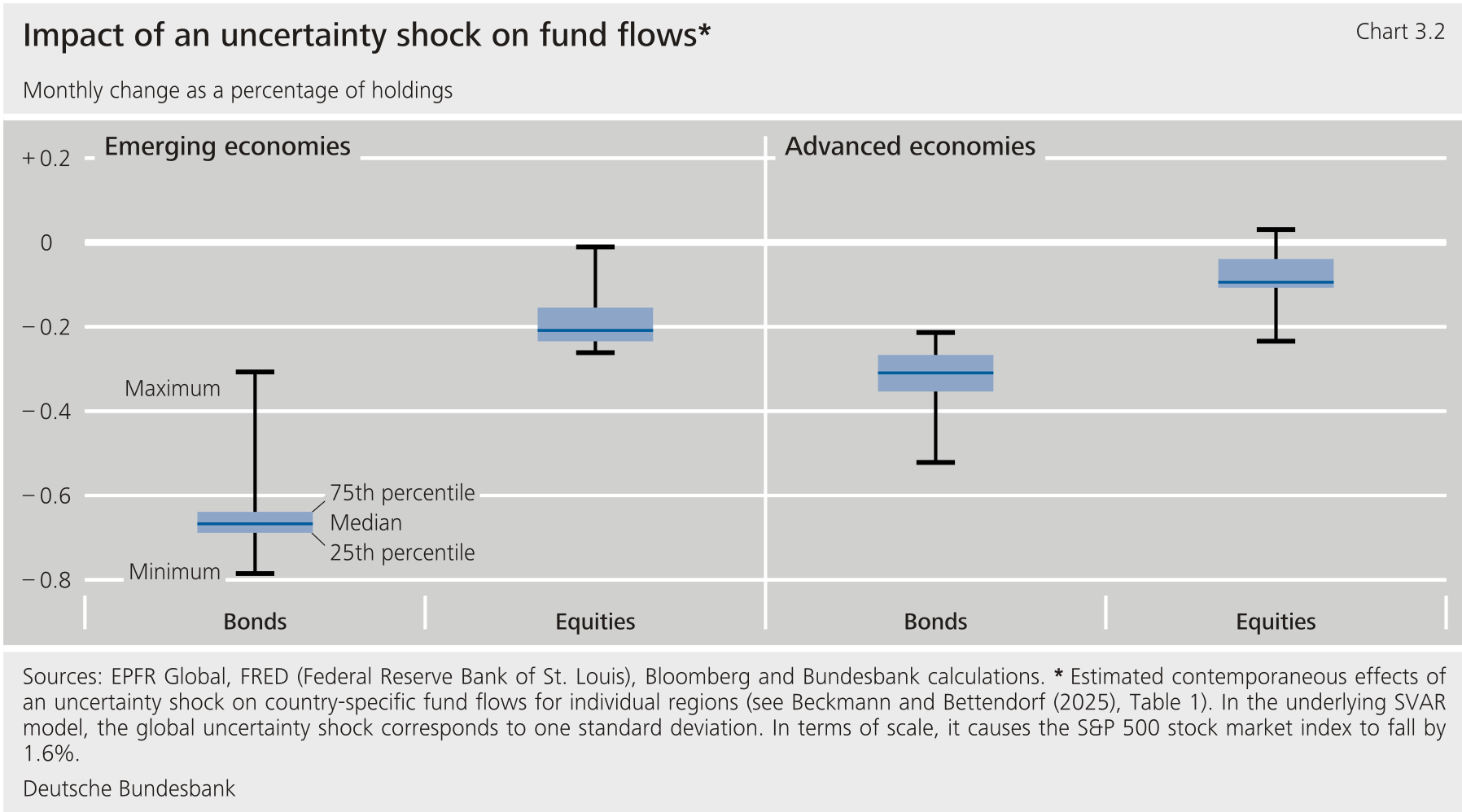
Bundesbank analyses conclude that the negative effects on portfolio flows due to uncertainty shocks are greater in emerging markets than in advanced economies. 19 This applies to both equity fund flows and bond fund flows. Moreover, bond fund flows are more sensitive to uncertainty shocks than equity fund flows. In the emerging economies, outflows due to uncertainty shocks are around three times as high as those in developed countries for bond and equity funds alike. However, monthly bond fund flows as a percentage of total holdings are significantly more pronounced.
These results make clear that emerging markets are more vulnerable in the event of an unexpected increase in global uncertainty. The high sensitivity of emerging market bonds is a potential indicator that, in periods of elevated uncertainty, international investors will target these assets when scaling back their positions to minimise risks. It is possible that investors expect contagion effects to be greater in emerging markets than in advanced economies. Conversely, equity flows appear less sensitive to uncertainty shocks than bond flows. Yet it is worth noting that equity prices are far more volatile than bond prices, as the latter are anchored by the nominal value that is reimbursed at maturity. Bond markets are therefore affected more by volume adjustments than equities. In contrast, price adjustments are more pronounced for equities.
The level of impact caused by uncertainty is closely linked to macroeconomic and institutional factors. In both emerging markets and advanced economies, uncertainty shocks tend to have a lower impact on portfolio flows in countries that invest heavily in research and development and have highly developed financial markets. Infrastructure variables also play a role in bond funds.
The results of this study have important implications for economic policy, especially in the emerging markets. According to the results, international investors tend to reduce their positions in emerging markets during periods of uncertainty, regardless of whether bond or equity funds are involved. That said, bond funds are more prone to outflows than equity funds. The results suggest that favourable macroeconomic and institutional conditions can mitigate the impact of uncertainty shocks and keep investors on side. Specifically, the quality of financial and real infrastructure increases a country’s resilience to unforeseen adverse events. At the same time, economic policy that stimulates investment in research and development enhances a country’s economic outlook and its ability to adapt.
List of references3
Baele, L., G. Bekaert, K. Inghelbrecht and M. Wie (2020), Flights to Safety, The Review of Financial Studies, Vol. 33(2), pp. 689‑746.
Baker, S. R., N. Bloom and S. J. Davis (2016), Measuring Economic Policy Uncertainty, The Quarterly Journal of Economics, Vol. 131(4), pp. 1593‑1636.