What significance does financial stability have in the Federal Open Market Committee’s monetary policy discussions? 80th edition – January 2026

Dimitrios Kanelis, Lars H. Kranzmann, Pierre L. Siklos

80th edition – January 2026

What significance does financial stability have in the Federal Open Market Committee’s monetary policy discussions?

13/01/2026 — Dimitrios Kanelis, Lars H. Kranzmann, Pierre L. Siklos

Financial stability has grown in importance for central banks since the Global Financial Crisis (GFC) of 2007‑09. This edition of our research brief explores how the Federal Reserve’s Federal Open Market Committee incorporates financial stability into its monetary policy deliberations in order to fulfil its mandate objectives. We show that discussions on financial stability during the low interest rate period (2009‑15) – a period during which the federal funds rate was at the zero lower bound – played a part in the tightening of monetary policy. The monetary policy communications, meanwhile, focused on the mandate objectives.

Federal Open Market Committee meeting on 28 October 2025
Federal Open Market Committee meeting on 28 October 2025 Federal Open Market Committee meeting on 28 October 2025 – Source:: Federalreserve
Federal Open Market Committee meeting on 28 October 2025Federal Open Market Committee meeting on 28 October 2025 — Source: Federalreserve

The Global Financial Crisis (GFC) of 2007‑09 made it plain that instability in the financial system can impair monetary policy transmission and thus jeopardise the objectives set out in the central bank mandate. In addition, the literature is once again discussing a policy of “leaning against the wind” – that is to say, monetary policy that preventively counteracts emerging financial risks with a view to avoiding larger macroeconomic fluctuations (Svensson, 2017).

In a new study (Kanelis, Kranzmann and Siklos, 2025), we explore how discussions on financial stability shape the monetary policy decisions of the Federal Open Market Committee (FOMC) and its monetary policy communication. Within the Federal Reserve System, formal responsibility for financial stability lies primarily with the Board of Governors, while the FOMC sets monetary policy and discusses stability risks as part of risk management. The FOMC convenes eight times a year, with each meeting following the same procedure. Staff briefings on the economic situation are followed by a plenary session, then policy options are discussed, and finally the voting members cast their votes. Decisions are explained in a statement and a press conference, and the minutes of FOMC meetings are released three weeks after each meeting. 

We analyse these minutes using techniques situated at the interface between machine learning and natural language processing. First, we use the structural topic model (Roberts et al., 2016) to identify the topics covered in the discussions. That model identifies topics based on word probabilities and takes correlations between topics into account. This topic prevalence analysis captures discussions on price stability and full employment, which we call mandate objectives, as well as those on financial stability. In the next step, we train the language model RoBERTa (Liu et al., 2019) with a new dataset so as to extract the economic sentiment from the minutes.

Discussions on financial stability have gained importance on the FOMC since the GFC.

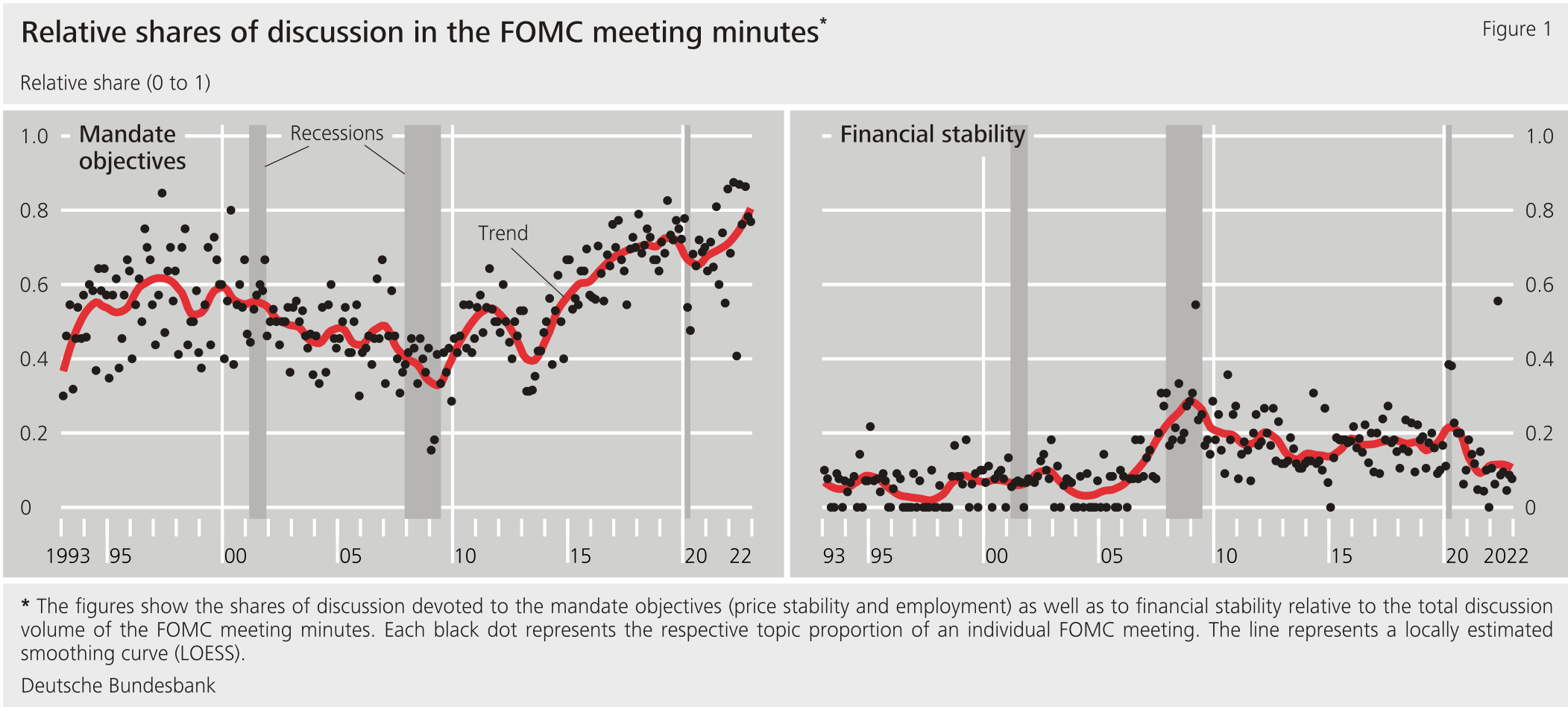
The analysis reveals that, since the GFC, discussions on mandate objectives and on financial stability have become more important in the FOMC’s monetary policy deliberations. The generally elevated importance of financial stability rose further still for a time at the onset of the COVID-19 pandemic (Figure 1).

Figure 1: Relative shares of discussion in the FOMC meeting minutes

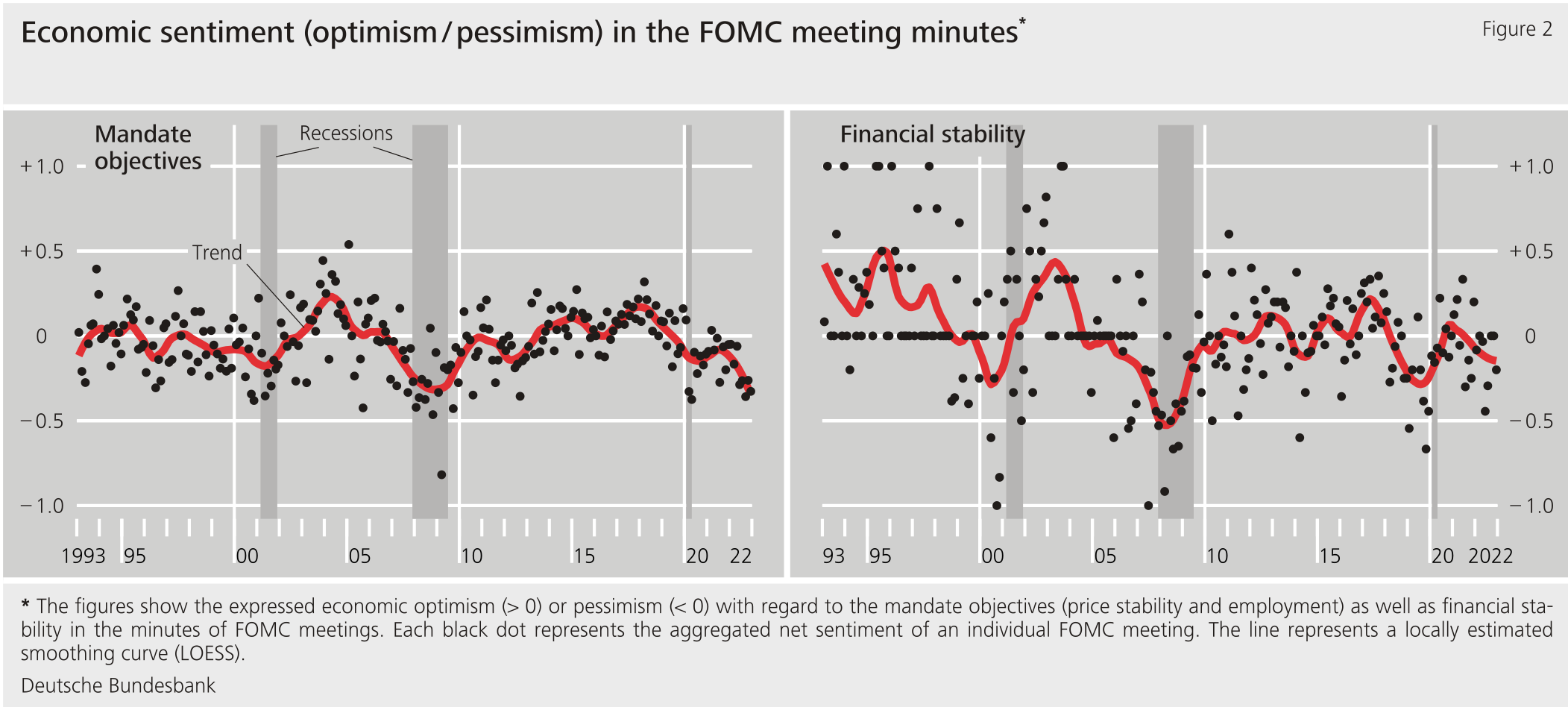
By contrast, the sentiment analysis shows that optimism in the FOMC’s deliberations on the mandate objectives peaked in the 2000s but then plummeted during the GFC (Figure 2). The sentiment of discussions gradually recovered in the 2010s, only to worsen again at the start of the COVID-19 pandemic. Sentiment measured for financial stability was highly volatile initially because that topic had barely been discussed beforehand. After bottoming out during the GFC and the topic becoming a more regular talking point in FOMC meetings, it was possible to measure sentiment more reliably. Pessimism increased significantly during the dotcom bubble and at the onset of the COVID-19 pandemic. 

Figure 2: Economic sentiment (optimism / pessimism) in the FOMC meeting minutes

A larger share of discussions on financial stability at FOMC meetings influences monetary policy decisions …

So to what extent do discussions on financial stability influence monetary policy decisions and communication? To answer this question, we take the variables derived from the minutes on the shares of discussions and the sentiment of discussions with regard to the mandate objectives and financial stability, and feed these into Taylor rules (Coibion and Gorodnichenko (2012); Carvalho et al. (2021)). In addition, we exploit these variables to explain the sentiment of the FOMC’s statements. Our approach pays particular attention to the zero lower bound (ZLB) period between 2009 and 2015, during which the Federal Reserve deployed unconventional measures to influence capital market interest rates. We use the shadow rate of Wu and Xia (2016) to measure the impact of unconventional monetary policy. The shadow rate is a hypothetical short-term interest rate that would materialise in the absence of a nominal ZLB. It measures the pressure placed on longer-term interest rates when non-standard monetary policy measures are taken (Deutsche Bundesbank, 2019).

In the estimates, an increase in discussions on financial stability is generally accompanied by falling short-term interest rates, which we attribute to concerns about spillovers to the real economy. At the ZLB, by contrast, increasing discussions on financial stability are accompanied by monetary policy tightening. This tightening is reflected not in the federal funds rate, but in a more restrictive balance sheet policy that we approximate using shadow rates. The tighter monetary policy was motivated by concerns that investors might search for yield – that is, invest more in riskier securities when the risk-free interest rate is low. This is indicated by a supplementary manual evaluation of the transcripts.

… but not the monetary policy communication in the FOMC’s statement. 

As far as communication is concerned, we can see that optimism among FOMC members with regard to the mandate objectives is reflected in the FOMC’s statement having a more upbeat tonality. We find no robust correlation, meanwhile, between the share or sentiment of discussions on financial stability and the tonality of the statement. The asymmetric impact of financial stability discussions on monetary policy implementation and communication makes it clear that monetary policy decisions cannot be fully explained without taking financial stability into account.

Conclusion

While the Federal Reserve does not have its own financial stability mandate, the minutes of FOMC meetings show that the Fed does take financial stability into account in its monetary policy considerations to ensure price stability and full employment. During the ZLB period, a higher share of FOMC discussions on financial stability was accompanied by a tightening of monetary policy. This was reflected not in the federal funds rate, but – as we demonstrate using the shadow rate – in the unconventional monetary policy instruments. No correlation can be found in the monetary policy communication. Overall, this suggests that financial stability considerations are incorporated indirectly into monetary policy decisions. 

List of references

Carvalho, C., F. Nechio and T. Tristão (2021), Taylor rule estimation by OLS , Journal of Monetary Economics 124, 140‑154.

Coibion, O. and Y. Gorodnichenko (2012), Why are target interest rate changes so persistent? , American Economic Journal: Macroeconomics 4, 126‑162.

Deutsche Bundesbank (2019), Interest rate pass-through in the low interest rate environment , Deutsche Bundesbank Monthly Report, April 2019.

Kanelis, D., L. H. Kranzmann and P. L. Siklos (2025), The financial instability – monetary policy nexus: Evidence from the FOMC minutes , Deutsche Bundesbank Discussion Paper No 13/2025.

Liu, Y., M. Ott, N. Goyal, J. Du, M. Joshi, D. Chen, O. Levy, M. Lewis, L. Zettlemoyer and V. Stoyanov (2019), RoBERTa: A Robustly Optimized BERT Pretraining Approach , arXiv:1907.11692.

Roberts, M. E., B. M. Stewart and E. M. Airoldi (2016), A model of text for experimentation in the social sciences , Journal of the American Statistical Association 111, 988‑1003.

Svensson, L. E. O. (2017), Cost-benefit analysis of leaning against the wind , Journal of Monetary Economics 90, 193‑213.

Wu, J. and F. Xia (2016), Measuring the macroeconomic impact of monetary policy at the zero lower bound , Journal of Money, Credit and Banking, 48, 253‑291.

Disclaimer

The views expressed here do not necessarily reflect the opinion of the Deutsche Bundesbank or the Eurosystem.

Has this page helped you?