How do geopolitical risks affect the euro area economy? 85th edition – August 2026

Research Brief Published on

Yevheniia Bondarenko, Nayeon Kang, Vivien Lewis, Matthias Rottner, Yves Schüler

85th edition – August 2026

How do geopolitical risks affect the euro area economy?
— Yevheniia Bondarenko, Nayeon Kang, Vivien Lewis, Matthias Rottner, Yves Schüler

While current indicators measure geopolitical risk from a predominantly US perspective, we build on them to develop a new measure of geopolitical risk that is specifically tailored to the euro area. Our results show that a sudden increase in geopolitical risks in Europe triggers significant recessionary and inflationary effects in the euro area, whereas typical risk measures do not capture these effects. We augment our indicator with two other euro area-specific measures of sanctions and shortages, which together enable a comprehensive analysis of geopolitical risks to the euro area economy.

Mehrere Schiffscontainer mit Flaggen verschiedener Länder, an Ketten aufgehängt. – Source: freshidea – stock.adobe.com
Mehrere Schiffscontainer mit Flaggen verschiedener Länder, an Ketten aufgehängt.
Source: freshidea – stock.adobe.com

doi.org/10.71734/RB‑85-en

Geopolitical risk (GPR) refers to the threat, realisation and escalation of adverse events associated with wars, terrorism and any tensions among states and political actors that affect the peaceful course of international relations (Caldara and Iacoviello, 2022). Since Russia’s invasion of Ukraine at least, the role of geopolitical risk has taken on a considerably more prominent role. 

As GPR mounts, there is also a growing need to reliably measure its economic impact. This is important for decision-makers – particularly central banks – so they can identify economic developments such as recessionary effects or rapid increases in the price level at an early stage and respond appropriately. Central banks and international institutions therefore use indicators intended to quantify geopolitical risk.

Most existing GPR indicators – including the widely used index developed by Caldara and Iacoviello (2022) – are based on media sources from the English-speaking world and, by extension, have a strong US focus. This means that forms of geopolitical risk specific to certain regions, especially in the euro area, are not adequately captured.

For this reason, in a new study (Bondarenko et al., 2026) we develop a geopolitical risk indicator specifically for the euro area (EA GPR). Our study shows that unexpected increases in the EA GPR index (EA GPR shocks) have a pronounced economic impact, including significant recessionary and inflationary effects that are either underestimated or not captured by typical measures, referred to here as the “US-centric GPR index”.

Measuring local perceptions of risk in the euro area
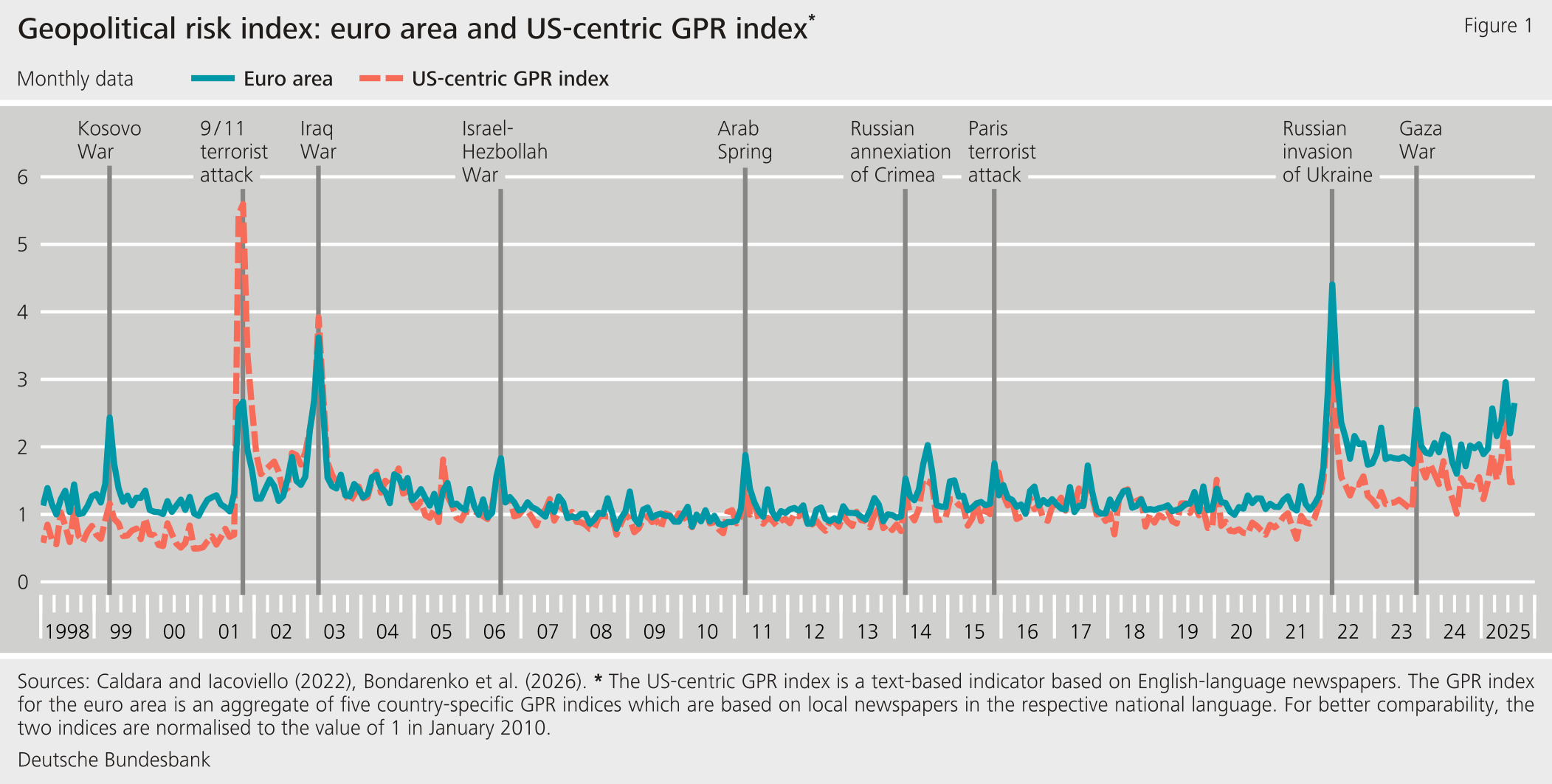
The EA GPR index is constructed from newspaper articles in the five largest euro area economies – Germany, France, Italy, Spain and the Netherlands. We analyse the frequency of terms associated with war, conflict and terrorism in leading national newspapers in the respective national language. Using GDP weights, we aggregate the country-specific indices to form a single euro area measure. In this way, we have developed an indicator with a daily and monthly frequency, which is available for download. Figure 1 shows the monthly EA GPR index from January 1998 to August 2025 and compares it with the US-centric GPR index of Caldara and Iacoviello (2022).

Geopolitical risk index: euro area and US-centric GPR index

The comparison shows that GPR is inherently region-specific and is shaped by local media narratives and geographical proximity to conflicts. While both indicators exhibit a similar response to key global events, the US-centric GPR index does not adequately capture the particular geopolitical risks to the euro area. The EA GPR index tailored to the euro area has a much stronger and more persistent response to certain regionally important events, such as the Russia-Ukraine war. By contrast, the terrorist attack of 11 September 2001, which marks the peak of the US-centric GPR index, plays a smaller role for the euro area. These differences underscore the importance of local geopolitical risks (see Bondarenko et al., 2024). 

Decline in output and higher inflation in the euro area due to Russia’s invasion of Ukraine
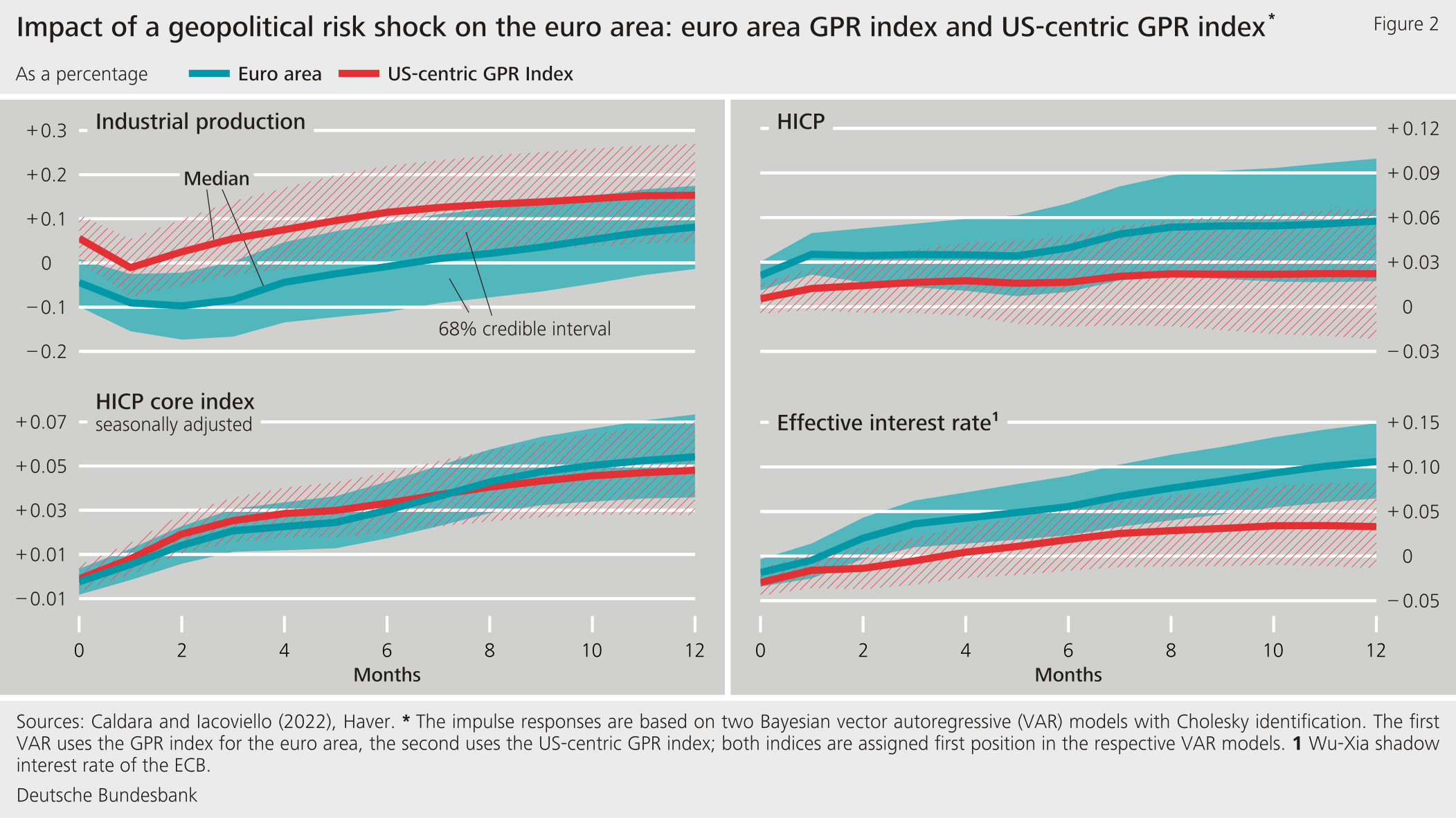
To estimate the economic effects of changes in the EA GPR index, we use a Bayesian vector autoregressive model augmented by adjustments for the COVID‑19 pandemic. This approach allows us to compare the effects on the euro area of unexpected increases in the EA GPR index with those of the US-centric GPR index.

Impact of a geopolitical risk shock on the euro area: euro area GPR index and US-centric GPR index

Geopolitical shocks, i.e. unexpected increases in the GPR index, in the euro area lead to a decline in output and rising inflation, as shown in Figure 2. The US-centric GPR index systematically underestimates these effects. For example, in the latter index, unlike the EA GPR index, production and inflation effects are not statistically significant (see Chart 2). In a what-if analysis, we calculate the impact of Russia’s war of aggression on euro area output. In the analysis, we keep geopolitical risk at pre-war levels and determine that euro area output would have been around 1 % higher and prices 0.6 % lower by mid-2022 in the absence of the spike in geopolitical risks caused by the Russia-Ukraine war. Our results are consistent with a growing body of literature emphasising the economic relevance of geopolitical risks (see, for example, Goldbach and Nitsch, 2026; Khalil et al., 2025; Fecht et al., 2026).

In addition, our study examines two key transmission channels that can amplify the economic impact of geopolitical risk in the euro area: sanctions and shortages. To do this, we augment our analysis with two news-based indicators to measure the intensity of sanctions and shortages. These were constructed specifically for the euro area. We find that sanctions play only a limited role in the transmission of geopolitical shocks, whereas shortages are a significant contributor to the emergence of inflationary pressures. 

Conclusion

We provide a comprehensive set of indicators for analysing geopolitical risks in the euro area. Our results show that geopolitical shocks in the euro area have pronounced recessionary and inflationary effects. By contrast, if the economic impact of geopolitical risks in the euro area is analysed based on the commonly-used GPR index of Caldara and Iacoviello (2022), the economic effects on the euro area are systematically underestimated. Using a what-if analysis, we also quantify the macroeconomic effects of the Russia-Ukraine war on the euro area economy in 2022 and demonstrate substantial output losses and elevated inflation dynamics. Central banks aim to keep prices stable. This is why it is important that the inflation risks of geopolitical events can be assessed correctly.

List of references

Bondarenko, Y., V. Lewis, M. Rottner and Y. Schüler (2024), Geopolitical risk perceptions, Journal of International Economics, Vol. 152, 104005.

Bondarenko, Y., N. Kang, V. Lewis, M. Rottner and Y. Schüler (2026), Geopolitical Risk in the Euro Area: Measurement and Transmission, Deutsche Bundesbank Discussion Paper 14/2026. 
Data: github.com

Caldara, D. and M. Iacoviello (2022), Measuring Geopolitical Risk, American Economic Review, Vol. 112, No 4, pp. 1194‑1225.

Fecht F., Greppmair S., Imbierowicz B. (2026), A Geopolitical Shock to Bank Assets and Monetary Policy Transmission, manuscript, Deutsche Bundesbank. 

Goldbach, S. und V. Nitsch (2026), Bridge Over Troubled Water? German Foreign Direct Investment in Times of Geopolitical Tensions, Economics Letters, 263, 112896.

Khalil, M., D. Osten and F. Strobel (2025), Trade dynamics under geopolitical risk, Deutsche Bundesbank Discussion Paper 03/2025.

Wu, J. C. and F. D. Xia (2017), Time-varying lower bound of interest rates in Europe, Chicago Booth Working Paper No 17‑06. 

Authors

Yevheniia Bondarenko

Deutsche Bundesbank | Research Centre

Nayeon Kang

Deutsche Bundesbank | Research Centre

Vivien Lewis

Deutsche Bundesbank | Research Centre

Matthias Rottner

Deutsche Bundesbank | Research Centre

Yves Schüler

Deutsche Bundesbank | Research Centre

Disclaimer

The views expressed here do not necessarily reflect the opinion of the Deutsche Bundesbank or the Eurosystem.