Annex

Climate Report

I. GHG and climate metrics: background information and methods 

“Carbon” as a synonym for GHG

In this report, “carbon” is used as a synonym for GHG emissions, in line with widespread use in the area of GHG metrics. However, the term “carbon” is misleading, as the GHG metrics do not cover carbon dioxide (CO2) alone but also other GHG within the meaning of the Kyoto Protocol, such as methane (CH4) and nitrous oxide (N2O).

GHG

Share of global emissions (expressed as CO2e) 1

Examples of key sources

Carbon dioxide (CO2)

73.6 %

  • Burning of fossil fuels
  • Manufacture of cement
Methane (CH4)

17.7 %

  • Agriculture: cattle farming
  • Natural gas: leaks during extraction, transport
Nitrous oxide (N2O)

6.2 %

  • Agriculture: use of fertilisers
Other

2.6 %


CO2e as a unit for GHG

The various GHGs are measured by their GHG or warming effects in CO2e or tCO2e.

Quantities of GHG emissions worldwide and in Germany

Annual global GHG emissions are around 50 billion tCO2e. 2 In Germany, they amount to around 760 million tCO2e. This means that average per capita emissions in Germany are just under 9 tCO2e.

II. GHG and climate metrics on the euro portfolio and bonds issued by promotional and development banks

Source of GHG data

To calculate GHG metrics for Bundesbank investments in banks, GHG data derived from the banks’ disclosures (e.g. sustainability reports) are used. The Bundesbank obtains relevant data from the ESG data provider ISS ESG. When calculating GHG metrics, the Bundesbank does not use data on GHG emissions modelled or estimated by data providers. 3  

Lead times for GHG data and retroactive updates of GHG metrics from previous portfolio reference dates

In principle, the aim is to ensure that portfolio holdings and GHG data relate to the same year, data availability permitting. However, for the reporting dates of both 31 December 2023 and 31 December 2024, the GHG metrics are based on data on banks’ GHG emissions in 2023. These were the latest available GHG data when this report was prepared, which is why they were also used for the portfolio reference date of 31 December 2024. For next year’s climate-related disclosures, the plan is to retroactively adjust these calculations using GHG data for 2024. Following the same principle, the calculations as at 31 December 2023 reported in this document have been adjusted to reflect the GHG data for 2023 (having been based on the 2022 data in last year’s disclosures).

Scope 1, 2 and 3 GHG emissions

Category

Comprises

Examples of sectors with comparatively high emissions 

Scope 1Direct GHG emissions
  • Electricity producers
  • Producers of cement, steel
  • Airlines
Scope 2Indirect GHG emissions from the production of purchased energy (primarily electricity)
  • Heavy industry
  • Chemical companies
Scope 3 

Upstream


Indirect GHG emissions along the value chain (except scope 2)
  • Retail
  • Food companies

Downstream


  • Oil and gas producers
  • Manufacturers of cars, aircraft
  • Banks
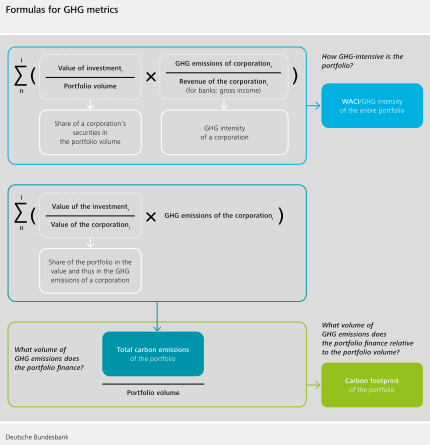
Formulas for GHG metrics

III. GHG and climate metrics for sovereign investments

Sources and measurement approaches for GHG data

The GHG data on sovereigns used in this report are mostly obtained from the United Nations Framework Convention on Climate Change (UNFCCC) data interface, where the UNFCCC lists GHG data recorded by sovereigns and reported to the UNFCCC. In cases where no recent GHG data are available for a given sovereign in the UNFCCC data interface, GHG data from the World Resources Institute (WRI) modelled for this report are used. The data are obtained using the production-based, or territorial, measurement approach: sovereigns are assigned those GHG emissions that occur within their borders or in their jurisdiction. 

Production-based/territorial GHG emissions are also used for sub-sovereigns or federation members/regions. The respective national authorities (e.g. statistical offices) serve as data sources.

GHG data based on the consumption-based measurement approach are not yet included in this report. This approach draws on foreign trade data. Unlike in the production-based approach, sovereigns are not allocated GHG emissions from exported goods but are additionally allocated GHG emissions from imported goods. However, a number of consumption-based methods have so far led to – in some cases – large discrepancies in GHG levels. This report therefore focuses on the well-established production-based approach. 

Lead times for GHG data and retroactive updates of GHG metrics from previous portfolio reference dates

In principle, the aim is to ensure that portfolio holdings and GHG data relate to the same year, data availability permitting. However, GHG data on sovereigns have longer lead times than GHG data on companies. At the time of reporting, the majority of the latest available GHG data refer to 2022 or 2023. In most cases, then, the GHG data merely serve as a provisional basis for the GHG metrics as at the portfolio reference dates of 31 December 2023 and 31 December 2024. To nonetheless provide a meaningful picture of developments in sovereigns’ GHG profiles over time, longer periods are considered for the GHG metrics (WACI, total carbon emissions and carbon footprint) than for amounts that are not invested in sovereigns.

LULUCF as a GHG sector

Measurements of sovereign GHG emissions often differ in whether they include the land use, land use change, and forestry (LULUCF) sector. For example, LULUCF can be a major – and sometimes the largest – source of GHG in densely wooded regions given deforestation. By contrast, reforestation may lead to negative emissions, resulting in an improved GHG profile. LULUCF then constitute GHG sinks.

LULUCF thus play an important role in many national and international climate objectives. However, in view of the complicated accounting of LULUCF, climate researchers still have reservations concerning the quality and comparability of such data. 

The GHG metrics in this report are shown both with and without LULUCF.

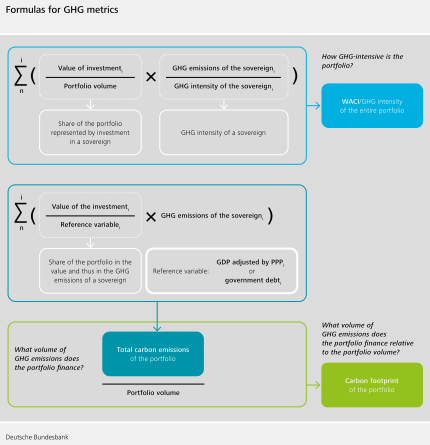
Formulas for GHG metrics

Methodological caveats concerning the total carbon emissions and carbon footprint of sovereign investments

The methods for calculating the total carbon emissions and carbon footprint are not as well established for investments in sovereigns as they are for investments in companies. Methodological challenges notably include adequately capturing which sovereign shares and thus which GHG emissions are financed by investments in the portfolio. 

Early climate-related disclosures often took sovereign debt as the reference variable. Government bonds (held in a portfolio) do indeed account for a part of sovereign debt. However, sovereigns and their GHG emissions are not financed through sovereign debt alone. Under this approach, the financed emissions would therefore be overstated.

The PCAF recommends using GDP adjusted by PPP as the reference variable instead. Unlike sovereign debt, GDP adjusted by PPP is clearly related to a sovereign’s GHG emissions. However, the relationship between government bonds (held in a portfolio) and GDP adjusted by PPP is unclear.

Both approaches therefore have substantial downsides. Despite these reservations, this report includes the total carbon emissions and carbon footprint based on both approaches in order to contribute to the discussion of methodological developments and to identify differences in results.

Production volumes of fossil fuels: methodology for the indicators

Production volumes of coal, crude oil and natural gas are measured by energy content in terajoules (TJ), 4 and are set in relation to the size of the economy (GDP adjusted by PPP), analogously to the WACI methodology. Weighted averages of the intensity of coal, crude oil and natural gas production volumes are calculated for sovereign investments on this basis.

IV. The Eurosystem’s monetary policy holdings – additional metrics

Table 7: Covered bonds in monetary policy CBPP3 and PEPP portfolios: scope 3 GHG metrics


Portfolio as at:

31.12.2020

31.12.2021

31.12.2022

31.12.2023

31.12.2024

WACI of Bundesbank share
(in tCO2e/€mn of gross income)

Scope 3

454
(86 %)

797 
(92 %)

1,587
(94 %)

1,78
(93 %)

1,725
(96 %)

Total carbon emissions of Bundesbank share 
(in tCO2e)

Scope 3

3.7 million
(83 %)

8.6 million
(88 %)

18.1 million
(89 %)

28.1 million
(90 %)

23.7 million
(93 %)

Carbon footprint of Bundesbank share
(in tCO2e/€mn of investment)

Scope 3

59
(83 %)

124
(88 %)

254
(89 %)

409
(90 %)

370
(93 %)

Coverage (by portfolio volume) in italics and parentheses.

Sources: ISS ESG, ECB and Bundesbank calculations.

Table 8: Corporate bonds in monetary policy CBPP3 and PEPP portfolios: scope 3 GHG metrics


Portfolio as at:

31.12.2020

31.12.2021

31.12.2022

31.12.2023

31.12.2024

WACI of Bundesbank share
(in tCO2e/€mn of gross income)

Scope 3

1,414
(98 %)

1,344
(99 %)

1,077
(97 %)

1,201
(97 %)

1,237
(94 %)

Total carbon emissions of Bundesbank share 
(in tCO2e)

Scope 3

71.2 million
(96 %)

77.6 million
(95 %)

88.6 million
(96 %)

78.3 million
(96 %)

65.3 million
(92 %)

Carbon footprint of Bundesbank share
(in tCO2e/€mn of investment)

Scope 3

980
(96 %)

894
(95 %)

912
(96 %)

853
(96 %)

803
(92 %)

Coverage (by portfolio volume) in italics and parentheses.

Sources: ISS ESG, ECB and Bundesbank calculations.

Has this page helped you?