Digital money: options for large-value payments in central bank money Monthly Report – September 2025
Published on
Digital money: options for large-value payments in central bank money Monthly Report – September 2025
The progressive digitalisation of the financial system and technological innovations such as distributed ledger technology (DLT) are paving new ways to settle financial market transactions (especially large-value payments). However, these require existing structures to be adapted to safeguard security, efficiency and stability in the financial system. To this end, there are plans to expand the provision of central bank money settlement, which has so far involved the use of central bank reserves, to add the option of using wholesale central bank digital currency (CBDC). Unlike existing central bank money solutions, this next step in the technological evolution of central bank money can be integrated into programmable transactions and therefore offers potential in terms of automating and more efficiently settling transactions. At the same time, central banks will be able to ensure that central bank money can be used even in a DLT environment for transactions requiring maximum security and reliability, such as in the interbank sector.
There are two fundamental approaches to designing wholesale CBDC: interoperability solutions that connect existing systems, and platform-based solutions that bring together money and assets within a common infrastructure. Whilst interoperability solutions are quicker to roll out, platforms promise greater efficiency gains but involve greater implementation hurdles.
In exploratory work carried out between May and November 2024, the Eurosystem tested various interoperability solutions, including the Trigger Solution developed by the Bundesbank. The testing confirmed the potential that market DLT applications offer in connection with wholesale CBDC, for example through accelerated processes, reduced risks and improved transparency. At the same time, it identified challenges such as technological fragmentation and high integration costs.
Based on these findings, the Eurosystem committed to a dual-track approach in July 2025. In the short term, the Pontes initiative will provide a technical bridge solution for settling transactions in central bank money in a DLT-based environment. Running in parallel, the Appia initiative is focused on developing a long-term strategic vision outlining how cash, assets, infrastructures and market participants could interact.
In an increasingly digitalised world, one of the Eurosystem’s tasks remains promoting the smooth functioning of payment systems. However, there are no easy answers to what the role of private and public forms of money will be in the future and how new technologies will be integrated into existing financial structures. Developing viable solutions that will help shape the digital financial ecosystem with a focus on stability and competitiveness requires open analytical processes, a willingness to learn and structured dialogue with the market. The appropriateness of possible approaches can be measured by the extent to which they strike a balance between benefits and risks, always with the proviso that they do not compromise the Eurosystem’s primary objective of maintaining price stability. Leveraging its expertise and its status as part of the Eurosystem, the Bundesbank is helping to ensure this.
1 New technologies for the financial system of the future
1.1 Technological advances make it necessary to adapt
Technological innovations are opening new doors for central bank money settlement. 1 Central bank money currently exists in two forms: as cash and as deposits held at the central bank, which are referred to as central bank reserves. Cash is available to the general public as a physical means of payment. By contrast, central bank reserves are primarily available to commercial banks and are therefore used mainly in the interbank sector. In particular, they are used to settle critical payments and securities transactions. These transactions often involve large sums, require maximum security and are called large-value payments, though there is no hard and fast definition of what constitutes a large value. 2 In the euro area, large-value payments are settled in TARGET Services, the market infrastructure for payments and securities settlement in central bank money operated by the Eurosystem. Technical innovations and changing user demands can require existing structures to be adapted – for example, to allow for new ways of settling digital transactions in central bank money. Central bank digital currency (CBDC) is often brought up in this context, specifically wholesale CBDC when talking about large-value payments. 3 This is not to be confused with retail CBDC. The Eurosystem is currently looking into the latter as part of its digital euro project investigating how to expand the benefits of cash to digital processes for the general public. Unlike wholesale CBDC, a digital euro of this kind would thus be publicly available as a digital means of payment. 4
DLT is opening up new settlement options, but it also brings with it a need to adapt. 5 DLT is based on a distributed ledger, which collects and stores transaction records. This enables digital or digitally represented money and assets to be transferred across networks in the form of tokens. 6 The innovative character of DLT is primarily down to two features: first, the distributed ledger simplifies validation processes between the parties involved, which would otherwise only be possible via multiple intermediaries or systems, and second, smart contracts 7 that could run on a DLT solution automate the execution of transactions when predefined conditions are met. This makes transactions “programmable”. Many market participants are already testing the potential uses of DLT in feasibility studies and pilot projects. Regulatory frameworks such as the German Electronic Securities Act (Gesetz über elektronische Wertpapiere – eWpG) and the European DLT pilot regime are also contributing to these developments. However, more suitable settlement assets are needed for the cash leg of transactions in order to better harness the advantages of DLT.
Where possible, central bank money should be the first choice when settling large-value payments. The Principles for Financial Market Infrastructures (PFMI) recommend that systemically important financial market infrastructures conduct their money settlements in central bank money, where practical and available, to avoid credit and liquidity risks. 8 In this respect, a secure and efficient monetary and financial system should seek to make central bank money settlement an option if new technologies are going to be increasingly adopted for large-value payments and securities settlement such as DLT in the future. By making continual efforts to develop TARGET Services, the Eurosystem is already adapting its settlement infrastructures to changing market needs. However, DLT-based transactions and existing TARGET Services are not readily interoperable at present. It is therefore important to further develop the systems’ technical capabilities in such a way that they meet new settlement requirements and offer new functionalities. 9
1.2 Wholesale CBDC as an extension of the central bank’s existing services
Unlike existing central bank money solutions, wholesale CBDC can be integrated into programmable transactions. This means that DLT-based transactions can be settled when they meet predefined conditions. This opens up possibilities for conditional and automated settlement that have so far been impossible or only possible to a limited extent with traditional systems, such as in the case of scheduled transfers. 10 In this way, wholesale CBDC combines security and efficiency with a high level of potential for innovation.
1.3 Design options for wholesale CBDC
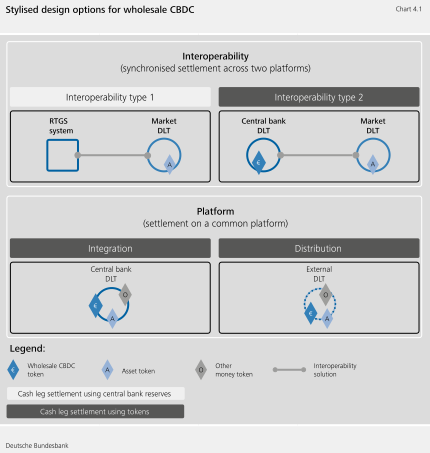
Wholesale CBDC could use both existing and new infrastructures. There are two approaches, each with two variants (see Chart 4.1):
Interoperability solutions expand existing systems’ functions, but keep the systems separate. They connect either real-time gross settlement (RTGS) systems and DLT platforms (type 1) or different DLT platforms with each other (type 2) to enable settlement across systems on a delivery versus payment (DvP) basis and a payment versus payment (PvP) basis. 11
Integration and distribution solutions involve a common platform on which tokenised central bank reserves are provided. Such a platform can be operated by either the central bank (integration) or a third party (distribution). Platform solutions – often referred to as “unified” or “shared” ledgers – could potentially offer greater efficiency gains than interoperability solutions. 12 However, due to increased complexities of governance, technical implementation and further development, they are likely to involve significantly greater implementation hurdles.
Depending on the use case, these can also be combined. Irrespective of the solution chosen, it has to meet the requirements for central bank money settlement. Stability, universality, efficiency and – where possible – technological and participant-based neutrality are key guiding principles in this regard.
Gradually integrating DLT-based solutions into the monetary and financial system will help the transition. To foster innovation as quickly as possible, it would be expedient to first link market DLT initiatives with established systems using interoperability solutions. This would make it possible to cater to the first use cases, thereby addressing initial market demand. In the medium term, however, it may be worth setting up common platforms and using tokenised central bank reserves to tap the full potential of DLT.
Considering money and assets together will create new opportunities for the development of innovative financial market infrastructures. In addition to interoperability solutions and tokenised central bank reserves, focus is also turning to private tokenised forms of money such as stablecoins and tokenised deposits as well as tokenised securities and other tokenised assets that could be used in a DLT ecosystem. At the moment, government and private sector initiatives to tokenise money and assets are often independent of each other. However, a holistic approach could unlock reciprocal synergies and help discover new use cases. 13 In this context, wholesale CBDC could play a key role in shaping future financial market infrastructures in an increasingly tokenised economy.
Central banks around the world are researching wholesale CBDC or are working to put it to practical use. Since 2016, the Bundesbank has been investigating the possible application of DLT in payments and securities settlement. In the course of this work, developments included the “Trigger Solution”, a type 1 interoperability solution, which was tested for the first time in 2021. 14 It forms a bridge between market DLT platforms and the Eurosystem’s RTGS system, resulting in transactions on these market DLT platforms “triggering” the corresponding payment in central bank money. Once this payment has been successfully made, the corresponding transaction, such as the transfer of a security, takes place. Other euro area national central banks, such as the Banque de France and the Banca d’Italia, are also exploring solutions for such applications. 15 After extensive theoretical considerations, the Eurosystem began exploring the practical application of new technologies for the central bank money settlement of large-value payments in 2023. 16 On the international stage, it is mainly central banks in economies with advanced financial markets that engage in work related to wholesale CBDC. According to the latest survey conducted by the Bank for International Settlements (BIS), there has been a significant uptick in global activities. 17 There is an increasing shift from experiments to work on live solutions. This momentum could also solve the chicken-and-egg problem that often lies at the heart of new technologies: the prospect of usable wholesale CBDC solutions could incentivise market participants to adopt DLT, thereby fostering the emergence of a new, integrated ecosystem of tokenised money and assets.
2 The Eurosystem’s exploratory work
2.1 Interoperability solutions being tested
The Eurosystem is moving forward with the testing of DLT in payments and securities settlement in order to make central bank money fit for the future. To this end, it launched exploratory work in 2023 to explore the potential benefits, challenges and limitations of using DLT to settle wholesale financial transactions in Europe. 18 The aim was to test, in cooperation with national central banks, financial market infrastructure providers and credit institutions, how market DLT platforms could be connected to the existing TARGET Services. Alongside technical issues, legal and operational aspects were also examined in the context of real business processes – always with the overarching aim of preserving the role of central bank money as a secure settlement asset and thus a stable anchor of the monetary and financial system.
Interoperability between market DLT platforms and existing payment systems was tested using three solutions. The Banca d’Italia developed a TARGET Instant Payment Settlement (TIPS) Hash-Link solution that connects market DLT platforms with TARGET Services. It and the Bundesbank’s Trigger Solution are “type 1” interoperability solutions. By contrast, the Banque de France put forward a “type 2” interoperability solution that issues tokenised central bank money on a Eurosystem DLT infrastructure.
The exploratory work attracted widespread market interest, enabling a variety of test scenarios to be tried out. Participants ranged from central and commercial banks to investment firms and infrastructure providers to specialised technology and DLT companies – reflecting the broad interest across the European financial sector. Between May and November 2024, 64 participants from nine European countries carried out more than 200 transactions in 58 distinct use cases. 19 In total, around €1.6 billion was settled in central bank money.
The use cases covered represent key areas of innovation in payments and securities settlement. They can be divided into five categories; see Table 4.1 for an overview. This categorisation is based less on the distribution of test cases and more on the key areas of innovation and application in which DLT applications can be expected to enhance efficiency: securities and derivatives, interbank payments, tokenised deposits, funds and cross-border and cross-currency payments. The main focus of the exploratory work was on securities and derivatives, which is likely to mainly be due to the high level of maturity and the strong interest of institutional market participants in this area. By contrast, other fields – particularly tokenised deposits and cross-border payment flows – received far less attention.
DLT-based issuance, transfer and redemption of tokenised deposits
Commercial banks
Funds
Subscription of fund shares, redemption, payment initiation
Asset managers, transfer agents, custodian banks
Cross-border and cross-currency payments
Payment-versus-payment (PvP) in various currencies
Central banks, large international banks
2.2 Potential benefits of DLT-based settlement
The test shows that DLT, in conjunction with central bank money, can contribute to the modernisation of the monetary and financial system. The following potential benefits are relevant:
Speed and efficiency gains: the use of DLT can speed up capital market processes – such as the issuance of securities – from several days to a few hours from a purely technical point of view. 20 Even for intra-day collateral relocation or complex lifecycle processes, there is a measurable gain in speed and efficiency.
Integration and automation: if trading, settlement and custody are merged on a single platform, end-to-end processes are created without media discontinuities. Smart contracts can automate coupon payments, margin calls and repayments, for example.
Reducing intermediation and risk: direct interaction between market participants via DLT reduces systemic fragmentation, lowers intermediation costs and eliminates coordination effort. PvP or DvP in a DLT environment 21 using central bank money also minimises default risk.
Reducing market barriers and fostering innovation: facilitating access to DLT-based infrastructures could attract new players and thereby enhance competition in the financial sector. In addition, new business models and product categories could emerge.
Improved transparency and audit trail:DLT enables transaction history to be documented and verified seamlessly and permanently, which is a major advantage particularly in terms of regulation, compliance and market integrity.
2.3 Potential hurdles
In addition to identifying potential benefits, the tests also highlighted hurdles to broad use of DLT that need to be overcome. The following are relevant here:
Technological fragmentation and insufficient standardisation: the variety of DLT platforms underlines the market's innovative power. However, it makes interoperability more difficult and creates the risk of new silos and market fragmentation.
Legal uncertainties: the absence of a European legal framework for DLT-based assets can hamper development. Clear rules are crucial to fostering trust and investment.
Limited scalability and technical maturity: Although limitations in technical performance, potential security risks and integration into existing systems still pose challenges, the technology opens up opportunities for innovation and continuous optimisation. The tests thus provide a valuable basis for evolution in order to meet the high requirements of real-time operations in European wholesale and securities settlement.
High extent of integration: Connecting existing systems to new DLT infrastructures is a technical and organisational challenge. However, it provides an opportunity to modernise existing systems and realise long-term efficiency gains.
Heterogeneous market echo: While some actors are already pursuing ambitious DLT strategies, others are cautious – for example, because of costs, governance issues or unclear business models. Close dialogue can help to strengthen understanding and trust in technology.
3 Future-proofing the role of central bank money in a digitalised financial system
3.1 Strategic framework
The exploratory work has shown that DLT-based financial market transactions in central bank money are technically feasible, but that institutional and market-related challenges remain. The Eurosystem thus announced in July 2025 that it would step up its activities through a strategy featuring two tracks: Pontes and Appia. 22
The Pontes and Appia initiatives are intended to build bridges and pave the way for the future of central bank money. The terms have Latin roots that are intended to convey a pan-European image. Pontes – Latin for “bridges” – links new DLT solutions with existing infrastructures, thus covering the short-term need for action on the cash side. Appia, named after the historic Via Appia (Appian Way in English), one of the oldest Roman roads, focuses on the idea of infrastructure and symbolises consistency and new paths. Appia is designed to define the long-term role of central bank money and to develop a strategic blueprint that aligns with the Eurosystem’s mandate. 23
This strategic approach follows a principle of gradual, learning-based transformation. Fundamental changes in the financial system of a stability-oriented economy should not take place as a sudden “big bang”, but should be gradual, learning-based and coevolutionary. In this context, technological or institutional pre-commitments should be avoided – in favour of flexibility and adaptability in a dynamic and changing environment.
3.2 Technological bridge (Pontes)
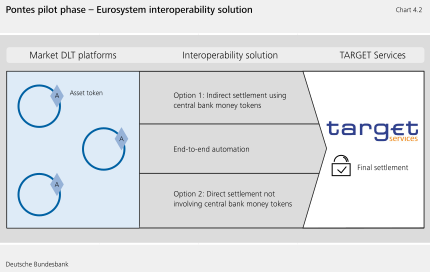
Pontes is the Eurosystem’s initiative to develop a technical bridge solution in a timely manner that enables DLT-based transactions to be settled in central bank money. By the end of the third quarter of 2026, a pilot is scheduled to be provided that links market DLT platforms with the existing TARGET Services, especially for applications in the context of securities transactions and wholesale payments in euro. Pontes will act as a technical bridge that provides market participants with a single access point that takes up DLT innovations in the market and builds on established Eurosystem structures. This combines key components and functionalities of the interoperability approaches previously tested during the exploratory work. Rapid provision has multiple objectives. The focus is on enabling transactions in central bank money in a DLT-based environment. At the same time, the Eurosystem would be able to gain further insights into operational, legal and technical requirements through productive pilot operations. In addition, the market would probably be able to obtain practical insights and planning certainty regarding the development of DLT-based applications, thus creating incentives for innovative market developments.
The pilot solution provides two options for settling the cash leg: either token-based via a Eurosystem DLT platform or directly in the RTGS system of TARGET Services. It thus corresponds conceptually to a combination of interoperability types 1 and 2 (see Chart 4.1). The connection to the market DLT platforms is via an interface. This ensures that the two legs of a PvP or DvP transaction are settled synchronously on the respective platforms. In both cases, the legal finality of the cash leg settlement remains anchored in TARGET Services. Chart 4.2 shows a schematic representation of the process.
Continuous interaction with the market is intended to lead to a needs-based solution. The close dialogue with the market established during the exploratory work will be continued under Pontes to ensure the development of an appropriate and targeted solution. Going past the pilot phase, advancements are envisaged in order to fully integrate Pontes into TARGET Services in technical, legal and operational terms, thus ensuring a sustainable and future-proof infrastructure. The evolution of Pontes could also, for example, go so far as to only provide one tokenised settlement option, ensuring immediate legal settlement finality. The settlement of international payments including currency exchange could also be made possible.
3.3 From building a bridge to designing the path (Appia)
Appia provides a strategic framework for the future role of central bank money in the digital financial system. The focus is on the systematic way in which the Eurosystem, together with market participants, intends to gradually explore and answer relevant questions on the design of new financial market structures over the next few years. Such a target state requires strategic flexibility and technological openness, which create space for innovation – without any rushed precommitment to specific solutions. Compatibility with the mandate, the question of access and functional integration into the monetary and financial system are among the particularly relevant factors here.
New solutions must be in line with the central bank’s mandate – regardless of the technological design. Although one of the Eurosystem’s tasks is to promote the smooth functioning of payment systems, even in an increasingly digitalised world, technological developments must not be driven forward solely on the basis of the logic of individual trends. The appropriateness of possible solutions can be measured by the extent to which they strike a balance between benefits and risks, always with the proviso that they do not compromise the Eurosystem’s primary objective of maintaining price stability.
Access to central bank money – as a particularly secure means of settlement – is an important control lever. The technological architecture has a decisive impact on the roles that central banks, credit institutions and new players can play. However, it must not gatekeep access to central bank money and the corresponding infrastructures. Whether the group of participants remains narrowly restricted, as is the case today, or whether it is opened up to other players is fundamental to the monetary and financial system. The if and how of more fundamental changes would have to be decided after broader debate, including within society and politics. Until such a course has been set, it will be necessary to tightly restrict the money-holding sector’s access to central bank money and the corresponding infrastructures. Certainly, technological decisions and their implementation in a system architecture must not supersede or pre-empt deliberate decisions on the future monetary system. Enhanced access could enable innovation and efficiency gains in certain areas, such as the integration of retail payments, the greater interconnectedness of centralised and decentralised financial services or the international acceptance of automated settlement of foreign exchange transactions. However, the extent to which very broad access could impair the intermediation function of established actors – with potential implications for market structure, competition and incentives to innovate – needs to be noted. Only when objectives are clearly defined can the technical requirements and system architecture be determined in a meaningful way.
Access to and use of wholesale CBDCcan be particularly warranted when new forms of private digital money, such as stablecoins, become more important. This is particularly true in areas where maximum security and reliability should be ensured. The use of private digital forms of money can entail specific risks, for example with regard to legal certainty; concentration risk, credit risk or liquidity risk; and operational security. In certain cases, such risks can adversely affect not only individual market participants, but also the overall system. The functional suitability of a form of money – in terms of security, efficiency and system resilience, for example – should therefore determine how it is used in the respective use case.
To ensure a safe and efficient financial ecosystem, money and assets should be in sync. This is because maximum efficiency gains are likely to be achieved only once money and assets are directly interlinked, as payment and settlement processes will then no longer be sequential but can be conducted in an integrated manner. Accordingly, progress in tokenisation and the development of payment and settlement infrastructures are also expected to be key elements for deepening the European savings and investments union. The development of wholesale CBDC and ongoing tokenisation open up the long-term prospect of more highly interconnected international financial markets. In future, this would allow not only different market sectors to be linked, but also currency areas. Global initiatives aimed at interconnecting settlement platforms show that future solutions can reach far beyond national borders. 24
Central banks need to come up with appropriate responses to changes in the monetary and financial system. An open and gradual process is needed to exploit the potential benefits of new technologies whilst effectively mitigating their risks. The Bundesbank is leveraging its expertise and its status as part of the Eurosystem in order to help ensure that central bank money remains a reliable foundation for an efficient, stable and resilient financial system.