3 Outlook: NGEU disbursements to end, burden of debt service to have impact
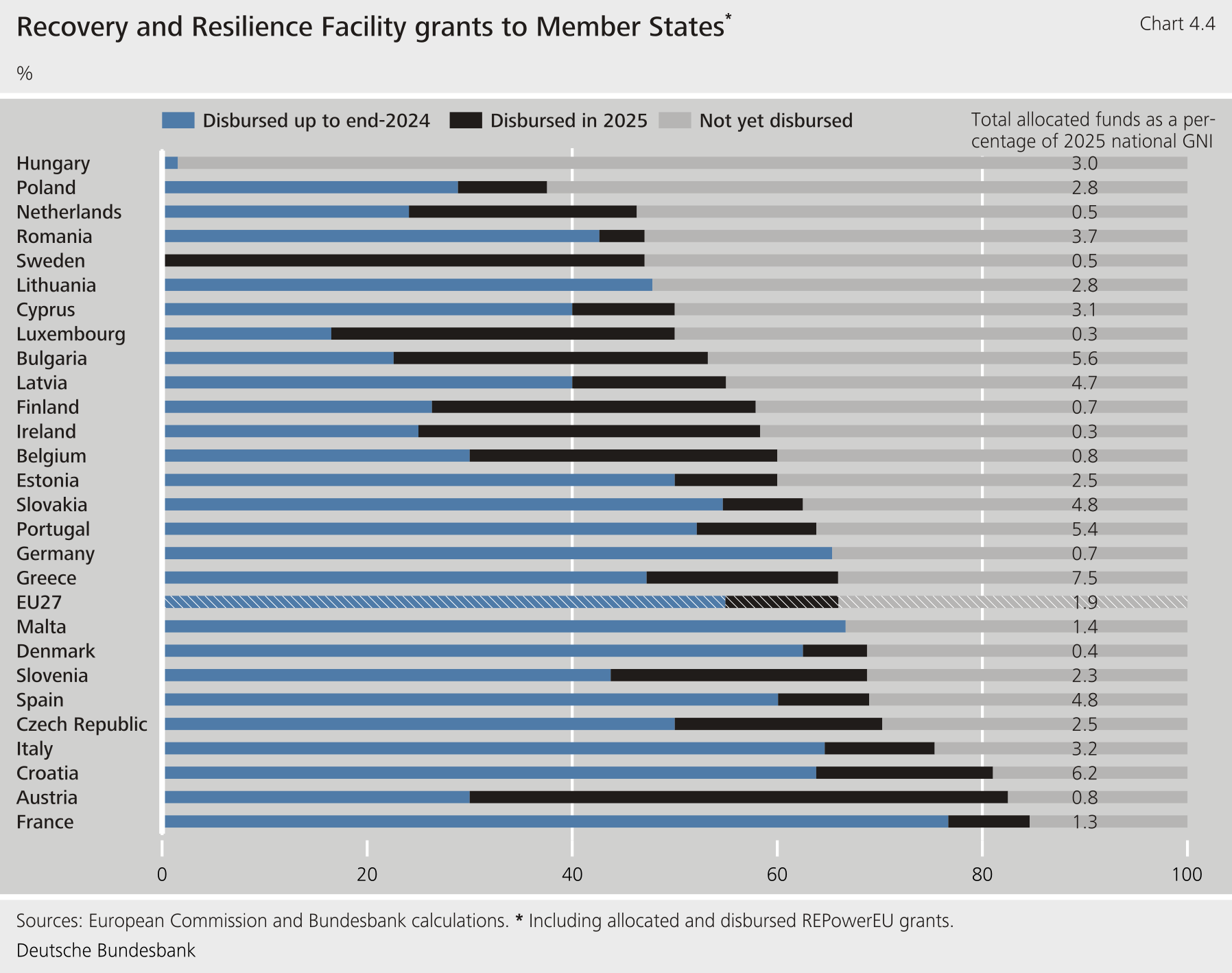
The European Commission is expected to disburse most of the remaining RRF grants by the end of 2026. By 30 September 2026, all Member States had submitted their final payment requests. 8 The European Commission is now assessing whether they have fulfilled the agreed milestones and targets. If the requirements have been met, the European Commission can disburse the appropriate funds by the end of 2026. 9 After November 2025, all Member States made further adjustments to their recovery and resilience plans to avoid forfeiting the remaining funds. The European Commission had given Member States this additional flexibility, effectively lifting the programme’s time limit. 10 For example, Member States can make any remaining RRF resources available as capital to national development and promotional banks. These institutions can subsequently use the funds for additional eligible investments.
At the start of the new financial framework in 2028, repayments of the debt raised for NGEU grants are set to begin from the EU budget. The European Commission is planning a total of €149 billion (in 2025 prices) for the NGEU debt service from 2028 to 2034. 11 This corresponds to an annual average of 0.1 % of 2025 EU GNI, or just over 9 % of the budget volume proposed by the European Commission. In current prices, it is planning to spend €24 billion per year on debt service. If interest costs rise even further beyond their currently expected level, repayments will be lower than planned. As a result, a larger share of repayments will be shifted into future financial frameworks. That the NGEU debt service would restrict future fiscal headroom was known when NGEU was adopted and does not come as a surprise. Member States now have to agree on whether they want to finance these resources by making higher contributions to the EU budget or by reducing other expenditure within it. For either variant, the debt burden will ultimately be borne by the population of the Member States.
The debt burden is one of the factors making negotiations on the next financial framework difficult and controversial. In July 2025, the European Commission proposed a financial framework totalling just under €2 trillion, or 1.26 % of EU GNI per year. Germany and other net contributors are now calling for significant cuts, especially in traditional spending on cohesion and agricultural policy. 12 At the same time, they want to give greater weight to spending on other priorities, such as competitiveness and defence, in the EU budget. No agreement has been reached so far.
If repayment of NGEU debt is postponed, this will shift burdens further into the future and could undermine credibility. Such a postponement is being discussed. However, deferring repayment will not reduce the burden, but instead allocate it to future budgets and exacerbate the financial problems there. There are no signs that the pressure on public finances in the EU will ease elsewhere in the future. On the contrary, public finances are likely to come under even greater pressure in future, for example as a result of demographic change and increasing geopolitical challenges. When agreeing on NGEU, Member States resolved that repayments should not be a burden in the current financial framework. Instead, repayment is to be addressed in the coming financial framework. The credibility of such repayment promises will be undermined if repayment is postponed before its financial burden has even been felt.
The EU budget is to be geared more towards joint European tasks. However, this does not mean that the EU will have to take on additional debt. In some areas, there are good reasons for taking joint action at a European level. Examples include basic research, cross-border infrastructure, foreign policy and development aid, migration to the EU, border protection, energy security and climate action. It would therefore be welcome if these areas were to be given greater focus in the EU budget. The Member States will, however, be able to finance these tasks within the regular EU budget by reprioritising expenditure or making higher contributions.
If the EU incurs debt under certain conditions, such as for NGEU, this should be reported in a transparent manner. For example, when they report the Maastricht debt level, the Bundesbank and the Dutch central bank also publish the national share of EU debt. 13
In addition, European fiscal rules should also limit joint EU debt so that it does not endanger sound public finances. This is another reason for looking at the fiscal burden holistically. The additional EU debt will ultimately have to be serviced by the Member States. It therefore should not supplement national fiscal headroom. Instead, higher EU debt should lead to a corresponding reduction in national borrowing.
A recent proposal from the Bundesbank shows how this can be achieved without revisiting the European fiscal rules, which have just been reformed. 14 In the case of EU borrowing, the proposal suggests that, where debt is not already included in national debt levels, Member States should transfer the corresponding volume of national bonds to the EU. This would make the fiscal burden of joint borrowing visible in the national deficit and debt ratios. In addition, national fiscal headroom would shrink automatically.