The digital euro: key elements and outlook Monthly Report – March 2026
Published on
The digital euro: key elements and outlook Monthly Report – March 2026
Monthly Report Published on
The ECB Governing Council’s decision of 29 October 2025 marked the entry of the Eurosystem into the next phase of the digital euro project. Furthermore, on 19 December 2025, the Council of the European Union formally adopted its negotiating mandate on the digital euro. This means that, in the space of just a few weeks, two significant milestones were reached on the road to a possible introduction of central bank digital currency for the general public in the euro area.
The digital euro is intended to create an additional, electronic form of central bank money that – like banknotes – would appear as a liability item on the Eurosystem’s balance sheet. It would introduce the benefits of cash to the digital world and ensure that everyone in the euro area also has digital access to a public form of money in the future. The digital euro is intended to complement cash, not replace it – people will still be able to choose between physical and digital forms of payment. At the same time, it could play a part in boosting the efficiency and resilience of European payments and strengthening their strategic autonomy in a globalised and digitalised financial system.
Consumers stand to gain a digital means of payment that can be used throughout the euro area in a uniform way in different payment situations, such as in shops, in e-commerce or for person-to-person payments. Payment service providers, meanwhile, would have the opportunity to leverage the shared European infrastructure by developing new features and add to their existing range of services.
The Eurosystem could conduct its first pilot transactions as of mid-2027 and be ready to potentially roll out the digital euro as from 2029. The final decision on issuance will only be taken by the Governing Council once the legal basis has been adopted.
This article outlines the current status of the project and describes the key design features of the digital euro and the added value it would bring.
1 Strategic considerations
The digital euro is one of the Eurosystem’s key innovation projects. Introducing it would make central bank money fit to meet the needs of an increasingly digital economy. At the same time, it would allow for improvements in the quality of cashless payments, for example in terms of efficiency, strategic autonomy and resilience. The digital euro is designed to be a complementary electronic form of central bank money. Cash, as a physical form of central bank money, would remain available without restrictions.
Central bank money plays a crucial role in underpinning confidence in the monetary system. It appears as a liability item on the central bank’s balance sheet and is free of credit or liquidity risk. To date, the general public have only been able to access central bank money in the form of cash – that is, as Eurosystem banknotes and coins issued by Member States. Cash therefore plays an important role as a generally accessible form of public money. It helps ensure that different forms of private money – such as bank deposits – can always be converted into central bank money at face value. In this way, it supports the singleness of money in the euro area.
With the use of cash on the decline and digital payment methods on the rise, the role of cash in everyday payments is changing. The share of cash in all payment transactions declined from 74 % in 2017 to 51 % in 2023 in Germany. 1 In the euro area as a whole, it fell from 72 % in 2019 to 52 % in 2024. 2 This development has spurred debate as to how broad access to public money can be maintained as the payment environment becomes ever more digital. A digital euro plays a role here as an additional digital form of central bank money for the general public.
The digital euro can help reduce the current fragmentation of euro area payments and strengthen integration. At present, there is no end-to-end pan-European payment solution built on European infrastructure. National systems such as iDEAL in the Netherlands or Bizum in Spain are mostly confined to individual countries or specific use cases, and their usefulness for cross-border payments is limited at best. This fragmentation leads to efficiency losses and hampers competition, forcing consumers to switch to different methods depending on the payment situation. A digital euro could address this by providing a common standard for digital payments across the euro area.
Another key objective of the project is to strengthen Europe’s strategic autonomy in payments. At present, just under two-thirds of all card payments in the euro area are settled via non-European systems, 3 and many Member States do not have national solutions of their own. 4 A significant part of day-to-day payment settlement is therefore reliant on global providers whose business models, fee structures and technical standards are shaped largely by decisions taken outside Europe. In times of geopolitical tension or regulatory changes in third countries, these dependencies can pose risks to the stability, functioning and further development of European payments. The digital euro would counteract this by offering a European-run infrastructure that is legally and operationally independent. This would give the euro area greater autonomy in terms of technical standards, interfaces or the resilience of critical functions, for example.
The digital euro should also be seen in the context of privately issued digital assets, in particular US dollar-denominated stablecoins. Stablecoin volumes in circulation have increased significantly in recent years. At present, however, they are used mostly for transactions in crypto markets and, to a degree, in cross-border payments, while uptake in day-to-day payments has so far only been marginal. However, if they were to gain a foothold in everyday payments, this could encourage greater use within the euro area of privately issued forms of money, some of which are regulated outside Europe. A digital euro could counteract this tendency.
Besides the strategic dimension, the operational resilience of payments is another key factor. Digital payment systems are complex, technically interconnected infrastructures. This leaves them potentially exposed to disruptions such as cyberattacks, technical malfunctions or widespread power and grid outages. Having an additional digital payment channel built on European infrastructure can help keep payment systems running in a crisis. The digital euro would thus also contribute to making the European payment system more resilient.
The growing proliferation of digital payment methods also increasingly raises questions surrounding data protection, data sovereignty and financial inclusion. Many payment service providers (PSPs) process more usage and transaction data than is strictly necessary for settling payments. At the same time, certain groups within the population continue to face barriers to accessing and using digital payment methods. The digital euro would address these issues through high data protection standards and a design that minimises barriers to access. This way, it would contribute to data sovereignty and help make payment transactions more inclusive.
2 Political process and project progress
Establishing a digital euro calls for a specific European legal basis. The European Commission therefore presented the Single Currency Package in June 2023. 5 This package comprises two proposals for digital euro Regulations 6 as well as a systematic reorganisation of the legal framework for euro cash within the euro area. The idea behind this package is to legally define the interplay between cash and the digital euro and to safeguard their coexistence. The package furthermore seeks to flesh out the status of cash as legal tender, achieve harmonisation, and ensure that cash is accepted as a means of payment.
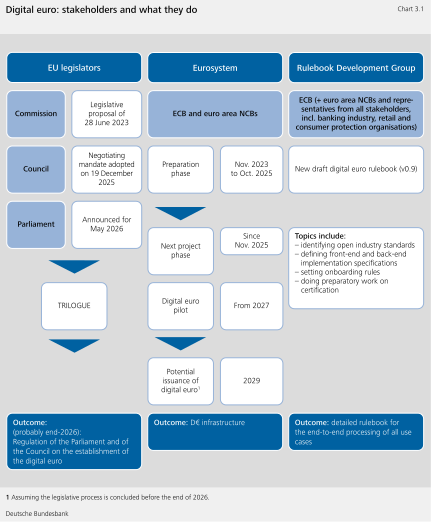
The legislative process is currently at the consultation stage. On 19 December 2025, the Council of the European Union adopted its negotiating mandate on the proposals, thereby laying the groundwork for the forthcoming negotiations with the European Parliament. 7 Rapporteur Fernando Navarrete presented his draft report to the Committee on Economic and Monetary Affairs of the European Parliament on 5 November 2025. 8 The European Parliament is expected to deliberate on specific amendments to the legislative proposal in May 2026. It has already expressed a generally positive opinion on the establishment of a digital euro: on 10 February 2026, the vote on the ECB Annual Report saw the adoption of corresponding amendments by a large majority. 9
Once the European Parliament has staked out its position, a trilogue will follow between the European institutions involved in the legislative process (Parliament, Council and Commission). When the legislative process concludes will depend on how the negotiations proceed. The Eurosystem is supporting the political process with technical, legal and operational expertise.
In the Eurosystem, the first preparatory work on the possible establishment of a digital euro began back in 2020. October 2021 saw the launch of a two-year investigation phase. This examined fundamental questions regarding the design, possible use cases, and the impact on payments and the financial system. That was followed in November 2023 by the preparation phase, in which the conceptual and technical groundwork for a potential digital euro, in particular, was developed.
While the legislative procedure was ongoing, the Governing Council of the ECB decided on 29 October 2025 to complete the preparation phase launched in November 2023, on schedule, and to initiate the next project phase (technical readiness phase). 10 This aligned with the wish of the Heads of State or Government of the euro area Member States to accelerate progress on the digital euro. The preparation phase was used to develop the conceptual and technical groundwork for a possible digital euro.
Key milestones achieved during this phase were:
an initial draft of the digital euro scheme rulebook; 11
the technical design of the Digital Euro Service Platform (DESP);
comprehensive analyses of user needs and market structures; 12
the selection of external providers for five digital euro components and related services. 13
Chart 3.1 summarises the various workstreams and the next steps in the interplay between the legislative procedure and technical and operational preparations in the Eurosystem.
Technical implementation of the digital euro is largely governed by the digital euro scheme rulebook, which is being developed by the Eurosystem in collaboration with market participants. The current draft version (RDG v0.9) has already been the subject of consultation for several months. Feedback is being used to revise and update the rulebook. Further work will focus on liaising with technical service providers, harmonising market standards and specifying key implementation requirements, such as for near-field communication (NFC) and offline payments. Front-end, onboarding and certification matters are also being fleshed out on an ongoing basis.
With the next project phase now underway, the Eurosystem is pressing ahead with technical and organisational readiness. Work is centred on infrastructure construction (in particular IT systems, interfaces with PSPs as well as organisational and operational structures), testing and piloting, and ongoing coordination with market participants. If work on the digital euro continues to advance as planned, the pilot with initial transactions could start beginning in the second half of 2027.
The ECB estimates that development costs (internal and external) will amount to around €1.3 billion until a possible first issuance in the course of 2029, with annual operating costs projected at around €320 million from 2029 onwards. 14 The final cost will depend on the final design and components. The seigniorage generated by the digital euro is likely to be sufficient to cover at least the Eurosystem’s operating costs. 15 Depending on the assumptions made, the potential investment costs for supervised institutions are considered to be roughly comparable with those of previous regulatory initiatives such as the Payment Services Directive (PSD2). 16
Like all national central banks in the euro area, the Bundesbank is a constituent part of the Eurosystem’s project management. It is also one of the group of six national central banks mandated by the Governing Council to provide and operate, in particular, the clearing and settlement infrastructure. The Governing Council will not decide on the actual issuance of the digital euro until the European legal basis has been adopted and the results of the current project phase become available.
3 Design elements of the digital euro
3.1 Stakeholder rights and obligations
Key design elements of the digital euro will be enshrined in the future legislation. Some points are awaiting final clarification as the legislative procedure has not yet been completed. 17 This description of the design features is therefore based on the European Council’s negotiating mandate, which already contains numerous clarifications and compromise proposals that take into account, amongst other things, key concerns of the banking industry.
The digital euro has been conceived primarily as a complementary electronic form of central bank money for everyday payments, not as a store of value. The amounts that users are able to hold will therefore be limited (see Section 3.5). Like euro banknotes, the digital euro would be issued by the Eurosystem, but the related user services would be provided by credit institutions and other PSPs. Credit institutions established in the euro area would be required to offer basic digital euro services to certain natural persons residing in the euro area who are already using their payment services.
Both online and offline payments would be possible with the digital euro. The online version of the digital euro would require internet or mobile network connectivity and could be used for all the use cases mentioned above. The offline version would allow payments to be made without a network connection. In an offline transaction, payment information is exchanged directly between the payer and payee as long as their respective devices are in close proximity, like at the point of sale in bricks and mortar stores.
Being a day-to-day means of payment, the digital euro would not bear any interest. Basic digital euro payment services – that is, services that are mandatory for using the digital euro – would be offered free of charge to consumers. These include, for example, maintaining one digital euro payment account per PSP and the use of at least one payment instrument. 18 Depending on the PSP’s product range, PSPs may offer additional services subject to a fee.
Like cash, the digital euro would also be legal tender. Payees resident in the euro area would therefore be obliged to accept the digital euro. For proportionality reasons, certain exceptions to mandatory acceptance are envisaged. These relate to enterprises that accept only cash as a means of payment and to natural persons acting in the course of a purely personal or household activity.
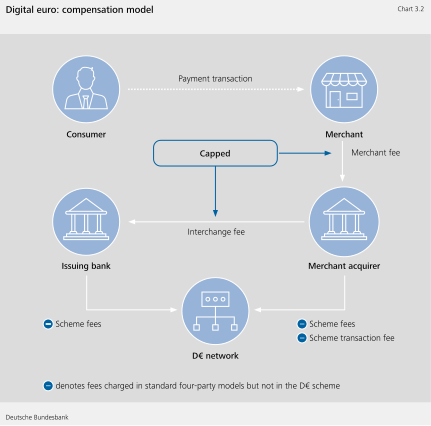
The European Council also provides for fee caps as a way of protecting payees from excessive payment fees for mandatory acceptance of the digital euro (see Chart 3.2). Harmonised fee caps would cover both merchant fees and interchange fees between PSPs. The Council’s position would also require PSPs to offer their merchant customers the essential acquiring services 19 for acceptance of the digital euro. That would provide a workable approach to implementing mandatory acceptance.
To ensure that mandatory payment services can be provided cost-efficiently, the European Council’s position envisages a compensation model that distinguishes between a transitional (five to ten-year) period and a long-term model. During the transitional period, online transactions would be subject to a uniform fee cap based on the average fees for comparable payments made with debit cards. A lower national fee cap may be set if that cap is lower that the euro area cap by a statistically significant margin. This cap would benefit smaller merchants, in particular, as the calculated average can be expected to be below what smaller merchants currently have to pay to accept digital payments. 20
The long-term aim is for the euro area to have a uniform cap that encourages cost-efficient operations. That cap should reflect the actual costs incurred by an efficient PSP to provide digital euro services, including a reasonable margin of profit. This assessment would be based on cost analyses and efficiency benchmarks in payments, the precise design of which will be defined as implementation progresses. This would keep the cost of accepting the digital euro predictable for merchants, while maintaining sufficient incentives for PSPs to provide and further develop the mandatory payment services.
Users would have two ways to access the digital euro. They could use their PSP’s app or online banking software or, alternatively, the reference implementation provided by the ECB and the national central banks (ECB app). Both options would cover all mandatory digital euro payment services and would be free of charge for consumers.
The digital euro is not intended to be programmable money. Neither the Eurosystem nor other actors would be able to define by technical means what a digital euro may and may not be used for. 21 The digital euro would thus be a general purpose means of payment, much like cash. This principle of neutrality is a key element of the project and is explicitly anchored in the Regulation.
The digital euro would transfer the benefits of cash to the digital sphere without replacing cash. This would preserve the freedom to choose between physical and digital forms of payment. In addition, establishing the digital euro would pursue multiple objectives that can be categorised as relating to the dimensions outlined in Section 1: efficiency, resilience and autonomy.
3.2 Access to the digital euro
Access to the digital euro would be possible through multiple channels. The plan is to integrate it into PSPs’ existing digital access points (such as their online and mobile banking software), supplemented by additional access options that support broad usability, including at the point of sale (such as card-based payment instruments). Having multiple access channels can increase reach and make it easier for different target groups to use the digital euro. The European Council’s negotiating mandate stipulates that at least one payment instrument for digital euro payments per consumer would be free of charge. The right to choose which instrument would be free of charge (whether physical card, digital wallet or similar) would lie with the consumer.
It would also be possible to switch to a different PSP. This would include porting your DEAN (digital euro account number for the digital euro, similar to IBAN), as is already standard for mobile phone numbers. This would require the portability of holdings, as is also the case with traditional bank accounts, in order to make the switch to a new provider workable and to promote competition among banks. Switching providers would be free of charge for consumers. Consumers would also be able to choose a provider for the digital euro payment account that is different from the institution that operates their traditional payment account.
Depending on the use case, it would be possible to initiate payments through various channels, such as contactless (for example via NFC) or based on an alias. With an alias, an identifier commonly used in everyday life (such as a person’s mobile phone number) is linked to the payment address. The aim is to ensure that the key channels for initiating a payment work in much the same way in the primary use cases, thereby creating a consistent user experience for consumers and merchants.
Liquidity would be provided primarily through linked bank accounts. In addition, deposit and withdrawal options through existing channels (such as an ATM or branches) would be possible. Processes would be designed to support easy and instant transfers between the consumer’s own bank account and their own digital euro payment account.
Looking ahead, additional functionalities for conditional payments could be supported. These would not make the digital euro less usable. Rather, optional additional functions would enable payments – at the initiative of users or their service providers – to be automatically triggered when predefined conditions (like certain points in time or events) occur. The digital euro would remain a means of payment suitable for general use. Conditional payments can simplify processes, reduce risks and enable innovative business models such as usage-dependent billing or micropayments in the internet of things. Use cases and concepts of this kind have been explored together with market participants on the digital euro innovation platform. 22 The results suggest that conditional payments can make it easier to integrate payments into digital end-to-end processes and create additional utility. 23
Supplementary information
Public perceptions of the digital euro
The Bundesbank commissioned the public opinion research firm forsa to conduct a representative survey of the population on the digital euro in October 2025 (sample size n = 2,004). The sample group was composed solely of individuals aged 18 years and above.
Awareness of the digital euro has remained virtually unchanged compared with a survey conducted in 2024. In autumn 2025, 42 % of respondents answered “yes” when asked whether they had heard of the digital euro (2024: 41 %). 1
At the same time, the survey shows that knowledge of the digital euro remains limited: among those who had already heard of the digital euro, 26 % were able to accurately explain that it is a central bank digital currency which serves as an additional means of payment. The remaining respondents were unable to answer the open-ended question correctly. In addition, misunderstandings continue to arise: for example, some respondents believe that the digital euro is a crypto-asset, while others fear that cash will be abolished. Overall, this shows that there is a clear need to inform the public. To address this, the Eurosystem will, in due course, launch a comprehensive information and branding strategy for the digital euro.
Despite the existing gaps in knowledge, a relevant part of the population is generally open to a digital euro. Just under half of the respondents could definitely (14 %) or probably (34 %) imagine using the digital euro, while 23 % would be unlikely to use it and 27 % would definitely not use it. Furthermore, willingness to use the digital euro varies according to sociodemographic characteristics: younger respondents tend to show a higher degree of openness – in the 18 to 29 age group it stands at 65 %.
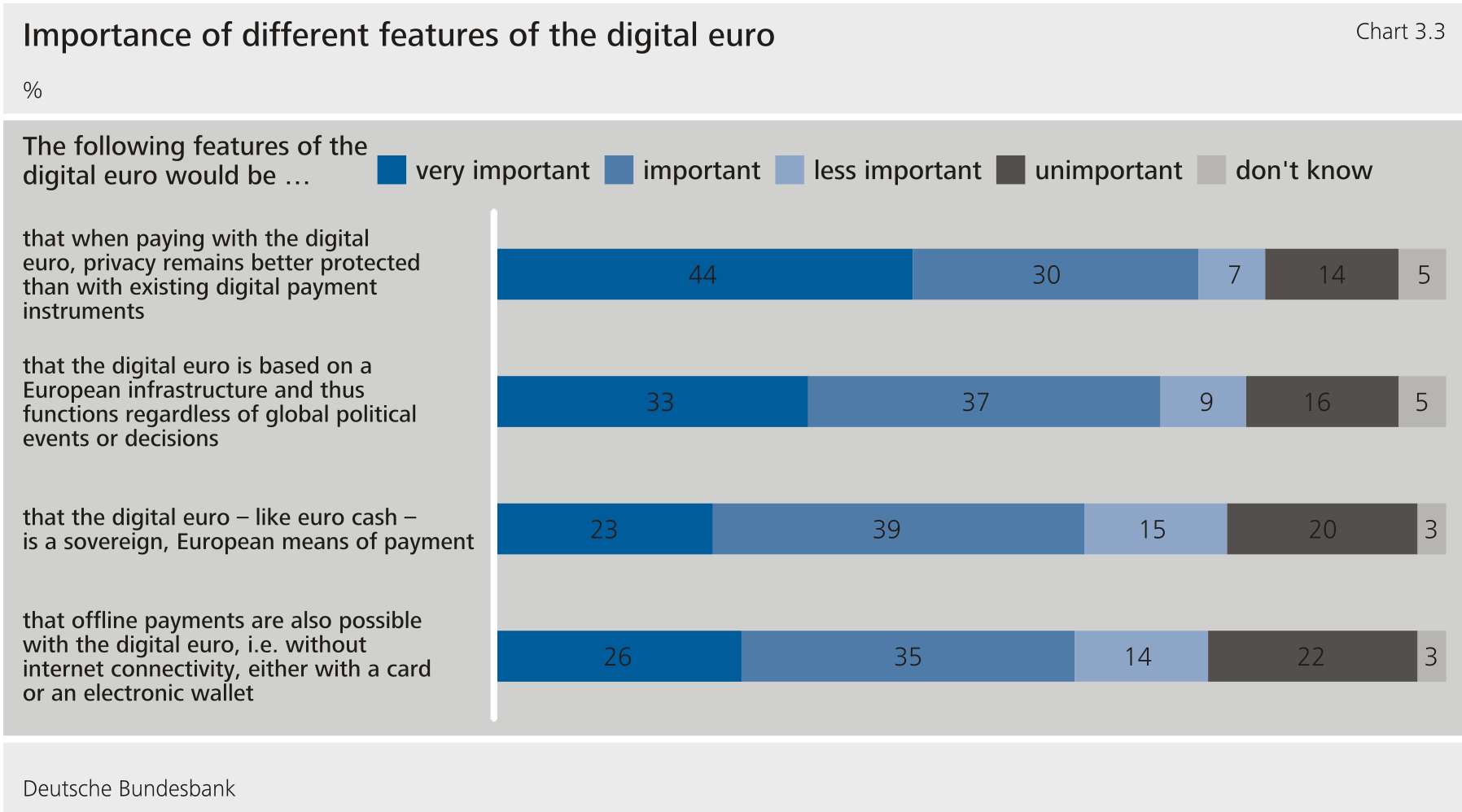
Chart 3.3 below summarises the features of a digital euro that would be particularly relevant. Privacy protection is especially important for a clear majority: 44 % consider this to be “very important” and a further 30 % consider it to be “important”. The requirement that the digital euro should be based on a European infrastructure and thus function regardless of global political events or decisions was also strongly supported (33 % “very important”, 37 % “important”, 70 % combined). Many respondents also consider it important that the digital euro – like euro cash – is a sovereign or European means of payment (23 % “very important”, 39 % “important”, 62 % combined). Finally, many consider the option to pay offline, i.e. without internet connectivity, to be important (26 % “very important”, 35 % “important”, 61 % combined). (Any deviation from 100 % is the result of “don’t know” responses.)
3.3 Data protection, privacy and offline functionality
The design of the digital euro follows the principle of data minimisation. Here a distinction should be made between online and offline payments. In online mode, where an internet connection exists, only the information required to execute the transaction is processed. As is the case with today’s digital payments, identity verification and the legally required controls to prevent money laundering and terrorist financing will be carried out by the banks and PSPs where the account for the digital euro was opened. The Eurosystem will receive and process only pseudonymised payment data and will not create individual payment profiles from the transactions. Technical and organisational measures will prevent the natural or legal persons behind an individual transaction from being revealed to the Eurosystem.
Online payments will be technically processed through the DESP, which is designed as the Eurosystem’s central infrastructure. The DESP will process transaction data exclusively in pseudonymised form and will be functionally separate from the payment service providers’ systems. Customer data will remain with the respective payment service providers; the Eurosystem will not have access to private payment transactions. Access to data will be strictly role-based and limited to the functions required in the given case.
A special feature of the digital euro is the planned offline functionality, which would allow payments to be made without an internet or mobile phone connection. The information required for a payment is securely stored on the end device and exchanged directly between the payer and the payee during the transaction. In the case of offline payments, payment service providers will not receive individual transaction data. As soon as one of the devices involved is back online, they will receive only the summarised or technical information necessary for synchronisation, to avoid incorrect entries and to limit the risk of manipulation. This means that individual transaction details are not disclosed, not even to the payment service provider managing the account, such as the bank or savings bank. In order to limit risks relating to money laundering and security, separate credit limits and specific transaction limits will be provided for offline use. These would have to be set by the European Commission on the basis of a recommendation from the EU Authority for Anti-Money Laundering and Countering the Financing of Terrorism (AMLA). In this regard, the European Council’s negotiating mandate specifies that the limit for offline balances should be sufficient to cover everyday expenditure over a period of at least 72 hours.
Overall, this results in a two-tier data protection framework: while the online mode meets the legal requirements for widespread use in payments, including regulatory requirements, the offline mode is intended to provide an even higher level of privacy whilst, at the same time, safeguarding against misuse through appropriate security mechanisms. However, what the two modes have in common is that the Eurosystem cannot at any point gain insight into users’ personal payment data.
3.4 Inclusion and accessibility
The ongoing digitalisation of payments makes everyday life easier for many consumers, but it can create barriers to access and use for individual population groups. Empirical surveys – including those from the Bundesbank Online Panel for Households (BOP-HH) – show that it is notably people over the age of 70, people with visual or hearing impairments, users with physical disabilities and people with lower digital skills who report having disproportionate difficulties using digital payment methods. 24 In addition, problems are more frequently cited by people in financial difficulties, those who live in rural areas and those with a migration background. Typical hurdles include limited readability (font size, contrast ratio), lack of audio and language support, complex menu navigation, and difficulties with registration or troubleshooting. Regulatory requirements for accessibility in the EU are laid down by the European Accessibility Act, which was transposed into German law in 2025 through the Accessibility Improvement Act (Barrierefreiheitsstärkungsgesetz – BFSG). The Act sets minimum standards for specified digital products and services; however, restrictions may still occur in everyday life if applications do not sufficiently minimise barriers to access or if personal support is lacking.
Against this backdrop, the Commission’s proposal for a regulation on the digital euro and the negotiating mandate adopted by the Council of the European Union already emphasise the inclusion aspect. The legal framework stipulates that the digital euro should be designed in a way that is easy to access and use for older people, as well as people with disabilities, functional limitations or limited digital skills. These include easily accessible interfaces, clear and reduced process steps and alternative modes of access to the digital euro. Alongside mobile applications, alternative payment instruments would be on the table as options, meaning that payments with the digital euro would not necessarily require a mobile end device.
Furthermore, the proposed legal framework requires payment service providers to support these user groups with access to and use of the digital euro – such as when it comes to registering or using basic payment functions. The unbanked population – those without a traditional payment account – should also be granted special access rights. To this end, Member States must designate at least one payment service provider that will provide the relevant basic services and is also able to offer the necessary in-person support. The aim of these rules is to ensure that the digital euro is made available to as many people as possible in the euro area and that existing barriers to access to digital payment services are reduced.
3.5 Liquidity mechanism: holding limit and waterfall
The digital euro is being designed as a means of payment and not as an investment instrument. In order to support this objective and to limit possible effects on financial stability and monetary policy, the digital euro will, by law, not be remunerated and there will be holding limits for credit balances in digital euro. According to the Council of the European Union’s negotiating mandate, the holding limits will be set jointly by the ECB and the Council. 25 A distinction can be made between natural and legal persons, as well as between users resident in the euro area and “visitors” to the euro area, amongst other things.
The proposal for a regulation provides for a single access point (SAP) for the technical implementation of the holding limits. 26 The SAP will act as a central interface for payment service providers and serve as a storage for pseudonymised user IDs and limit-relevant information. First, this allows the system to ensure that specific holding limits are met, and second, that individual users are unable to be identified thanks to the Eurosystem’s pseudonymisation. The SAP would be required regardless of whether users are able to maintain only one or more accounts for the digital euro. It would also facilitate account switching in exceptional situations.
An automatic (de)funding mechanism, known as the “waterfall” functionality, is envisaged for practical use. It will ensure that payments can be executed even if a transaction would, in mathematical terms, cause the individual holding limit to be breached. In such cases, excess amounts would be automatically transferred to the payee’s linked payment account with a payment service provider. Conversely, in the event of insufficient funds, liquidity could be automatically transferred from the payee’s bank account to the account for the digital euro. From the user’s perspective, the (de)funding would be carried out in the background and without the need to take any additional action; the holding limit would remain effective as a stability instrument without restricting the ability to use the digital euro in everyday life.
This automatic connection between an account for the digital euro and a bank account may also be made across different payment service providers. The banking industry had pointed out during the legislative process that such institution-wide liquidity provision (open funding) may entail costs. The Council of the European Union’s negotiating mandate therefore envisages that payment service providers decide for themselves whether they wish to offer such links to other institutions. If no agreement is reached between the payment service providers involved, the automatic waterfall function would not be available in these cases. The corresponding scheme is due to be reviewed three years after its entry into force.
With regard to financial stability and monetary policy implementation, the combination of non-remuneration, holding limits and automated (de)funding intended to help limit structural reallocations from bank deposits to the digital euro. Eurosystem analyses have shown that a design model of this kind effectively limits potential risks to the stability of the financial system and the effective implementation of monetary policy. 27 In addition, supplementary Bundesbank studies have demonstrated that the effect on liquidity in the German banking sector would not be significant assuming, for example, a holding limit of €3,000. 28 The actual level of the holding limit will be determined only shortly before the digital euro is brought into circulation.
4 The digital euro for tomorrow’s European payment landscape
4.1 Transforming digital payments
European payment systems are undergoing profound change. Digital payment methods continue to gain in importance, and customers are increasingly coming to expect instant payment execution, a high degree of user-friendliness and seamless integration into digital platforms. At the same time, the tokenisation of financial instruments and payment processes is progressing. Payments are increasingly being thought of as part of end-to-end digital processes that operate around the clock and can be integrated into automated operations.
Against this backdrop, both public and private payment infrastructures are evolving.TARGET Instant Payment Settlement, or TIPS, is a platform operated by central banks that enables the immediate settlement of payments between payment service providers in central bank money. At the same time, new solutions are emerging in the private sector – such as wallet schemes, tokenised deposits or e-money tokens issued by banks – which find particular use in tokenised market environments.
Privately issued stablecoins, which have so far mostly been denominated in US dollars, may also increasingly be embedded in digital ecosystems, thereby increasing Europe’s dependence on US regulation. This development shows that the future payment landscape is being shaped not only by technical factors, but also by strategic and geopolitical considerations. For the euro area, the question of how to foster innovation and enhance efficiency without impacting Europe’s strategic autonomy is therefore becoming increasingly important.
4.2 The digital euro and instant payments
Recently, instant payments – in particular the legally binding provision of SEPA instant credit transfers since October 2025 and the Eurosystem’s TIPS service – have significantly accelerated European payments. Payment service providers can settle their customers’ payments in commercial bank money within seconds. In particular, this strengthens account-to-account payments, where payments are executed directly from one bank account to another without the need for recourse to card system infrastructures. This can benefit bricks-and-mortar retail payments in particular through the development of new solutions on the instant payments infrastructure.
However, the current rules on instant payments essentially only cover the settlement of payments between payment service providers. Consumers and merchants also need solutions that cover the entire payment process – from the initiation of the payment to final settlement (end-to-end). To ensure this, payment service providers from various European countries, for example, have joined forces to form the European Payments Initiative (EPI), which offers a European wallet solution based on instant credit transfers (see Section 4.3). Similarly, merchants are increasingly seeking to establish their own payment initiatives based on instant credit transfers. One example of this is the “pay-by-bank” method, in which customers initiate payments directly from their bank account without recourse to card systems. 29
By contrast, the digital euro as a new form of central bank money is a much more comprehensive project. It is intended to safeguard the role of public money, make the European payment infrastructure more resilient and strengthen data protection in transactions. In this respect, the digital euro differs from private payment methods based on instant payments. 30 For the euro area, there is therefore much to suggest a complementary development: SEPA instant payments and TIPS are improving the efficiency and reach of private payment instruments. The digital euro would complement these as a single, Europe-wide public payment solution.
4.3 The digital euro and private sector initiatives
The digital euro is designed to complement cash and existing private payment solutions – not replace them. Therefore, various payment methods are likely to coexist in future, too. Crucially, private innovation and public objectives – in particular resilience, strategic autonomy and reliable access to central bank money – will have to be intertwined. This can most effectively be achieved through a two-pillar approach – with the digital euro as a basic public offering, complemented by innovative private initiatives.
Private sector offerings such as the EPI, which aim to achieve pan-European reachability, play a key role in this context. The Bundesbank expressly supports this project and welcomes the latest plans to establish the interoperability between the Wero wallet and other European payment solutions. 31 At the same time, its progress so far shows that the project’s reach, acceptance and comprehensive market presence must be further expanded in order to realise the full potential of such initiatives. Against this backdrop, the digital euro would provide points of connection for close technical and functional integration with private sector solutions. These include in particular:
the integration of the digital euro into private providers’ wallets;
harmonised user experiences at the point of sale and online through common acceptance standards, which would enable merchants to offer both private payment solutions and the digital euro without additional effort and cost; and
the ability to increase the reach and visibility of European solutions through shared branding and acceptance strategies (co-branding).
Such coordinated development can help ensure the intertwined – rather than the parallel and separate – growth of European infrastructure and private sector innovation.
5 Conclusion
The digital euro is a long-term project aimed at the further development of European payments. The Eurosystem is thus responding to structural changes in payment behaviour, technological advances in payments and a changing geopolitical and economic environment. The aim of the digital euro is to safeguard broad access to central bank money in the digital environment while at the same time enhancing efficiency, resilience and strategic autonomy in European payments.
The European Commission proposed the legal framework for a possible digital euro in its Single Currency Package presented in June 2023. The Council of the European Union has since adopted its negotiating mandate, and deliberations in the European Parliament are ongoing. Only once the European legal basis has been adopted can the ECB Governing Council make a decision on the potential introduction of the digital euro. In parallel, the Eurosystem is working on the technical and organisational requirements during the ongoing project phase.
The Eurosystem is therefore now preparing the first pilot, scheduled to begin in the second half of 2027, which is also attracting great interest in the German banking industry. Given the size of the German market, the Bundesbank considers it important that this market is appropriately represented through the participation of German institutions. Although this means additional effort and cost for the institutions in question, it also offers the opportunity to play an active role and help shape a key long-term project.
In light of the growing political support to introduce the digital euro, there is also a need for in-depth discussion as to how the interplay between private sector solutions and the digital euro can be organised in a way that is acceptable to all parties. The design elements developed so far – including uniform usability across Europe, high data protection standards, an offline functionality, a strong focus on inclusion and mechanisms to limit potential effects on financial stability – are intended to shape the digital euro as a complementary means of payment for everyday needs. Cash will continue to exist as a physical form of central bank money. The digital euro is not intended to replace existing payment solutions, but to complement them and provide an additional public anchor in digital payments.
Whether the digital euro will be introduced and what its specific features will be largely depends on the outcome of the legislative process and the results of the ongoing project phase. The Eurosystem is pursuing a gradual and open-ended approach. At its core lies the question of how generally accessible central bank money can also strengthen payments in an increasingly digital economy.