How monetary policy shapes the financial cycle 79th edition – November 2025

Martin Kliem, Norbert Metiu

79th edition – November 2025

How monetary policy shapes the financial cycle

26/11/2025 — Martin Kliem, Norbert Metiu

Since the financial crisis, financial cycles – medium to longer-term co-movements between credit aggregates and asset prices – have increasingly been the subject of both research and economic policy debate. Monetary policy plays a key role in this context, as it can help stabilise financial cycles within the scope of its primary objective, for example by taking account of developments in the housing market when setting interest rates. Looking back, such a monetary policy in the United States would have been able to significantly suppress the boom and subsequent bust in the US housing market in the 2000s – and thus also the far-reaching implications for its real economy.

Statistical illustrations with several stacks of coins – Source: m.mphoto / Adobe Stock
Statistical illustrations with several stacks of coinsSource m.mphoto / Adobe Stock

A growing number of scientific studies highlight how having a deeper understanding of financial cycles is important for financial stability (Borio, 2014; Aikmann et al., 2015). These medium to longer-term co-movements between credit aggregates and real estate prices typically last between 8 and 20 years and are thus significantly longer than traditional business cycles. Financial cycles are a crucial consideration for central banks, in particular when designing macroprudential measures such as the countercyclical capital buffer – and, due to interactions that could arise, they are also of interest to monetary policy (see also Deutsche Bundesbank, 2019). However, it remains unclear to what extent the central bank itself – through its interest rate policy – shapes these cycles. A new Bundesbank study (Kliem and Metiu, 2025) investigates how monetary policy interacts with financial cycles – and whether the central bank can have a stabilising effect in periods of financial turmoil.

To this end, the study analyses US data from 1969 to 2020 using an econometric time series model. The aim is to identify the driving force (“shock”) behind the co-movement between credit and house price growth at medium frequencies (8 to 20 years). This explains around 60 % of the volatility in credit growth and as much as 86 % of the volatility in house price growth during this period. An expansionary shock to the financial cycle typically leads to credit growth and rising house prices (see also Chart 1, black line), accompanied by an increase in gross domestic product (GDP) and a higher inflation rate. The effect on financial variables such as credit and house prices is significantly stronger than that on real economic variables such as GDP and inflation.

Monetary policy has a decisive impact on the financial cycle
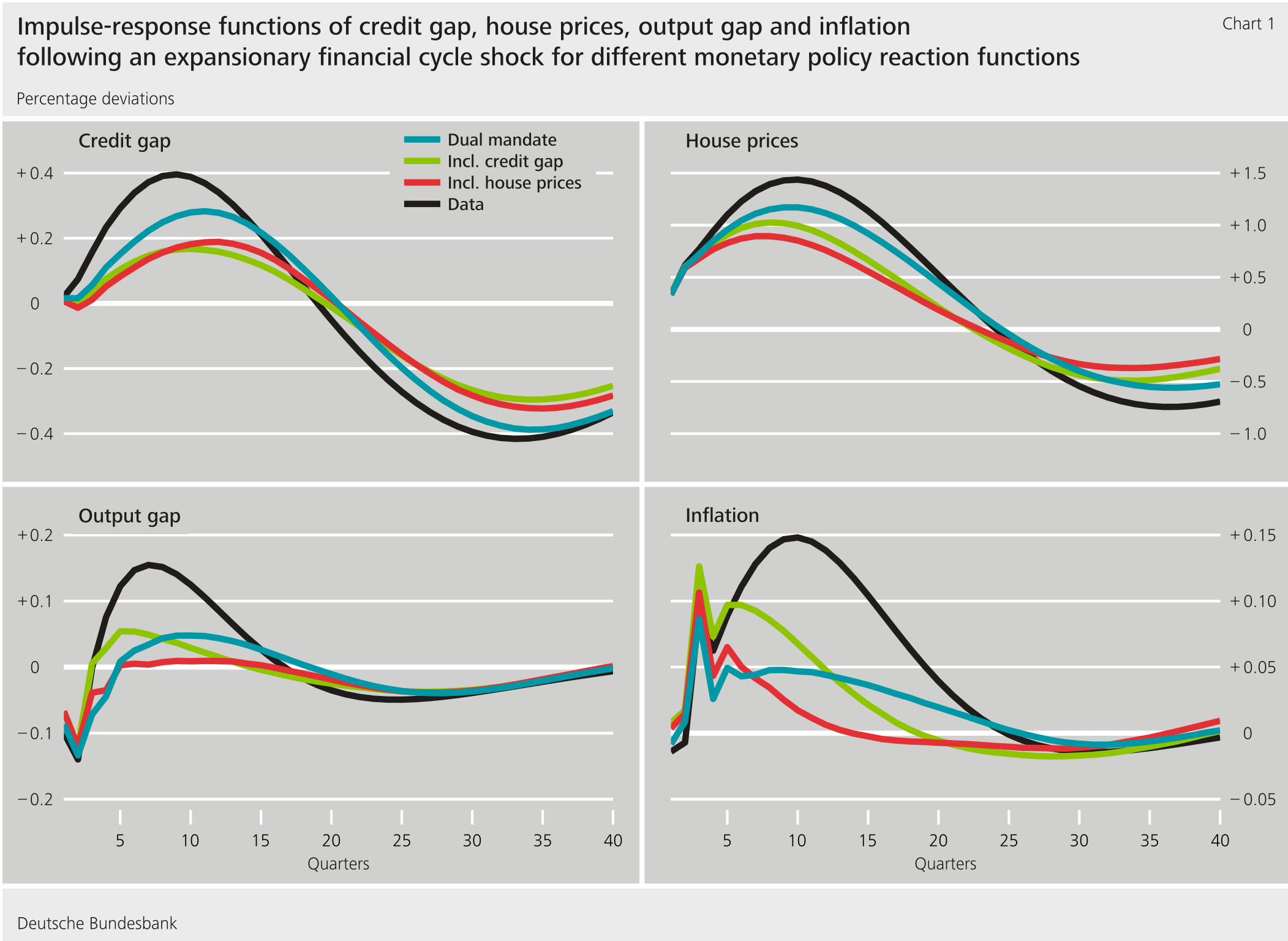
The study examines the impact of monetary policy on the financial cycle using counterfactuals (McKay and Wolf, 2023), i.e. how financial and real economic variables would have moved had US monetary policy taken a different path. The focus is on three different optimised monetary policy reaction functions, each based on minimising a central bank’s loss function. First, the authors analyse what is known as a dual mandate: in this scenario, monetary policy aims to minimise inflation and output gap fluctuations. This scenario thus takes into account comparable target variables such as the US Federal Reserve’s current monetary policy strategy. Another subject of analysis is how optimal monetary policy changes when either the credit gap or house prices are additionally included in the loss function. The output gap and credit gap are the deviation of GDP and credit from their respective trends. In this way, it is possible to assess the effectiveness of monetary policy strategies that directly counteract financial market developments – known as leaning-against-the-wind policies.

Impulse-response functions of credit gap, house prices, output gap and inflation following an expansionary financial cycle shok

Chart 1 shows how various monetary policy rules shape the financial cycle. The chart depicts the reactions of the output gap, inflation, the credit gap and house prices to an expansionary financial cycle shock (impulse-response functions). 

The black line shows the reaction of the variables under historically observed monetary policy. The blue line illustrates the scenario of an optimised dual mandate in which monetary policy exclusively seeks to stabilise inflation and the output gap. This policy has not only the expected effects on inflation and the output gap but also a stabilising impact on fluctuations in the credit gap and house prices. These effects are significantly stronger in the case of the two leaning-against-the-wind policies, represented by the red and green lines. In these scenarios, the central bank additionally takes into account either the credit gap or house prices. Both variants stabilise the respective target variables to a far greater extent, reducing their standard deviation by around 20 %.

These results underscore the fact that monetary policy can have not only medium-term effects but also influence longer-term dynamics in financial markets. It thus acts at the point of intersection between the real economy and the financial sector and can ultimately help increase an economy’s resilience to financial crises. The specific magnitude of these effects is also likely to depend on the national specificities of financial and housing markets. 

Monetary policy could have suppressed the US house price boom of the early 2000s

The study also looks at the much-discussed question of whether the Federal Reserve’s monetary policy contributed to the US housing boom of the 2000s. Using counterfactuals, the study shows that each of the monetary policy rules analysed would have stabilised the US housing market much more effectively than historically observed monetary policy. A policy designed to systematically address rising house prices would have been particularly effective. Under such a policy, real house prices would have risen by around 20 percentage points less during the boom and would have fallen only half as sharply during the subsequent bust.

Conclusion

The study suggests that monetary policy can make an important contribution to stabilising financial cycles. Central banks can significantly suppress fluctuations in financial markets, especially when they take account of credit or house prices alongside their primary objectives. However, this benefit comes with potential costs, as such a generally stabilising policy can also be accompanied by a larger deviation, for example of inflation from its target, at times and in specific circumstances (see also Adam and Woodford, 2021). 

References

Adam, Klaus and Michael Woodford (2021). “Robustly optimal monetary policy in a new Keynesian model with housing”. Journal of Economic Theory 198.

Aikman, David, Andrew G. Haldane and Benjamin D. Nelson (2015). “Curbing the Credit Cycle”. Economic Journal 125 (585), 1072‑1109.

Borio, Claudio (2014). “The financial cycle and macroeconomics: what have we learnt?” Journal of Banking & Finance 45, 182‑198.

Deutsche Bundesbank (2019). “Financial cycles in the euro area ”, Monthly Report, January.

Kliem, Martin and Norbert Metiu (2025). “Shaping the Financial Cycle through Monetary Policy .” Discussion Paper 33/2025, Deutsche Bundesbank.

McKay, Alisdair and Christian K. Wolf (2023). “What can time-series regressions tell us about policy counterfactuals?” Econometrica 91 (5), 1695‑1725.

Disclaimer

The views expressed here do not necessarily reflect the opinion of the Deutsche Bundesbank or the Eurosystem.

Has this page helped you?