Concentration of the banking market without any clear impact on the strength of monetary policy transmission 81st edition – February 2026

Sebastian Bredl

81st edition – February 2026

Concentration of the banking market without any clear impact on the strength of monetary policy transmission

— Sebastian Bredl

doi.org/10.71734/RB-81

The concentration of the banking market potentially influences lending rates. A new study (Bredl, 2025) conducted as part of the ChaMP Research Network examines this relationship in more detail. It focuses on the concentration of regional banking markets and on lending business with small enterprises. The results show that regional concentration has no clear impact on the transmission of monetary policy impulses.

The skyline of Frankfurt am Main at sunset – Source:: David J. Engel – stock.adobe.com
The skyline of Frankfurt am Main at sunset
Source: David J. Engel – stock.adobe.com

Interest rate pass-through is an important part of monetary policy transmission. It describes how strongly banks adjust their lending and deposit rates when monetary policy or market interest rates change. The structure of the banking market could influence this relationship. For example, according to the “structure-conduct-paradigm”, a more concentrated banking market could be associated with less competition between banks. This, in turn, could weaken interest rate pass-through in the banking sector (see Deutsche Bundesbank, 2026). However, it is also conceivable that high concentration is the result of intense competition in which only the most efficient banks survive.

Market concentration at regional level more relevant than at national level

There is no strong evidence in the literature of a link between banking market concentration and the degree of competition at the national level (see Claessens and Laeven, 2004). One reason could be that the structure of the banking market at the regional level, as opposed to the national level, is decisive for the degree of competition.

Indeed, Heckmann-Draisbach and Hardt (2024) find evidence that a higher concentration of the German banking market at the regional level hampers competition and causes a weaker interest rate pass-through. The data used by the authors shed light on how banks expect their interest rates on loans to households, non-financial corporations (NFC) and general government, as well as on deposits, to change under two scenarios. The two scenarios differ only in terms of the general level of interest rates, meaning that the difference in lending and deposit rates between the two scenarios is a suitable measure of the interest rate pass-through. For the purpose of calculating regional market concentration, a bank’s entire business is assigned to the region in which its head office is located.

Loan-level data as basis for calculating regional market concentration

The study by Bredl (2025) is based on loan-level data from the AnaCredit dataset for the entire euro area. This dataset offers several benefits. First, it allows market concentration measures to be calculated at various regional levels without the need for ad hoc assumptions about the regional allocation of banks’ business. This is because the lending bank and the borrowing enterprise are known for each loan. As many banks are represented in several regional markets, it is possible to examine whether the interest rates a bank charges for loans differ depending on the regional market concentration. In addition, the loan-level data allow the focus to be placed on a specific business area. The study only considers loans to small non-financial corporations, as it is for these firms that an effect of the regional market structure is most likely to occur. Furthermore, the data contain a wealth of information on the loans granted that can subsequently be considered in the analysis. This helps to isolate any effect of market concentration. 

Market concentration without any clear impact on the interest rate pass-through
Market concentration is measured using two variables. The first is the regional Herfindahl-Hirschman Index (HHI). This is calculated by adding up the squared market shares across all banks in a region. The second variable is the bank-specific market share in a region. It is thus possible to examine whether a higher market concentration affects interest rates in the same way for all banks in a region, or whether the effect is different for banks with high and low market shares.

There is evidence that banks with a higher market share in a region tend to demand higher lending rates. By contrast, regional market concentration does not play a role in loan pricing. This suggests that high bank-specific market shares weaken the intensity of competition, which in turn enables higher lending rates to be imposed. However, this effect disappears if bank-specific characteristics are fully taken into account in the estimations. It therefore appears that unobserved bank characteristics correlated with the level of regional market shares are what are driving the level of lending rates. 

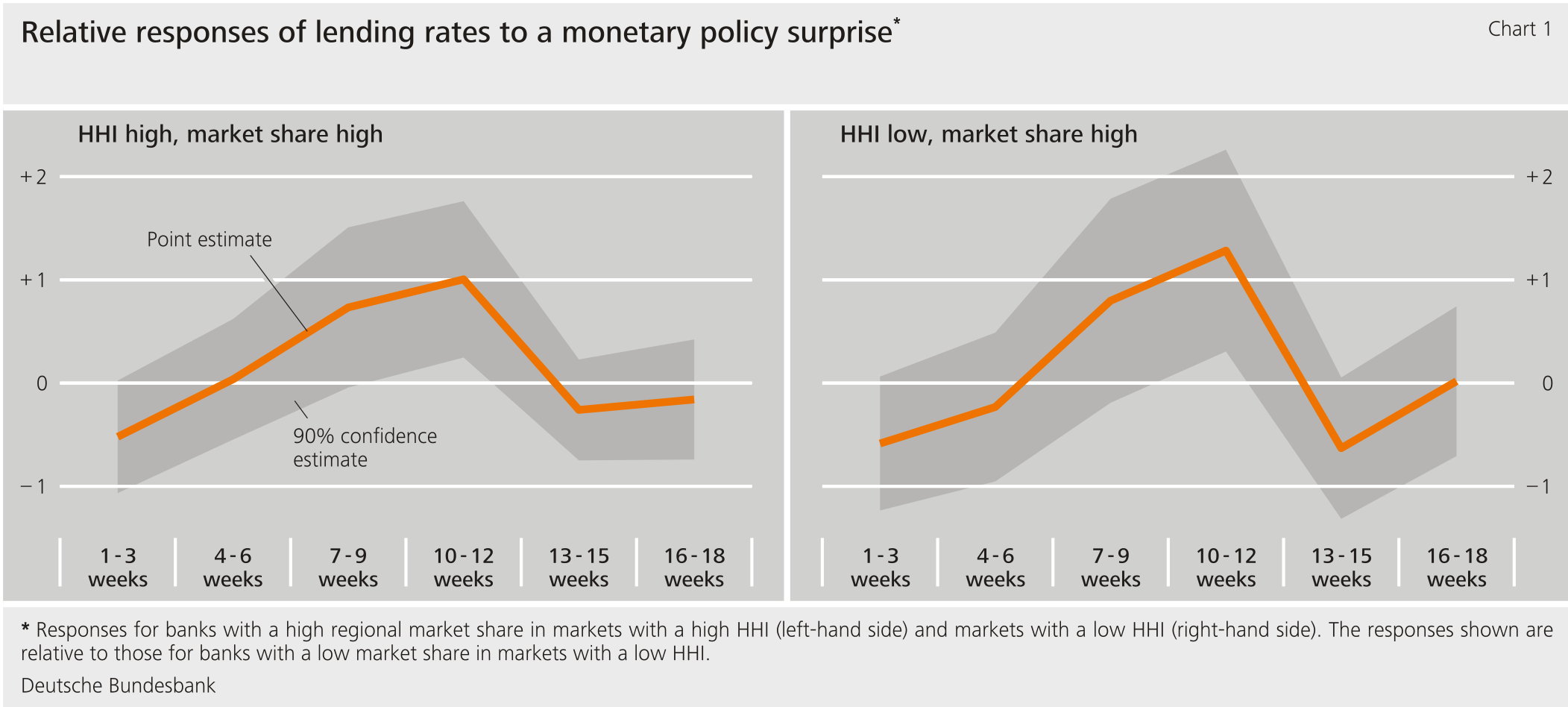
Furthermore, there is no systematic correlation between the market share of individual banks in a region and the strength of the interest rate pass-through in the wake of monetary policy tightening in 2022 and 2023. This picture emerges for the pass-through of changes in a short-term market interest rate (three-month EURIBOR) and the pass-through of monetary policy surprises (see Chart 1). These monetary policy surprises are measured by the change in market interest rates over a narrow time frame around the announcement of monetary policy decisions contained in the event-study database from Altavilla et al. (2019). 

Chart 1: Relative responses of lending rates to a monetary policy surprise

Concentration of the banking market with no clear effect on monetary policy transmission

The results of the study suggest that the regional concentration of the banking market does not play a significant role in monetary policy transmission. However, the study by Heckmann-Draisbach and Hardt (2024) shows that there is also conflicting evidence in the literature. Overall, further research appears necessary to better understand what the source of these divergent results is. For example, it is conceivable that concentration only plays a role in the interest rate pass-through in certain loan or deposit categories or in certain countries. Differences in the data basis or methodological approaches used might also play a role.

List of references

Altavilla, C., L. Brugnolini, R. S. Gürkaynak, R. Motto and G. Ragusa (2019). Measuring euro area monetary policy , Journal of Monetary Economics 108, pp. 162–179.

Bredl, S. (2025). Regional loan market structure, bank lending rates and monetary transmission , Bundesbank Discussion Paper No 30/2025.

Claessens, S. and L. Laeven (2004). What Drives Bank Competition? Some International Evidence , Journal of Money, Credit and Banking 36(3,2) pp. 563−83.

Deutsche Bundesbank (2026). Does increased concentration in the banking market in the euro area cause a change in interest rate pass-through?, Monthly Report, January 2026.

Heckmann-Draisbach, J. and J. Hardt (2024). Hampered Monetary Policy Transmission – A Supply Side Story? , Journal of Money, Credit and Banking, forthcoming.

Disclaimer

The views expressed here do not necessarily reflect the opinion of the Deutsche Bundesbank or the Eurosystem.

Has this page helped you?