Climate policy is costly for firms: Evidence from the EU Carbon Border Adjustment Mechanism 82nd edition – March 2026

Mengjie Shi, Yupu Zhang, Christoph Meinerding

82nd edition – March 2026

Climate policy is costly for firms: Evidence from the EU Carbon Border Adjustment Mechanism
— Mengjie Shi, Yupu Zhang, Christoph Meinerding

Is EU climate policy costly for firms at the current juncture? The academic literature has not come up with consistent empirical evidence so far. New research evaluating the recent decision to introduce the EU Carbon Border Adjustment Mechanism suggests that European carbon pricing has finally started to bite.

Flags of the European Union
Flags of the European Union in front of the Berlaymont in Brussels – picture.source Fotosearch.de
Flags of the European Union in front of the Berlaymont in BrusselsFlags of the European Union
picture.source Fotosearch.de

doi.org/10.71734/RB-82-en

Climate policy has gained a lot of momentum in recent years, with the EU Emissions Trading System serving as a worldwide flagship. However, existing empirical evidence about the effectiveness of carbon pricing remains inconclusive. In particular, it is unclear how strongly carbon pricing hurts regulated firms and whether it induces a tradeoff between financial performance and combating climate change. New empirical Bundesbank research shows that recent changes in EU carbon pricing are having noticeable effects on firms (see Shi, Zhang, Meinerding (2025)). This view is also indirectly supported by the current backlash in EU climate policy. EU legislators are currently implementing a follow-up reform of EU climate policy that is supposed to relieve the financial burden on European firms. 

The EU Carbon Border Adjustment Mechanism

In December 2022, the EU legislative bodies agreed to introduce a new carbon pricing tool. The EU Carbon Border Adjustment Mechanism (CBAM) represents the world’s first carbon border tax. It narrows an obvious loophole in the current EU carbon pricing scheme. At present, the EU only puts a price on carbon emissions generated within the EU. Under the CBAM, importers of certain goods will also have to pay a price for carbon emissions generated during the production of these goods outside the EU. 

That said, the CBAM is about to see its first major reform already before the first payments are due. EU legislative bodies have postponed the official starting date for one year, from 2026 to 2027. Moreover, simplifications for small enterprises will exempt about 90 per cent of importing firms (which make up only 1 per cent of the covered emissions, though) from CBAM payments. These changes aim to reduce the financial and administrative burden on firms.

Previous research: Why were the effects of EU climate policy limited?

At the same time, researchers have found no clear effect of EU carbon pricing on firms’ financial performance in the past. Researchers attribute this to two main factors. First, the EU Emissions Trading System was not stringent enough during its early phases to have a significant impact. This has been documented by Dechezlepretre, Nachtigall and Venmans (2023), Colmer, Martin, Muuls and Wagner (2023) or Trinks and Hille (2026), amongst others. Second, researchers face severe challenges when measuring causal effects of climate policy empirically. They often lack proper microdata or reasonable exogenous variation to make meaningful causal inference. 

The new Bundesbank study overcomes these challenges and demonstrates that more stringent carbon pricing negatively affects firms’ financial performance. Notably, this negative impact is estimated solely from market expectations incorporated in equity prices. As of now, no tax payments have been due under the CBAM.

The announcement of the CBAM agreement had a negative impact on firms’ stock prices
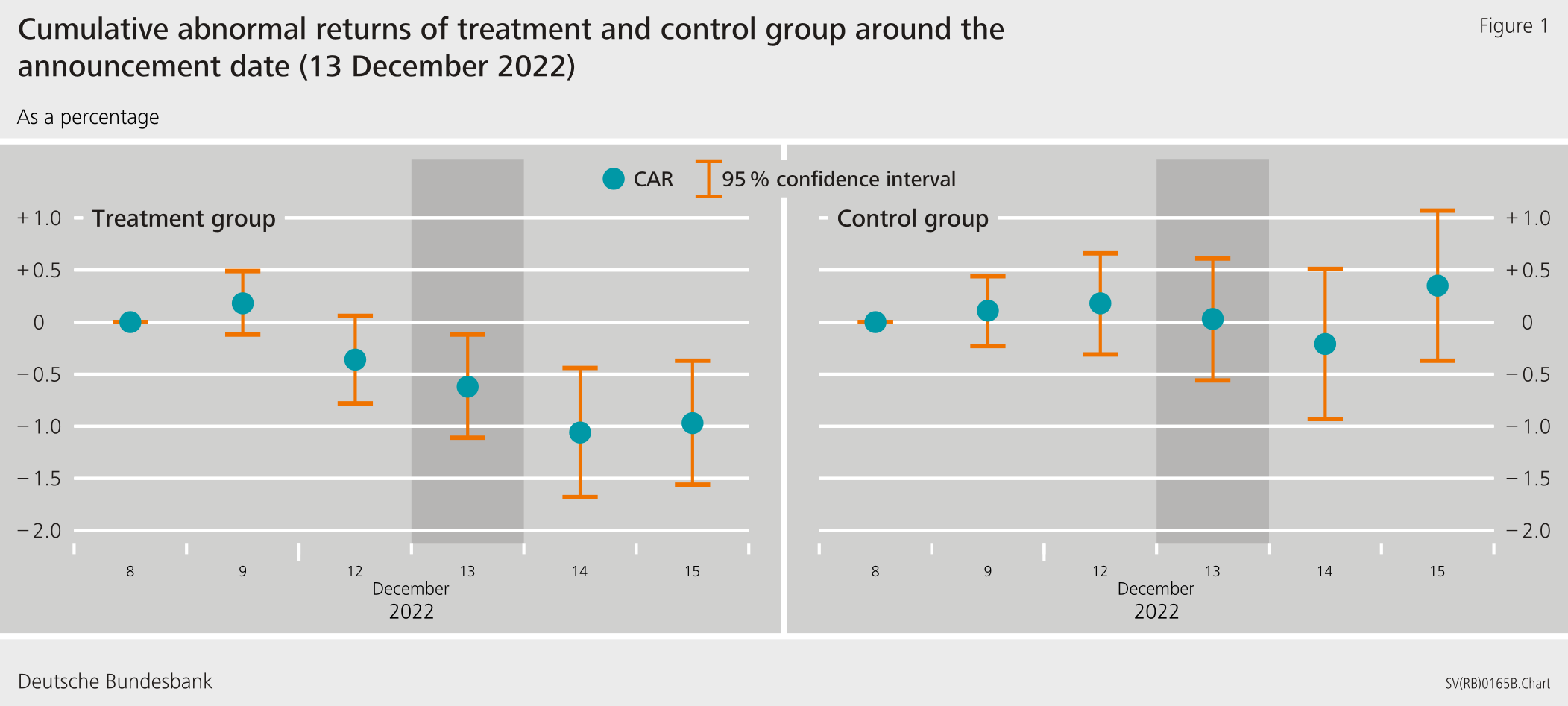
The announcement of the CBAM agreement caused stock prices of treated firms to drop by an average of 1.3 percentage points, relative to the control group. In the study, we combine stock return data for publicly traded European firms with supply chain information from FactSet Revere and compare the stock returns of two groups of firms. Firms that have suppliers in CBAM-affected industries outside the EU are put into the treatment group. Firms that only have suppliers inside the EU and in non-affected industries are put into the control group. Figure 1 shows the cumulative stock returns of these two groups of firms in a short time window around the main event date of 13 December 2022. On this date, the main legislative bodies of the EU reached their decisive agreement concerning the CBAM.

Cumulative abnormal returns of treatment and control group around the announcement date (13 December 2022)

The CBAM agreement also serves as a signal concerning follow-up decisions about EU carbon pricing. In parallel to the CBAM process, the EU negotiated other reforms that further enhance the stringency of the EU Emissions Trading System. For example, the system of free emission allowances that are currently allocated to firms in certain sectors will be phased out gradually. On 13 December 2022, the agreement concerning these other reforms was still outstanding. Yet firms that currently profit from free allowances experienced anticipatory negative stock returns of about one percentage point around this date.

The magnitude of the treatment effect is not overly worrisome, but remarkable for several reasons. First, multiplying the average treatment effect of 1.3 percentage points with the total market capitalization of all treated firms suggests losses of above €1 billion over the event window. This estimate is roughly in line with (discounted) EU estimates of the expected CBAM revenues until 2050. Second, since our analysis focuses on customer firms within the EU, the results suggest that a substantial share of the financial burden is borne by importers and not fully passed through to producers abroad. Third, the treatment effect measured over the narrow event window should be regarded as a kind of lower bound for the (unknown) total effect of the CBAM on firms. Finally, the economic significance of the treatment effect is also indirectly supported by the recent backlash in EU climate policy, which comprises a reform of the CBAM.

Ex-post climate policy evaluation will shape our research agenda going forward

From a broader perspective, these findings are part of a larger research agenda focused on evaluating climate policy. A series of climate policy tools have now been implemented and statistical offices collect data on a continuous basis. We are entering a stage where we can evaluate both the effectiveness and unintended side effects of existing climate policies empirically ex-post through event studies. Such causal evidence will enable policymakers to recalibrate climate policy so as to limit the negative impact on the aggregate economy. 

In the specific case presented here, recent changes in EU carbon pricing policy had measurable negative effects on the financial performance of regulated firms. At the same time, the magnitude of this effect appears manageable, limiting worries about the prospects of our economy in light of steadily increasing carbon prices. In addition, as previously mentioned, a reform of the CBAM, which is supposed to relieve the financial burden in particular for small firms, is currently underway.

References

Colmer, J., R. Martin, M. Muuls, and U. Wagner (2025): Does pricing carbon mitigate climate change? Firm-level evidence from the European Union emissions trading scheme , Review of Economic Studies 92(3), pp. 1625–1660

Dechezlepretre, A., D. Nachtigall, and F. Venmans (2023): The joint impact of the European Union emissions trading system on carbon emissions and economic performance , Journal of Environmental Economics and Management, 118 (C)

Shi, M., Y. Zhang, and C. Meinerding (2025): The impact of climate policies on financial mar-kets: Evidence from the EU Carbon Border Adjustment Mechanism , Bundesbank Discussion Paper 14/2025

Trinks, A., and E. Hille (2026): Carbon costs and industrial firm performance: Evidence from international microdata , Energy Economics 153 (109077)

label.authors

Mengjie Shi

Yupu Zhang

Christoph Meinerding

publication.disclaimer.title

publication.disclaimer.description

Has this page helped you?