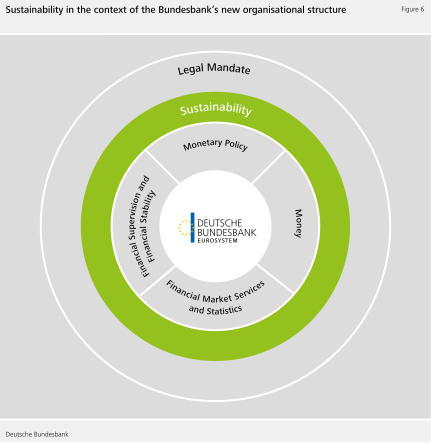
As part of its “Strategy 2027”, the Bundesbank realigned its strategy and steering process. The Bank implements its legal mandate and has a direct external impact through its outward core services, which comprise the areas of “Monetary Policy”, “Money”, “Financial Supervision and Stability”, and “Financial Market Services and Statistics”. Sustainability plays a key role in this context, as it permeates all of the Bundesbank’s core services and is relevant to all areas. Thus, for several years now, the Bundesbank has been closely examining the impact of climate-related risks and, increasingly, nature-related risks on its core services (see Figure 6).
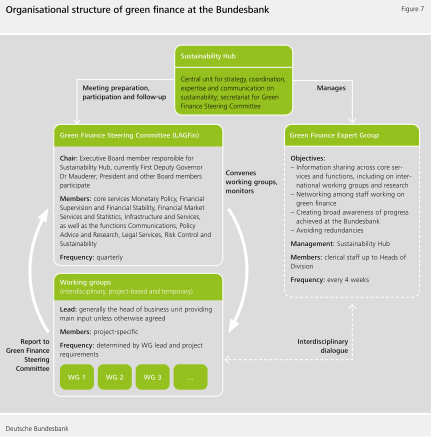
Since 2021, the Green Finance Steering Committee (LAGFin) has acted as the central steering and advisory body for interdisciplinary sustainability topics and projects at the Bundesbank. It is headed by First Deputy Governor Sabine Mauderer. President Joachim Nagel and other Executive Board members regularly attend meetings. The Committee’s permanent members comprise management-level staff representing the core services Monetary Policy, Financial Supervision and Stability, Financial Market Services and Statistics, Infrastructure and Services and the functions Communications, Policy Advice and Research, Legal Services, Risk Control, and Sustainability. The Committee can use working groups to handle interdisciplinary sustainability-related projects. 1 The working group leaders report to the participating members of the Executive Board regularly, during committee meetings, thus ensuring continuous project monitoring. In this way, the Committee ensures that the Executive Board and the relevant core services and functions build strong networks and are always informed about sustainability topics and projects in the Bank. At the same time, this allows Executive Board members to steer interdisciplinary analyses and projects in a targeted way.
The Green Finance Steering Committee is flanked by the Green Finance Expert Group, a forum for regular expert-level interaction and dialogue. In 2025, a range of specialist lectures provided new impetus and further promoted capacity building within the Bundesbank. Alongside this institutionalised monthly dialogue, staff are supported by an interactive internal knowledge platform on climate-related and nature-related work inside and outside the Bundesbank.
The Sustainability Hub was set up in August 2023 and reports directly to First Deputy Governor Sabine Mauderer. The Hub’s tasks are strategy, coordination, specialist work and communications. It advises the Executive Board on strategic issues, including climate change, the transition of the economy and sustainability. As part of its strategy work, the Hub provides impetus and sets overarching sustainability objectives in consultation with the core services and functions. It is then at the discretion of the core services and functions to translate these into objectives and tasks of their own. The Hub also acts as the secretariat and agenda setter for the Green Finance Steering Committee and coordinates specialist information sharing within the Green Finance Expert Group and in interdisciplinary projects. Through all of the above, the Bundesbank is further strengthening its sustainability credentials. As a specialist unit, the Hub plays a part in setting the agenda for projects and analytical work and, through its own expert work, acts as an incubator for the Bank as a whole.
The Hub’s analytical work focuses on three major topics: the transition to a net zero economy, nature-related risks, and physical risks and adaptation to climate change. It also has a process for systematically identifying and analysing new developments and trends in the field of sustainability, provides key impetus and supports the Bundesbank in responding to new developments relating to sustainability strategically and at an early stage. It provides targeted communication on the topic of sustainability both within the Bank and externally. By offering training courses, including in the area of climate education, it supports the work of core services and functions and raises employees’ awareness of the topic. The Hub acts as the central point of contact for the public and external stakeholders in overarching matters. It explains the relevance of sustainability for central banks to a wide audience through informative channels such as “Forum Bundesbank”, “Euro20+” and “Finance Flash”. In addition, it represents the Bank together with experts from the core services and functions in national and international cross-sectional committees (see Section 1.1).
Figure 7 gives a simplified overview of the organisational structure of green finance at the Bundesbank. Sustainability – above all, the impact of climate change, of nature and biodiversity loss and of climate policy on the economic and financial system – has an influence on almost all of the Bundesbank’s core services and functions.