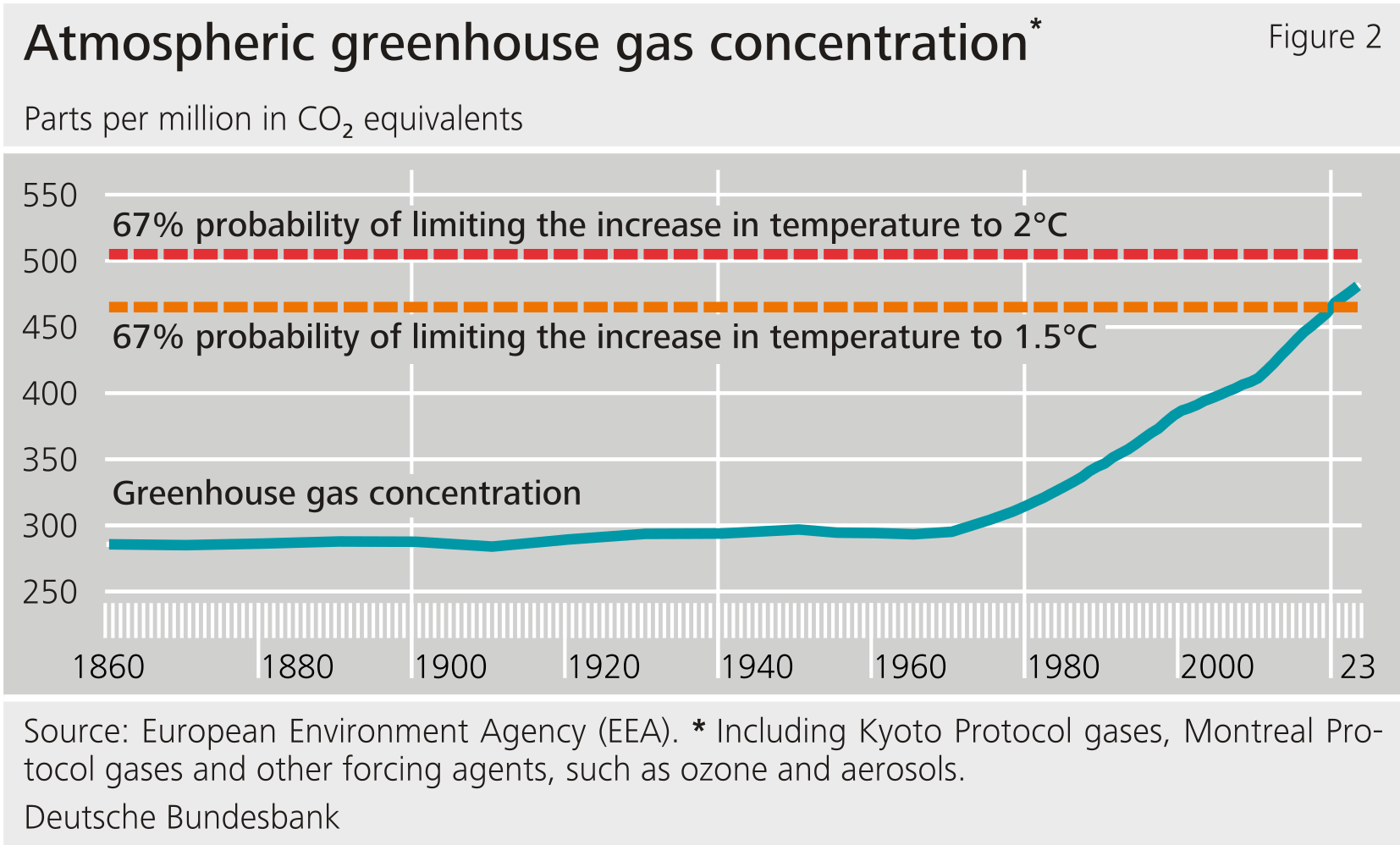
Climate change and the loss of natural habitats and biodiversity, as well as the transition to a net zero economy, continue to pose key challenges to the stability of the economy and financial system. Fossil fuel dependency has an increasingly adverse economic impact. However, amidst geopolitical tensions and economic uncertainty, climate and nature protection have recently been “put on the back burner” in many countries and institutions. The concentration of greenhouse gases in the atmosphere is rising continuously, making it increasingly unlikely that global warming will be limited to 1.5 degrees Celsius – the main objective of the Paris Agreement (see Figure 2 1 ). This shows the urgency of reducing greenhouse gas emissions in order to achieve national and international climate targets. These global developments directly affect the Bundesbank’s core business areas.
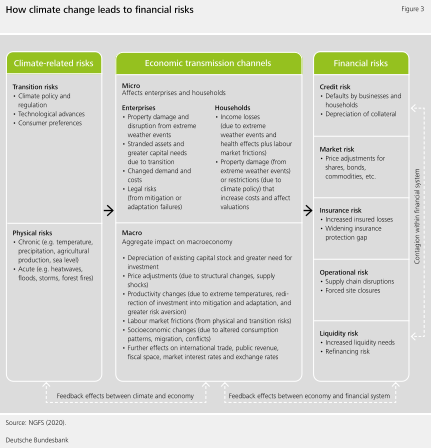
On the one hand, the concentration of greenhouse gases results in “acute” and “chronic” physical climate risks, such as floods, droughts and long term increases in temperature and sea levels. These risks will continue to increase as the concentration of greenhouse gases rises. On the other hand, climate policy measures to achieve a net zero economy, technological innovation and changes in consumer behaviour can lead to what are known as transition risks or opportunities. 2 It has recently become clear just how dependent on fossil fuels the German and European economies have become and what economic uncertainties and risks this entails. The extent to which transition risks and opportunities arise depends on various factors, some of which are political. It is therefore often hard to quantify. Figure 3 shows that physical and transition risks can have economic implications. At the micro level, these could include, for instance, the destruction of assets or productivity losses on the part of firms. 3 In addition, the solvency and collateral value of (public or private) borrowers could be adversely affected. At the macro level, public revenue and fiscal space 4 can be impaired, as can price stability and the transmission of monetary policy, 5 spilling over to other core business areas of the Bundesbank. Via these economic transmission channels, physical and transition climate-related risks affect the financial system as drivers of existing financial risks. The Focus Chapter in Section 1.2 looks at the extent to which climate-related risks and the long-term sustainability of fossil fuel-based business models are putting the stability of the German financial system at risk.
In this challenging context, the Bundesbank remains committed to analysing the impacts of climate change and nature and biodiversity degradation on the economic and financial system and to addressing the implications for its own balance sheet by taking the appropriate risk management measures. In 2021, the Eurosystem central banks agreed on a common framework to make non-monetary policy portfolios more sustainable and increase transparency on their own climate performance. 6 In subsequent years, the Eurosystem adopted further measures to integrate climate-related risks more closely into monetary policy operations within its mandate and to take them into consideration in the future design of the operational framework for implementing monetary policy. 7 As part of the 2025 strategy assessment, the ECB’s Governing Council committed to taking into account, within the monetary policy mandate and general activities, the implications of climate change and the loss of nature and biodiversity for monetary policy and central banking. 8
With this fifth annual report, which is part of the Eurosystem-wide climate-related disclosures, the Bundesbank wishes to underscore once more the importance of the climate-related risk management of financial assets as well as transparency and disclosure. In times when short-term risks are the prime focus, it is all the more important not to lose sight of long-term developments and to set the course for a sustainable future – not only in view of the Federal Climate Action Act (Klimaschutzgesetz), but also to safeguard economic and financial stability.
1.1 Milestones and highlights in 2025
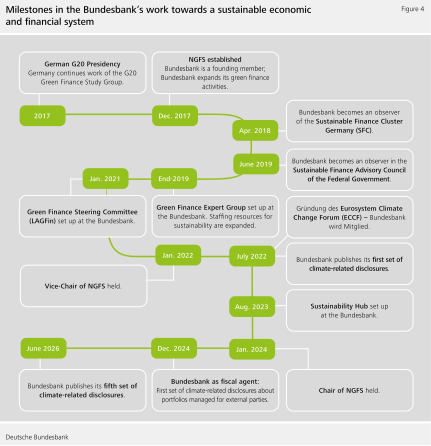
The Bundesbank has been comprehensively addressing climate change and the impact on its mandate and business areas for several years. It began with a particular focus on climate-related risks and has increasingly extended it to include nature-related risks. In addition, the Bundesbank advocates for a more sustainable economic and financial system. Figure 4 provides an overview of the key milestones of recent years.
National and international cooperation with a broad range of stakeholders to gain a better understanding of the economic and financial risks arising from climate change and climate policy remained an important aspect of the Bundesbank’s climate-related work in 2025. At the national level, the Bundesbank has been an observer on the Standing Committee of the Sustainable Finance Cluster (SFC) since April 2018. This body is a central point of contact for questions relating to sustainable finance in Germany. It thus contributes to the standing dialogue with key financial players on sustainability issues and, in particular, the impact of climate change and nature and biodiversity degradation on the financial system. For example, in October 2025, the Bundesbank, together with the SFC, organised a talk on sustainable finance for its clients in the public sector asset management sector. 9 Topics included developments in the area of sustainable finance, the regulatory framework and public investors’ practical experience with the issue of sustainability. In addition, in December 2025, the Bundesbank hosted the quarterly meeting of the Standing Committee of the SFC.
In the global context, the Bundesbank has a key influence on the activities of the NGFS.Bundesbank First Deputy Governor Dr Sabine Mauderer will continue in her role as Chair of the Network until June 2026. In addition, various Bundesbank core services and functions actively contribute to the work of several NGFS working groups, such as on the macroeconomic impact of climate action or by co-chairing the Expert Network on Data. The key NGFS publications in 2025 included innovative short-term climate scenarios examining the direct effects of climate change and climate policy on the economy and the financial system 10 and also, for the first time, an input paper for the G20. 11 This paper presents a practice-oriented framework for anchoring climate adaptation into transition planning and guidelines for developing adaptation goals and metrics.
Together with the BMF, the Bundesbank also represents Germany in the G20 Sustainable Finance Working Group (SFWG). One of the issues the SFWG explored in 2025 was how firms could integrate investment to adapt to climate change into their transition plans and how to improve data standardisation in global trade in carbon offset certificates. The Bundesbank and the BMF are likewise both members of the OECD’s Sustainable Finance Working Party (SFWP), established in 2025. The SFWP brings together central banks, supervisory authorities and finance ministries from 39 jurisdictions to facilitate efficient, open and sound financial markets that also take sustainability aspects into account. In addition, the Bundesbank promotes knowledge transfer, including in the Eurosystem, the NGFS and the G7, for example by exchanging best practices in modelling climate-related risks and by publishing its own analytical tools and thus making them available to interested users. 12
Risks from nature and biodiversity loss are a growing area of interest. In the 2025 monetary policy strategy assessment, the ECB’s Governing Council committed to fully taking into account, within its mandate, the implications of climate change and nature degradation for monetary policy and central banking. 13 For the first time, a Bundesbank study has shown that banks in Germany are highly dependent on ecosystem services through their lending to enterprises. 14 Ecosystem services provide inputs for economic activities. If these are no longer available, or their availability is limited, due to nature and biodiversity degradation, the supply of goods and services from various economic sectors may be at risk. These risks can spill over to banks by loans to affected enterprises.In addition, the Bundesbank conducts internal analyses to examine the extent to which its own financial assets are exposed to nature-related risks.
Climate-related risks remain an area of interest for financial and banking supervision. Physical climate-related risks such as extreme weather events are becoming increasingly important. 15 The Bundesbank is involved in implementing the prudential regulation created by the so-called “EU banking package” and addressing sustainability risks. This includes assisting the European Banking Authority (EBA) in the preparation of guidelines and technical standards on environmental, social and governance (ESG) risks, including risk management, scenario analysis, stress testing and disclosure. In the area of financial stability, too, the Bundesbank is continuously investigating potential vulnerabilities that can arise in the financial system as a result of climate-related risks (see also Focus chapter).
At the same time, the Bundesbank’s analyses show that the banking sector is, in principle, well placed to finance the transition to a net zero economy. In a comprehensive analysis, the Bundesbank examines the investment and financing required to transition to a net zero economy in Germany by 2045 and the role of the German banking system in providing the necessary funds. 16 The results show that banks’ capital adequacy is sufficient to provide the additional investment, even under conservative assumptions. At the same time, however, it is clear that structural barriers and a lack of incentives have, up until now, dampened the willingness to invest in decarbonisation measures in key sectors. This is also suggested by the results of Bundesbank surveys. The study thus provides valuable impetus for the current debate and for the design of an effective framework for financing the transition.
On behalf of the European System of Central Banks (ESCB), the Bundesbank once again successfully procured climate and other sustainability data and concluded contracts with two data providers. It thus continues to safeguarding the common dataset of the national central banks in the ESCB in this area. This is an important prerequisite for comparable climate metrics in portfolio management and reporting (see Chapter 5) as well as for the implementation of the monetary policy use cases decided by the ECB Governing Council. 17
The Bundesbank uses innovative technologies to tap new data sources in the field of sustainable finance. For example, in cooperation with the Ludwig Maximilians University of Munich, the Greenhouse Gas Insights and Sustainability Tracking(GIST) project uses artificial intelligence (GenAI) to extract sustainability information from unstructured public sources, such as sustainability and annual reports, and to make it usable for central bank and statistical purposes. A key objective is to improve the transparency and consistency of greenhouse gas emissions data reported by companies and, in some cases, provided by commercial vendors, and of other environmental metrics. The Bundesbank is thus making an important contribution to enhancing the data basis for research and analysis and to accessing new data sources and methods in statistics.
Focus chapter
Monitoring the financial system vulnerabilities arising from climate-related risks
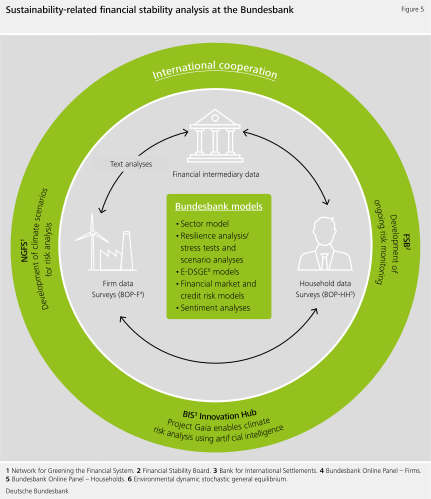
The Deutsche Bundesbank is committed, within its mandate, to contributing to the stability of the German financial system, and is therefore also intensively involved in analysing climate-related risks. It fulfils this task through its own independent analyses and through close international cooperation with institutions such as the Financial Stability Board (FSB) and the NGFS, as shown in Figure 5. The aim is to understand the potential impact of climate change and climate policy on the financial system and to identify systemic vulnerabilities at an early stage. The Bundesbank is investigating how physical risks from climate change and transition risks – i.e. risks arising from the transition to a net zero economy – affect the financial system via credit, market, liquidity and insurance risk. 1 To this end, the Bundesbank has developed a macroprudential analytical framework that builds on the NGFS’s global scenario framework and the FSB’s internationally coordinated climate risk analyses and is tailored specifically to the German financial system. In several Financial Stability Reviews and one-off publications, the Bundesbank has already examined the possible consequences of climate change and climate policy on the German financial system in detail. Various models show that, overall, it is resilient to the transition risks analysed so far.
Germany is a highly industrialised country, and its exposure to natural hazards is relatively low compared with other regions of the world. The focus of previous analyses has therefore been on transition risks that can arise from climate policy, technological change and changes in preferences. These risks can affect banks, insurers and other financial intermediaries’ balance sheets via the real economy, in particular through portfolios concentrated in high-emissions sectors. At the same time, physical risks, such as extreme weather events, continue to rise. The Bundesbank recognises the potential consequences, and analyses whether physical and transition risks can accumulate and be amplified in the financial system, for example through herd behaviour in financial markets or concentrations in particularly vulnerable economic sectors.
The Bundesbank is investigating how various climate policies could affect the economy as well as banks, funds and insurers. To this end, the Bundesbank uses its own climate scenarios and NGFS climate scenarios, which show how emissions, carbon prices and temperatures could evolve depending on the policy stance – from “business as usual” to more ambitious climate targets. Economic models are used to calculate the potential implications for Germany for key outcomes such as economic growth, inflation, interest rates and financial stability. A dedicated sectoral Bundesbank model also looks at how individual sectors are affected. 2 Particularly energy-intensive sectors, such as parts of industry, transport and fossil energy production, could suffer especially large losses in relation to their economic output. Services sectors are usually less affected.
Analyses to date show that the German financial system is well equipped to cope with the consequences of climate change, 3 but that, in isolated cases, banks and insurers could be affected more severely. Studies show that, in the event of a gradual transition to more climate protection – as in the “Net Zero 2050” scenario – the impact on inflation and economic growth in Germany will remain fairly moderate and the financial system will be able to cope with the burdens. Financial institutions that are highly invested in carbon-intensive sectors or investments with very long maturities should take full account of the resulting risks. The larger losses on securities and (moderately) rising credit losses following sudden climate policy changes, such as a rapid increase in the carbon price, are an argument in favour of a slow and orderly “green” transition. Long-run analyses suggest that physical climate-related risks tend to be moderate for Germany, but they could increase in the future. 4 The Bundesbank is therefore working to gain an even clearer picture of these risks.
The Bundesbank plays an active role in international cooperation to assess climate-related risks. It is helping to develop and modify climate scenarios within the framework of the NGFS. In addition, the Bundesbank contributes to analyses of increasing physical risks from extreme weather events and their impact on German financial market participants within the framework of the G7. Work on an FSB monitoring toolkit that captures indicators on climate-related risks and vulnerabilities is another area of the Bundesbank’s work. The toolkit includes proxies for climate-related risks and political framework conditions, exposure metrics to measure a financial system’s exposure to these risk drivers and risk metrics that quantify potential losses. Work on this toolkit is scheduled for completion in the course of 2026 and integrated into regular risk monitoring.
At the same time, it is clear that the analysis of climate-related risks continues to present significant challenges. Important data gaps exist, in particular, for granular emissions data and transition information at the firm level, as well as for georeferenced data to track the precise location of real assets with an elevated exposure to physical climate-related risks. In addition, consistent, internationally comparable disclosures about climate-related risks and strategies are lacking. Broad data availability and/or market transparency and disclosure of climate-related risks are therefore highly relevant. The Bundesbank is addressing these gaps through business and household surveys, the use of AI-based methods to analyse unstructured data from corporate reports, 5 its own data procurement projects and participation in international initiatives to harmonise disclosure standards and climate data.
The results so far show that climate-related risks affect the financial system via traditional financial channels, but place new demands on financial stability analysis. In particular, due to the timeline, inherent model uncertainties and potentially complex non-linearities a continuous review of the analytical methods is needed. Overall, the German financial system appears resilient to climate-related risks, even though long-term challenges persist. The Bundesbank will further deepen its analyses in order to keep an eye on the stability of the financial system, also amidst increasing climate-related risks.