3 Strategy

Climate Report

3.1 Sustainable investment strategies for the Bundesbank’s own non-monetary policy portfolios/investments

Climate and sustainability risks can threaten the financial viability of particularly affected businesses and states. To limit potential financial risks, the Bundesbank therefore considers sustainability aspects when choosing what assets to invest in. Through its investment activities, the Bundesbank also aims to promote climate protection and sustainability within its statutory mandate. For this reason, the Bundesbank has implemented sustainable investment strategies for its own non-monetary policy portfolios/investments (euro portfolio and the foreign currency portion of its reserve assets). 

3.1.1 Euro portfolio

The Bundesbank manages a non-monetary policy euro-denominated securities portfolio (euro portfolio) as an asset-side counterpart to its long-term provisions for civil servant pensions and healthcare assistance, capital and reserves. As a result, the maximum volume of the euro portfolio is predefined and its proportional share in the Bundesbank’s balance sheet can be regarded as low. 

The euro portfolio currently contains euro-denominated covered bonds from the jurisdictions of Germany, France, Finland, Belgium, the Netherlands, Norway, Sweden and Australia. It also contains euro-denominated unsecured bonds issued by selected non-euro area institutions, including supranational development banks, national promotional banks and other institutions with a public mandate. Unsecured bonds in the portfolio have a significantly lower weighting than covered bonds. In principle, the debt securities are held to maturity.

Within its statutory mandate, the Bundesbank’s target criteria include not only return, safety and liquidity but also sustainability considerations. The focus of these sustainability aspects is on climate change and the transition to a net zero economy.

Covered bonds:

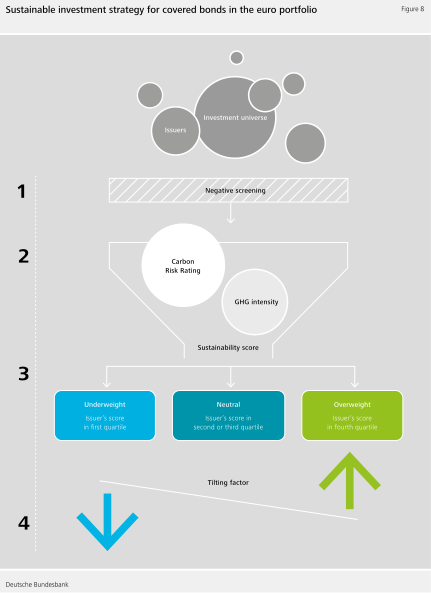
A four-step sustainable investment strategy has been established for covered bonds in the euro portfolio (see Figure 8):

Sustainable investment strategy for covered bonds in the euro portfolio
  1. Negative screening: Issuers are screened for proven and serious breaches of globally recognised minimum standards. These include the United Nations (UN) Global Compact, the Organisation for Economic Co-operation and Development (OECD) Guidelines for Multinational Enterprises, the International Labour Organization (ILO) core labour standards and international treaties on prohibited weapons. If such standards are breached – for example, because of human rights violations – the issuer’s securities are excluded from the pool of possible investments.
  2. Definition of sustainability indicators: Issuer-related indicators create a sustainability score consistent with the Bundesbank’s definition of sustainability. The indicators used currently are the “Carbon Risk Rating” developed by the ESG data provider ISS ESG and the issuers’ GHG intensity.
  3. Classification and steering: Issuers are classified into three groups based on their sustainability score, which determines whether they are overweighted, underweighted or declared neutral compared to the benchmark.
  4. Tilting: A tilting factor is applied to determine the degree to which issuers are over- and underweighted within the benchmark portfolio.

Unsecured bonds

Unsecured bonds, which have been newly approved in 2025, are rated according to a climate-focused sustainability score. This is based on three pillars (footprint, ambition, transparency) and serves as a framework for approval, ongoing management and review. It is aligned with the concept used for the foreign currency reserves (see Section 3.1.2). 

The sustainable investment strategy for the euro portfolio is continuously refined and reviewed in light of new data and evolving market practices. Through the described methodologies, the Bundesbank takes account of climate-related risks and opportunities in managing the euro portfolio. 

3.1.2 Reserve assets

The Bundesbank’s reserve assets comprise gold holdings, receivables from the IMF and foreign currency reserves. It makes its foreign currency investment in US dollars, Japanese yen, Australian dollars, Canadian dollars, Chinese yuan (renminbi) and, since 2024, pound sterling. Most of this investment is in sovereign bonds. Holdings also include bonds issued by sub-sovereigns (e.g. federal states and provinces) and national or supranational promotional and development banks (belonging to the supranationals and agencies issuer group).

In 2023, the Bundesbank introduced a sustainable investment strategy for the foreign currency portion of its reserve assets. This was designed to take greater account of climate-related financial risks and – where this is possible given its primary currency and monetary policy tasks – to combat climate change.

The strategy focuses on the eligibility of issuers. Since restrictions on sovereign bonds (United States, Japan, Australia, Canada, China and the United Kingdom) are virtually impossible given the overarching requirements of currency policy, the Bundesbank has developed suitable approaches for the remaining relevant issuer groups (sub-sovereigns and promotional and development banks).

For the Bundesbank to purchase securities issued by sub-sovereigns, the sub-sovereign must have a better climate profile than the corresponding sovereign. The climate profile is determined by the total GHG emissions and the volumes of fossil fuels produced in the sub-sovereign region, each relative to the size of its economy. This means that, in its foreign currency investment, the Bundesbank avoids sub-sovereigns with a worse climate profile than the corresponding sovereign. If a sub-sovereign has a significantly worse climate profile than the corresponding sovereign, the Bundesbank would consider actively selling those securities holdings.

For the Bundesbank to purchase bonds issued by promotional and development banks, they must meet minimum requirements for a climate-focused sustainability score. Sustainability scoring for issuers is based on three pillars: 1) green and/or brown shares of business activities; 2) ambition, e.g. concerning GHG reduction targets or the exclusion of fossil energy financing; 3) transparency and/or the quality of climate-related disclosures. The results of these three pillars are weighted and merged to form an overall score, with pillar 1 being the main focus of the overall score. In its foreign currency investment, the Bundesbank will therefore not invest, in particular, in promotional and development banks which provide substantial funding to sectors that harm the climate and the environment, such as the fossil fuel sector. The sustainability scoring is also in line with the Bundesbank’s aim of creating an incentive for issuers to set themselves climate goals and disclose climate-related information. If an issuer falls significantly short of the sustainability requirements, a sale is considered. In addition, as for the euro portfolio, ongoing negative screening for proven and serious breaches of globally recognised minimum standards is carried out for promotional and development banks.

3.2 The Bundesbank as fiscal agent

Based on its legal mandate (Section 20 of the Bundesbank Act read in conjunction with Section 19 of the Bundesbank Act), the Bundesbank acts as a fiscal agent for central government, federal state governments and other public administrations. Its main activities in this context include passive portfolio management, trading and settlement as well as independent risk control and reporting. It provides passive or rules-based portfolio management for equities and bonds based on the specifications of individual clients.

In recent years, the consideration of sustainability and climate action objectives has become an established investment criterion for clients’ financial investments. In this context, the Bundesbank provides its clients with operational and analytical support in implementing customised sustainability objectives. Depending on the client’s specifications, measures such as exclusion criteria (for example, breaches of globally recognised minimum standards), positive lists, climate and sustainability-related scoring and tilting methods are implemented. 

For equity investments, many clients now use indices that are tailored to their intended sustainability objectives. Here, the sustainability benchmarks defined by the EU (the EU climate transition benchmark (CTB) and the EU Paris-aligned benchmark (PAB)) are playing an increasingly important role. These benchmarks embed GHG reduction targets through clear decarbonisation paths (for example, significant reductions in GHG intensity compared with the baseline and annual decarbonisation) as well as binding minimum standards. Clients are also increasingly integrating bonds into their sustainable investment strategies, applying sustainability criteria in their fixed income investments, including covered bonds or investments in green or social bonds.

The Bundesbank produces reports on sustainability aspects of the managed portfolios at the request of clients (for example, for the central government special fund and the social security funds) thus to ensuring transparency. The reports cover climate-related and sustainability-related metrics and their development over time. These include the GHG profile of the assets, the green and brown shares of the business activities of the invested securities’ issuers, energy-related metrics as well as shares of green, social and sustainability bonds in fixed income portfolios. On this basis, clients can track the target achievement and progress of their investments and further develop their strategies. The Bundesbank checks the availability and quality of the underlying data, continuously develops the methodology and systems, and ensures robust, comparable sustainability-related reporting.

Has this page helped you?