The German economy and financial system continue to face the consequences of climate change, nature and biodiversity degradation as well as fossil fuel dependency. Climate change and the loss of natural habitats and biodiversity, as well as the transition to a net zero economy, continue to affect the long-term stability of the economy and financial system. At the same time, dependencies on fossil fuels are having an increasingly adverse economic impact. 1 A transition to renewable energy sources would therefore make the German and European economy not only more climate-friendly and nature-friendly, but also more resilient and less vulnerable to fossil fuel supply shocks. If the global concentration of greenhouse gases in the atmosphere continues to rise, limiting global warming to 1.5 degrees Celsius will become increasingly unlikely. The Bundesbank remains committed to its mandate to analyse the resulting risks to the financial system and to take measures to ensure price stability, to protect its own balance sheet and to contribute to financial stability.
The Bundesbank further expanded its climate-related and nature-related work in 2025. The most important developments include the introduction of AI-based data analysis tools, the lead management of a Eurosystem-wide ESG data procurement project and conducting a range of analyses, such as on nature-related risks and the current challenges of transformation financing in the German banking sector (see Section 1.1). At the national level, the Bundesbank promotes exchange of information on sustainability and the impact of climate change and nature and biodiversity degradation on the financial system. In 2025, the Bundesbank’s First Deputy Governor, Sabine Mauderer, continued to chair the Network for Greening the Financial System (NGFS). In addition, the Bundesbank, together with the Federal Ministry of Finance (BMF), represented Germany in the G20 Sustainable Finance Working Group (SFWG) and in the newly established Sustainable Finance Working Party (SFWP) of the Organisation for Economic Co-operation and Development (OECD). The Bundesbank also contributes to knowledge transfer in national and international formats, including the Eurosystem, the NGFS and the G7, through the exchange of experiences in modelling climate-related risks and by publishing its own analytical tools.
One focus is on analysing climate-related risks and the resilience of the German financial system. The Bundesbank has developed a macroprudential analytical framework that examines physical and transition climate-related risks in the financial system (see Focus chapter). The analyses show that the German financial system is resilient to transition risks overall, but some financial institutions may be more affected. Stress tests with short-term shocks, such as a sudden carbon price increase, confirm that a gradual transition to a net zero economy, broad data availability, and improved market disclosure and enhanced transparency about climate-related risks could be beneficial in terms of financial stability. Physical risks, such as extreme weather events, are increasingly being taken into account in the Bundesbank’s analysis, particularly in view of international linkages via supply chains and insurance markets.
The Bundesbank pursues sustainable investment strategies for its own non-monetary policy portfolios/investments (euro portfolio and foreign exchange share of reserve assets). These include a four-stage strategy for covered bonds and sustainability scores for bonds issued by promotional and development banks and by sub-sovereigns (e.g. federal states and provinces) (see Section 3.1). These strategies take climate-related risks into account and promote the transition to a net zero economy within the scope of the Bundesbank’s statutory mandate.
The greenhouse gas (GHG) metrics of the euro portfolio show some slight increases compared with previous years, but are on a downwards trajectory over the long term. In 2025, the euro portfolio consisted mainly of covered bonds issued by commercial banks and bonds issued by promotional and development banks. For covered bonds, an improved data situation means that metrics on scope 3 emissions can be reported for the first time (see Section 5.1.1.1). These show that the GHG balance sheet of covered bonds is almost entirely determined by the emissions financed by commercial banks. Scope 1 and 2 metrics increased slightly between 2023 and 2024. 2 This is also related to the fact that some banks changed their approaches to accounting for GHG emissions under the new European Sustainability Reporting Standards (ESRS). Over a longer period starting in 2021, however, the scope 1 and 2 metrics of covered bonds declined.
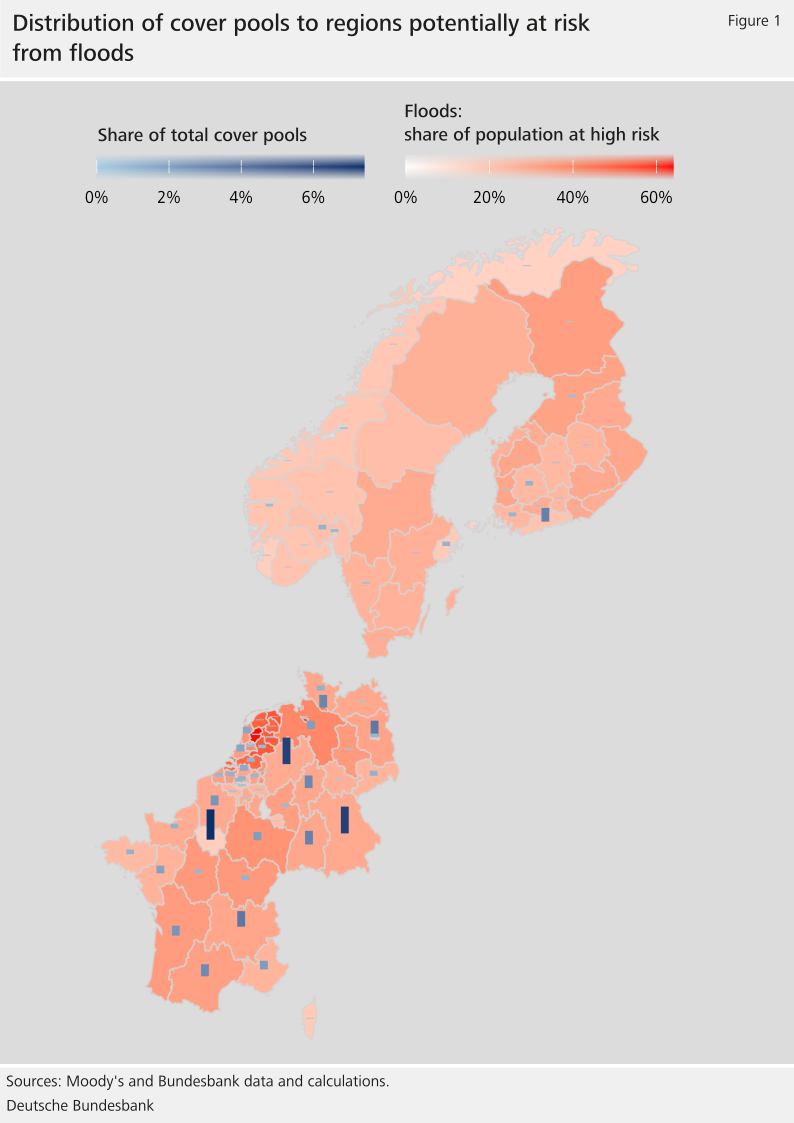
The covered bonds are secured by cover pools, composed mostly of residential real estate loans. Their physical climate-related risks were investigated for the first time, with the analysis based on the regions where the underlying assets are located (see Section 5.1.1.3). In these regions, a relatively large amount of property is exposed to flood risks, whereas risks from rising sea levels, forest fires and hurricanes are less prevalent (see Figure 1).
A considerable share of the financing activities of promotional and development banks is classified as “green” (beneficial to the environment). This is channelled to renewable energy sources and public transport infrastructure, amongst other things (see Section 5.1.1.2). Adding promotional and development bank bonds to the euro portfolio has therefore had a positive impact on its sustainability performance.
For reserve assets, the climate-related metrics of sovereign investments in particular have improved. The GHG intensities of sovereigns have been falling almost continuously since 2015 (see Section 5.1.2.1). For the first time, the report includes not only climate aspects but also a dedicated analysis of the nature-related aspects of sovereigns (see Section 5.1.2.3). This shows, amongst other things, that there are still considerable gaps internationally with the UN Biodiversity Framework objective of conserving 30 % of the world’s land and ocean area. In addition to investments in sovereigns, the Bundesbank’s reserve assets include gold holdings (see Section 5.1.3), receivables from the International Monetary Fund (IMF) (see Section 5.1.1.1) and (as with the euro portfolio) bonds issued by promotional and development banks (see Section 5.1.1.2). This report also contains climate-related metrics for these investments.
The Bundesbank will continue to deepen its analyses of climate and nature-related risks and expand its sustainable investment policies. It is committed to improving the availability and quality of sustainability data and supports consistent disclosure requirements. Within its mandate, the Bundesbank strives to incorporate climate and sustainability-related aspects into its investment decisions in order to contribute to reaching the goals of the Paris Climate Agreement and the climate neutrality goals of the EU and Germany (see Chapter 6). The annual climate-related disclosures remain an important tool for documenting progress and creating transparency.