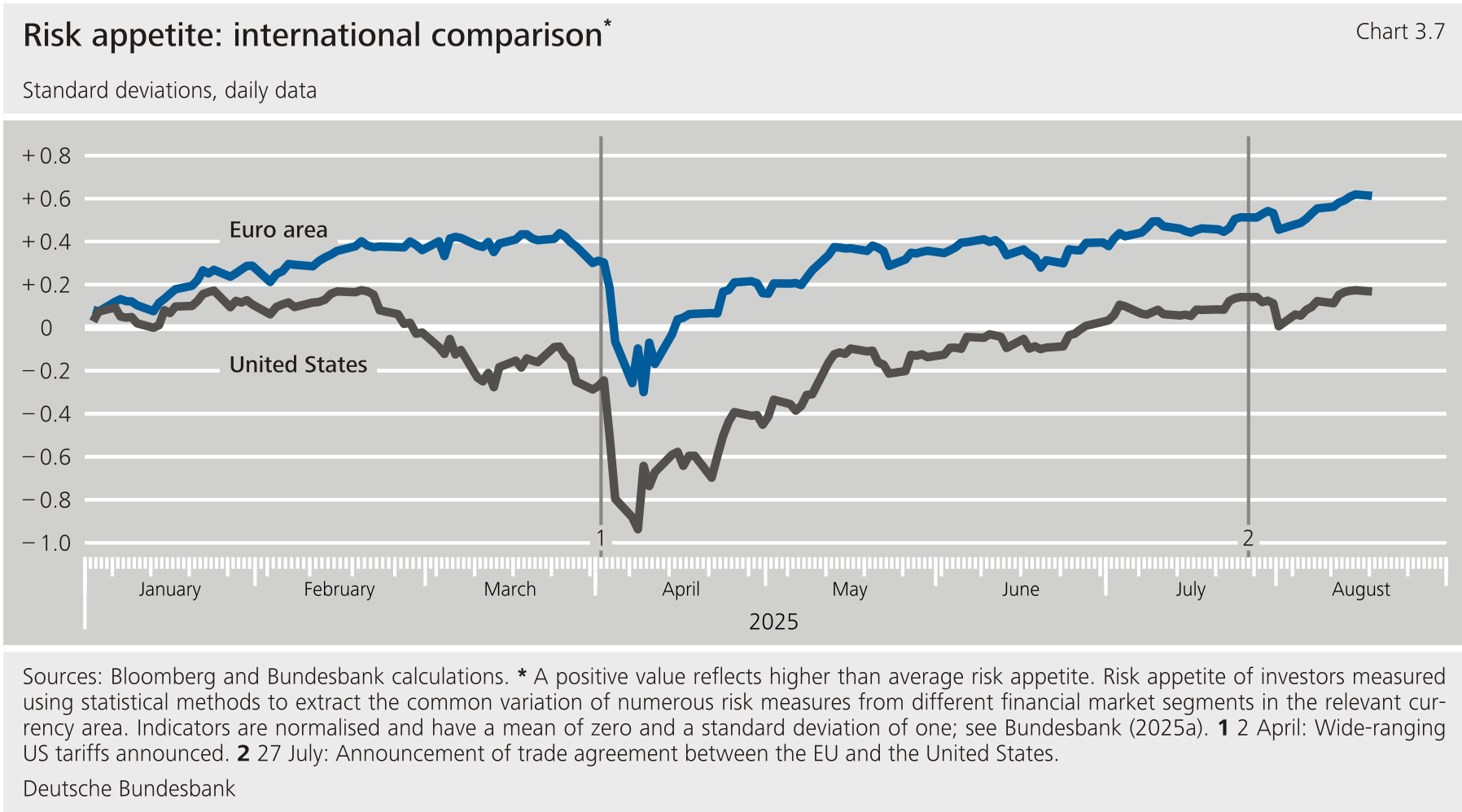
In financial markets, the sharply higher uncertainty surrounding US tariff policy at the beginning of April eased, and risk appetite rose. After the US administration announced large-scale tariffs at the beginning of April, investors lowered their growth expectations in many places. In addition, uncertainty about the scale of the expected economic slowdown initially put financial markets under considerable pressure. However, when it emerged from the deals reached since then that the tariffs actually imposed by the United States would fall short of the tariffs that had previously been threatened, financial market nervousness eased, risk premia fell, and risk appetite increased. The US-EU trade deal announced at the end of July followed the same pattern and failed to have any lasting influence on capital markets.
While yields on US government bonds rose, Bund yields barely changed on balance; nonetheless, the euro appreciated markedly against the US dollar. In the United States, government bond yields rose noticeably until the end of May amid growing concerns about the US administration’s trade and fiscal stance, the resulting fiscal risks and the upside impact these had on risk premia. However, this was counteracted by the economic outlook in the United States, which continued to deteriorate over the course of the quarter. From the perspective of market participants, this increased the likelihood that the Federal Reserve would ease monetary policy more strongly over the next few months, yet yields on ten-year US Treasuries rose on balance. By contrast, yields on German federal securities were dampened, especially in April, by high demand for safe assets, before picking up again thanks to the somewhat brighter economic outlook in the euro area. At the same time, the US dollar depreciated significantly both against the euro and in nominal effective terms. The United States’ widening interest rate advantage over the euro area in combination with the persistent marked depreciation of the US dollar could indicate a loss of confidence amongst international investors in US economic and fiscal policy. This impression was particularly strong as the second quarter got underway; as it progressed, upward pressure on the euro came increasingly from monetary policy on both sides of the Atlantic. This is because expectations of further monetary policy accommodation dwindled in euro area money markets after the ECB indicated in June that its rate-cutting cycle might be nearing its end. This change in expectations persisted after the Eurosystem left key interest rates unaltered at the ECB Governing Council meeting in July.
Markets for riskier assets saw prices rise as risk appetite grew. In the international equity markets, uncertainty about the outcome of the tariff dispute has increasingly taken a back seat since the end of April. Greater optimism among market participants regarding the outcome of the trade dispute and growing risk appetite boosted European and, above all, Japanese and US equity prices. In addition, despite the subdued US economic outlook, upward revisions to US firms’ earnings expectations helped to drive the sharp rise in the price of US securities. In the European corporate bond markets, increased risk appetite led to a decline in risk premia, with high-yield corporate bond spreads narrowing particularly sharply.
2 Exchange rates
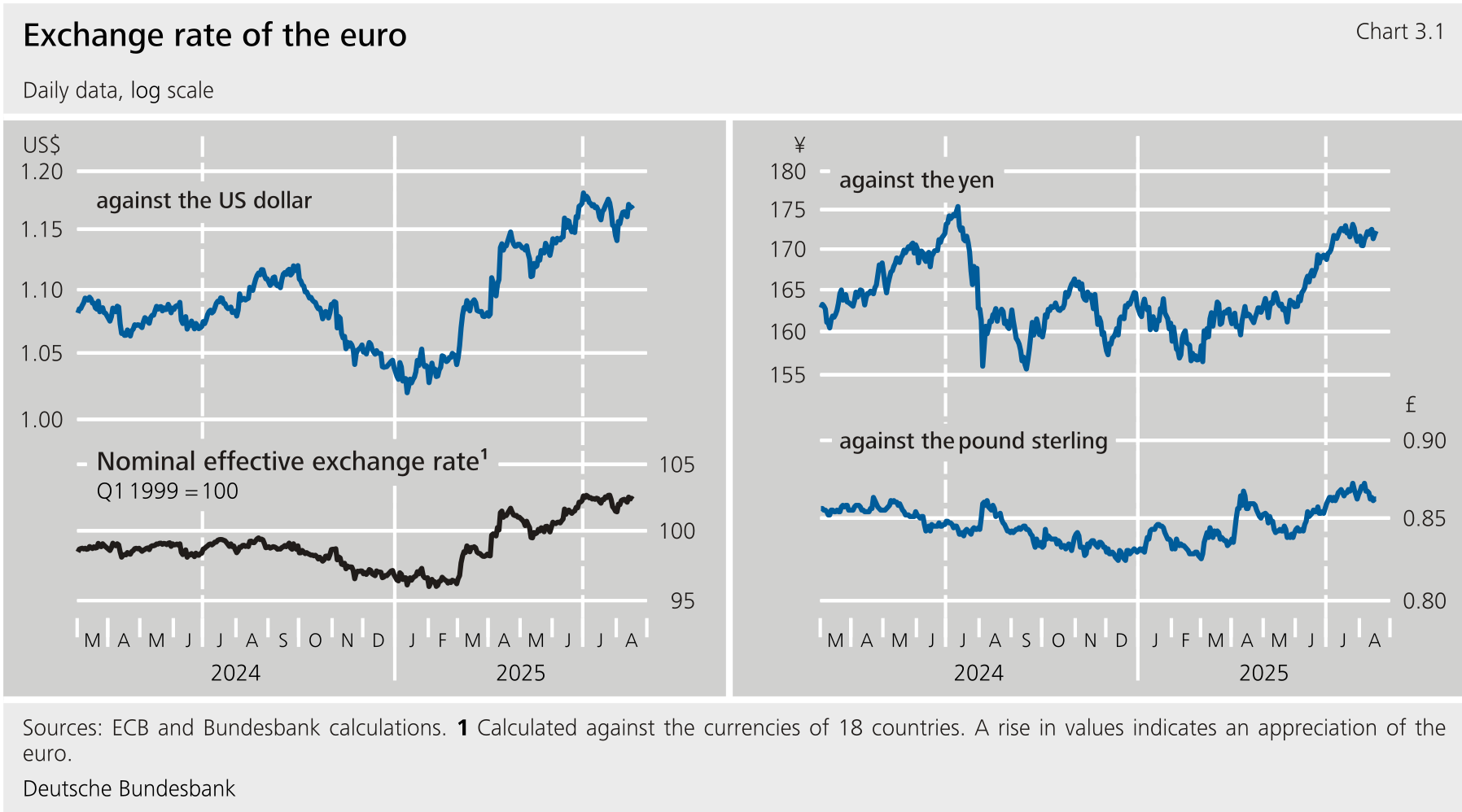
The euro has recorded further significant price gains against the US dollar since the start of the second quarter of 2025. The main factor behind this development was US policy. In early April, US President Trump’s announcement of plans to impose wide-ranging additional import tariffs led market participants to question their previously high confidence in the security of the US dollar in light of views voiced by parts of the new US administration about monetary policy. This gave the euro a significant boost. The unusual correlation between a widening US interest rate advantage and a depreciation of the euro temporarily reversed – even though yields in the United States on both short-term government bonds and in the OIS market rose in comparison to the euro area, the euro appreciated. Although the equity markets had shaken off the repercussions of the tariff decisions within a month (see the section entitled “Securities markets“), the euro continued to appreciate against the US dollar. This was partly due to President Trump’s repeated calls for faster interest rate cuts, his musings about removing the Chair of the Federal Reserve, and a credit downgrade of US Treasuries by a rating agency. The tax and fiscal package launched by the Trump administration also had a negative impact on the US dollar by further fuelling concerns about US debt sustainability. From June onwards, the euro appreciated against the US dollar mainly owing to changes in financial markets’ expectations of monetary policy in the two currency areas. On this side of the Atlantic, monetary policy signals supported the euro, while in the United States, surprisingly weak labour market data, amongst other things, helped to tilt the US interest rate outlook more strongly to the downside. The euro is currently trading at US$1.17, an appreciation of 7.9 % compared to the beginning of the second quarter.
The euro also appreciated significantly against the yen, reaching a new peak for the year. President Trump’s announcement in early April of his intention to introduce high additional import tariffs caused the yen to appreciate significantly against the US dollar, too. The euro-yen exchange rate thus remained broadly unchanged in April and May. From June onwards, however, the euro appreciated significantly against the yen. On the one hand, this stemmed from the market perception that the Eurosystem’s monetary policy easing cycle could be coming to an end. On the other hand, it became increasingly clear that it would not be possible to conclude a swift tariff deal with the United States with as favourable an outcome for the Japanese economy as hoped for in some cases. Against the backdrop of trade policy uncertainty and the associated economic concerns, the Bank of Japan did not raise its key interest rates. At the same time, the uncertainty about fiscal policy resulting from the Japanese upper house elections led to a slight increase in risk premia on Japanese government bonds. All of these factors weighed on the yen. Most recently, the euro was trading at 172 yen, meaning that it has appreciated by 6.6 % against the yen since the beginning of April.
The euro has gained significant ground against the pound sterling since the start of the second quarter. In April, the US administration’s tariff initiatives also had an impact on the euro-pound sterling exchange rate. The original wide-ranging US tariff announcements initially caused the euro to appreciate markedly against the pound sterling owing to the UK’s particularly close trade links with the United States. However, the euro lost some of these gains after the bilateral trade agreement, which was relatively favourable for the United Kingdom, was announced at the beginning of May. Surprisingly high UK inflation readings, which were followed by restrictive signals from the Bank of England, as well as unexpectedly positive UK growth figures from the first quarter supported the recovery of the pound sterling in May. In early June, the trend was reversed and the euro appreciated once more against the pound sterling as the market considered it increasingly likely that that the Eurosystem’s policy rate cuts were nearing an end, as reported above. As this report was published, the euro was trading at £0.86, or around 3.2 % higher than at the start of the second quarter.
The effective appreciation of the euro has weakened the price competitiveness of Germany and the euro area as a whole; it can now longer be described as favourable, but rather as neutral. Developments in the nominal effective euro are particularly important for monetary policy analysis (see the supplementary information entitled “Measures of the appreciation of the euro in the monetary policy debate“). Since the end of the first quarter of 2025, the euro has appreciated by 4.1 % against a trade-weighted basket of the currencies of 18 trading partners. Around 55 % of this effective appreciation is attributable to the gains against the US dollar, the pound sterling and the yen described above. However, the bilateral appreciation of 6.8 % against the renminbi also played a role. The effective appreciation of the euro has weakened the price competitiveness of both Germany and the euro area to such an extent that it can now no longer be described as favourable. However, this was partly the result of revised data from the World Bank’s International Comparison Program (see the supplementary information “Recent data revisions indicate less favourable price competitiveness for Germany and the euro area“).
Supplementary information
Measures of the appreciation of the euro in the monetary policy debate
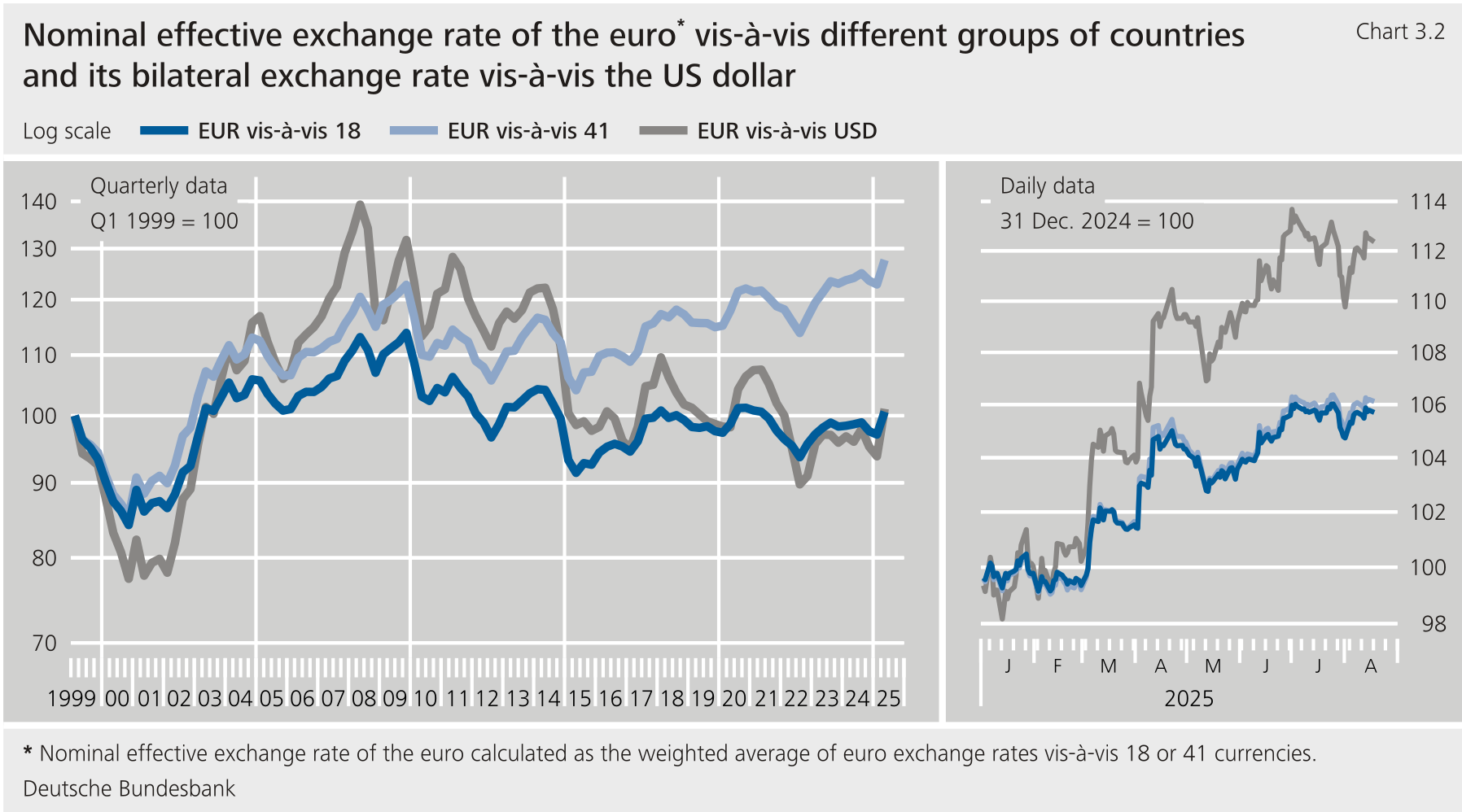
The euro’s gains against the US dollar in the year to date have recently become a topic of economic policy debate. The single currency has appreciated by 12.4 % against the US dollar since the beginning of 2025 (see Chart 3.2 and the section entitled “Exchange rates”). These sizeable gains have raised concerns of late that the euro-US dollar exchange rate had reached a level that was placing an excessive strain on the euro area economy. One key question this situation raises from a monetary policy perspective concerns the extent to which the euro’s gains are exerting downward pressure on domestic inflation by making imports cheaper. This and the following supplementary information illuminate this question from two different angles. The present text demonstrates that certain euro effective exchange rates are primarily suited to measuring the upward pressure affecting the domestic economy. The subsequent supplementary information, entitled “Recent data revisions indicate less favourable price competitiveness for Germany and the euro area”, explores the question of how to assess the euro’s current valuation level.
The euro’s appreciation against the US dollar is less representative than a measure of the euro’s effective appreciation against a basket of partner currencies, though both measures do point to strains for euro area exporters. To begin with, the euro’s bilateral exchange rate against the US dollar only covers trade relations with the United States. It also covers trade with countries whose currencies are fixed against the US dollar. Lastly, it also captures trade in goods that are invoiced in US dollars, especially energy and commodity imports. That said, these often originate from countries that already have a fixed exchange rate regime against the US dollar. A far more representative measure of the euro area’s trade relations than the euro-US dollar exchange rate, though, is the euro’s nominal effective exchange rates. These represent the average of the bilateral euro exchange rates against a large number of currencies, weighted by partner countries’ shares in euro area trade. The euro’s effective appreciation in the year to date came to only 5.7 % against a group of 18 partner currencies, compared with 6.1 % against a group of 41 partner currencies (see Chart 3.2). These rates of appreciation are far lower than the 12.4 % gained by the euro against the US dollar. This shows that a narrow analysis of just the bilateral euro-US dollar exchange rate overlooks the fact that the euro this year has appreciated by far less against other currencies than against the US dollar. Nevertheless, it should be noted that the euro has experienced a marked appreciation in effective terms as well so far this year. Above all, a very swift effective appreciation of the euro will generally place a strain on the euro area economy unless the firms in question benefit from cheaper imports.
The impact of an appreciation of the euro on domestic inflation can be overstated by high inflation rates in partner countries; however, the effect can be largely avoided by making an appropriate selection of partner currencies in the effective exchange rate. A comparison of movements by the effective euro against a group of 18 partner currencies since the introduction of the euro in 1999 with the same for a broad group of 41 partner currencies shows that developments have been fairly mixed. Thus, the value of the effective euro against 18 currencies in the second quarter of 2025 was only 0.3 % higher on balance than in the first quarter of 1999. Compared with 41 currencies, meanwhile, the euro appreciated by 28 % over the same period, peaking recently. Now one might conclude from this that the effective euro – especially the one calculated against the broad group of currencies – is particularly informative because it covers a larger share of foreign trade. That is often not the case, however, because the broad group contains currencies of countries with very high inflation rates in some cases. However, an appreciation by the euro against a high-inflation country tends to exert less deflationary pressure, or even none at all, in the euro area because the decline in imported goods prices brought about by the appreciation is lessened by price increases caused by domestic inflation in the partner country. In fact, the euro’s strong appreciation in effective terms against the broad group of 41 currencies can be attributed in large part to partner currencies of countries such as Türkiye and Argentina, which experienced bouts of very high domestic inflation. 1 The effective euro’s sustained strong appreciation against a broad aggregate of currencies and the peak it has now reached are therefore structural in nature and of only limited informative value in terms of inflationary pressures in the euro area. For this reason, it is more suitable to use the effective euro exchange rate vis-à-vis 18 currencies because the partner countries included in that group generally pursue a stability-oriented monetary policy and also account for much of the euro area’s trade. 2
When it comes to assessing a currency’s valuation level, though, it makes sense to use real euro exchange rates rather than nominal effective ones. The fact that the effective euro against 18 partner currencies was much the same in the second quarter of 2025 as it was in the first quarter of 1999 suggests that the euro’s valuation level is not excessively high at present. Even so, that conclusion is only valid up to a point, if only because this approach does not compare the euro’s exchange rate with a compelling reference value derived from economic theory. 3 What is more, it would be ideal to combine even greater representativeness with consideration of the effect of high inflation differentials within a single indicator, rather than excluding the latter by restricting the group of partner currencies. For these reasons, concepts based not on a nominal exchange rate but on a real effective one are normally used to assess a currency’s valuation level. The real effective exchange rate of the euro measures the price of a basket of goods in the euro area relative to the weighted average of its price abroad. It thus compares nominal exchange rate movements with national price movements. If, for example, the euro appreciates at the same time as trading partner countries’ prices increase in relative terms by the same percentage, the euro area’s price competitiveness will not change because the impulse from the appreciation, which is actually deflationary in nature, will be offset by the higher prices abroad. It is for this reason that the euro’s real effective exchange rate normally serves as a key input when calculating the euro area’s price competitiveness and thus when assessing the euro’s valuation level (see the supplementary information entitled “Recent data revisions indicate less favourable price competitiveness for Germany and the euro area”).
What conclusions, then, can be drawn from the above considerations with regard to the economic importance of the euro’s appreciation against the US dollar this year? First, the euro’s swift appreciation against the US dollar is undoubtedly creating additional headwinds for the euro area economy in cases where affected firms are unable to benefit from cheaper imports. Second, the euro’s nominal effective appreciation is smaller than its bilateral gains against the US dollar. Assessing the euro-US dollar exchange rate in isolation, then, overstates the headwinds produced by the euro’s current strength. Third, nominal euro exchange rates are not well suited for assessing the euro’s current valuation level. Real effective exchange rates of the euro should be used for this purpose, as in the supplementary information below entitled “Recent data revisions indicate less favourable price competitiveness for Germany and the euro area”.
Supplementary information
Recent data revisions indicate less favourable price competitiveness for Germany and the euro area
The euro’s current valuation level is normally assessed using price competitiveness indicators. Lately, the euro’s strong appreciation against the US dollar in the year to date has led some observers to call the euro’s valuation level excessively high and warn of damage to the euro area economy. Assessments of the euro’s valuation level are normally based on concepts that compare a price competitiveness indicator calculated using the euro’s real effective exchange rate with a reference value derived from economic theory (see the supplementary information entitled “Measures of the appreciation of the euro in the monetary policy debate”). The Bundesbank’s work in this field mainly uses an indicator based on the productivity approach, the theoretical framework of which builds on the Balassa-Samuelson hypothesis (see below). Owing to data revisions, it has now become necessary to recalculate this indicator.
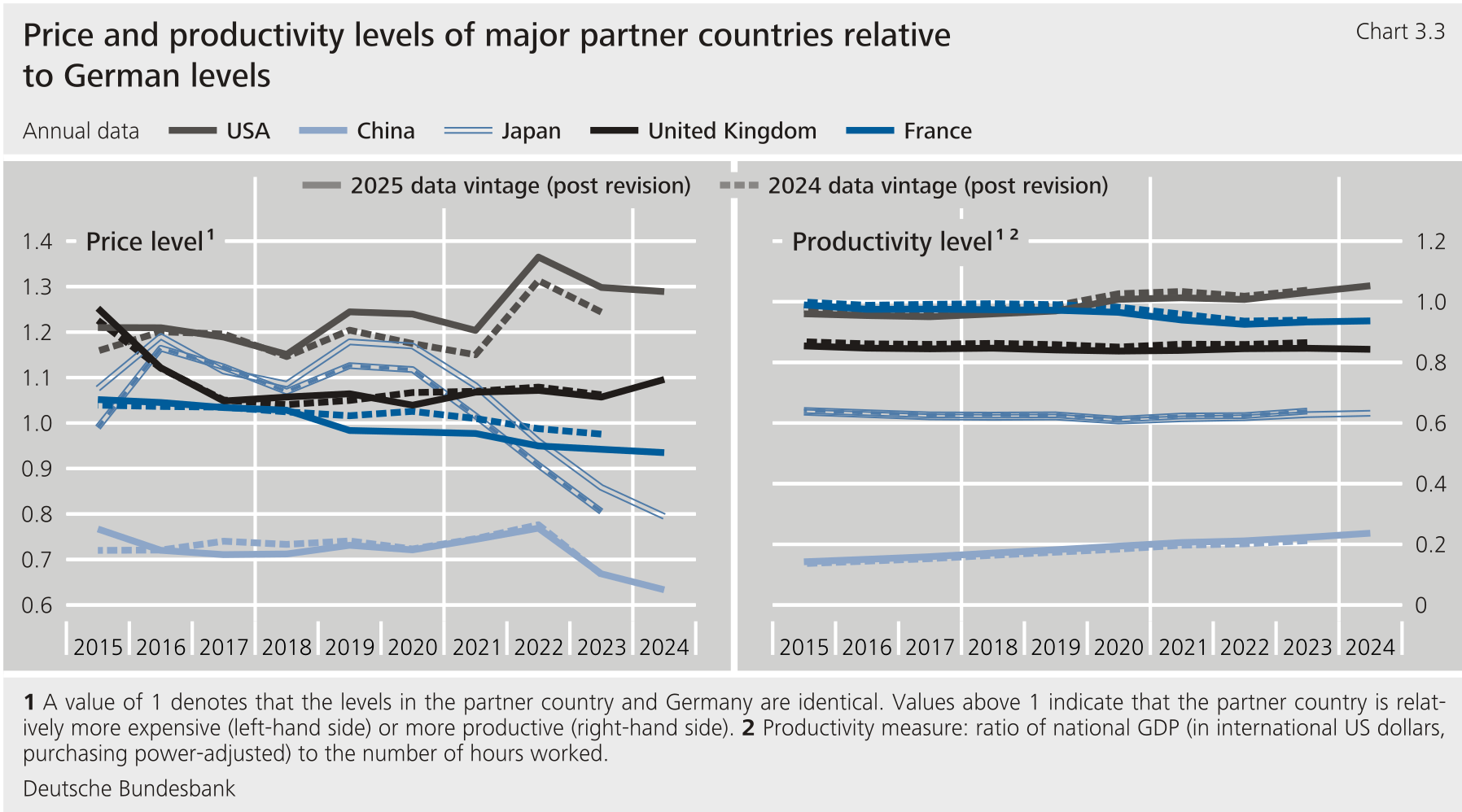
Using an indicator based on the productivity approach, the Bundesbank assesses the price competitiveness position of 57 economies on an ongoing basis. This indicator makes use of data on relative price and productivity levels. 1 The relative price level is a real exchange rate and provides information on the ratio of prices for a common, broad basket of goods in two countries, expressed in a single currency. All other things being equal, a lower price level indicates that competitiveness is more favourable. For example, Germany’s relative price ratio vis-à-vis the United States was 78 % last year – that is to say, a comparable basket of goods was 22 % cheaper in Germany than it was in the United States. 2 However, prices are not the only factor that determines price competitiveness. Productivity is another key factor. Viewed in isolation, the higher a country’s productivity, the more favourable its competitiveness will be. However, the interdependencies between prices, productivity and competitiveness are more complex. For example, higher productivity levels are normally associated with higher prices because productivity gains allow wages to rise even in sectors that are not affected. This does not necessarily mean, though, that a country’s price competitiveness will suffer as a result of this in international markets. Because if higher productivity leads to higher prices of non-tradeable goods, a country’s price level will rise without worsening its competitiveness. This theoretically expected and empirically valid positive correlation between a country’s relative productivity level and its relative price level (the Balassa-Samuelson effect) should be taken into account when assessing price competitiveness. 3 This is why the Bundesbank’s productivity approach to assessing price competitiveness extends beyond a mere assessment of prices by also accounting for productivity effects.
The indicator now needs to be recalculated on account of new and revised historical data on relative price and productivity levels. The World Bank’s International Comparison Program has released new and revised data on the prices of common baskets of goods, based on which relative price levels can be calculated. These data reveal that the relative price level of key partner countries such as the United States and Japan vis-à-vis Germany was higher than previously assumed. The relative price levels of China and France, meanwhile, are now lower than before (see Chart 3.3, left-hand panel). Revisions have also been made to the historical productivity data on value added per hour worked. Based on these revised figures, the German economy is moderately more productive than previously assumed (see Chart 3.3, right-hand panel). However, the relative productivity of the United States and China vis-à-vis Germany rose further in 2024, according to the updated figures. Re-estimating the Balassa-Samuelson effect with the revised data confirms the existence of a positive, though now somewhat weaker correlation between a country’s relative productivity and relative price level. 4
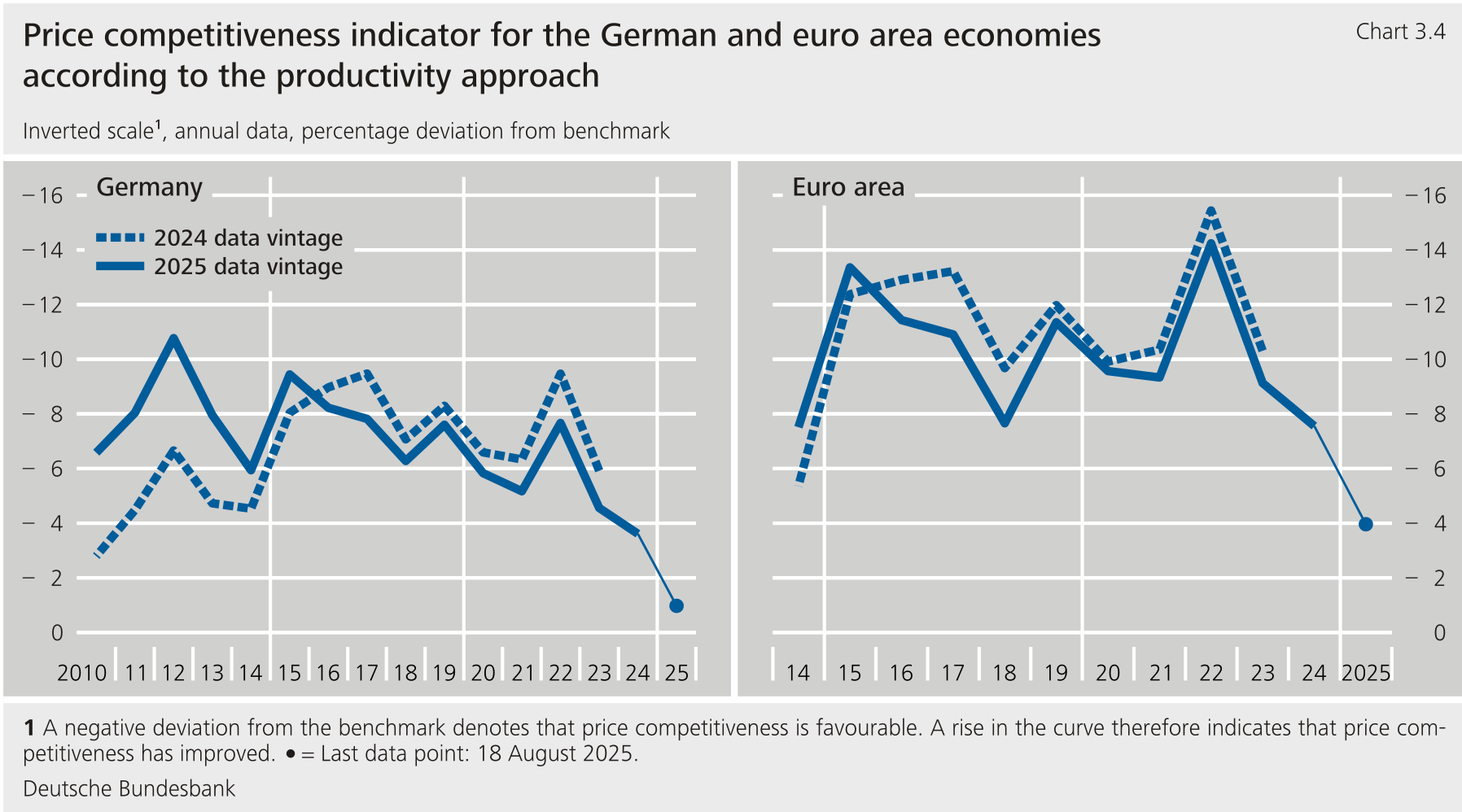
The new data indicate that the German economy’s price competitiveness is less favourable than previously assumed and that it declined further in 2024, following the trend of the past ten years. The left-hand panel of Chart 3.4 illustrates the indicator values for Germany after recalculation. It shows that, following the data revision, price competitiveness has been between 1 and 2 percentage points lower on average in recent years. According to the new data, a trend deterioration in German competitiveness began back in 2016, and not in 2018, as the previous numbers had suggested. These reassessments mean that Germany’s price competitiveness position fell earlier into a range which can no longer be described as favourable. 5 As previously forecast, the new figures for 2024 confirm that the trend decline continued into last year, with a further deterioration of 1 percentage point. Owing to the euro’s significant appreciation in the first half of 2025, the daily indicator value for Germany on 18 August 2025 now only falls short of the benchmark by 1 %.
The euro area’s price competitiveness declined significantly in 2024. The right-hand panel of Chart 3.4 also presents the indicator values for the euro area. It shows that the data revisions had less of an impact on the euro area than they did on Germany. The new figure for 2024 did cause a marked drop in the euro area’s price competitiveness, though. If the indicator value is now forecast based on developments in the nominal effective euro for 18 August 2025, one obtains an assessment of the euro area’s price competitiveness which would no longer be considered favourable under an IMF framework, say (-4 %). 6
The price competitiveness indicator based on the productivity approach suggests that the euro’s valuation level is not excessively high at present, but rather that it is consistent with fundamentals. Taking the data revisions into account, the price competitiveness of both Germany and the euro area has deteriorated in recent years and can now no longer be considered favourable. The price competitiveness of Germany and the euro area has also been worsened by the euro’s significant appreciation in the year to date. That said, the recalculated indicator values suggest that, for Germany and the euro area, the euro’s valuation level is not in a range that, in isolation, ought to be considered alarming.
3 Securities markets
3.1 Bond market
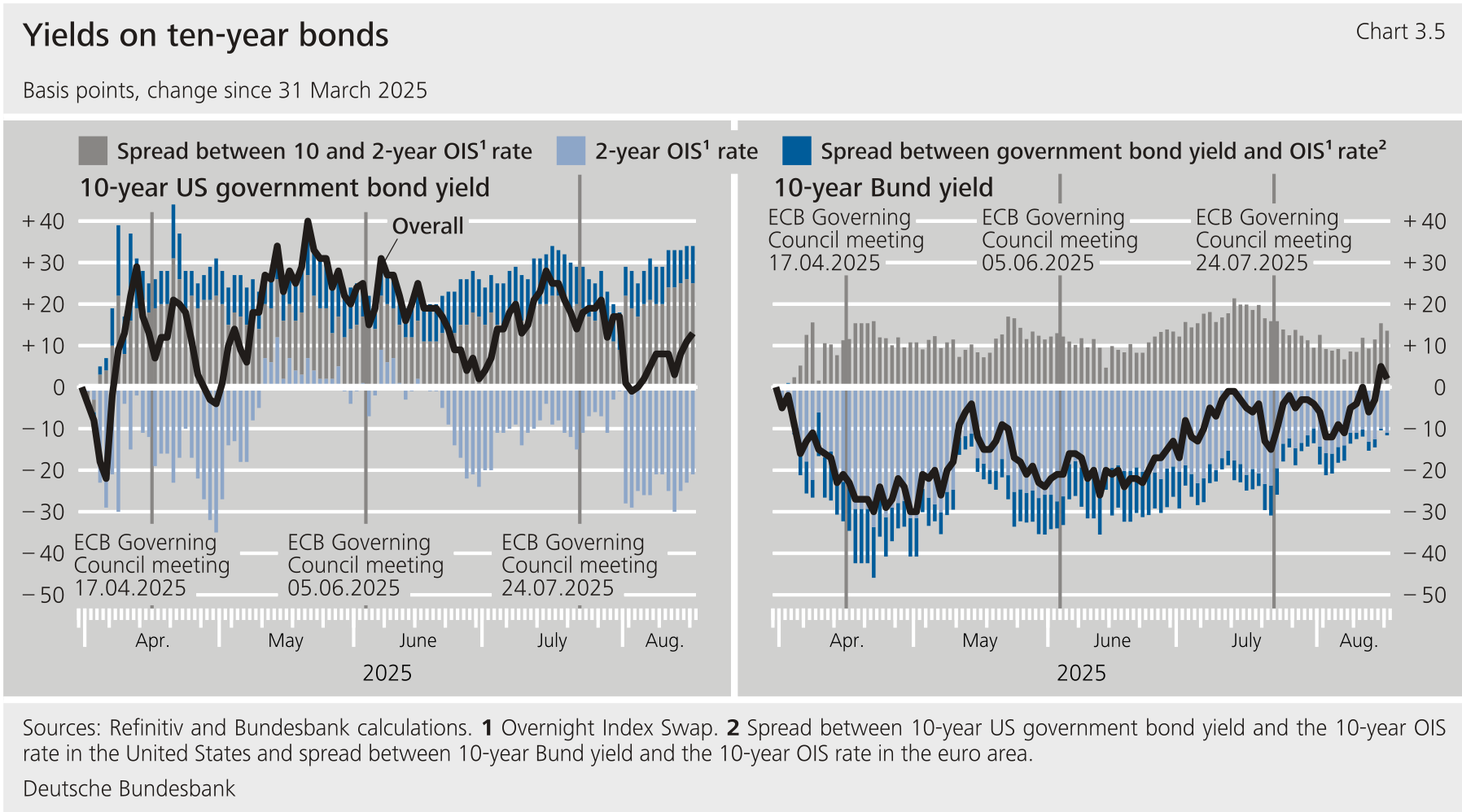
US government bond yields went up slightly on balance in an unsettled political environment. Yields on ten-year US Treasuries initially fell immediately after the US administration announced its plans to impose extensive additional import tariffs at the beginning of April. This was because market participants saw the resulting trade barriers as a potential drag on US economic activity and thus considered future policy rate cuts to be more likely. This was reflected in declining interest rate swap rates (OIS rates) for two-year maturities in the United States. Nonetheless, investors were also increasingly concerned about the US administration’s trade and fiscal policy stance, which was reflected in higher credit risk premia on US government bonds. This was partly due to a US legislative package passed at the beginning of July, which envisages extensive tax cuts and government spending for the next few years and is likely to significantly expand debt at the US federal level. Consequently, yields on US Treasuries rose markedly as a result, especially for medium to long-term maturities. It also changed the relative valuation of ten-year US Treasuries against the US OIS rate with the same maturity. For example, the distinctly positive difference between the yield on ten-year US Treasuries and this benchmark for a secure interest rate in US dollars widened further at the end of March. The above-mentioned expectations that US policy rates would decline were compounded by surprisingly weak overall labour market figures at the beginning of August. The subdued US policy rate expectations also carried over to long-term yields, as shown by model analyses that decompose ten-year US yields into average US policy rate expectations and term premia. By contrast, US term premia rose. These premia compensate buyers of long-term bonds for the assumption of interest rate risk. Accordingly, market participants appeared to be more uncertain about future US policy rate developments than at the end of the first quarter. The higher term premia are also reflected in a steeper yield curve for US government bonds. On balance, US government bond yields rose in the light of these opposing influences.
The trade conflict with the United States and its subsequent abatement also shaped long-term government bond yields in the euro area. In April, when market participants considered a scenario of very high US tariffs on imports from the European Union possible, long-term yields in the euro area fell significantly. Like in the United States, this reflected concerns that such a situation could weigh heavily on euro area economic activity and necessitate additional policy rate cuts. The ECB Governing Council’s decision at its April meeting to cut key interest rates by 25 basis points also helped to lower yields on short and long-dated government bonds in the euro area. As a result, however, market participants scaled back their expectations of further interest rate cuts, which boosted these yields again. This was partly due to statements by ECB President Lagarde suggesting that the rate-cutting cycle was largely complete, even though the Governing Council had lowered key ECB interest rates by a further 25 basis points in June. Money market forward rates continued to pick up slightly after the ECB Governing Council’s meeting in July, at which it decided to keep interest rates unchanged. Of late, market participants were expecting at most one interest rate cut by the end of the year.
Yields on ten-year federal securities remained practically unchanged on balance in a turbulent market environment. The uncertainty stemming from the US administration’s fiscal and trade policies had a different impact on ten-year Bund yields than on US yields. Unlike US Treasuries, federal securities were sought after as a safe investment, particularly in April, putting pressure on Bund yields and dampening their lead over OIS rates with the same maturity. Since May, however, Bund yields have picked up again as the economic outlook has brightened, risk appetite has increased and fewer policy rate cuts have been expected. On balance, Bund yield remained virtually unchanged and, as this report went to press, were hovering around their level at the end of March. The yield spread to US Treasuries thus widened slightly. In the thirty-year maturity segment, yields on both sides of the Atlantic reached long-term peaks.
GDP-weighted yield spreads of ten-year euro area government bonds over Bunds with the same maturity have narrowed on balance since the end of March. This was mainly due to the decline in yields on government bonds with relatively high risk premia, such as Italian and Greek government bonds. These bonds benefited particularly strongly from the increase in risk appetite. By contrast, risks related to the relative valuation of euro area government bonds have receded into the background.
Long-term yields on Japanese bonds increased slightly, while yields on UK bonds remained broadly unchanged on balance. During the reporting period, increased uncertainty surrounding future fiscal policy in the run-up to an upper house election temporarily boosted yields on ten-year Japanese government bonds slightly. However, the increasing economic concerns stemming from the trade dispute with the United States exerted downward pressure on yields. They also prompted the Bank of Japan to keep the policy rate unchanged at 0.5 % over the period under review. On balance, yields on ten-year Japanese sovereign bonds went up only slightly. In the United Kingdom, a social policy initiative originally aimed at limiting fiscal costs was only implemented in a much weaker form. The resulting gloomier outlook for UK government finances temporarily pushed up risk premia and longer-term yields, which had fallen at the beginning of May in light of the relatively favourable bilateral trade agreement with the United States. In addition, during the reporting period, the Bank of England made two cuts of 25 basis points each to its policy rate, citing ongoing disinflation. On balance, the yield on ten-year UK government bonds has remained largely unchanged since the end of March.
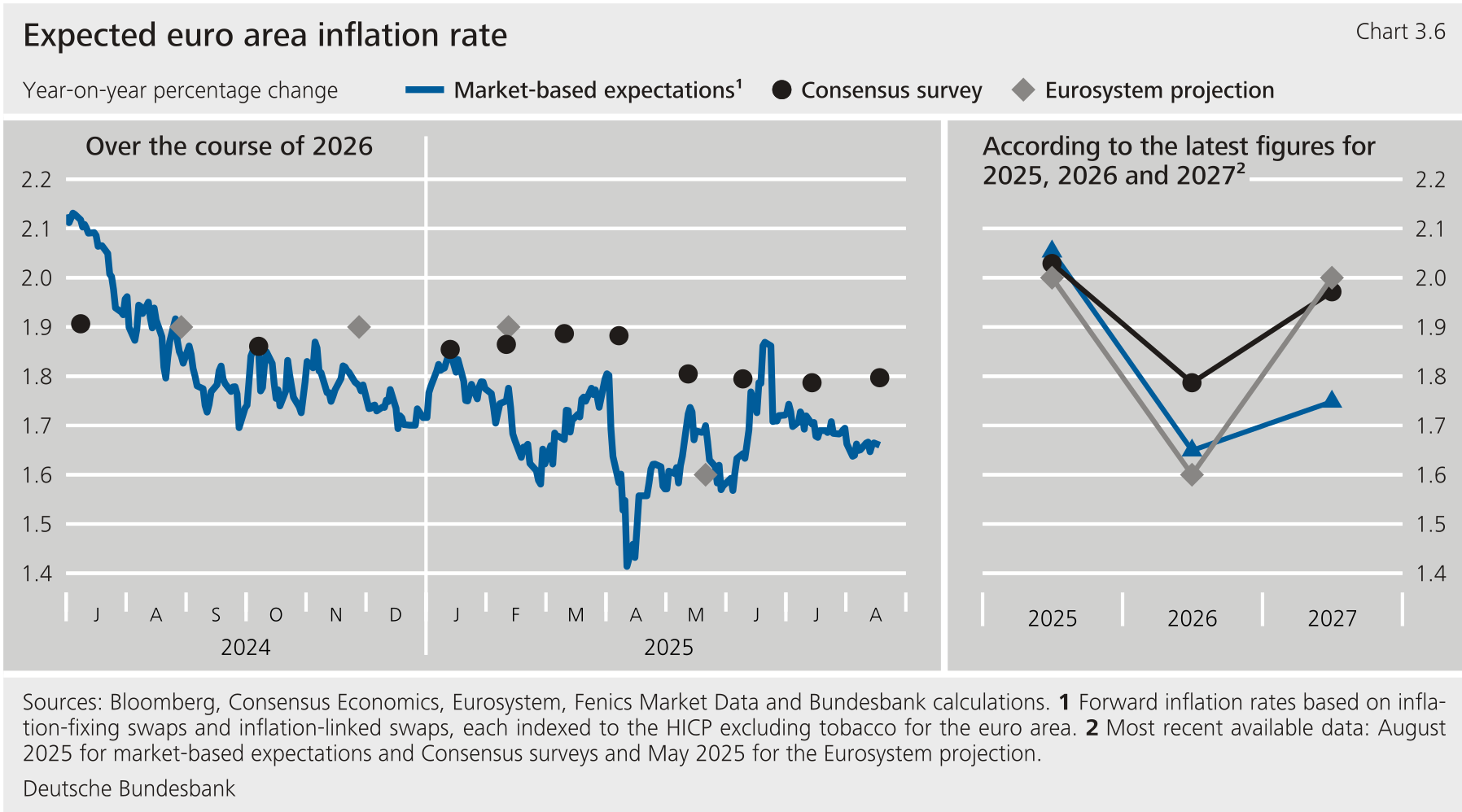
Market-based inflation expectations derived from inflation swaps for the euro area declined somewhat on balance amid fluctuations. Euro area inflation expectations in financial markets and according to expert surveys remain at 2.1 % for 2025, which is in line with the Eurosystem’s price stability target of 2 %. According to both approaches, as well as the Eurosystem, inflation is projected to fall short of the target in 2026 before a countermovement towards the target inflation rate in 2027. During the review period, oil price developments caused short-term fluctuations in market-based inflation expectations. This was the case, for example, when oil prices rose sharply as a result of the military conflict between Israel and Iran in June. While President Trump’s announcement of possible additional sanctions against Russia raised energy prices, it had little impact on market-based inflation expectations. On balance, market-based inflation expectations for the euro area fell slightly by 13 basis points for 2026 and 7 basis points for 2027, largely owing to spillovers from the United States resulting from recent weak labour market figures there.
Market prices and surveys point to inflation expectations remaining firmly anchored at the level of the stability target. At 2.1 %, the five-year forward inflation rate five years ahead is in line with the target and has not changed markedly since the end of the first quarter. Longer-term survey-based inflation expectations for the euro area calculated on a quarterly basis by Consensus Economics also remained at the 2 % inflation target level in July.
Yields on European corporate bonds fell further as risk appetite grew. While risky financial market investments have recovered since the end of April, yields on BBB-rated corporate bonds with residual maturities of between seven and ten years have also declined markedly, both for financial and non-financial corporations. Yields on particularly high-risk corporate bonds fell even more sharply. Since the yields of German federal securities with the same maturities barely changed on balance, the yield spreads narrowed considerably. The only substantial reflection of the military clashes between Israel and Iran in June was a temporary increase in spreads in the high-risk segment. Overall, the financing costs of European firms, as measured by yield spreads, were recently below their corresponding five-year averages irrespective of their credit quality ratings.
3.2 Equity market
International equity markets recorded price gains amid increased risk appetite. In direct response to President Trump’s tariff announcements in April, equities prices around the world fell sharply. The prospect of a restrictive tariff regime darkened the global growth outlook and heightened uncertainty in the financial markets, thus putting considerable pressure on investors’ risk appetite. This is also illustrated by an indicator that measures euro area investors’ risk appetite based on the common daily change in 13 individual indicators from five different asset classes. 1 When the US administration later suspended the announced tariff regime whilst also floating the idea of bilateral trade negotiations, equity markets recovered quickly, however. Market participants began to pay less attention to the US administration’s ever-changing tariff threats and increasingly began to expect a settlement of the tariff dispute. The deals the United States struck with the United Kingdom, Japan and the European Union later on therefore did not trigger any major stock price movements. Given the above, on balance, there was rise in the prices of both European equities (Euro Stoxx: + 6.6 %) and above all in Japanese and US equities (Nikkei 225: + 22.7 % and S&P 500: + 14.9 %). In the United States, the price of shares in enterprises from the information technology sector went up, in particular. In addition to increased risk appetite, higher earnings expectations for US firms also contributed to the significant increase in US equities prices. The prices of German and UK equities as measured by the CDAX and FTSE 100 rose by 7.1 % and 6.7 %, respectively.
European bank equities recorded higher price gains compared to the overall market. During the review period, European banks’ equity prices significantly outperformed the overall Euro Stoxx index (+25.8 %), one reason being that earnings expectations were higher over both the short and medium term. In addition, some positive quarterly figures boosted prices. In the United States, bank equities recorded price gains on a similar scale to the market as a whole (+15.9 %).
Valuation levels of European and US equities remain above their long-term average. For US equities, both the equity risk premium and the implied cost of equity, i.e. the sum of safe interest rates and risk premia, decreased. These valuation measures are calculated using a dividend discount model that takes into account both short and medium-term earnings expectations as well as risk-free interest rates. 2 For European enterprises, whose short-term earnings expectations declined slightly, the equity risk premium rose somewhat while the implied cost of equity remained largely the same. Measured in terms of the implied cost of equity, the valuation of both European and US equities is above its long-term average.
(This article is based on data available up to 18 August 2025, 22:00.)