1.1 Growing risk appetite in the financial markets despite recurring uncertainties
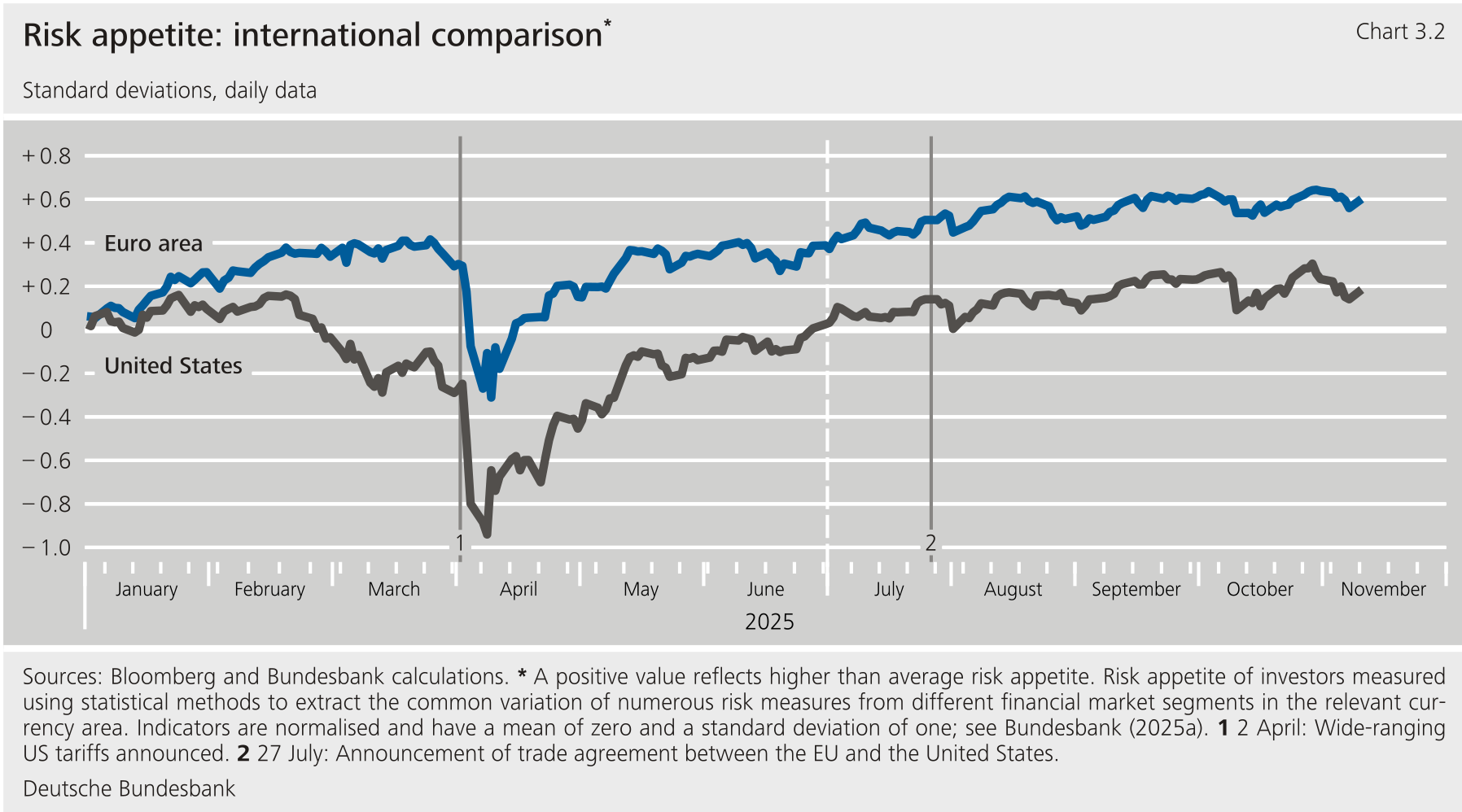
In the global financial markets, risk appetite continued to grow despite the further temporary escalation in the trade dispute. Together with favourable macroeconomic developments for the euro area, falling capital market rates in the United States, and persistent optimism about the economic potential of artificial intelligence, this bolstered equity prices. These reached new highs on both sides of the Atlantic in late October and early November, respectively. Although prices temporarily saw significant declines in early October due to the escalation of the trade dispute between the United States and China, market sentiment remained resilient overall. In the market for European corporate bonds, greater risk appetite dampened risk premia, which recently stood close to their historical lows across all credit rating classes. By contrast, the spreads on French government bonds widened slightly in light of the political developments and fiscal uncertainties in France. As a result, for the first time since the introduction of the euro, the yields on French government bonds were for a time higher than those on Italian government bonds, which had somewhat declining yields.
1.2 Euro depreciates slightly against the US dollar despite narrowing interest rate spread between the currency areas
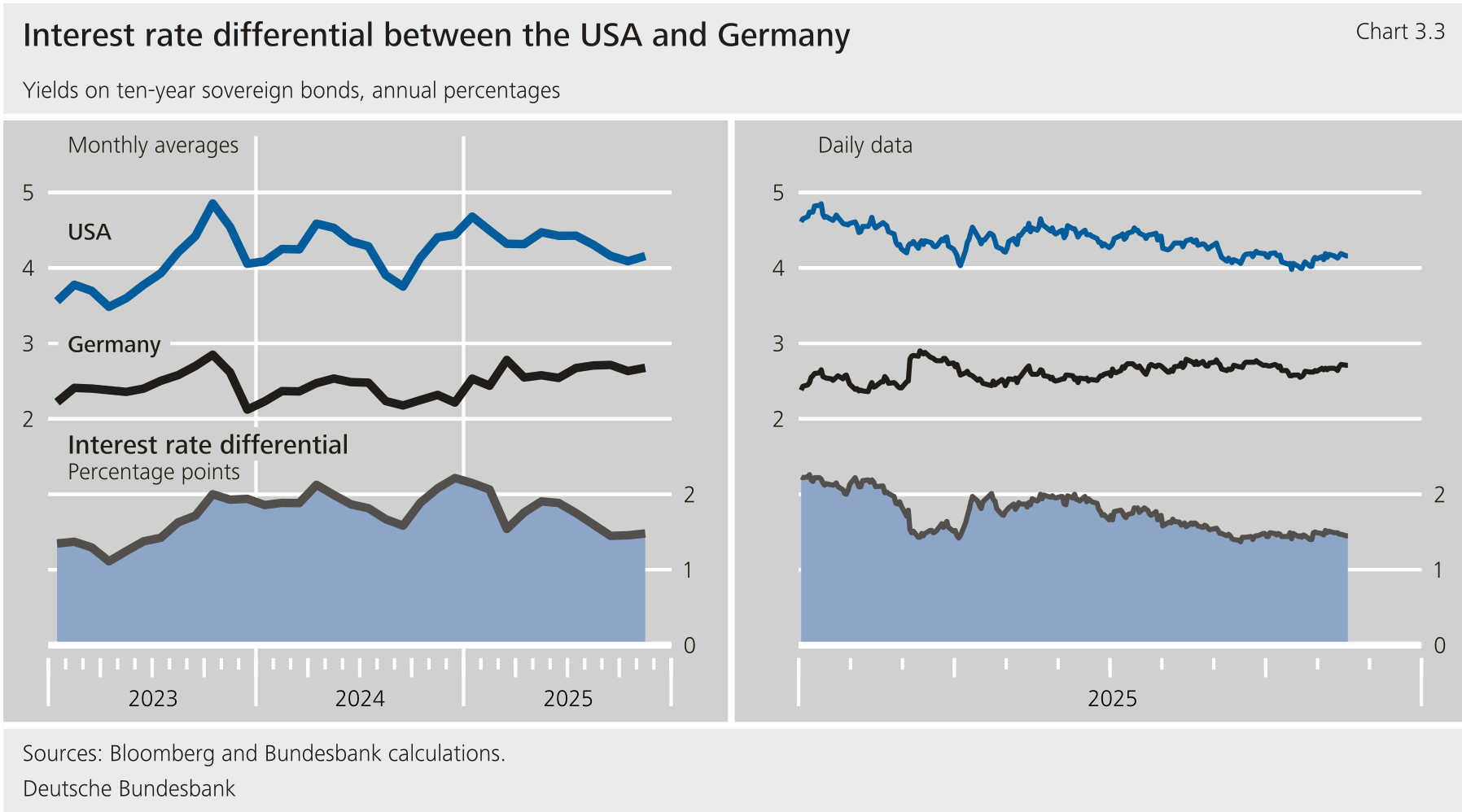
Yields on US government bonds declined markedly, while those on German federal bonds rose slightly on balance; nevertheless, the euro depreciated somewhat against the US dollar. In the United States, there was a marked decline in the yields on ten-year US Treasuries. A negative impact was had, in particular, by the unexpectedly weak US labour market, which was a major factor in the deterioration of the overall economic picture in the United States. In addition, market participants expected further interest rate cuts from the US Federal Reserve, potentially as early as the next meeting of the Federal Open Market Committee in December this year. In the euro area, by contrast, the yields on government bonds rose slightly. One reason for this was that the euro area economy proved more resilient than had been initially assumed. At last report, the majority of market participants expected that the Eurosystem’s rate-cutting cycle had been completed. As a result, the interest rate differential between the currency areas narrowed. However, the euro depreciated slightly on balance against the US dollar, which thus ended its pronounced weak phase of the first half of the year.
2 Exchange rates
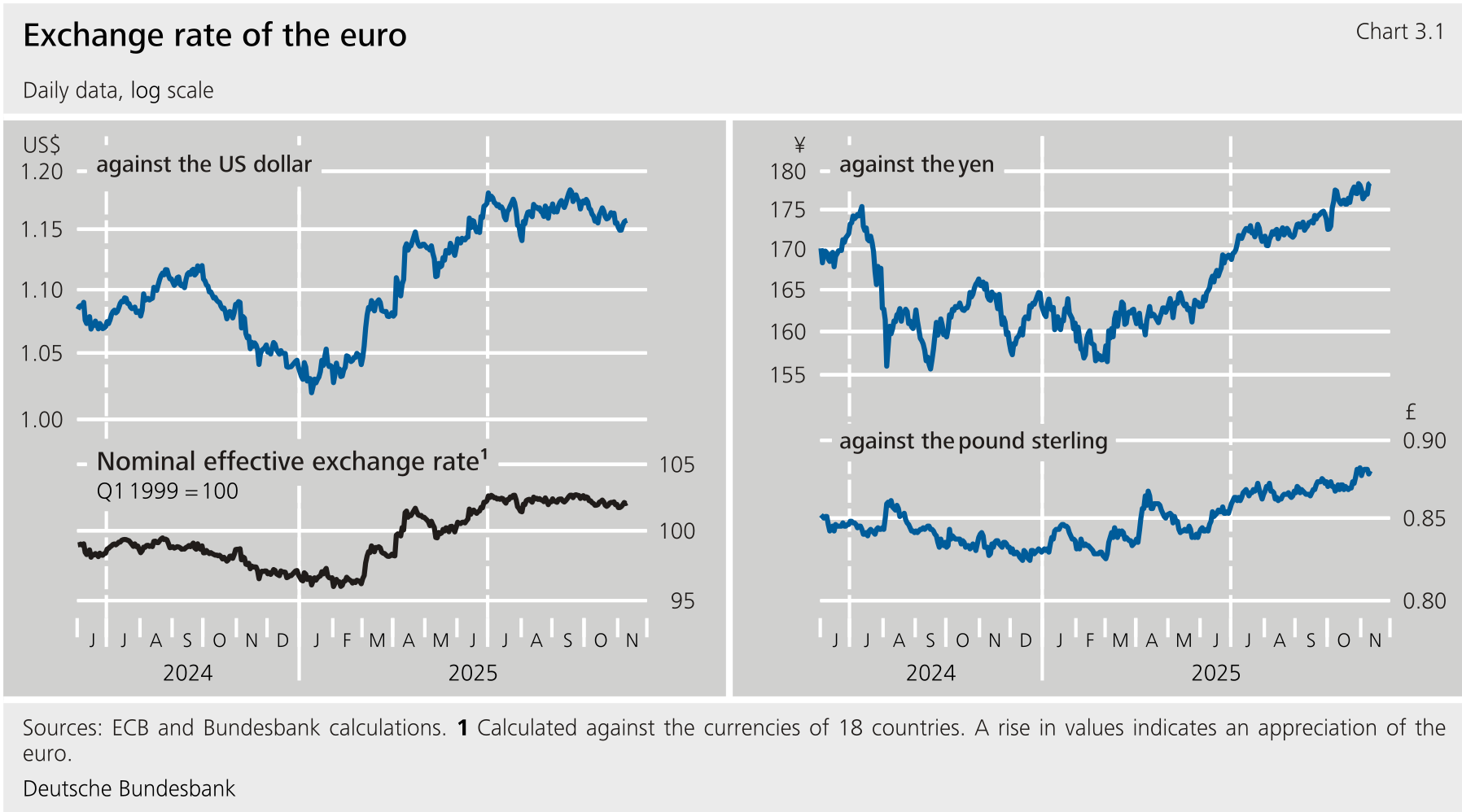
The euro depreciated slightly against the US dollar compared with the start of the third quarter of 2025; the US dollar thus ended its pronounced weak phase of the first half of the year. Trade policy weighed down the single currency against the US dollar initially. It depreciated markedly at the end of July in the wake of the trade agreement between the EU and the United States. This agreement provides for a tariff of 15 % on the majority of European imports to the United States while tending to ease duties on US imports to the EU. According to economic theory, unilateral hikes in import tariffs ought to strengthen the currency of the country imposing the tariffs; if the US imports less from the euro area due to the tariffs, its demand for euros will be lower.
The monetary policy outlook in the United States supported the euro only temporarily. After having previously remained robust, the labour market in the United States reported surprisingly weak figures in August and September that caused the euro to appreciate markedly. This also had to do with the changed communication of the Fed, which focused more on employment. For example, in his address in August at the Economic Policy Symposium in Jackson Hole, Fed Chair Powell highlighted downside risks in the labour market that could justify an easing of monetary policy. This was interpreted as a signal for impending interest rate cuts in the United States. At the same time, market participants increasingly assumed for the euro area that the rate-cutting cycle was nearing its end. This shift in the relative monetary policy outlook buoyed the euro through to September. It was only when expectations of additional interest rate steps in the United States suffered a setback that the euro depreciated again. The French government crisis exerted downward pressure on the euro only temporarily. At the end of the period under review, the single currency stood at US$1.16, 1.1 % down on the start of the second quarter.
The euro appreciated markedly against the yen and reached a new all-time high. While the euro continued to trend sideways against the yen in August as market participants were expecting the Bank of Japan to hike key interest rates, political uncertainty in Japan weighed on the yen subsequently. The yen thus depreciated when the Japanese prime minister resigned and it became apparent that a political movement could prevail in the government that favoured higher government expenditure and closer collaboration with the Bank of Japan. Market participants interpreted this as a sign that the new government advocates a loose monetary policy by the Bank of Japan and could exert pressure to this effect. They consequently somewhat scaled back their expectations of an impending policy rate hike. In the wake of this development the euro reached a new all-time high against the yen of ¥180 at the end of the period under review; 6.1 % higher than at the beginning of the third quarter.
The euro also gained ground against the pound sterling compared with the start of the third quarter. In August the pound was initially supported by monetary policy impulses from the Bank of England. Although it cut the key interest rate as expected to 4 %, the decision on the Monetary Policy Committee proved unexpectedly close at 5 to 4 votes and Governor Bailey stressed a cautious and gradual approach to any further possible interest steps. However, expectations of further interest rate cuts received new impetus in October when poor labour market figures and surprisingly low inflation figures were reported, thereby weakening the pound. Concerns about the United Kingdom’s public finances placed a further significant drag on the pound. This was particularly the case at the end of October when the Office for Budget Responsibility markedly downgraded its long-term productivity forecast for the United Kingdom. The forecast is crucial for British budget planning because productivity is the most important pillar of long-term economic growth and thus determines expected tax revenue. The correction of the productivity forecast therefore opened up a fiscal gap that needs to be closed due to regulatory debt and deficit targets. The pound depreciated noticeably in the wake of this and fell to its lowest level against the euro since April 2023. As this report went to press, the euro was trading at £0.88 and thus around 2.8 % higher than at the end of June.
On a weighted average against the currencies of 18 major trading partners, the euro was nearly unchanged on balance. It was weighed on primarily by its losses against the US dollar and the renminbi, but supported by its gains against the yen, pound and Korean won. In effective terms, it was 0.2 % lower than at the start of the third quarter.
3 Securities markets
3.1 Bond market
US Treasury yields declined markedly in the third quarter of 2025 in the wake of the downward revision of the US economic outlook and falling US key interest rate expectations. Unexpected weakness on the US labour market emerged in August and September. The Fed cut the key interest rate in mid-September and announced that in its view swifter interest rate cuts could be justified. Further US economic data also pointed to a surprisingly gloomy economic picture. Market participants therefore made downward revisions to their expectations of the path of US key interest rates. The easing of monetary policy weighed more heavily here than the very expansionary fiscal policy stance of the United States that, taken for itself, resulted in lower scarcity premia on the US Treasury market. The dampening effects prevailed overall, with yields on ten-year US Treasuries falling by 11 basis points compared with the end of June.
The erratic trade policy that is being legally contested within the United States served to unsettle the bond markets and caused some abrupt yield fluctuations at times. This was particularly apparent in mid-October when the trade dispute between the United States and China suddenly flared up again. In response to China’s announcement of export restrictions for rare earths, the US President threatened a sharp rise in the US import tariff on goods from China. However, fears of an escalation dissipated again when both countries suspended the trade dispute for at least one year at the start of November. Furthermore, at a hearing in November, the US Supreme Court raised doubts about the legitimacy of the import tariffs imposed by the US President through emergency decrees.
Yields on ten-year federal securities increased slightly on balance compared with the end of June against the backdrop of better-than-expected economic data. Monetary policy in the euro area generated next to no stimulus for the bond market in the last few months. A decisive factor contributing to this was the ECB Governing Council, which repeatedly stressed that its monetary policy stance was appropriate and that it was “in a good position“ to hang on for the time being and await further cyclical developments. In the period under review, the economy in the euro area proved somewhat more robust than expected and more resilient against growth risks. Market participants therefore considered it highly likely that the monetary policy cycle had come to an end at the current key interest level. The yield on Bunds decoupled from the international interest rate linkage with US Treasuries, which are generally decisive for determining the global interest rate level. On balance, the ten-year yield on German government bonds rose by 10 basis points. There was also slight increase in real terms, measured as the difference between the yield on ten-year Bunds and expected inflation over the same period. However, the Bund market was unable to evade the geopolitical uncertainties. Yields on federal securities were subject to sharp fluctuations during the escalating trade dispute between the United States and China in mid-October. Bunds serve as a safe haven in times of high uncertainty. They are purchased by risk-sensitive investors as uncertainty grows and sold as uncertainty subsides, which is accompanied by corresponding yield fluctuations.
GDP-weighted yield spreads of ten-year euro area government bonds over Bunds with the same maturity narrowed further despite high French bond yields. The GDP-weighted yield on long-term government bonds in the euro area remained unchanged overall. However, there were mixed developments among the individual jurisdictions. It was noticeable that the yield spread over Bunds demanded by market participants for investing in French government bonds rose markedly in the period under review. At times these yields also exceeded those of Italian bonds with the same maturity for the first time. This was caused by the political developments in France and the growing concern that the country’s fiscal problems could increase. Several rating agencies downgraded France’s credit rating or lowered their outlook. The expansion of the spread remained limited to French bonds. By contrast, the spreads on government bonds from euro area countries with similar credit ratings to France actually narrowed. This indicates that markets assumed the risks were limited to France and could be addressed there. The decisive factor explaining the narrower spreads of government bonds in other euro area countries was high risk appetite in the financial markets.
The long-term yields on Japanese bonds continued their upward trend; long-term yields on UK bonds remained at a high level. The yields on ten-year Japanese government bonds reached long-term highs in the period under review and stood at 1.7 % as this report went to press. The decisive factor for this was the expectation that Japan could pursue a more expansive fiscal policy under its new prime minister while simultaneously putting more pressure on the Bank of Japan to ease its monetary policy (see section 2 “Exchange rates“). In the United Kingdom, long-term yields remained at a high level (4.6 %) due to the unchanged negative fiscal outlook and rose significantly again towards the end of the review period following the government’s decision to refrain from planned income tax increases in the coming budget. UK bonds (gilts) thus have the highest yields among the major advanced economies. They are well above the level of US Treasuries (see section 2 “Exchange rates“).
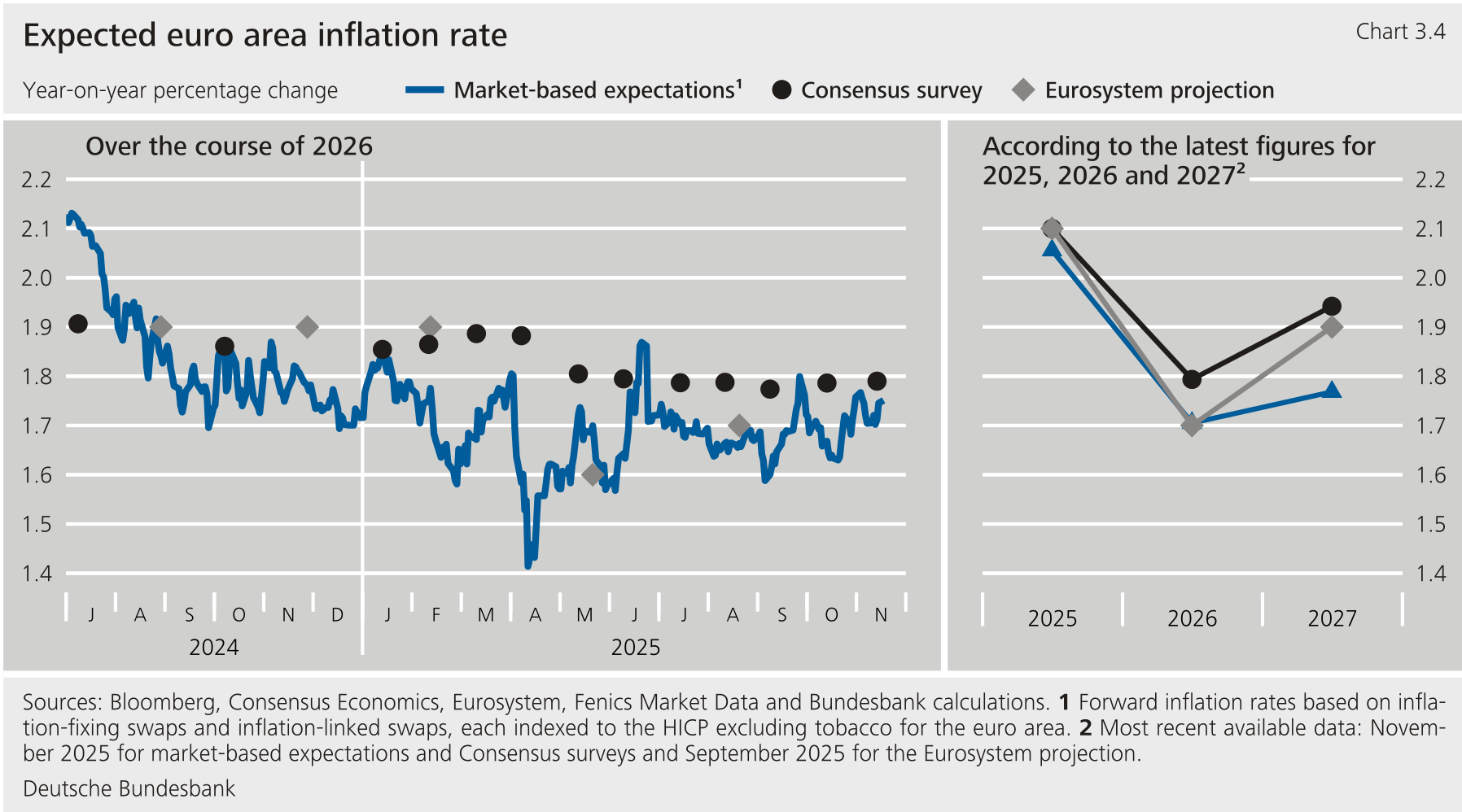
Market-based inflation expectations for the euro area up until 2027, which are derived from inflation swaps, remained virtually unchanged in the period under review and ended the period close to the Eurosystem projection. As this report went to press, market-based inflation expectations stood at 2.1 % for 2025 and at 1.7 % and 1.8 %, respectively, for 2026 and 2027. The markets therefore signalled a temporary dip below the 2 % mark for the coming year. The most recent rise in market-based inflation expectations for the end of the projection horizon in 2027 was less pronounced than had previously been the case. This is likely to be primarily because carbon prices resulting from the EU Emissions Trading System (EUETS2) will now not be levied across the EU until 2028. The moderate rise in the inflation rate caused by this will therefore now not be felt until 2028. 1 The most recent Eurosystem projection in September also forecast an inflation rate of 1.7 % for 2026 and a return towards the inflation target in 2027 at 1.9 %. The expert survey-based inflation expectations calculated by Consensus Economics likewise pointed to a slight undershooting of the 2 % target in 2026 (1.8 %) and a return to 1.9 % in the following year. In the period under review, both the market and survey-based measures and the Eurosystem projections expected the inflation rate to fall below of the inflation target only for a short time. The market also saw an increasing risk of the stability objective of 2 % being undershot in the medium term. The temporary rise in energy prices due to the additional sanctions imposed by the United States in October against Russian oil and energy groups did not have any lasting impact on market-based inflation expectations. Overall, inflation expectations stood close to or at the medium-term price stability objective of 2 %.
Long-term market-based inflation expectations and surveys pointed to firmly anchored expectations at the level of the stability objective. The five-year forward inflation rate five years ahead remained almost unchanged from the end of the second quarter and was thus aligned with the target at around 2 %. Similarly, the longer-term survey-based inflation expectations for the euro area from Consensus Economics, collected on a quarterly basis, remained at the inflation target.
Yields on European corporate bonds saw mixed developments during the period under review. Owing to the further growth of investors’ risk appetite, risk premia and thus spreads fell across all credit rating classes. In the high-yield bond segment, this led to falling yields. In the investment grade segment, which is considered particularly safe by market participants and in which the risk premium is correspondingly low, the rising safe interest rates more than offset the lower risk premium. On balance, yields rose slightly compared with the end of the second quarter. As this report went to press, bonds with an AA rating were yielding 3.3 %. Yields on BBB-rated corporate bonds also rose slightly to 3.8 %, with yields on the bonds of financial corporations’ remaining virtually unchanged. The financing costs for businesses therefore remained low.
3.2 Equity market
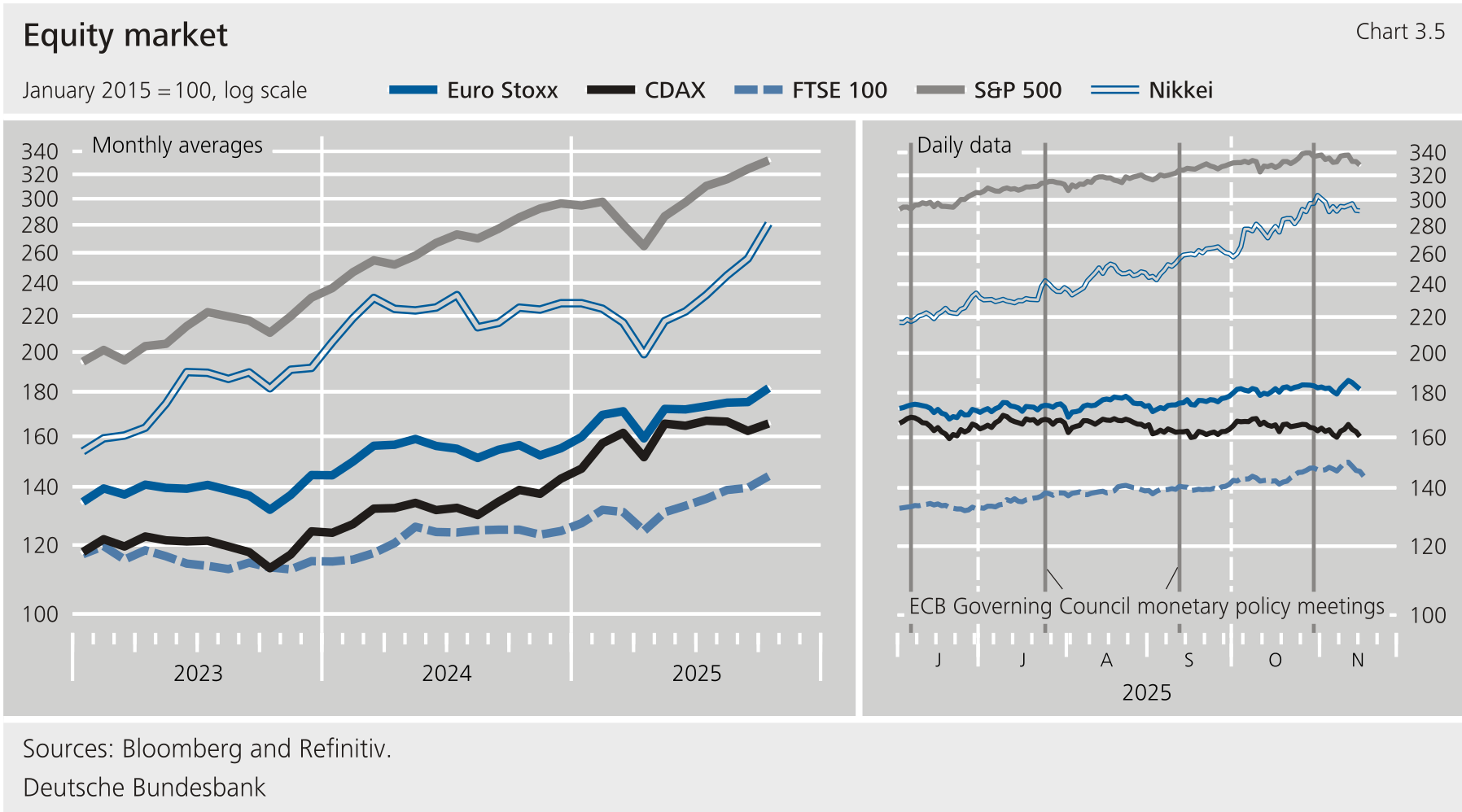
The international equity markets continued their upward trend and traded near all-time highs towards the end of the period under review despite ongoing trading uncertainties in many countries. The easing of US monetary policy boosted investors’ risk appetite, while the gradual de-escalation of the trade dispute with the United States reduced trade uncertainty. Although the markets barely responded directly to the signing of the US trade agreements with Japan, the EU and the United Kingdom, the resulting lower risk of a further escalation of the trade dispute supported share prices on the whole. New tariff threats by the US President at the start of August and the start of October consequently weighed on risk appetite for a time, and the relevant volatility indices temporarily soared. However, the uncertainties had comparatively little impact on equity prices and price losses were quickly recovered. After reaching new highs at the end of October, a downward trend set in at the beginning of November that was temporarily interrupted by reports about a foreseeable end to the government shutdown. In addition, the majority of US firms surprised with better-than-expected quarterly results, resulting in US equities recording price gains on balance (S&P 500: + 7.5 %). One reason why the US equity markets did not respond very much to the political uncertainty was that the price gains in the United States primarily reflected high long-term dividend expectations of technology companies on which the current economic outlook has little bearing. These expectations reflected investors’ optimism that the high investments made by these companies in the field of artificial intelligence would pay off in the long term. Correspondingly, the major technology firms (Magnificent Seven) once again recorded above-average price increases, but these gains began to fade at the end of the reporting period in view of the high valuation levels. The prices of European equities were largely unperturbed by the political uncertainty in France and likewise reached new highs (EuroStoxx: + 5.7 %). This also reflected an improvement in short-term dividend expectations. In Japan, the formation of a new government with the prospect of an expansive monetary and fiscal policy as well as a sharp upturn in earnings expectations in the wake of a record low yen exchange rate made a decisive contribution to new record highs (Nikkei 225: + 24.3 %). The leading index in the United Kingdom also reached a new all-time high as part of the global upward trend (FTSE 100: + 10.4 %). By contrast, German equity prices as measured by the CDAX declined (− 2.9 %).
European bank equities posted higher price gains than the market overall. Over the period under review, European banks’ equity prices recorded significantly stronger gains (+ 18.9 %) than the EuroStoxx index overall. The main reason for this was that their short and medium-term earnings expectations rose in line with the slightly brighter economic outlook. In the United States, bank equity prices were somewhat more subdued (+ 4.7 %) than the market as a whole. US bank equities recorded sharp price losses in mid-October when two regional banks reported losses due to presumably fraudulent loans to enterprises, thereby temporarily fuelling fears of a new crisis affecting regional banks in the United States. Ultimately, however, these concerns did not prove to be lasting and had only a small impact on the US banking index (S&P 500 Banks).
Valuations of European and, in particular, US equities are still higher than the long-term average. For US equities, the implied cost of equity, i.e. the sum of safe interest rates and risk premia, remained virtually unchanged, while medium-term earnings expectations, in particular, rose. The cost of equity is calculated using a dividend discount model that takes into account both short and medium-term earnings expectations and risk-free interest rates. The price gains of European equities were driven largely by a decline in the implied cost of equity and a rise in short-term earnings expectations, while medium-term earnings expectations fell slightly. Measured in terms of the implied cost of equity, the valuation of European equities is above its long-term average and the valuation of US equities is close to its historical peak.