

I General government 1
1.1 Expansionary government finances, large deficit
1.2 Tie temporary increase in deficits to addressing acute challenges
1.3 Comply with EU rules and safeguard sound public finances
2 Tax revenue
2.1 Tax estimate: Tax growth will accelerate next year
2.2 Upward revision to May estimate
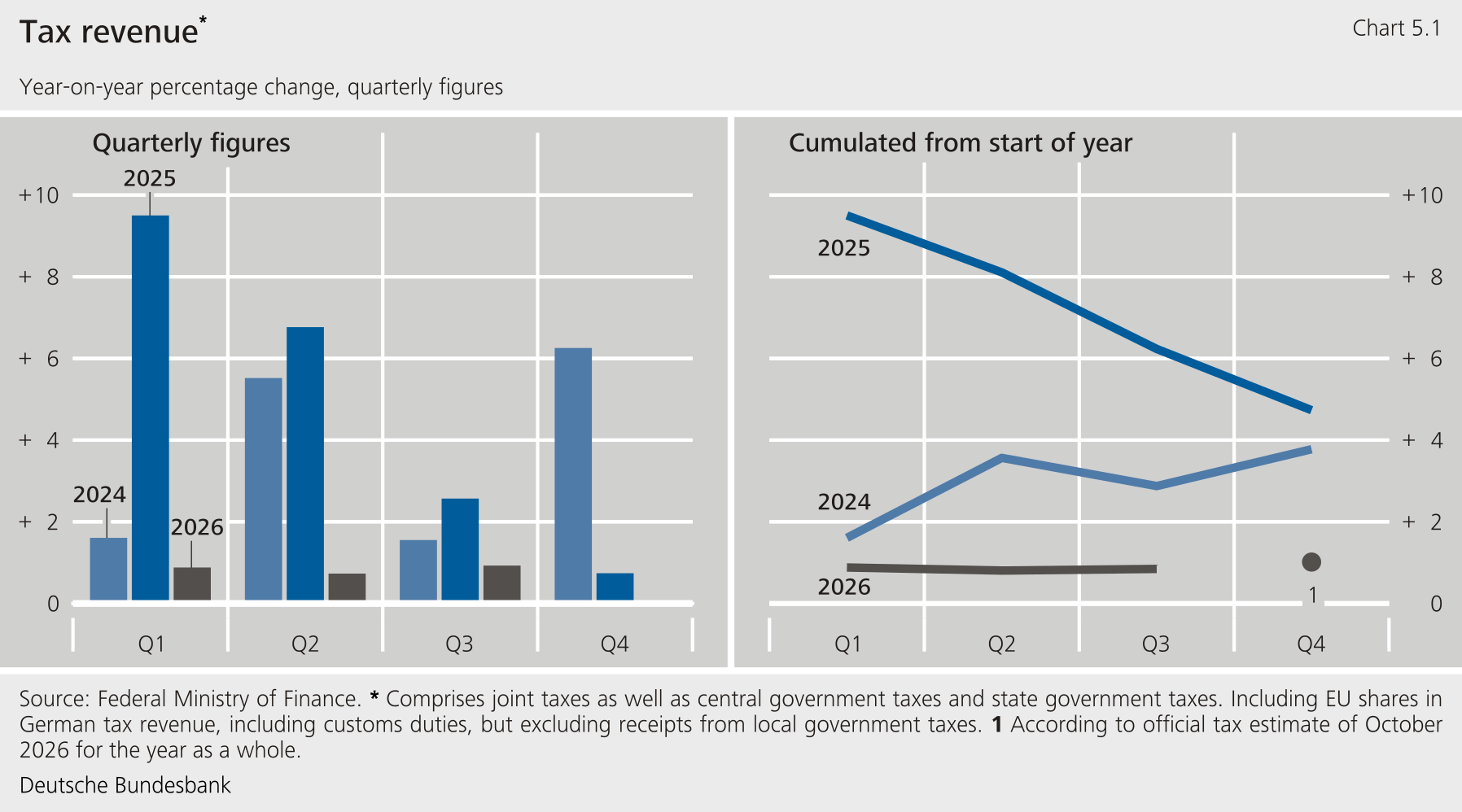
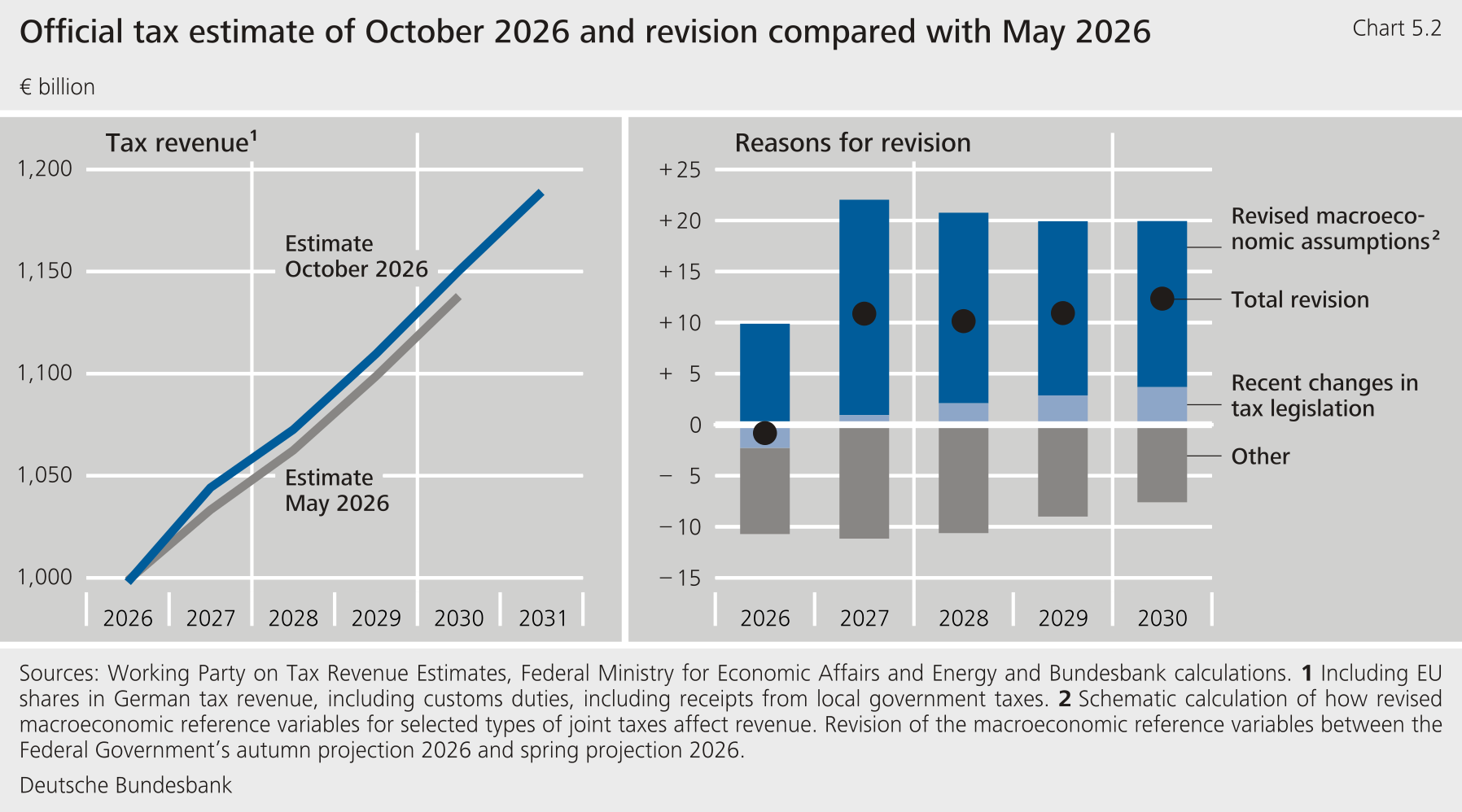
The macroeconomic tax reference variables are seeing significantly stronger growth, and this will be reflected in an upward revision from next year onwards. The tax estimate is based on the respective macroeconomic projection by the Federal Government, the plausibility of which has been certified by the institutions involved in the Joint Economic Forecast. According to the forecast, profits in particular will grow more strongly than expected in the spring projection. This applies to both the current year and the year to come. However, the tax estimate for the current year’s tax revenue is largely based on previous cash developments. Cash receipts from income tax and corporation tax are significantly lower than the dynamic growth in aggregate profits would suggest. This is why the tax estimate for these types of tax has not been revised upwards for the current year. Revenue from the taxing of interest income has been revised substantially upwards in the tax estimate. This is because receipts from withholding tax on interest income and capital gains have been markedly higher over the course of the year thus far than previously estimated. The upward revision is consistent with the fact that interest rates with fixation periods have risen significantly since mid-year. The tax estimate then also extrapolated the higher 2026 level into subsequent years. Tax hikes will increase revenue. The federal legislators recently passed a gradual increase in the tobacco tax for the years 2027 to 2030. This amended legislation will considerably increase the prices of certain tobacco products. Additional revenue of €4½ billion by 2030 is thus anticipated.
3 Central government finances
3.1 Overall deficit will rise sharply in 2026 but remain below planned figure
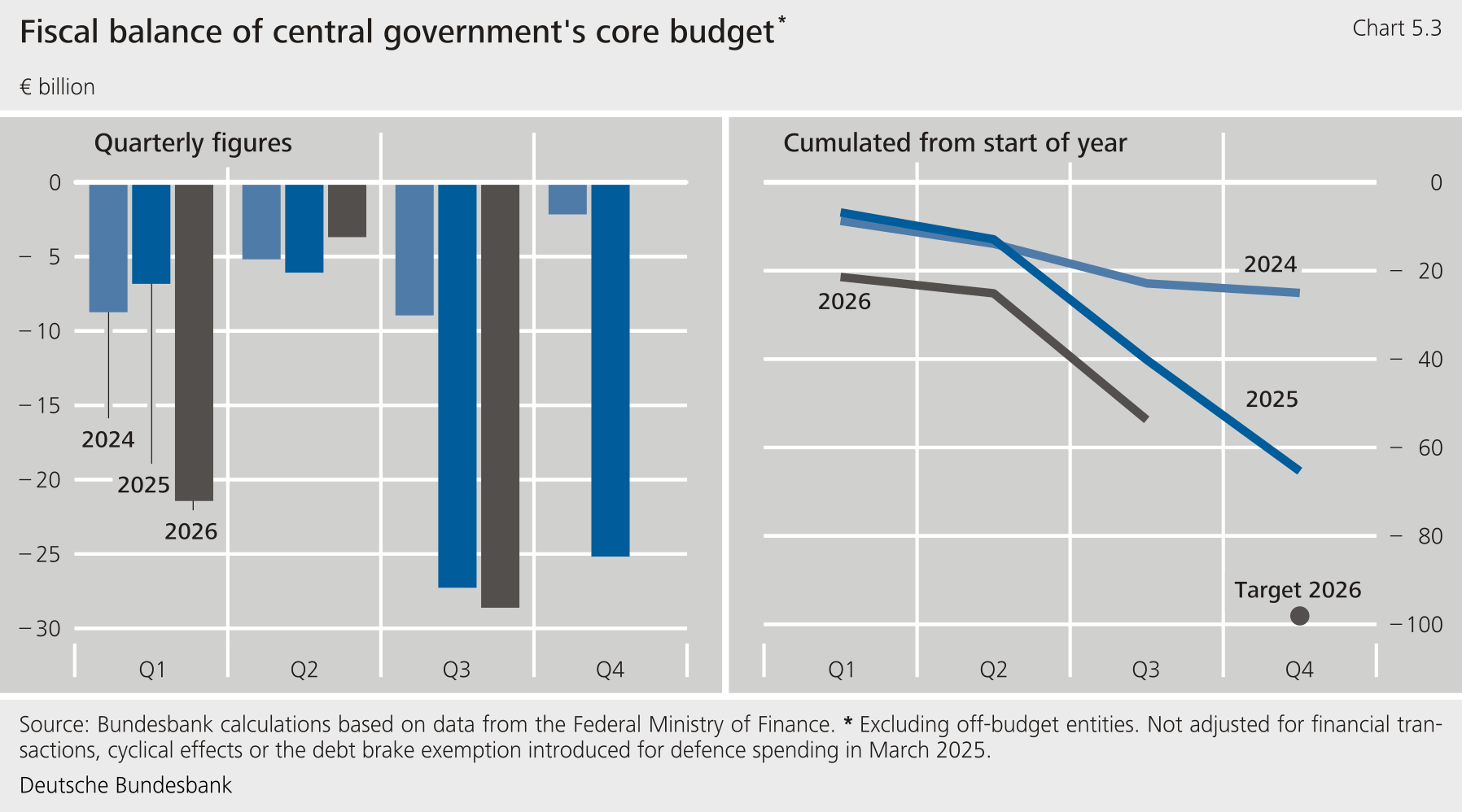
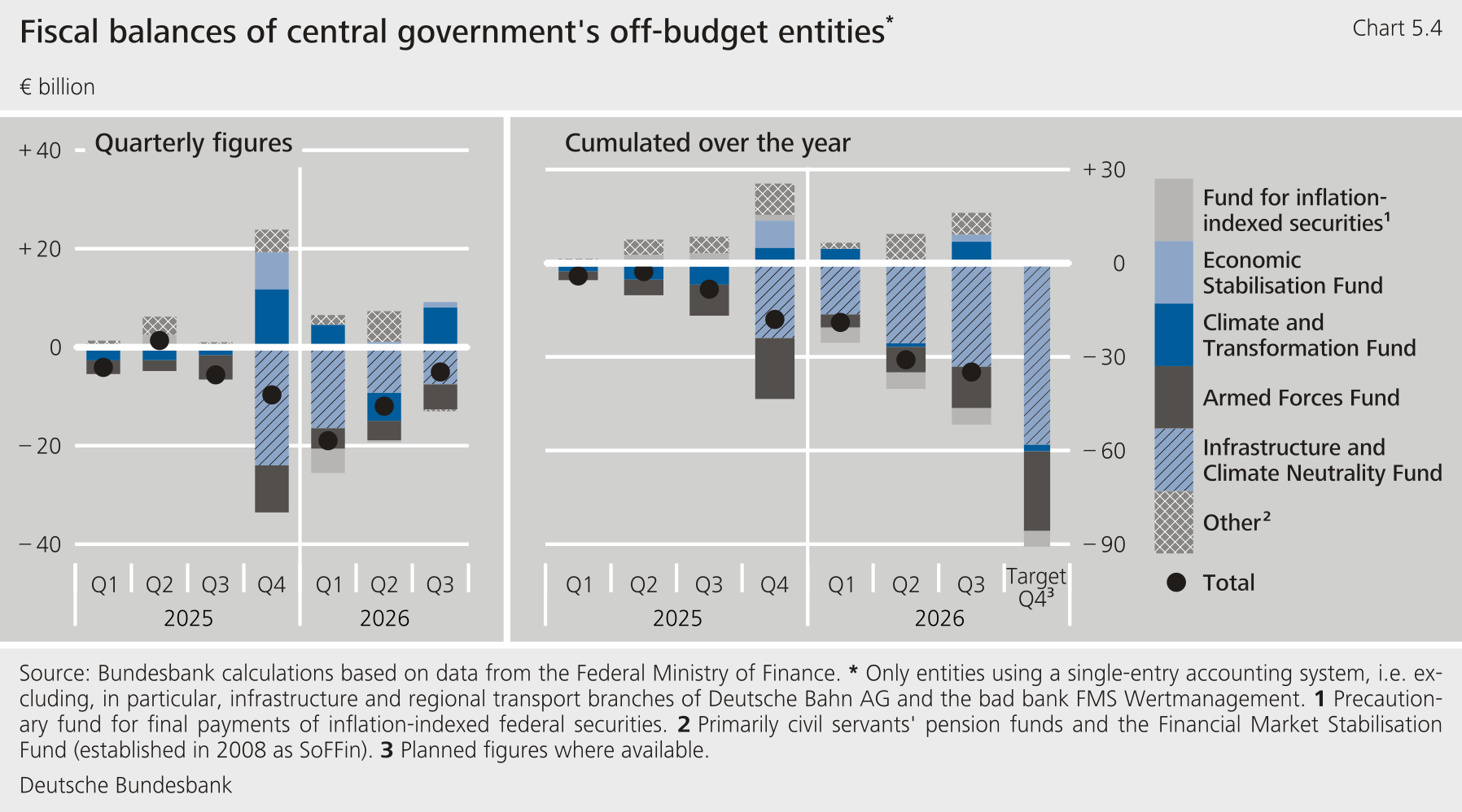
The Infrastructure and Climate Neutrality Fund alone posted a deficit of €33 billion. In the same period last year, it had not yet disbursed any funds. €16 billion of its deficit was attributable to payments to other special funds: in addition to a Climate Fund transfer, a total of €6 billion was channelled into the transformation fund and the health fund for use by hospitals. State governments received €1½ billion, including funds for their local governments. In addition, investment grants of €15 billion were distributed, chiefly for the railway network. Considerable fund outflows will probably continue up to the end of the year, particularly to state governments and their local governments. However, the planned deficit of €58 billion is likely to be significantly undershot. As things currently stand, the Climate Fund has a surplus of €7 billion. The result thus improved by €14 billion on the year. This is mainly attributable to two factors. First, the transfer from the Infrastructure and Climate Neutrality Fund was received earlier than in the previous year. Second, carbon emission allowances generated significantly greater revenue, particularly through earlier sales than in the previous year. At the same time, the fund’s expenditure rose by a substantial €6½ billion. This was probably due, in particular, to the new subsidy to reduce electricity grid charges. Instead of the estimated deficit of €2 billion for the year as a whole, there could be a surplus, as investment expenditure is likely to remain below the planned figures. Nevertheless, the result will probably deteriorate year-on-year (2025: + €5 billion). For the Economic Stabilisation Fund, SoFFin and the precautionary items for civil servants’ pensions, the combined surpluses could be somewhat lower for 2026 as a whole than in the previous year (€18 billion). Central government does not release any planned figures for these entities. For the Armed Forces Fund established in 2022, the deficit in the first three quarters rose by €3 billion to €13 billion. The estimated deficit of €26 billion will only be recorded if expenditure in the fourth quarter is as high as in the first three quarters taken together. On an annual basis, central government pays interest burdens accrued through period-based inflation to the fund for inflation-indexed securities. The fund will only distribute these amounts, cumulated over the lifetime of the securities, to investors once the securities are redeemed. This is why the fund initially generates surpluses from central government payments during the lifetime of a bond. Repayments will then result in deficits. For the year thus far, the fund has recorded a deficit of almost €5½ billion, as planned (following a surplus of €2 billion a year earlier). As a security was redeemed, the fund made compensation payments of €5 billion. 11 Furthermore, the fact that the fund reimbursed central government sums for securities held in the latter’s own portfolio had a burdening effect. The revenue accrued by the fund for this purpose was then repaid to central government on an ad hoc basis. In the core budget, this will reduce interest expenditure on a one-off basis. Next year, this relief will no longer be provided, with the result that interest expenditure in the core budget will rise more sharply.
3.2 Outlook for 2027
Particularly noteworthy here are sums of €4 billion for the acquisition of shares in an energy industry enterprise and €3 billion for higher loans to the Federal Employment Agency. These are financial transactions that fall outside the scope of the debt brake, and they require a corresponding build-up of financial assets. Most recently, the Chair of the Federal Employment Agency raised the possibility of a debt cancellation for at least part of these loans. Were this to occur, grants would have to be booked instead of loans. The grants would then fall under the debt brake. Other expenditure will include additional spending in other areas, for example because some social benefits will not be cut as previously planned, and because the global expenditure cuts estimated from efficiency gains are now expected to be €1 billion lower. By contrast, reduced investment grants to the Autobahn GmbH and reduced grants to the pension insurance scheme, in particular, will each provide relief of €2 billion. The Autobahn GmbH is set to receive a borrowing authorisation (see below for more on this). In connection with the cut in grants, the pension insurance scheme is likely to be relieved by, amongst other things, larger haircuts for taking early retirement.
The standard limit for structural net borrowing of 0.35 % of GDP results in deficit scope of just over €38 billion. Of this amount, €16 billion is attributable to permissible structural borrowing, €10 billion to cyclical burdens (€2½ billion less than in the summer draft) and almost €13 billion to acquisitions of financial assets (€7½ billion more than in the draft). At €7 billion, central government makes only slightly more use of the remaining reserves than planned in the summer draft. The impact of the exemption for defence spending comes in at just shy of €85 billion. The starting point is spending by the Federal Ministry of Defence and expenditure to strengthen Ukraine’s defence capabilities and for domestic security purposes. This amounts to €130 billion altogether. €45 billion (1 % of GDP ), which falls under the regular new borrowing limit, is to be deducted from this sum. The usable scope for borrowing is €1 billion lower than in the draft budget, mainly owing to a larger deducted amount following the upward revision of GDP .
4 State government finances 17
5 Social security funds
5.1 Pension insurance scheme
5.1.1 Significant deterioration in finances in 2026
5.1.2 High financing pressure over the next few years, comprehensive reform announced
5.2 Federal Employment Agency
6 Annex: A review of subsidies
6.1 Why review subsidies?
6.2 How large is the subsidy volume?
6.3 What approaches to reducing subsidies are being discussed?
To make the tax mix more growth-friendly, a given financial need can be covered by cutting tax expenditures in the case of taxes that are less damaging to growth – rather than increasing the burdens elsewhere. Economic studies suggest that consumption taxes, such as value added tax, are less detrimental to economic growth than income tax, for example. 31 With regard to distributional policy objectives, needs-based or income-related assistance seems to be more effective and efficient than broad-based tax incentives. Decarbonisation could be geared more heavily towards broadly and consistently applied carbon pricing. Generally speaking, this would allow emissions to be reduced more efficiently than through specific subsidies. 32 The tax and transfer system can be made more efficient if it does not include conflicting measures. Simultaneous concessions for both fossil fuels and low-carbon transport, for example, represent one such contradiction.