1.1 Expenditure driving deficit and contribution rates
Germany’s government finances are on an expansionary course. The deficit is set to rise, mainly on account of steep expenditure growth. According to the Bundesbank’s June forecast, 2 the deficit ratio will grow to around 5 % by 2028 and the debt ratio will rise to roughly 70 % (2025: 2.8 % and 63.5 %, respectively 3 ). Higher defence expenditure is the main contributor to this, but non-military investment expenditure, tax cuts and additional transfers (for example, for lower electricity grid fees or higher mothers’ pensions) will also play a role. Interest burdens will rise significantly too, mainly owing to higher interest rates. Furthermore, strong growth in social security expenditure will have a temporary expansionary effect. Various cost-saving measures are set to be implemented in the health insurance scheme, starting in 2027. 4 The contribution rates of the long-term care insurance scheme and the pension insurance scheme will rise from 2027 and 2028, respectively. At the Federal Employment Agency, labour market-related expenditure is “breathing” in time with the economic cycle: it is currently rising sharply, and will fall again as the economy recovers.
The fiscal outlook up to 2028 has not changed significantly since the June forecast. Although the planned pension reform is likely to significantly ease the burden on central government finances in the longer term, it would initially entail increasing additional burdens from 2028 onwards (see Chapter 6). The new central government plans include extensive consolidation, but this has only been fleshed out to a limited extent (see Chapter 3.2). Substantial action is thus still required here in order to ensure compliance with the debt brake from 2028 onwards and to avoid a potential conflict with the EU rules.
1.2 Leeway from fiscal rules is extensive and broadly interpreted
The fiscal rules for central and general government currently afford considerable leeway. The Federal Government also interprets the rules very broadly. The national rules allow for extensive borrowing via the sectoral exemption for defence spending and the Infrastructure and Climate Neutrality Fund. However, these special loans do not only finance growth in the areas of defence, infrastructure and climate action. They also close budget gaps or finance other measures. 5 Overall, central government is taking greater advantage of discretionary scope (see Chapter 3.2). The EU rules currently also allow Germany considerable leeway. Germany has activated the EU exemption for defence spending. In addition, it interpreted the regular leeway generously in its fiscal-structural plan of last August. 6
Nonetheless, public finances may potentially stand in conflict with the broad fiscal requirements in various areas.
Central government plans currently still demonstrate a considerable, unspecified need for consolidation in order to comply with the debt brake from 2028 onwards.
Multi-year cash advances at the local government level are likely to continue growing significantly. This indicates imbalances and does not align with budgetary requirements. 7
In the case of the social security funds, central government is bridging funding gaps with multi-year, non-interest-bearing loans which have already been extended in some cases (see Chapter 3.2). However, structural financing gaps here ought, in general, to be closed by increasing contribution rates or making spending cuts.
With regard to the general government EU rules, the Federal Ministry of Finance is planning a deficit for 2026 that exceeds the 3 % reference value. According to the plans, the reference value will still be exceeded even if the increased defence spending permitted under the exemption is deducted. 8 The Stability Council also expressed concerns that Germany could exceed the 3 % limit set for the general government deficit ratio. 9 The European Commission, meanwhile, based its decision on a more favourable forecast and therefore did not initiate an excessive deficit procedure. 10 It will assess the result for 2026 in due course.
Effective fiscal rules are not an end in themselves, but safeguard resilient public finances and thus also a stability-oriented monetary union. By international standards, Germany still has a relatively low debt ratio, and it continues to have the best possible rating in the capital markets. In view of this, temporarily increasing net borrowing in order to finance urgent, extensive additional needs for defence and infrastructure seems reasonable. However, under the current plans, there is a risk that the deficit ratio will exceed 4 % not only in the short term, but permanently. Should this be the case, the debt ratio will rise above 100 % in the long term, interest burdens will grow strongly and scope for fiscal action will be reduced. Such a development also runs counter to EU rules and jeopardises the resilience of public finances.
1.3 Maintain reform momentum and utilise it for sound public finances too
Germany is facing major fiscal policy challenges. A number of important and extensive structural reforms are under way and will be a welcome development. What matters now is that the various reforms are implemented swiftly. The quicker the reform measures enter into force, the sooner they can improve growth conditions and ease the burden on government finances and the social welfare system. Sound public finances, reliable social welfare systems and efficient administration support positive economic development.
In the case of the social security funds, the Federal Government is working on returning them to a sound footing on a permanent basis. In this vein, it plans to fully implement the Pension Commission’s comprehensive and pioneering package of measures (see Chapter 6). The July reform of the health insurance scheme is likely to significantly alleviate the pressure on contribution rates for a time. Further longer-term reforms have been announced for both the health insurance scheme and the long-term care insurance scheme.
The Federal Government intends to improve administrative processes at thefederal, state and local government levels. It also wants to reduce bureaucratic burdens. To this end, reporting requirements should be eliminated as far as possible, and administrative processes should become more digital. In addition, approval procedures are to be simplified, with increased assumed approvals forming part of this. There is much to be said for a broad-based and coordinated approach across government levels. 11
Germany should provide credible prospects that deficit and debt ratios will fall again. The EU rules also envisage a return to course by the next decade at the latest – and thus impose tighter requirements than the extended debt brake. For central government, this means using concrete measures to resolve outstanding consolidation needs in its plans and to begin reducing the deficit at the end of the planning period.
Debt brake reform is crucial if stable guardrails are to be put in place for Germany’s government finances once again. A debt brake reform is the Federal Government’s objective, in line with the coalition agreement; it has tasked a commission with drawing up recommendations. The commission’s report is not yet available, however. In November 2025, the Bundesbank submitted its own reform proposal. 12 According to this proposal, the sectoral exemption should be phased out gradually starting in 2030. In addition, the proposal re-embeds the key objectives of the EU treaties and fiscal rules into national borrowing limits. Furthermore, it cements scope for borrowing to fund infrastructure investment, but ties this more tightly to proof of additional expenditure. It ultimately falls to policymakers to lay down the basic principles of a reform and to enshrine them in the Basic Law (Grundgesetz).
Supplementary information
EU fiscal rules: more flexibility, higher debt
Reformed EU rules and exemption granted on first application
In 2024, country-specific budgetary limits were derived from the new EU fiscal rules for the first time. These were set in medium-term fiscal-structural plans (FSPs) to apply for several years starting in 2025. The rules are aimed at strengthening debt sustainability in the medium term. However, they may also permit substantial deficits on the path towards this goal. In this case, high debt ratios will initially continue to rise as anticipated. In addition, the rules allow for discretion, meaning that a temporarily expansionary fiscal stance may be permitted in spite of already high deficits or debt. 1 But once the plan comes to an end, the Member States’ government finances should always be on a sound structural footing. “Sound” means that high debt ratios will fall sufficiently and converge towards 60 % from the end of the planning horizon at the latest.
Shortly after multi-annual net expenditure paths had been endorsed, 2 the European Commission and the Council of the European Union granted an exemption allowing for additional deficits. 3 This decision was made in the context of Russia’s military strikes on Ukraine. The exemption allows EU Member States to borrow more for defence spending for several years while remaining in compliance with the EU rules. Specifically, from 2025 to 2028, a country may run an annual deficit of up to 1.5 % of GDP higher than set out in its FSP, provided it spends more on defence. However, for defence capabilities to rise markedly, Member States must also make efficient use of these additional opportunities.
The exemption for additional defence spending is suitably defined, as well as limited in terms of volume and duration. 4 Nevertheless, it allows for considerably higher deficits and debt to accrue without violating the rules. Higher interest expenditure will then weigh on future budgets. The national escape clause has now been activated for 14 of the 21 euro area countries. If Member States make use of the exemption, the following is possible:
their debt ratio in 2028 could be around 6 percentage points higher than outlined in their FSP;
the structural primary balance ratio achieved at the end of the planning horizon could be 1.5 % of GDP less ambitious than the sound structural footing calculated in the FSP.
It is now also becoming apparent that, irrespective of this escape clause, debt and structural deficits will be higher than outlined in the FSPs – while still remaining within the rules. This will happen if macroeconomic developments are less favourable, interest expenses higher or taxes and revenue lower than envisaged in the FSP. This is likely to be the case for many Member States.
As a result, debt ratios may continue to rise even in the medium term, pushing a sound structural footing even further out of reach. Of course, there may be good reasons for limited exemptions, or macroeconomic developments may indeed turn out to be unexpectedly poor. Nevertheless, this means that fiscal targets will once again be missed and progress towards sound government finances will not be made.
European Commission forecast: many highly indebted Member States making no progress on consolidation; targets being missed by a wide margin
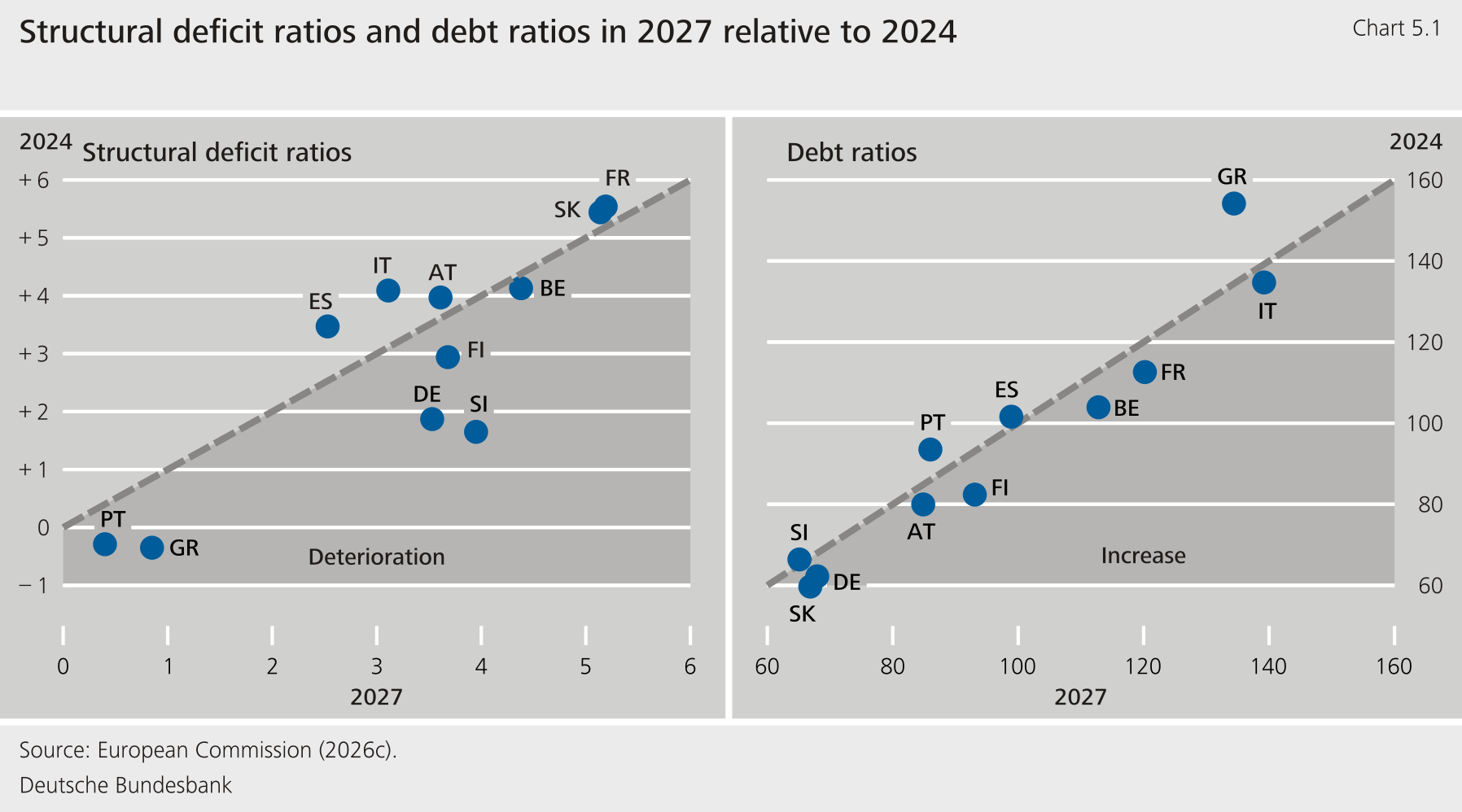
The European Commission has recently projected unfavourable fiscal developments. The FSPs for achieving sound fiscal positions apply from 2025. Still, the European Commission expects that, in many euro area countries, the situation in 2027 will be worse than in 2024 – unless Member States undertake new measures before then. Specifically, the euro area’s debt ratio is projected to be more than 3 percentage points higher in 2027 than in 2024. In 7 of the 11 euro area countries with debt ratios exceeding the reference value, it will rise even more sharply. 5 At the same time, the structural deficit is climbing markedly in some countries: these are Germany, Belgium and Finland (see Chart 5.1). In 2027, the deficit ratio is (still) above the reference value of 3 % in 7 of the 11 countries examined here, and just below it in Italy (see Chart 5.1).
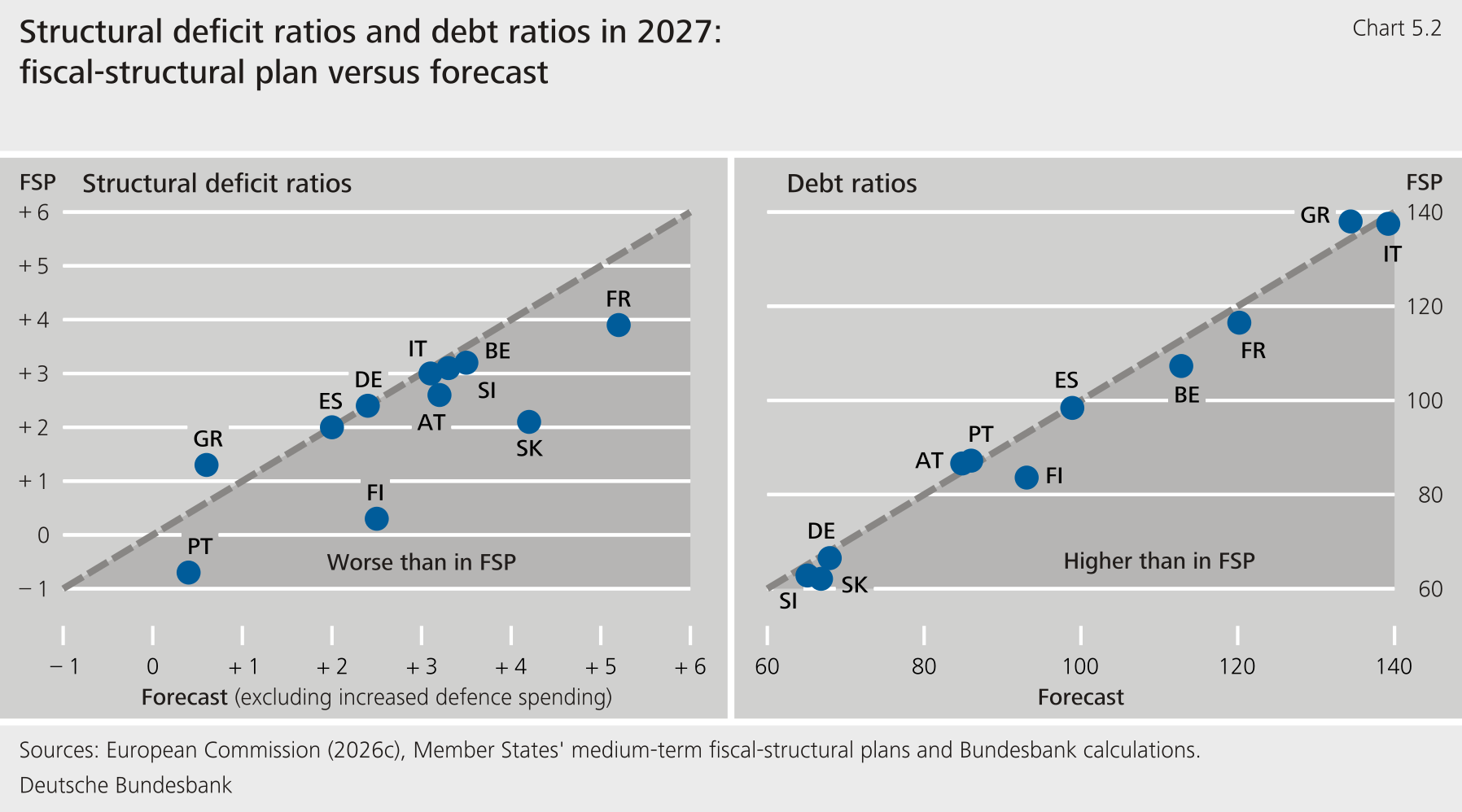
The projected fiscal situation is also generally less favourable than what had been aimed for in the FSPs. This is not only due to the exemption for additional defence spending. Almost all highly indebted euro area countries had planned on substantially consolidating their budgets by 2027. But in some cases, countries are missing their targeted structural deficit ratios by a considerable margin. According to the European Commission’s forecast, the consolidation gap goes well beyond the expected additional defence spending (see Chart 5.2). 6 And it cannot be explained by higher interest payments either. Rather, the missed targets are mainly due to excessive net primary expenditure beyond defence and/or less favourable macroeconomic developments. 7 In many cases, debt ratios are also higher in 2027 than outlined in the FSPs 8 (see Chart 5.2). Conversely, the European Commission expects that, among the highly indebted countries, Greece, Austria and Portugal will reduce their debt ratios by more than planned by 2027.
Spring fiscal surveillance package: Commission finds 2025 results mostly in line with rules and proposes extending escape clause
Fiscal surveillance in the spring package examined the outcomes of the preceding year. The European Commission found that almost all euro area countries had at least broadly complied with the new rules. 2025 is the first year for which budget outcomes are also measured against the new limits, taking into account the escape clause. 9 Overall, the European Commission concluded that almost all euro area countries either did not exceed their maximum allowable spending growth or did so only to an extent that would not trigger sanctions. 10 An excessive deficit procedure was launched against Bulgaria because its deficit ratio in 2025 exceeded the reference value. 11
In its spring package, the European Commission also proposes expanding the existing exemption to include energy-related measures. 12 These could then be considered exempt alongside defence spending: from 2026 onwards, up to 0.3 % of GDP per year and, cumulatively, up to 0.6 % of GDP by 2028. Member States would need to request this, and the Council would have to accept the request on the basis of a recommendation from the European Commission. Member States would have to demonstrate that the measures (i) are additional and (ii) reduce dependence on imported fossil fuels or promote decarbonisation. Measures counted under the new exemption would have to have been taken after February 2026. This new cap would generally apply within the unchanged existing cap of 1.5 % of GDP. At the same time, however, the European Commission proposes that countries that have already exhausted the existing cap through defence spending should be permitted to use the new cap for energy support measures on top of that.
The proposed new cap would likely expand the general scope for running deficits and increasing debt. This is because it appears to cover a broad and relatively undefined range of measures. Examples given by the European Commission include the electrification of industry, building heating and transport, investment in power grids and electricity storage, energy saving and the expansion of clean energy sources. Unlike defence expenditure, the newly proposed cap does not refer to a clear statistical category. This makes it difficult to measure whether the measures are truly additional. 13 All in all, it is likely that Member States will find it relatively easy to create general scope for deficits by allocating expenditure to the exemption category. The earmarking of funds is unlikely to be much of a constraint. Moreover, the new exemption further increases the already high complexity and limited transparency of the rules and their implementation.
Given high deficits and debt levels in many cases, future interpretation and application of rules should clearly focus on achieving sound government finances
In future, the EU fiscal rules should be applied more consistently to ensure that high debt ratios actually fall in a reliable manner. Achieving a sound structural footing should not be put off. This is important both in view of the critical fiscal situation in some Member States and for the credibility of the rulebook. Therefore, there are strong arguments for the European Commission and the Council of the European Union to interpret existing leeway more in favour of consolidation incentives. Repeated use or expansion of escape clauses should also be avoided. Ultimately, high levels of debt threaten the sustainability of government finances and make governments less resilient. Governments frequently encounter new spending needs as they pursue worthwhile objectives. However, this does not mean that these can only be achieved through additional debt. Instead, revenue and expenditure can be prioritised. Even in the past, however, there has rarely been a favourable moment to reduce high deficits, with the necessary consolidation instead being repeatedly postponed. That being said, it is important to align fiscal policy with the rules rather than adapting the rules to short-term fiscal policy preferences.
Given the above, there is an argument to be made for not expanding the escape clause. Deficits and debt levels are already high in many cases, and the credibility of the rules would be undermined. The Federal Ministry of Finance has also warned that the escape clause must not jeopardise the credibility of the fiscal framework. Furthermore, some countries have expressed criticism. 14 The Council intends to continue discussions with the European Commission on expanding the escape clause. 15
Table 5.1: Public finances in euro area countries European Commission’s spring forecast, May 2026
Country
General government fiscal balance As a percentage of GDP
General government gross debt As a percentage of GDP
Structural budget balance As a percentage of potential GDP
Interest expenditure As a percentage of GDP
Defence spending1 As a percentage of GDP
2025
2026
2027
2025
2026
2027
2025
2026
2027
2025
2026
2027
Reference value2
2025
2026
2027
Austria
– 4.2
– 4.1
– 4.1
81.5
83.4
84.9
– 3.6
– 3.5
– 3.6
1.6
1.8
1.9
0.6
0.7
0.9
1.0
Belgium
– 5.2
– 5.2
– 5.4
107.9
110.5
112.8
– 4.9
– 4.4
– 4.4
2.2
2.4
2.7
0.9
1.4
1.6
1.8
Bulgaria
– 3.5
– 4.1
– 4.3
29.9
32.3
35.5
– 4.1
– 4.1
– 4.1
0.8
1.2
1.3
1.3
1.9
1.9
2.2
Croatia
– 3.0
– 2.9
– 2.7
56.3
55.9
55.6
– 3.7
– 3.1
– 2.6
1.4
1.4
1.3
1.0
1.5
1.6
1.7
Cyprus
3.4
2.1
2.5
55.0
50.4
45.5
1.9
1.3
1.9
1.1
1.2
1.2
.
.
.
.
Estonia
– 2.0
– 4.5
– 4.8
24.1
26.9
30.5
– 0.8
– 3.8
– 4.7
0.5
0.6
0.8
2.0
3.9
4.6
4.9
Finland
– 3.4
– 4.5
– 4.6
88.5
91.2
93.1
– 1.9
– 3.2
– 3.7
1.6
1.9
2.0
1.2
1.7
2.6
2.4
France
– 5.1
– 5.1
– 5.7
115.6
118.1
120.2
– 4.7
– 4.6
– 5.2
2.2
2.6
2.8
.
.
.
.
Germany
– 2.7
– 3.7
– 4.1
63.5
65.8
68.0
– 1.8
– 2.9
– 3.5
1.1
1.2
1.2
1.1
1.5
1.9
2.2
Greece
1.7
0.8
0.6
146.1
140.7
134.4
0.5
– 0.7
– 0.9
3.2
3.2
3.2
2.2
2.4
2.6
2.5
Ireland
1.8
1.4
1.2
32.9
32.4
31.6
– 0.7
1.6
1.5
0.5
0.5
0.6
.
.
.
.
Italy
– 3.1
– 2.9
– 2.9
137.1
138.5
139.2
– 3.7
– 3.2
– 3.1
3.9
4.1
4.2
.
.
.
.
Latvia
– 2.5
– 3.3
– 4.3
46.9
48.8
53.8
– 2.5
– 3.4
– 4.5
1.1
1.4
1.4
2.5
3.2
4.1
5.5
Lithuania
– 1.8
– 2.2
– 2.7
39.5
44.6
48.4
– 1.6
– 2.2
– 2.7
0.9
1.1
1.3
1.4
2.7
2.9
3.5
Luxembourg
– 2.0
– 1.2
– 1.6
26.5
29.2
30.2
– 0.2
0.3
– 0.5
0.3
0.5
0.6
.
.
.
.
Malta
– 2.2
– 2.2
– 2.1
46.4
46.2
46.2
– 1.8
– 1.6
– 1.1
1.2
1.3
1.3
.
.
.
.
Netherlands
– 1.6
– 2.5
– 1.9
44.4
46.9
47.0
– 1.1
– 1.1
– 1.1
0.7
0.7
0.8
.
.
.
.
Portugal
0.7
– 0.1
– 0.4
89.7
87.6
86.0
0.6
0.2
– 0.4
1.9
2.0
2.1
0.8
0.8
0.8
0.8
Slovakia
– 4.5
– 4.6
– 5.4
61.4
63.7
66.9
– 4.3
– 4.3
– 5.1
1.5
1.7
1.8
1.4
2.0
1.9
2.3
Slovenia
– 2.5
– 3.3
– 3.5
65.7
64.9
65.1
– 2.6
– 3.7
– 3.9
1.3
1.3
1.4
1.1
1.3
1.6
1.8
Spain
– 2.4
– 2.4
– 2.0
100.7
99.6
98.9
– 3.2
– 2.9
– 2.5
2.4
2.5
2.5
0.9
1.0
1.2
1.4
Euro area
– 2.9
– 3.3
– 3.5
88.7
90.2
91.2
– 2.8
– 2.9
– 3.2
1.9
2.1
2.2
.
.
.
.
Sources: European Commission (2026b and 2026c). 1 Defence spending is reported only for euro area countries that have activated the escape clause. Only nationally financed expenditure is relevant for fiscal surveillance. 2 In most cases, the reference value is the value from 2021. If defence spending decreased after 2021, the lower value is applied.
2 Tax revenue
2.1 Signs of slight revenue shortfalls for 2026 compared with tax estimates
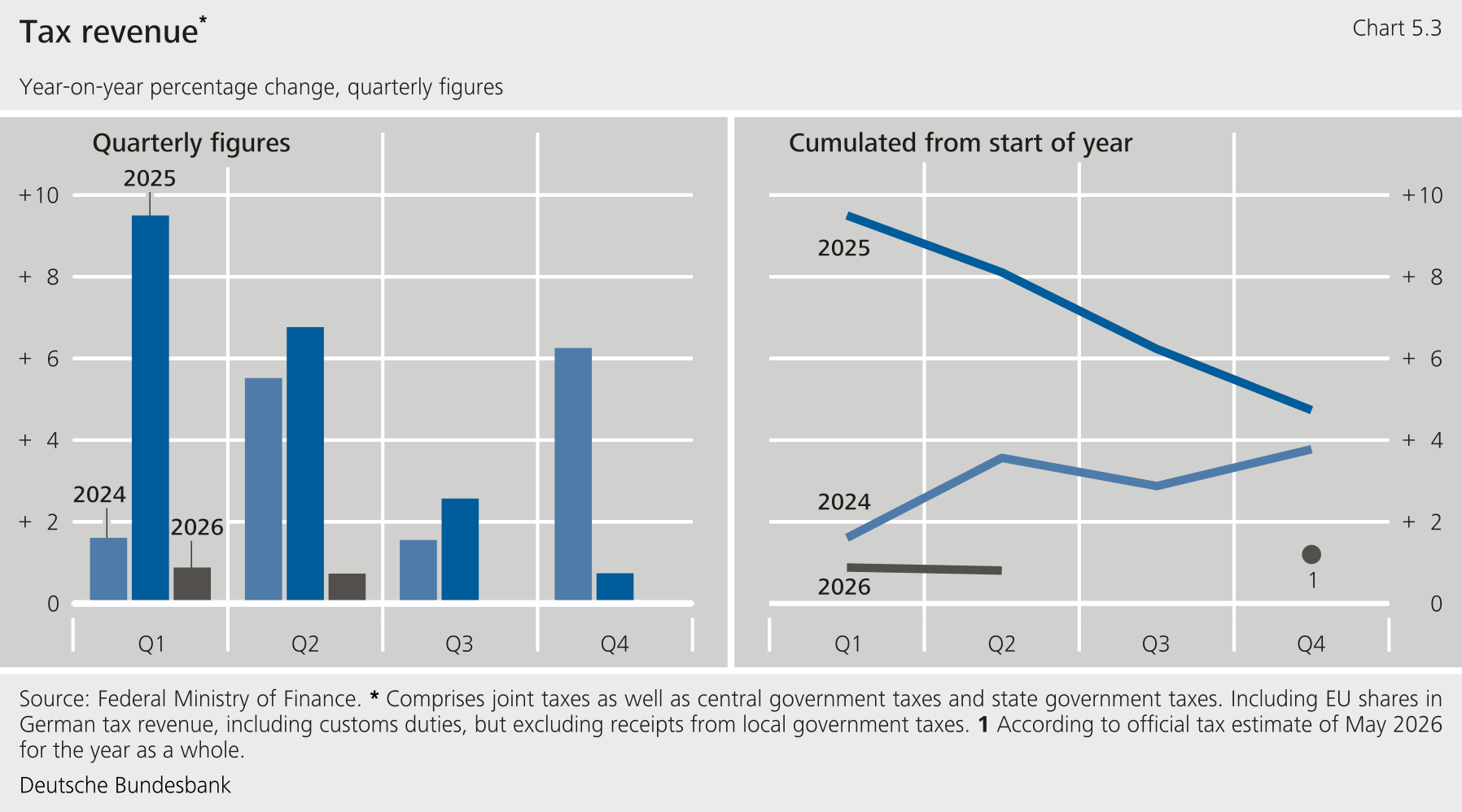
Tax revenue could see somewhat weaker growth this year than expected in the last tax estimate. Up to the middle of the year, the growth rate lagged below the estimated rate for the year as a whole (1.2 %), at 0.8 %. 13 The estimate could also be undershot for the year as a whole. Economic developments over the remainder of the year, not least, will be a decisive factor here. That being said, the picture differs between individual taxes.
VAT growth in the first half of the year was weaker than expected for the year as a whole. However, it is often volatile over the course of the year; the estimated annual result is therefore still plausible.
Wage tax revenue was on track in the first half of the year. However, its growth weakened significantly in May and June. Should this continue over the remainder of the year, revenue for the year as a whole would stay below estimate.
Income taxes on dividends (non-assessed taxes on earnings) have so far seen much stronger growth than estimated for the year as a whole. However, this is also likely to have been due to the fact that this year’s dividend payment dates were somewhat more strongly concentrated in the first half of the year than was the case in 2025. In light of this, the estimate for the year as a whole remains plausible.
Withholding tax on interest income and capital gains saw surprisingly brisk growth in May and June. Additional revenue relative to the last tax estimate thus also seems possible for the year as a whole.
Table 5.2: Tax revenue
Type of tax
H1
Estimate for 20261
2025
2026
€ billion
Year-on-year change
Year-on-year change
€ billion
%
%
Tax revenue
Total2
447.6
451.2
+ 3.6
+ 0.8
+ 1.2
of which:
Wage tax3
127.1
133.0
+ 5.9
+ 4.6
+ 4.6
Profit-related taxes
90.1
89.0
– 1.0
– 1.1
– 3.1
Assessed income tax4
36.9
35.8
– 1.1
– 3.1
– 1.7
Corporation tax5
19.8
18.2
– 1.6
– 8.0
– 7.3
Non-assessed taxes on earnings
18.9
20.7
+ 1.8
+ 9.4
+ 2.5
Withholding tax on interest income and capital gains
14.5
14.4
– 0.1
– 0.7
– 8.1
VAT6
154.2
158.4
+ 4.2
+ 2.7
+ 3.5
Other consumption-related taxes7
48.3
45.5
– 2.9
– 5.9
– 4.2
Sources: Federal Ministry of Finance, Working Party on Tax Revenue Estimates and Bundesbank calculations. 1 According to official tax estimate of May 2026. 2 Comprises joint taxes as well as central government taxes and state government taxes. Including EU shares in German tax revenue, including customs duties, but excluding receipts from local government taxes. 3 Child benefits and subsidies for supplementary private pension plans deducted from revenue. 4 Employee refunds and research grants deducted from revenue. 5 Research grants deducted from revenue. 6VAT and import VAT.7 Taxes on energy, tobacco, insurance, motor vehicles, electricity, alcohol, air traffic, coffee, sparkling wine, intermediate products, alcopops, betting and lotteries, beer and fire protection.
2.2 Simplify tax system, reduce subsidies
The Federal Government intends to change income tax rates and incentives. It is also planning to increase income tax allowances and child benefits. These are set to increase in 2027 and 2028. In 2027, the government intends to raise employees’ standard allowance for income-related expenses. In addition, it is planning to impose higher tax rates on very high taxable income (top-income tax bracket: “Reichensteuer”) and a higher flat tax rate for mini jobs. 14 In doing so, it intends to partially offset the revenue shortfalls arising from the aforementioned measures. The government is planning both limits for and increases in tax subsidies. On the one hand, it wants to reduce income tax relief for spending on measures involving renovating, maintaining and modernising occupied housing by one-quarter. However, it also wants to considerably expand the tax exemption for supplementary pay for work on Sundays and public holidays. 15
Tax shortfalls from the package of measures are relatively small. This limits the need for additional action in the government budgets, which already have large deficits. Annual shortfalls are likely to reach mid-single-digit billions in net terms.
Reducing special tax rules and incentives could create room for manoeuvre in government budgets and simplify the tax system. With fewer special rules and subsidies, the tax system would be simpler and more transparent. Bureaucracy costs could fall. The planned decrease in the tax reduction for tradespeople’s services will result in additional tax revenue of less than €1 billion. It will not simplify tax law. The revenue shortfalls resulting from the planned changes to supplementary pay could have a greater impact over the medium term. They are likely to make tax practices more complicated. This is because it is becoming more attractive to restructure income components and relocate them to areas that could benefit from this. Overall, there is much to be said for approaching the reduction of subsidies as comprehensively as possible. A broad approach covering all types of tax is recommended. 16 Additional revenue could then be used to lower tax rates or consolidate government budgets.
3 Central government finances
3.1 Deficit in 2026 rises sharply, but less than planned
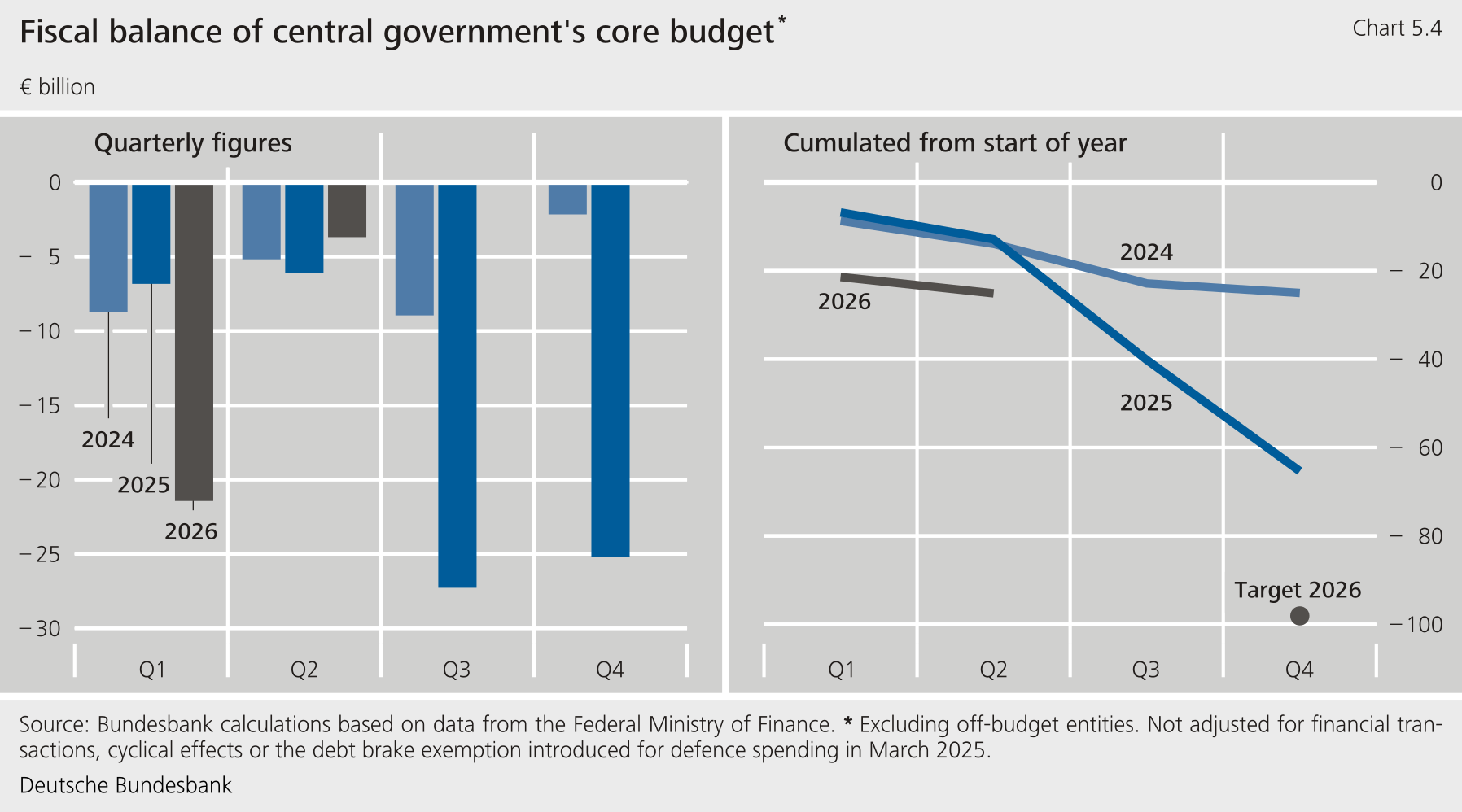
The central government deficit (core and off-budget entities 17 ) will grow very substantially this year. However, it is likely to remain below the planned figure of €191 billion.The core budget could match the planned deficit of €98 billion, though (see also Table 5.3, items 1 and 3, for more information). Potentially weaker than planned tax revenue growth is expected to be compensated for by lower expenditure. As in previous years, lower expenditure could be on the cards for investment grants and military procurement, in particular. In the case of personnel expenditure, it is likely that less will be spent than planned on implementing the Federal Constitutional Court’s requirements for minimum civil servant pay this year. By contrast, loans to compensate for the Federal Employment Agency’s deficit will probably be higher than projected.
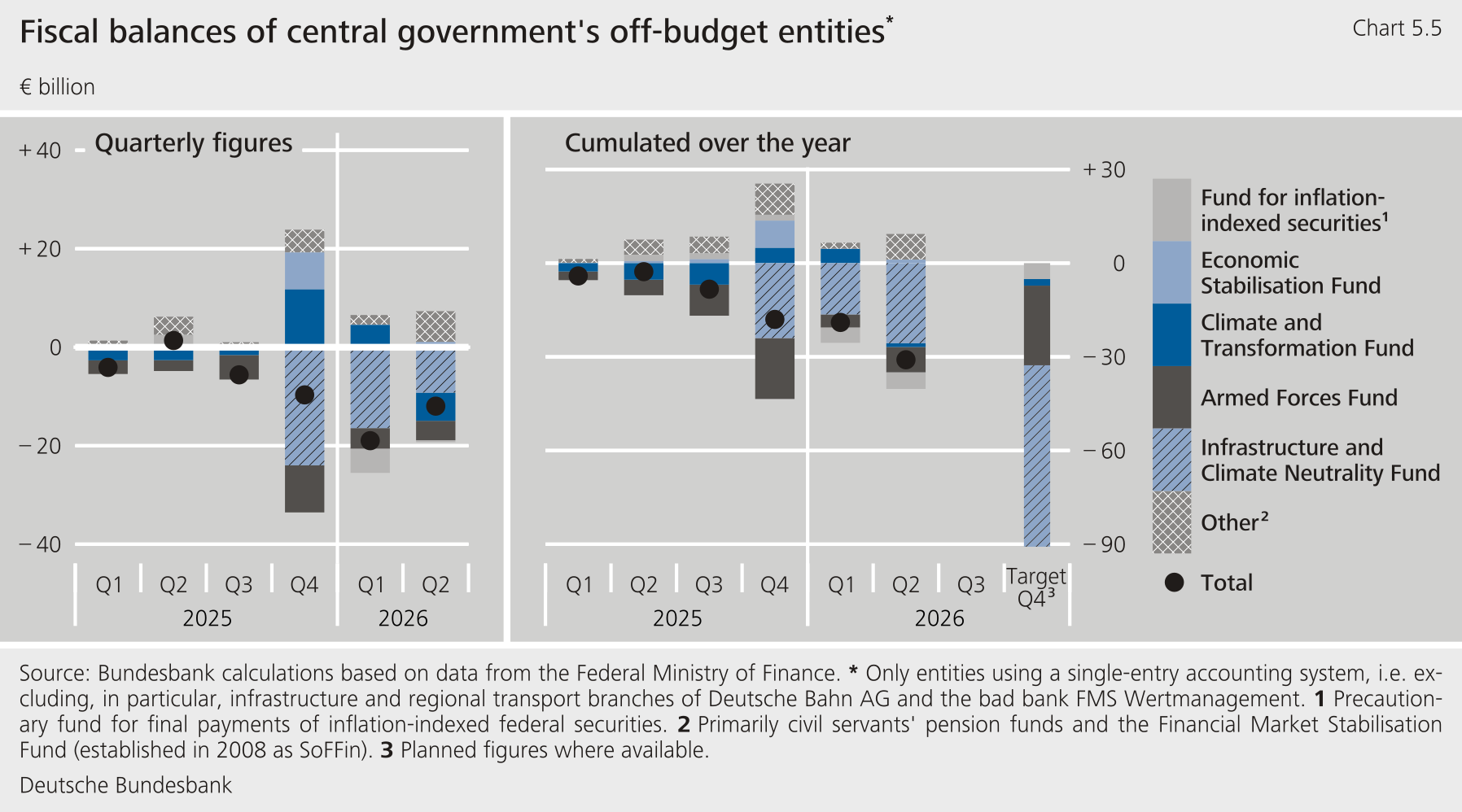
The off-budget entities’ deficit (Table 5.3, items 4 to 9) will rise very sharply in 2026 relative to the previous year. This is mainly due to expenditure by the Infrastructure and Climate Neutrality Fund. 18 The deficit of the Infrastructure and Climate Neutrality Fund is likely to rise significantly in the second half of the year compared with the previous year. 19 This is due, not least, to the fact that state and local governments will increasingly draw on funds.
Relative to the planned figures, however, the off-budget entities’ deficit increase will probably be lower as expenditure undershoots estimates once again. For the Armed Forces Fund and the Climate Fund, outflows in relation to the target were subdued in the first half of the year. Here, the deficits for the year as a whole are likely to be smaller than planned. In the case of the Infrastructure and Climate Neutrality Fund, outflows from the state government share could be higher. In particular, local governments could apply for more funds to alleviate their budgetary strain. However, reduced spending on central government projects by the Infrastructure and Climate Neutrality Fund could more than compensate for that.
Table 5.3: Key central government budget data
Item
€ billion (unless otherwise indicated)
Actual
Target
Draft
Fiscal plan
2025
2026
2027
2028
2029
2030
Deficit (surplus – )
1
Central government total (3 + 4 + 9)
83.8
190.9
211.2
210.5
210.7
221.0
2
As a percentage of GDP1
1.9
4.2
4.4
4.3
4.2
4.2
of which:
3
Core budget
65.4
98.1
125.5
152.8
152.1
167.4
4
Off-budget entities2 with borrowing plan figures
36.2
92.8
85.7
57.7
58.6
53.6
5
Infrastructure and Climate Neutrality Fund
24.0
58.1
54.9
56.7
57.9
52.2
6
Armed Forces Fund
19.5
27.5
30.0
-
-
-
7
Climate Fund
– 4.8
2.1
3.3
1.0
0.7
1.4
8
Other3
– 2.4
5.1
– 2.5
.
.
.
9
Off-budget entities2without borrowing plan figures4
– 17.8
.
.
.
.
.
10
Central government total, structural5
63.1
163.8
193.5
203.1
208.3
222.7
11
As a percentage of GDP1
1.4
3.6
4.1
4.1
4.1
4.3
Scope for borrowing under debt brake (core budget)
12
Withdrawal from reserves
-
-
6.8
3.9
-
-
13
General reserves remaining thereafter
10.7
10.7
3.9
-
-
-
14
Coin seigniorage
0.1
0.1
0.1
0.1
0.1
0.1
15
Net borrowing excluding sectoral exemption for defence spending (3 − 12 − 14 − 23)
36.7
40.4
33.4
23.5
19.1
15.6
16
Cyclical component in the budget procedure
– 7.5
– 15.6
– 12.3
– 8.0
– 3.9
0.0
17
Balance of financial transactions
– 15.4
– 9.6
– 5.4
0.6
1.5
1.6
18
Structural net borrowing6 (15 + 16 + 17)
13.8
15.2
15.6
16.1
16.7
17.2
19
Standard limit of 0.35 % of GDP
13.5
15.2
15.6
16.1
16.7
17.2
20
Overshoot (+) (18 − 19)
0.3
-
-
-
-
-
21
Balance on control account7
57.8
57.8
57.8
57.8
57.8
57.8
Scope for borrowing outside debt brake
22
Net borrowing in newer special areas8
72.1
143.2
170.2
184.0
190.8
204.0
of which:
23
Sectoral exemption for defence spending
28.6
57.6
85.4
125.3
132.9
151.8
24
Additional defence expenditure in core budget vis-à-vis 20249
10
36
63
.
.
.
25
Armed Forces Fund10
19.5
27.5
30.0
-
-
-
26
Borrowing authorisation remaining thereafter
57.5
30.0
-
-
-
-
27
Infrastructure and Climate Neutrality Fund
24.0
58.1
54.9
56.7
57.9
52.2
28
Additional infrastructure investment vis-à-vis 202411, e
– 1.0
18.3
17.5
18
19
17
29
Borrowing authorisation remaining thereafter
476.0
417.9
363.0
306.3
248.4
196.2
Additional core budget figures
30
Expenditure
493.3
524.5
555.4
588.2
597.8
635.4
31
Investment
55.4
58.4
56.3
50.8
50.2
49.2
32
Investment excluding financial transactions
39.2
47.9
50.0
49.8
49.8
48.9
33
of which: financed via sectoral exemption for defence spending
2.1
3.8
9.1
.
.
.
34
of which: investment in central government infrastructure11, e
18.1
24.2
27.5
27
28
27
35
Investment ratio in percent (relevant for Infrastructure and Climate Neutrality Fund)12
8.7
10.5
10.8
10.8
10.7
10.1
36
Interest13
29.8
30.2
41.8
55.2
68.1
80.7
37
Grants to the statutory pension insurance scheme13
122.4
127.4
132.0
151.8
155.0
164.5
38
Global expenditure increases/cuts13
-
– 8.8
– 10.9
– 25.5
– 24.5
– 24.1
39
Need for action13
-
-
-
– 22
– 39
– 48
40
Revenue
427.9
426.4
429.9
435.4
445.7
468.0
41
Tax revenue
388.6
387.2
394.7
406.4
416.6
437.3
42
From NGEU
-
10.6
-
-
-
-
43
Global revenue increases/shortfalls
-
– 1.4
1.0
– 4.8
– 4.8
– 4.1
Central government's consolidated debt
44
Memo item: total14
1 886
2 103
2 314
2 520
2 727
2 944
of which: debts with repayment plan
45
Emergency borrowing (from 2020 to 2023)15
324.7
324.7
324.7
324.7
324.7
324.7
46
Armed Forces Fund and Infrastructure and Climate Neutrality Fund15
66.5
150.1
234.9
293.6
351.5
403.7
47
Total outstanding repayment amount from NGEU grants16
92
118
118
114
110
107
* Sources: Federal Ministry of Finance, Federal Republic of Germany – Finance Agency and Bundesbank calculations. 1GDP according to Federal Government's 2026 spring projections. 2 Off-budget entities for which central government publishes monthly cash data. Budgeted figures in accordance with central government budget plan, pursuant to borrowing plan (aside from Infrastructure and Climate Neutrality Fund and Armed Forces Fund). In particular, corporations such as Autobahn GmbH and the infrastructure and regional transport branches of Deutsche Bahn AG are excluded. 3 In particular, the repayment fund for inflation-indexed federal securities and the 2021 Flood Relief Fund (above all to assist the Ahr Valley). 4 In particular, the Economic Stabilisation Fund (above all, assistance loans from the COVID‑19 pandemic), SoFFin (special fund formed during the end-2008 financial market crisis) and the precautionary funds for civil servants' pensions. 5 Cyclical adjustment for all years according to Federal Government's 2026 spring forecast. For 2025, adjustment for financial transactions also includes off-budget entities without planned figures. 6 Reference variable for borrowing limit under the debt brake. 7 Since 2016, aggregate overshooting and undershooting of the borrowing limit (adjusted for new borrowing/repayment of emergency borrowing). 8 Excluding net borrowing for the interest of the Investment and Repayment Fund, which was established to overcome the financial crisis at the start of 2009. The fund's deficit is captured in (9) and thus also in central government's consolidated debt (44). 9 Brought into line with COFOG definition (Ministry of Defence expenditure less pension payments and hospital costs; plus civil protection, aid to Ukraine and contributions to the UN Blue Helmets' missions). 10 The Federal Government plans to have fully exhausted the Armed Forces special fund by end-2027. The 2026 deficit given at (1) is thus projected to be €2 billion higher than in the economic plan. 11 Investment in central government infrastructure (core budget and Infrastructure and Climate Neutrality Fund; for Actual 2024 core budget only): all fixed asset formation and investment grants to federal enterprises such as Deutsche Bahn AG and Autobahn GmbH and public sector institutions for purposes such as the expansion of Germany's broadband network (from the classification scheme: main category 7, groups 81 and 82, items 891 and 894). 12 The Federal Government deems the additionality of the credit-financed expenditure of the Infrastructure and Climate Neutrality Fund to be fulfilled if the budgeted figure amounts to at least 10 %. 13 Figures from central government's fiscal plan for 2026‑2030 (Bundestagsdrucksache 21/7301). 14 2025: outstanding central government borrowing at the end of the year (including all central government off-budget entities but excluding cash advances) according to Finance Agency plus Germany's share of NGEU debts (47). From 2026 onwards: extrapolated with deficit (1) less coin seigniorage (14) and change in NGEU debts. 15 Repayments of emergency borrowing (from COVID‑19 pandemic) and Armed Forces Fund borrowing postponed from 2028 to start in 2033. 16NGEU budgeted figures multiplied by Germany’s share of 25 % in EU gross national income. From 2028 onwards, minus equal repayments over 31 years.
3.2 Central government planning very large deficits up to 2030 and facing high consolidation needs for its targets
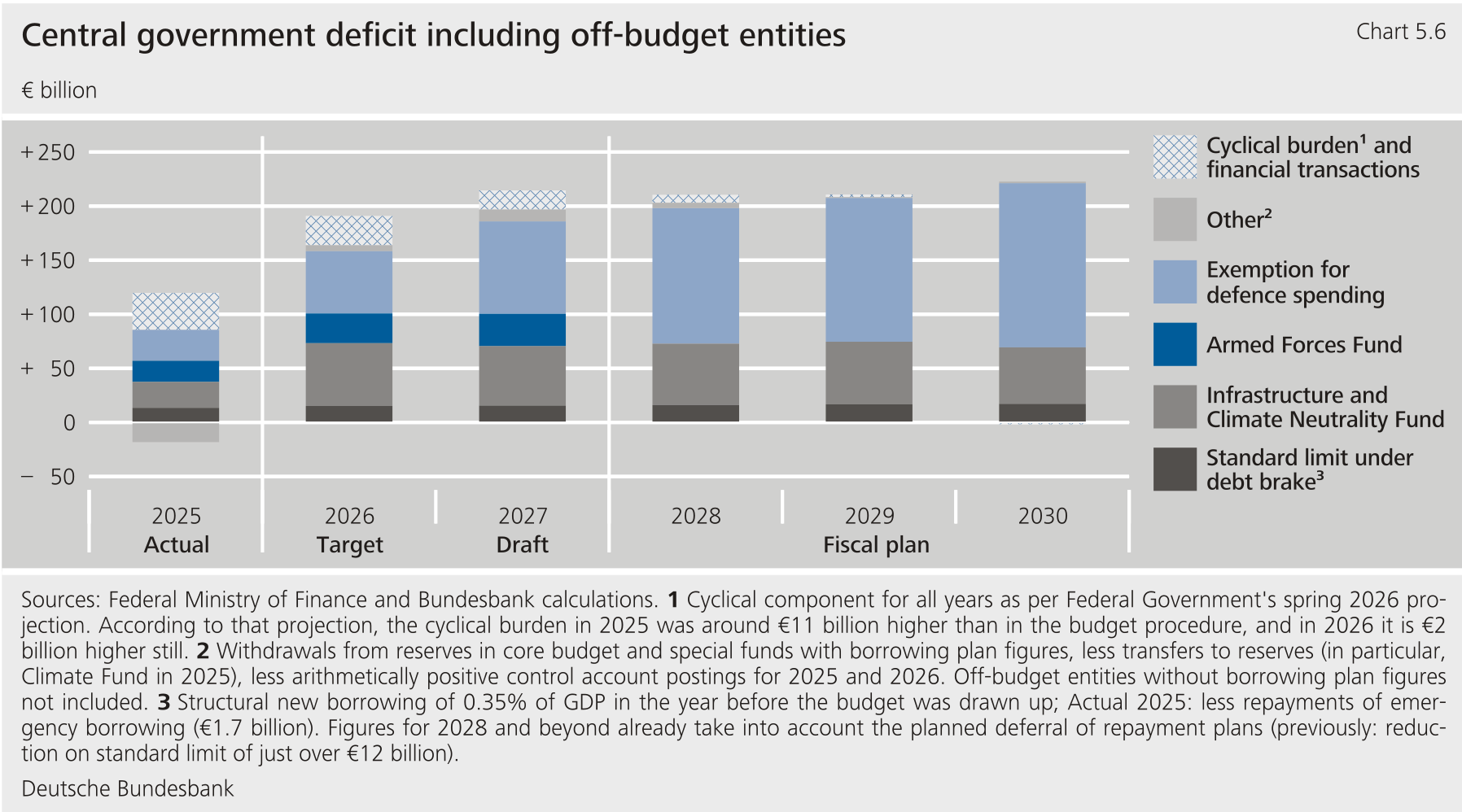
Looking ahead to 2027, the Federal Government is reckoning with further significant growth in central government’s overall deficit, planning for it to reach a total of €211 billion (Table 5.3, item 1). It will use discretionary scope and reserves to comply with the debt brake. The core budget is the main factor driving the rising deficit: revenue (item 40) is barely growing but expenditure (item 30) is climbing sharply. The increase in expenditure is predominantly attributable to the sectoral exemption for defence spending (item 23). In order to comply with the debt brake, the government is factoring in a variety of consolidation measures – some of which are yet to be fleshed out or are still awaiting adoption by legislators – as well as drawing on discretionary scope for configuring the budget and utilising €7 billion from the remaining reserves (item 12).
The high central government deficit is expected to stay more or less steady in the period until 2030. Meanwhile, the structural deficit (item 10) will keep climbing due to central government's increasing use of the exemption for defence spending. Cyclical burdens and net acquisition of financial assets (items 16 and 17) will decline, which will curb the unadjusted deficit. 20 The structural deficit is being pushed upwards by the defence sector. It is set to rise from 3½ % of GDP to 4¼ % in the period between 2026 and 2030. According to budgetary planning, just over 0.3 percentage point of this will come from the standard limit under the debt brake in 2030. A further 2.9 percentage points will be provided by the exemption for defence spending. And 1 percentage point will stem from the Infrastructure and Climate Neutrality Fund.
However, there is still much to be done if the government wishes to achieve the goals enshrined in the fiscal plans and thus to comply with the debt brake. Compliance with the 0.35 % structural borrowing limit is achieved only because outstanding need for action in the core budget has already been factored into the plans, reducing the deficit. That need for action will rise to 1 % of GDP (€48 billion) in 2030, the final year of the planning period (item 39). Unless this can be generated through consolidation measures, the structural deficit will grow as large as slightly more than 5 % in 2030.
The very considerable need for action in 2030 is due to structural tax revenue growing at a much slower pace than grants to the pension insurance scheme and interest expenditure. In the fiscal plan for the core budget (running from 2028 to 2030), structural tax revenue is valued as rising by an average of 2½ % per year. 21 That is only just enough to cover the planned sharp increase in grants to the pension insurance scheme (item 37). This increase is due, not least, to the substantial rise in the contribution rate which 2028 will bring, as central government grants are tightly linked to that. At the same time, the grants from central government are being driven higher by the effect of additional expenditure stemming from the latest pension reform (higher mothers’ pensions, extended guaranteed threshold for pension level). In addition, annual interest expenditure is expected to increase by just under €40 billion (item 36). This is mainly because average interest rates are on the rise. The mounting debt level (item 44) is also having a significant impact, though. The reserve will ease the burden on the budget by €7 billion in 2027, thus bridging the need for action already existing that year. The remaining reserves are to be used up in 2028. Looking at other expenditure that falls under the debt brake, virtually no growth is projected even without deducting the need for action.
The need for action would be significantly higher still if central government had not made use of discretionary scope. For example, in its plans, it incorporates further non-specific budgetary relief (global item beyond the need for action) or leaves foreseeable budgetary burdens out of the picture. In addition, the new scope for borrowing will be used not only to finance additional investment and defence expenditure, but also other elements from the core budget. Specifically:
Pressure will be lifted from the budget through larger blanket spending cuts (global item) representing a range of unspecified measures (item 38). In 2026, a global spending cut of €9 billion is budgeted. Experience shows that that figure is achievable. The budget plan for 2027 puts the amount higher, at just under €11 billion. Figures of around €25 billion per year are envisaged from 2028 to 2030, evidently with sought-after efficiency gains in mind.
Revenue losses resulting from the agreed changes to income tax will eat up revenue buffers budgeted for 2028 onwards. The annual general government revenue losses associated with this reform are likely to rise on balance to somewhere in the mid-single-digit billions (see Chapter 2.2). Just under one-half of these losses will be for central government. Moreover, the Federal Government has announced that it will shoulder some of the shortfalls in tax revenue for state and local governments. The budgeted global revenue shortfalls of around €5 billion per year from 2028 onwards (item 43) would thus be more or less used up. 22
From 2027 onwards, the core budget will effectively be utilising Infrastructure and Climate Neutrality Fund borrowing by taking possession of some of the Climate Fund’s receipts from carbon emission certificates. Since 2025, the Climate Fund has been receiving debt-financed transfers from the Infrastructure and Climate Neutrality Fund. Last year, these transfers were higher than were needed to offset the deficit. This seemed set to be the case for the following years, too. Starting in 2027, portions of the revenue from certificates are now to be transferred to the core budget. At the same time, the Climate Fund will continue to receive debt-financed funds from the Infrastructure and Climate Neutrality Fund. This means that, in net terms, part of the Infrastructure and Climate Neutrality Fund’s borrowing will thus be diverted into the core budget. In 2027, central government will mobilise €3 billion in this way. The amounts involved could be even higher in years to come.
Central government plans to make use of the reserve in the Flood Assistance Fund, which it formed through borrowing in 2025. This was borrowing which – at the time – exceeded the debt brake limit somewhat. In 2023 and 2024, central government had covered the fund’s exact financing needs by making transfers from the core budget matching the actual amounts required. In 2025, the fund required €1 billion, but central government transferred the full €2½ billion that had been earmarked. In so doing, it created a reserve of €1½ billion within the fund (included in item 8). It plans to use this reserve in 2027 and probably still in 2028 to avoid having to pay out so much in central government grants. By making the larger transfer to form a reserve in 2025, central government overshot the borrowing limit imposed by the debt brake by €½ billion during budget implementation.
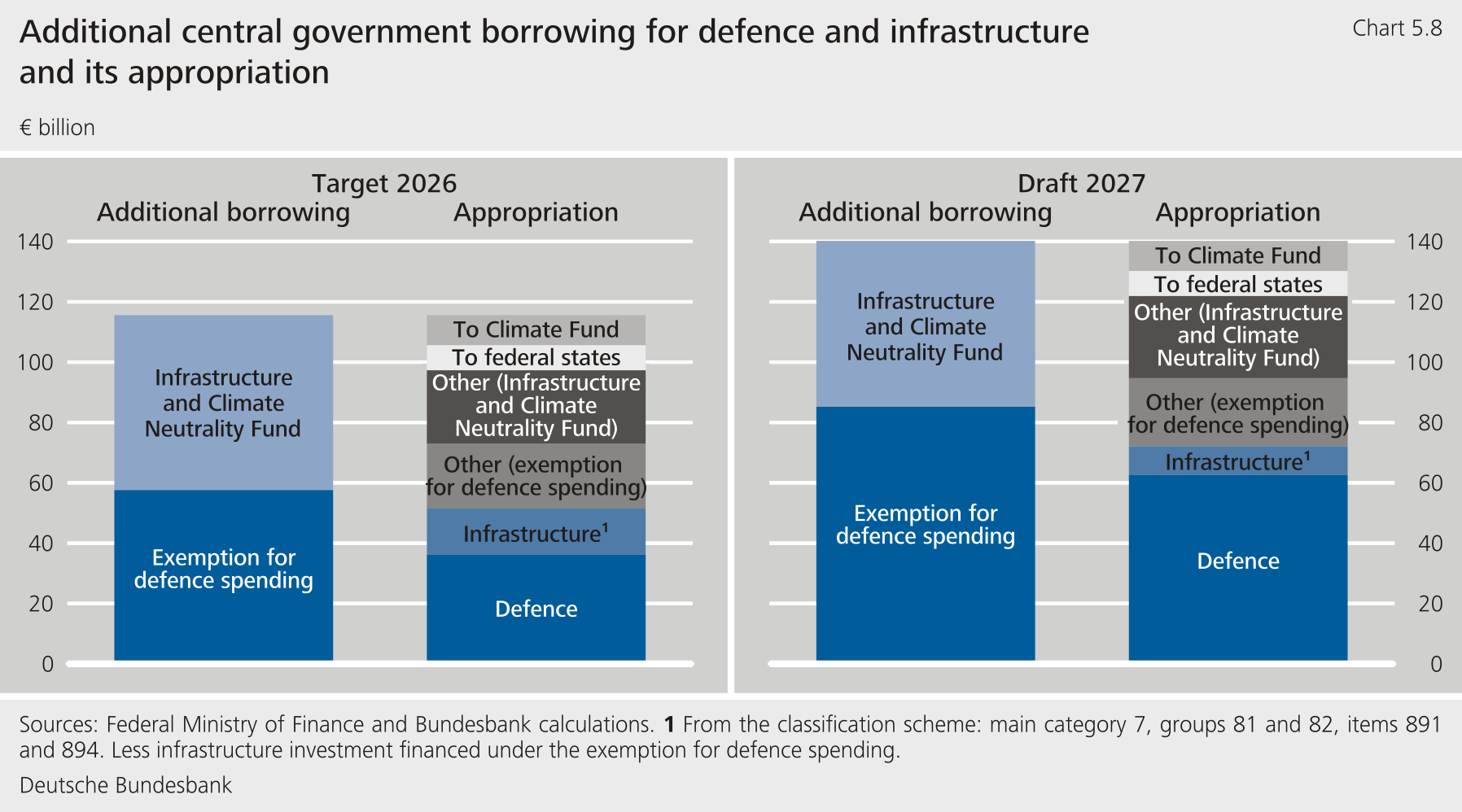
Borrowing facilitated by the scope afforded for defence and infrastructure will continue to exceed actual additional expenditure in these areas going forward. 23
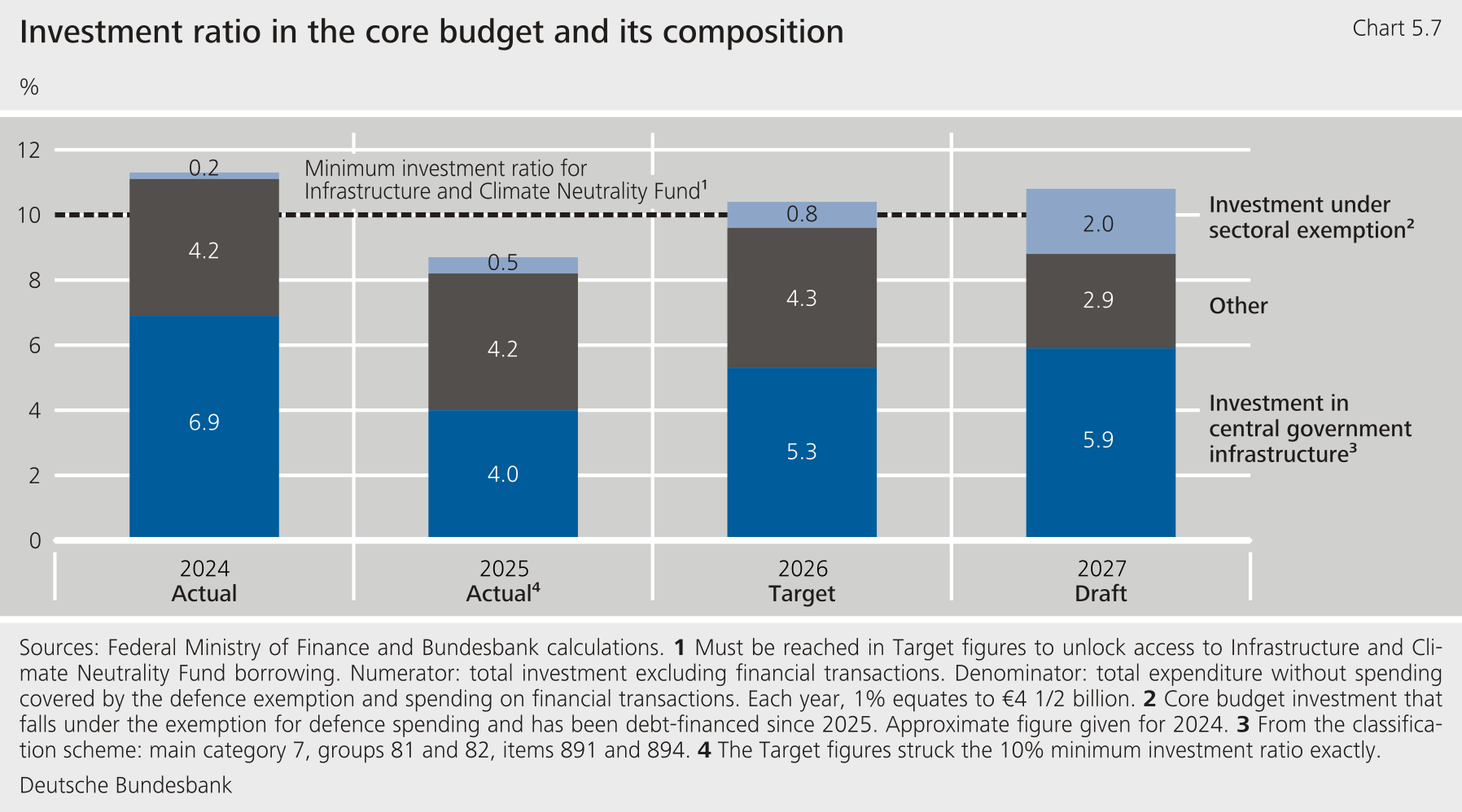
Infrastructure and Climate Neutrality Fund borrowing is specifically supposed to finance additional investment in infrastructure and climate neutrality. Central government’s infrastructure investment is set higher in the 2027 draft budget. However, at €17 billion, the increase compared with the actual figure for 2024 (item 28) is still far lower than the Infrastructure and Climate Neutrality Fund’s net borrowing for central government investment (€37 billion). At the same time, central government is also using borrowing under the exemption for defence spending to finance some investment in infrastructure (with €4 billion budgeted for this year and €9 billion in the draft budget for 2027 (item 33)). 24 The €17 billion in additional investment in central government infrastructure is therefore ultimately accompanied by additional borrowing of as much as €46 billion.
State and local governments are not required to use funds from the Infrastructure and Climate Neutrality Fund to actually finance additional investment. It is therefore likely that they will use the resources for other purposes to a large extent.
The Climate Fund receives €10 billion per year from the Infrastructure and Climate Neutrality Fund. As the current plans stand, it is not to be expected that Climate Fund investment will actually increase compared with the figure for 2024, at least not in 2027. 25
It is a similar picture where borrowing under the exemption for defence spending is concerned: the increase in defence-related expenditure compared with 2024 (item 24) falls considerably short of the levels of new borrowing.
The government is postponing repayments of emergency borrowing once again. This will expand budgetary scope by just over €9 billion per year from 2028 onwards. 26 Germany’s Basic Law (Grundgesetz) requires the government to adopt a repayment plan if it engages in emergency borrowing. The funds borrowed are to be repaid “within an appropriate period of time”. Repayment was originally scheduled to start in 2023. In view of the still fairly extensive burdens stemming from the pandemic, the Bundestag extended the repayment schedule. It based its approach on the repayment schedule for the Next Generation EU off-budget entity, which is, as before, set to start in 2028. The new plan now envisaged for central government’s emergency borrowing will not commence until 2033. The idea is for repayment to still be complete by around 2060. For this to happen, a higher amount would need to be paid off each year accordingly. 27
Central government is granting multi-year interest-free loans to the health and long-term care insurance schemes. These loans are recorded outside the scope of the debt brake. However, any structural financing gaps in the schemes ought, in general, to be closed by increasing contribution rates or making spending cuts. Structural reforms have been announced with a view to closing financing gaps in a sustainable manner. In addition, these insurance schemes need to generate structural surpluses for a time if they are to repay the loans from central government as planned. Central government is also granting sizeable loans to the Federal Employment Agency. It has not specified when it expects these to be repaid. Forgiving the Federal Employment Agency’s loans once again would place a corresponding strain on central government finances. 28
Central government is facing major fiscal policy challenges. The current plans contain large deficits and additional need for action. On top of this, the plans incorporate the additional configuration choices outlined above. Central government would be well advised to focus the expanded borrowing options for infrastructure and defence more tightly on actual additional expenditure in these areas. Against this backdrop, central government has no fiscal leeway to co-finance further tasks at other levels of government. Rather, there is extensive consolidation work to be done. In order to bring the high deficits down reliably, it is advisable to tighten the debt brake (see Chapter 1.3).
4 State government finances
Although the state government budget situation as a whole could deteriorate somewhat in 2026, it is likely to remain sound. 29 State governments closed 2025 with broadly balanced budgets in structural terms, notwithstanding a significant deficit in unadjusted terms. The structural balance and the unadjusted balance could both be somewhat less favourable this year. In particular, more federal states are planning to make use of the expanded structural scope for borrowing than last year. Tax revenue growth is weak, partly because a positive one-off effect in the case of inheritance tax no longer applies. On the expenditure side, many federal states are likely to significantly step up transfers to their local governments. However, if they use funds from the Infrastructure and Climate Neutrality Fund to do so, it will not place a strain on state government budgets. Part of the Infrastructure and Climate Neutrality Fund is earmarked for state government investment. State governments are likely to utilise those resources to relieve some of the pressure on their budgets: they do not have to prove any additional investment in order to draw on funds.
It would make sense to use the tailwinds provided by the Infrastructure and Climate Neutrality Fund to address infrastructural weak points. To this end, it is important to invest the funds in a targeted manner, channelling them into improving infrastructure. According to the data currently available for 2026, however, fixed asset formation by state government has remained subdued.
A number of important areas for reform call for action at the state government level, too. This includes state governments’ willingness to reform the health and long-term care insurance schemes and scaling back tax expenditures – both via the Bundesrat. The federal states bear much of the responsibility for ensuring efficient administration and cutting bureaucracy. One of the important inherent tasks of state governments is to make sure that local government finances are sound. State governments determine budgetary rules for local governments, supervise local government budgets and can even prescribe amendments to the budgets submitted. At the same time, state governments are required to ensure that their local governments have adequate financial resources at their disposal. Here, they can take a much more targeted approach than central government.
5 Social security funds
5.1 Federal Employment Agency
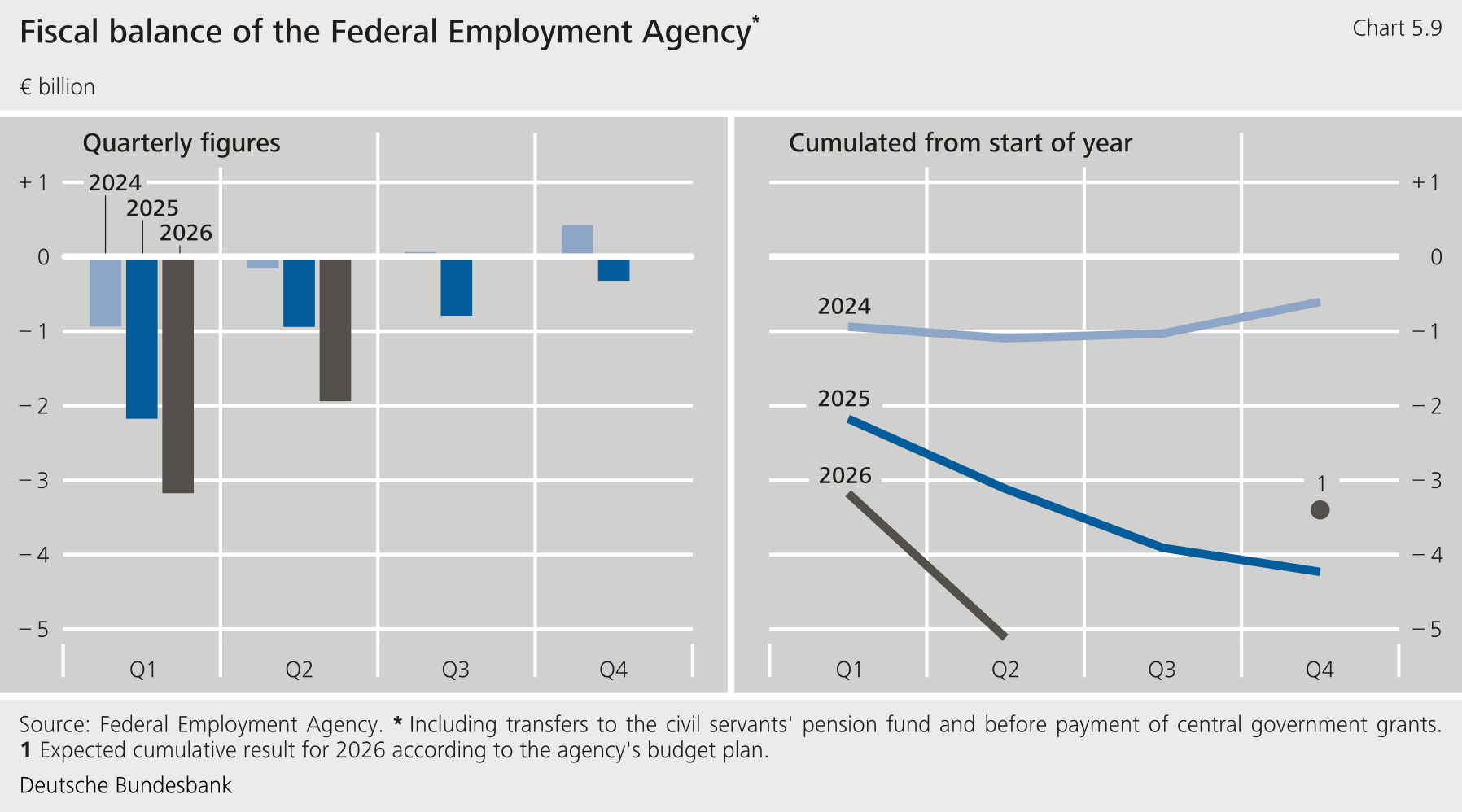
The ongoing economic slowdown will see the Federal Employment Agency’s deficit rise significantly this year. The Federal Employment Agency has already posted a deficit of €5 billion in the first half of the year (compared with €3 billion in the previous year). 30 Payments for unemployment benefits are a driving factor. As things currently stand, the deficit could reach around €7 billion for the year as a whole.
Central government is plugging the Federal Employment Agency’s financing gap with loans in order to stabilise the contribution rate. The Federal Employment Agency had used up all of its spare reserves over the course of 2025. Central government bridged the shortfall with a €1½ billion loan. This year, the Federal Employment Agency is likely to require a larger loan than central government was planning (€4 billion). By contrast, the €5 billion envisaged for next year in the central government’s draft budget could suffice. By granting these multi-year loans, central government is able to prevent the contribution rate to the unemployment insurance scheme from rising. However, the Federal Employment Agency then needs to repay the loans out of future surpluses. If the Federal Employment Agency’s deficit turns out to be partly structural in nature, 31 the Federal Employment Agency’s contribution rate would have to be raised.
5.2 Pension insurance scheme
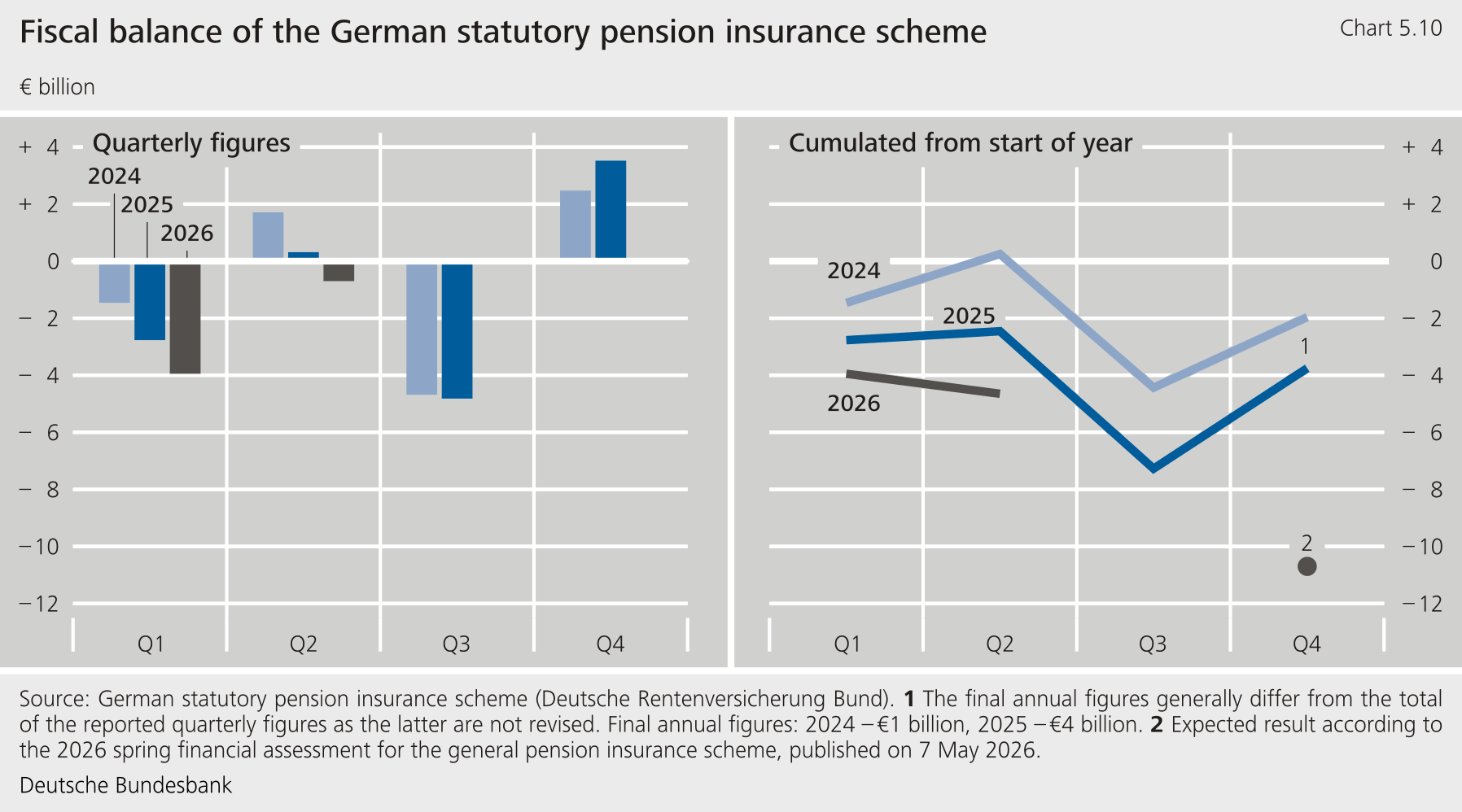
The financial situation of the statutory pension insurance scheme deteriorated significantly in 2026. The reserve is being eroded, but will subsequently provide a buffer once more. The statutory pension insurance scheme is expected to post a substantial deficit of around €11 billion in 2026 (compared with €4 billion in 2025).The first half of 2026 already saw a deficit of €4½ billion (compared with €2½ billion in 2025). The shortfall is likely to increase significantly again in the second half of the year. Revenue will continue to grow markedly (+ 4 % so far), but expenditure will rise more strongly than before (+ 5 %): pensions were adjusted at just over 4 % in the middle of the year, following just over 3½ % in the previous year. The number of pensions will probably grow to a similarly marked extent as seen in the first half of the year (+ 0.6 %).
Financing pressures will continue to rise over the medium term. There will then be a jump in the contribution rate in 2028. The number of pensions is likely to rise somewhat faster in the coming years. In addition, central government is going to slash its grants to the pension insurance scheme by €1 billion next year – a step forming part of its package to close its budget gap. The sustainability reserve is thus likely to reach somewhere around its statutory minimum of 0.2 times the scheme’s monthly expenditure at the end of 2027. Under the status quo, the contribution rate will then have to increase sharply from 18.6 % to almost 20 % in 2028. This is because there are practically no more funds available from the reserve and expenditure will continue to grow more strongly than the contribution base, including central government grants that are linked to it (and linked to the contribution rate as well).
6 Pension reform
6.1 Convincing overall package presented
Demographic change is posing challenges to public finances and is weighing on prospects for growth. Due to rising life expectancy and the retirement of the baby boom generation, Germany’s statutory pension insurance scheme is coming under increasing pressure. At the same time, the smaller labour force is weakening potential growth and thus the economic base for social security contributions and taxes.
The Federal Government established a commission to reform the pension system. The Pension Commission’s aim was to develop proposals for a sustainable pension scheme, thereby limiting rises in the contribution rate and ensuring that central government finances do not become overburdened. Furthermore, such a reform could make an important contribution to strengthening the macroeconomic growth outlook. The Pension Commission presented its overall concept in June 2026. 32
The overall concept put forth by the Pension Commission represents a convincing response to the financial challenges posed by demographic ageing. The Bundesbank is in favour of implementing this concept. 33 The proposed measures would strengthen employment, particularly through extended periods of employment as a result of higher age limits. At the same time, they would dampen the financing pressure on the “pay-as-you-go” system utilised by the statutory pension insurance scheme. The reform has the potential to ease the burden on contributors and the federal budget over the long term, as the pension expenditure in the pay-as-you-go system would be lower. A mandatory funded component would supplement the unfunded pay-as-you-go pension. The aim is to raise the replacement rate of the overall pension consisting of unfunded and funded components above the current overall replacement rate under the statutory pension insurance scheme in future. Through a funded pension component, the statutory pension insurance scheme would be able to take advantage of potential returns on the capital markets. In this context, the Federal Government would guarantee the current minimum replacement rate of 48 % if this is not achieved by the combination of unfunded pay-as-you-go and funded pension components. Large parts of the population would thus participate in the capital market. This would both broaden and deepen the capital market.
To ensure that the reform package has the best possible impact, legislators should implement it as swiftly as possible. It is therefore welcome that the Federal Government is aiming to pass legislation by the end of the year. In order to mitigate the demographic burdens on public finances and the labour market, it is important to swiftly implement the changes to the age limits, in particular – not least given the large age cohorts that are close to retirement. The impact of the reform will also depend on how legislators implement its recommendations in concrete terms. Alongside the transitional periods, numerous other aspects are relevant here. 34 In this context, it is advisable that legislators be especially mindful of the aims mentioned above.
6.2 Selected aspects of the reform package
The following remarks provide assessments of selected aspects of the comprehensive reform proposals – including with regard to the statement submitted to the Pension Commission by the Bundesbank.
6.2.1 Adjust age limits swiftly
The Pension Commission proposes linking age limits to life expectancy as well as abolishing early reduction-free retirement. This is welcome. This is because the changes are likely to result in longer periods of employment. Taken in isolation, this would strengthen the potential labour force and dampen the financial pressure on both the statutory pension insurance scheme and the federal budget. Accordingly, both the pension contribution rate and the central government funds granted to the statutory pension insurance scheme would be significantly lower over the long term than they would be if the age limits were left unchanged. Furthermore, the Pension Commission also recommends measures to mitigate social hardship caused by the increased age limits, in particular.
With regard to the standard retirement age, the Pension Commission specifically recommends that it should be linked to future developments in life expectancy after 2031. Based on current legislation, the standard retirement age will rise to 67 years by 2031 for those born from 1964 onwards. No further increase is currently planned. If the standard retirement age remains unchanged, the ratio of years of employment to years of retirement will steadily decrease as life expectancy rises. The Pension Commission therefore proposes that further rises in life expectancy should be translated into additional years of employment and additional years of retirement at a ratio of two to one. This would largely stabilise the ratio.
The Pension Commission recommends that the minimum retirement age for long-term insured persons under the statutory pension insurance scheme should be raised in a timely manner and, after 2031, in the same way as the standard retirement age. This is the minimum age from which long-term insured persons can draw an early old-age pension (with reductions).At present, early retirement is possible after at least 35 years of insurance under the statutory pension insurance scheme and from a minimum age of 63 years. The proposal envisages that the minimum age will initially rise to 64 years as soon as possible. From 2032 onwards, it should rise in the same way as the standard retirement age, with the Pension Commission envisaging a gap of three years between the standard retirement age and the minimum retirement age for long-term insured persons. Given demographic change and the shortage of skilled workers, there is good reason to raise the limit quickly in this way so that there is a three-year gap between the statutory retirement age and the minimum age. For those born in 1965, the minimum age would then be 64 years.
Early reduction-free pensions after 45 years of contributions should be abolished. The Pension Commission has not set out a recommended time frame for this proposal. However, in this case too, swift implementation seems appropriate. This is because this would also likely strengthen employment and ease the burden on pension finances – especially when combined with the aforementioned change to the minimum retirement age for long-term insured persons. 35 Reduction-free pensions particularly benefit highly qualified skilled workers and men. 36 Given equal overall contributions and calculated over the entire entitlement period, those who benefit from reduction-free pensions receive higher pensions on average than other insured persons. This weakens the equivalence principle of the statutory pension insurance scheme, according to which the same contributions should result in the same pension entitlements. Abolishing early reduction-free pensions would thus ease the burden on contributors, other pensioners, and the Federal Government (as the contribution rate for the pay-as-you-go system would, taken by itself, be lower).
6.2.2 Regularly review reductions and supplements
The Pension Commission proposes that the reductions and supplements for early and deferred retirement should be reviewed at regular intervals and calculated in accordance with actuarial principles.This is welcome. The Pension Commission wants to make early and deferred retirement as financially neutral as possible for insured persons. At present, however, it sees no urgent need to make any adjustments to the reductions or supplements.
It would make sense to agree upon a suitable, specific approach as part of the reform.The rates could subsequently be reviewed for the first time immediately afterwards. To this end, methods, assumptions and calculation methods for the rates would first need to be determined. Time frames for reviewing and adjusting the rates would then need to be set out.
In its final report, the Pension Commission makes reference to updated calculations from the Bundesbank. 37 Based on the underlying standard assumptions used, these result in somewhat higher standardised monthly reductions for early retirement. On this basis, they could thus rise from the current 0.3 percentage point per month to 0.4 percentage point per month. By contrast, the level of supplements for deferred retirement after reaching the statutory retirement age is largely appropriate. These results are based on the current legal situation and the perspective of insured persons. 38
6.2.3 Provide a transparent account of benefits that are not covered by contributions and fund them out of taxes
The Pension Commission recommends that benefits for which no contributions were paid should be categorised and quantified in a clear and comprehensible manner. Those benefits should then be financed out of central government funds. 39 There are good reasons for this approach. The rule would also apply to any new relevant benefits and to later expansions of benefits in this area. To this end, legislators would have to state which individual benefits they categorise as not being covered by contributions and then finance them out of central government funds. Under this approach, funding could be based more on objective criteria rather than on the prevailing fiscal situation, as appears to have been the case with the recent ad hoc decision to reduce central government funds in 2027. This approach would make it clear which benefits are financed out of taxes and where responsibility for financing them lies. It would furthermore make them a clear and verifiable item in the review and prioritisation of central government tasks and spending.
The volume of central government grants 40 to the statutory pension insurance scheme is currently higher than the statutory pension insurance benefits that are not covered by contributions, where the latter are defined narrowly, but lower if those benefits are defined broadly. 41 A pragmatic approach, like the one proposed by the Social Advisory Council, would be for legislators to first define a suitable and well-reasoned catalogue of benefits that are not covered by contributions. 42 They could also be assisted in this task by a commission as required. For catalogued benefits, central government would then allocate central government funds in the amount of the (estimated) expenditure on those benefits. Once the actual expenditure outturns become known, a final set of accounts could be drawn up to balance out any estimation inaccuracies. To avoid any abrupt changes when migrating to the new system, a transitional period could be arranged during which central government funds converge towards the new level.
6.2.4 Swedish-style funded pension model
The Pension Commission recommends supplementing the German statutory pension insurance scheme with a mandatory, individually managed funded pension scheme based on the Swedish model. That is a convincing proposal as well. Sweden has many years of experience in running a funded subsystem and has built on that track record to improve and refine it. This appears to be a good starting point. There would therefore need to be a good case for deviating from the Swedish blueprint.
Specifically, the Pension Commission is proposing an additional capital contribution to the statutory pension insurance scheme. That additional contribution would be used to build up the funded pension component. The contribution rate to this component would rise in four increments of ½ percentage point to 2 %, ideally between 2028 and 2031. It would enable insured persons to accumulate their own stock of retirement assets during the contribution period. As of the normal retirement age, those assets would then be converted into a life-long funded pension. Based on a 2 % contribution rate, the annual volume of savings would probably come to just under 0.7 % of GDP (2026: €30 billion). 43 The volume of financial assets built up over the long term out of the capital contributions and the funded pensions crucially depends on how the investments perform. Volumes of between 25 % and 60 % of GDP would be the outcome over the long run, given return-growth differentials of between 0 % and 4 %.
To establish a funded pension scheme of this kind, a number of design-related decisions need to be made. If the Swedish template is followed, that would mean, inter alia, that:
Money allocated to the scheme would be invested in a broadly diversified manner, with the bulk being allocated to a global, returns-oriented portfolio. Other policy objectives would be subordinated to that principle. Investment decisions would generally be made by a politically independent unit that communicates those decisions transparently.
During the build-up phase, insured persons could choose from a number of portfolio profiles. In Sweden, the default option is a state-run, high-equity investment fund. Insured persons who do not make an individual choice are opted into this default option. They can also opt out of the state-run default investment fund and invest instead in private certified products that have to meet specified minimum standards. This is important to safeguard competition among providers and give insured persons a range of funds to choose from.
During the pension payout period, insured persons in the state-run model in Sweden can choose between a portfolio option and an insurance-based option. Both contain lifetime annuities without any other option for the funds to be disbursed or inherited by a survivor. 44 The insurance-based option is heavily invested in fixed income government bonds. It provides a guaranteed nominal minimum annuity that is calculated very prudently, plus a possible (variable) share in profits. The portfolio option, meanwhile, is geared more towards generating returns and does not offer a guaranteed minimum annuity. For this reason, the pensions this option generates are likely to fluctuate more strongly. In other words, this option offers the potential for higher annuities, but is at the same time more risky. In Sweden, insured persons who do not make any active decision are opted into the portfolio option.
Longevity risk is generally balanced across the cohort of persons subject to mandatory insurance (across state and private insurers). The insurance-based and portfolio options are, however, segregated in terms of risk.
In Sweden, funded pensions are adjusted annually during the payout phase to account in particular for the performance of individual capital stocks. Annuities are calculated such that they generally remain static in real terms until the end of the insured person’s life. Hence, they are not based on income trends, which tend to rise in real terms over time. Assuming the payout volume (present value) remains unchanged throughout the retirement phase, a real static annuity will be higher than an income-oriented annuity at the start of retirement and lower at the end. Longevity risk is thus hedged to a lesser extent. Assuming a positive correlation between incomes and life expectancy, the Swedish model therefore provides less of a hedge for the longevity of generally high-earning insured persons.
For insured persons, the funded pension component provides a (mandatory) supplement to their pension provision – one that offers the prospect of relatively high returns combined with low management costs and a hedge against longevity risk. A returns-oriented investment in the capital market can be expected to generate relatively high income streams over the long run (given a higher level of risk). At the same time, the bulk design enables costs to be kept low – in Sweden, management costs are roughly 0.1 %. What is more, since participation is mandatory for all insured persons, the adverse selection problem inherent in voluntary private pension insurance policies does not arise upon retirement. Annuities turn out higher in mandatory insurance schemes because the cohort of insured persons is not expected to consist predominantly of persons with an above-average life expectancy.
Furthermore, the funded pension component can contribute to broader and deeper capital markets. The funded pension component generates a substantial volume of funds that are invested in global capital markets. That means it can promote liquidity, diversification and capital market-based financing. As with the Swedish blueprint, it would play a part in improving the capital market culture in Germany and, over time, help strengthen domestic capital markets.
The contribution to the funded pension component raises the overall contribution rate. In economic terms, this contribution differs significantly from a tax, however. 45 By contributing to this scheme, insured persons acquire claims depending on how much they contribute and the return in capital markets. Those contributions are thus more a kind of mandatory insurance scheme, albeit one where the investment options take the insured persons’ particular preferences into account, to a degree. Thus, contributions to a funded pension scheme have little in common with a tax. It seems plausible that contributions to the funded pension component will crowd out other forms of private old-age provision, at least partially. 46 Therefore, distortions to the labour supply and employment caused by contributions would probably be smaller than in the case of a tax or of contributions to the statutory health insurance scheme, which are mainly tax-like in nature. In addition, there would be a lower contribution rate to the pay-as-you-go system over time than absent the reform (see Section 6.3.2).
6.2.5 Coordinate the funded pension component with government-sponsored private pension schemes
The Pension Commission recommends interlinking the various funded pension components with government participation and developing them as a complete package. There are good reasons for that. Specifically, the Pension Commission recommends doing so for the funded component of the statutory pension insurance scheme, the public standard package of government-regulated and government-sponsored private pension products, and the early start pension. In this way, truly shared or similar solutions for account management, asset management, IT, and general administration would be able to reduce costs and take advantage of economies of scale. Investment principles, product standards and information could also be harmonised. This would avoid parallel structures, promote transparency, and potentially simplify investment decisions for those covered by the statutory pension insurance scheme or who make use of government-sponsored pension products.
In conjunction with the funded pension component, it seems advisable for legislators to look into whether the various government and government-sponsored modules are fit for purpose. Given that the funded component of the statutory pension insurance scheme would be quite broadly based, it seems worth questioning the broad and extensive government support provided in the other pillars. This is particularly true because public finances are under considerable consolidation pressure. With that in mind, thought could be given to gearing government sponsorship of private pension products in a more targeted manner towards lower-income households. In this context, it could be considered whether to only grant allowances for the government-sponsored instruments and no longer provide tax allowances.
6.2.6 Reform civil servants’ pensions with the same effect
The Pension Commission recommends that changes to the statutory pension insurance scheme be applied to civil servants with the same effect. This is generally logical, but should be aligned with the principle of alimentation (that is, the principle of appropriate support for civil servants). Expenditure on civil servant pensions is also rising significantly, and the consequences of rising life expectancy are becoming evident. It therefore makes sense to apply, for example, rising retirement ages and the recommendations on reductions and supplements to civil servants as well (see Sections 6.2.1 and 6.2.2). In particular, the changes in age limits would further reduce the demographic drag on the potential labour force. There is much to suggest that such adjustments should be implemented at the central, state, and local government levels at a similar time to the changes in the statutory pension insurance scheme. Other adjustments would need to be aligned with the principle of alimentation. This would concern, for instance, dampening the maximum replacement rate (based on past or future developments in the statutory pension insurance scheme).
The Pension Commission recommends that central, state, and local governments, when conferring civil servant status, should set aside sufficient provision for future pensions. This is welcome. On this basis, later pension expenditure would have to be sufficiently taken into account from the outset and the provision would have to be topped up in a rules-based manner. At present, conferring civil servant status may appear more advantageous in the short term because the pension burdens are not incurred until much later in the future. This biases personnel decisions at the expense of future budgets. Appropriately gauged provisions would mean that pension costs would already be transparent when deciding whether or not to confer civil servant status. This would also improve the basis for deciding whether an activity should be performed by civil servants or salaried staff.
6.3 How the reform would affect pension adjustment, statutory pension insurance scheme contribution rates, and the central government budget
The proposed reform contains a variety of components. The financial impact will depend on their specific design and implementation. In order to analyse how the contribution rate, replacement rate, and central government funds, as the core parameters, evolve over the longer term, assumptions must also be made regarding capital market yields and macroeconomic developments. In its final report, the Pension Commission mapped indicative pathways for these core parameters with, in some cases, fairly wide ranges. 47 The following sections do not contain Bundesbank calculations for individual scenarios, but instead discuss, in a predominantly qualitative manner, specific issues concerning the financial effects on pension expenditure, the contribution rate in the pay-as-you-go system, and the central government budget. Uncertainty is even higher here than for standardised projections, as many specifications and configurations are still to be determined.
In the statutory pension insurance scheme, the current minimum threshold of 48 % for the replacement rate will apply until 2031. The Pension Commission recommends that the pension adjustment formula be fully reinstated thereafter. This means that the full effect of both the sustainability factor and the pension-dampening effect of a rising contribution rate will once again play out. This means that if the ratio of contributors to pension recipients falls, or if the contribution rate rises, then pensions will also rise less sharply. Taken in isolation, this, in turn, would push down both the contribution rate and central government funds and thus spread the financial pressure on the pension insurance scheme more broadly across the core parameters.
The Pension Commission also proposes increasing the impact of the sustainability factor after 2031. That would additionally dampen pension expenditure and the replacement rate under the statutory pension insurance scheme. Specifically, the factor would be raised from its current value of 0.25 to 0.33.All else being equal, this would mean that the replacement rate in 2050 would be roughly 0.4 percentage point lower (in 2050, pensions would thus be around 1 % lower than they would have been without this increase in the sustainability factor). 48
The Pension Commission recommends a new mandatory additional funded pension component. Central government funds would safeguard an overall replacement rate of 48 % upon retirement with funded and pay-as-you-go pension components (transitional factor). According to the Pension Commission, the new funded pension component is intended, over the long run, to increase the overall replacement rate upon retirement (see Section 6.2.4). As long as the funded component is insufficient to raise the overall replacement rate of the standard pension to at least 48 % upon retirement, central government would top it up to 48 %. In this respect, the pension-reducing impact of the sustainability factor would be partially offset from 2032 onwards. The pension adjustment formula would then apply to insured persons as they continue to draw their pensions. Central government would continue to provide a top-up for these pensions upon entry into retirement owing to the base effect. The extent to which top-ups would even be necessary depends, in particular, on the return on the funded pension component. Based on the Pension Commission’s simulations, the mandatory funded pension component would probably even fully offset the decline in the replacement rate under the statutory pension insurance scheme from 2032 onwards. In the simulation, the overall replacement rate upon retirement does not fall below 48 % 49 even without central government topping up the replacement rate. By 2050, it rises to more than 50 %. 50
According to the pension adjustment formula, a higher contribution rate would dampen the pension adjustment. The Pension Commission also recommends that the new contributions to the funded pension component be taken into account in the pension adjustment formula. It is logical that these should also be factored into the calculation of the replacement rate under the statutory pension insurance scheme. All else being equal, this would reduce pension expenditure and thus also the contribution rate in the pay-as-you-go system from 2028 onwards (see the supplementary information entitled “The complex interplay between the new contribution to the funded system and the minimum threshold”). The Pension Commission recommends that the contribution rate to the funded pension component rise to 2 % by 2031. Taken in isolation, this would likely reduce the contribution rate in the pay-as-you-go system by around ½ percentage point.
The pension adjustment would be higher because numerous other proposals from the Pension Commission would markedly dampen the contribution rate (see Section 6.3.2).
Supplementary information
The complex interplay between the new contribution to the funded system and the minimum threshold
The new capital contribution in combination with the minimum threshold applicable up until 2031 results in complex adjustment responses and interactions. Taken in isolation, this means that central government funds are higher, and pension expenditure and the contribution rate to the pay-as-you-go system are lower.
Central government: Central government is currently obliged to refund the statutory pension insurance scheme for the difference between the usual pension adjustment and the additional expenditure resulting from the minimum threshold of 48 %. 1 The (usual) pension adjustment formula contains a contribution rate factor: higher contributions (by employers and employees taken together) dampen the pension adjustment. If the new contribution to the funded pension component is taken into consideration in this contribution rate factor (as recommended by the Pension Commission), this dampens the usual pension adjustment by the full amount of the increase in the contribution rate. 2 Central government therefore refunds the pension insurance scheme for the full contribution rate effect.
Pension expenditure: However, the contribution to the funded pension component also dampens the actual pension adjustment in conjunction with the minimum threshold: a higher contribution rate to the statutory pension scheme reduces the disposable income of the insured persons (in the denominator of the replacement rate, but there only in the amount of the employee contribution). In order to keep the statutory pension insurance scheme replacement rate at 48 %, the actual pension adjustment is thus correspondingly lower. However, taken in isolation, it is lower by only around half of the total increase in the contribution rate and thus less than under the usual pension adjustment formula.
Contribution payers: These receive considerable relief thanks to the mechanisms of pension adjustment and central government refunds. Ultimately, this could amount to around ½ percentage point of the contribution rate. Central government, in turn, also benefits from this, as its funds are largely linked to the pay-as-you-go contribution rate. De facto this means that contribution payers will pay an additional contribution of 2 % of income subject to compulsory insurance into the funded pension component going forward. All other things being equal, however, the contribution rate to the pay-as-you-go scheme is around ½ percentage point lower.
6.3.2 Contribution rate in the pay-as-you-go system: numerous reform elements have a dampening effect
According to the Pension Commission, the contribution rate could, by 2050, be around 1½ percentage points lower than without reform. Under current legislation, the contribution rate could therefore rise to almost 21½ % in 2050. If the full package is implemented, the contribution rate would be significantly lower in 2050, at just over 20 %. This eases the burden on both contribution payers and the central government budget.
The reform affects the contribution rate in the pay-as-you-go system via various channels. First off, all measures that reduce spending are relevant. 51 These include, in particular, an increase in the age limits, the abolition of reduction-free early retirement and – as described above – lower pension increases. This dampens pressure on the contribution rate under the pay-as-you-go system and the central government funds linked to it. In addition, revenue-related measures create relief: the self-employed are included (those previously already self-employed will have an opt-out option), and contributions for persons in marginal employment rise to the normal level. In addition, central government refunds are higher as a result of the minimum threshold of 48 % applicable up until 2031. The positive effects on the labour market of the measures relating to when and on which terms people can retire also strengthen the statutory pension scheme’s revenue base. Additional expenditure will be incurred going forward as longer contribution periods or first-time contributions (self-employed persons) result in higher pension entitlements and those in marginal employment will, in future, receive benefits in return for their statutory contribution payments.
6.3.3 Central government budget: initially likely to be burdened, but relief further down the line
Looking ahead, lower central government funds are likely to ease the burden on the central government budget. Over many years, however, significant additional expenses could arise from temporarily higher payments to the pension insurance scheme and tax shortfalls.
Central government funds: According to the Pension Commission’s simulations, the reform means that central government funds will be increasingly lower. This is mainly because the reform lowers the pay-as-you-go contribution rate. To date, the regular central government funds have been largely linked to this rate. 52 The share of central government funds in GDP is thus around 0.2 percentage point lower in 2050 (corresponding to around €10 billion in 2026). The minimum threshold that will apply up until 2031 means that the refunds will result in additional burdens on central government (see the supplementary information entitled “The complex interplay between the new contribution to the funded system and the minimum threshold”). From 2032 onwards, the transitional factor to safeguard the overall replacement rate potentially creates an additional burden.
Taxes: Employees can deduct the contribution under the pay-as-you-go system and probably the new contribution to the funded pension component from taxable income. Employers can deduct their contributions from their profit tax base as operational expenditure. Through this channel, the contribution under the pay-as-you-go system, which is lower all else being equal, raises tax revenue. However, the new capital contribution reduces tax revenue. Assuming a contribution rate of 2 % to the funded pension in 2031, tax shortfalls in the order of just under 0.2 % of GDP could result across all government levels (2026: just over €8 billion) (see the supplementary information entitled “The complex interplay between the new contribution to the funded system and the minimum threshold” for details on the repercussions of the higher capital contribution on the contribution to the pay-as-you-go system). Without further adjustments, around half of this would hit the central government budget.
Basic allowance for the elderly: Further expenses may arise from the recommendations on the basic allowance for the elderly. These could amount to around €½ billion to €1 billion.
Other parts of the reform package have a positive impact on central government finances: if those subject to the statutory pension insurance scheme work longer as a result of higher age limits, their taxable income will tend to increase and, with it, tax revenue. If retirement income from the funded pension component rises, taxable income will likewise grow (provided the funded pension component is treated the same, for tax purposes, as the current statutory pension). The recommended application of the changes to civil servants’ pensions would also ease the burden – albeit less so for central government than for state governments.
This article is based on data available up to 18 August 2026, 11:00.
Chetty, R., J. N. Friedman, S. Leth-Petersen, T. H. Nielsen and T. Olsen (2014): Active vs. Passive Decisions and Crowd-Out in Retirement Savings Accounts: Evidence from Denmark, The Quarterly Journal of Economics, Vol. 129(3), pp. 1141‑1219.
Stability Council (2026), Beschluss des Stabilitätsrates zur Einhaltung des Nettoausgabenpfades gemäß § 2 Abs. 1 Nr. 4 Stabilitätsratsgesetz, 11 May 2026.