Public finances Monthly Report – May 2026

Monthly Report

Non-final working translation 

1 General government budget 1

1.1 Current situation and outlook

Underlying trends

Government finances are currently characterised by expansionary fiscal policy. The deficit and debt will rise considerably owing to sharp expenditure growth. The deficit ratio will expand to around 4 % this year (2025: 2.7 %). Without further intervention, it will keep rising in 2027 and converge very closely on the 5 % mark. The expansionary stance is based on a high structural expenditure ratio, which stood at almost 50 % last year. 2 Pressure on government finances is also reflected in the contribution rates of the social security funds, which surged to a total of 42½ % in 2025. The pension insurance scheme is expected to see a jump in contribution rates in 2028. In the case of the health and long-term care insurance schemes, reform efforts are aimed at preventing further increases in contribution rates.

2026 as a whole

The deficit ratio is expected to rise to around 4 % this year. The unfavourable economic situation is putting pressure on the ratio. In structural terms, the ratio is set to be around 3½ %. The economic cycle is most notably reflected in spending by the Federal Employment Agency and in tax revenue (affected by weak economic profits). The impact of temporary effects is negligible. Notably, the lower energy tax on petrol and diesel in May and June will result in only modest tax revenue losses.

Expenditure will rise sharply this year. Additional spending on defence as well as on pensions, healthcare and long-term care is particularly sizeable. In addition, central, state and local governments are likely to invest more in infrastructure. Central government is also providing new subsidies to reduce electricity grid fees. Furthermore, higher average interest rates and debt are driving interest expenditure up sharply.

Turning to revenue, shortfalls due to changes in tax legislation are dampening growth somewhat. The most significant factors here are the expanded depreciation options affecting business taxes and the lower VAT rate for meals in restaurants. Contribution rates to the social security funds rose only slightly at the start of the year, and only for the health insurance institutions. Central government is bridging funding gaps in the health and long-term care insurance schemes as well as in the Federal Employment Agency with larger loans. The pension insurance scheme is financing its deficit from its reserves. 

Further outlook

The deficit ratio looks set to move closer towards the 5 % mark next year. Central government’s deficit looks set to grow further, mainly because debt-financed defence expenditure is rising. In addition, the pension insurance scheme’s deficit is likely to rise sharply again.

Looking further ahead, central government’s plans up to 2030 are in line with a general government deficit ratio of just over 4 %. The cyclical burden currently reflected in the figures will only temporarily increase the deficit. Central government has structural scope for borrowing of 0.35 % of GDP, supplemented by its debt brake exemption for defence spending and the Infrastructure and Climate Neutrality Fund. For 2028 to 2030, it is anticipating structural net borrowing of between 3.7 % and 3.9 % of GDP (see “Central government finances”, Table 5.3, item 1.d-n). On top of this, state governments have structural scope for borrowing of 0.35 % of GDP. As a general rule, local governments are required to strictly limit their deficits. The social security funds generally have to balance their budgets without borrowing. The pension insurance scheme will therefore, starting in 2028, bring down its deficit by means of higher contribution rates as it will have exhausted its flexible reserves by then. Looking ahead, the other pillars of the social security funds will have to manage again without central government loans.

With a deficit ratio of around 4 %, the debt ratio is increasingly moving away from the 60 % reference value (2025: 63.5 %). Higher debt is also accruing at the EU level. The portion of the debt for which Germany is accountable is expected to grow to 3½ % this year.

1.2 Fiscal rules require adaptation measures

National requirements not easily met

Central government will have to adopt major adaptation measures in the future in order to comply with debt brake requirements. Specifically, although additional defence spending can be financed through unlimited borrowing. Apart from this, however, the 0.35 % threshold applies to structural net borrowing. Central government planning clearly shows that central government will not comply with the 0.35 % limit without corrective measures (see “Central government finances”, Table 5.3, item 2.a6): in other words, funding gaps identified in the benchmark figures need to be closed by means of concrete measures and any new burdens placed on the budget financed without additional net borrowing. Moreover, to truly improve defence capabilities and infrastructure, it is advisable to utilise the available borrowing capacity more extensively to increase spending in these areas. As things currently stand, it appears that central government will use a large portion of this scope to close budget gaps and finance other policy objectives. The same seems to be the case for state and local governments with respect to the share of the Infrastructure and Climate Neutrality Fund that is available to them. 

State government finances are in relatively good shape overall. By contrast, the large deficits and rising cash advances of local governments indicate a need for consolidation. State government budgets recorded a structural surplus overall in 2025. They have a combined net borrowing allowance of 0.35 % of GDP and can access a total of €100 billion from the Infrastructure and Climate Neutrality Fund. State governments are also tasked with ensuring that their local governments’ finances are sustainable. There is clearly much that needs to be done here. If other means to consolidate local government budgets have been exhausted, state governments have to resolve this issue using their own resources (see “State government finances”). 

Measures to compensate for higher energy prices ideally preserve energy-saving incentives and are designed to be temporary and targeted. Additional measures do not appear urgent at present. Should an escalation in developments result in measures being considered, it would be advisable to base them on the criteria outlined at the start. One major argument against broad and extensive support measures is that they would further strain government finances, which are already in need of consolidation. In addition, such measures can increase upward pressure on consumer prices over the medium term. This would make it more difficult for monetary policy to bring inflation back down to 2 % over the medium term. 

EU requirements must also be observed

EU rules limit net general government spending growth. There is unlikely to be a clash with the EU rules in the period up to and including 2029 if central government closes gaps in the budget as announced. According to the Federal Government’s plans and projections, Germany will exceed the maximum growth rate for net expenditure in 2026. And this remains the case even after factoring in the EU national escape clause for defence expenditure. 3 However, Germany stayed below the limit in 2025, with room to spare. This left a “balance” on the relevant control account; the amount by which the limit will be exceeded can be offset against this. There is also considerable leeway for spending in the remainder of the period to and including 2029. 4 Germany is likely to comply with EU rules if central government closes budget gaps in line with the benchmark figures.

However, Germany is planning to exceed the EU reference value for the deficit ratio, and in 2026 and 2027 this is even after deducting the exempted defence expenditure. Based on its plans and projections, the Federal Government expects to exceed the 3 % limit for several years. In 2026 and 2027, the ratio will exceed the limit even after deducting the defence expenditure that is exempted under the EU national escape clause. Germany will comply with the defence-adjusted limit again in 2028, provided central government closes the gaps in the central government budget. The Stability Council warned in May that there is a risk of an excessive deficit in 2026. The logical step would therefore be for central government and state governments to take measures to avert this. This is also recommended by the Independent Advisory Board to the Stability Council. 5  

1.3 Major reforms planned

Reform the debt brake

In the longer term, resilient government finances require significantly lower deficits than are permitted under the current national rules. A persistently high and rising debt ratio has a destabilising effect and undermines fiscal policy flexibility. To ensure, over time, that the debt ratio returns at an appropriate pace to the EU reference value of 60 %, Germany must bring its deficit ratio back down significantly in the period ahead. By contrast, the sectoral exemption for defence spending under the debt brake allows for unlimited deficits indefinitely.

To reliably safeguard sound government finances and comply with EU rules, central government legislators ought to adjust the debt brake. The Federal Government is planning a reform of the German debt brake and is consulting an expert commission. Last autumn, the Bundesbank presented a reform proposal aimed at firmly anchoring a framework for sound government finances whilst also protecting government investment. 6 Ultimately, it is up to legislators to agree on suitable requirements and to enshrine them in the Basic Law. Regardless of the specific design, it is essential to gradually phase out the sectoral exemption for defence spending and to once again set a sufficiently ambitious ceiling for borrowing.

Reduce intense financial pressure on health, long-term care and pension insurance schemes

Fundamental reforms are on the agenda for healthcare, long-term care and pensions. Minor adjustments are unlikely to be enough to rein in the rapid growth in spending and the currently envisaged sharp rise in contribution rates. With regard to central government grants, it is important to keep in mind that central government finances are under immense strain. Any increase in central government grants only add to the strain and would need to be offset elsewhere.

A commission is currently drawing up proposals for reforms to the pension insurance scheme and funded pension provision. The Bundesbank submitted an expert opinion on the matter on request (see “Pension Commission to present reform proposals for longer-term developments”).

For the health insurance scheme, the Federal Government has presented draft legislation aimed at providing short-term financial relief. Many of the proposed measures appear reasonable. They largely focus on the expenditure side. A key element is a revenue-based expenditure cap. However, underlying cost pressure on service providers remains high. On the revenue side, there are plans to somewhat restrict non-contributory co-insurance. This could strengthen incentives to work. The preferential treatment of minor employment through lower contribution rates is set to be phased out. In addition, the package targets higher-income individuals: more people would be brought into the statutory health insurance scheme, and contributions for higher earners would rise. In addition, central government intends to raise its contributions for recipients of basic social security. However, the increase planned is only small and in increments up to 2031, which is not justified by the level of insurance benefits. At the same time, the general central government grant will decrease by almost 15 % as of 2027. The Federal Government justifies this by pointing to the need for consolidation in the central government budget. It is advisable for non-insurance-related benefits to be financed out of central government grants, as a general principle. It would then make sense to clearly define non-insurance-related benefits and then use tax resources to finance them in a rule-based manner. Regardless, further structural reforms are both necessary and required to curb cost dynamics and ensure the sustainability of the health insurance scheme.

2 Tax revenue

2.1 Low growth in the first quarter

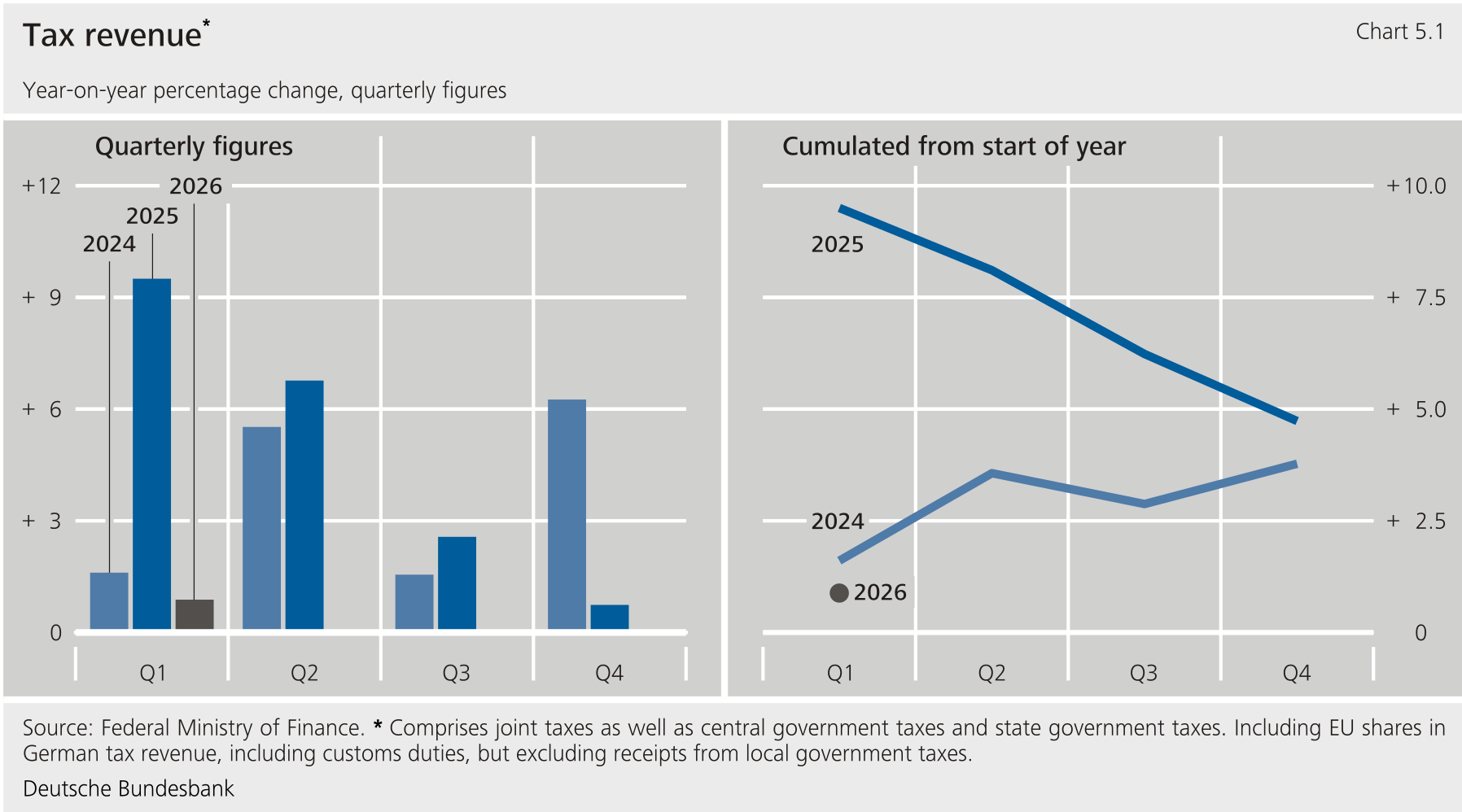
Tax revenue in the first quarter was only 1 % higher than in the first quarter of the previous year. It came under pressure from prior-year settlements for profit-related taxes and timing shifts in central government taxes.  

  • For assessed profit-related taxes, there were more tax refunds overall. In addition, total back-payments to the tax authorities were lower. The decline was particularly pronounced for corporation tax. Meanwhile, advance payments for the current year – a major revenue item – remained largely stable.
  • The strong rise in wage tax can be broadly explained by positive wage developments and an accelerating base effect: in the previous year’s quarter, a retroactive increase in the basic allowance led to lower revenue. By contrast, the adjustment of the tax scale to inflation at the start of the year had a dampening effect on revenue.
  • In the case of central government taxes on energy, tobacco and electricity, a one-off effect in the first quarter of 2025 distorted the figures: at that time, time shifts had boosted recorded revenue, which have now fallen sharply as a result.
Tax revenue
Tax revenue
Table 5.1: Tax revenue
Type of taxQ1Estimate for 20261
20252026
€ billion

Year-on-year change

%

Year-on-year change

%

Tax revenue
Total2

222.3

224.2

+⁠ 0.9

+⁠ 1.2

of which: 
Wage tax3

61.3

65.0

+⁠ 6.0

+⁠ 4.6

Profit-related taxes

45.3

43.2

– 4.6

– 3.1

of which:    
Assessed income tax4

20.1

19.0

– 5.4

– 1.7

Corporation tax5

10.6

8.7

– 17.8

– 7.3

Non-assessed taxes on earnings

5.4

6.6

+⁠ 22.0

+⁠ 2.5

Withholding tax on interest income and capital gains

9.2

8.9

– 3.2

– 8.1

VAT6

79.0

81.9

+⁠ 3.6

+⁠ 3.5

Other consumption-related taxes7

25.3

22.6

– 10.8

– 4.2

Sources: Federal Ministry of Finance, Working Party on Tax Revenue Estimates and Bundesbank calculations. 1 According to official tax estimate of May 2026. 2 Comprises joint taxes as well as central government taxes and state government taxes. Including EU shares in German tax revenue, including custom duties, but excluding receipts from local government taxes. 3 Child benefits and subsidies for supplementary private pension plans deducted from revenue. 4 Employee refunds and research grants deducted from revenue. 5 Research grants deducted from revenue. 6 VAT and import VAT. 7 Taxes on energy, tobacco, insurance, motor vehicles, electricity, alcohol, air traffic, coffee, sparkling wine, intermediate products, alcopops, betting and lotteries, beer and fire protection.

2.2 Tax estimate lowers expectations; more dynamic growth anticipated from 2027 onwards

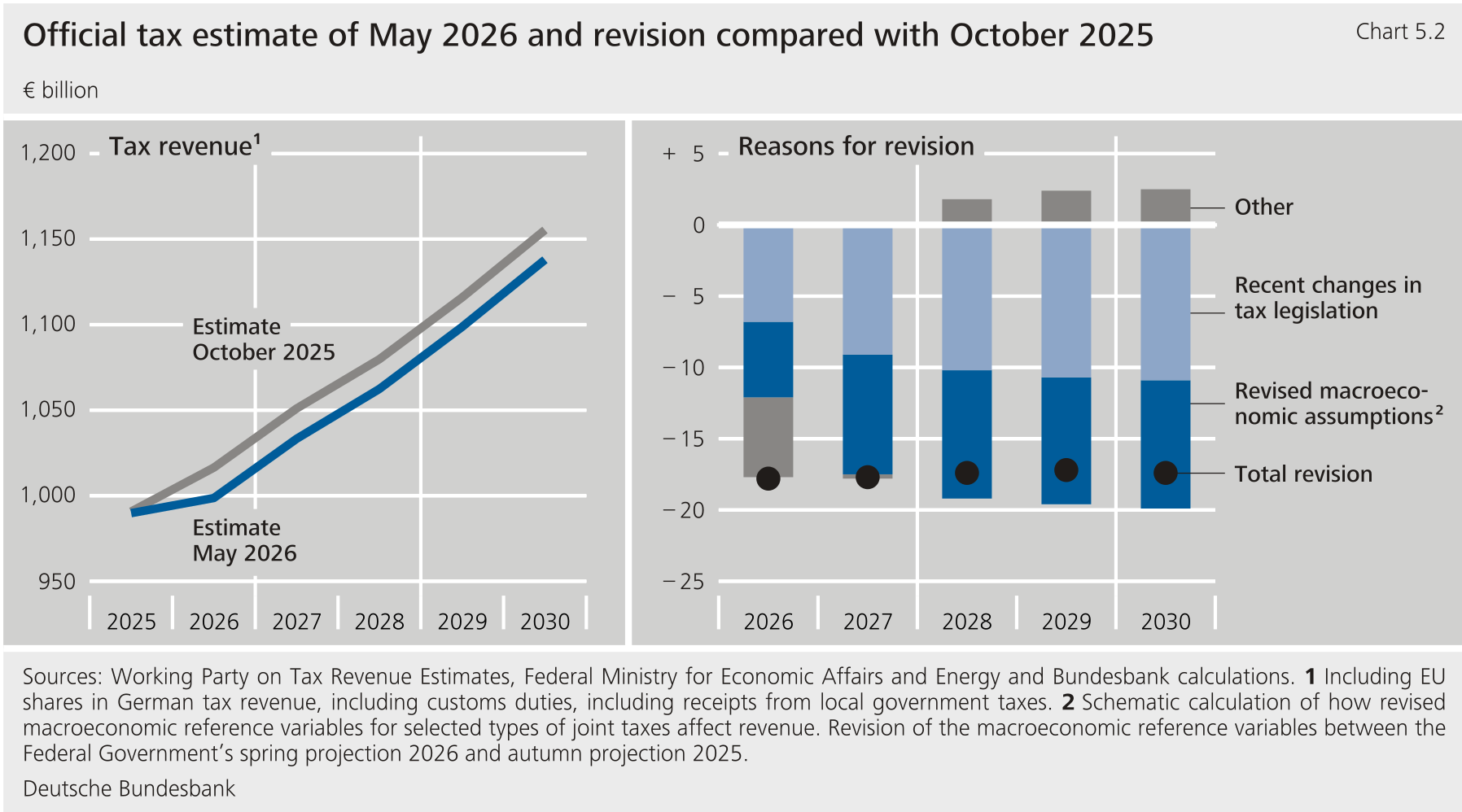
For 2026 as a whole, too, the new tax estimate projects a tax revenue increase of only 1 %. Tax cuts are having a significant impact. For example, bracket creep is compensated for in the income tax scale, higher depreciation rates apply to movable fixed assets and newly purchased electric vehicles, and the reduced VAT rate now applies permanently to meals in restaurants. In addition, profit-related taxes are developing weakly and, in some cases, declining significantly: although the drop in corporation tax seen in the first quarter is slowing, revenue has still been revised down by 7½ % for the year. Withholding tax is also falling for the first time after strong increases in recent years. In addition, one-off effects are having a dampening effect – for example, in the case of the aforementioned central government taxes (see above) and inheritance tax. 

According to the tax estimate, growth will accelerate to 3½ % next year. This is partly because nominal macroeconomic reference variables will once again grow at a moderately faster pace. Profit-related taxes will also return to a moderate growth trajectory. However, legislative changes will continue to markedly dampen growth – especially the option of accelerated depreciation. It is also assumed that contribution rates to the health and long-term care insurance schemes will rise. This will reduce taxable income. 

In the subsequent years from 2028 to 2030, revenue is projected to continue to rise by an average of 3½ %. The development is largely determined by macroeconomic assumptions and progressive taxation. Legislative changes will lead to shortfalls, especially in 2028 and particularly for business taxes. In 2028, the sharply rising contribution rate to the statutory pension insurance scheme will also have a negative impact on revenue.

Changes in tax legislation that have not yet been included but are already specifically planned would only slightly alter the overall picture. The tax estimate only takes account of enacted changes. The Federal Government’s plan to partially exempt overtime bonuses from income tax is therefore not included. Other measures, meanwhile, would lead to additional revenue: specifically, tobacco tax is set to be raised and excise duties levied on products with negative health effects (such as highly sugary drinks). Overall, these changes could result in slightly lower revenue this year, and slightly higher revenue from 2027 onwards. 

Further measures have been announced but not yet specified. They are likely to reduce tax revenue overall: the Federal Government has announced an income tax reform for 2027, but no formal agreements have been reached so far. It is also unclear whether bracket creep will continue to be offset. At the very least, income tax allowances would probably still need to be adjusted annually from 2027 onwards. And the reform of the statutory health insurance scheme is also likely to have an impact on tax revenue. To the extent that the reform curbs growth in contributions, this could result in some additional tax revenue.

Compared with the tax estimate from October 2025, there are marked revenue shortfalls. Around half of this is due to new tax cuts. For 2026 to 2028, the revenue shortfalls amount to 0.4 % of GDP each year, and for 2029 and 2030, they amount to 0.3 % of GDP each year. Profit-related taxes, in particular, have been reduced significantly. This is largely due to downward revisions of the projected figures for entrepreneurial and property income. Furthermore, the estimate assumes based on the results from the first quarter that, this year, there will be a temporary downward decoupling of profit-related taxes from this reference variable. Last but not least, the downward revision also reflects the impact of new tax cuts. These include, in particular, the permanent VAT rate cut on meals in restaurants, the electricity tax cut for energy-intensive industry and agriculture, the increase in the commuter travel allowance in income tax returns, the new additional income tax allowance for pensioners and the temporary reduction of energy tax on petrol and diesel.

Official tax estimate of May 2026 and revision compared with October 2025

Table 5.2: Official tax estimate figures and the Federal Government's macroeconomic projections 
Item202520262027202820292030
Tax revenue1  
€ billion 

989.8

998.7

1033.3

1062.4

1098.7

1138.0

% of GDP

22.1

21.7

21.7

21.6

21.7

21.9

Year-on-year change (%)

4.4

0.9

3.5

2.8

3.4

3.6

Revision compared with previous tax estimate (€ billion)

– 0.9

– 17.8

– 17.7

– 17.4

– 17.2

– 17.4

Memo item: Revenue shortfalls due to envisaged tax relief (€ billion)


Changes in tax legislation adopted after finalisation of the tax estimate and other specifically planned changes2

.

– 0.7

0.0

1.0

1.4

1.2

Revenue shortfalls if bracket creep is compensated for in same manner as previously from 20273

.

.

– 8.2

– 16.7

– 23.1

– 29.7

Real GDP growth (%) 


Spring projection (April 2026)

0.2

0.5

0.9

0.9

0.9

0.9

Autumn projection (October 2025)

0.2

1.3

1.4

0.9

0.9

0.9

Nominal GDP growth (%) 


Spring projection (April 2026)

3.3

2.8

3.8

3.0

3.0

3.0

Autumn projection (October 2025)

3.0

3.9

3.7

2.9

2.9

2.9

Sources: Working Party on Tax Revenue Estimates, Federal Ministry for Economic Affairs and Energy and Bundesbank calculations. 1 Including EU shares in German tax revenue, including customs duties, including receipts from local government taxes.  2 Bundesbank estimates in part: Pension Reform Act (Altersvorsorgereformgesetz; recently enacted), Ninth Act amending the Tax Consultancy Act (Neuntes Gesetz zur Änderung des Steuerberatungsgesetzes) and other tax regulations (excluding tax-free and social contribution-exempt “relief bonus”), tax exemption for overtime bonuses, gradual tobacco tax hikes from 2026 onwards, levy on sugary drinks.  3 Since 2014, the income tax scale has been shifted year after year, usually in line with the estimated inflation of the previous year. The figures shown here are the revenue shortfalls that will result if this practice is continued and the basic income tax allowance also shifts in line with the inflation rate of the previous year in each case. The effects are roughly estimated and are based on the Federal Government's current spring projection and wage tax receipts based on the current tax estimate. They are stated as defined in the national accounts. 

3 Central government finances

3.1 First quarter of 2026

The central government deficit including off-budget entities 7 in the first quarter of 2026 was far larger on the year. It increased by almost €30 billion to €41 billion. Both the core budget and the off-budget entities were affected. 

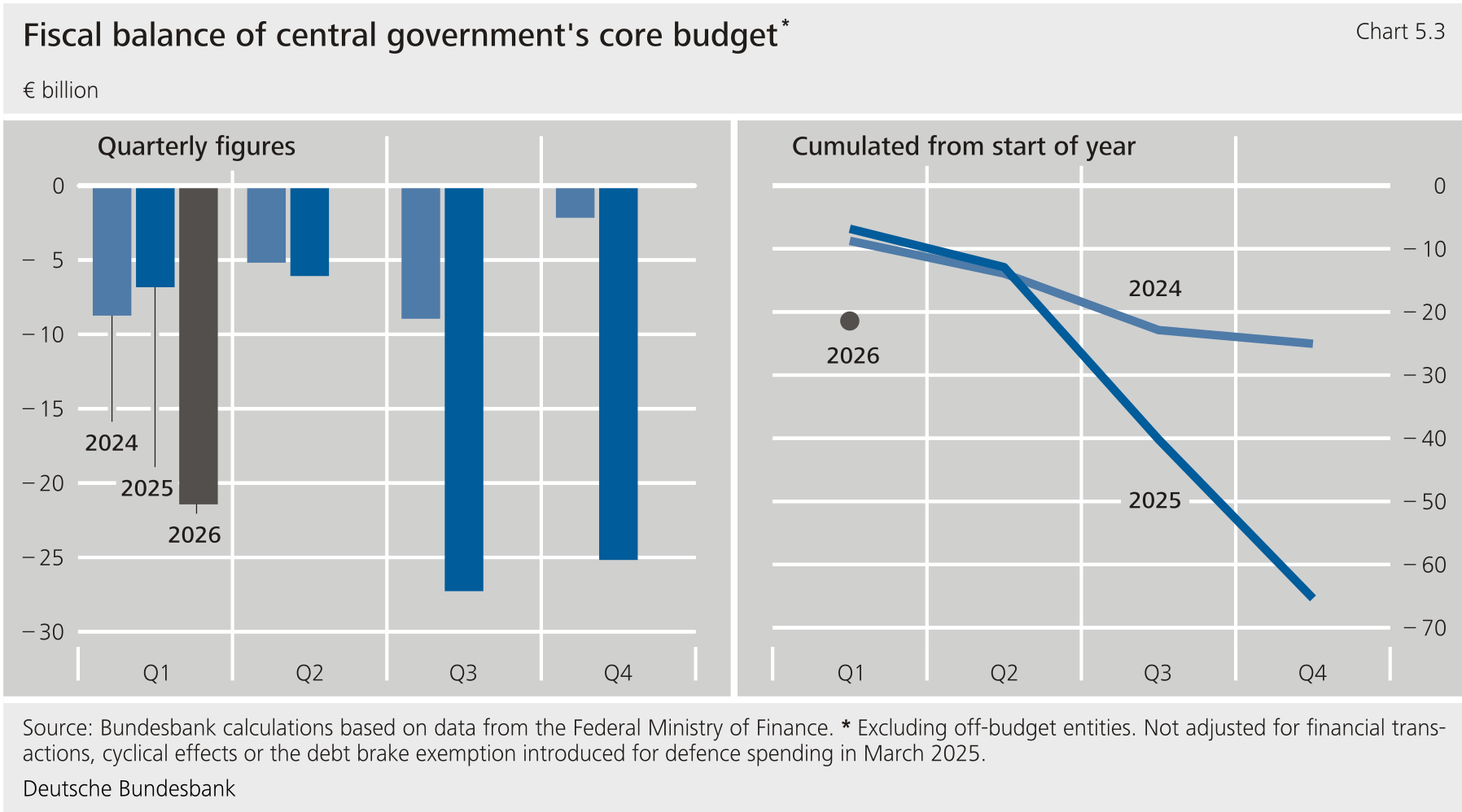
In the core budget, the deficit increased by €15 billion to €21 billion (see Chart 5.3 below). Revenue fell sharply, by €8 billion. Tax revenue declined by €5½ billion. This was due to higher (tax-reducing) transfers to the EU budget. In addition, favourable one-off effects on central government taxes from the previous year did not recur, and profit-related taxes decreased. Other revenue evidently included much lower repayments of crisis assistance to central government than in the previous year. By contrast, expenditure rose steeply, by 5½ %. Central government grants increased, in particular (+⁠ €3 billion), especially to the statutory pension insurance scheme and, it would appear, to Ukraine. Spending in the defence sector grew very steeply, by €2½ billion (+⁠ 19 %). Investment expenditure as defined in the budget rose by €1½ billion. Of this, infrastructure-related spending in the core budget fell by €1½ billion to €2 billion. 8 However, this was more than offset by financial transactions, which are also classified as investments: lending to social security funds rose significantly (+⁠ €7½ billion), while there was not a repeat in early 2026 of the capital injection to Deutsche Bahn in early 2025 (−⁠ €4½ billion). 

Fiscal balance of central government's core budget

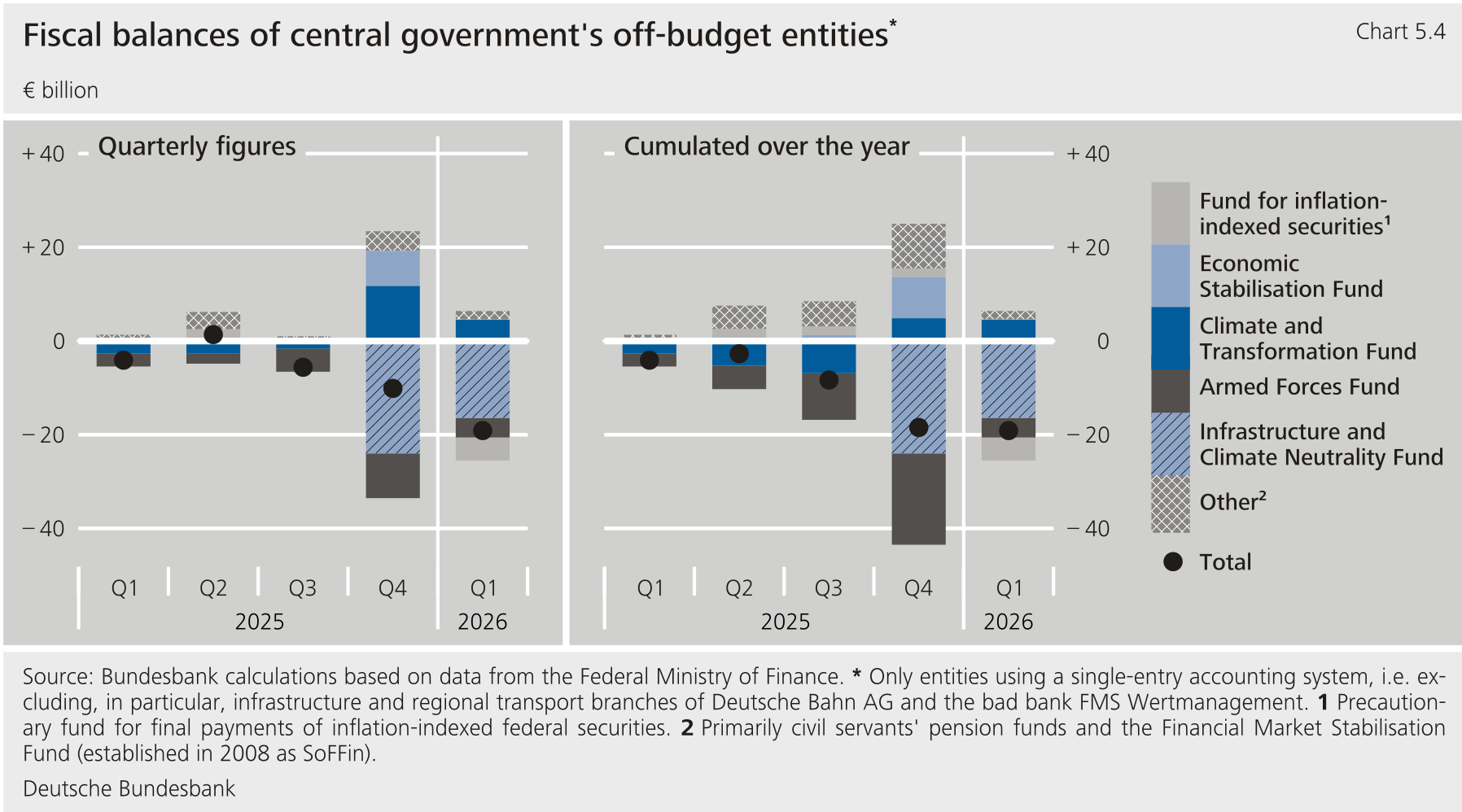
The deficit of off-budget entities grew similarly sharply to €19 billion. 

  • The Infrastructure and Climate Neutrality Fund recorded a deficit of just over €16 billion. Payments to state and local governments have not yet been disbursed. Transfers to other special funds amounted to almost €13 billion, including €10 billion to the Climate Fund. 9 Adjusted for resources given to the Climate Fund as well, the Infrastructure and Climate Neutrality Fund accounts for a large part of the year-on-year increase in the deficit of the off-budget entities (it was not yet in operation in the first quarter of 2025).
  • The Climate Fund posted a surplus of €4½ billion owing to the large transfer. As a result, the outcome improved by €7 billion compared with the start of the previous year (deterioration of €3 billion excluding the cross-transfer from the Infrastructure and Climate Neutrality Fund). The fund’s expenditure appears to have increased mainly due to the new subsidy being paid to reduce electricity grid fees.
  • The fund for inflation-indexed securities recorded a deficit of €5 billion. Because a federal debt instrument was redeemed, the fund paid compensation for the inflation that had accrued over the lifetime of the debt instrument. 10 At the start of the previous year, the result had been balanced.
  • For the Armed Forces Fund established in 2022, the deficit rose by €1½ billion to just over €4 billion. Central government intends to fully utilise the fund’s remaining credit authorisations by the end of 2027.

Fiscal balances of central government's off-budget entities

3.2 Outlook for 2026

Central government’s deficit will rise strongly over the year as a whole, too. This is the case for both the core budget and the off-budget entities.  

The core budget could close the current year roughly in line with the planning. There would thus be a strong increase of €32 billion in the deficit, taking it to almost €100 billion. The main reason for this is additional expenditure under the exemption for defence spending, which central government is financing via borrowing (plan: +⁠ €29 billion). In the case of civil servants’ pay, it appears that the funds set aside in the budget are sufficient to cover additional expenditure following the Federal Constitutional Court’s decision of autumn 2025. 11 Central government’s total expenditure could be lower than planned, not least because budgeting for overall investment spending is typically generous. On the revenue side, the current tax estimate showed shortfalls of €5 billion compared with the target. Contributing factors include, in particular, the temporary lowering of the energy tax and less favourable macroeconomic developments. Transfers to the EU budget, for which fairly high amounts are budgeted, could serve as something of a buffer.

Developments in off-budget entities are being driven by a surging deficit in the Infrastructure and Climate Neutrality Fund. Overall, central government is estimating a €55 billion increase in the deficit of off-budget entities with borrowing plan figures, taking it to €91 billion. 12  

  • The deficit of the Infrastructure and Climate Neutrality Fund is set to rise from €24 billion last year to €58 billion. On the one hand, there could be delays to central government’s investment projects, as in previous years. These outflows would then be lower than planned. On the other hand, there could be far higher outflows from the state government share than the budgeted €8½ billion. 13 Payments to the state governments are not tied to an increase in investment in those states or the local governments. In addition, there may also be payments for projects from 2025. Another factor pointing to greater outflows is that local governments need to reduce their high deficits and can draw down funds from the special fund to do so – without increasing spending on investment. 14
  • The Climate Fund’s result is set to deteriorate by €7 billion. In particular, the new subsidy for electricity grid fees (+⁠ €6½ billion) is having a much greater impact than the eliminated costs of the gas storage levy (−⁠ €3 billion). However, as in previous years, the deficit could be smaller than projected due to lower overall outflows.
  • The deficit in the Armed Forces Fund is expected to increase by €6 billion.
  • The result of the precautionary fund for inflation-indexed federal securities is expected to be €7 billion lower. In addition to the aforementioned compensation payments in the first quarter, another strain is that transfers received in previous years for own securities holdings are being returned to the core budget on an ad hoc basis.

3.3 Outlook for 2027 to 2030

Benchmark figures adopted by the Federal Government

According to the benchmark figures for the central government budget, structural net borrowing will rise significantly to just shy of 4 % of GDP over the 2027 to 2030 period (here and below, see Table 3.3, in this case item 1.d-n). Central government’s credit financing (core budget and off-budget entities) will thus go up from €109 billion most recently to €197 billion next year and then to €202 billion in 2030 (see item 1.c). A key factor is additional deficits in connection with defence. 15 At the same time, borrowing for cyclical burdens and financial asset acquisitions will decline. The debt brake limit for structural borrowing in the core budget is regularly adhered to in the plans – including in this case; however, further measures still need to be adopted to this end, and the benchmark figures include extensive unspecified savings (items 1.a6-n and 2.a6). The Infrastructure and Climate Neutrality Fund will post deficits of around €60 billion up to 2029 and €49 billion in 2030 (item 1.b1). 16

Table 5.3: Key data from the benchmark figures for central government finances*
€ billion (unless otherwise indicated) 
ItemActual 2025Target 20262027 BF2028 BF2029 BF2030 BF
1.Net borrowing 
1.aCore budget overall1

65.2

98.0

110.8

134.9

137.1

152.7

 Comparative: fiscal plan summer 2025

81.8

89.9

88.1

116.5

126.9

.

1.a1Sectoral exemption for defence spending

28.6

57.6

80.3

121.0

128.3

147.3

 Comparative: fiscal plan summer 2025

32.1

54.3

64.2

107.2

122.1

.

1.a2Cyclical component in the budget procedure2

– 7.4

– 15.6

– 12.0

– 8.0

– 3.9

 Comparative: fiscal plan summer 2025

– 18.2

– 12.9

– 8.2

– 3.9

.

1.a3Balance of financial transactions

– 15.4

– 9.6

– 2.9

– 2.3

– 0.7

– 0.7

 Comparative: fiscal plan summer 2025

– 16.4

– 7.6

– 0.3

– 2.1

– 1.1

.

1.a4Structural net borrowing (+) excluding defence exemption (1.a-1.a1+1.a2+1.a3)

13.8

15.2

15.6

3.6

4.2

4.7

1.a5Standard limit of  0.35 % of GDP3

13.5

15.2

15.6

3.6

4.2

4.7

1.a6-nOvershooting of standard limit

0.3

1.a7Transfer to (-)/withdrawal from (+) reserves4

10.7

1.a8.nMemo item: Level of general reserves

10.7

10.7

1.bKey off-budget entities outside the debt brake

43.5

83.6

85.7

59.5

60.2

49.1

 Comparative: fiscal plan summer 2025

61.2

84.4

84.6

58.4

59.2

.

 of which:


1.b1Infrastructure and Climate Neutrality Fund (ICNF)

24.0

58.1

58.2

59.5

60.2

49.1

 Comparative: fiscal plan summer 2025

37.2

58.9

57.1

58.4

59.2

.

 Remaining borrowing authorisations at year-end

476.0

417.9

359.7

300.2

240.0

190.9

1.b2Armed Forces Fund

19.5

25.5

27.5

 Comparative: fiscal plan summer 2025

24.0

25.5

27.5

.

 Remaining borrowing authorisations at year-end

57.5

32.0

4.5

1.cCore budget and off-budget entities (1.a +⁠ 1.b)

108.7

181.6

196.5

194.4

197.3

201.8

 Comparative: fiscal plan summer 2025

119.0

148.8

145.2

174.9

186.1

.

1.dCore budget and off-budget entities structural (1.c +⁠ 1.a2 +⁠ 1.a3)

85.9

156.4

181.6

184.1

192.7

201.1

1.d-nCore budget and off-budget entities structural,  % of GDP5

1.9 %

3.4 %

3.8 %

3.7 %

3.8 %

3.9 %

2.Additional core budget figures


2.aExpenditure6

494.9

524.5

543.3

586.9

588.9

625.1

 Comparative: fiscal plan summer 2025

503.0

520.5

507.5

546.4

572.1

.

2.a-n1Memo item: additional expenditure versus fiscal plan

– 8.1

4.0

35.8

40.5

16.8

.

2.a-n2of which under defence exemption

3.3

16.1

13.8

6.2

.

 of which:


2.a1Investment

55.4

58.4

51.3

47.6

46.7

48.5

2.a2Investment excluding financial transactions

39.2

47.9

47.7

46.9

46.3

48.2

 Comparative: fiscal plan summer 2025

45.4

47.7

47.2

46.4

46.2

.

2.a3Investment in central government infrastructure (2024 before ICNF: €30.9 bn)7

18.1

24.2

.

.

.

.

2.a4Investment ratio (relevant for Infrastructure and Climate Neutrality Fund)8

8.7 %

10.5 %

10.4 %

10.1 %

10.1 %

10.1 %

2.a5Interest

29.9

30.3

42.7

56.1

67.2

78.7

2.a6Global spending cuts, need for action as of 20279

– 8.8

– 20

– 29

– 51

– 60

2.bRevenue 10 

428.0

426.5

432.5

452.0

451.8

472.4

 of which:


2.b1Tax revenue 11

388.6

387.2

398.4

407.7

416.3

435.0

 Comparative: fiscal plan summer 2025 (less precautionary item)

385.8

379.6

388.0

398.6

412.8

.

2.b2From NGEU

10.6

2.b3Global revenue increases/cuts

– 1.4

.

.

.

.

* Sources: Federal Finance Ministry and Bundesbank calculations. Methodological notes in Deutsche Bundesbank (2016). Deviations possible due to rounding. 1 Deviation from Federal Ministry of Finance figures for 2025: excluding supplement for repaid emergency borrowing. 2 For 2025 as at March 2026, thereafter according to the Federal Government's 2026 spring projections. 3 Based on the GDP of the year before the budget was drawn up. Less repayments of emergency borrowing (Actual 2025, from 2028 according to repayment plan from 2022). 4 The benchmark figures include the use of reserves in 2027, but no amount is mentioned. The coalition committee of 12 May 2026 agreed to postpone use of the reserves without announcing budget relief to offset this. 5 GDP of the respective year according to the Federal Government's 2026 spring projections. 6 Transfers from transfer of tax funds to state governments deducted from revenue (see footnote 11). 7 Investment in central government infrastructure: all non-financial asset formation and investment grants to federal enterprises such as Deutsche Bahn AG and Autobahn GmbH and public sector institutions (from the budget classification table: main category 7, groups 81 and 82, items 891 and 894). 8 The Federal Government deems the additionality of credit-financed expenditure of the Infrastructure and Climate Neutrality Fund to be fulfilled if the planned ratio is at least 10 %. Target 2025: 10.0 %. 9 2027: Scope of consolidation package still to be specified. 2028 and beyond: Remaining need for action after deduction of consolidation package extrapolated from 2027. Additional global spending cuts are not shown in the benchmark figures. 10 Total revenue less net borrowing. Withdrawal from reserves and coin seigniorage (also not affecting fiscal balance; typically: €0.2 billion p.a.) not deducted in absence of data. Includes net tax revenue (see footnote 10). 11 After deduction of supplementary central government transfers, shares of energy tax revenue, compensation under the 2009 reform of motor vehicle tax and budgetary recovery assistance to federal states.

Net borrowing is higher than in the fiscal plan from summer 2025. For 2027, it is almost €23 billion greater for the core budget (item 1.a). Although the gap will shrink up to 2029, it will still amount to €10 billion. In particular, expenditure under the exemption for defence spending is now estimated to be higher (item 2.a-n2). Furthermore, the Federal Government is now anticipating that cyclical burdens will be €4 billion higher each year from 2027 to 2029 (see item 1.a2). Higher cyclical burdens can be financed through borrowing under the debt brake, and the Federal Government is making full use of this scope in the benchmark figures. However, tax revenue has not yet been adjusted to reflect the fact that the economy is considered to be in somewhat worse shape. It will have to be adjusted in due course to reflect the results of the tax estimate. In addition, in its benchmark figures central government is planning further loans to the Federal Employment Agency in 2027. And previous loans to the respective social security funds will not be repaid until later than previously planned (see item 1.a3). The additional borrowing by central government resulting from such financial transactions is permitted under the debt brake. 17

According to the benchmark figures, the need for consolidation in the central government budget remains high. In the fiscal plan from summer 2025, the Federal Government reported an extensive unspecified need for action increasing from €34 billion in 2027 to €74 billion in 2029. In the current benchmark figures, the gap has narrowed to around €20 billion in 2027 without consolidation measures. This is mainly due to base effects from the more favourable result for 2025 and upward revisions to tax revenue compared with last summer. In the meantime, however, the new tax estimate has revised tax expectations downwards again compared with tax revenue in the benchmark figures, by up to €4 billion in 2027 at the peak. The gaps will thus increase again. 

Benchmark figures leave important questions unanswered

The benchmark figures envisage for 2027 that measures in the amount of the need for consolidation of €20 billion will ease the strain on the budget. However, the measures are mostly recorded only as global items: to budget for them specifically, the Federal Government must first adopt the relevant draft legislation. Smaller grants to the pension insurance scheme are planned (−⁠ €4 billion). This is probably down to the fact that the Federal Government will not transfer the 2027 grants for the higher mothers’ pensions to the pension insurance scheme until 2028. The latter will likewise probably only pay out the higher benefits retroactively in 2028. 18 It will most likely be difficult to achieve the planned relief in other areas. Digitalisation is intended to save central government €3 billion. A contribution of €2 billion is envisaged to be made by each of the following: first, combating tax fraud and setting new rules for crypto-asset profits; second, additional levies on products with adverse health impacts (such as very sugary drinks); and third, lower grants to the statutory health insurance scheme. Slightly smaller savings are envisaged in the ministry for building, in family benefits and in subsidies. 

In subsequent years, there will still be very large gaps, even though the aforementioned measures are expected to provide further relief overall. The Federal Government does not plan to address these gaps until later, amongst other things by postponing burdens for repayment of emergency borrowing and debt of the Armed Forces Fund. For as long as redemptions are postponed, the scope for borrowing would be just over €12 billion higher from 2028 onwards. It is not clear when repayment is planned to begin in this scenario. The Federal Government does not explain why it intends to abandon parallel repayments of NGEU debt and central government emergency borrowing. This was the reason given by the previous government for the first postponement of repayment plans for emergency borrowing in 2022. 19 Germany's Basic Law requires an appropriate timeline for a repayment schedule. 

The benchmark figures give barely any indication of planned infrastructure investment. There are some data on the combined budgetary investment of the core budget, the Climate Fund and the Infrastructure and Climate Neutrality Fund (excluding financial transactions). The planned investment ratio in the core budget is slightly above the minimum of 10 %. This must be achieved as a minimum in the budget plan in order for borrowing in the Infrastructure and Climate Neutrality Fund to be permitted. In addition to infrastructure investment, this planned investment ratio includes investment grants for other purposes, calls on guarantees and development aid. However, the benchmark figures do not break down the planned investment any further. As a result, it is also unclear what amounts are intended to go towards central government infrastructure. 20  

When it comes to improving infrastructure, it is particularly interesting to see whether infrastructure-related spending by central government will grow significantly overall. After this spending actually decreased last year in the core budget and the Infrastructure and Climate Neutrality Fund combined, an increase is expected in the medium term. However, without significant reshuffling of the budget, the increase compared with the starting year of 2024 will continue to fall well below the borrowing of the Infrastructure and Climate Neutrality Fund. 21  To improve infrastructure, it would be advisable to place greater weight on ensuring, at all levels of government, that borrowing by the Infrastructure and Climate Neutrality Fund increases infrastructure expenditure. 22

Finally, it is unclear how central government’s plans are supposed to line up with EU rules. According to the forecasts available from the Federal Government, the general government deficit ratio, adjusted for permitted additional defence spending, will be above the 3 % limit in 2026 and 2027 (see “Fiscal rules require adaptation measures”). There is no evidence of measures to counter this in the new benchmark figures. In addition, the exemption for defence spending in the EU runs out in 2028, whereas credit-financed defence expenditure is set to increase further up to 2030. Thus, it is not apparent how the benchmark figures and the exemption for defence spending are meant to align with EU rules. The Federal Government is aiming to reform the debt brake. In this context, the exemption for defence spending would have to be rolled back, in particular. 

4 State government finances

4.1 Annual outturn of core budgets and off-budget entities in 2025

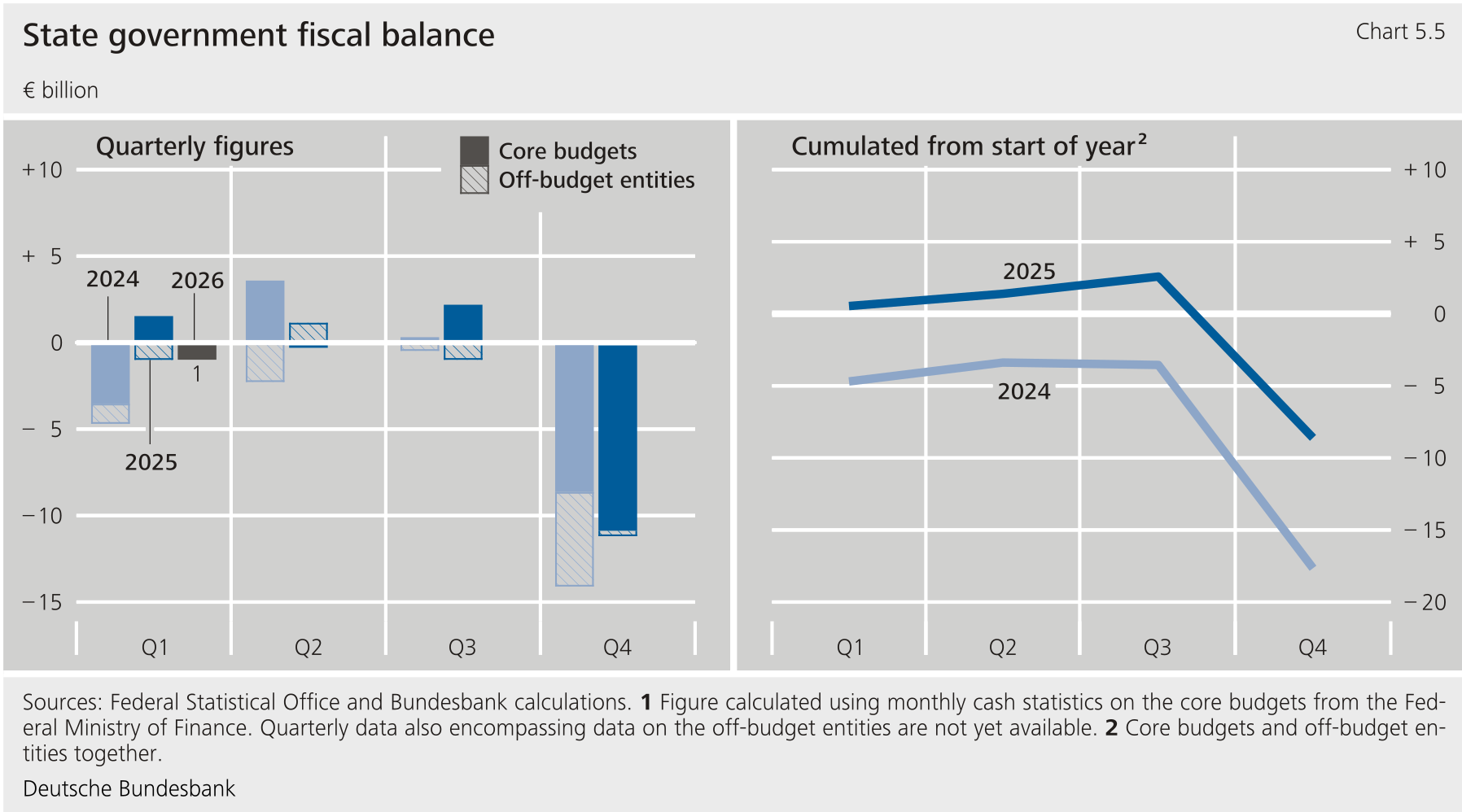
State governments, including their off-budget entities, halved their deficit to €8½ billion last year. Temporary burdens were eliminated; these had stemmed from high acquisitions of participating interests and tax revenue shortfalls due to inflation compensation bonuses. One-off effects also provided relief in 2025. In particular, inheritance tax revenue was exceptionally high. 23 By contrast, cyclical burdens on state government finances were stronger than in 2024.

State government fiscal balance

While state government budgets were also structurally improved in 2025, local governments were in a tighter position. Bundesbank calculations show a smaller structural surplus for the state governments as a whole, as against a structural deficit of more than €20 billion for local government. 24 There are differences between the individual state governments. On aggregate, however, there is a major financial imbalance. 

In 2025, fixed asset formation by state governments probably was not yet boosted by the Infrastructure and Climate Neutrality Fund. 25 Growth in fixed asset formation was only relatively moderate, at 2½ % (+⁠ €½ billion). State governments have not yet drawn on any resources from the special fund, but they can still do so for projects begun in 2025. However, this is unlikely to have triggered many additional projects in 2025, as the details of the state government share of the special fund were not finalised until the end of 2025. 

4.2 First quarter of 2026 and outlook for year as a whole

The state government core budgets closed the first quarter of 2026 with a deficit of just over €1 billion. 26 The balance thus deteriorated by around €3 billion on the same quarter of the previous year. In particular, declining receipts from public administrations (−⁠ €1 billion) had a dampening effect on revenue. By contrast, state governments themselves made significantly higher payments to their local governments (+⁠ €2½ billion). In the first quarter of 2026, too, state governments still received no investment grants from the Infrastructure and Climate Neutrality Fund. To date, no reliable information is available on developments in fixed asset formation: state governments finance around half of this via their off-budget entities (including universities). Their results are not yet available.

It is difficult to gauge how state government budgets will continue to develop in 2026. According to the official tax estimate, growth in tax revenue is stronger for state than for central and local government; even so, the increase is muted, at just over 1 %. Another crucial factor will therefore be how much of their expanded structural scope for borrowing state governments use – to support their local governments, for example. It is also important how much funding they receive from the Infrastructure and Climate Neutrality Fund and whether they use these resources for additional projects or to close funding gaps. As a rule, state governments do not need to provide proof of additional investment in order to access the funds. However, state government infrastructure is only likely to see a marked improvement if investment expenditure actually increases.

State governments have a special responsibility for the financial situation of their local governments. This is all the more true given that the structural financial position of state governments is comparatively robust overall, while that of local governments is very tight. This is borne out by the current tax estimate: for 2026, it distinctly reduces local government’s revenue expectations, but only slightly reduces those of state government. Budgetary problems in local government are reflected, not least, in increasing cash advances. To ensure that these do not continue building up in local governments and causing ever greater problems, immediate countermeasures would have to be taken. As part of their budgetary oversight, state governments are required to ensure that overburdened local governments undergo sustainable consolidation, for one thing. For another, they are responsible for ensuring adequate funding. In other words, they would have to provide local governments with additional funds if necessary. 

To counter problems in local government as early as possible, the Bundesbank would find it helpful if local governments were only allowed to take out cash advances from their state governments. At the least, holdings of cash advances which are unlikely to bridge short-term financing gaps and still exist at the end of the year would then have to be recorded with the state government. It would also make sense to require state governments to count these loans towards their own credit limits under their debt brakes. This would take account of the state governments' responsibility. With unfavourable financial developments in local government having an immediate impact on state government budgets, this would also reduce their political economy incentives to put off tackling these problems.

5 Social security funds

5.1 Pension insurance scheme

5.1.1 Outlook for 2026

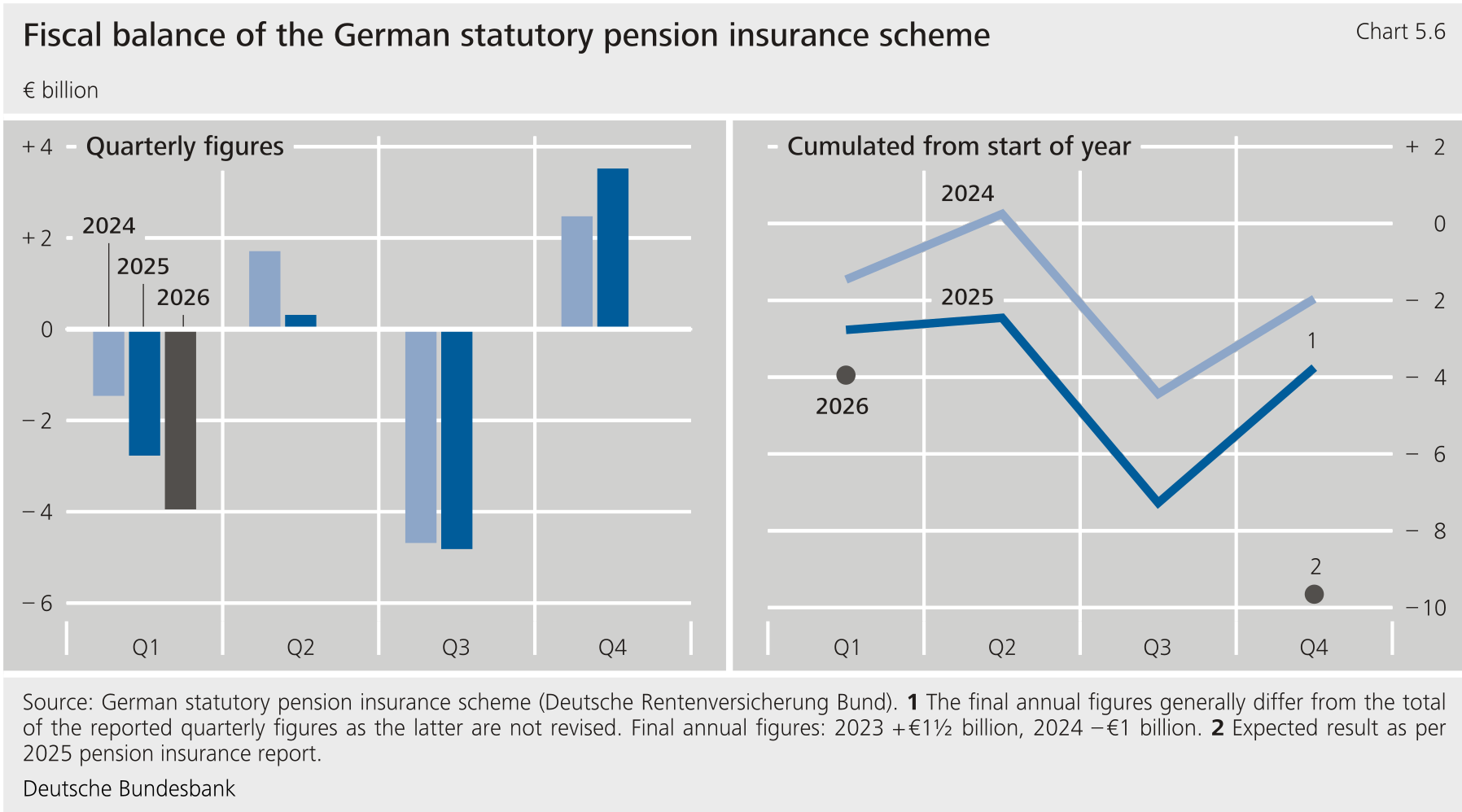
The statutory pension insurance scheme was running a deficit of €4 billion at the start of 2026. This meant the deficit was again just over €1 billion higher than in the first quarter of 2025. Revenue growth of 4 % was much weaker than growth in expenditure (+⁠ 5 %). The pension adjustment in mid-2025 accounted for just over 3½ % of the increased spending. The rest of the increase was attributable in equal shares to a rising number of pensions and higher supplementary contributions to the statutory health insurance scheme. 27

Fiscal balance of the German statutory pension insurance scheme

The deficit is likely to increase strongly in 2026 as a whole, too. The underlying trend from the first quarter is likely to continue: revenue will grow significantly, but expenditure will climb much more strongly. In November of last year, the Federal Government was therefore expecting a deficit of €9½ billion for 2026 (2025: just over €3½ billion). However, pensions will increase by around ½ percentage point more at the start of July than anticipated at that time. Because of this additional expenditure of just over €1 billion in 2026, the deficit is likely to be commensurately higher. There are also uncertainties about macroeconomic developments. On the revenue side, contributions to compensatory benefits are dampening potential shortfalls. On the expenditure side, however, additional numbers of retirees could have an impact, as in previous episodes of pronounced weakness.

5.1.2 Pension Commission to present reform proposals for longer-term developments

The Pension Commission is set to present pension reform proposals by June. Upon request, the Bundesbank has sent the Commission an opinion. 28 In order to alleviate prospective pressures on pension finances and the Federal Government budget, it would particularly make sense to reduce the financial incentives for early retirement and to link the retirement age to life expectancy as of 2031. This would increase the potential labour force and hence also the chance of higher GDP, more tax revenue and a larger contribution base. It would also put tighter constraints on expenditure growth overall. As a result, the contribution rate would not have to go up as sharply. Increases in the contribution rate will thus have less of a dampening effect on the annual pension adjustments. This would make individual monthly pensions higher. The 48 % threshold for the replacement rate from a standard pension will continue to apply until 2030. In principle, it would be consistent to adjust the pension entitlement points for a standard pension to the higher statutory retirement age. Given the retirement age of 67 in 2031, 47 points would be required for a standard pension (instead of the current 45 points). This would reduce expenditure growth and thus the rise in the contribution rate. It would also ease the burden on the central government budget. 

5.2 Federal Employment Agency

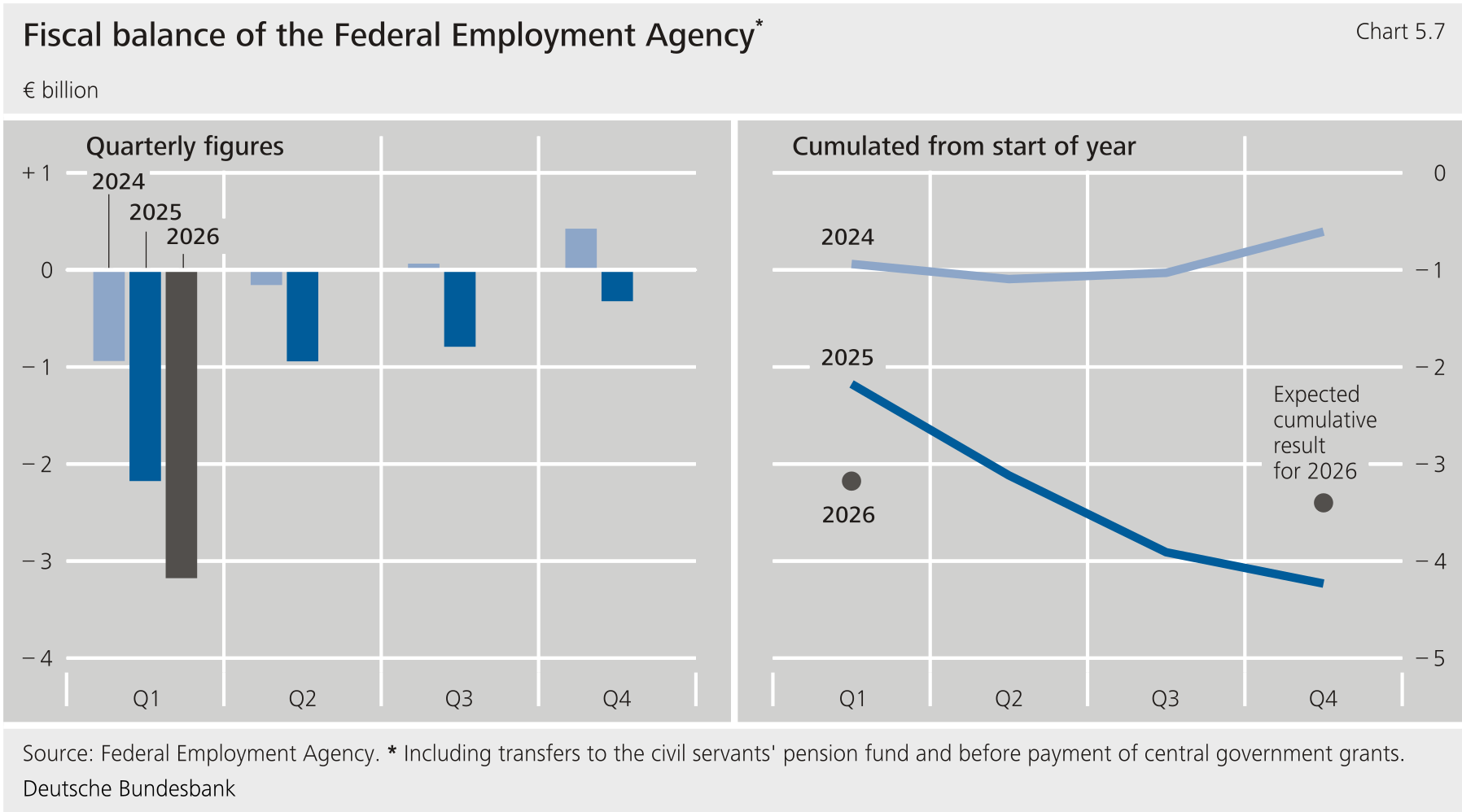
The Federal Employment Agency posted a significant deficit of €3 billion at the start of the year. 29 This meant a €1 billion decline in the deficit year on year. This primarily reflects the deterioration in labour market conditions. The Federal Employment Agency’s revenue grew significantly, at just under 4 %. However, expenditure growth was much greater (just under 11 %). Spending on unemployment benefits, an especially weighty expenditure item, actually increased by almost 17 %. 

Fiscal balance of the Federal Employment Agency*

The Federal Employment Agency’s deficit is also likely to increase considerably in the year as a whole (2025: just over €4 billion). A small decrease in the deficit to €3½ billion was planned. However, labour market developments are now worse than expected. This is unlikely to be offset by the possibility of lower spending on active labour market policy, for which fairly generous amounts were again budgeted. 

The Federal Employment Agency no longer has any available funds and is covering its current deficits using federal government loans. These could grow to a cumulated amount of just over €8 billion at the end of the year. By granting these loans, federal government is preventing contribution rates to the unemployment insurance scheme from having to go up. Economically, this makes sense, because from today’s perspective the shortfalls are cyclically induced and the Federal Employment Agency will probably be able to repay the loans later out of cyclical surpluses. However, the actual plan is for the Federal Employment Agency to use reserves to cushion cyclical fluctuations. Leaving that aside, the contribution rate will in any case have to be raised when it looks unlikely to suffice to finance the Federal Employment Agency’s structural expenditure. 

This article is based on data available up to 18 May 2026, 11:00.

List of references

Deutsche Bundesbank (2026a), Public finances, Monthly Report, February 2026.

Deutsche Bundesbank (2026d), Government investment: gear new scope for borrowing towards infrastructure, Monthly Report, January 2026.

Deutsche Bundesbank (2026c), Commentaries: Economic conditions and Public finances, Monthly Report, April 2026.

Deutsche Bundesbank (2026d), Stellungnahme der Deutschen Bundesbank zur Alterssicherungskommission vom 12. März 2026.

Deutsche Bundesbank (2025a), Public finances, Monthly Report, August 2025.

Deutsche Bundesbank (2025b), A Bundesbank contribution to the reform debate: How the debt brake could be developed further, Reports and studies, November 2025.

Deutsche Bundesbank (2025c), Public finances, Monthly Report, November 2025.

Deutsche Bundesbank (2016), Key central government budget data in connection with the debt brake, Monthly Report, February 2016, pp. 68-69.

Deutsche Bundesbank (2023), The growing significance of central government’s off-budget entities, Monthly Report, June 2023, pp. 63‑82.

Independent Advisory Board to the Stability Council (2026), 25. Stellungnahme zur Sitzung des Stabilitätsrats am 11. Mai 2026, version dated 8 May 2026.

Grave, D., A. Steinbach and M. Teurer (2026), Zusätzlichkeit der Investitionen des Bundes aus dem SVIK aus finanzpolitischer Sicht, Wirtschaftsdienst, Vol. 106., Issue 4, pp. 258-266, April 2026. 

Has this page helped you?